
Life, 1898-09-22 · page 6 of 20
Life — September 22, 1898 — page 6: what you’re looking at
What you’re looking at
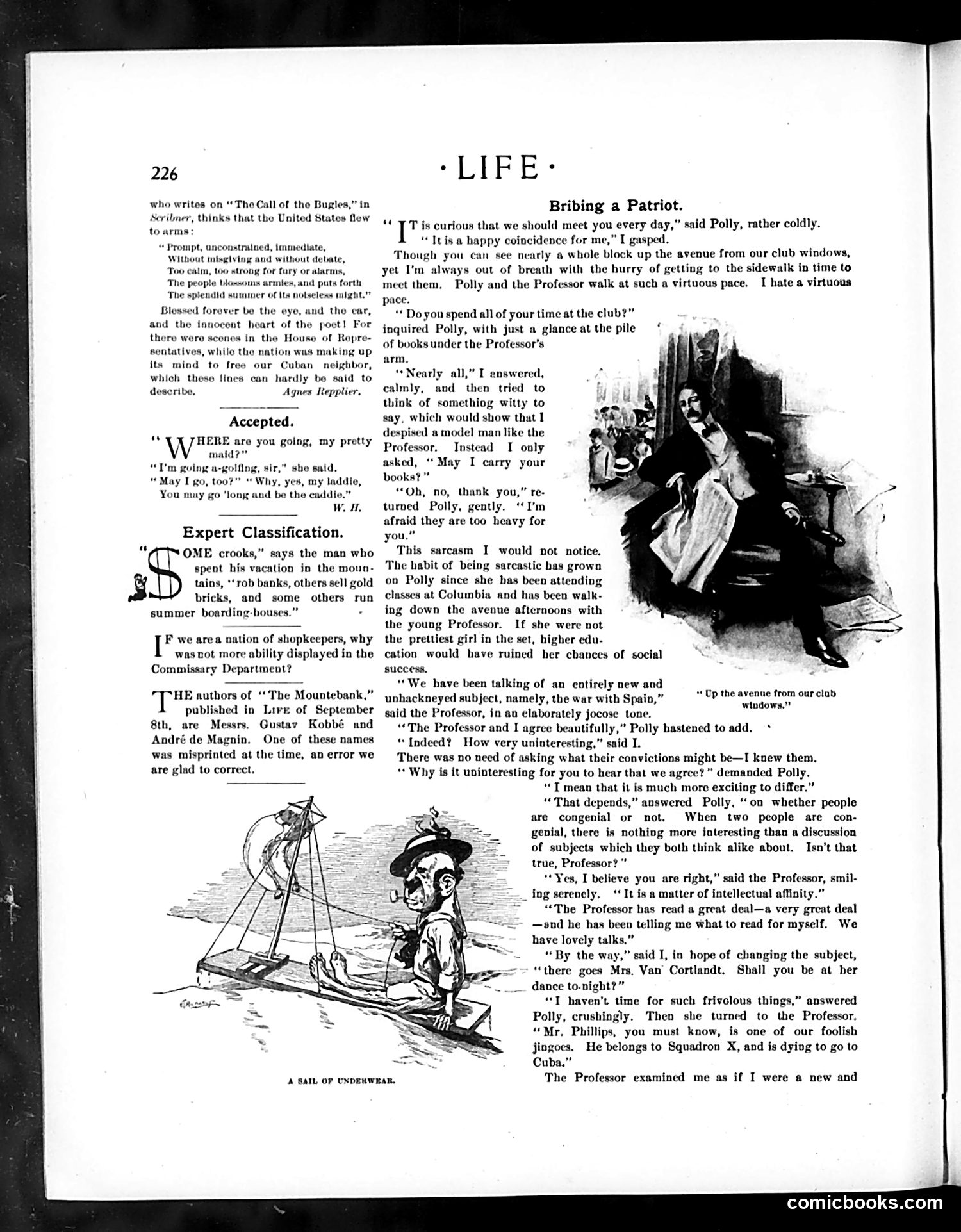
This cartoon depicts a figure using underwear as a makeshift sail on a small raft—a visual pun on the phrase "bail of underwear" (playing on "bail" meaning escape or financial payment). The cartoon likely satirizes financial corruption or improper use of resources. The figure appears to be escaping or fleeing using improvised means, suggesting someone evading consequences through dubious methods. Without additional context about specific historical events or named figures referenced on this page, the exact political target remains unclear. However, the cartoon's placement in *Life*'s satirical section indicates it mocks a recognizable contemporary scandal or public figure involved in financial misconduct or fraud circa the publication date. The humor relies on the visual absurdity of using clothing as nautical escape equipment.
📄 Transcribed text from this page (OCR, searchable)
Machine-transcribed from the original scan — historical spelling and the odd misread are preserved.
226 who writes on “The Call of the Bugles,” in Secrilmer, thinks that the United States flew to arms: “ Prompt, unconstrained, Immediate, Without misgiving aud without debate, ‘The splendid summer of Its nolsele Blessed forever be the eye, and the ear, and the innocent heart of the poet! For there were scons in the House of Repre- sentatives, while the nation was making up its mind to free our Cuban neighbor, which these lines can hardly be said to describe, Agnes Kepplier. Accepted. HERE are you going, my pretty . V maid?” “I'm going a-golfing, sir,” she said. “May I go, too?” “Why, yes, my laddie, You may go "long and be the caddie.” WH. Expert Classification. OME crooks,” says the man who spent his vacation in the moun- tains, ‘rob banks, others sell gold bricks, and some others run summer boarding-houses.” F we area nation of shopkeepers, why was not more ability displayed in the Commissary Department? HE authors of “The Mountebank,” published in Lire of September 8th, are Messrs. Gustay Kobbé and André de Magnin. One of these names was misprinted at the time, an error we are glad to correct. A SAIL OP UNDERWEAR. *LIFE- Bribing a Patriot. “ I" is curious that we should meet you every day,” said Polly, rather coldly. “It isa happy coincidence for me,” I gasped. Though you can see nearly a whole block up the avenue from our club windows, yet I’m always out of breath with the hurry of getting to the sidewalk in time to meet them, Polly and the Professor walk at such a virtuous pace. I hate a virtuous pace. ‘* Doyou spend all of your time at the club?” inquired Polly, with just a glance at the pile of books under the Professor's arm, ‘Nearly all,” I enswered, calmly, and then tried to think of something witty to say, which would show that I despised a model man like the Professor. Instead I only asked, ‘May I carry your books?” “Ob, no, thank you,” re- turned Polly, gently. “I'm afraid they are too heavy for you.” This sarcasm I would not notice. The habit of being sarcastic bas grown on Polly since she bas been attending classes at Columbia and has been walk- ing down the avenue afternoons with the young Professor. If she were not the prettiest girl in the set, higher edu- cation would have ruined her chances of social success, “We have been talking of an entirely new and unhackneyed subject, namely, the war with Spain,” said the Professor, in an elaborately jocose tone. ‘The Professor and I agree beautifully,” Polly hastened to add. * “ Indeed? How very uninteresting,” said I. There was no need of asking what their convictions might be—I knew them. “Why is it uninteresting for you to hear that we agree? ” demanded Polly. “T mean that it is much more exciting to differ.” “That depends,” answered Polly, ‘on whether people are congenial or not. When two people are con- genial, there is nothing more interesting than a discussion of subjects which they both think alike about. Isn't that true, Professor?” “Yes, I believe you are right,” said the Professor, smil- _ {ing serenely. ‘It is a matter of intellectual affinity.” “The Professor has read a great deal—a very great deal —ond he has been telling me what to read for myself. We have lovely talks.” “By the way,” said I, in hope of changing the subject, “‘there goes Mrs. Van’ Cortlandt. Shall you be at her dance to-night?” “T haven't time for such frivolous things,” answered Polly, crushingly. Then she turned to the Professor. “Mr. Phillips, you must know, is one of our foolish jingocs. He belongs to Squadron X, and is dying to go to Cuba.” The Professor examined me as if I were a new and “Up the avenue from our club windows.” comicbooks.com