
A complete issue · 20 pages · 1898
Life — July 28, 1898
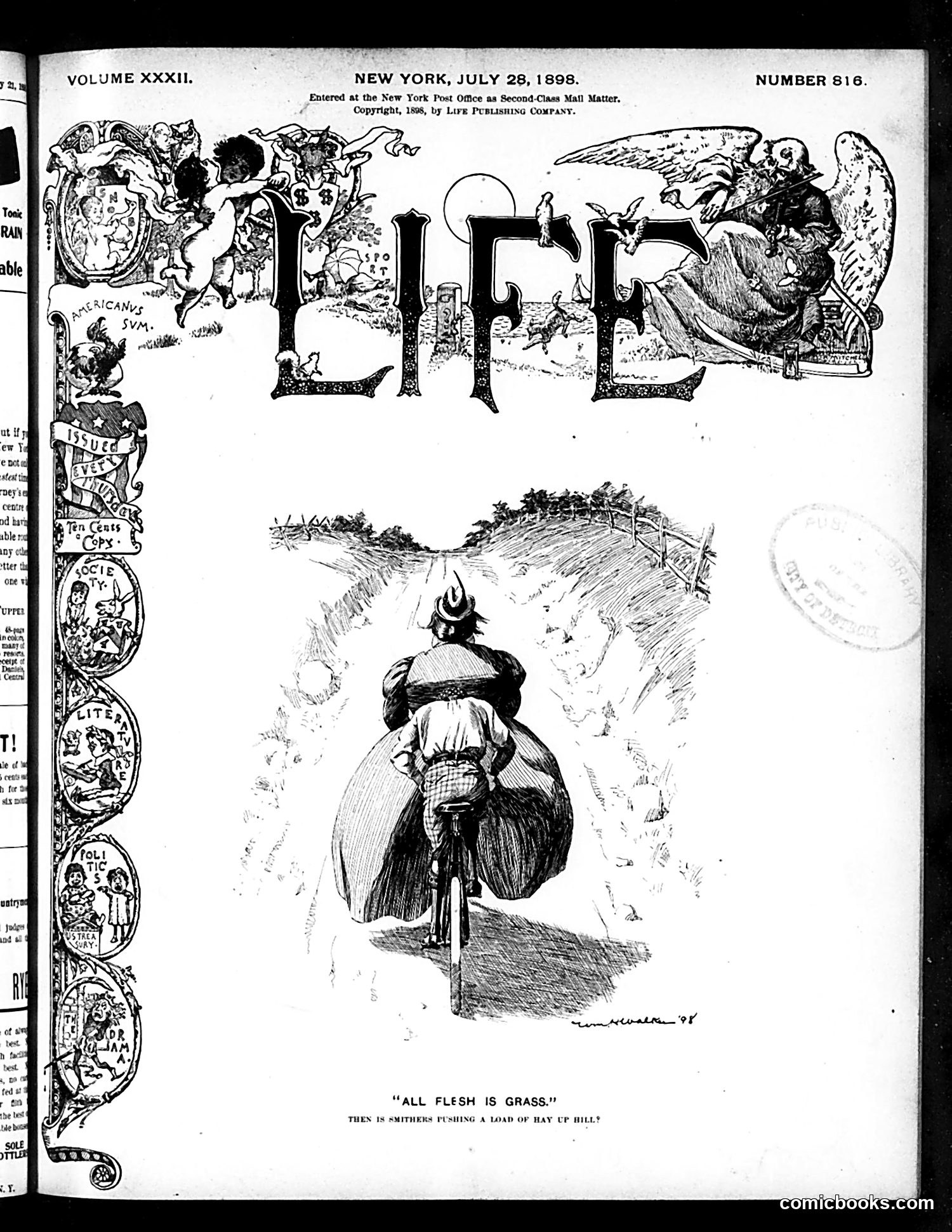
This Life magazine cover from July 28, 1898 features a political cartoon titled "All Flesh is Grass," with the subtitle "Then is Smithers pushing a load of hay up hill!" The image shows a cyclist struggling to push a bicycle loaded with hay up a steep hill—a visual pun on the phrase "all flesh is grass" (meaning human mortality, from Isaiah 40:6). The joke appears to be about someone named Smithers undertaking an impossibly difficult task, represented by pushing heavy hay uphill on a bicycle. Without additional historical context, the specific political reference remains unclear—it likely referenced a contemporary figure or event recognizable to 1898 readers. The satirical point seems to mock either Smithers' foolish effort or some associated public endeavor considered futile or absurdly difficult.
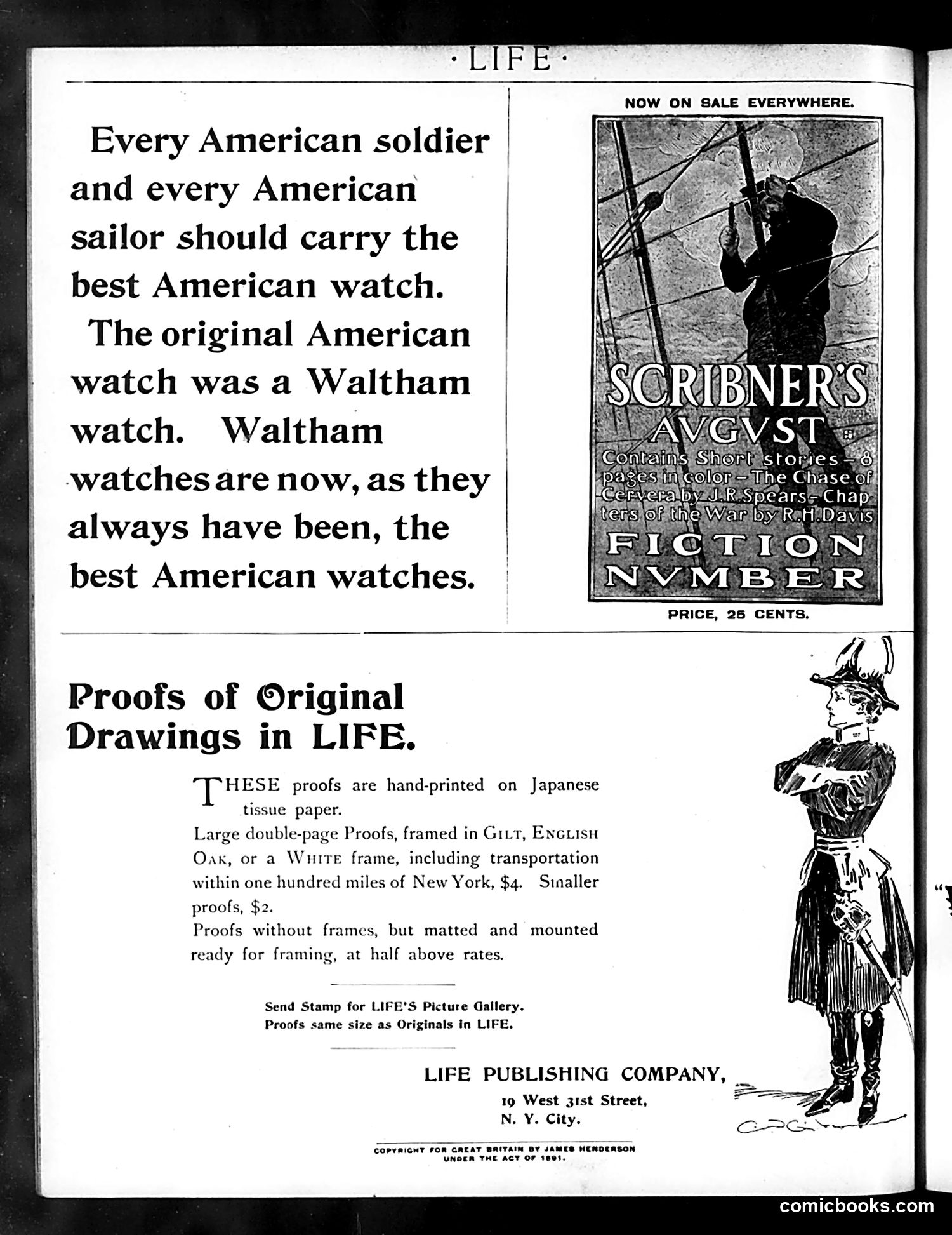
This page contains primarily **advertisements** rather than editorial cartoons. The top half advertises **Waltham watches**, appealing to patriotism by claiming American soldiers and sailors should carry "the best American watch"—a Waltham. This appears designed to boost sales during a military context (likely WWI era, given the soldier/sailor reference). Below that is an ad for **Scribner's August Fiction Number** (25 cents), featuring a sailor climbing rigging. The bottom section advertises **proofs of original drawings** from Life magazine itself, available framed or unframed on Japanese tissue paper at various prices ($2-$4), with contact information for Life Publishing Company in New York City. No political satire or cartoon commentary is evident on this page.
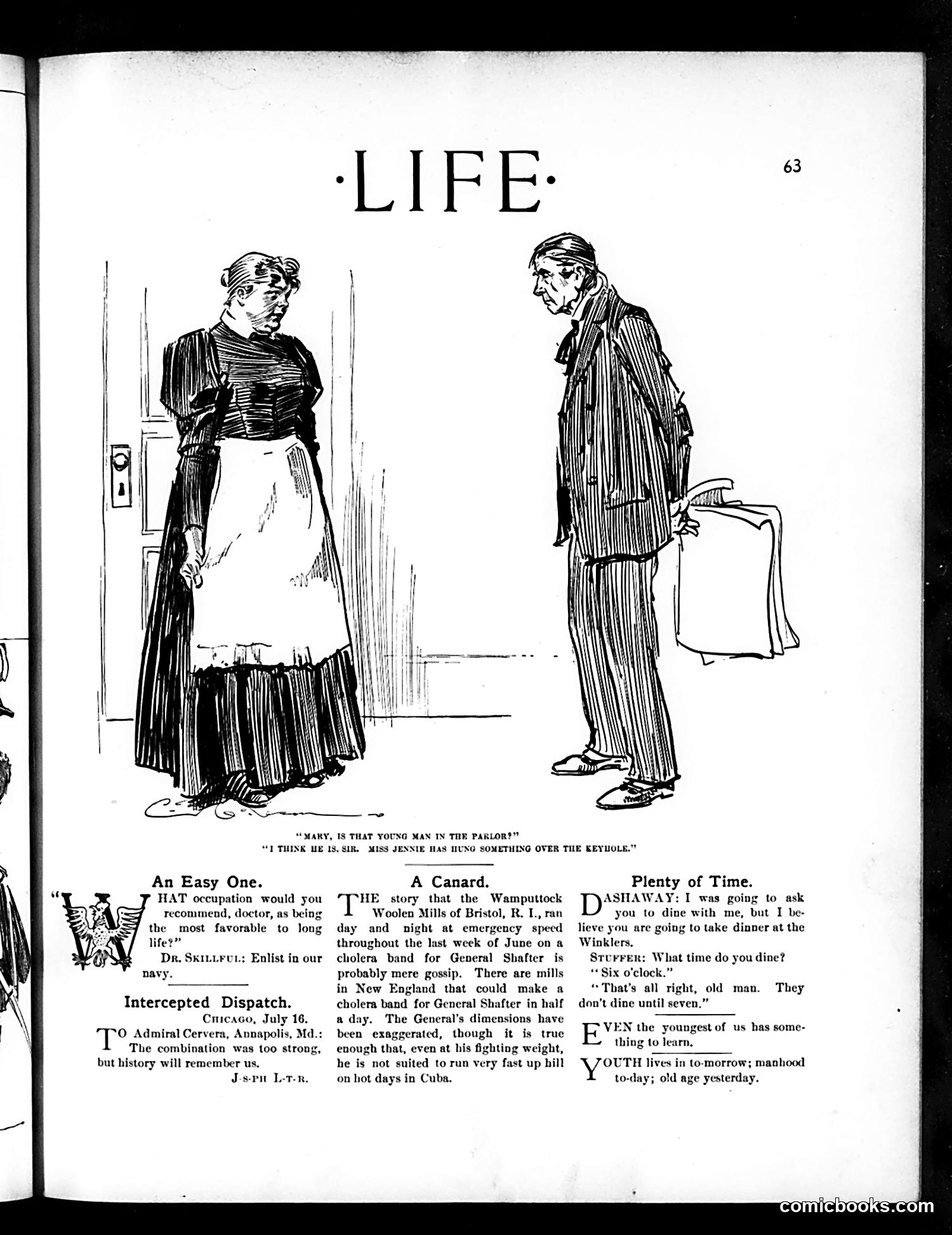
This page from *Life* magazine contains three separate humor pieces. The main cartoon shows a maid speaking to an older man, with the caption suggesting she's interested in a young man and has "hung something over the keyhole"—a period reference to romantic or sexual interest. Below are three brief jokes: "An Easy One" concerns a doctor's occupation; "Intercepted Dispatch" references Admiral Cervera and the Spanish-American War (mentioning Cuba and General Shaffer), satirizing the military campaign; and "A Canard" mocks a gossip story about the Wamputtock Woolen Mills in Bristol, suggesting exaggeration about General Shaffer's physical dimensions and military capabilities. The humor relies on contemporary references to the Spanish-American War and local New England textile industry gossip.
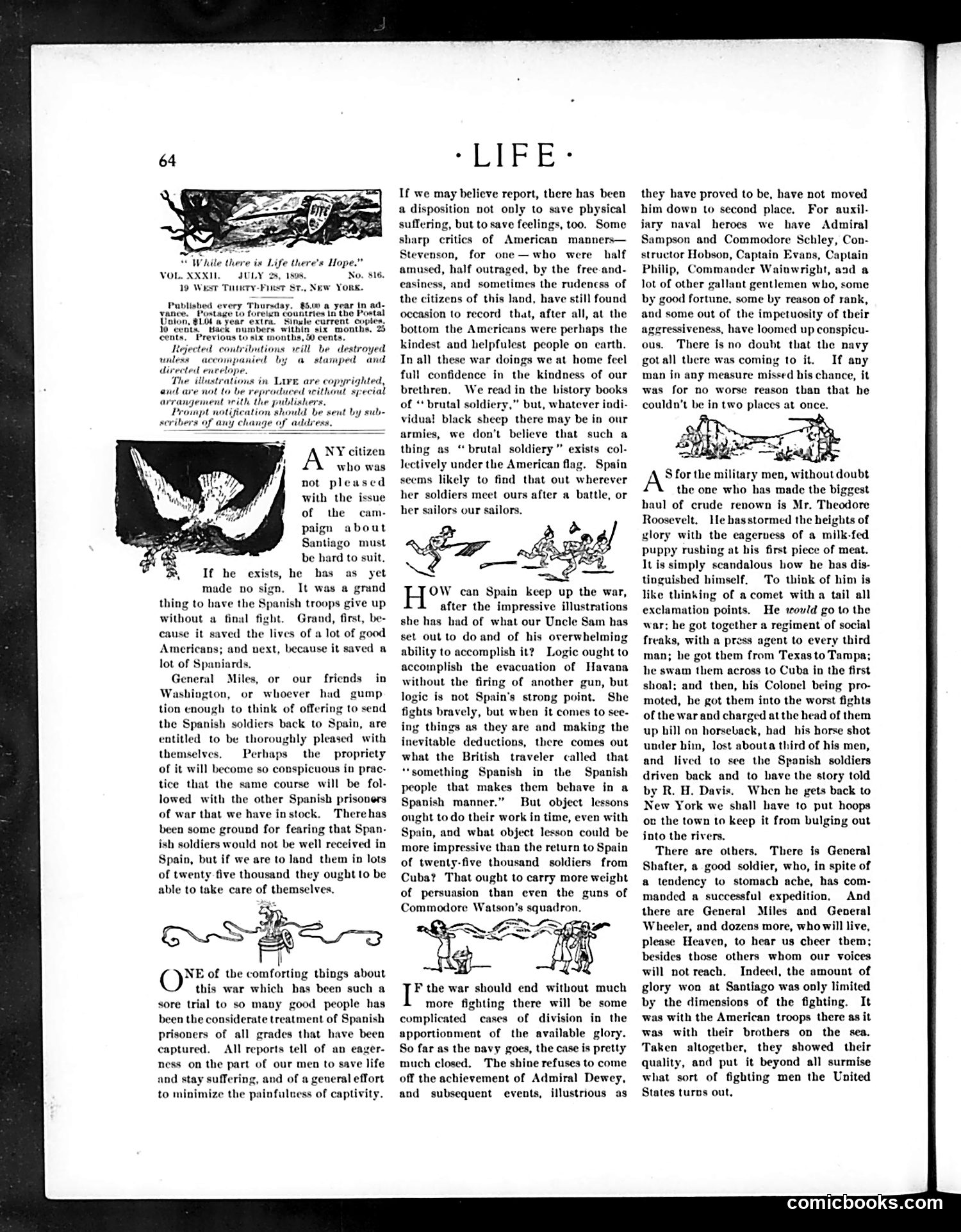
This editorial page discusses American military conduct during the Spanish-American War, specifically praising U.S. troops' treatment of Spanish prisoners and contrasting American "kindness" with Spanish behavior. The author argues Americans are "perhaps the kindest and helpfulest people on earth" and defends the character of American soldiers against accusations of brutality. The page includes several small decorative illustrations (soldiers, military scenes) rather than satirical political cartoons. The content is earnest commentary rather than satire, defending U.S. military honor and contrasting American versus Spanish conduct. References to "Santiago," "Cuba," "Havana," and named officers (Admiral Dewey, General Shafter) anchor this to the 1898 Spanish-American War context. The tone is propagandistic rather than satirical.
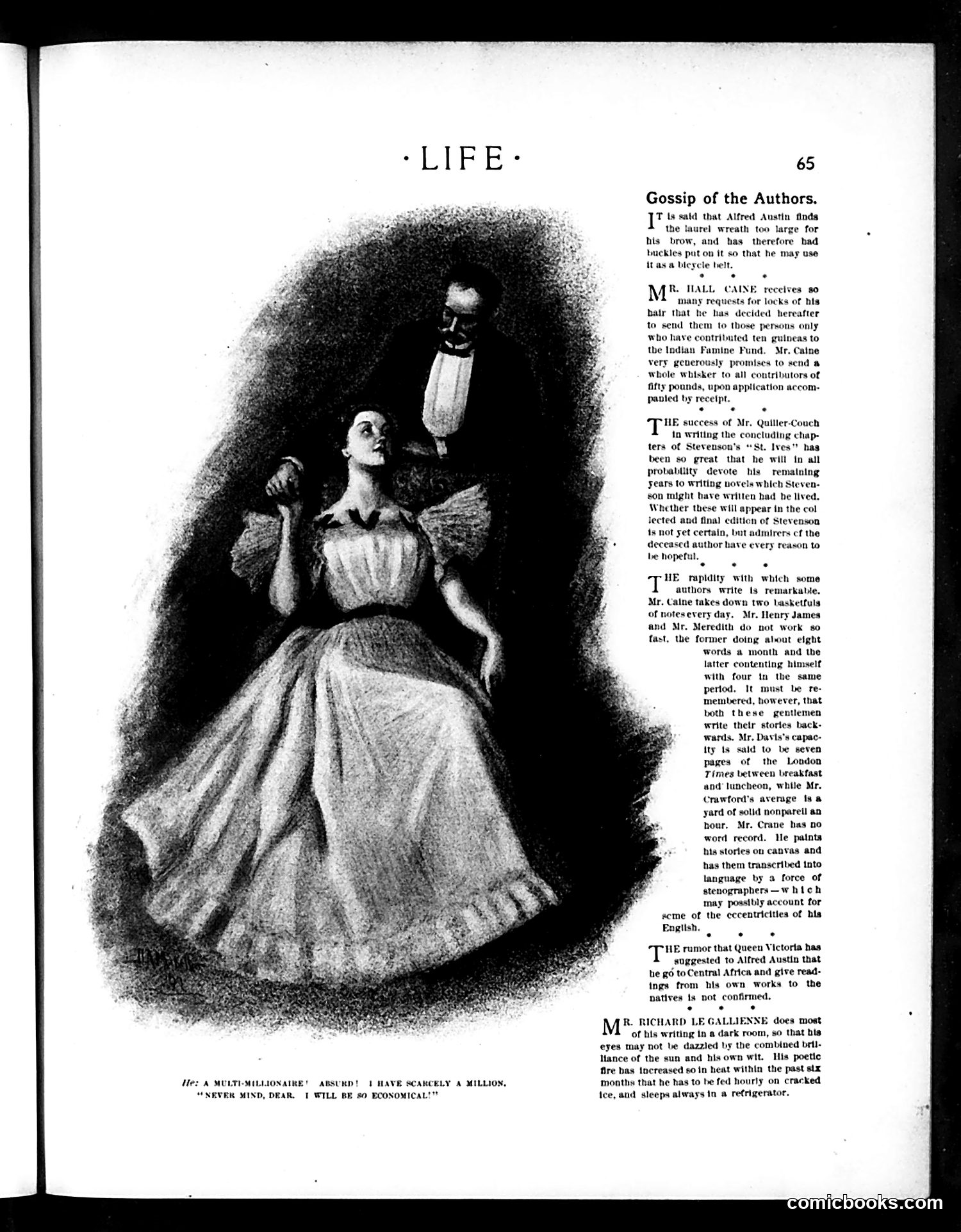
The main illustration depicts a wealthy man and woman, with the caption: "He: A MULTI-MILLIONAIRE! ABSURD! I HAVE SCARCELY A MILLION. 'NEVER MIND, DEAR. I WILL BE SO ECONOMICAL!'" **The satire:** This cartoon mocks the pretensions of the wealthy class during the Gilded Age. A man claiming to have "scarcely a million" dollars is presented as poor—absurd by ordinary standards—while his wife reassures him she'll economize. The joke targets both their complete detachment from middle-class financial reality and the woman's assumed role as household manager, unable to comprehend true poverty. The "Gossip of the Authors" section right side discusses literary figures of the era, including references to Robert Louis Stevenson and other contemporary writers.
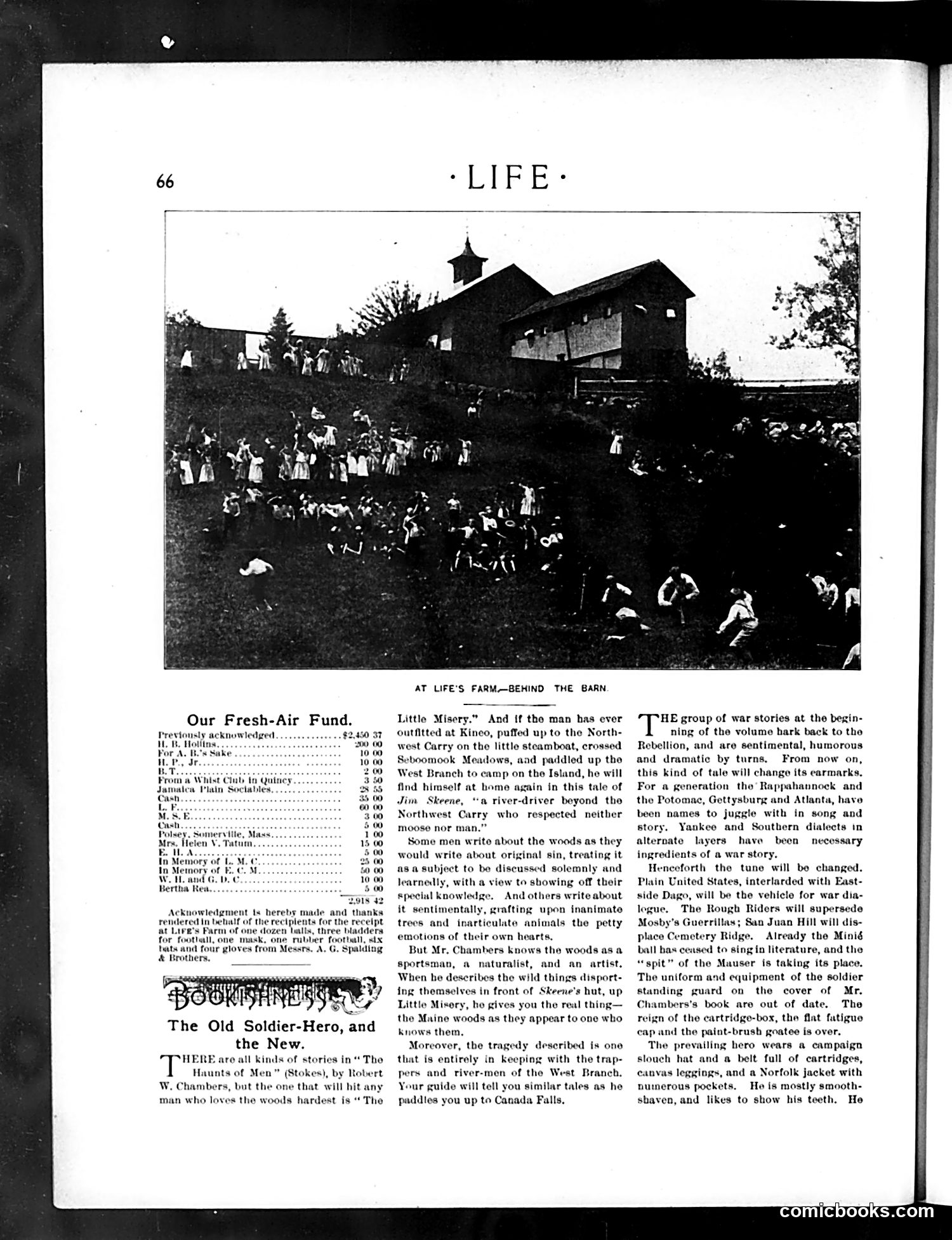
This page contains two distinct sections: **Upper Image:** A photograph labeled "At Life's Farm—Behind the Barn" showing a large outdoor gathering of people near farm buildings. This appears to be documenting an actual event at Life magazine's property rather than a cartoon. **Lower Section:** Two articles discussing Civil War literature. "The Old Soldier-Hero, and the New" compares old war narratives (citing Robert W. Chambers' "The Haunts of Men") with newer, more realistic accounts. The piece critiques romanticized portrayals, noting that recent war stories—particularly about river-men of the West Branch—present "tragedy" and authentic experience that contrasts with earlier sentimental treatments. The satirical angle appears subtle: Life is essentially mocking outdated, overly heroic war narratives in favor of grittier, more truthful depictions emerging from actual soldier accounts.
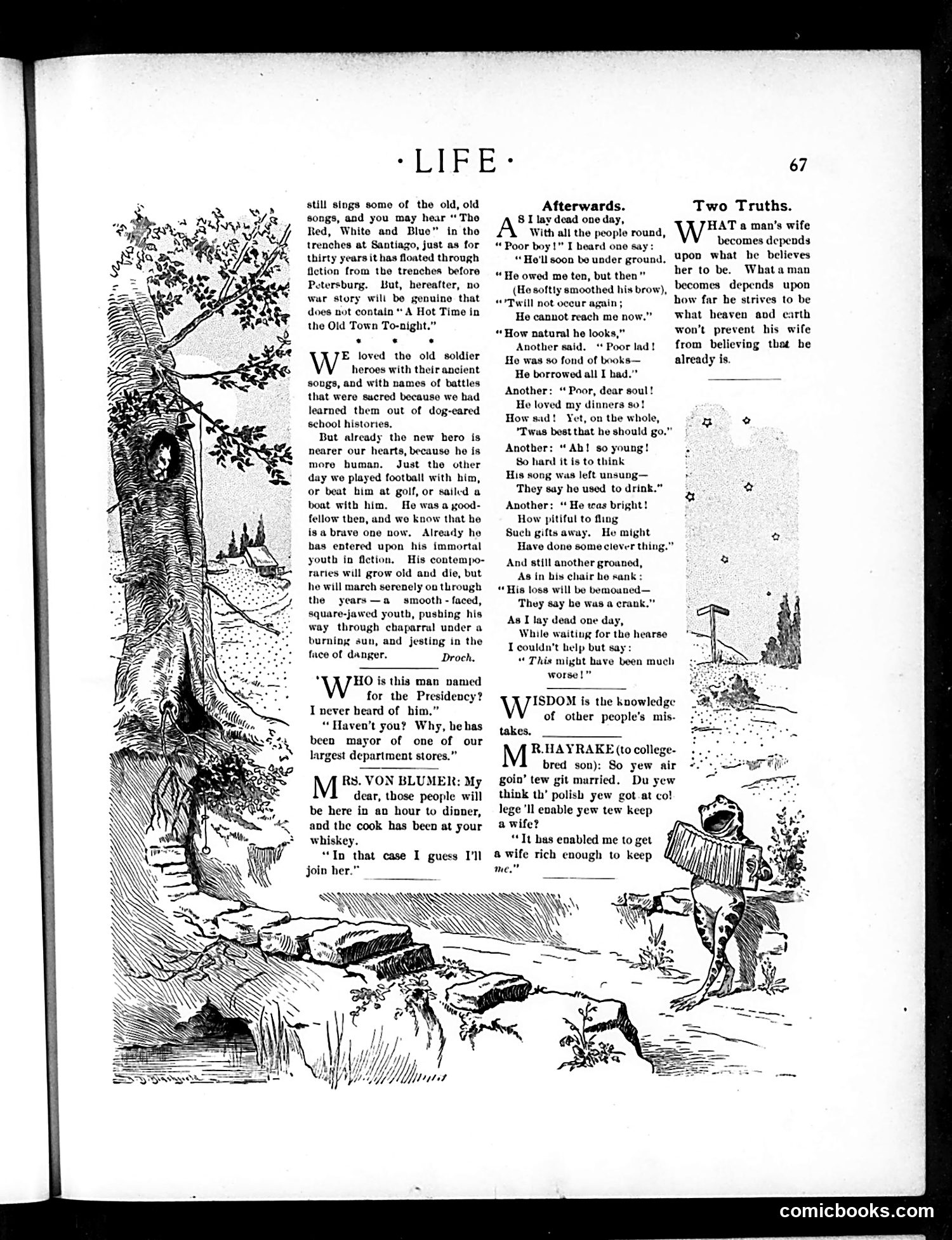
This page contains three separate satirical pieces typical of Life magazine's humor: 1. **"Afterwards"** - A darkly comic dialogue where people discuss a dead man, joking he'll "soon be under ground" and cannot hear them. The satire mocks how people speak ill of the deceased or make light of death. 2. **"Two Truths"** - A short piece about wives' influence on men's beliefs, suggesting a woman's convictions shape her husband's worldview—satirizing marital dynamics and female persuasiveness. 3. **"M. Von Blumer"** - A brief exchange about a man named for the Presidency, with someone jokingly offering to "join" him for dinner and whiskey, implying he's insignificant despite his grand-sounding name. The accompanying illustrations are decorative woodland/pastoral scenes. The overall tone is genteel, turn-of-century American humor focused on social observations.
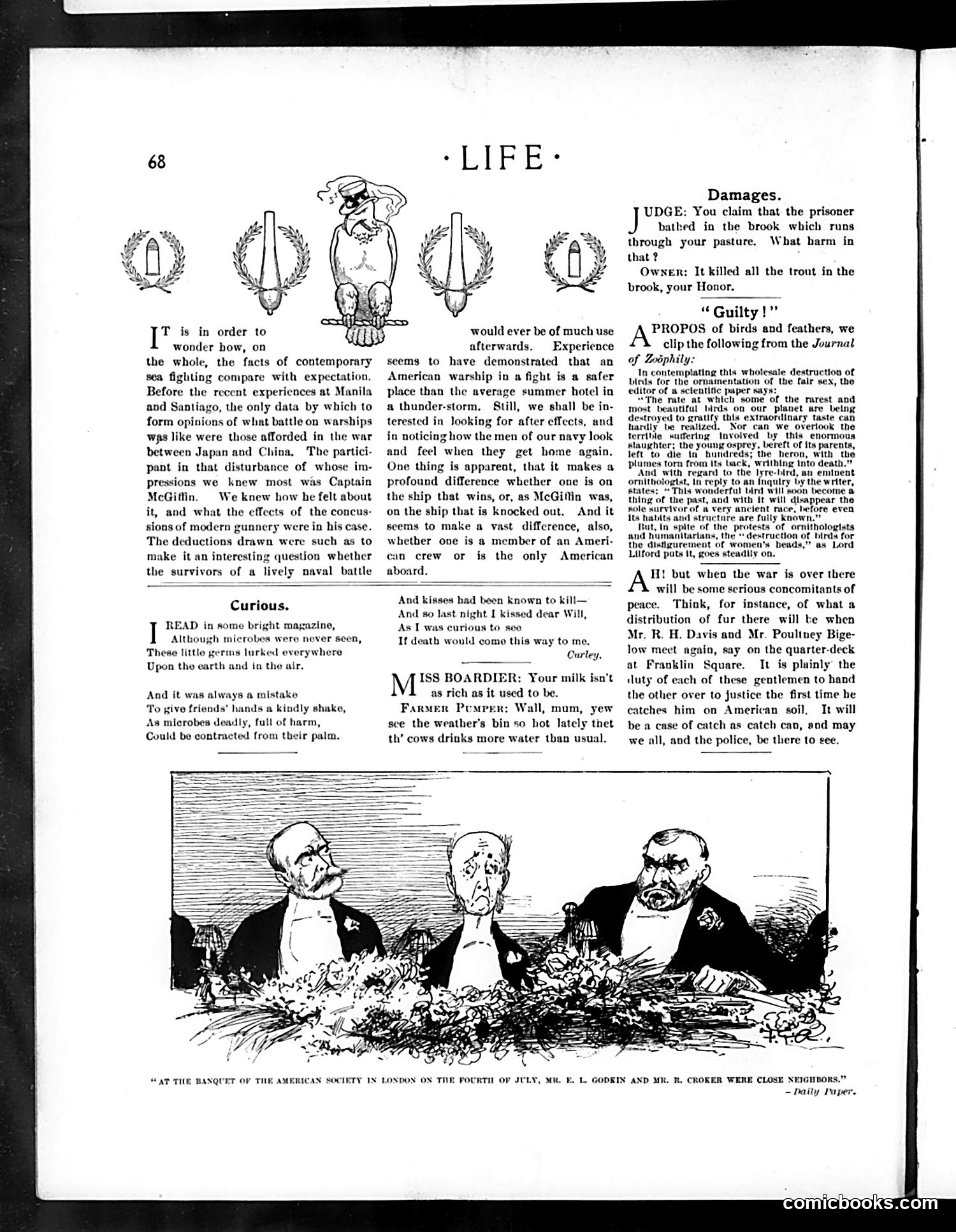
This *Life* magazine page satirizes American naval affairs and international relations, likely from the early 1900s based on the warship discussion. The main cartoon depicts three men at a banquet of the American Society in London on July 4th. The caption identifies them as Mr. E.L. Godkin and Mr. B. Croker (likely prominent American public figures of the era), shown as "close neighbors" at the table. The satire appears to mock these individuals' positions or rivalries within American society abroad. The exaggerated facial expressions suggest personal animosity or ideological conflict between them. The upper text discusses naval battles between Japan and China, examining whether American warships or crew performance determined combat outcomes—contemporary geopolitical commentary relevant to turn-of-the-century American interests in Asia.
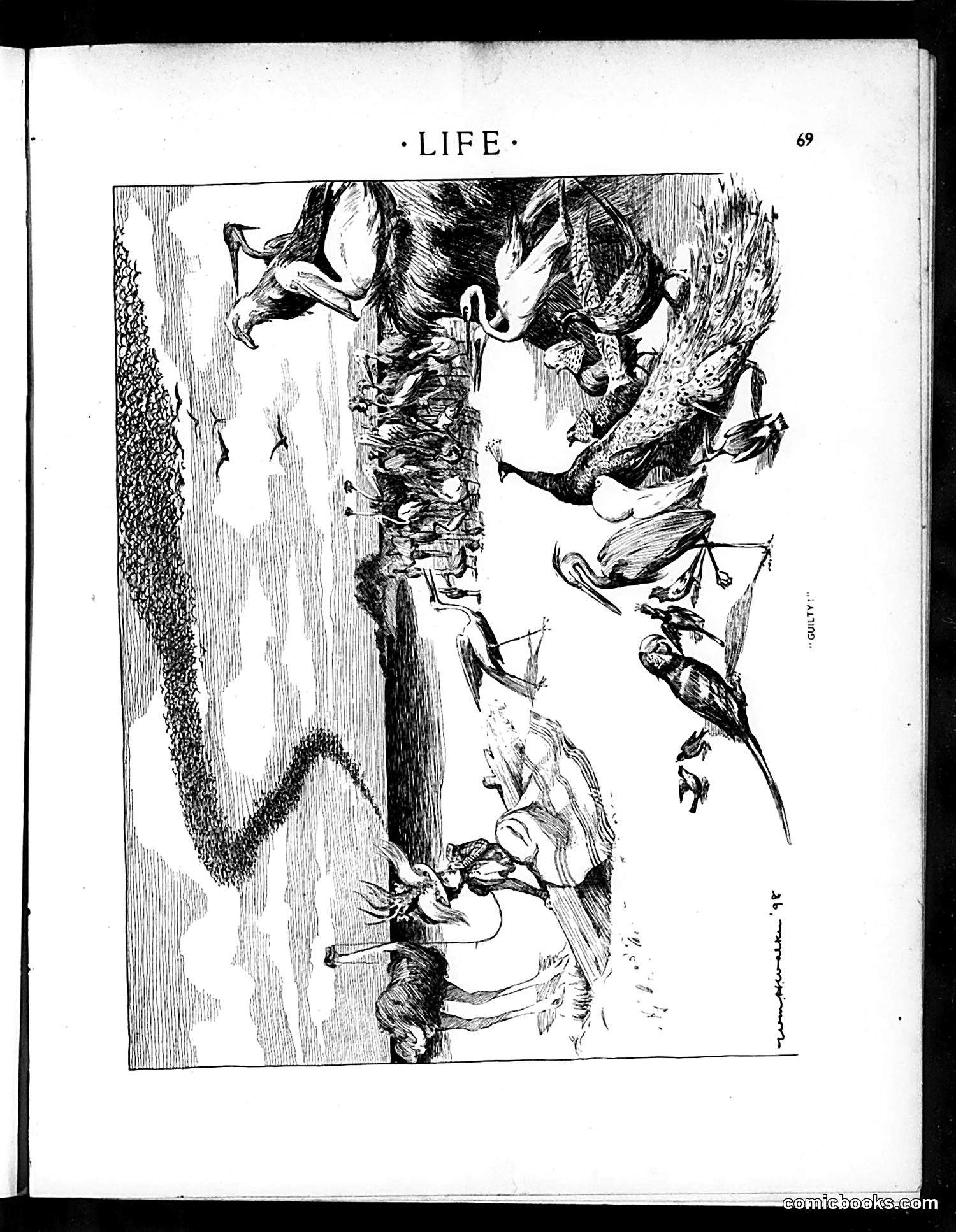
I can see this is page 69 of Life magazine, containing a detailed black and white engraving or illustration. However, the image is oriented sideways and the OCR text provided is blank or unreadable, making it difficult to identify specific political figures, captions, or satirical references. The artwork appears to depict multiple human figures in what seems to be a satirical or comedic scene, rendered in a Victorian-era engraving style typical of Life's publications. Without legible caption text or context identifying the subjects or the specific event being satirized, I cannot accurately explain what political or social commentary this particular cartoon conveys to a modern reader. To provide accurate historical interpretation, I would need either the page rotated for proper viewing or clearer OCR text identifying the figures and context.
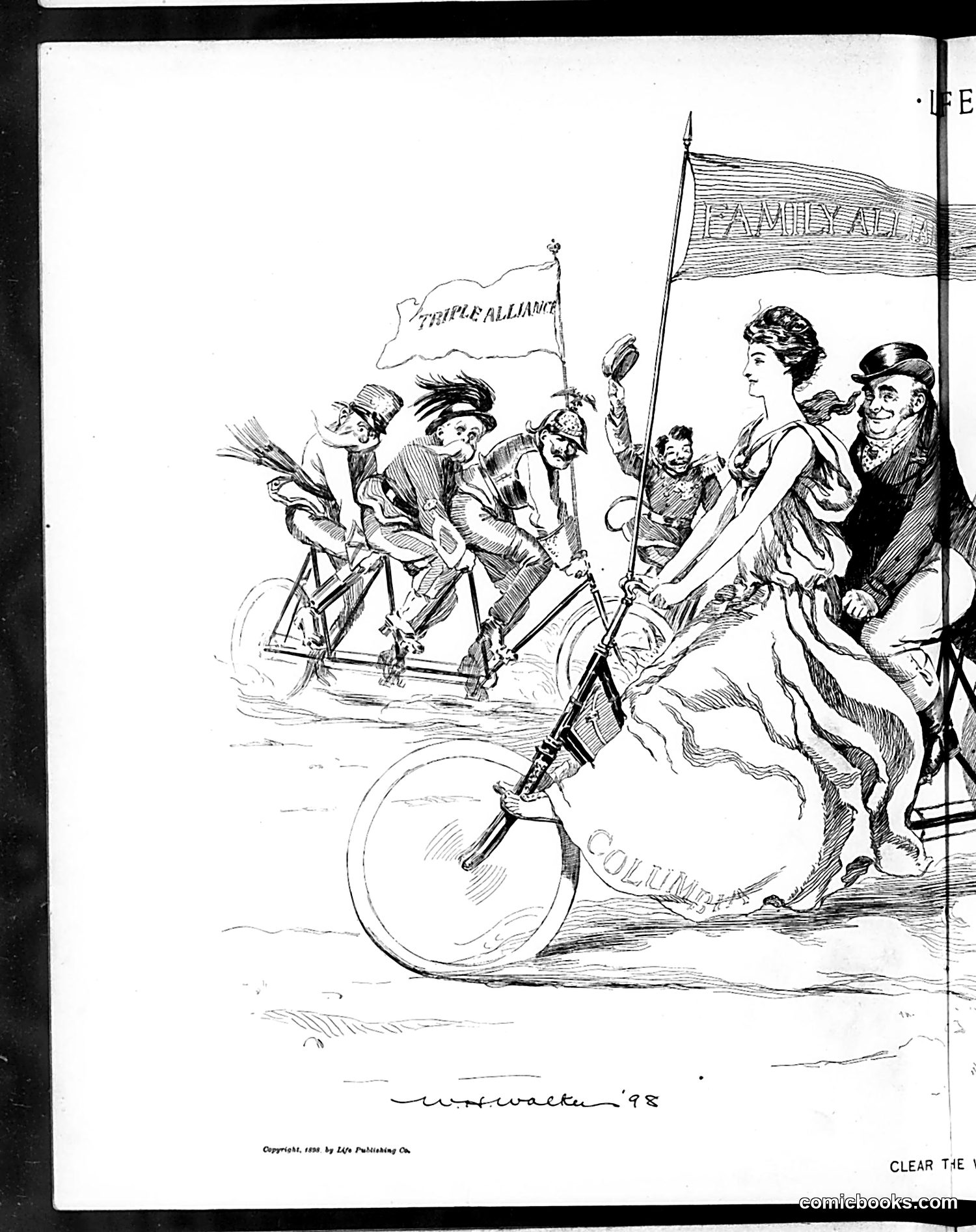
This 1898 Life magazine cartoon satirizes the **Triple Alliance** (Germany, Austria-Hungary, Italy) and **Columbia** (personification of the United States). The image shows cyclists bearing the "Triple Alliance" flag approaching Columbia, who stands with the "Family Altar" flag. Children cluster around her protectively. A man on a unicycle labeled "Country" appears to be blocking or confronting the approaching cyclists. The satire critiques foreign powers' potential threat to American domestic values and sovereignty. The "Family Altar" represents traditional American home life, while the cyclists represent aggressive European militarism. The precarious unicycle symbolizes America's unstable position defending itself against these powerful alliances. This reflects 1890s American isolationist sentiment and anxiety about European imperial ambitions.
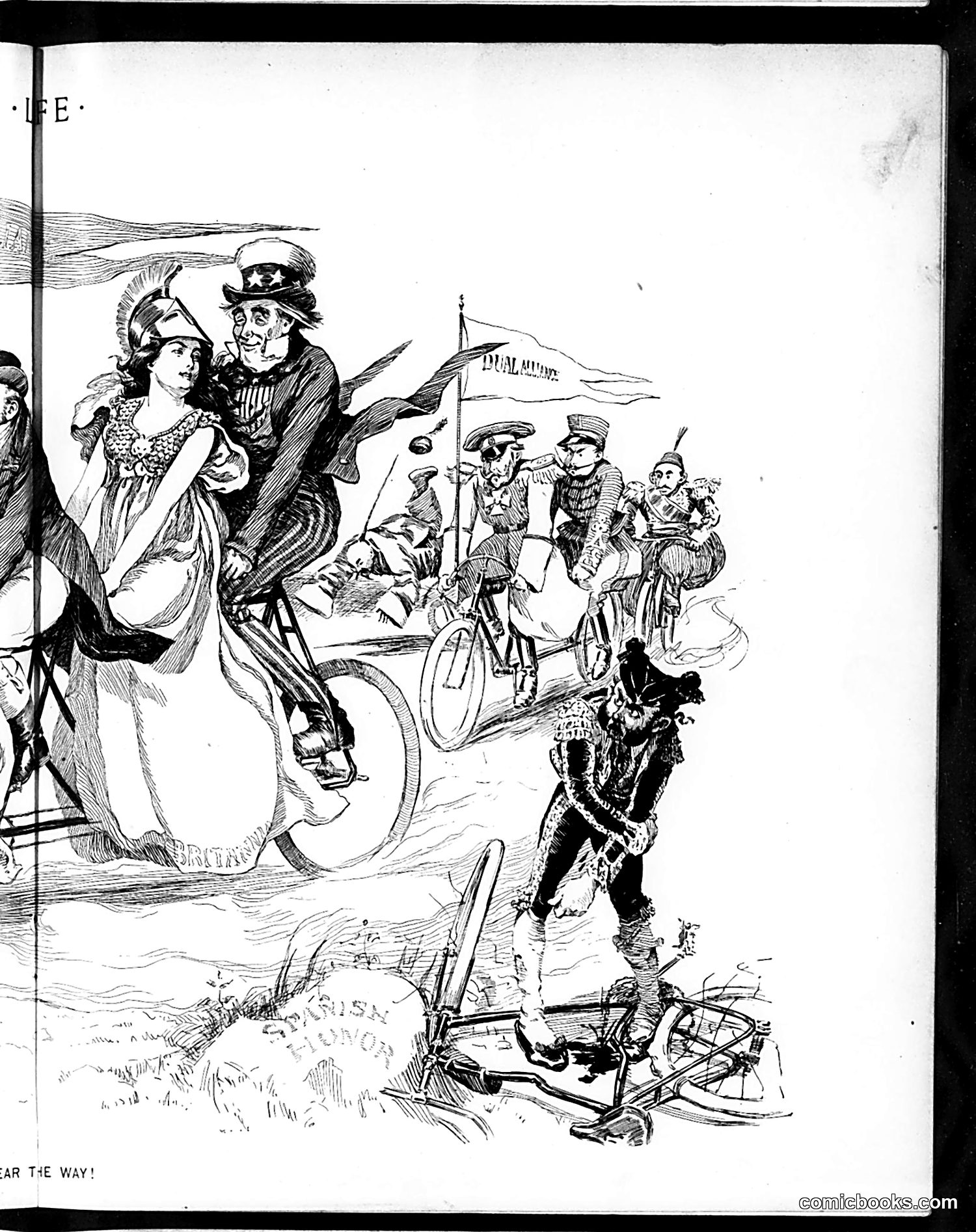
This appears to be a satirical cartoon from *Life* magazine depicting a military or diplomatic procession. On the left, a well-dressed couple (appearing to represent civilian or aristocratic authority) gestures toward a marching group on the right carrying a flag marked "DULMAINE" (or similar). The procession includes military or uniformed figures, while a disheveled character in the foreground—seemingly representing a common soldier or laborer—lies defeated or exhausted among fallen weapons and debris. The satire likely critiques the disconnect between civilian leadership directing military campaigns and the suffering of ordinary soldiers. The contrast between the elegant couple's detached gesture and the destruction below suggests commentary on how political or military elites send common people to war while remaining removed from consequences. Without the magazine's date and full text, the specific historical conflict remains unclear.
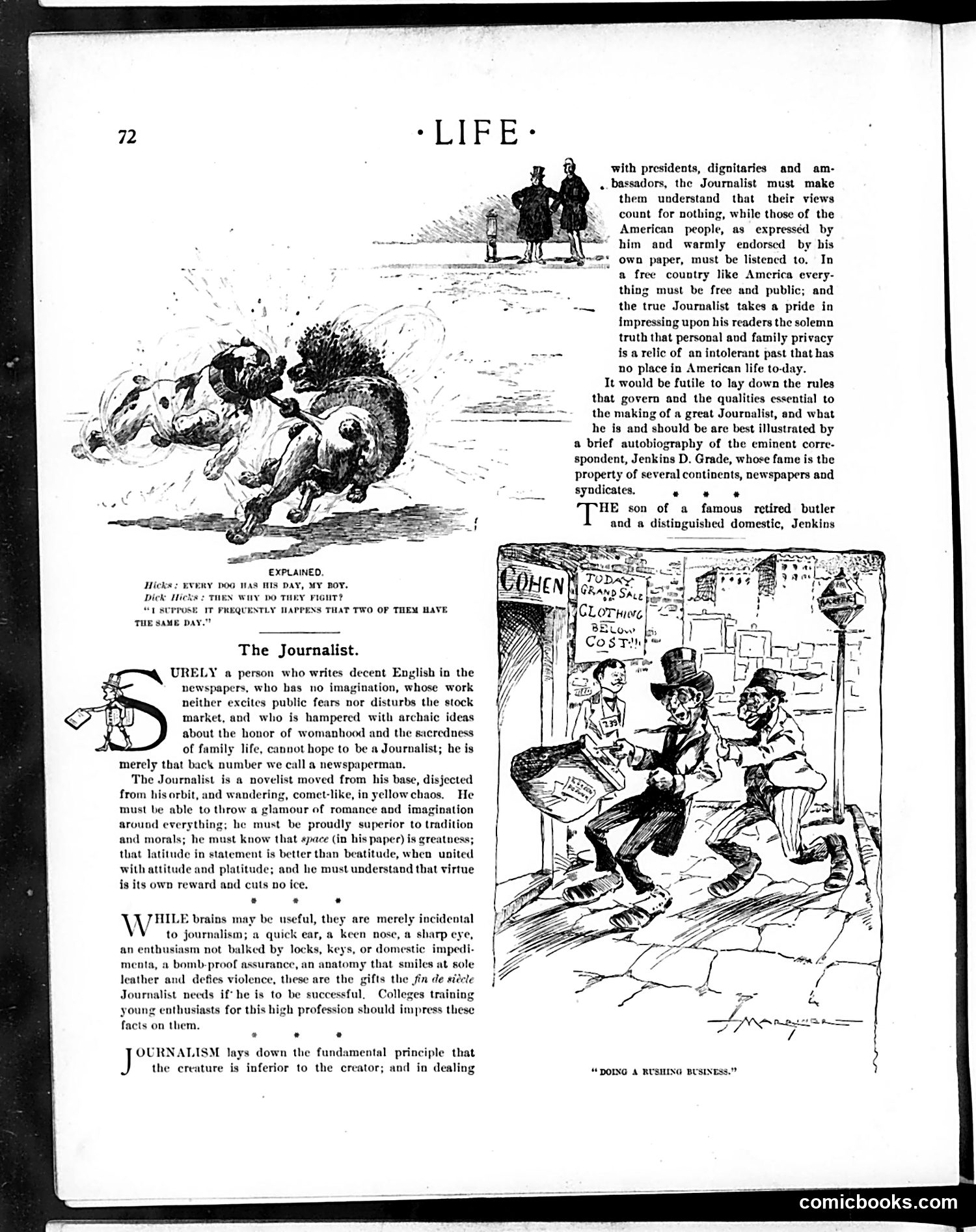
This page discusses the qualities needed for serious journalism. The top cartoon shows two dogs fighting ("Hicks" and "Dick Hicks"), illustrating the caption's point: fighting over trivial matters means "they have the same day" — a metaphor for journalists who engage in petty disputes rather than meaningful work. The main article defines what separates a true journalist from a mere "newspaperman." It emphasizes that real journalists must possess imagination, romance, moral conviction, and intellectual rigor — not just a sharp ear or keen nose for gossip. The lower cartoon titled "Doing a Rushing Business" appears to depict a newspaper office (Cohen's Grand Sale Clothing store), showing journalists or salesmen conducting business, likely satirizing the commercialization of news.
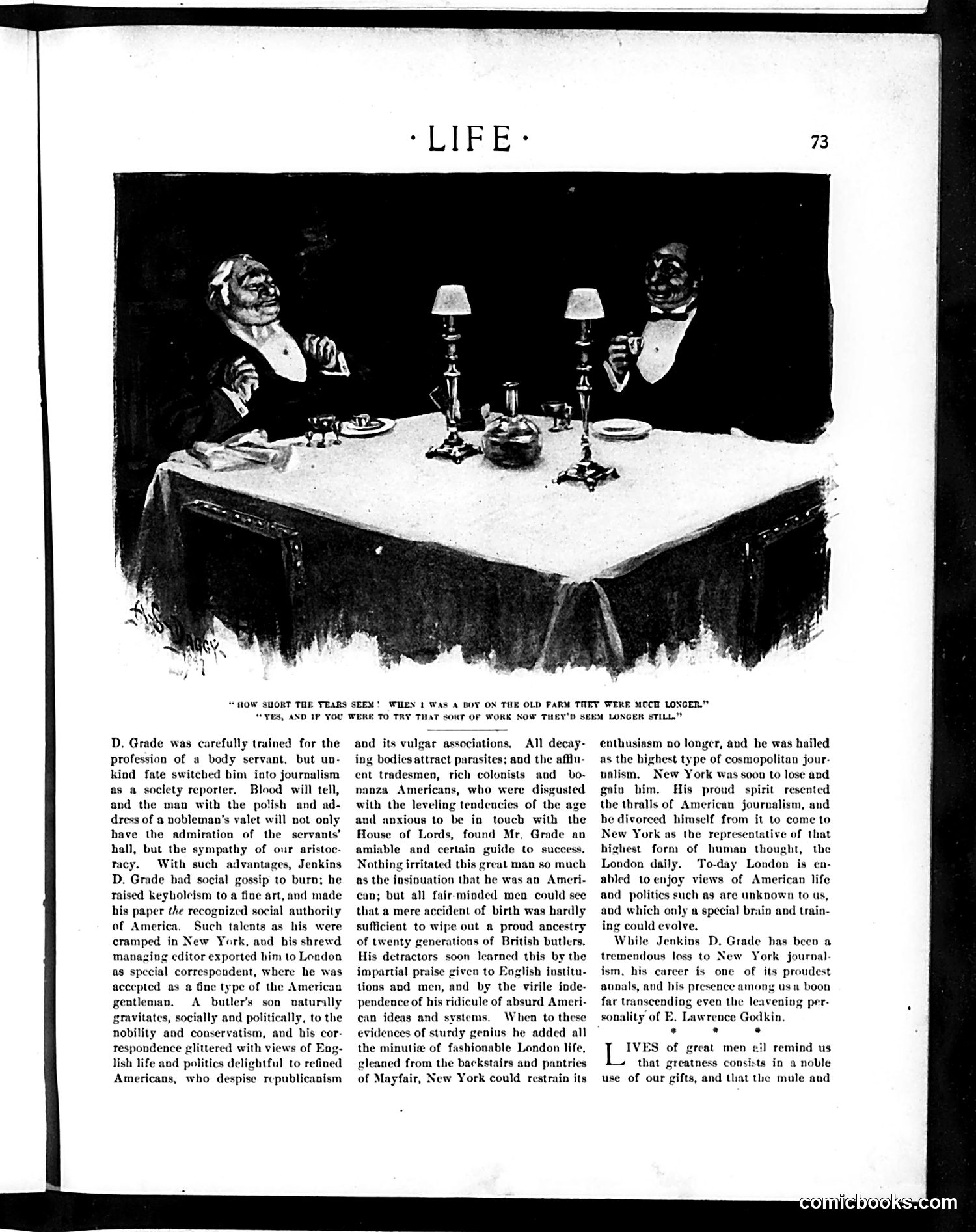
This Life magazine piece satirizes **Jenkins D. Grade**, a character representing American journalists who abandon republican values to court European aristocracy. The cartoon depicts two caricatured men dining formally, apparently reminiscing about farm life—the caption's nostalgic tone contrasts sharply with their refined setting, suggesting hypocrisy. The text reveals the satire's target: Grade was a butler's son trained as a servant who became a society reporter, then a correspondent in London. He achieved prominence by flattering wealthy Americans' Anglophilia and disdain for democracy's "leveling tendencies." The piece mocks his pretense—he denies being American while trafficking in London gossip gleaned from "backstairs and pantries." The satire attacks both Grade's class-climbing and the American elite's susceptibility to his snobbery. By praising him as the "highest type of cosmopolitan journalism," Life exposes how easily the wealthy abandon republican ideals for aristocratic affectation.
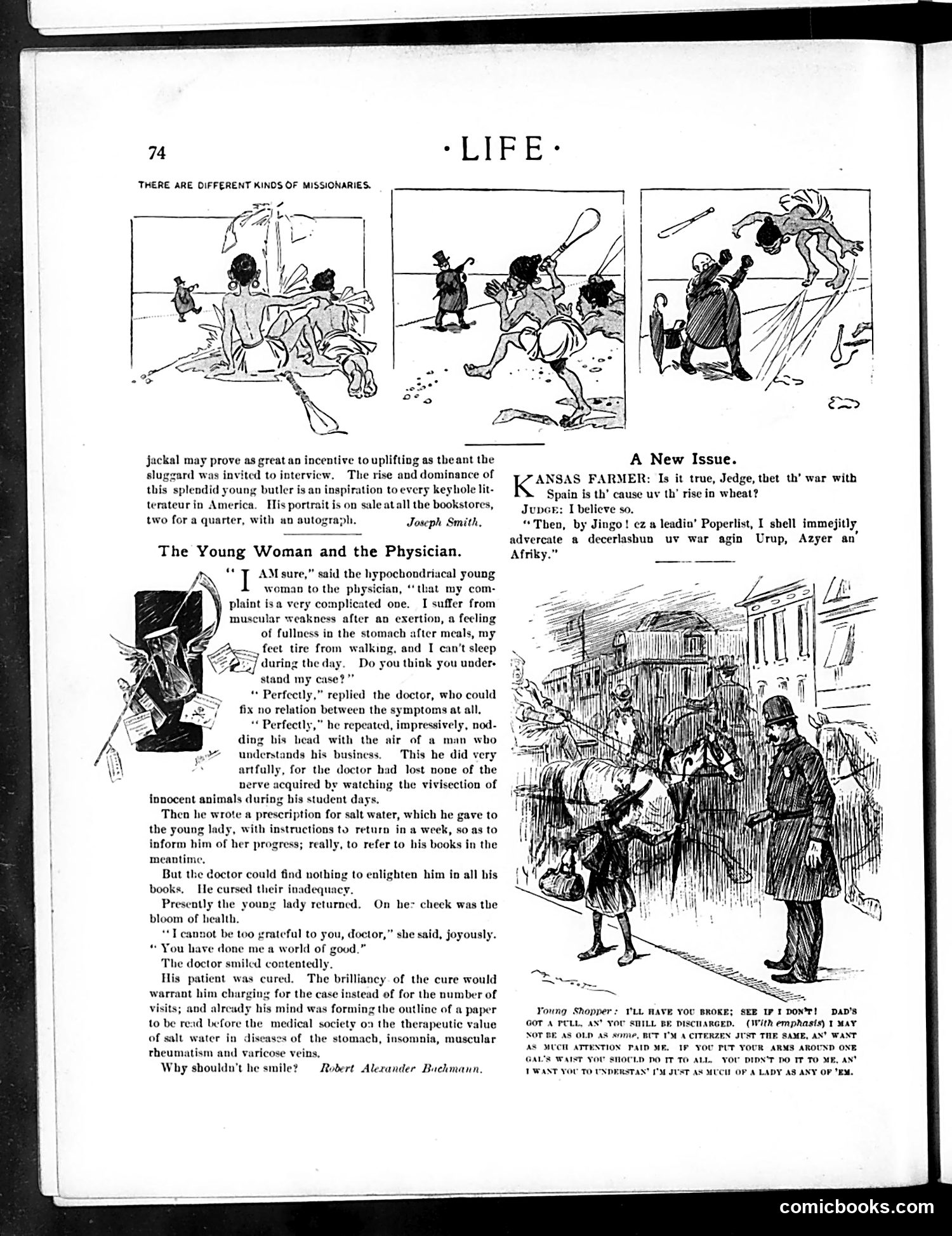
This page contains three satirical pieces: **"There Are Different Kinds of Missionaries"** (top): Three cartoon panels depicting physical conflict, likely satirizing hypocritical "missionaries" who preach morality while engaging in violence or crude behavior. **"The Young Woman and the Physician"** (left): A story mocking incompetent doctors. A hypochondriac woman complains of vague symptoms; the physician, admitting he cannot diagnose her, prescribes salt water. When she returns healthy (likely because nothing was wrong), he takes credit and plans to publish a medical paper about his "cure." The satire targets medical fraud and doctors' inflated self-importance. **"A New Issue"** (right): A dialogue between a Kansas farmer and a judge, using dialect to mock populist politicians. The farmer proposes declaring war on Europe, Asia, and Africa simply to profit from increased wheat prices caused by the Spanish-American War—satirizing how some exploited wartime for financial gain. The bottom sketch shows a young saleswoman asserting her rights and dignity to a dismissive employer.
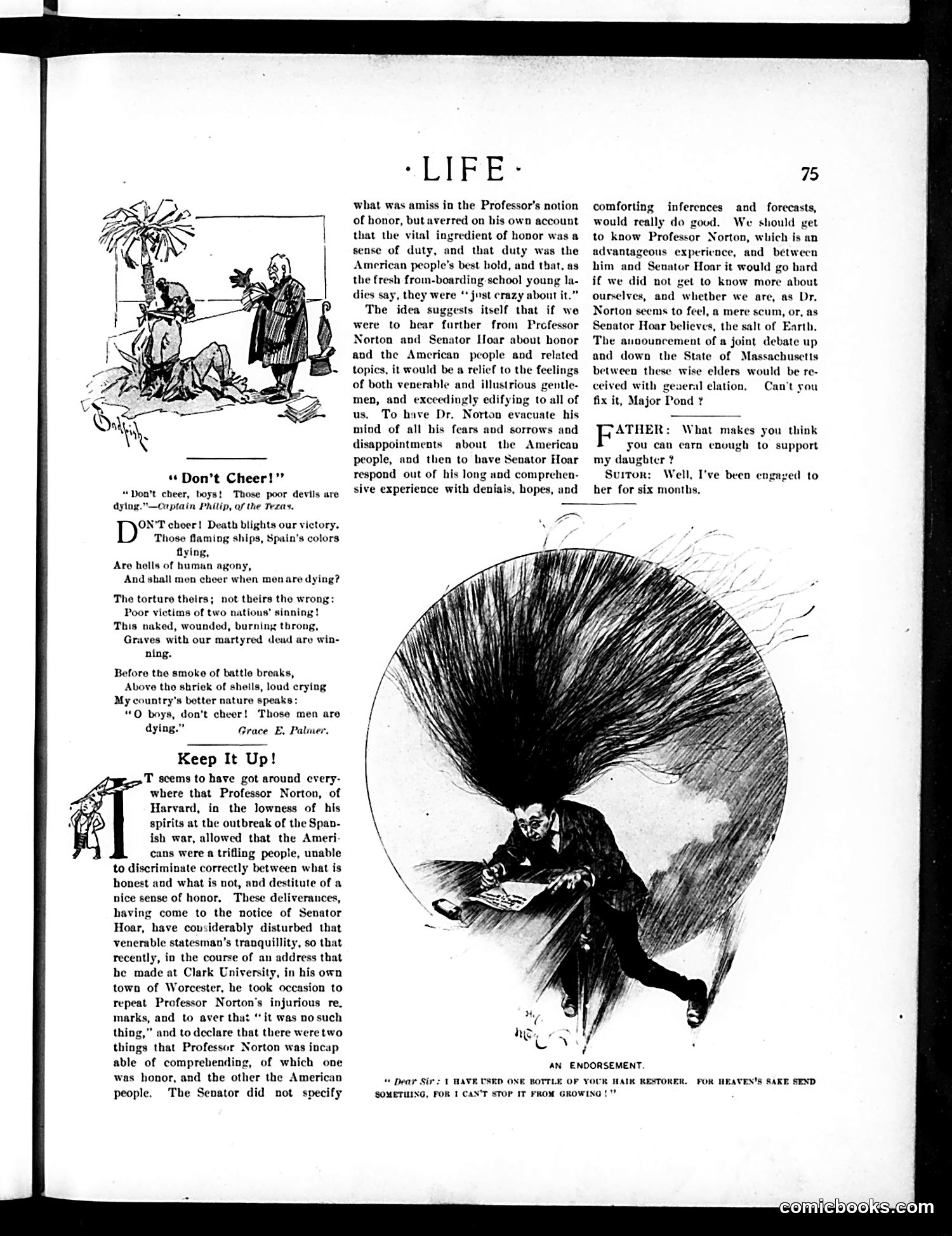
This page satirizes intellectual and political figures debating American honor during the Spanish-American War (1898). **"Keep It Up!" section:** The satire targets Professor Charles Norton of Harvard, who reportedly criticized Americans as lacking honor and moral discrimination. Senator George Hoar publicly defended Americans against Norton's characterization, asserting that duty and honor define American character. Life's editors mock this debate as tedious philosophizing, suggesting both men should publicly continue arguing so Americans can learn about their own national character—the joke being that elite intellectuals are out of touch with practical American values. **The smaller cartoons:** "Don't Cheer" mourns Spanish sailors dying in battle, questioning whether Americans should celebrate victory when enemy combatants are suffering. The hair restorer advertisement joke plays on ironic endorsements common in period advertising satire. The page reflects turn-of-century tensions between intellectual elites questioning American morality and patriots defending national character.
This cartoon presents a dialogue between "John" (representing Britain) and "Jonathan" (representing America), addressing late-19th-century imperial tensions. The exchange satirizes both nations' self-righteous posturing about global dominance. When Jonathan boasts about American expansionism ("I'm plaguey apt to brag"), John retorts that Britain isn't meek either. The cartoon mocks both countries' hypocrisy: each criticizes the other's imperialism while practicing their own. References to Spain's "backyard" (Cuba) and Hawaii annexation reflect contemporary U.S. expansion debates, while allusions to "Jingoes" reference aggressive British imperialism. The joke targets jingoism itself—the blind nationalism and double standards of powerful nations. Both characters are portrayed as self-deceived, lecturing each other about restraint while pursuing imperial conquest. The cartoon uses their shared Anglo-Saxon heritage ironically, suggesting they're more alike than either admits. This reflects Life magazine's satirical commentary on turn-of-the-century imperial rivalry.
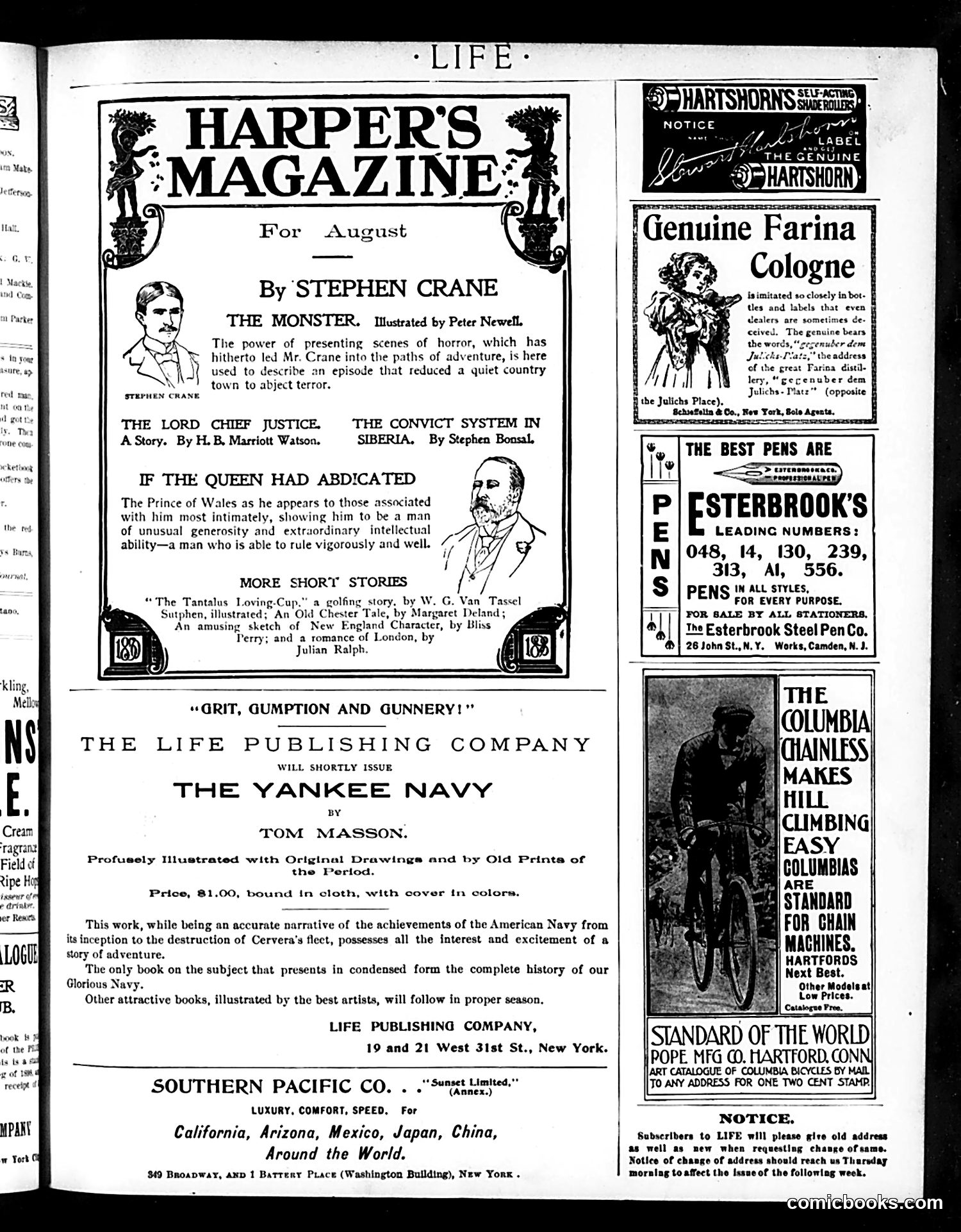
This is primarily a **table of contents and advertising page** for Harper's Magazine's August issue, not a political cartoon page. The main content announces fiction by **Stephen Crane** ("The Monster"), **H.B. Marriott Watson**, and **Stephen Bonsal**, featuring stories about horror, justice, and Siberian prisons. One item stands out politically: **"If the Queen Had Abdicated"** presents a **speculative piece about the Prince of Wales**, describing him as intellectually gifted and capable of vigorous rule—this appears to be British royal commentary, though the specific historical context is unclear from this page alone. The bulk of the page consists of **book advertisements** (particularly "The Yankee Navy"), product ads (pens, cologne, bicycles), and publisher notices. This appears to be a standard magazine filler/announcement page rather than satirical content.
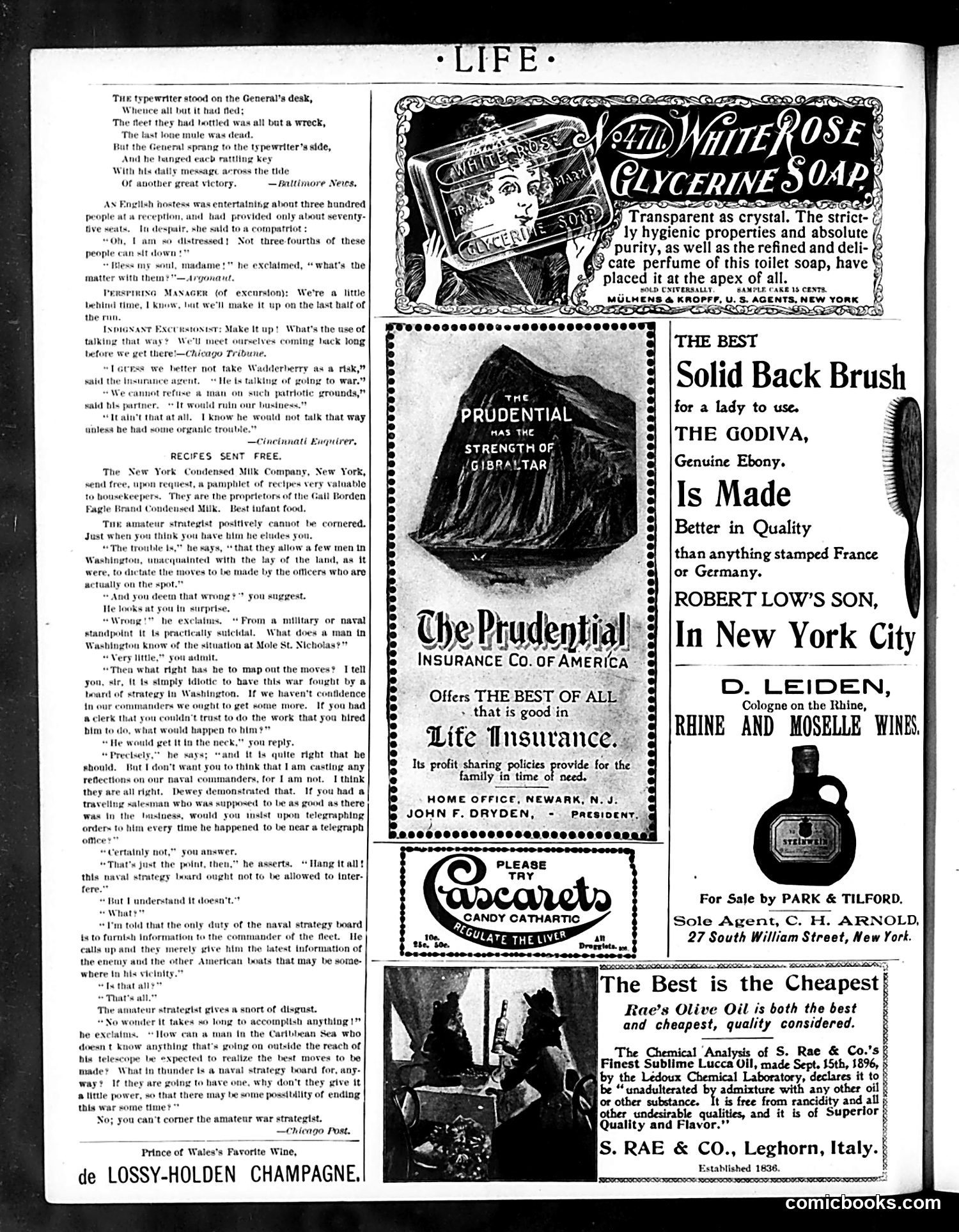
This page contains **satirical commentary on military strategy during the Spanish-American War era** (the references to naval strategy and Mole St. Nicholas suggest the 1898 conflict). ## Main Cartoon/Article The lengthy text piece ridicules an **"amateur strategist"**—a civilian who presumes to criticize U.S. military operations from Washington. The joke: this armchair strategist insists that military decisions made by distant bureaucrats are "idiotic," yet he simultaneously demands those same bureaucrats provide constant updates. He contradicts himself, failing to see that if he trusts commanders in the field, he shouldn't second-guess them from home. The satire targets **public interference in military affairs**—ordinary Americans opining on complex naval strategy they don't understand, while newspapers amplified such amateur commentary. ## Supporting Material Brief anecdotes illustrate related themes of absurd logic and miscommunication (the typewriter story, the English hostess's party). The bulk of the page comprises **period advertisements** for soap, brushes, insurance, and wine—typical Life magazine fare.
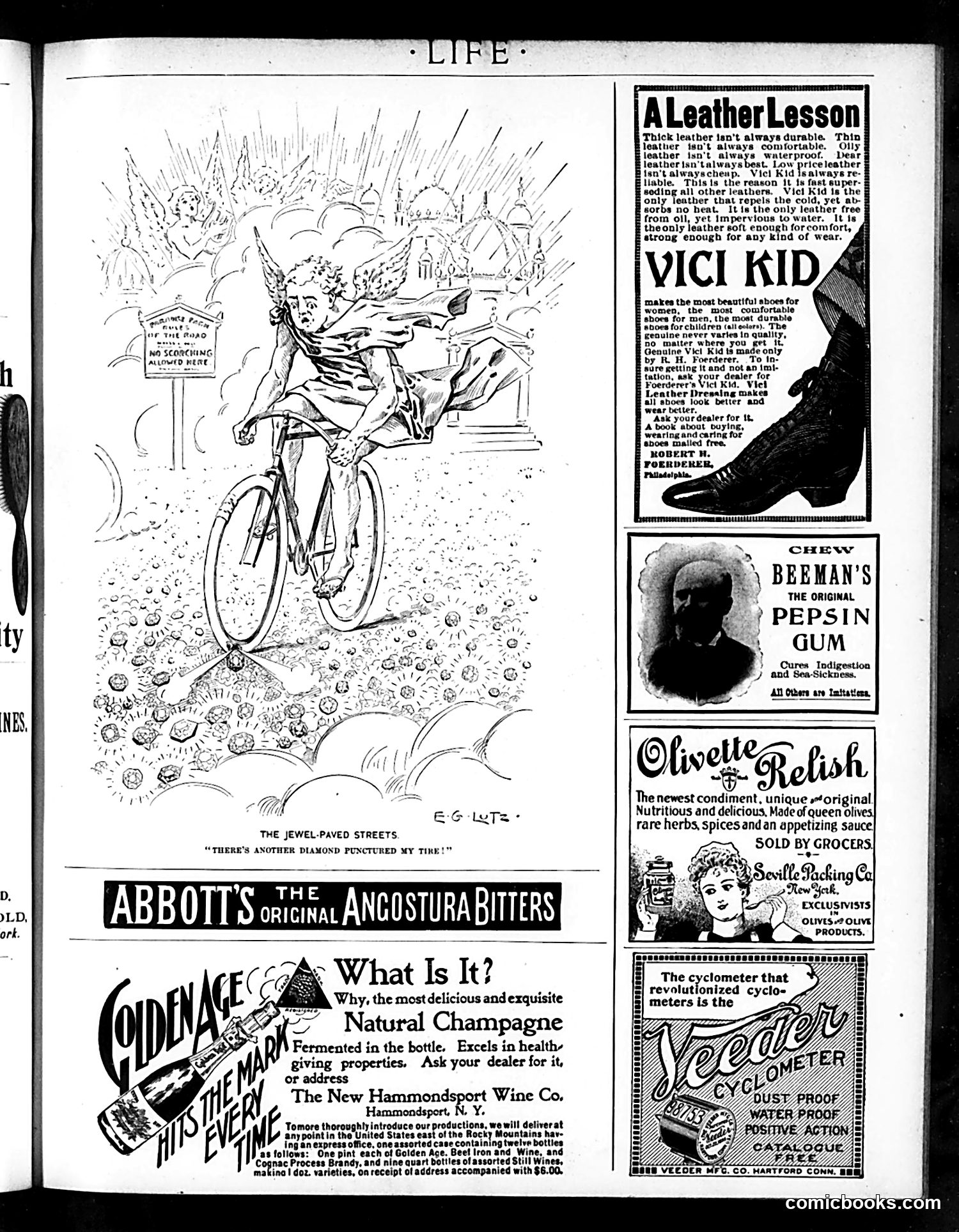
This page is primarily **advertisements** with one satirical cartoon. The main cartoon shows an angel on a bicycle riding through streets literally paved with jewels, with the caption "There's Another Diamond Punctured My Tire!" The joke satirizes **excessive wealth and luxury**—even diamonds (the hardest substance) are so abundant they're merely road hazards. This likely mocks the Gilded Age's extreme wealth disparity and conspicuous consumption among the very rich. The advertisements (Vici Kid leather shoes, Beeman's Pepsin Gum, Abbott's Bitters, Olivette Relish, Veeder Cyclometer, and Goldenaere Champagne) are typical early 20th-century product pitches emphasizing dubious health benefits and superiority claims—common before modern advertising regulations. The artist is credited as "E.G. Lutz" on the cartoon.
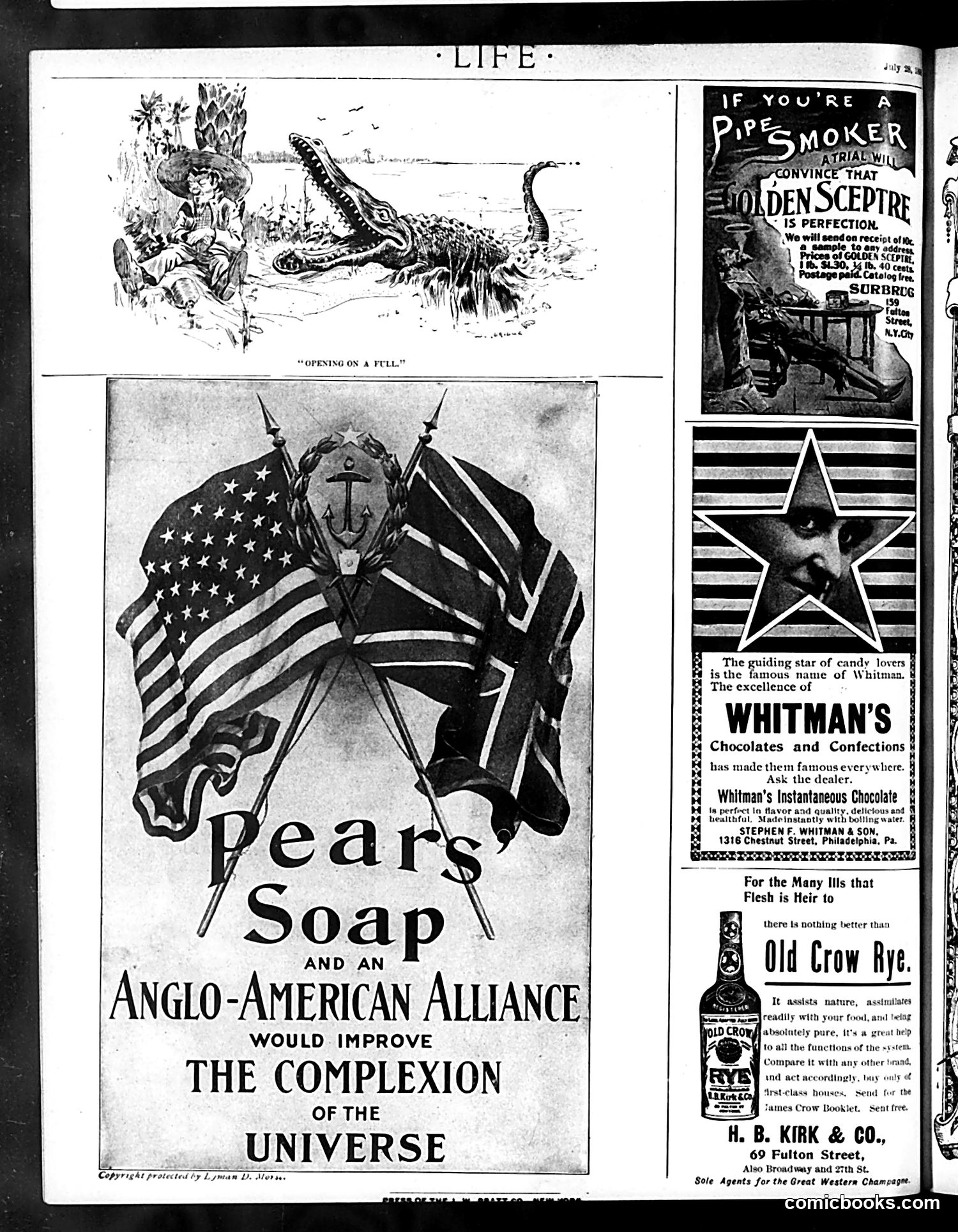
This **Life magazine satirical cartoon** mocks British-American diplomatic relations, likely from the early 1900s. The central image depicts a grotesque insect or demon-like creature bearing both the American flag and British Union Jack, labeled "Pears Soap and an Anglo-American Alliance Would Improve the Complexion of the Universe." **The satire works on multiple levels:** 1. **Political alliance criticism**: It ridicules proposed closer ties between America and Britain as absurd or cosmetically superficial—mere "soap" rhetoric masking deeper problems. 2. **The creature itself** represents the combined Anglo-American power, shown as monstrous rather than beneficial, suggesting the alliance would create something ugly. 3. **"Complexion of the Universe"** uses beauty/cleanliness metaphors to mock diplomatic language promising improvement through cooperation. The surrounding page contains period advertisements (chocolate, whiskey, soap) that reinforce Life's satirical juxtaposition: consumerist pitch alongside political critique.