
Life, 1898-07-28 · page 8 of 20
Life — July 28, 1898 — page 8: what you’re looking at
What you’re looking at
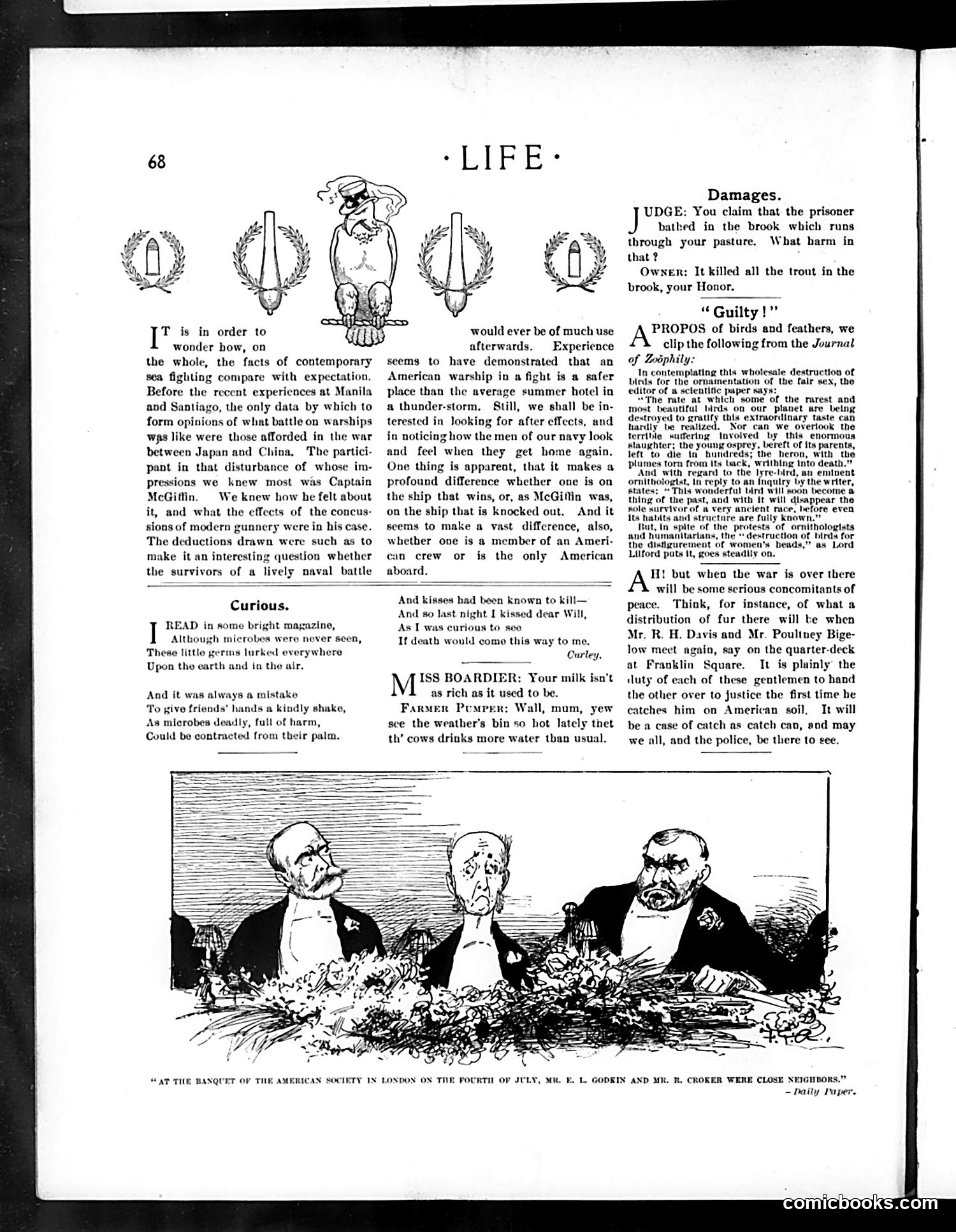
This *Life* magazine page satirizes American naval affairs and international relations, likely from the early 1900s based on the warship discussion. The main cartoon depicts three men at a banquet of the American Society in London on July 4th. The caption identifies them as Mr. E.L. Godkin and Mr. B. Croker (likely prominent American public figures of the era), shown as "close neighbors" at the table. The satire appears to mock these individuals' positions or rivalries within American society abroad. The exaggerated facial expressions suggest personal animosity or ideological conflict between them. The upper text discusses naval battles between Japan and China, examining whether American warships or crew performance determined combat outcomes—contemporary geopolitical commentary relevant to turn-of-the-century American interests in Asia.
📄 Transcribed text from this page (OCR, searchable)
Machine-transcribed from the original scan — historical spelling and the odd misread are preserved.
T is in order to wonder how, on the whole, the facts of contemporary sea fighting compare with expectation. Before the recent experiences at Manila and Santiago, the only data by which to form opinions of what battle on warships was like were those afforded in the war between Japan and China, The partici- pant in that disturbance of whose im- pressions we knew most was Captain McGitin. We knew how he felt about it, and what the effects of the concus- sions of modern gunnery were in his case. The deductions drawn were such as to make it an interesting question whether the survivors of a lively naval battle would ever be of much use afterwards. Experience seems to have demonstrated that an American warship io a fight is a safer place than the average summer hotel in a thunder-storm, Still, we shall be in- terested in looking for after effects, and in noticing how the men of our navy look and feel when they get home again. One thing is apparent, that it makes a profound difference whether one is on the ship that wins, or, as McGiflin was, on the ship that is knocked out. And it seems to make a vast difference, also, whether one is a member of an Ameri- can crew or is the only American aboard. Curious. READ in some bright magazine, Although microbes were never seen, These little germs lurked everywhere Upon the earth and in the air. And it was always a mistake To give friends’ hands a kindly shake, As microbes deadly, full of harm, Could be contracted from their palm. And kisses had been known to kill— And 80 last night I kissed dear Will, As I was curious to seo If death would come this way to me, Curley, ISS BOARDIER: Your milk isn't as rich as it used to be. Farmer Pemprer: Wall, mum, yew sce the weather's bin so hot lately thet th’ cows drinks more water than usual, “AT THE BANQUET OF THE AMERICAN SOCIETY IN LONDON ON THE POURTI OF JULY, MR. E. Damages. UDGE: You claim that the prisoner bathed in the brook which runs through your pasture. What barm in that ? ° Owner: It killed all the trout in the brook, your Honor. : ” “Guilty ! PROPOS of birds and feathers, we clip the following from the Journal of Zoophily: Tn contemplating thts wholesale destruction of birds for the ornamentation of the fair sex, the editor of a sctentific paper says: “The nite at which some of the rarest and most beautiful birds on our planet are being destroyed to gratify this extraordinary taste can hardiy be realized. Nor can we overtook the terrible sutfering Involved by this enormous slaughter; the young osprey, bereft of its parents, left to die tn hundreds; the heron, with the plumes torn from its back, writhing into death.” And with regard to the Iyre-bird, an eminent ornithotogtst, in reply to an inquiry by the writer, states: “This wouderful bird will soon become & thing of the past, and with It will disappear the sole survivor of very ancient nice, before even its habits and structare are fuily known.” But, in splte of the protests of ornithologists and humanitarians, the “destruction of birds for the dixtigurement of women's heads,” as Lord Lilford pats It, goes steadily o: H! but when the war is over there will be some serious concomitants of peace. Think, for instance, of what a distribution of fur there will be when Mr. R. H. Davis and Mr. Poultney Bige- low meet again, say on the quarter-deck at Franklin Square. It is plainly’ the «luty of each of these gentlemen to hand the other over to justice the first time he catches him on American soil, It will be a case of catch as catch can, and may we all, and the police, be there to see. L- GODIN AND MR. R. CROKER WERE CLOSE ¥! = Daity Paper.