
Life, 1898-07-28 · page 4 of 20
Life — July 28, 1898 — page 4: what you’re looking at
What you’re looking at
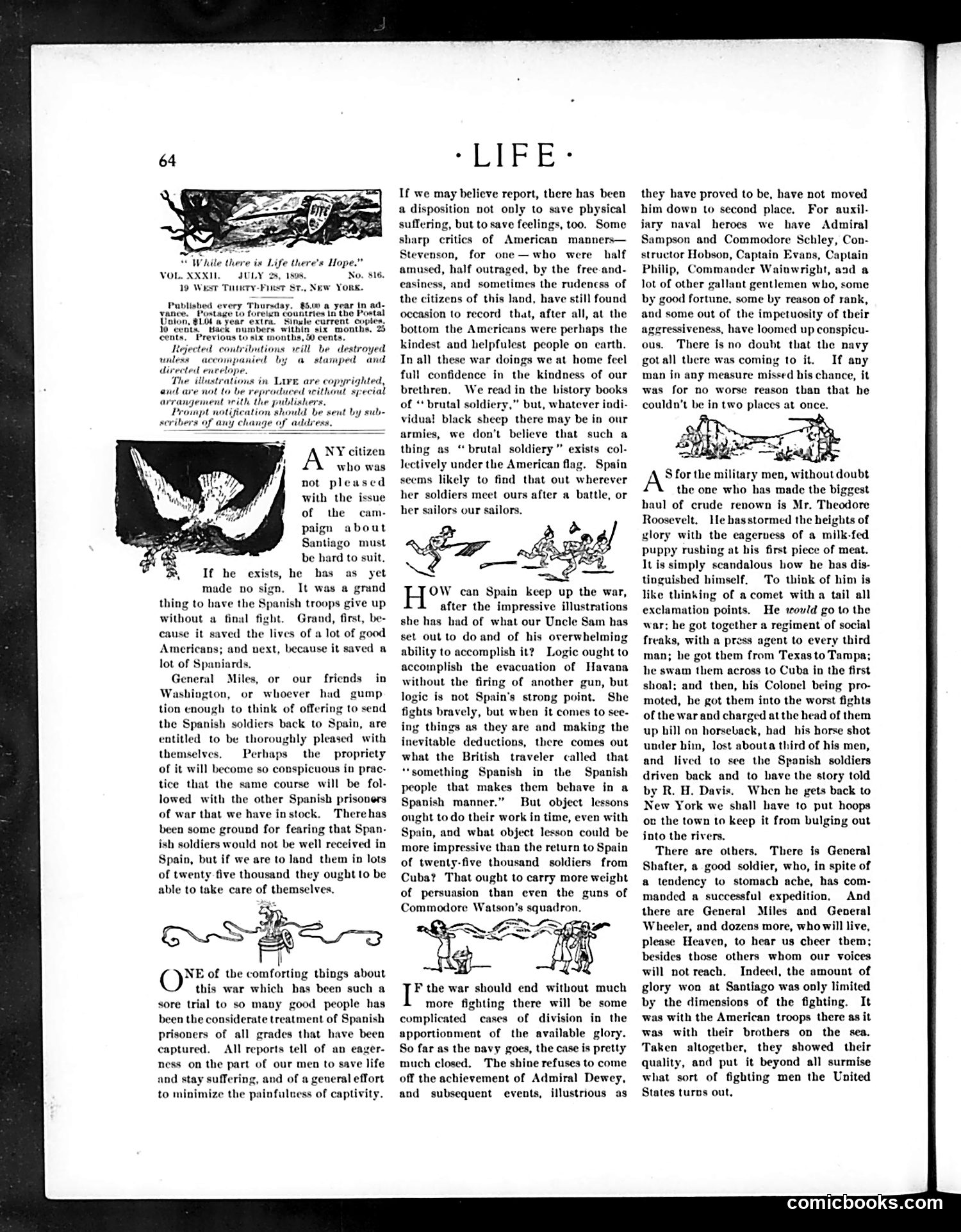
This editorial page discusses American military conduct during the Spanish-American War, specifically praising U.S. troops' treatment of Spanish prisoners and contrasting American "kindness" with Spanish behavior. The author argues Americans are "perhaps the kindest and helpfulest people on earth" and defends the character of American soldiers against accusations of brutality. The page includes several small decorative illustrations (soldiers, military scenes) rather than satirical political cartoons. The content is earnest commentary rather than satire, defending U.S. military honor and contrasting American versus Spanish conduct. References to "Santiago," "Cuba," "Havana," and named officers (Admiral Dewey, General Shafter) anchor this to the 1898 Spanish-American War context. The tone is propagandistic rather than satirical.
📄 Transcribed text from this page (OCR, searchable)
Machine-transcribed from the original scan — historical spelling and the odd misread are preserved.
there's Hope.” No. 816, Yors. st THIEY-FINsT SI Published every Thursday. $5.00 a year In ad- OF m countries in the Postal Previous to six months, 0 cents. ted contributions will be destroyed accompanied by a stamped and directed encelop The illustrations endl are not to be arr unless are copyrighted, d without special ement with the publisher: atification should be sent by sub- ny change of address, who was not pleased with the issue of the cam- paign about Santiago must be hard to suit. If he exists, he has as yet made no sign, It was a grind thing to have the Spanish troops give up without a final fight. Grand, first, be- cause it saved the lives of a lot of good Americans; and next, because it saved a lot of Span’ General Miles, or our friends in hington, or whoever had gump tion enough to think of offering to send the Spanish soldiers back to Spain, are entitled to be thoroughly pleased with themselves, Perhaps the _ propriety of it will become so conspicuous in prac- tice that the same course will be fol- lowed with the other Spanish prisoners of war that we have instock. Therehas been some ground for fearing that Span- ish soldiers would not be well received in Spain, but if we are to land them in lots of twenty five thousand they ought to be able to take care of themselves. l NE of the comforting things about this war which bas been such a sore trial to so many good people has been the considerate treatment of Spanish prisoners of all grades that have been captured. All reports tell of an eayer- ness on the part of our men to save life and stay suffering, and of a general effort to minimize the painfulvess of captivity. ‘LIFE* If we may believe report, there has been a disposition not only to save physical suffering, but to save feelings, too. Some arp critics of American manners— Stevenson, for one—who were half amused, half outraged, by the free-and- easiness, and sometimes the rudencss of the citizens of this land, have still found occasion to record that, after all, at the bottom the Americans were perhaps the kindest and helpfulest people on earth. In all these war doings we at home feel full confidence in the kindness of our brethren. We read in the history books of “brutal soldiery,” but, whatever indi- vidual black sheep there may be in our armies, we don’t believe that such a thing as “brutal soldiery” exists col- lectively under the American flag. Spain seems likely to find that out wherever her soldiers meet ours after a battle, or her sailors our sailors. Aart! Gh — Mf aE OW can Spain keep up the war, after the impressive illustrations she has bad of what our Uncle Sam has set out to doand of his overwhelming ability to accomplish it? Logic ought to accomplish the evacuation of Havana without the firing of another gun, but logic is not Spain's strong point. She fights bravely, but when it comes to see- ing things as they are and making the inevitable deductions, there comes out what the British traveler called that ‘something Spanish in the Spanish people that makes them behave in a Spanish manne: But object lessons ought to do their work in time, even with Spain, and what object lesson could be more impressive than the return to Spain of twenty-five thousand soldiers from Cuba? That ought to carry more weight of persuasion than even the guns of Commodore Watson’: p SSS F the war should end without much more fighting there will be some complicated cases of division in the apportionment of the available glory. So far as the navy goes, the case is pretty much closed. The shine refuses to come off the achievement of Admiral Dewey, and subsequent events, illustrious as they have proved to be, have not moved him down to second place. For auxil- iary naval heroes we have Admiral Sampson and Commodore Schley, Con- structor Hobson, Captain Evans, Captain Philip, Commander Wainwright, and a lot of other gallant gentlemen who, some by good fortune, some by reason of rank, and some out of the impetuosity of their aggressiveness, have loomed up conspicu- ous. There isno doubt that the navy gotall there was coming to it. If any man in any measure miseed his chance, it was for no worse reason than that he couldn’t be in two places at once. S$ for the military men, without doubt the one who has made the biggest haul of crude renown is Mr. Theodore Roosevelt. He has stormed the heights of glory with the eagerness of a milk-fed puppy rushing at his first piece of meat, It is simply scandalous how he has dis- tinguished himself. To think of him is like thinking of a comet with a tail all exclamation points. He would go to the war; he got together a regiment of social freaks, with a press agent to every third man; he got them from Texas to Tampa; he swam them across to Cuba in the first shoal; and then, bis Colonel being pro- moted, he got them into the worst fights of the war and charged at the head of them up bill on horseback, had his horse shot under hii, lost abouta third of his men, and lived to see the Spanish soldiers driven back and to have the story told by R. H. Davis. When he gets back to New York we shall have to put hoops ov the town to keep it from bulging out into the rivers. There are others, There is General Shafter, a good soldier, who, in spite of a tendency to stomach ache, has com- manded a successful expedition, And there are General Miles and General Wheeler, and dozens more, who will live, please Heaven, to hear us cheer them; besides those others whom our voices will not reach. Indeed, the amount of glory won at Santiago was only limited by the dimensions of the fighting. It was with the American troops there as it was with their brothers on the sea. Taken altogether, they showed their quality, and put it beyond all surmise what sort of fighting men the United States turns out, comicbooks.com