
Life, 1898-07-28 · page 13 of 20
Life — July 28, 1898 — page 13: what you’re looking at
What you’re looking at
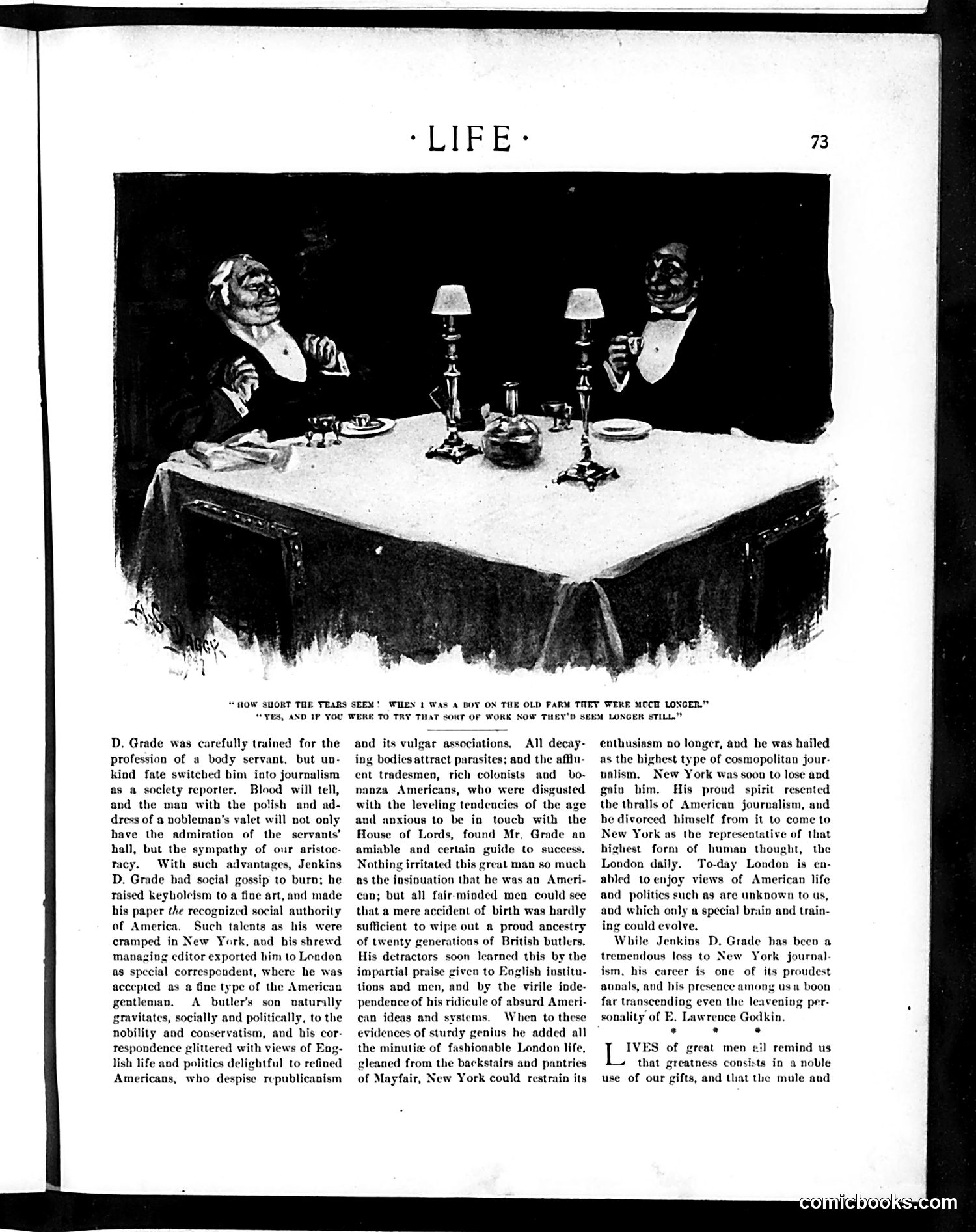
This Life magazine piece satirizes **Jenkins D. Grade**, a character representing American journalists who abandon republican values to court European aristocracy. The cartoon depicts two caricatured men dining formally, apparently reminiscing about farm life—the caption's nostalgic tone contrasts sharply with their refined setting, suggesting hypocrisy. The text reveals the satire's target: Grade was a butler's son trained as a servant who became a society reporter, then a correspondent in London. He achieved prominence by flattering wealthy Americans' Anglophilia and disdain for democracy's "leveling tendencies." The piece mocks his pretense—he denies being American while trafficking in London gossip gleaned from "backstairs and pantries." The satire attacks both Grade's class-climbing and the American elite's susceptibility to his snobbery. By praising him as the "highest type of cosmopolitan journalism," Life exposes how easily the wealthy abandon republican ideals for aristocratic affectation.
📄 Transcribed text from this page (OCR, searchable)
Machine-transcribed from the original scan — historical spelling and the odd misread are preserved.
“OW SUORT THE TEARS SEEM! WHEN 1 WAS A BOY ON THE OLD PARM THEY WERE MCCT LONGER” YES, AND IP YOU WERE TO TRY THAT SOUT OF WORK NOW THEY'D SI D. Grade was carefully trained for the profession of a body servant, but un- kind fate switched him into journalism as a society reporter. Blood will tell, and the man with the polish and ad- dress of a nobleman’s valet will not only have the admiration of the servants’ hall, but the sympathy of our aristoc- racy. With such advantages, Jenkins D. Grade had social gossip to burn; he raised keyholcism to a fine art, and made his paper the recognized social authority of America. Such talents as his were cramped in New York, avd bis shrewd managing editor exported him to London as special correspondent, where he was accepted as a fine type of the American gentleman, A butler’s son naturally gravitates, socially and politically, to the nobility and conservatism, and his cor- respondence glittered with views of Eng- lish life and politics delightful to refined Americans, who despise republicanism and its vulgar associations. All decay- ing bodies attract parasites; and the afflu- ent tradesmen, rich colonists and bo- nanza Americans, who were disgusted with the leveling tendencies of the ag and anxious to be in touch with the House of Lords, found Mr. Grade an amiable and certain guide to success. Nothing irritated this great man so much as the insinuation that he was an Ameri- can; but all fair-minded men could see that a mere accident of birth was hardly sufficient to wipe out a proud ancestry of twenty generations of British butlers. His detractors soon learned this by the impartial praise given to English institu- tions and men, and by the virile inde- pendence of his ridicule of absurd Ameri- can ideas and systems. When to these evidences of sturdy genius he added all the minutie of fashionable London life, gleaned from the backstairs and pantries of Mayfair, New York could restrain its LONGER STILL.” enthusiasm no longer, aud he was hailed as the highest type of cosmopolitan jour- nalism, New York was soon to lose and gain him. His proud. spirit resented the thralls of American journalism, and he divorced himself from it to come to New York as the representative of that highest form of human thought, the London daily. To-day London is en- abled to enjoy views of American life and politics such as are unknown to us, and which only a special brain and train- ing could evolve. While Jenkins D. Grade has been a tremendous loss to New York journal- ism, his career is one of its proudest annals, and his presence among us a boon far transcending even the leavening per- sonality of E. Lawrence Godkin. * * . IVES of great men ei] remind us that greatness consists in a noble use of our gifts, and that the mule and