
A complete issue · 20 pages · 1898
Life — July 14, 1898
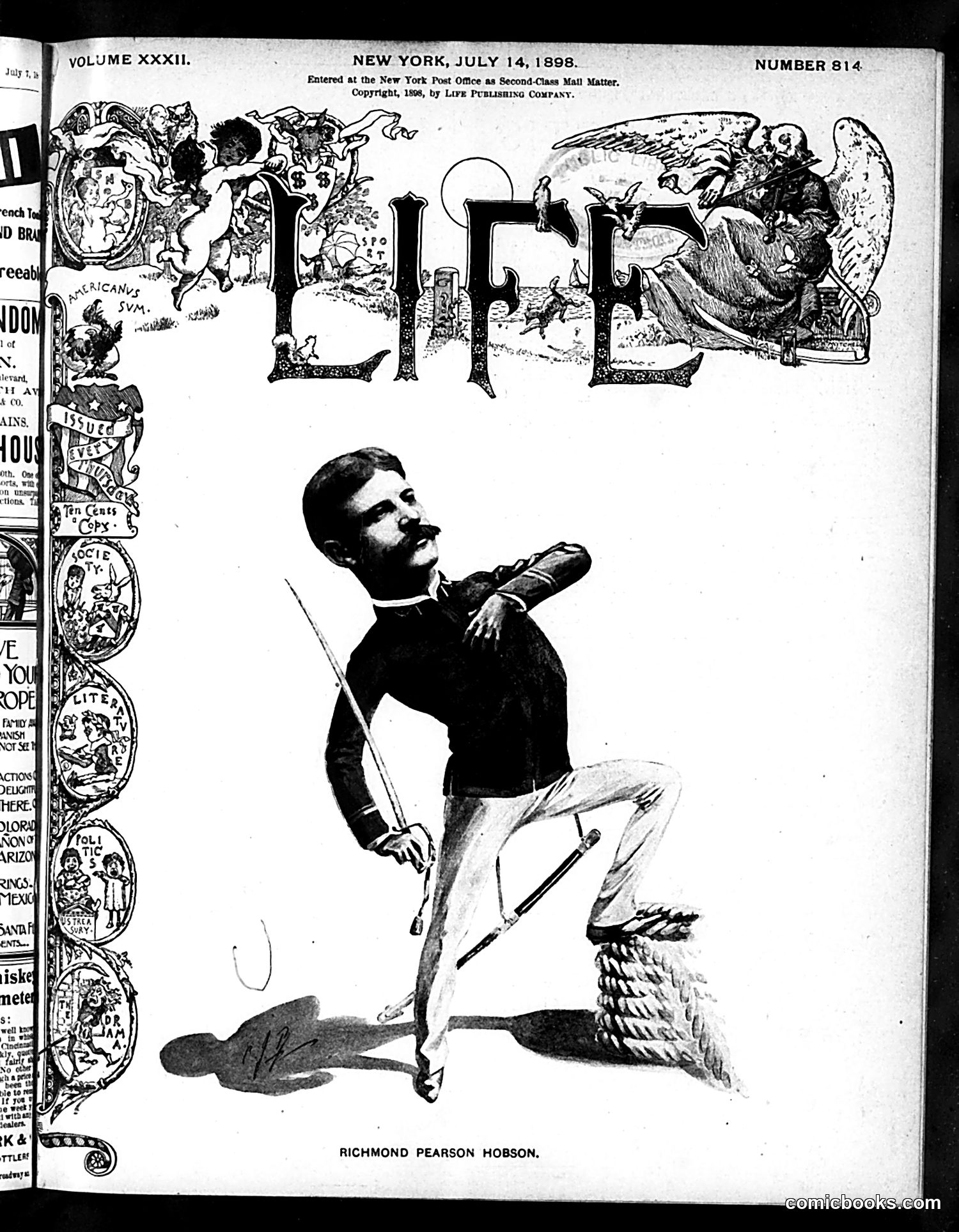
This is the cover of Life magazine featuring a caricature labeled "Richmond Pearson Hobson." The elaborate decorative header with allegorical figures suggests this is the main feature article. Hobson was a U.S. Navy officer who became a national celebrity in 1898 during the Spanish-American War, particularly after a daring naval action. The dramatic pose—wielding a sword while straddling what appears to be a ship or naval vessel—emphasizes his military heroism and adventurous character. The satirical treatment in Life's ornate, theatrical style likely both celebrates and gently mocks the intense public adoration Hobson received. The exaggerated artistic presentation reflects how he was elevated to celebrity status by American media and the public during this period of American imperial expansion.
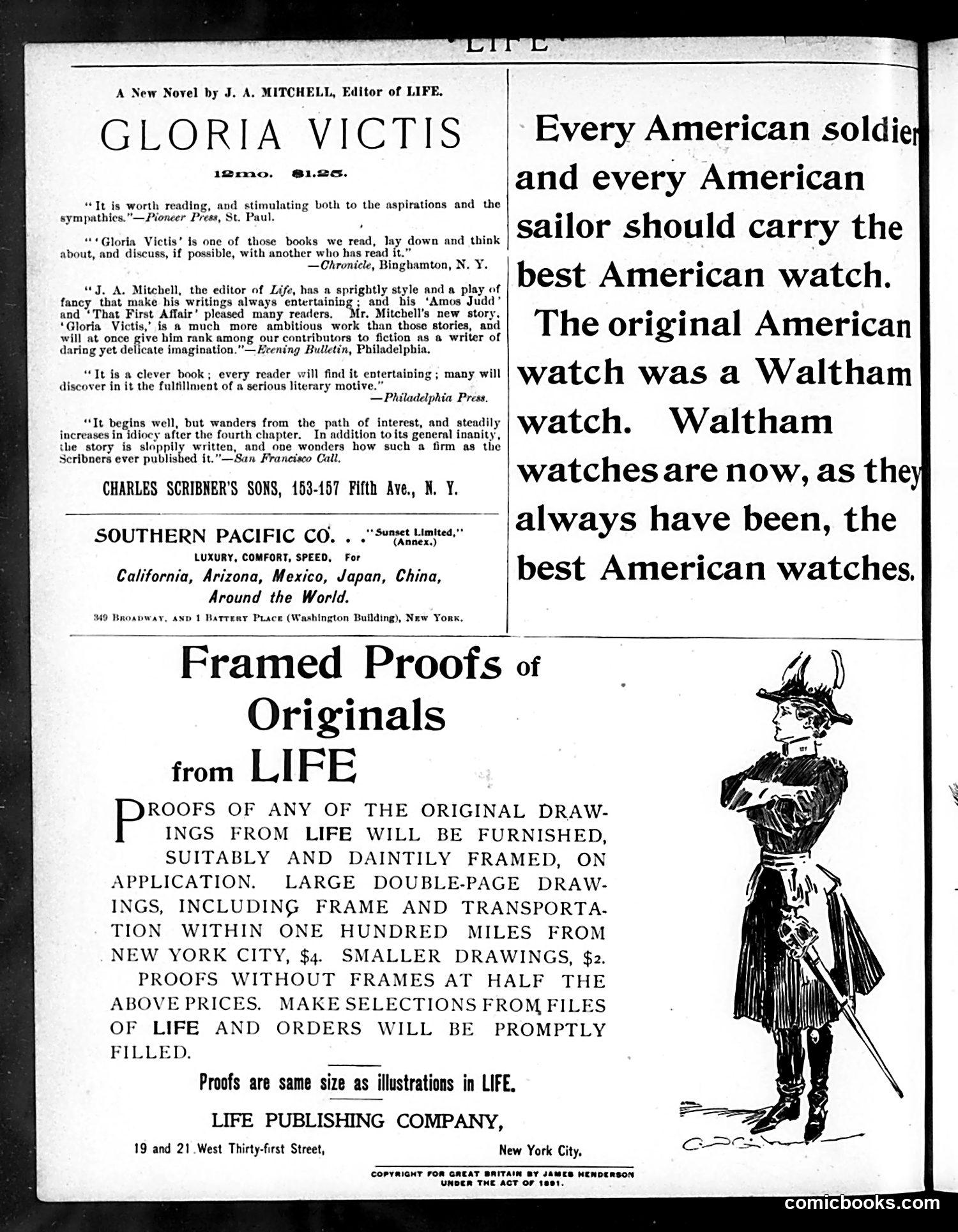
This page is primarily **advertising rather than satire**. It contains three distinct ads: 1. **"Gloria Victis"** — A novel by J.A. Mitchell (Life's editor), with positive reviews praising its literary merit and entertainment value. 2. **Waltham Watch advertisement** — A patriotic appeal stating American soldiers and sailors should carry Waltham watches, claiming they are "the best American watches." This appears to leverage WWI-era nationalism and military service. 3. **Framed Proofs service** — Life Publishing Company offers to frame original artwork from Life magazine for customers. The right side features an illustration of a fashionably dressed woman in Edwardian attire, likely decorative rather than satirical. Overall, this is a typical early-20th-century magazine page blending editorial content with commercial advertisements.
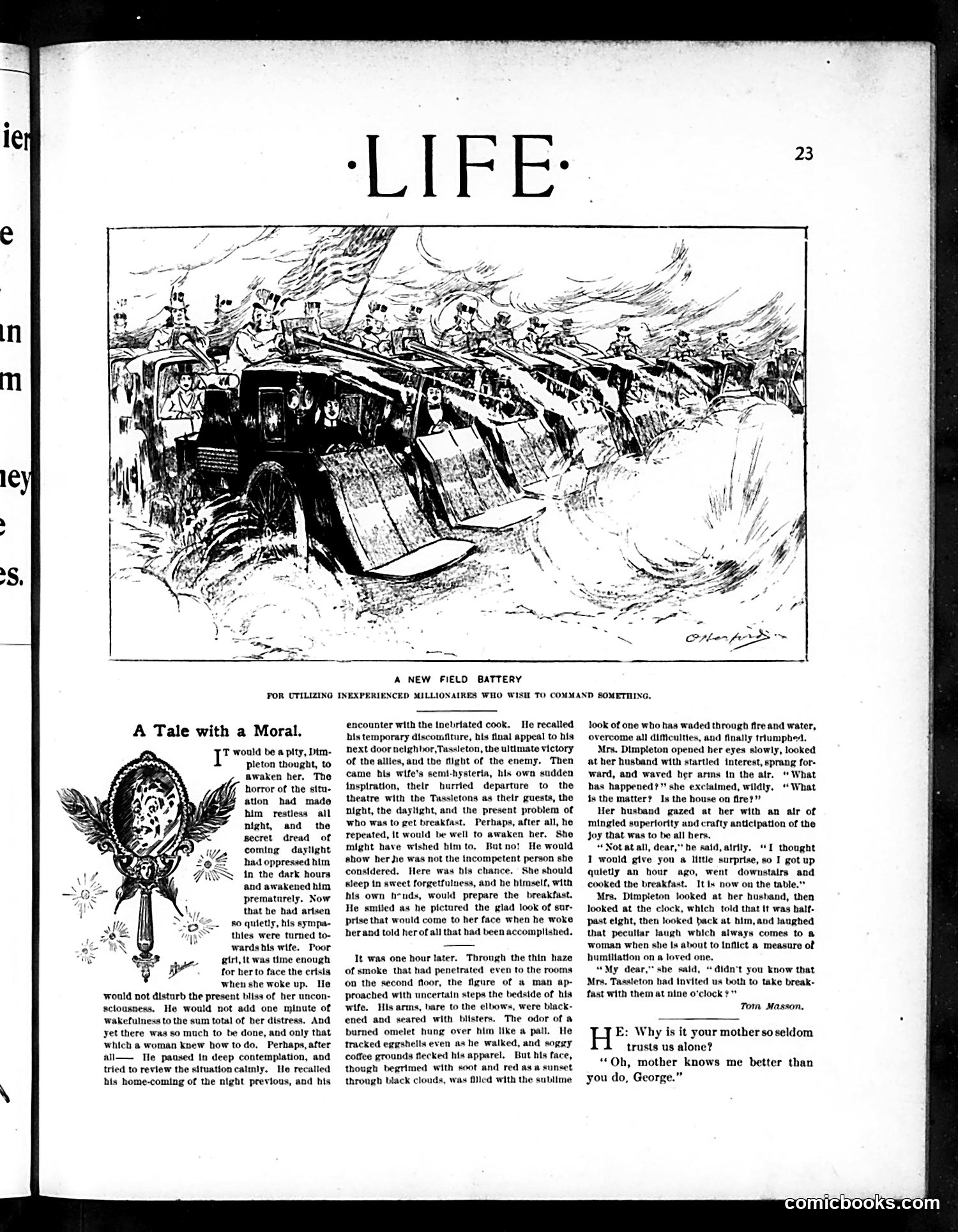
**Main Illustration**: "A New Field Battery for Utilizing Inexperienced Millionaires Who Wish to Command Something" depicts wealthy civilians operating an absurd military contraption—essentially a cannon or artillery piece. The satire mocks rich amateurs who desire military authority without competence. **"A Tale with a Moral"**: This short story concerns a husband's domestic conflict. His wife's hysteria during wartime causes him to reconsider her worth. The narrative emphasizes masculine superiority and female irrationality—common period attitudes. The closing dialogue ("Oh, mother knows me better than you do, George") reinforces gendered stereotypes about women's judgment. **Context**: Both pieces reflect early 20th-century attitudes toward wealth, military service, gender roles, and social hierarchy, using humor to critique and reinforce contemporary class and gender assumptions.
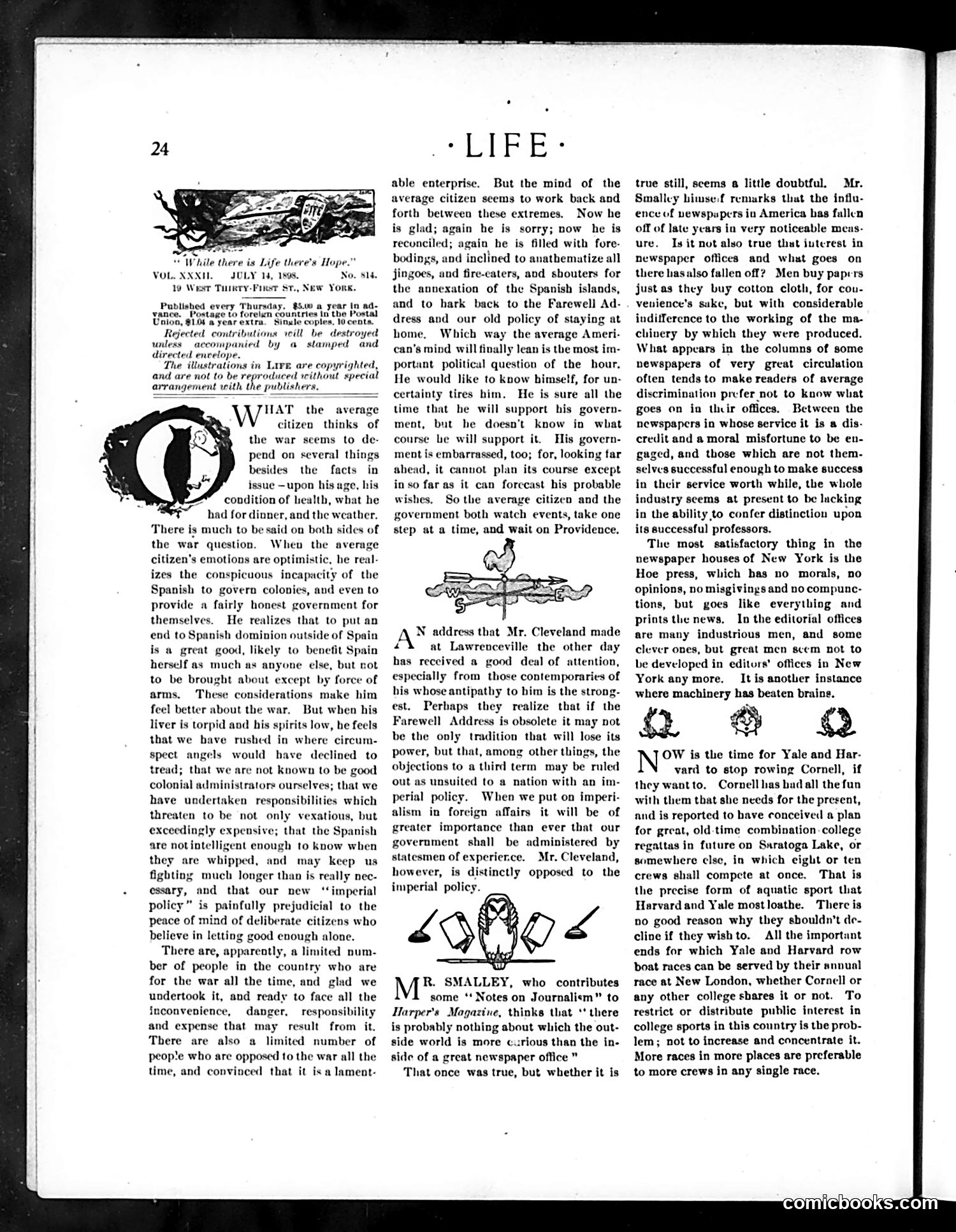
This page contains political commentary rather than cartoons. The main text discusses average American citizens' uncertainty about government policy, particularly regarding Spanish colonial administration and imperialism. A section references President Cleveland's Lawrenceville address, debating whether a "Farewell Address" on imperial policy remains relevant or is now outdated. The text criticizes newspaper offices for lacking moral conviction, praising the Hoe printing press as exceptionally principled—likely ironic commentary on press ethics. Finally, the piece discusses Yale and Harvard rowing competitions, arguing these colleges should prioritize public interest over athletic rivalry, preferring multiple races at different venues rather than concentrated competition. The overall tone is satirical commentary on American political ambivalence, media integrity, and institutional priorities circa the 1890s-1900s.
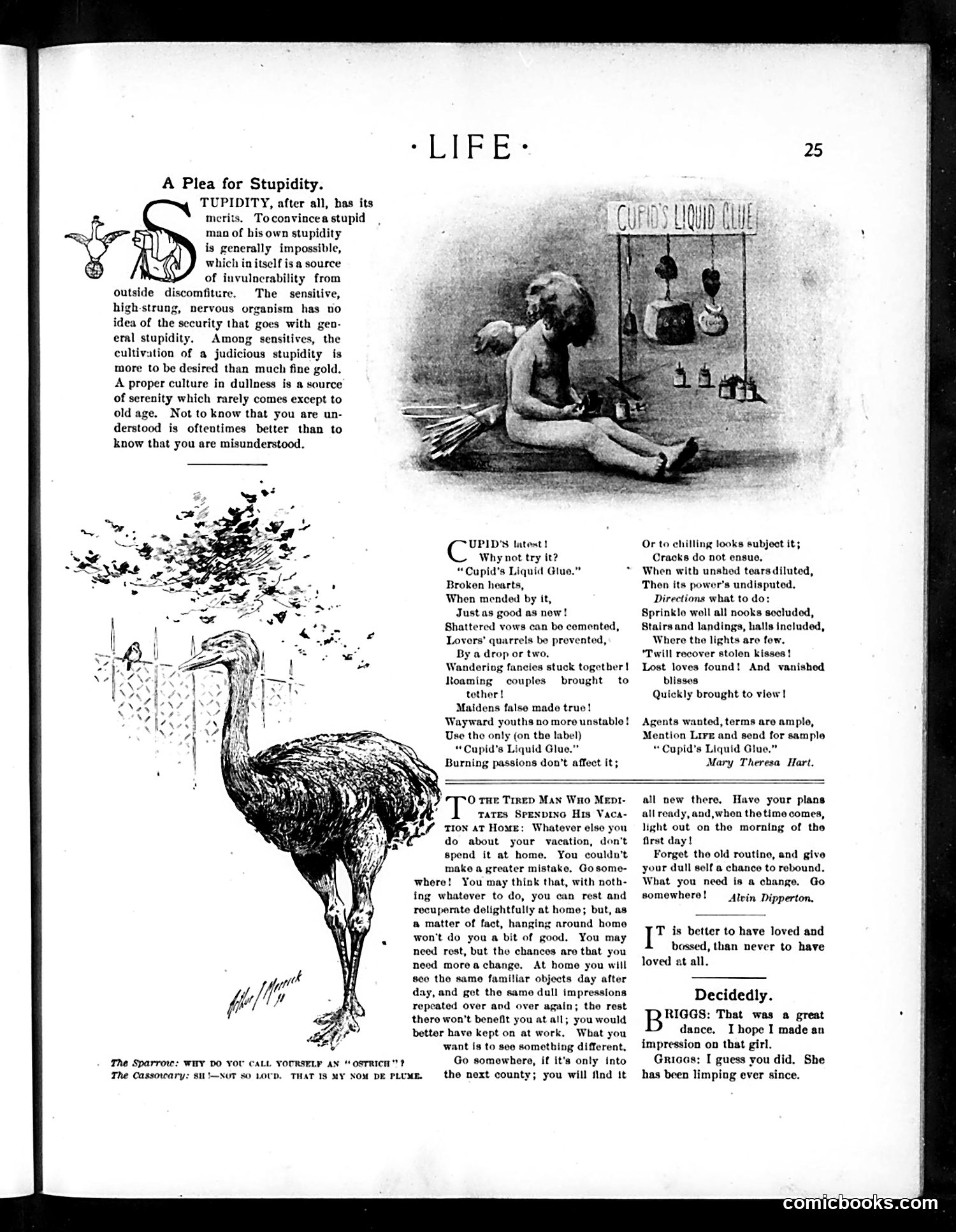
This page contains several satirical pieces rather than a single unified cartoon: **"A Plea for Stupidity"** argues that cultivated ignorance provides security and serenity unavailable to sensitive, intelligent people—a tongue-in-cheek defense of blissful obliviousness. **The ostrich cartoon** (captioned about calling yourself an "ostrich") uses the bird as a metaphor for willful ignorance or avoidance of reality. **"Cupid's Liquid Glue"** advertises a fictional adhesive product through humorous verse, playing on the notion that romantic commitment "glues" people together. The remaining brief items are conversational humor and social commentary: advice to vacation travelers, a quip about a disastrous dance, and observations about love and blessedness. The overall theme celebrates deliberate ignorance and avoidance as paths to happiness—typical of Life's satirical social commentary.
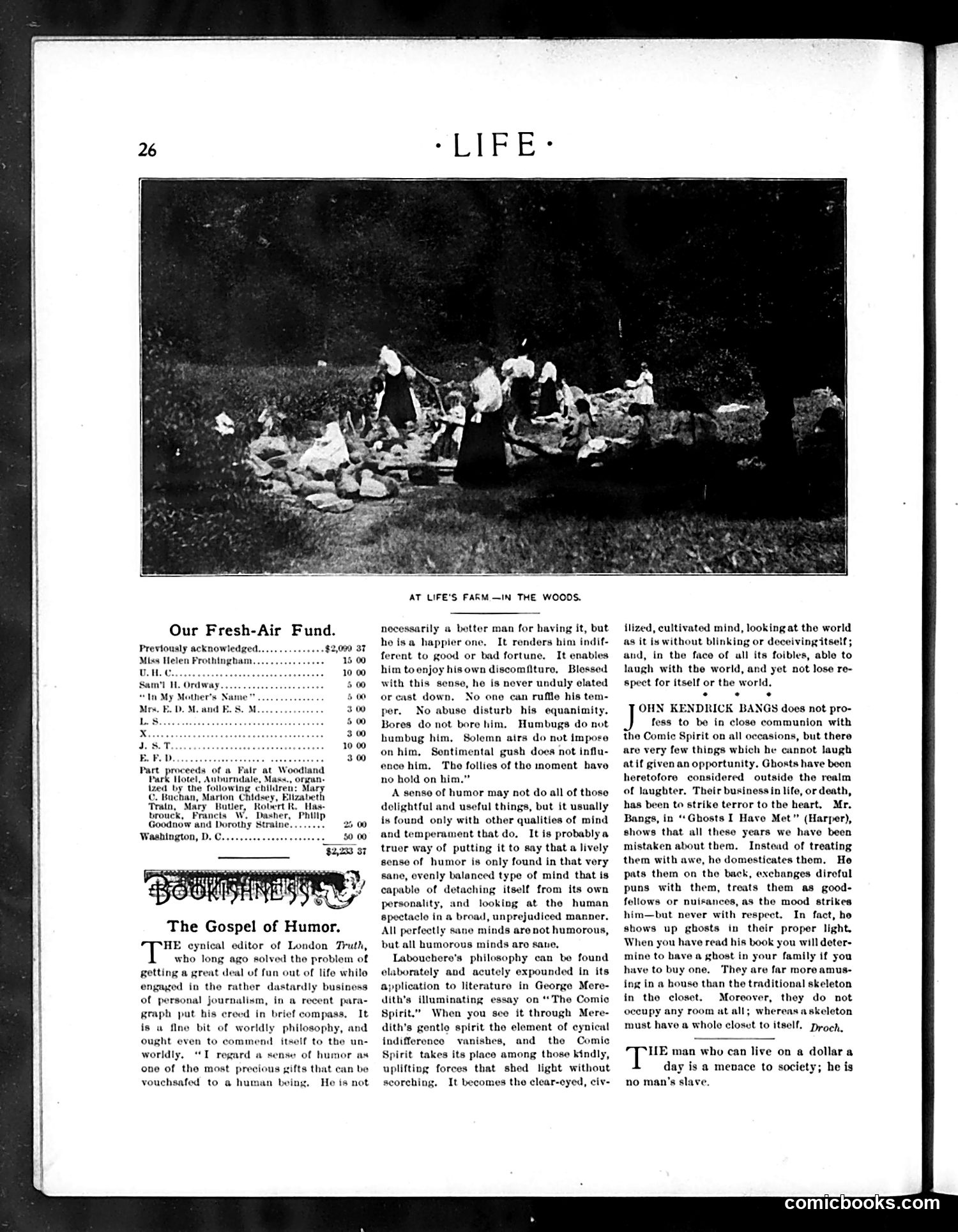
This page contains two distinct sections: **Top Image:** A black-and-white photograph captioned "AT LIFE'S FARM—IN THE WOODS" shows a group of people gathered outdoors, apparently at a social gathering or picnic. **"Our Fresh-Air Fund":** A fundraising list acknowledging donations (ranging from $2,700.37 down to smaller amounts) for what appears to be a charitable initiative providing outdoor recreation access. **"The Gospel of Humor":** The main article discusses humor's philosophical and social value, arguing that a balanced, detached sense of humor is a mark of mental health and wisdom. It references George Meredith's essay "On the Comic Spirit" and suggests that humor helps people maintain perspective on life's troubles. The page emphasizes humor as beneficial to individual character and society—a characteristic Life magazine frequently promoted during this period as wholesome American values.
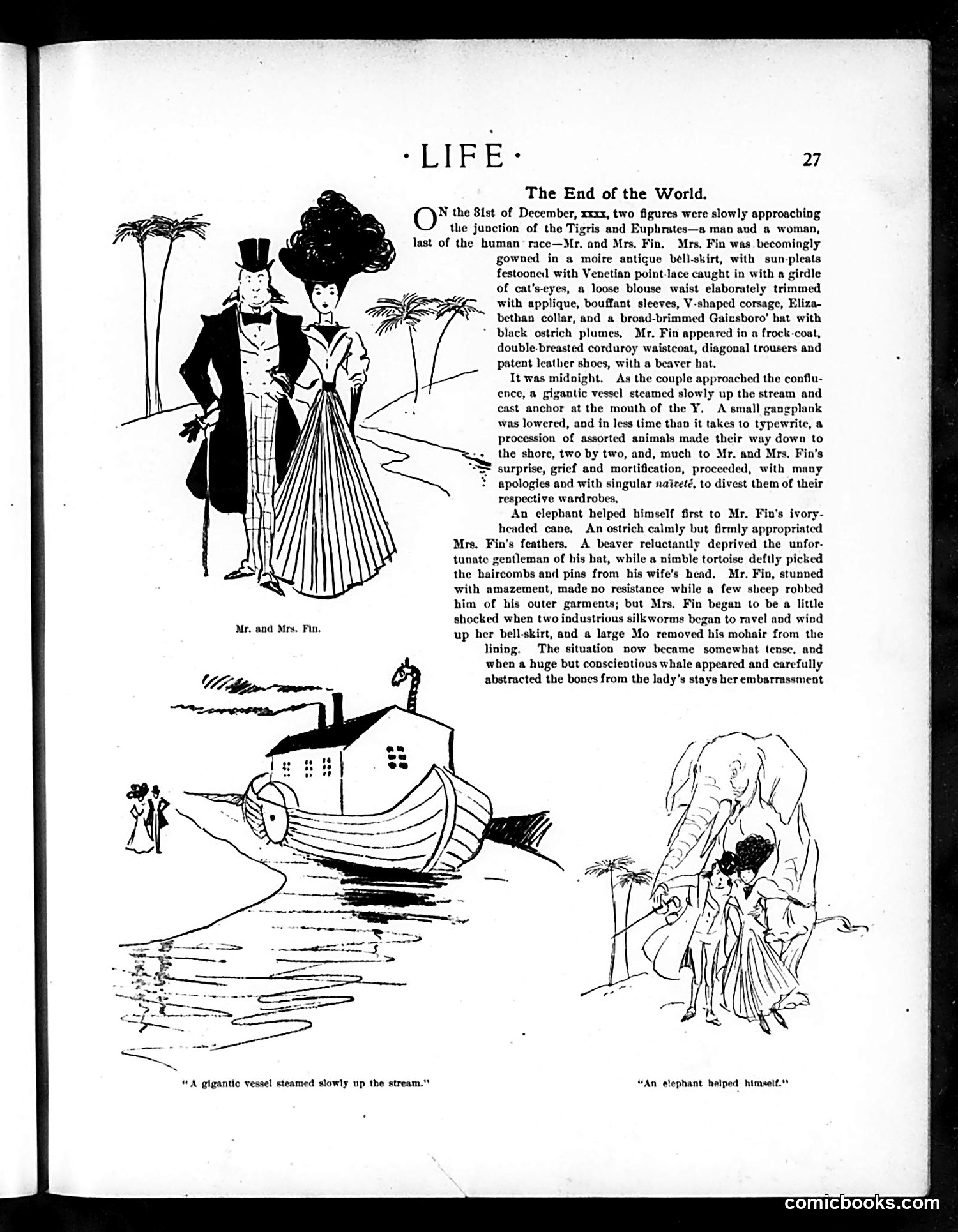
This is a humorous short story illustrated with satirical drawings. The narrative describes Mr. and Mrs. Fin arriving at the junction of the Tigris and Euphrates rivers on December 31st, apparently at world's end. The satire appears to mock fashionable Edwardian-era society: Mrs. Fin is dressed in exaggerated high fashion (bell-skirt, ostrich plumes, Gainsborough hat), while Mr. Fin sports formal wear. The humor derives from their concern with preserving wardrobe dignity even as exotic animals (elephant, whale, beaver, silkworms, sheep, tortoise) disembark from a vessel, creating chaos. The joke critiques the vanity of wealthy society—maintaining decorum and proper dress remains paramount even during apocalyptic circumstance. The animals' indifference to their fashionable distress underscores the absurdity.
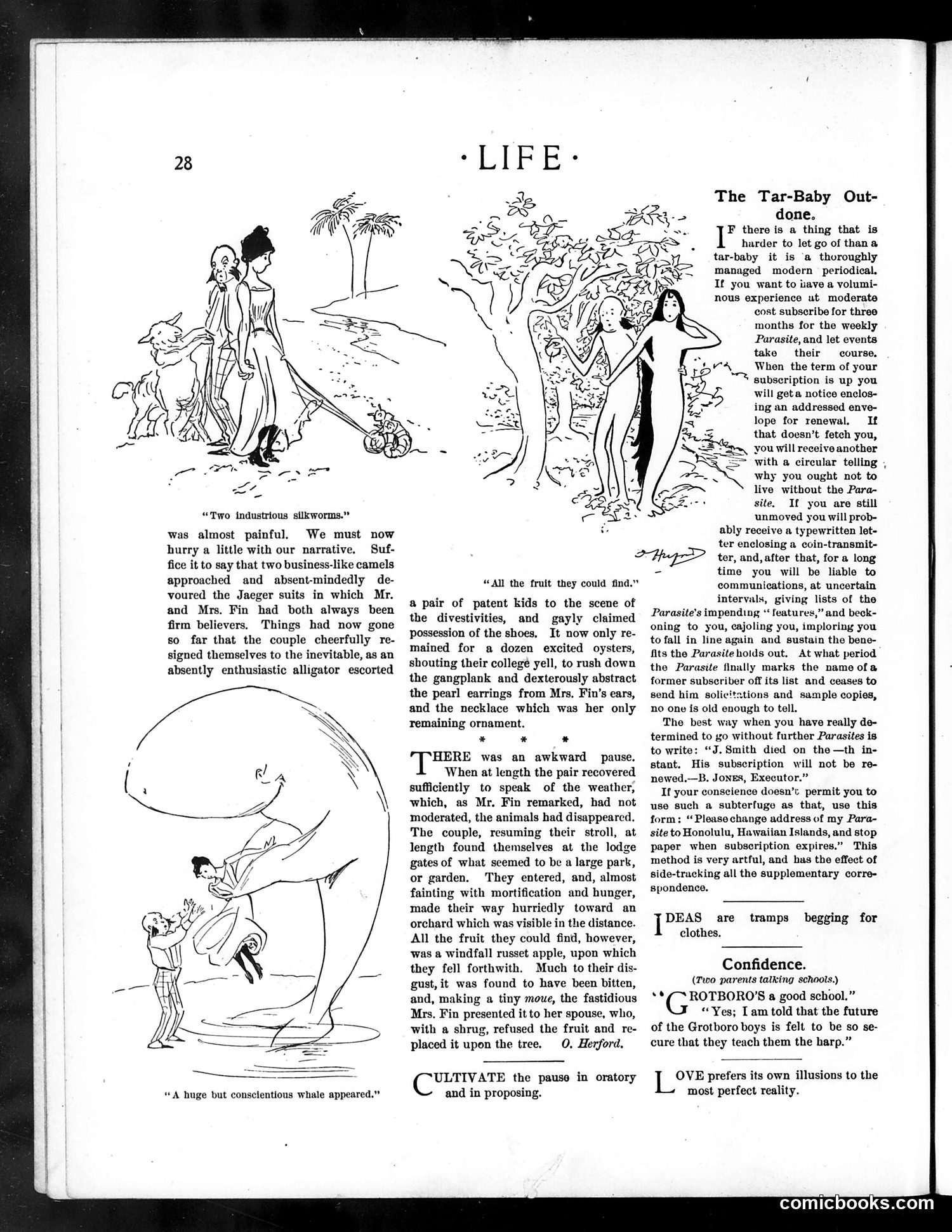
This page contains humorous illustrations and text about parasites—both literal and figurative. The top cartoons depict people encountering unwanted creatures: one shows a couple with children confronted by camels, another shows people discovering fruit and a whale. The main article, "The Tar-Baby Outdone," satirizes the *Parasite* magazine subscription. It mocks subscribers who receive renewal notices with circular reasoning about why they "ought not to live without" the publication. The satire suggests the magazine itself is parasitic—extracting money from subscribers through persistent, guilt-inducing renewal tactics. The smaller pieces below joke about social pretensions and self-deception—typical Life magazine fare mocking middle-class vanity and hypocrisy. The overall theme: unwanted dependencies, both biological and commercial.
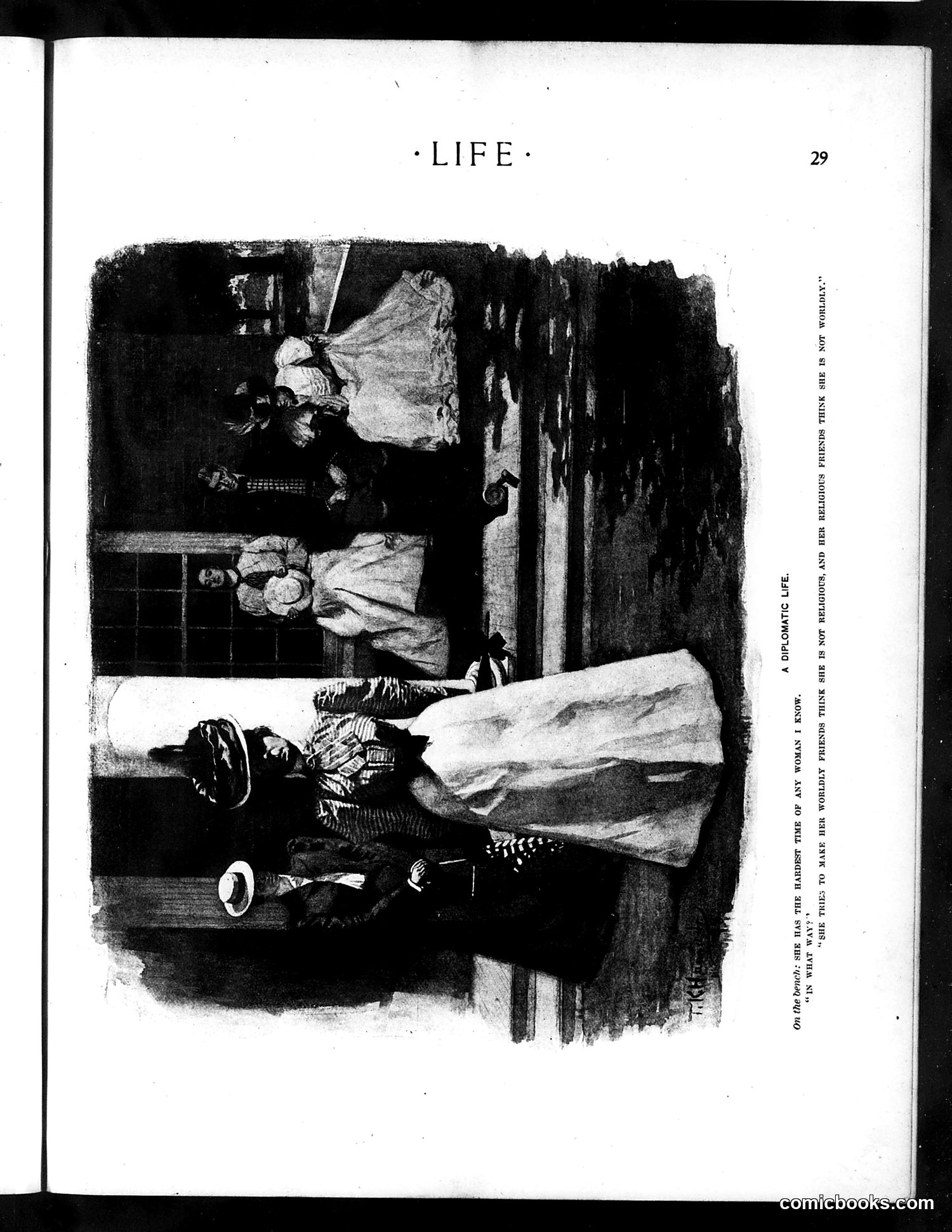
This page from *Life* magazine (page 29) contains a single illustration titled "A DRAMATIC LIFE" showing two figures in what appears to be an interior domestic scene. The image is rotated 90 degrees, requiring viewers to turn the page sideways to view it properly. The caption indicates this depicts a dramatic domestic moment, though the specific historical reference is unclear from the visible text alone. The illustration uses bold black ink in *Life's* characteristic satirical style. Without additional context about the publication date or clearer identification of the figures depicted, I cannot definitively identify which specific social or political situation this cartoon satirizes or what particular incident it references.
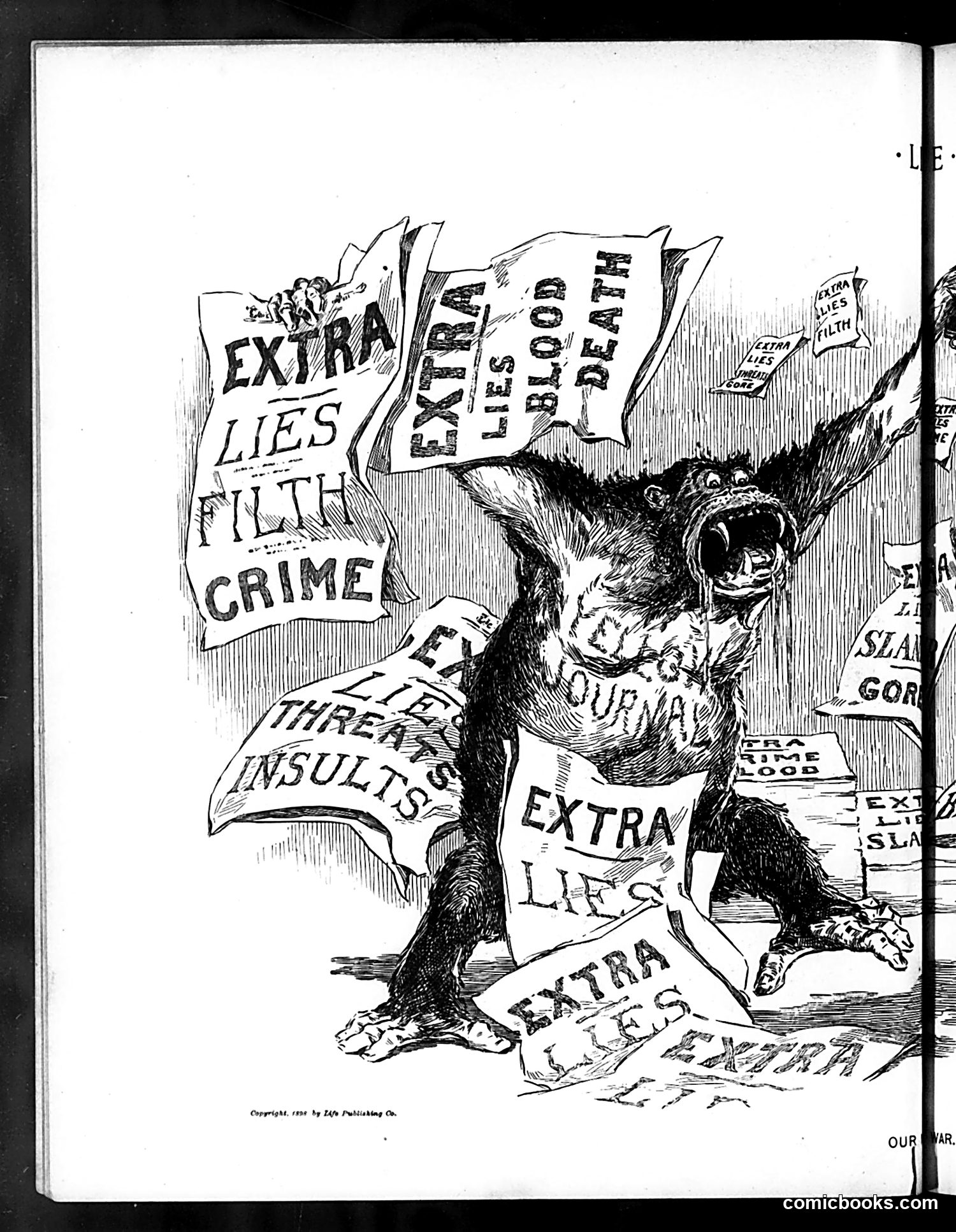
This is a satirical cartoon depicting a creature (likely representing the press or yellow journalism) wielding multiple newspapers/publications labeled "EXTRA," "LIES," "FILTH," "CRIME," "THREAT," "INSULTS," and "SLANDER." The beast appears monstrous and aggressive, wielding these publications as weapons. The satire targets **sensationalist newspaper journalism**—particularly "yellow journalism" practices of the era. The cartoon criticizes newspapers for spreading exaggerated or false stories focused on crime, scandal, and inflammatory content to boost sales and provoke public reaction rather than report truth. The repetition of "EXTRA" (denoting special editions) emphasizes how papers profited from sensationalism. This reflects genuine Progressive-era concerns about irresponsible press practices and their social impact.
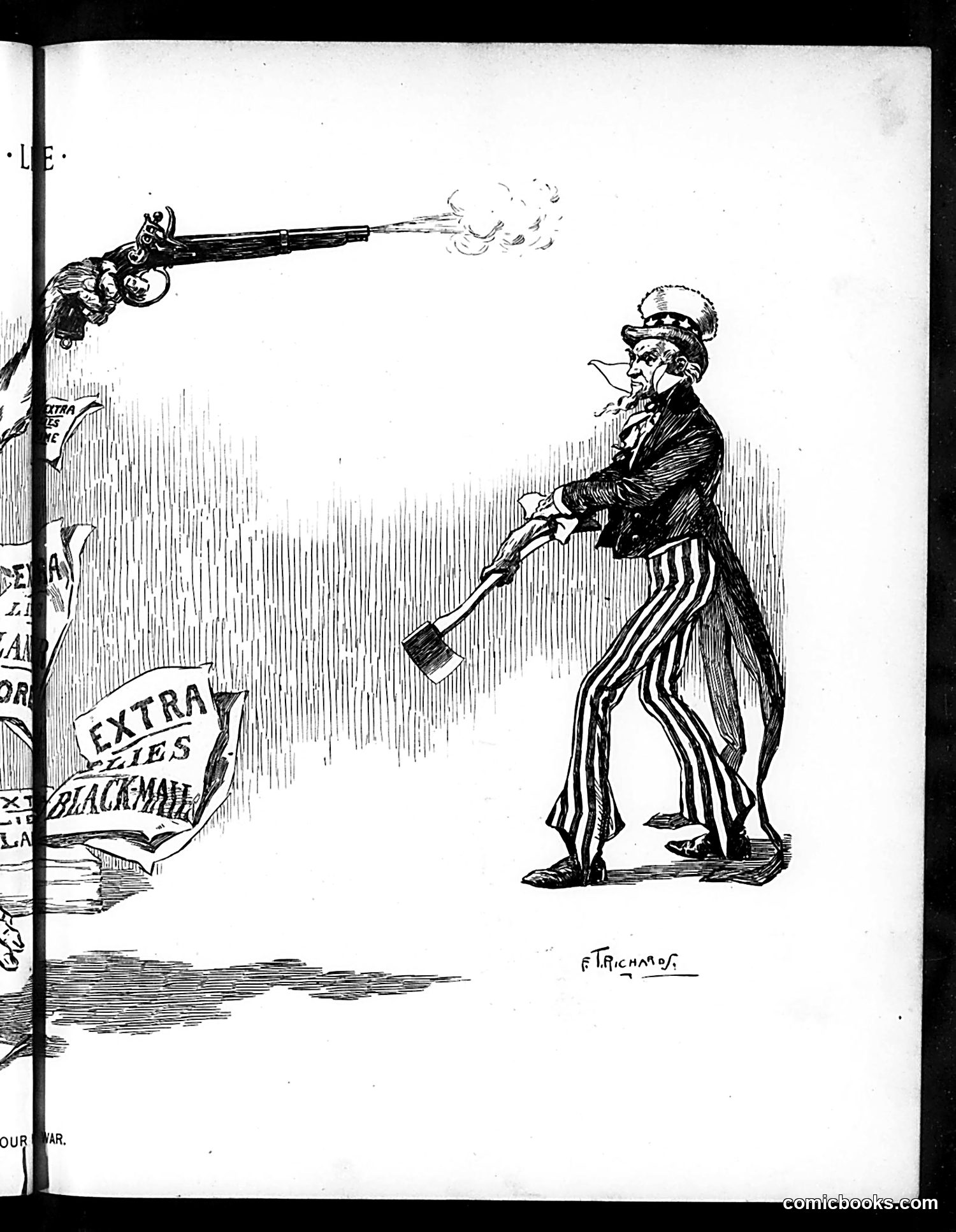
This political cartoon depicts Uncle Sam (the figure in the starred top hat and striped pants) holding a shovel, facing gunfire from the left side of the page. The visible text fragment "EXTRA CZIES BLACKMAIL" suggests this relates to extortion or threats. The cartoon appears to criticize American vulnerability to foreign pressure or coercion during a period of international tension. Uncle Sam's defensive posture with a shovel—a tool, not a weapon—suggests America is unprepared or outmatched against hostile forces employing firearms. The artist's signature reads "Flagmarodi" (or similar). Without the full page context and date, the specific historical event referenced remains unclear, though the imagery suggests concerns about American military readiness or diplomatic weakness facing foreign threats.
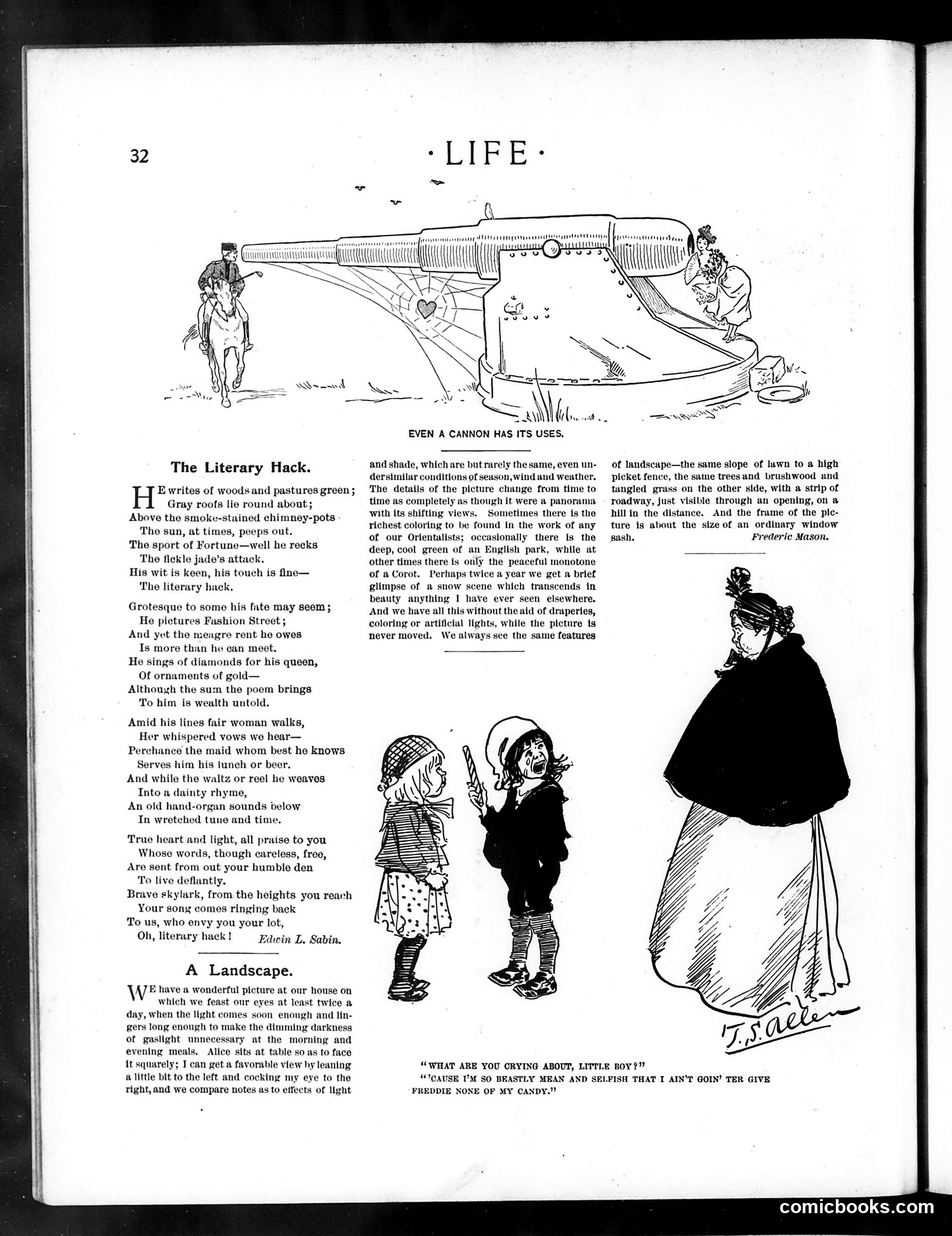
This page contains literary content and illustrations rather than political satire. "The Literary Hack" is a poem mocking hack writers who produce formulaic romantic verses about idealized pastoral scenes and urban romance. It satirizes clichéd imagery—"fair woman walks," "whispered vows," "dainty rhyme"—typical of mediocre Victorian-era poetry. The bottom illustration by T.S. Sullivant shows two children, with dialogue: "What are you crying about, little boy?" / "Cause I'm so beastly mean and selfish that I ain't doin' yer give perdue nose of my candy." This gently satirizes children's sentimentality in literature. "A Landscape" discusses how natural light transforms domestic scenes. The page critiques overwrought literary conventions rather than political issues.
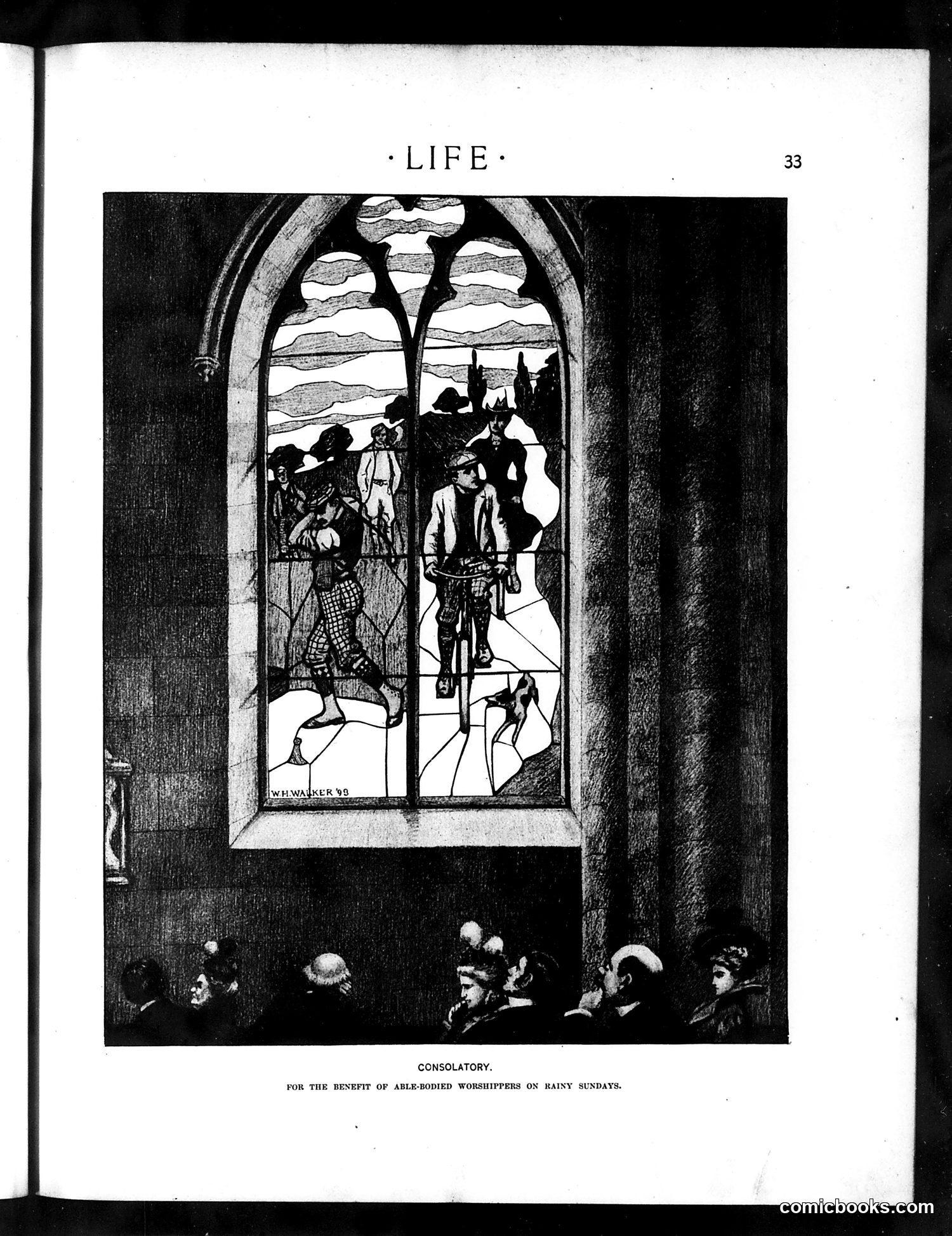
This satirical cartoon depicts a medieval church window through which worshippers can view outdoor activities instead of attending services. The window shows cyclists, hikers, and other recreational figures enjoying themselves in pleasant weather visible beyond the glass. The caption "Consolatory" with the subtitle "For the Benefit of Able-Bodied Worshippers on Rainy Sundays" uses irony to mock people who skip church. The joke appears to be that even rain shouldn't tempt physically capable people away from worship—yet the elaborate window display of outdoor pursuits seems designed as a tempting alternative. This satirizes both the excuses people make to avoid church and perhaps the tension between religious obligation and leisure activities that characterized early 20th-century American life.
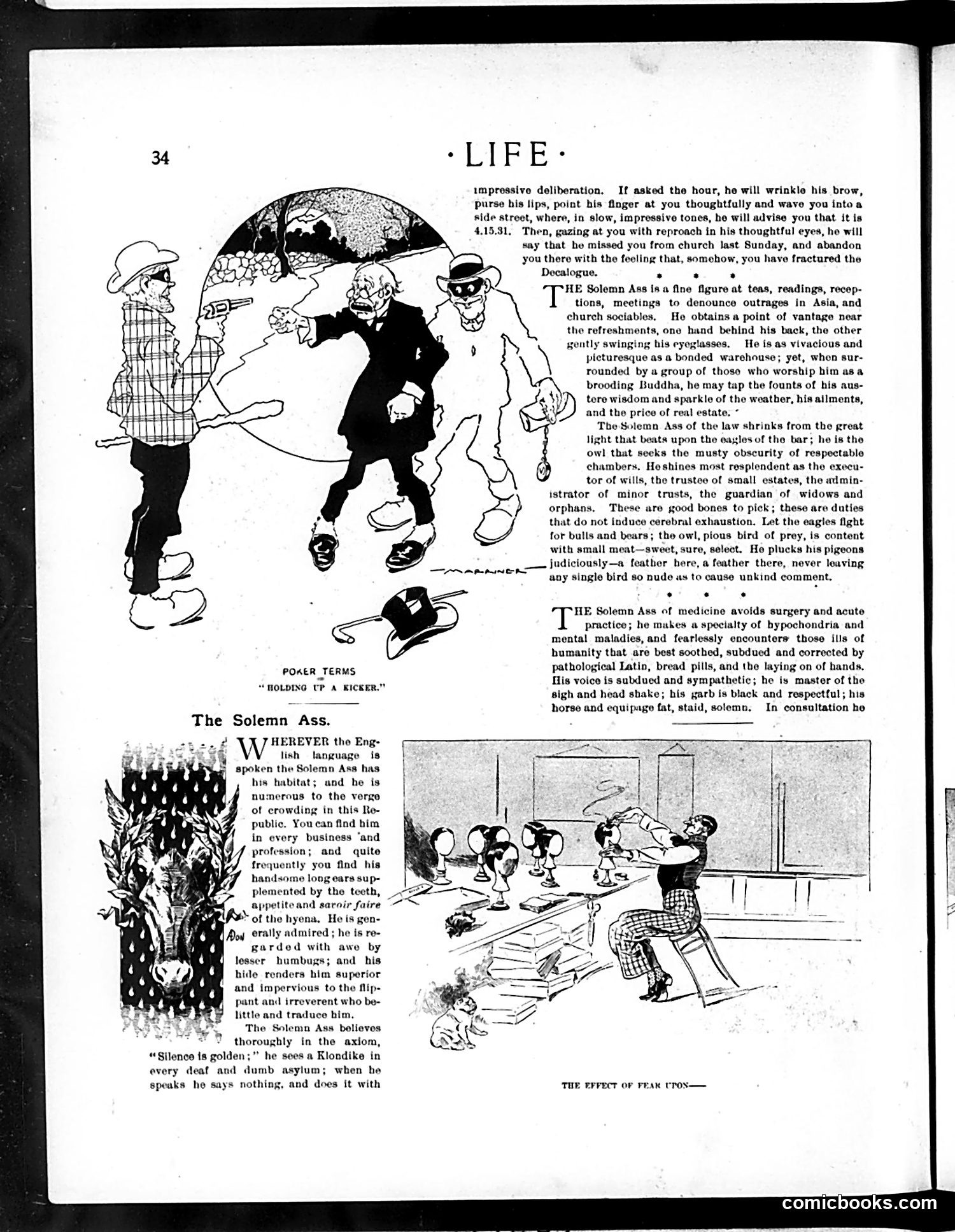
This page satirizes a recurring American archetype: the self-importantly grave, pretentious man who affects gravity and wisdom while actually being sanctimonious and shallow. The article catalogs "The Solemn Ass" across professions—law, medicine, business, religion. The top cartoon labeled "Poker Terms: Holding Up a Kicker" shows such a figure in formal dress among ordinary working men, visually establishing his pompous separation from common people. The bottom cartoon titled "The Effect of Freak Lyons" (unclear what "Freak Lyons" references) depicts him pontificating to an audience, likely showing the absurd deference he receives despite his emptiness. The satire's point: America is infested with men who weaponize solemnity, silence, and pseudo-respectability to gain undeserved authority. They thrive on obscurity, avoid real challenges, exploit vulnerable people (widows, orphans), yet command reverence through performative gravitas. The piece mocks both the Solemn Ass and society's gullibility.
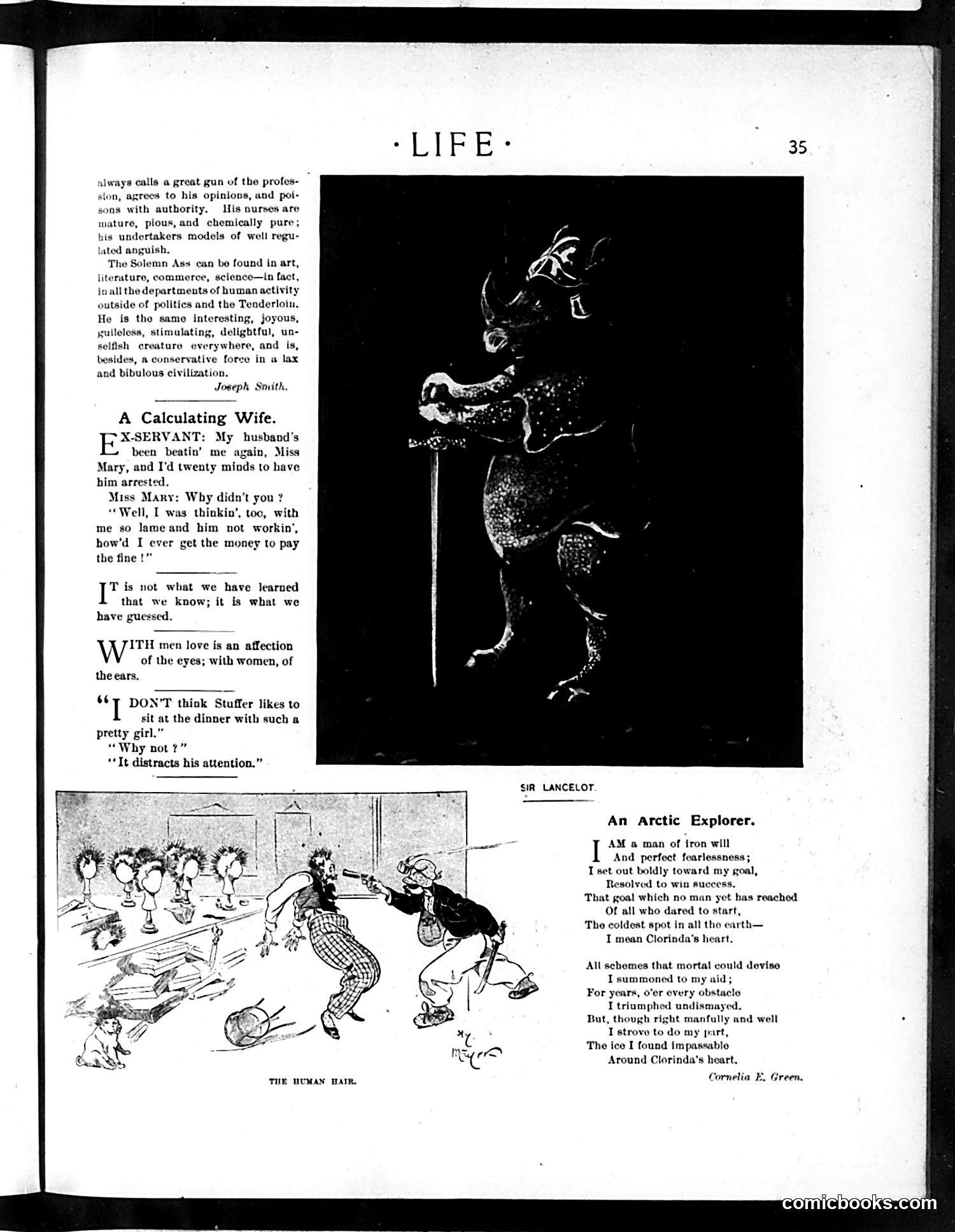
This page contains three humor pieces typical of early 20th-century *Life* magazine: **"A Calculating Wife"** mocks working-class domestic violence with dark humor. A servant won't report her husband's beatings because she fears losing his income—the joke ironically exposes the economic trap that forces poor women to tolerate abuse. **"The Human Hair"** (cartoon, lower left) depicts a slapstick scene of men's competition over a woman, likely satirizing male vanity and foolish courtship behavior. **"An Arctic Explorer"** (poem, right) is romantic doggerel parodying overwrought Victorian love poetry. The speaker compares winning his beloved Clorinda's affection to conquering Earth's coldest region—mocking both exploration narratives and melodramatic courtship rhetoric of the era. The page reflects *Life's* satirical targets: gender relations, class economics, and sentimental literary conventions. The Solemn Ass quote above addresses hypocrisy in institutions.
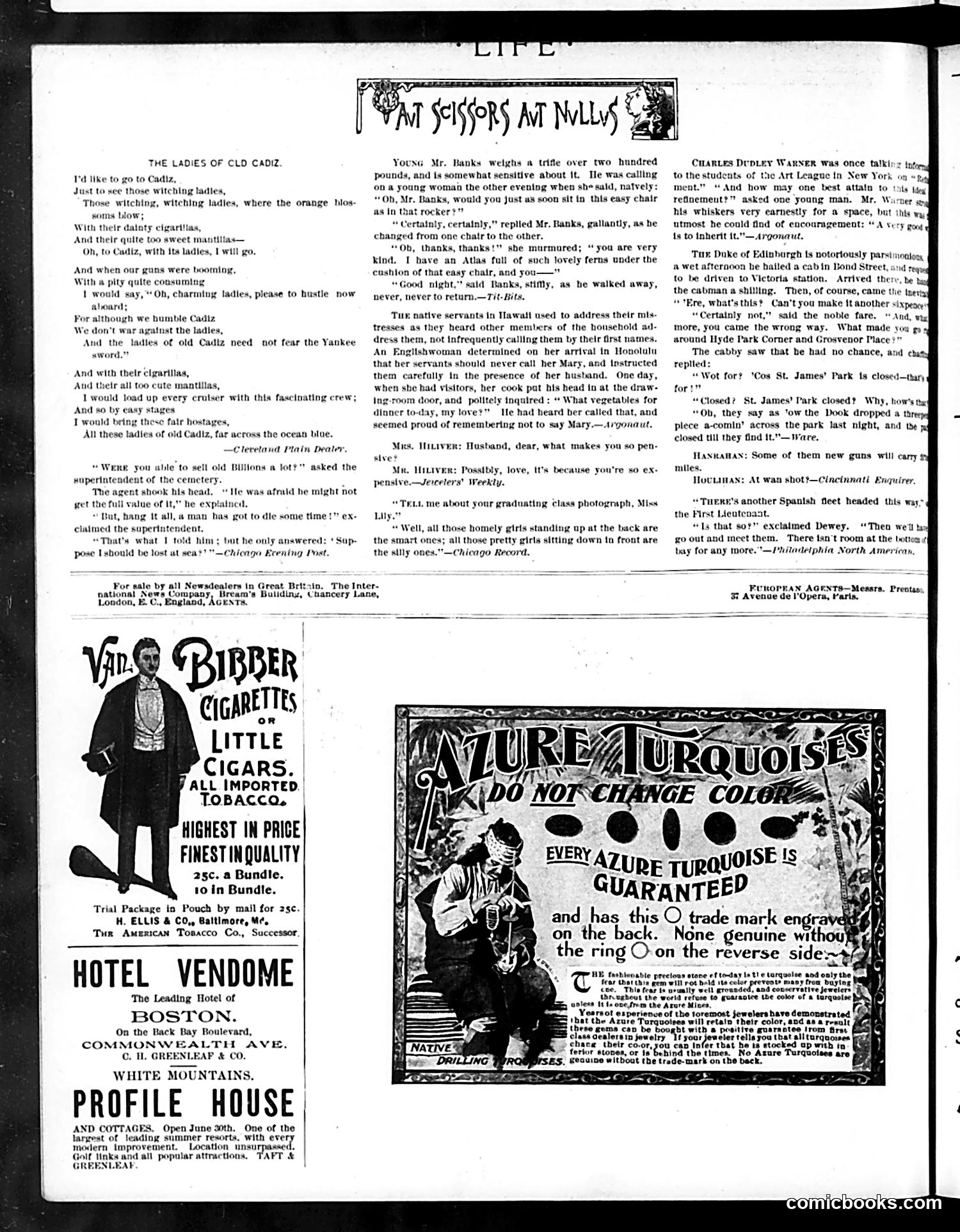
This page mixes satirical poetry, humorous anecdotes, and period advertisements (typical for Life magazine). The main literary content includes "The Ladies of Old Cadiz," a romantic poem about Spanish women, likely referencing the Spanish-American War era when U.S. naval forces operated near Cadiz. The poem humorously expresses interest in the local women while asserting Americans wouldn't harm them. Below are several brief comic anecdotes: one mocks an overweight man (Mr. Banks) who's embarrassed when a woman implies he's heavy; another describes Hawaiian servants inappropriately adopting their employers' terms of endearment; others offer mild domestic humor. The advertisements—Vade Bibber cigars, Hotel Vendome, Profile House—are typical period marketing. The page reflects early 20th-century American attitudes: casual body-shaming humor, colonial-era assumptions about colonial subjects, and genteel domestic comedy. The content would appeal to middle-class readers seeking light, sometimes risqué entertainment with no serious political commentary.
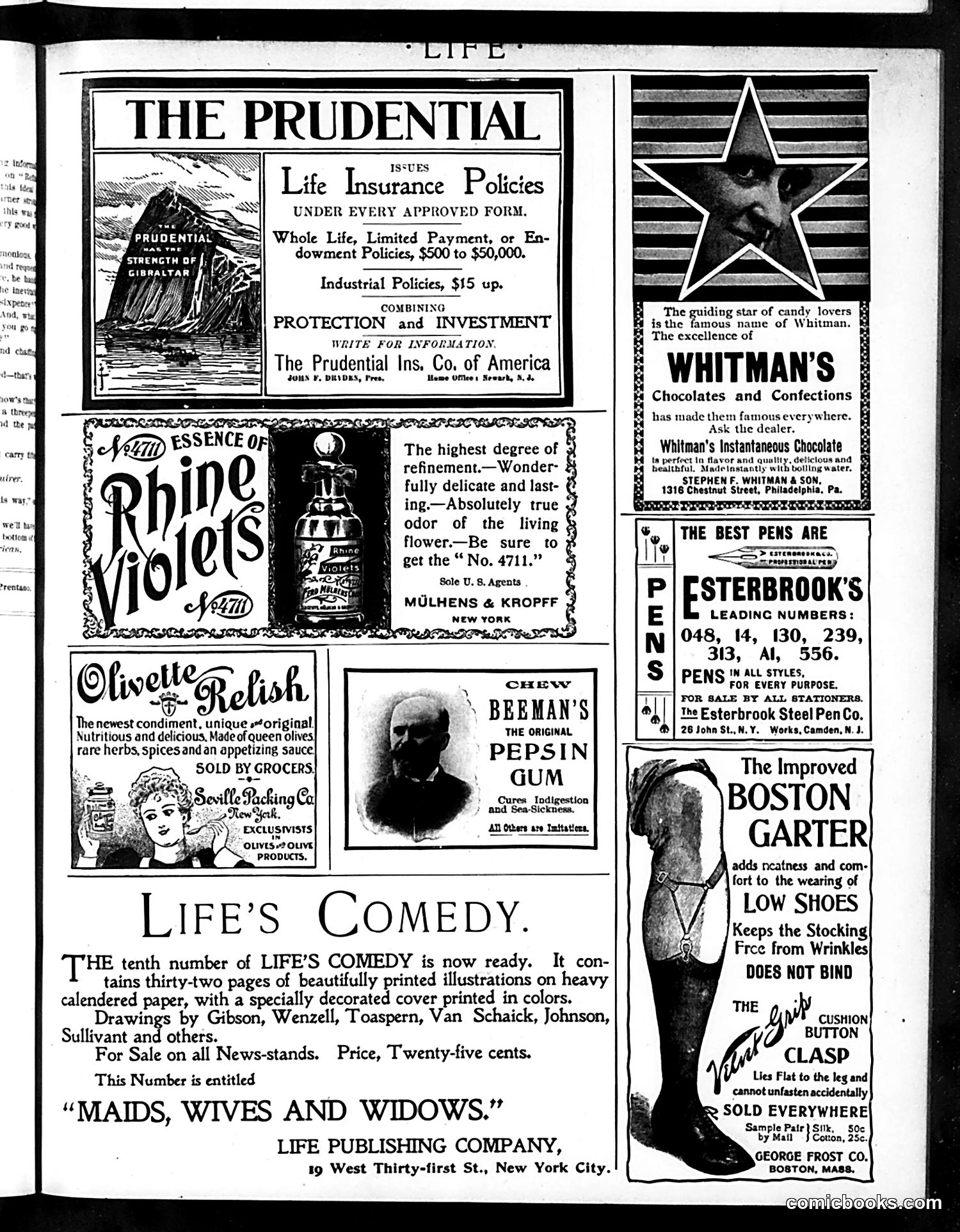
This page is primarily **advertising**, not satirical content. It's from *Life* magazine and features various commercial advertisements typical of the early 20th century. The notable ad is **"Life's Comedy,"** promoting a 32-page illustrated publication (issue #10) titled "Maids, Wives and Widows"—featuring drawings by prominent illustrators Gibson, Wenzell, and others. This suggests *Life*'s core business was publishing humorous illustrated content about domestic and social life, sold for 25 cents at newsstands. The other ads—for insurance, chocolates, pens, garters, pepsin gum, and olives—reflect period consumer products. These advertisements reveal what middle-class Americans considered desirable: life insurance for protection, imported German cologne ("No. 4711"), and various proprietary remedies (pepsin for indigestion). The page itself contains no apparent political satire or social commentary—it's a straightforward commercial publishing vehicle.
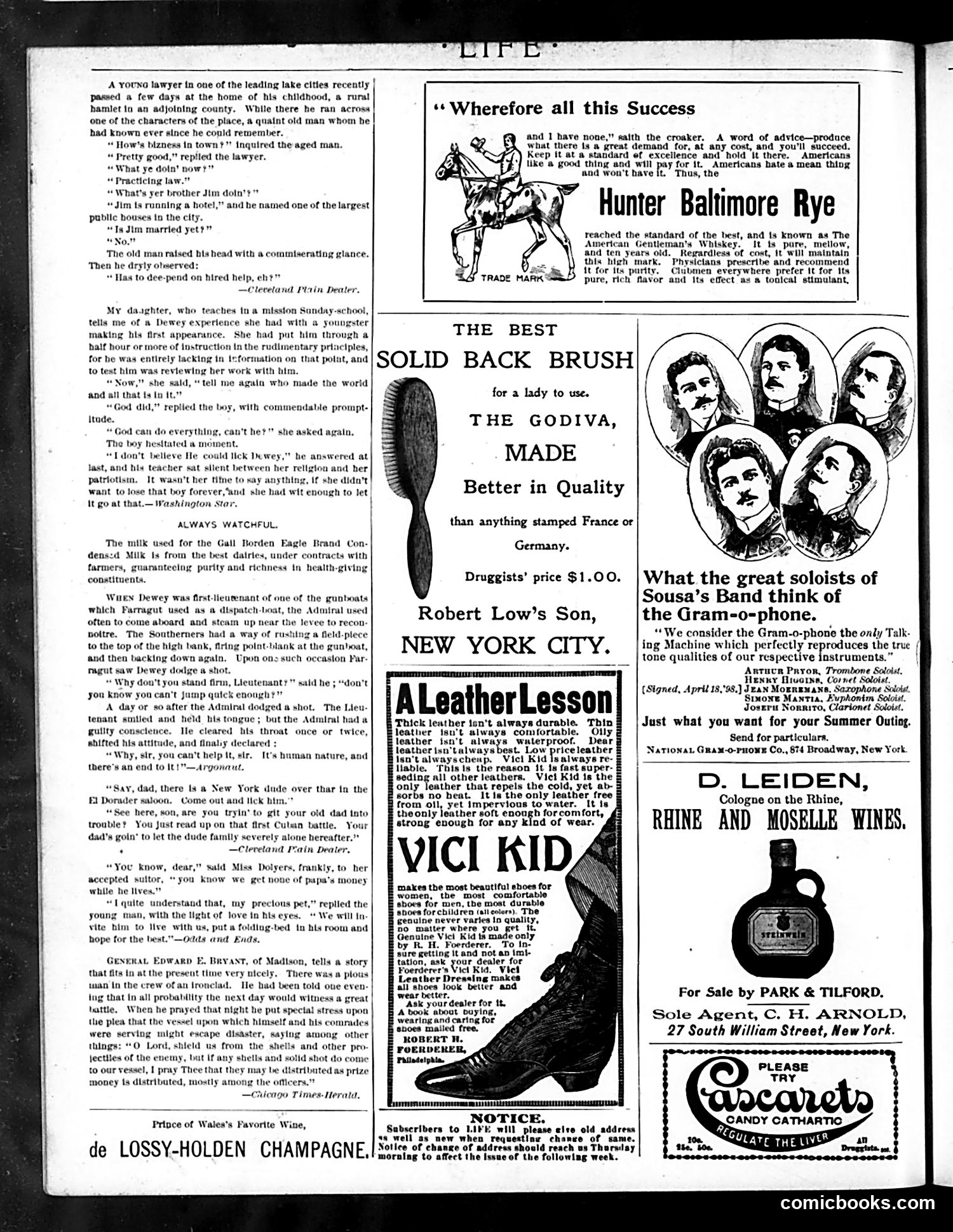
This page contains **humorous anecdotes** rather than political cartoons. The stories satirize American society through dialect humor and social observation: 1. **Rural vs. Urban**: A country lawyer returns home; an old man comically assumes hotel-running equals dependence on "hired help"—mocking rural notions of success. 2. **Dewey Worship**: A child's catechism lesson reveals excessive American reverence for Admiral George Dewey (Spanish-American War hero), unable to imagine anyone—even God—superior to him. 3. **"Always Watchful"**: Anecdotes about Dewey's military bravery, contrasting his dodging gunfire with Farragut's criticism. 4. **Social Commentary**: Multiple brief stories mock courtship customs, dude culture, and human nature. The page is primarily **advertising**—prominently featuring Hunter Baltimore Rye whiskey, solid-back brushes, leather shoes (Vici Kid), and other products. The anecdotes serve as filler content typical of Life magazine's satirical humor focused on contemporary American types and behaviors.
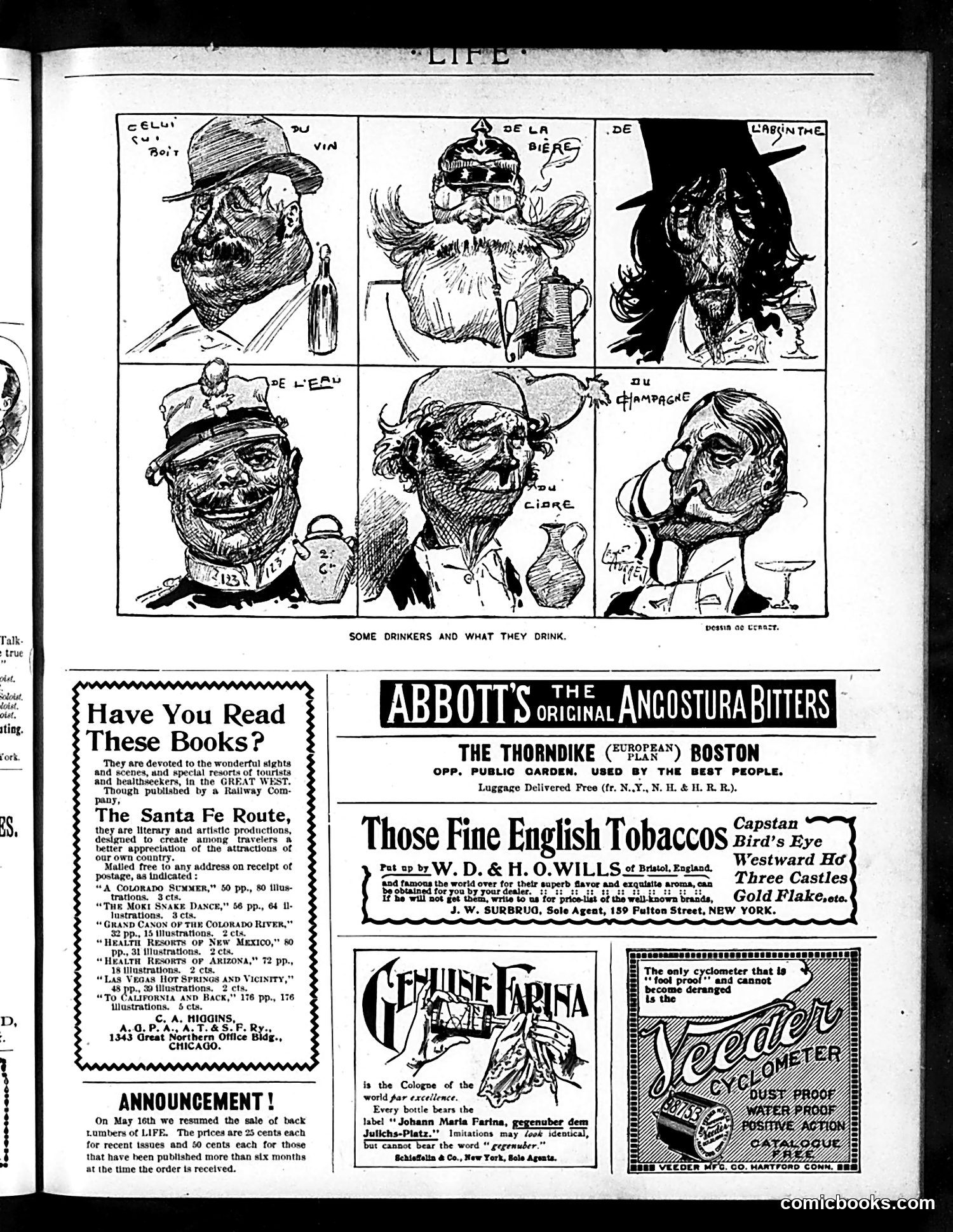
This satirical cartoon features six caricatured male faces, each labeled with French phrases identifying different types of drinkers and their beverages: wine, beer, absinthe, water, and champagne. The humor relies on exaggerated physiognomies—grotesque facial features, expressions, and styling—to mock stereotypical drinkers of various nationalities and classes. The style and labels suggest this is political/social commentary on drinking habits, possibly contrasting continental European beverage preferences with American attitudes. One figure appears deliberately uglified, playing on period prejudices about certain groups. The cartoon exemplifies Life magazine's satirical approach: using visual caricature to comment on social types and habits, likely targeting both immigrant communities and contemporary drinking culture debates. The detailed pen-and-ink technique was typical of the era's editorial cartooning.
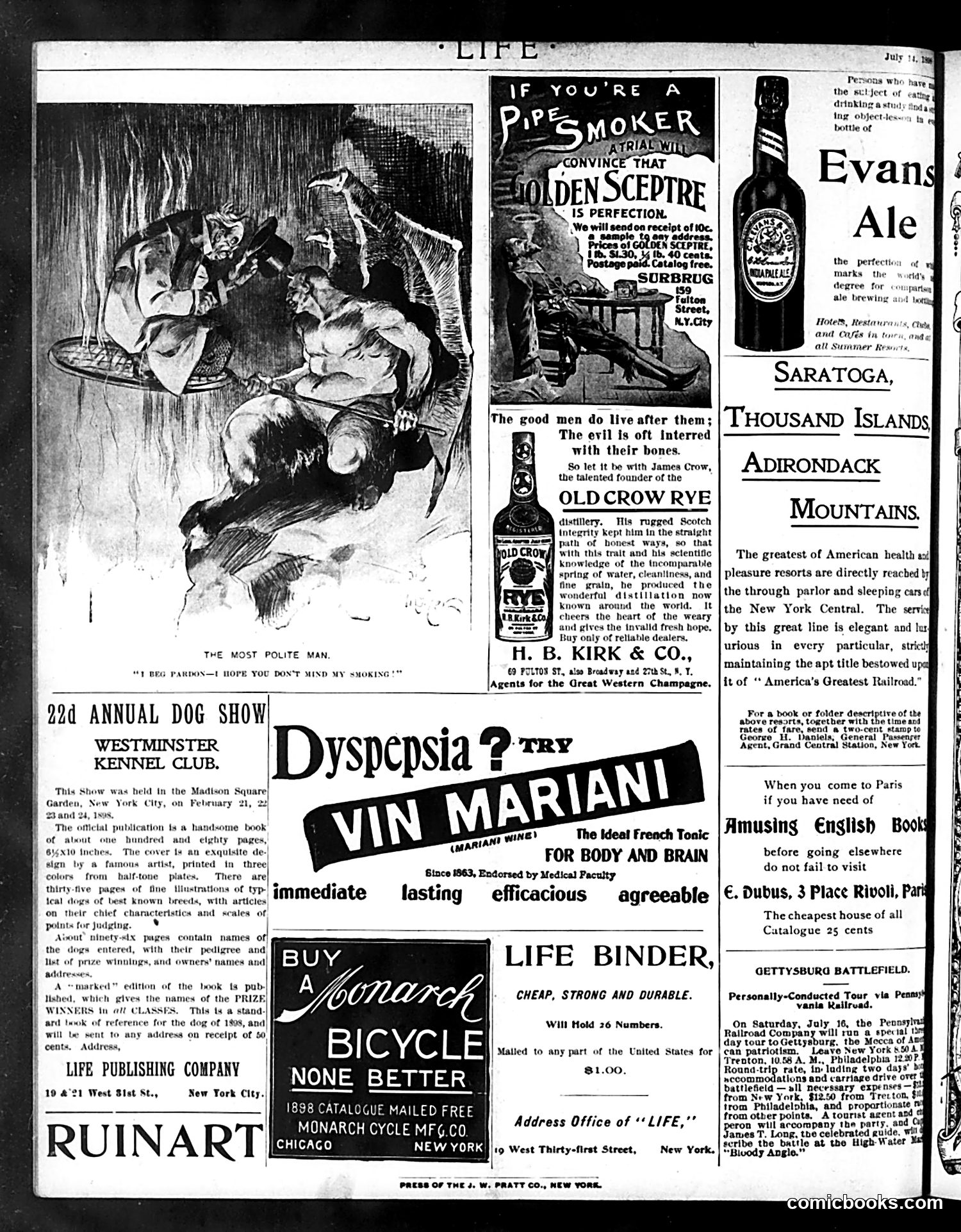
This cartoon satirizes excessive politeness—specifically the absurd social convention of apologizing for smoking while actively doing so. The figure depicted appears to be a gentleman in Victorian-era dress, smoking a pipe while simultaneously asking permission and expressing hope he's not offending his companion. The satire targets the contradiction between action and words: the speaker performs the transgressive act (smoking indoors) while performing exaggerated deference about it. This was likely commentary on how ritualistic politeness allowed socially undesirable behavior to proceed unchallenged. The caption's phrasing—"I beg pardon—I hope you don't mind"—is already smoke-filled, undermining the sincerity of the apology. The joke reflects late-19th century anxieties about smoking in shared spaces and social hypocrisy, where maintaining appearances through hollow courtesies substituted for genuine consideration.