
Life, 1898-07-14 · page 4 of 20
Life — July 14, 1898 — page 4: what you’re looking at
What you’re looking at
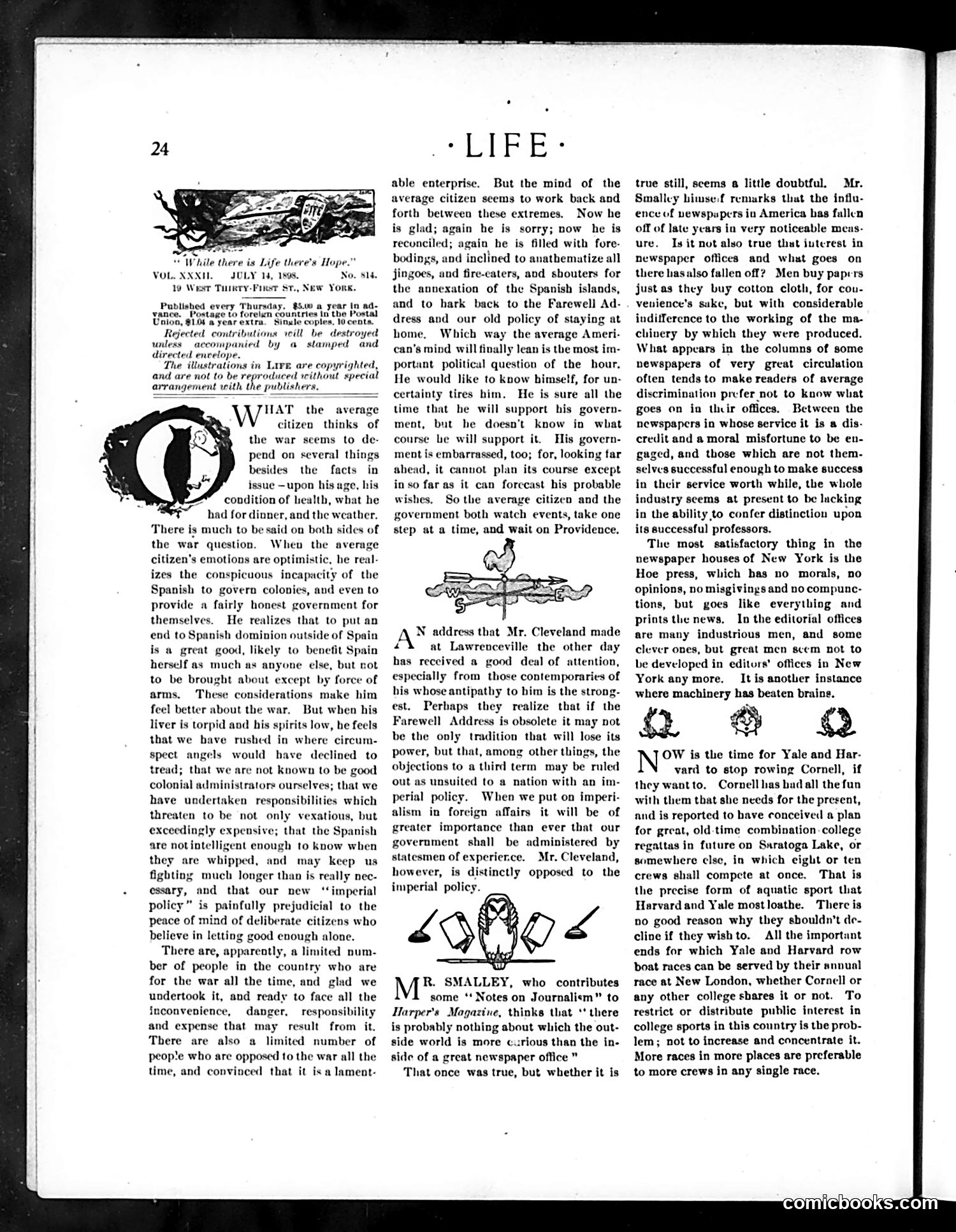
This page contains political commentary rather than cartoons. The main text discusses average American citizens' uncertainty about government policy, particularly regarding Spanish colonial administration and imperialism. A section references President Cleveland's Lawrenceville address, debating whether a "Farewell Address" on imperial policy remains relevant or is now outdated. The text criticizes newspaper offices for lacking moral conviction, praising the Hoe printing press as exceptionally principled—likely ironic commentary on press ethics. Finally, the piece discusses Yale and Harvard rowing competitions, arguing these colleges should prioritize public interest over athletic rivalry, preferring multiple races at different venues rather than concentrated competition. The overall tone is satirical commentary on American political ambivalence, media integrity, and institutional priorities circa the 1890s-1900s.
📄 Transcribed text from this page (OCR, searchable)
Machine-transcribed from the original scan — historical spelling and the odd misread are preserved.
Yo West Tutery frablishea every Thursday, $5.0 a e to forelxn countries t Sinule coples, 10 cents, vill be destroyed “rejee ted stamped and unless accompanied by a directed encelope. The illustrations in Lave are copyrighted, and are not to be reproduced without special arrangement with the the publishers, HAT the average citizen thinks of the war seems to de- pend on several things besides the facts in issue —upon his age, his condition of health, what he had for dinner, and the weather, There is much to be said on both sides of the war question. When the average citizen's emotions are optimistic, he real- izes the conspicuous incapacity of the Spanish to govern colonies, and even to provide a fairly honest government for themselves. He realizes that to putan end to Spanish dominion outside of Spain is a great good, likely to benefit Spain herself as much as anyone else, but rot to be brought about except by force of arms. These considerations make him feel better about the war. But when his liver is torpid and his spirits low, he feels that we have rushed in where circum- spect angels would have declined to that we are not known to be good colonial administrators ourselves; that we have undertaken responsibilities which threaten to be not only vexatious, but exceedingly expensive; that the Spanish are notintelligent enough to know when they are whipped, and may keep us fighting much longer than is really nec- essary, and that our new ‘imperial policy” is painfully prejudicial to the peace of mind of deliberate citizens who believe in letting good enough alone. There are, apparently, a limited num- ber of people in the country who are for the war all the time, and glad we undertook it, and ready to face all the inconvenience, danger, responsibility and expense that may result from it. There are also a limited number of peopte who are opposed to the war all the time, and convinced that it is a lament- able enterprise. But the mind of the average citizen seems to work back and forth between these extremes. Now he is glad; again he is sorry; now he is reconciled; again he is filled with fore- bodings, and inclined to anathematize all jingoes, and fire-eaters, and shouters for the annexation of the Spanish islands, and to hark back to the Farewell Ad- dress and our old policy of staying at home, Which way the average Ameri- can’s mind will finally lean is the most im- portant political question of the hour, He would like to know himself, for un- certainty tires him. He is sure all the time that he will support his govern- ment, but he doesn't know in what course be will support it. His govern- ment is embarrassed, too; for, looking tar ahead, it cannot plan its course except in so far as it can forccast his probable wishes, So the average citizen and the government both watch events, take one step at a time, and wait on Providence. N address that Mr. Cleveland made 2 at Lawrenceville the other day has received a good deal of attention, especially from those contemporaries of his whose antipathy to him is the strong- est. Perhaps they realize that if the Farewell Address is obsolete it may not be the only tradition that will lose its power, but that, among other things, the objections to a third term may be ruled out as unsuited to a nation with an im- perial policy. When we put on imperi- alism in foreign affairs it will be of greater importance than ever that our government shall be administered by statesmen of experience. Mr. Cleveland, however, is distinctly opposed to the imperial policy. R. SMALLEY, who contributes some * Notes on Journalism” to Harper's Magazine, thinks that ** there is probably nothing about which the out- side world is more curious than the in- side of a great newspaper office ” That once was true, but whether it is true still, seems a little doubtful. Mr. Smalley himse.f remarks that the influ- ence of pewspupers in America bas fallen off of late years in very noticeable meas- ure. Is it not also true that interest in newspaper offices and whut goes on there hasalso fallen off? Men buy papers just as they buy cotton cloth, for cou- venience's suke, but with considerable indifference to the working of the ma- chivery by which they were produced. What appears in the columns of some newspapers of very great circulation often tends to make readers of average discrimination prefer not to know what goes on in thir offices. Between the newspapers in whose service it is a dis- credit and a moral misfortune to be en- gaged, and those which are not them. selves successful enough to make success in their service worth while, the whole industry scems at present to be lacking in the ability to confer distinction upon its successful professors. The most satisfactory thing in the newspaper houses of New York is the Hoe press, which has no morals, no opinions, no misgivings and no compunc- tions, but goes like everything and prints the news, In the editorial offices are many industrious men, and some clever ones, but great men sccm not to be developed in editors’ offices in New York any more. It is another instance where machinery has beaten brains. OW is the time for Yale and Har- vard to stop rowing Cornell, if they wantto, Cornell has bad all the fun with them that she needs for the present, and is reported to have conceived a plan for great, old-time combination college regattas in future on Saratoga Lake, or somewhere clse, in which eight or ten crews shall compete at once. That is the precise form of aquatic sport that Harvard and Yale mostloathe. There is no good reason why they shouldn't de- cline if they wish to. All the important ends for which Yale and Harvard row boat races can be served by their annual race at New London, whether Cornell or any other college sbares it or not. To restrict or distribute public interest in college sports in this country is the prob- lem; not to increase and concentrate it. More races in more places are preferable to more crews in any single race.