
Life, 1898-07-14 · page 6 of 20
Life — July 14, 1898 — page 6: what you’re looking at
What you’re looking at
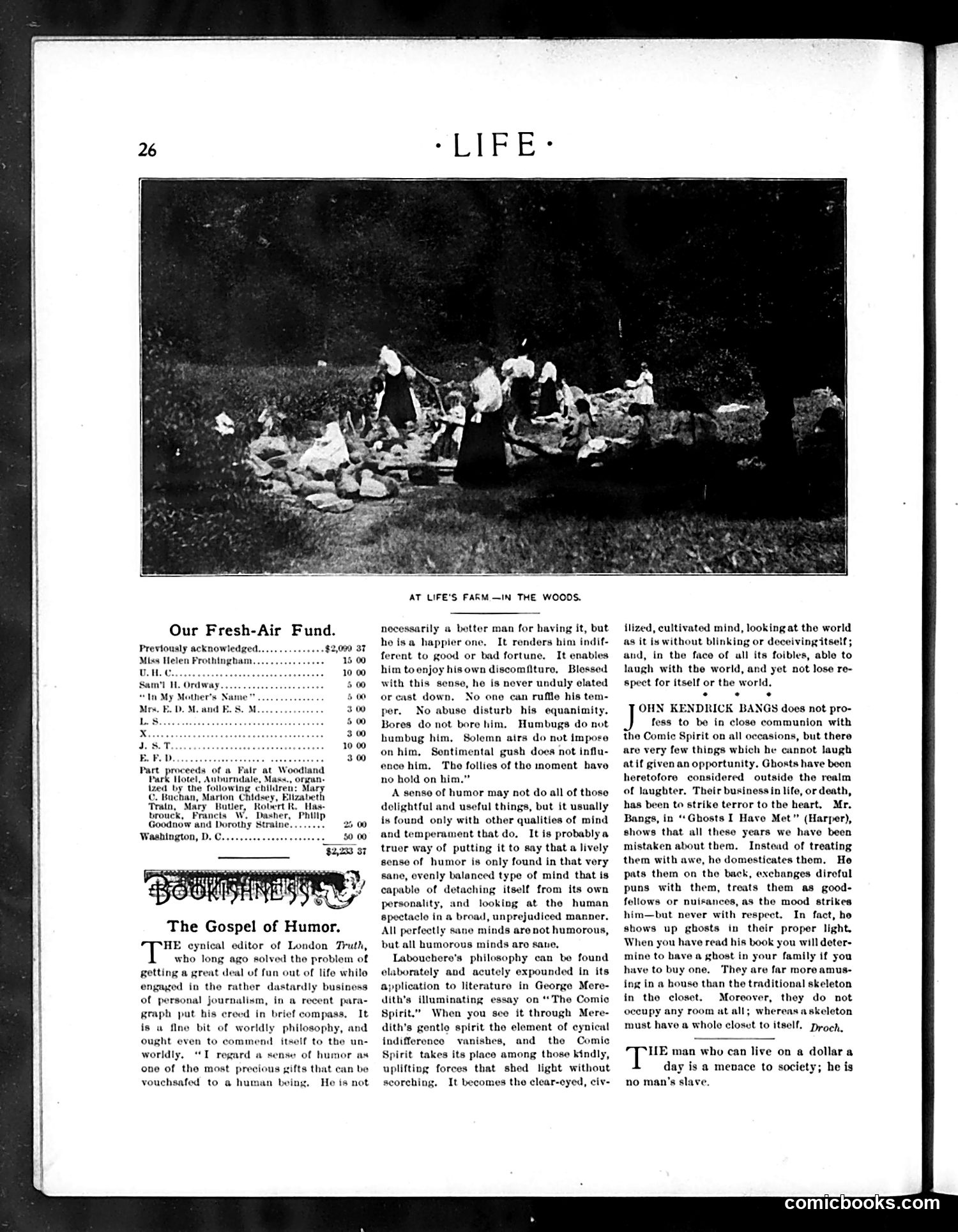
This page contains two distinct sections: **Top Image:** A black-and-white photograph captioned "AT LIFE'S FARM—IN THE WOODS" shows a group of people gathered outdoors, apparently at a social gathering or picnic. **"Our Fresh-Air Fund":** A fundraising list acknowledging donations (ranging from $2,700.37 down to smaller amounts) for what appears to be a charitable initiative providing outdoor recreation access. **"The Gospel of Humor":** The main article discusses humor's philosophical and social value, arguing that a balanced, detached sense of humor is a mark of mental health and wisdom. It references George Meredith's essay "On the Comic Spirit" and suggests that humor helps people maintain perspective on life's troubles. The page emphasizes humor as beneficial to individual character and society—a characteristic Life magazine frequently promoted during this period as wholesome American values.
📄 Transcribed text from this page (OCR, searchable)
Machine-transcribed from the original scan — historical spelling and the odd misread are preserved.
Our Fresh-Air Fund. $2,000 37 15 00 10 00 50 5 00 Previously acknowledged. Miss Helen Frothingham UL. Cece cere Sam'l H. Ordwa . Mary Butler, brouck, Fi ts W. Dash Goodnow and Dorothy Strat Washington, D. The Gospel of Humor. HE cynical editor of London Truth, who long ago solved tho problem of getting a great deal of fun out of life while engaged in the rather dastardly business of personal journalism, in a recent para- graph put his creed in brief comp It is a flne bit of worldly philosophy, and ought even to commend itself to the un- worldly, “I regard a sense of humor as one of the most precious gifts that can be vouchsafed to a human being, He is not AT LIFE'S FARM —IN THE WOODS. necessarily a botter man for having it, but ho is happier one, It renders him indif- ferent to good or bad fortune, It enables him toenjoy hisown discomfiture, Blessed with this sense, he is never unduly elated or cast down, No one can ruffle his tem- per. No abuse disturb his equanimity. Bores do not bore him. Humbugs do not humbug him, Solemn airs do not impose on him, Sentimental gush does not influ- ence him, The follies of tho noment have no hold on him.” A sense of humor may not do all of those dolightful and useful things, but it usually is found only with other qualities of mind and temperament that do. It is probably a truer way of putting it to say that a lively sense of humor is only found in that very sane, evenly balanced type of mind that is capable of detaching itself from its own personality, and looking at the human spectaclo in a broad, unprejudiced manner. All perfectly sane minds are not humorous, but all humorous minds aro sane, Labouchere’s philosophy can be found elaborately and acutely expounded in its application to literature in George Mere- dith’s illuminating essay on “The Comic Spirit.” When you sce it through Mere- dith’s gentlo spirit the element of cynical indifference and the Comic Spirit takes its place among those kindly, uplifting forces that shed light without scorehing. It becomes the clear-cyed, civ- vanishes, ilized, cultivated mind, looking at the world as it is without blinking or deceiving itsett; and, in the face of all its foibles, able to laugh with the world, and yet not lose re- spect for itself or the world, oe 6 OHN KENDRICK BANGS does not pro- fess to be in close communion with the Comic Spirit on all occasions, but there are very few things which he cannot laugh atif given an opportunity. Ghosts have been heretofore considered outside the realm of laughter. Their business in life, or death, has been to strike terror to the heart, Mr. Bangs, in “Ghosts I Havo Met” (Harper), shows that all these years we have been mistaken about them. Instead of treating them with awe, he domesticates them. Hoe pats them on the back, exchanges dircfal puns with them, treats them as good- fellows or nuisances, as the mood strikes him—but never with respect, In fact, ho shows up ghosts in their proper light. When you have read his book you will deter- mine to have a ghost in your family if you have to buy one, They are far more amus- ing in a house than the traditional skeleton in the closet, Moreover, they do not oceupy any room at all; whereas askeleton must have a whole closet to itself. Droch, IIE man who can live on a dollar a day is a menace to society; he is no man’s s comicbooks.com