
A complete issue · 24 pages · 1898
Life — May 26, 1898
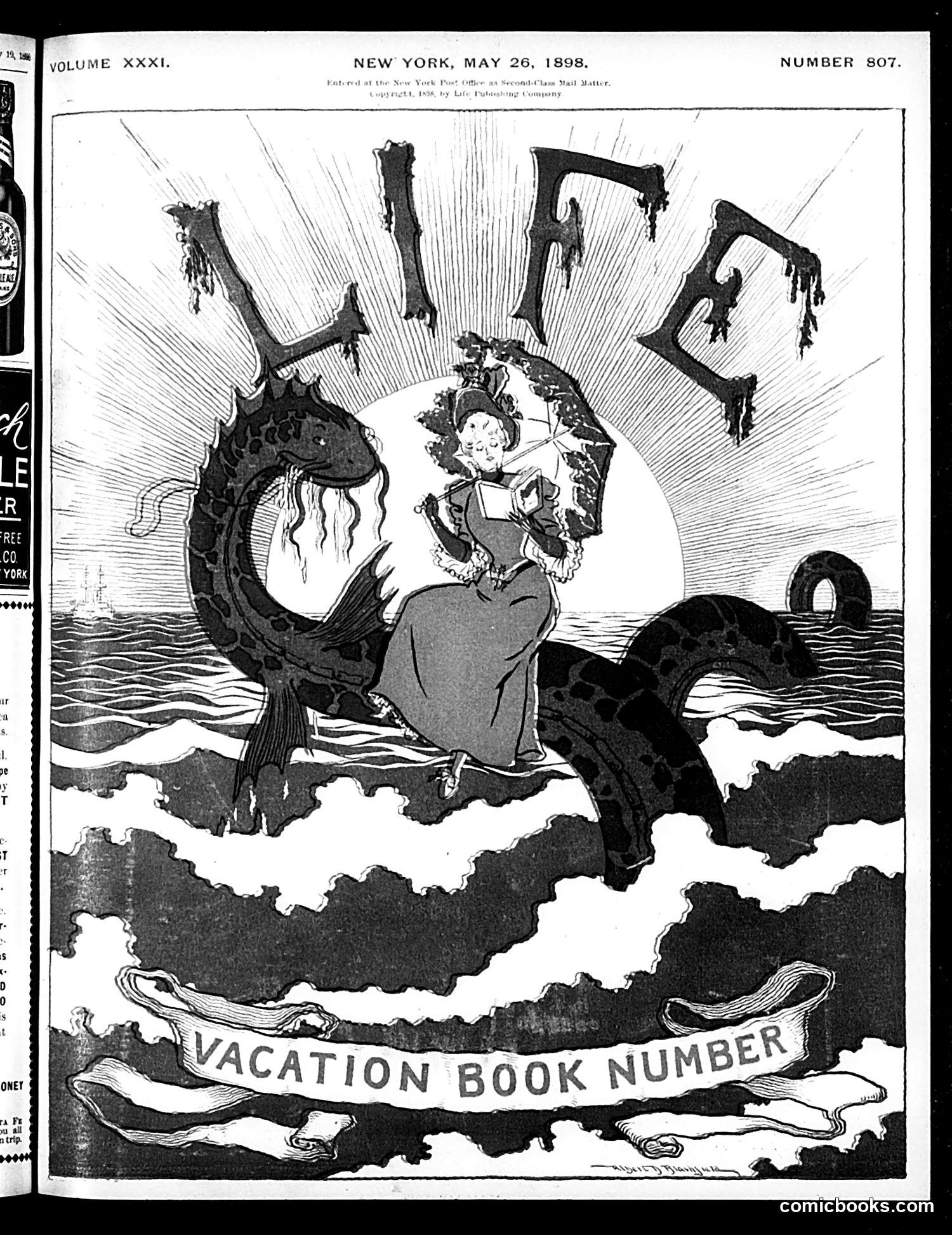
This is a "Vacation Book Number" cover illustration depicting a woman reading while surrounded by nightmarish sea creatures and disturbing imagery. The composition suggests anxieties about leisure travel during this period. The creatures—appearing to include jellyfish, octopi, and other marine monsters emerging from dark clouds—likely represent common Victorian-era fears about ocean travel and distant vacation destinations. The woman's serene reading posture contrasts sharply with the menacing supernatural elements surrounding her, creating satirical commentary on the gap between vacation fantasies and travel realities. Given the 1898 date, this probably reflects contemporary concerns about steamship safety and the exotic "dangers" associated with increasingly popular leisure tourism among the American middle class.
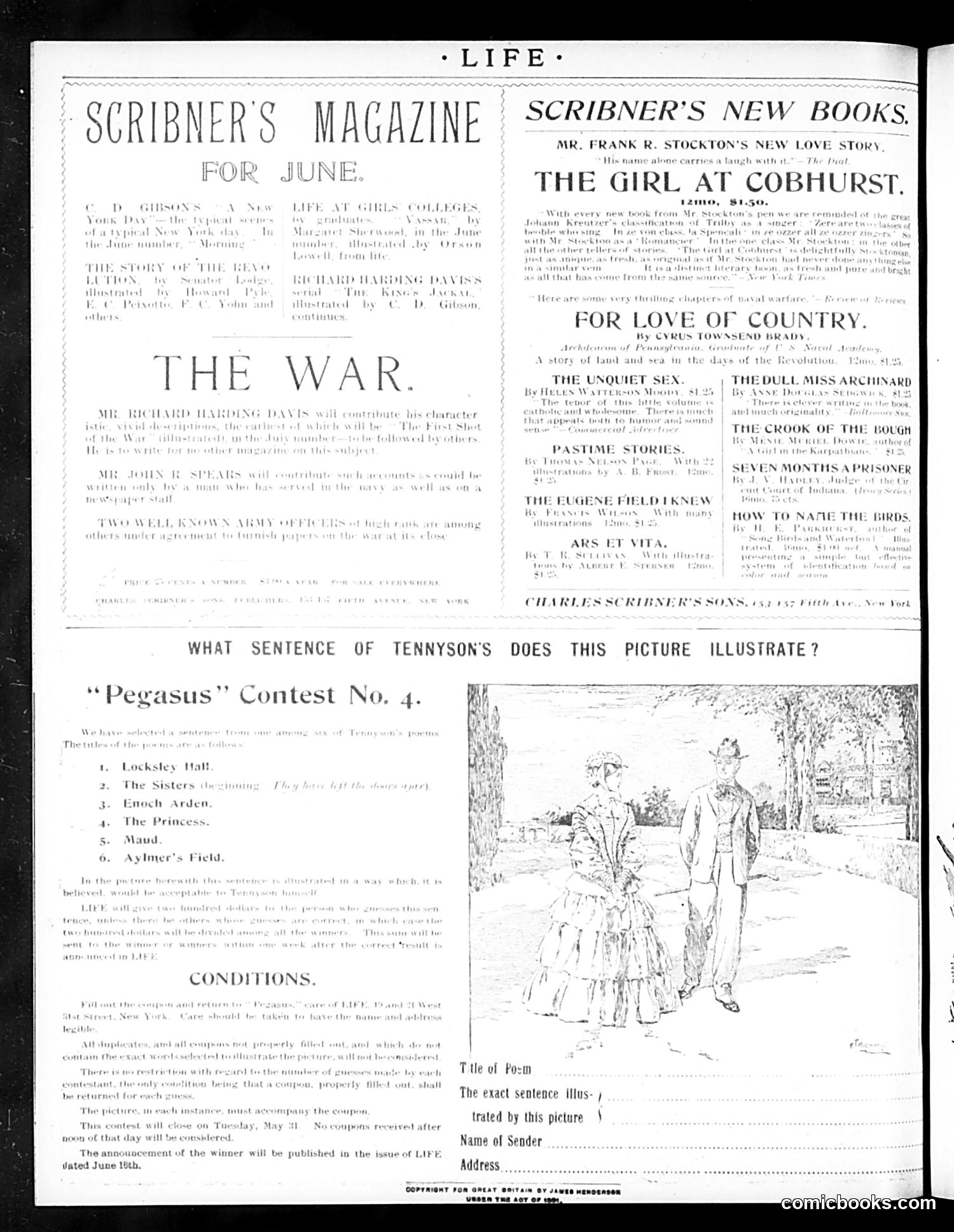
This page primarily features a **literary contest**, not political satire. The contest asks readers to identify which sentence from Tennyson's poetry is illustrated by the accompanying sketch. The image shows a Victorian-era couple in a garden setting—a woman in an elaborate dress and a man in formal attire. Readers must match this illustration to one of six Tennyson poem titles listed: "Locksley Hall," "The Sisters," "Uncle Arden," "The Princess," "Maud," or "Axlmere's Field." The contest offers monetary prizes ($100 to the winner) and was common in *Life* magazine during this period. This represents the magazine's literary engagement rather than political commentary—it's an interactive feature testing readers' knowledge of canonical Victorian poetry.
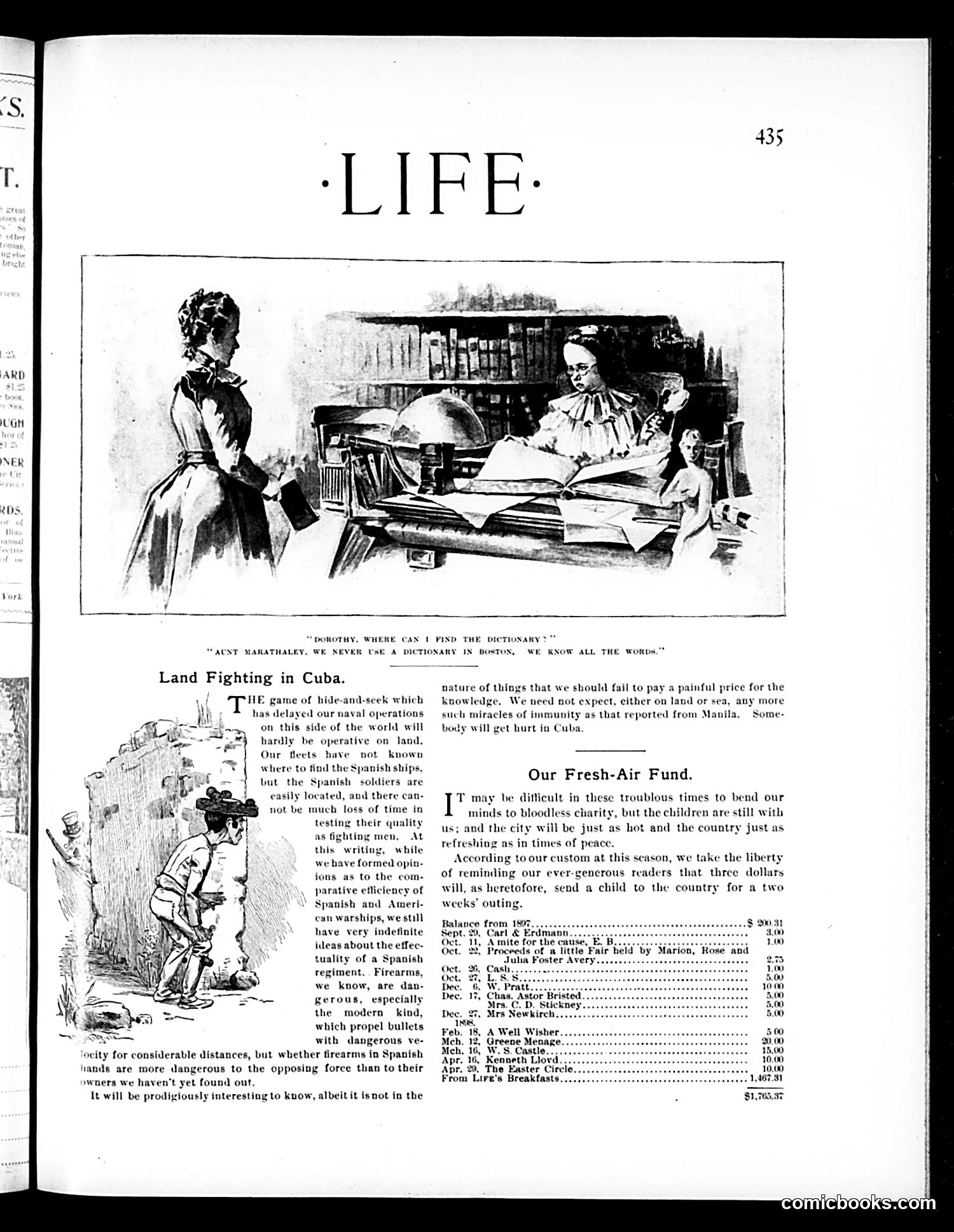
**Top illustration**: A domestic scene showing three women with a large dictionary. The caption quotes "Aunt Marathaley" claiming Bostonians need no dictionary because "we know all the words." This is satire of Boston's reputation for intellectual superiority and distinctive accent/dialect. The joke mocks provincial pride in one's own speech. **"Land Fighting in Cuba"**: Discusses the Spanish-American War's land operations. The accompanying sketch shows a soldier in combat. The text appears to debate the comparative danger of Spanish firearms versus American naval superiority, suggesting uncertainty about actual military effectiveness—satirizing overconfident war reporting. **"Our Fresh-Air Fund"**: A charitable fundraising list for sending urban children to the countryside, showing Life magazine's philanthropic efforts during this period. The page reflects turn-of-the-century American concerns: regional stereotypes, imperial warfare, and urban social welfare.
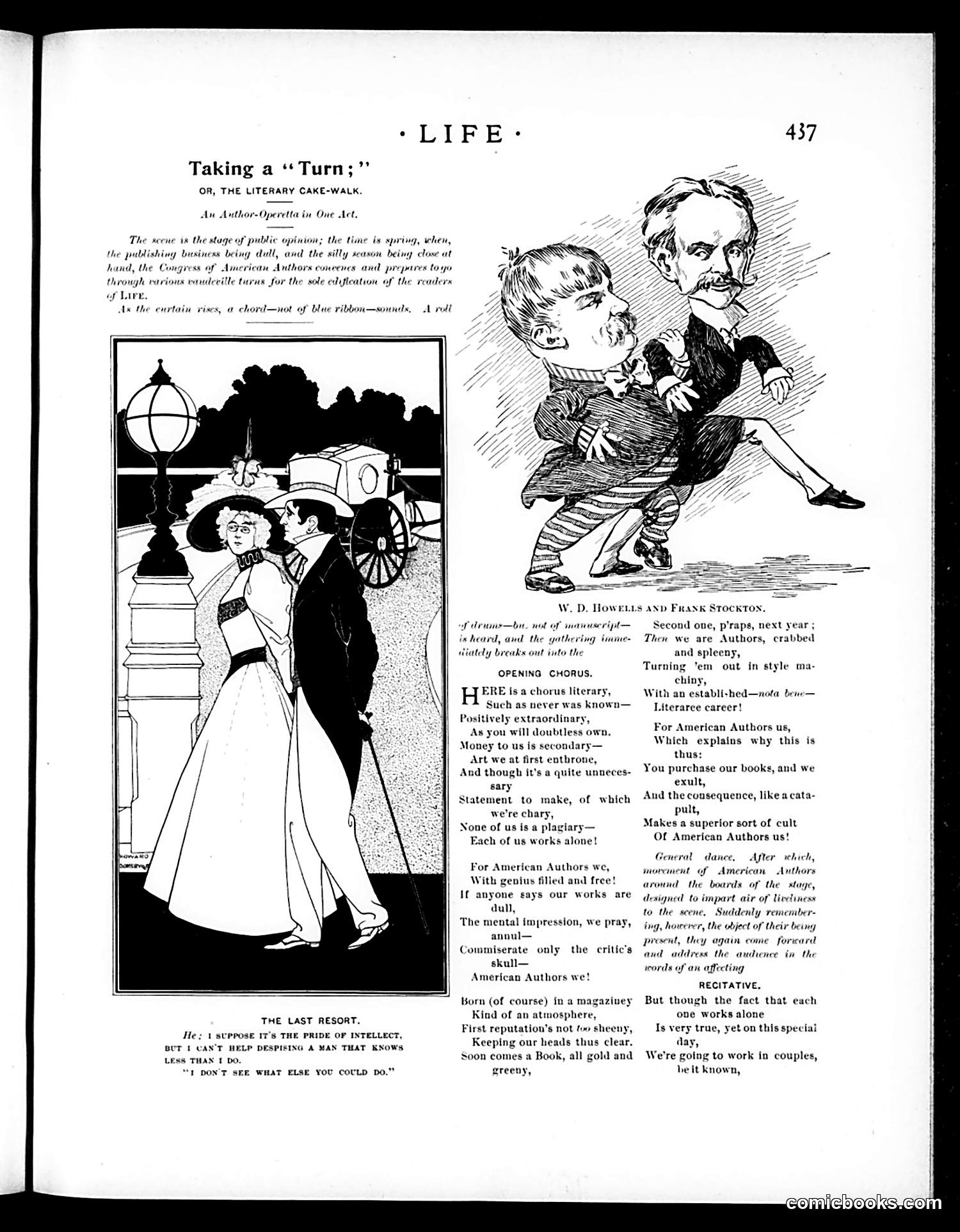
This is a satirical operetta about American authors. The title "Taking a 'Turn'" puns on a literary "turn" (stylistic shift) and an actual physical turn or walk. **The cartoons depict:** The left panel ("The Last Resort") shows a fashionable couple on what appears to be a public promenade, with a caption satirizing intellectual pride: a man boasts he won't help someone "despising a man that knows." The right panel caricatures **W.D. Howells and Frank Stockton** (identified below the image)—both prominent American authors of the period—walking together in exaggerated physical contortions. **The satire targets:** American authors' self-importance and their tendency to band together for mutual promotion during the spring publishing season, when the "Congress of American Authors" would gather to celebrate their own literary significance.
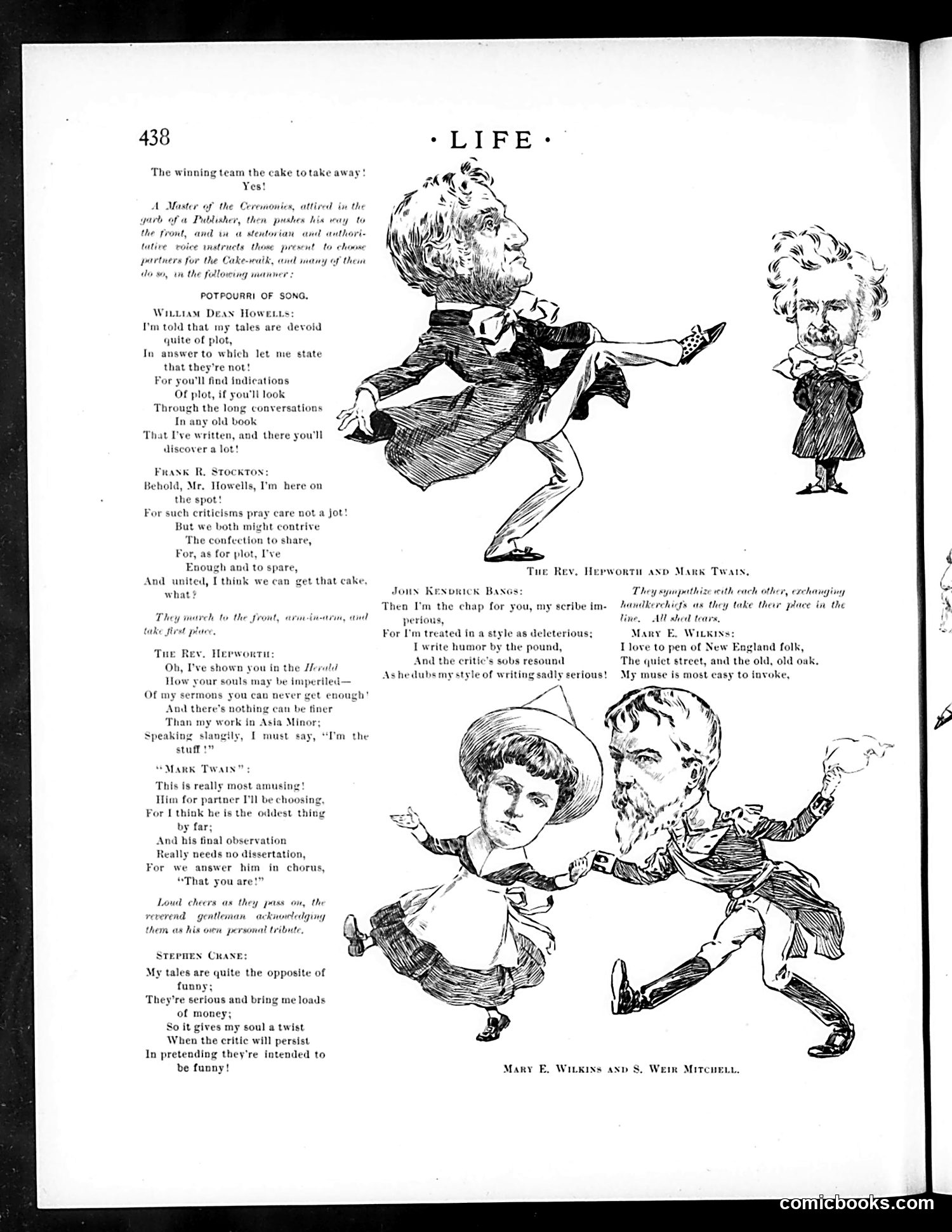
This page satirizes a literary "cake-walk" competition—a humorous contest where writers compete for a prize cake. The verses are credited to William Dean Howells, Frank R. Stockton, John Kendrick Bangs, and others, with each poet playfully defending their writing style. The caricatures appear to depict these prominent late 19th-century American authors. The satire mocks their distinct literary voices: Howells's serious realism, Stockton's plot-heavy tales, Bangs's humor, and Crane's cynicism. The "cake-walk" format (referencing both a literal competition and the African American dance form) is used to gently roast the authors' pretensions while they argue over literary merit. The joke relies on readers recognizing these famous writers and appreciating parodies of their recognizable styles.
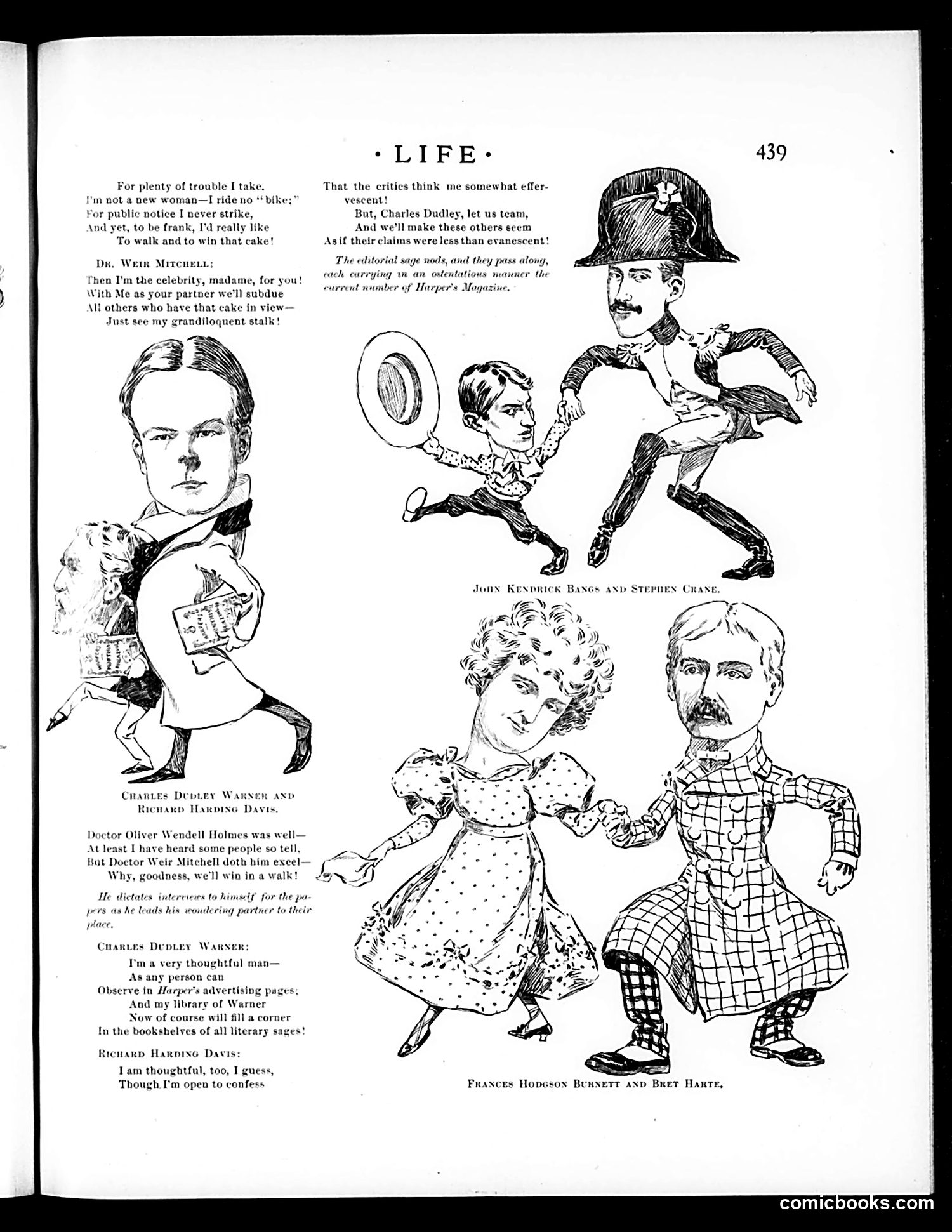
This page features satirical caricatures of literary and theatrical figures, labeled with their names. The left side shows **Charles Dudley Warner and Richard Harding Davis** in a back-to-back pose, with accompanying verse mocking their self-regard as literary figures destined for bookshelves. The upper right depicts **John Kendrick Bangs and Stephen Crane** in exaggerated poses, apparently satirizing their public personas or dramatic tendencies. Below them, **Frances Hodgson Burnett and Bret Harte** are caricatured in period dress, though the specific satirical point is unclear without additional context. The page appears to lampoon contemporary writers' pretensions to literary importance and their public self-presentation, a common theme in Life's satirical commentary on cultural figures of the era.
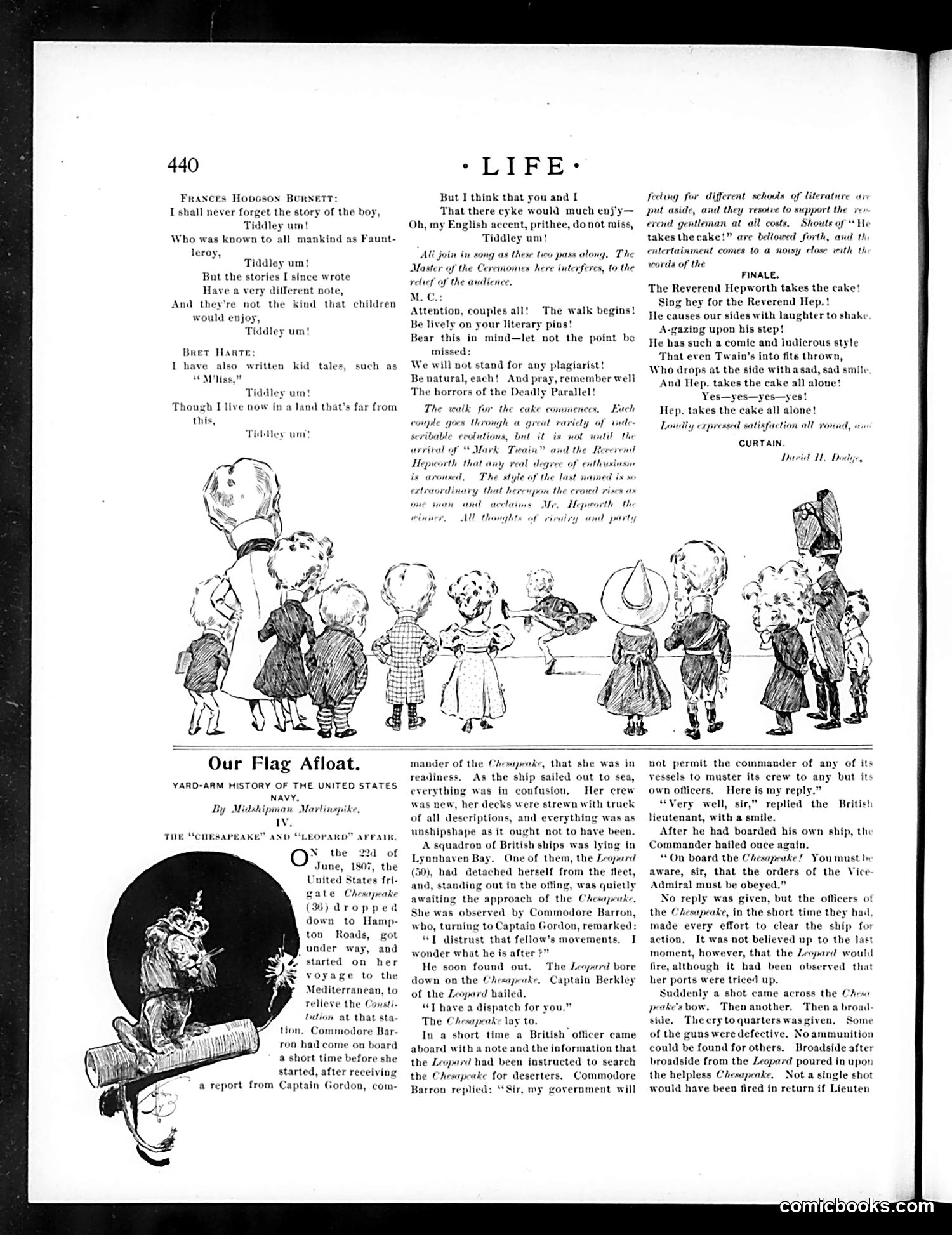
This page combines literary commentary with historical narrative. The top section features a dialogue among **Frances Hodgson Burnett, Bret Harte**, and others debating children's literature—specifically whether "Tiddley um!" represents quality writing. The speakers critique works by Mark Twain and Reverend Hypoeth, praising their comic, engaging style that captivates audiences. Below is "Our Flag Afloat," a historical account of the USS Chesapeake during the War of 1812. It describes a naval encounter where a British ship's crew attempted to board the American vessel, resulting in confusion and failed coordination. The text emphasizes the chaotic nature of early 19th-century naval warfare and British-American tensions during this period. A decorative naval emblem illustrates the historical narrative.
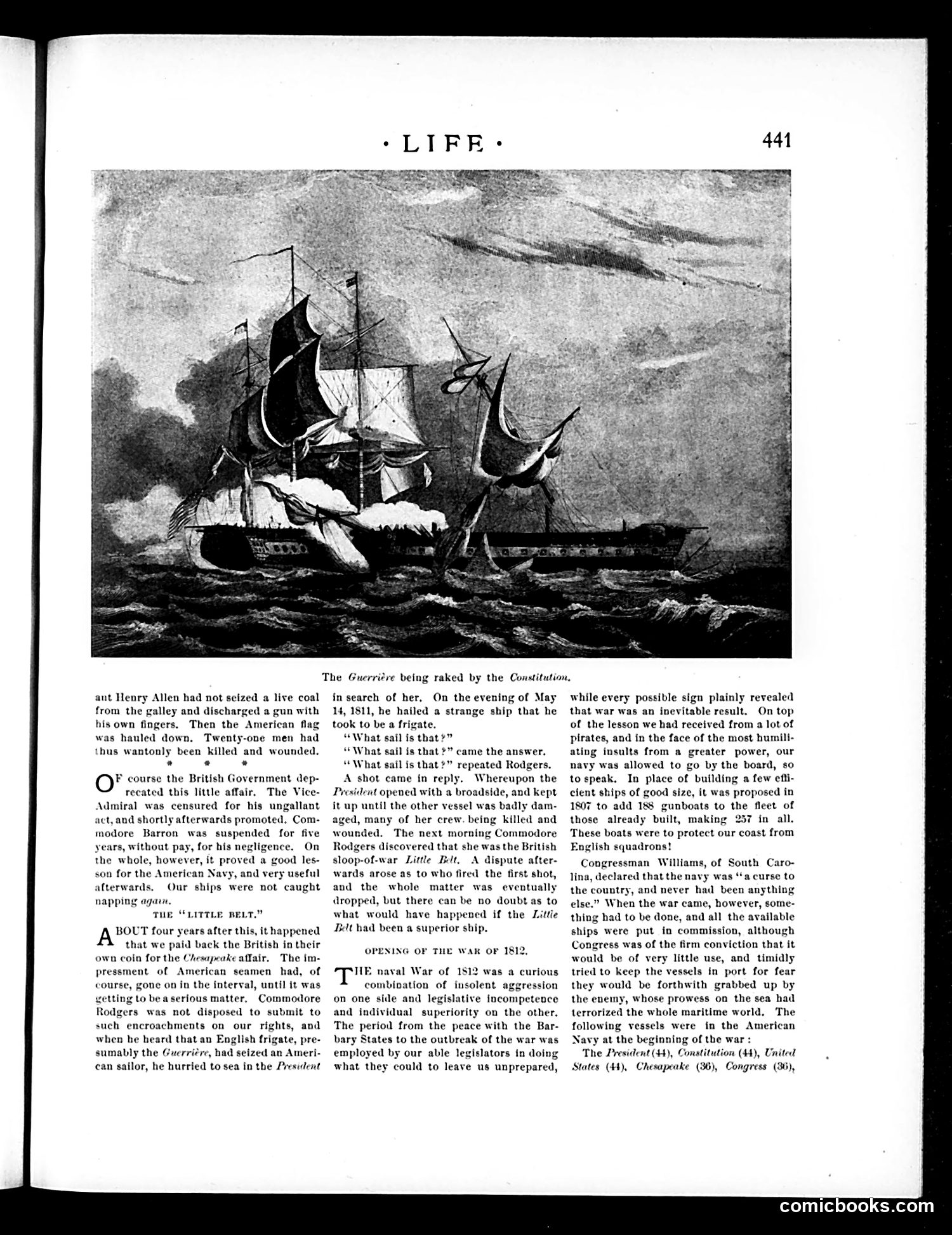
This page illustrates the naval Battle of the Guerrière and Constitution during the War of 1812. The engraving shows the British ship *Guerrière* being "raked" (fired upon from an advantageous angle) by the American frigate *Constitution*. The text describes how American Captain Henry Allen encountered a British vessel on May 14, 1811, which proved to be the *Little Belt*—a minor engagement that foreshadowed larger conflicts. The main narrative details Commodore Rodgers discovering the British ship-of-war *Little Belt*, ultimately leading to the opening engagements of the 1812 war. The article emphasizes American naval superiority and patriotic pride in American warship capability, presenting this victory as proof of American naval prowess against British maritime dominance.
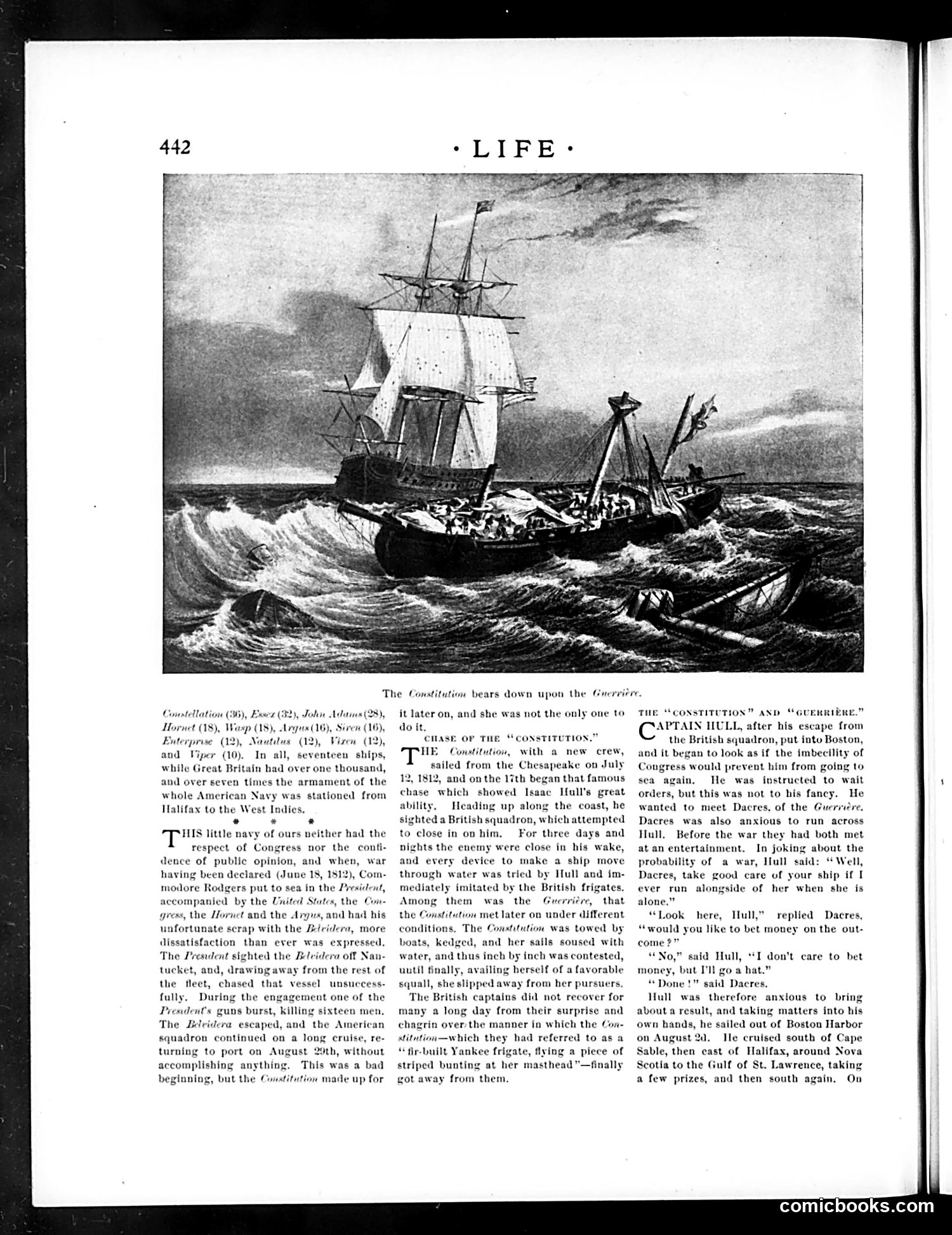
This page from *Life* magazine contains a historical engraving depicting "The Constitution bears down upon the Guerriere" — a naval engagement during the War of 1812. The accompanying text recounts the famous chase and battle between the American frigate USS *Constitution* and British frigate HMS *Guerrière*. The narrative focuses on Captain Isaac Hull's command of the *Constitution*, detailing the multi-day pursuit and eventual escape from a British squadron. The text emphasizes American naval prowess and Hull's tactical skill, presenting the encounter as a triumph of American seamanship. This is not political satire but rather historical narrative and illustration celebrating an early American naval victory—a patriotic account suited to *Life*'s audience during a period when such military history held cultural significance.
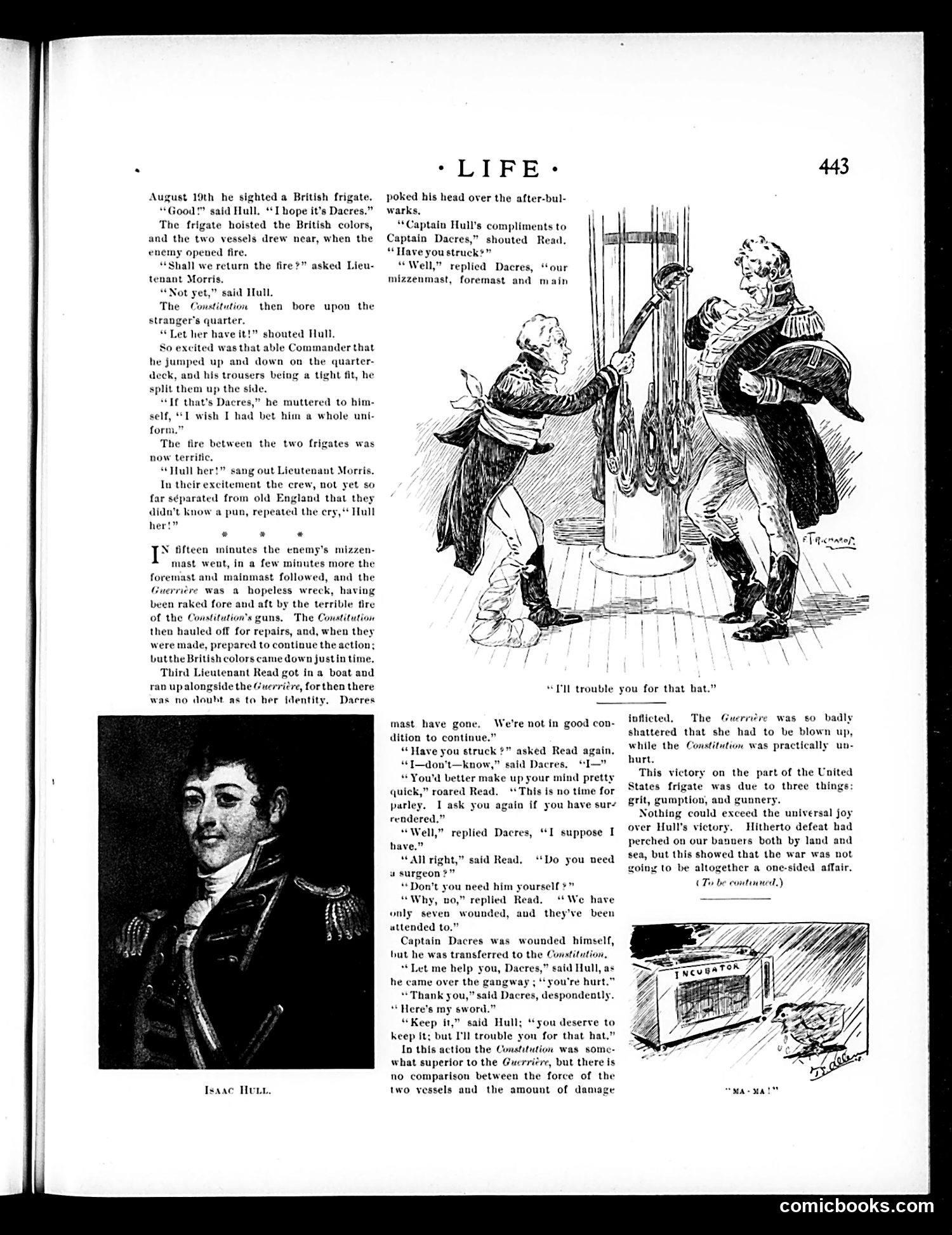
This page recounts a naval engagement during what appears to be the War of 1812, featuring the American frigate *Constellation* defeating the British frigate *Guerrière*. The text includes dialogue between Captain Isaac Hull (whose portrait appears on the left) and his officers during combat. The main cartoon depicts two naval officers in heated conversation aboard ship, with one appearing to offer his sword to the other—likely illustrating a moment of tension or honor between commanders. The smaller cartoon at bottom right labeled "Ma-Ma" appears to be an unrelated domestic humor sketch. This content celebrates American naval victory and heroism, presenting Hull as a bold, witty commander—patriotic content typical of Life's early historical narratives.
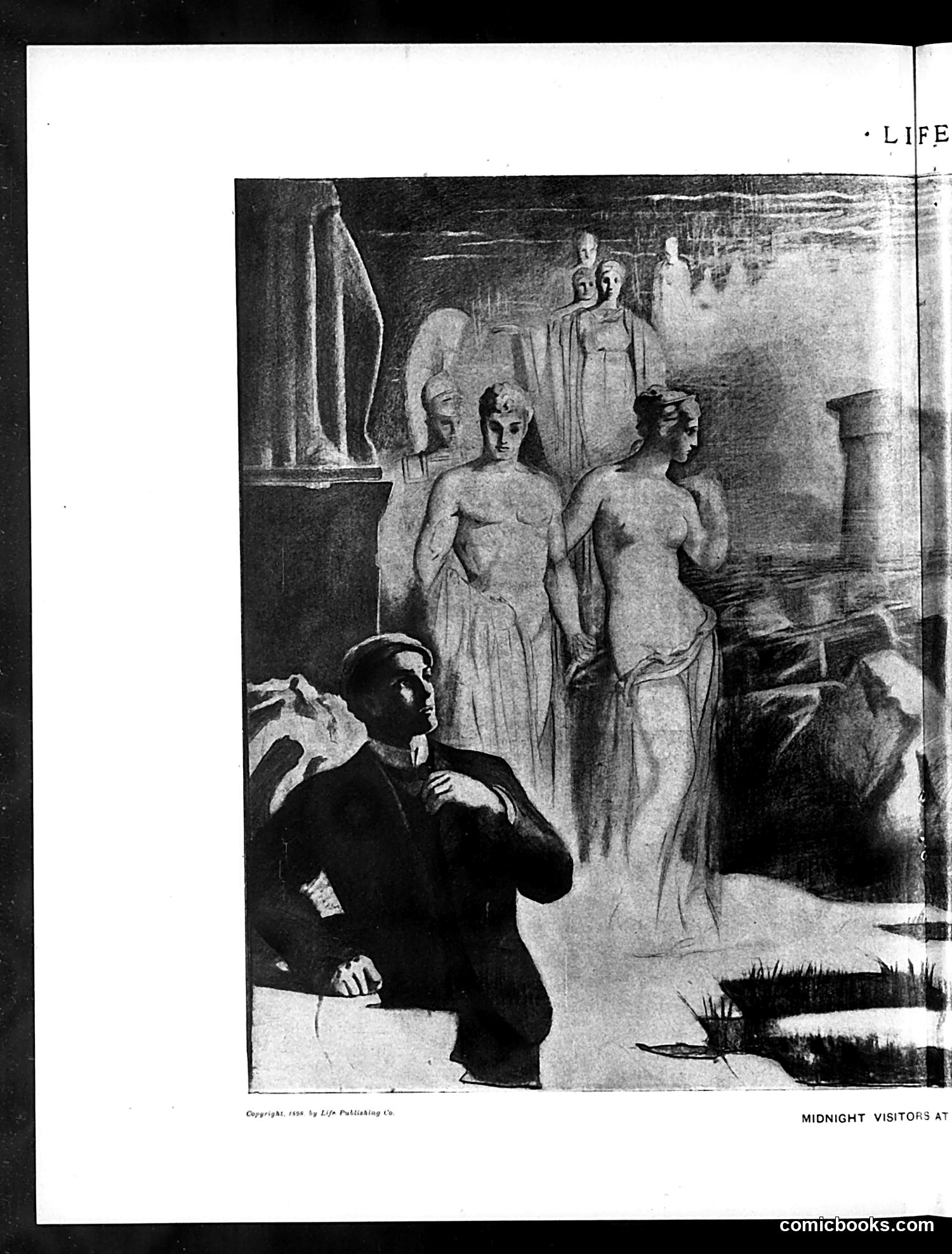
This appears to be a satirical illustration titled "Midnight Visitors At..." (title cut off). The image depicts a well-dressed man in dark clothing gesturing toward or addressing a group of classical female figures in robes—appearing as statues or allegorical representations. The satire likely criticizes a prominent public figure (the man) for his relationship with classical art, aesthetics, or ideals—perhaps mocking pretension, corruption of classical values, or improper conduct. The "midnight visitors" framing suggests secretive or scandalous activity. Without the complete title and publication date visible, the specific political or social reference remains unclear. The classical female figures suggest commentary on idealism versus reality, or possibly commentary on how a particular public figure has compromised or exploited cultural institutions or values.
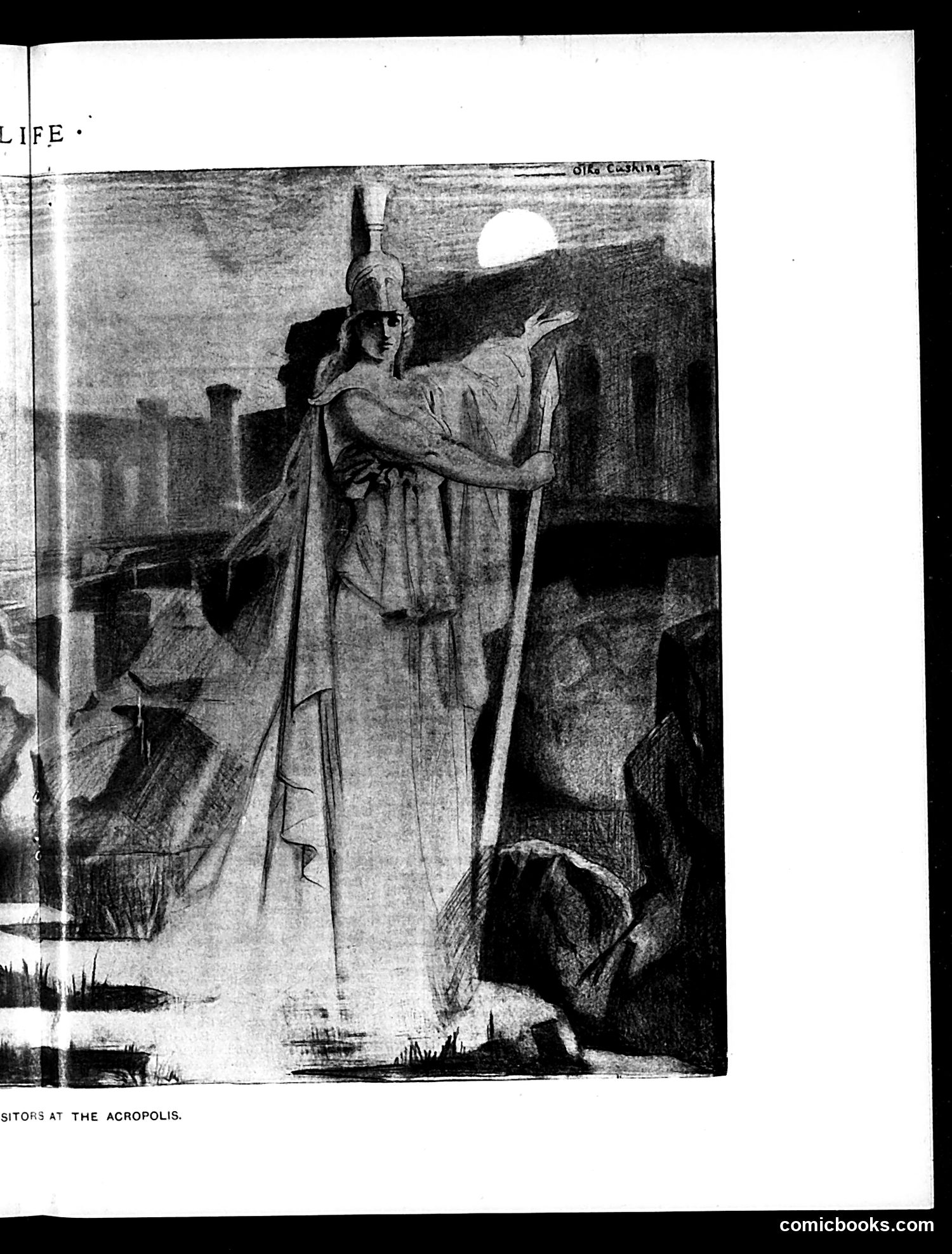
This illustration depicts a classical Greek sentinel or warrior standing guard at the Acropolis in Athens, shown against a moonlit backdrop of ancient ruins. The figure wears period military dress with a distinctive helmet and holds a spear. The satire likely comments on tourism or cultural reverence for classical antiquity—a common theme in early 20th-century Life magazine. The "visitor" framing (though the caption emphasizes the *guard* rather than tourists) may mock either: tourists' romanticized view of ancient Greece, or ironically contrast modern visitors with the serious historical sentinels who once protected these monuments. Without additional context or visible byline, the precise satirical target remains unclear, though the work exemplifies Life's use of classical imagery for contemporary social commentary.
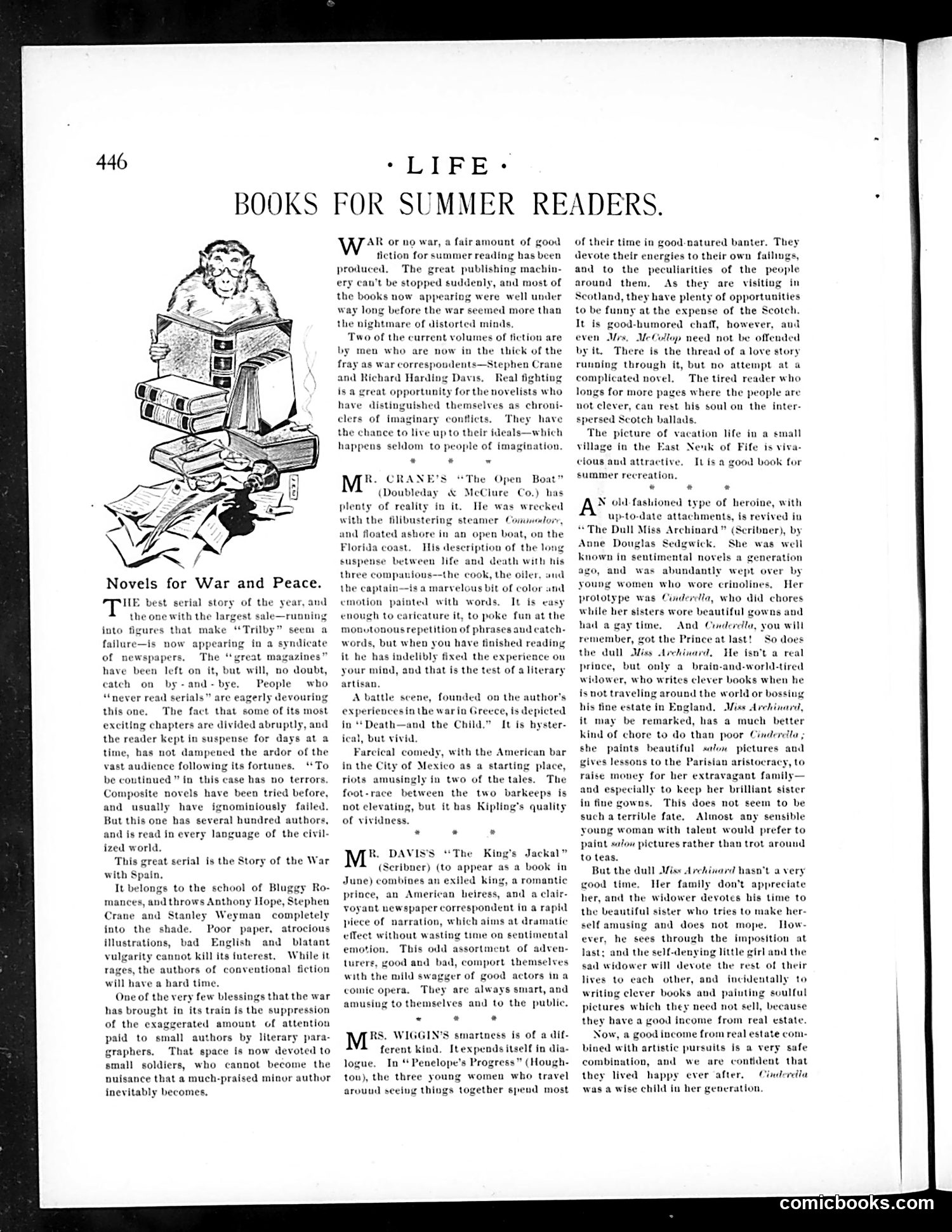
This page reviews summer fiction of 1898, notably during the Spanish-American War. The illustration shows a figure reading multiple books—a visual pun on "summer reading." **Key satirical point**: The opening section mocks how the actual Spanish-American War has become the most gripping "serial story" in America, surpassing even popular novels like *Trilby*. Life jokes that this real conflict, with its suspenseful delays and massive audience, has inadvertently become better entertainment than published fiction—written by "several hundred authors" (war correspondents and newspapers). **Literary references reviewed**: - Stephen Crane's *The Open Boat* (based on his shipwreck experience) - Richard Harding Davis's *The King's Jackal* - Works featuring war and adventure themes The satire suggests that actual war news has eclipsed conventional fiction, while also acknowledging that combat reporting by established novelists (Crane, Davis) lends literary credibility to their accounts of real events versus imagined conflicts.
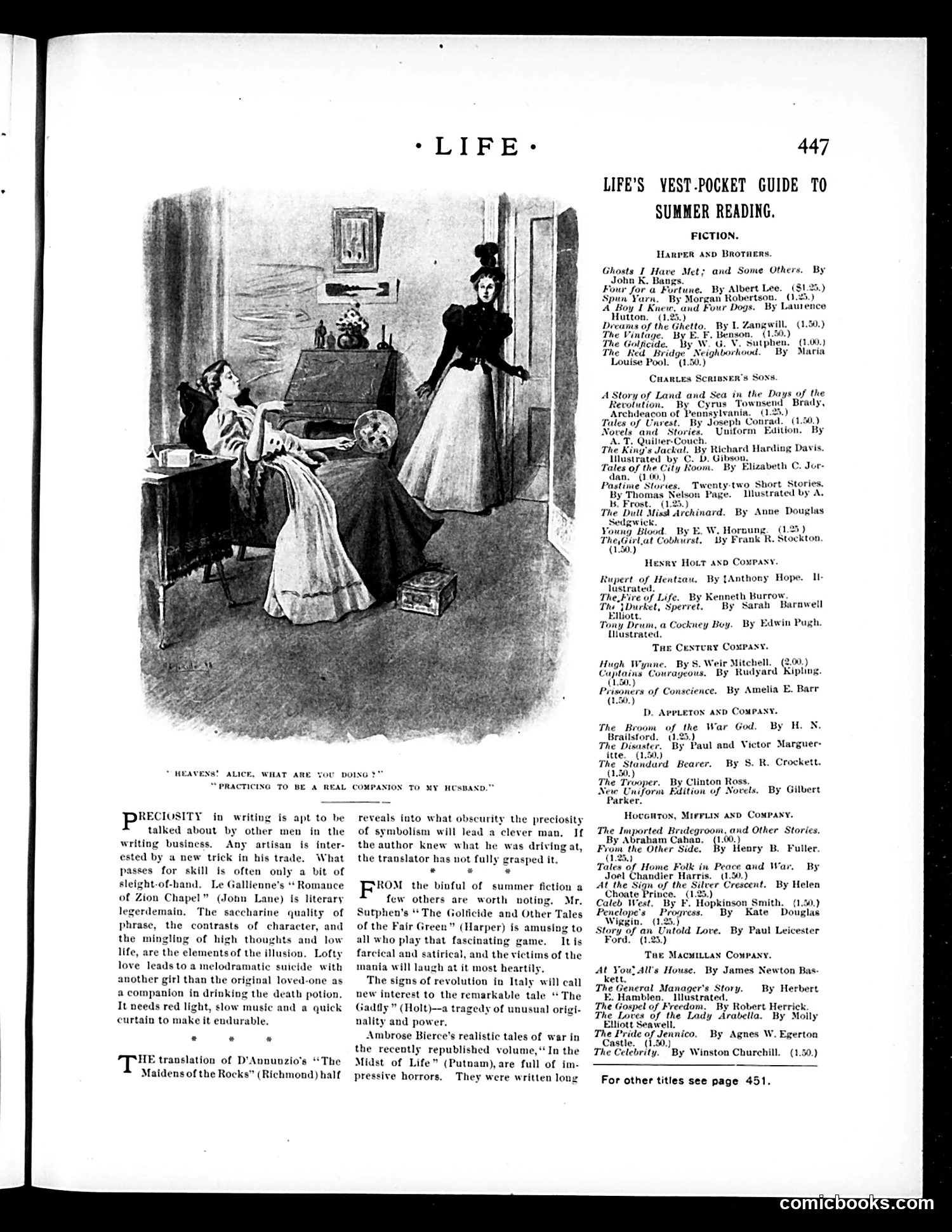
This is a book review and summer reading guide from *Life* magazine. The small illustration depicts a domestic scene with the caption "Heavens' Alice, what are you doing?" / "Practicing to be a real companion to my husband." The cartoon gently satirizes contemporary marriage expectations—specifically, the idea that wives must actively "practice" companionship as a marital duty. This reflects turn-of-the-century gender dynamics where women were expected to be ornamental and emotionally supportive rather than intellectual equals. The page itself lists recommended fiction for summer reading, organized by publisher. The literary commentary above criticizes affected writing styles ("preciosity" and "symbolism") while praising realism, particularly Ambrose Bierce's war stories. The cartoon's humor lies in its mild critique of prescribed gender roles—the wife's dutiful "practice" of wifehood as a learned performance rather than natural behavior.
This page contains book reviews and literary commentary, not political cartoons. The main text discusses travel literature, comparing historical figures (notably philosopher Kant, who traveled only through reading) with contemporary adventurers like Harry de Windt and Hugh Willoughby who explored Alaska and Florida respectively. The satire is gentle: the reviewer mocks the modern publishing glut—how easy it's become to write and publish books about travel adventures—contrasting this with Kant's era when travel narratives were rarer and more valued. The reviewer also humorously notes that these modern adventurers seem to *enjoy* their hardships (sleeping in bags, eating canned goods in disease-ridden swamps), viewing deprivation as noble rather than unpleasant. The right-hand page advertises Harper's Magazine for June, promoting articles on Cuban diplomacy, Chinese affairs, naval subjects, and Russian society. The decorative header features a classical caduceus symbol.
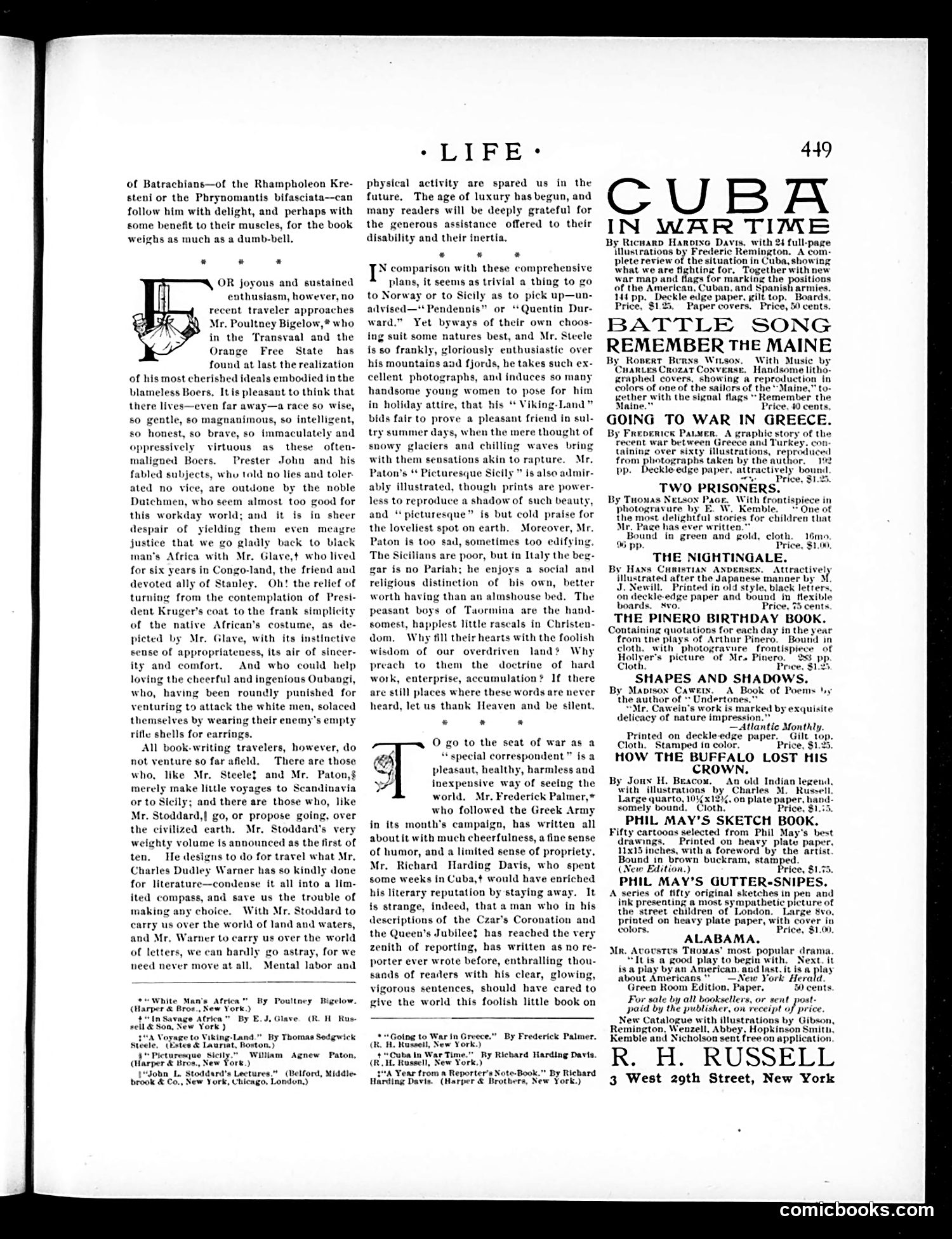
This page from *Life* magazine consists primarily of **book reviews**, not political cartoons. The reviewer discusses travel narratives and guides published recently, evaluating them for armchair travelers. The satire is subtle: the reviewer praises authors like **Poultney Bigelow** (who romanticizes the Boers in South Africa) and **Charles Dudley Warner** (who "condensed" literature), while gently mocking the trend of vicarious tourism. The joke culminates in praise for **John L. Stoddard's Lectures**—a multivolume compendium designed to let readers experience "the world of land and waters" without leaving home. The reviewer's final barb suggests modern readers need not exert themselves physically or mentally; "the age of luxury has begun." This critiques both the commercialization of travel writing and the leisured class's preference for passive consumption over genuine experience—a common *Life* magazine satirical target during this era (appears to be 1890s-1900s).
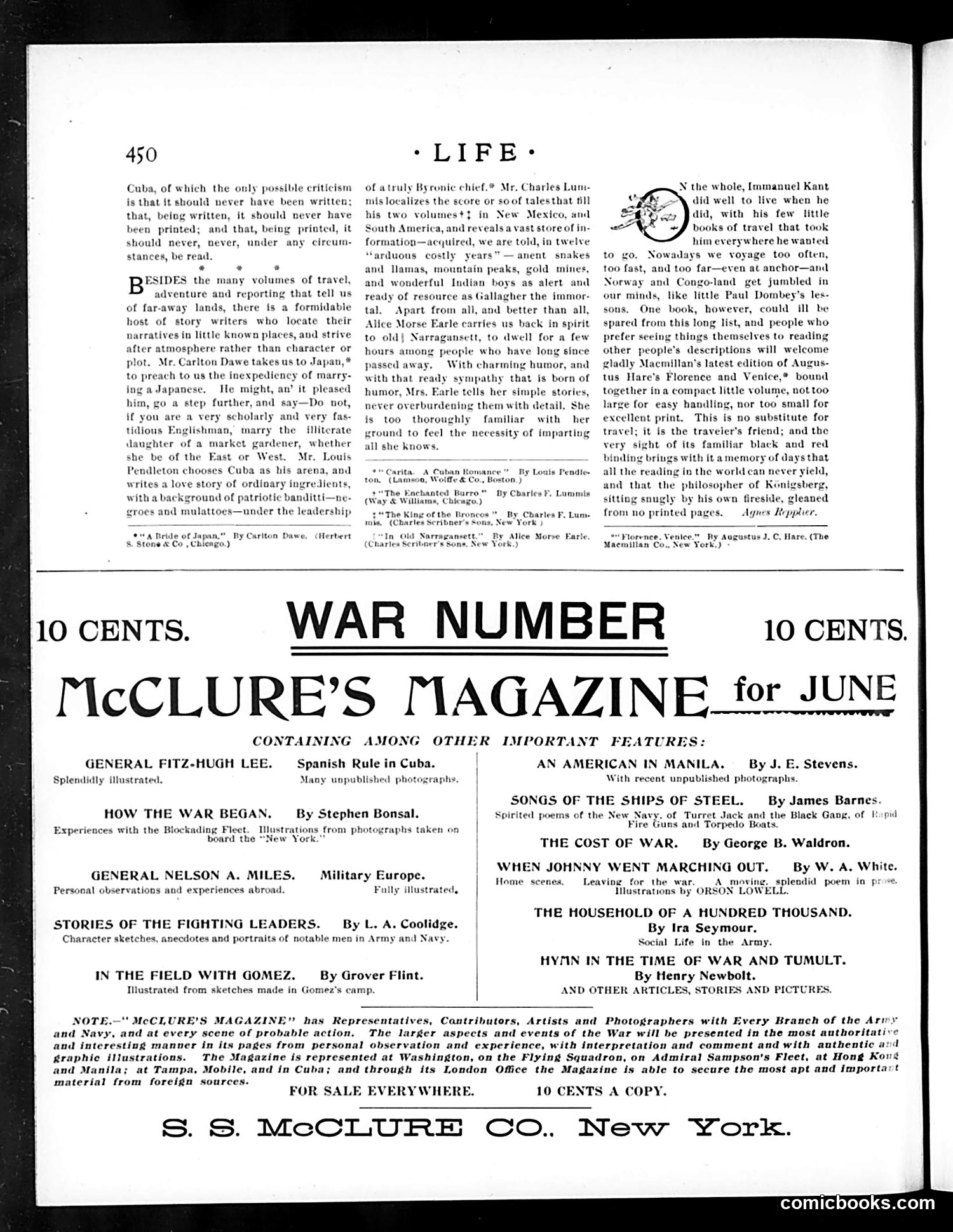
This is a back-cover advertisement for **McClure's Magazine**, announcing its "War Number" for June (likely 1898, during the Spanish-American War). The page costs 10 cents. The top section contains brief literary criticism about travel writing—dismissing some adventure novels set in exotic locations (Cuba, Japan, New Mexico) as poorly written, while praising Alice Morse Earle's historical work on Narragansett and Augustus Hare's guides to Florence and Venice. The critic (Agnes Repplier) argues these books enhance—but cannot replace—actual travel experience. The magazine's contents emphasize **military themes**: articles on General Fitz-Hugh Lee, an American officer in Manila, naval poetry ("Songs of the Ships of Steel"), and war costs. This reflects contemporary American imperial expansion and the Spanish-American War conflict. The page is essentially a sales pitch, not political satire.
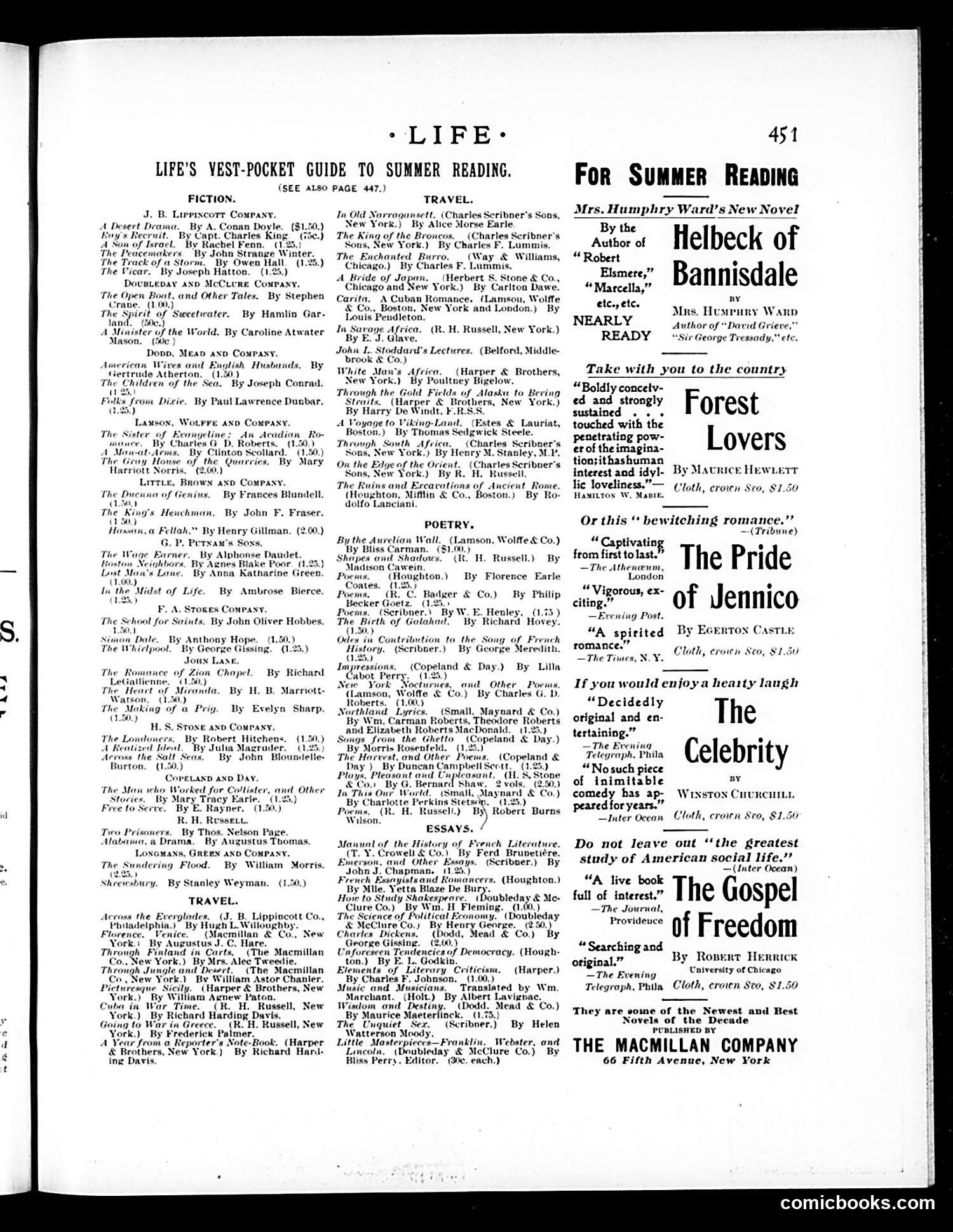
This is a satirical dialogue—not a political cartoon—depicting the chaos of amateur theatrical production. The humor targets the unreasonable demands of actors and the impossible compromises a stage manager must make. The sketch shows various performers (Miss Russell-Portman, Lady Beauclere, Mr. Deedes, etc.) making contradictory, self-centered requests: a pianist insists on playing in evening dress despite no space for a piano; actors refuse to work with certain cast members; performers argue about how to stage deaths or wear costumes. The satire mocks both amateur thespians' pretensions and the thankless position of stage management. The dialogue captures authentic theatrical absurdity—the collision between artistic ego and practical limitations. The page is otherwise filled with period advertisements (clothing, bicycles, whiskey), typical of Life magazine's format.
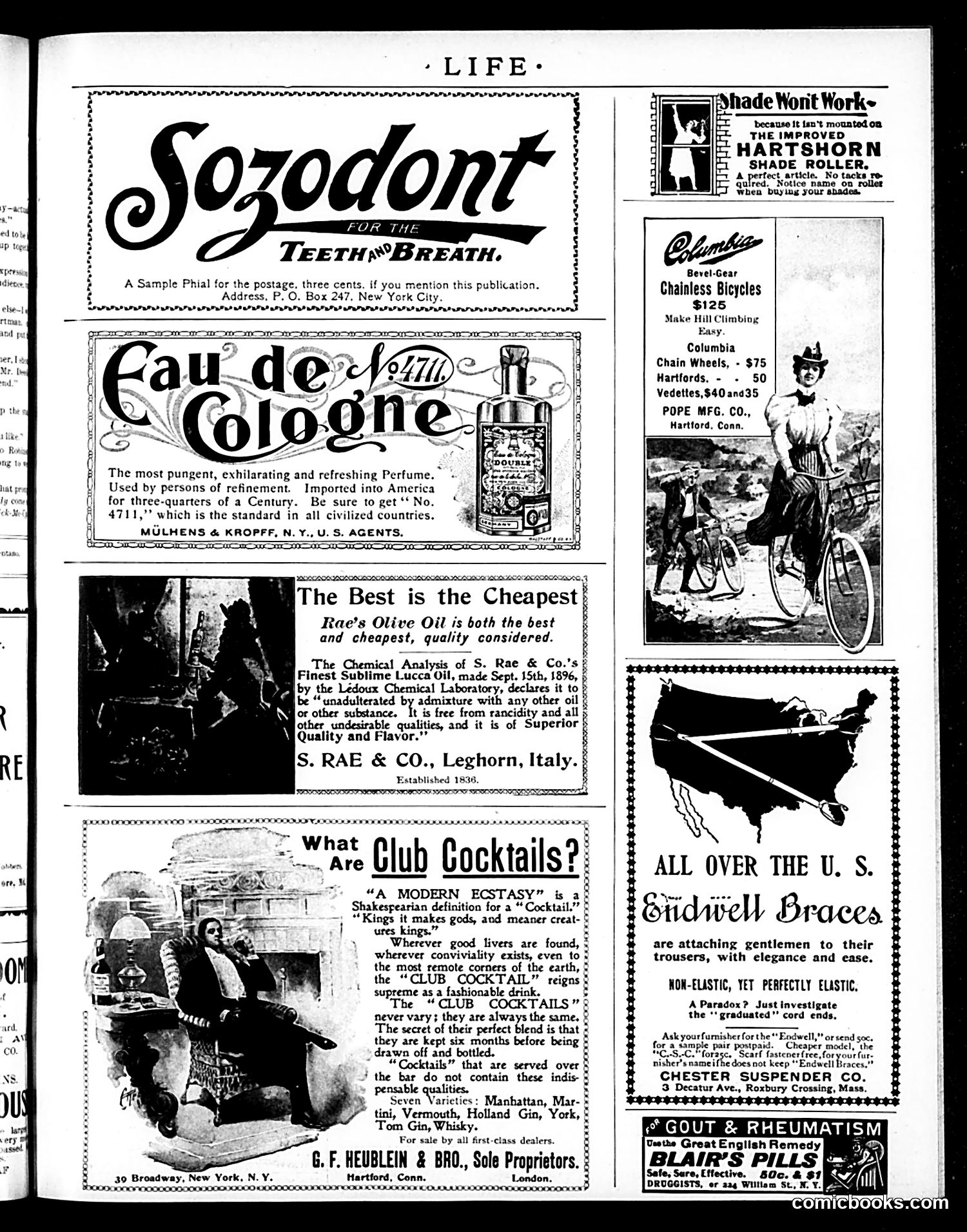
This is primarily an **advertising page** from Life magazine, not a satirical cartoon page. It contains various product advertisements from the late 1890s, including: - **Sozodont** (toothpaste/breath freshener) - **Eau de Cologne** perfume - **Rae's Olive Oil** (with chemical analysis claims) - **Club Cocktails** by Heublein & Bros. - **Columbia bicycles** - **Endwell Braces** (trouser suspenders) - **Blair's Pills** (for gout/rheumatism) The "What Are Club Cocktails?" section includes a mock-Shakespearean definition, suggesting gentle humor about cocktail culture among the fashionable set. Otherwise, the page reflects **consumer goods marketed to affluent, refined Americans** of the era—emphasizing quality, imported sophistication, and health claims typical of the period. There are no political cartoons or significant satirical commentary visible.
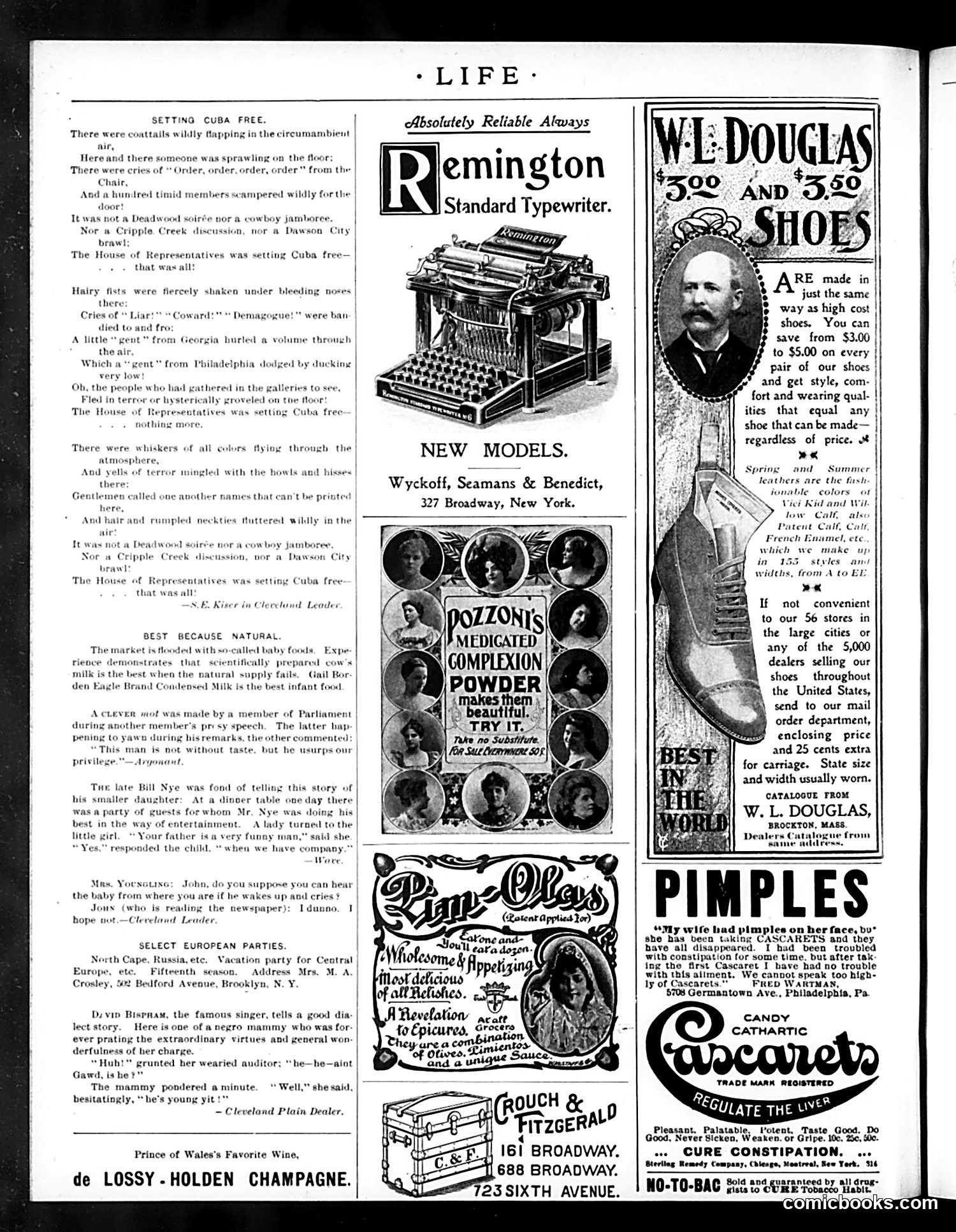
This page's main content is a satirical poem mocking the U.S. House of Representatives during debate over Cuban independence. The text describes the chamber in complete disorder—members shouting "Order!", throwing objects, shaking fists, yelling accusations of "Liar!" and "Coward!" The satire's point: Congress was behaving like a brawl (compared to "a Deadwood soirée" or "cowboy jamboree") while debating what should be a serious matter of state—freeing Cuba from Spanish rule. The repeated refrain "that was all" emphasizes the absurdity: despite this chaotic theater, the actual accomplishment was simply "setting Cuba free." This likely references the 1898 Spanish-American War period when Cuban independence dominated Congressional debate. The cartoon ridicules representatives as undignified and performative—more concerned with theatrical posturing than substantive governance. The page is otherwise advertisements (typewriters, shoes, patent medicines).
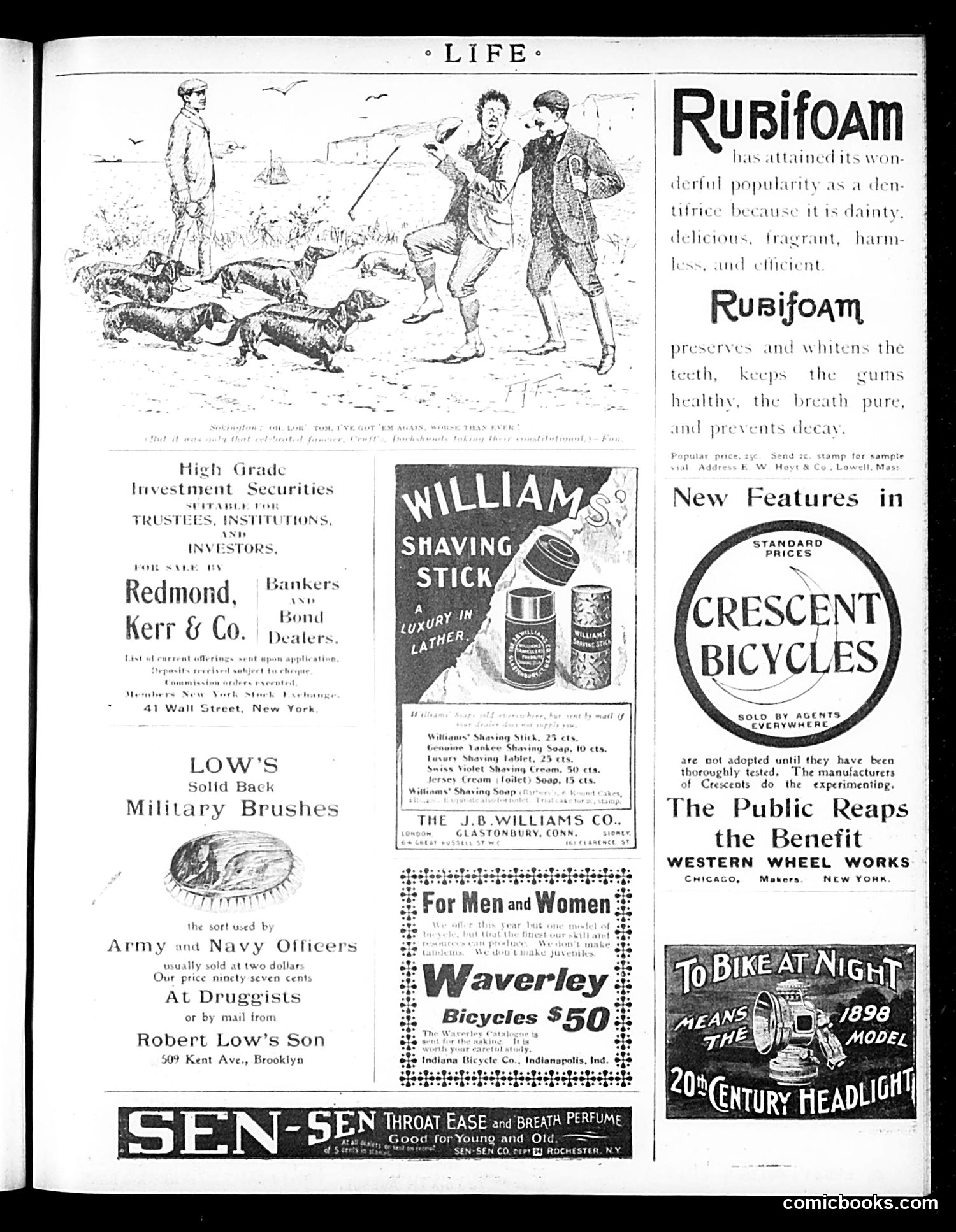
This is primarily an **advertising page** rather than satirical content. The page features multiple product advertisements typical of early 20th-century magazines: The prominent cartoon at top left depicts a seaside scene with gentlemen and dachshund dogs, likely illustrating a humorous social scenario—possibly commentary on leisure activities or fashion among the wealthy, though the exact joke is unclear without additional context. The bulk of the page advertises consumer products: **Rubifoam** toothpaste, **Williams' Shaving Stick**, **Low's Military Brushes**, **Waverley Bicycles** ($50), **Crescent Bicycles**, and a **Century Headlight** for bikes. The advertisements emphasize quality, affordability, and endorsement by institutions (military officers, trustees). This reflects advertising strategy of the era: building consumer confidence through authority figures and comparative pricing. The page demonstrates how Life magazine, while known for satire, relied heavily on advertising revenue—a common practice that subsidized publication costs.
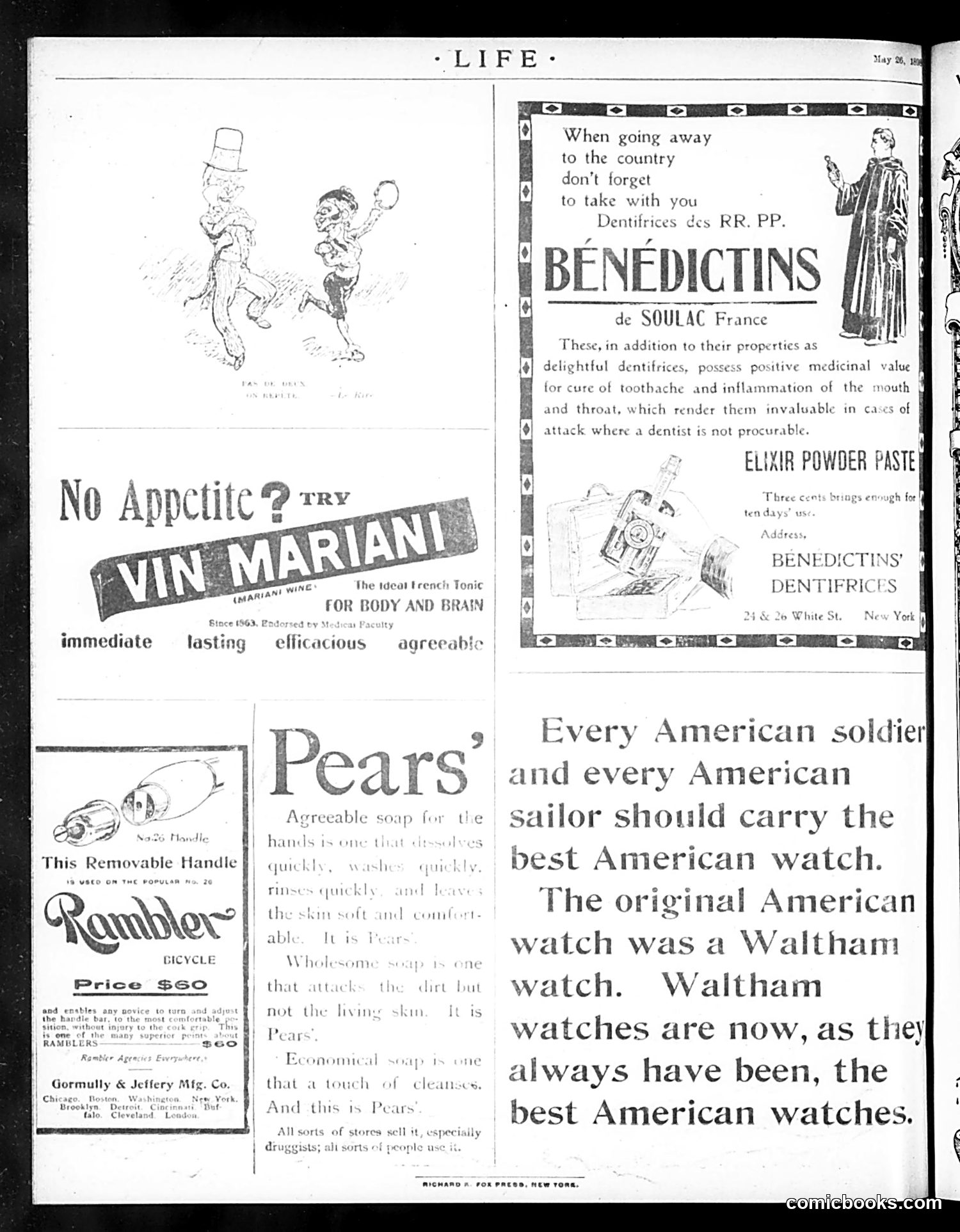
This page is primarily **advertisements** rather than political cartoons. The small sketch at top-left appears to be a generic illustration of two figures in motion, unrelated to specific satire. The advertisements reflect early 1900s consumer culture: - **Vin Mariani**: A French wine tonic marketed as a health cure-all ("for body and brain") - **Benedictins toothpaste**: A French dentifrice sold as a substitute when dentists are unavailable - **Pears' soap**: Advertised with medicinal/hygienic claims - **Ramblers bicycle**: Priced at $60, marketed as a "removable handle" innovation - **Waltham watches**: Patriotic appeal to American soldiers and sailors, emphasizing American manufacturing The content reflects **pre-WWI American commercial attitudes**—foreign imports marketed as luxury goods, health products making exaggerated medicinal claims (pre-FDA regulation), and competitive appeals to American patriotism in manufacturing. There is no evident political satire; this is straightforward period advertising.