
Life, 1898-05-26 · page 4 of 24
Life — May 26, 1898 — page 4: what you’re looking at
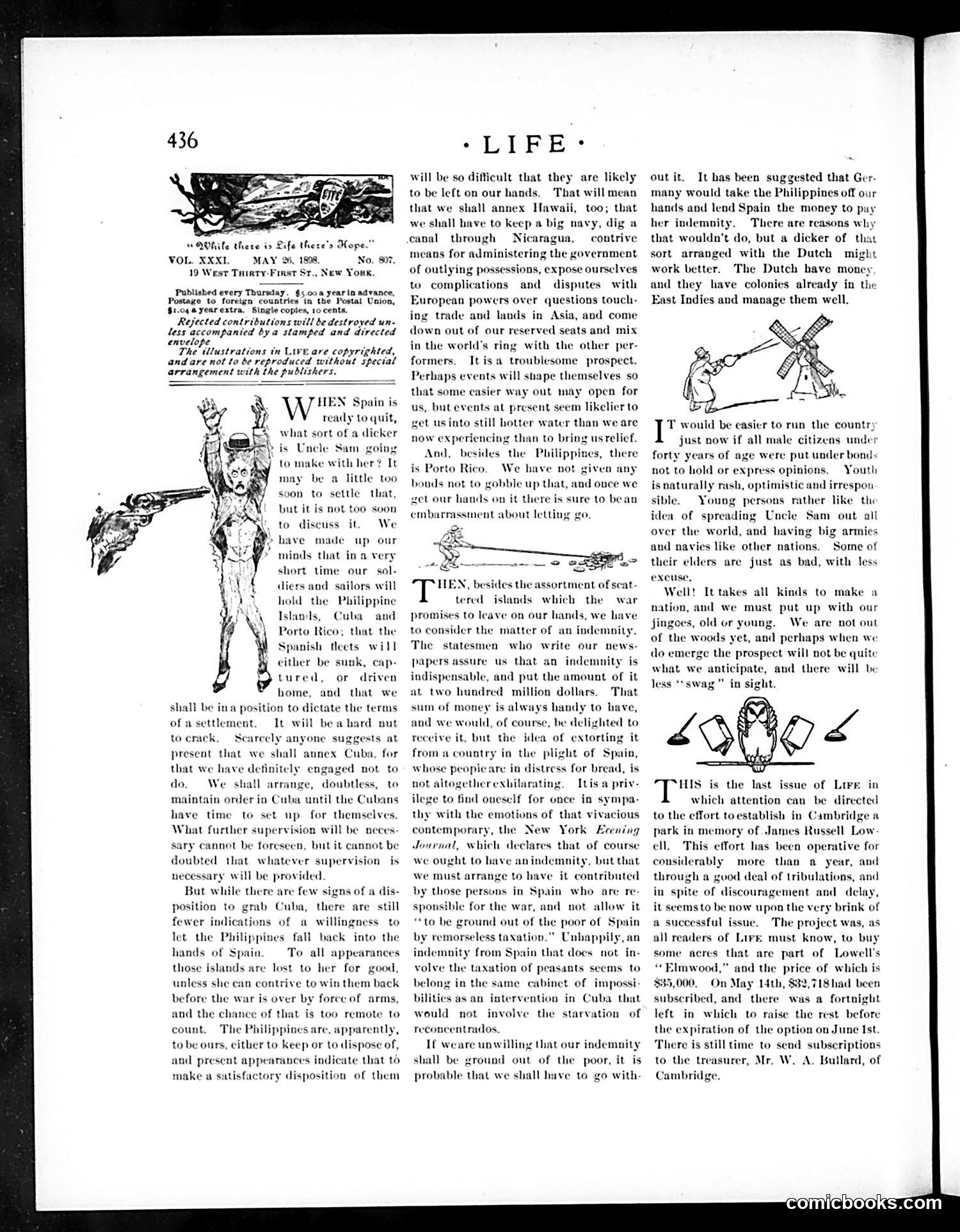
A restored page from Life, 1898-05-26. Page through the whole issue in the reader above.
📄 Transcribed text from this page (OCR, searchable)
Machine-transcribed from the original scan — historical spelling and the odd misread are preserved.
NOhife there is Life there's Hope.” VOL. XXXI. MAY 2%, 1898. No. 807. 19 West Trirty-Finst St., New York. Published every Thursday. 5.008 yearin advance, Postage to foreign countries in the Postal Union, $t.cgayear extra. Single copies, 10 centa. Rejected contributions will be destroyed un- less accompanied bya stamped and directed envelope The illustrations in Live are copyrighted, and are not to be reproduced without special arrangement with the publishers. HEN Spain is ready to quit, what sort of a dicker >is Uncle Sam going to make with her? It may be a little too soon to settle that, but it is not too soon We our to discuss it. have made up minds that ina very short time our sol- diers and sailors will hold the Philippine Islands, Cuba and Porto Rico; that the Spanish tleets will cither be sunk, cap- tured, or home, and driven that ion to dictate the terms of ascttlement. It will bea hard nut to crac Scarcely anyone suggests at present that we shall aunex Cuba, for that we have detinite d not to do. We shall arrange, doubtless, to maintain order in Cuba until the Cubans have time up for themsel we shall be ina posi enga to set What further supervision will be neces sary cannot be foreseen, but it cannot be doubted that whatever super necessary will be provided But while there are few si, position to grab Cuba, there are. still ns of a dis- fewer indications of a willingness to let the Philippines fall back into the hands of Spain. To all appearances those islands are lost to her for good, unless she can contrive to win them back before the war is over by force of arms, and the chance of that is too remote to count. The Philippines are, apparently, to be ours, cither to keep or to dispose of, ate that to n of them and present appearances ind make a satisfactory disposi *LIFE: will be so difficult that they are likely to be left on our hands. That will mean that we shall annex Hawaii, too; that we shall have to keep a big navy, dig a canal through Nicaragua, contrive means for administering the government of outlying possessions, expose ourselves to complications and disputes with European powers over questions touch- ing trade and lands in Asia, and come down out of our reserved seats and mix in the world’s ring with the other pe! formers. It isa troublesome prospect. Perhaps events will shape themselves so that some easier way out may open for us, butevents at present seem likclier to get usinto still hotter water than we are now experiencing than to bring usrelie And, besides the Philippines, there is Porto Rico. We have not given any bonds not to gobble up that, and once we tour hands on it there is sure to bean embarrassment about letting ¢ N, besides the assortment of scat tered i which the war promises to leave on our hands, we bi to consider the matter of an indemnity The statesmen who write our new: papers assure us that an indemnity is indispensable, and put the amount of it at two hundred million dollars. That sum of money is always handy to have, and we would, of course, be delighted to receive it, but the idea of extorting it from a country in the plight of Spain, whose peopicare in distress for bread, is not altogetherexbilarating. [tis a priv- ilege to find oneself for once in sympa- thy with the emotions of that vivacious contemporary, the New York Evening yurnal, Which declares that of course we ought to have anindemnity, but that we must arrange to have it contributed by those persons in Spain who are re- sponsible for the war, and not allow it “to be ground out of the poor of 8 by remorse! lands 8s taxation.” Unhappily, an indemnity from Spain that does not in- volve the taxation of peasants belong in the same bilities as an intervention in Cuba that would not involve the starvation of reconcentrados. ems to abinet of impossi If weare unwilling that our indemnity shall be ground out of the poor, it is probable that we shall have to go with outit. It has been suggested that Ger. many would take the Philippines off our hands and lend Spain the money to pay her indemnity. There are reasons wh that wouldn't do, but a dicker of that sort arranged with the Dutch might work better. The Dutch have money and they have colonies already in the East Indies and manage them well. would be easier to run the country just now if all male citizens under forty years of age were put under bonds not to hold or express opinions. Youth isnaturally rash, optimistic and irrespou Young persons rather like thi of spreading Uncle Sam out all over the world, and having big armies and navies like other natior ome of their elders are just as bad, with less excuse, Well! It takes all kinds to make a nation, and we must put up with our jingoes, old or young. We are not out of the woods yet, and perhaps when we do emerge the prospect will not be quite what we anticipate, and there will be less “swag” in sight. HIS is the last issue of Lire in which attention can be directed to the effort toestablish in Cambridge a park in memory of James Russell Low cll. This effort has been operative for considerably more than a year, and throu a good deal of tribulations, and in spite of discouragement and delay, it seems to be now upon the very brink of a successful issue. The project was, as all readers of Lire must know, to buy some acres that are part of Lowell's Imwood,” and the price of which is $35,000. On May Mth, $32,718had been subscribed, and there was a fortnight left in which to ra the rest before the expiration of the option on June 1st. There is still time to send subscriptions to the treasurer, Mr. W. A. Bullard, of Cambridge.