
Life, 1898-05-26 · page 16 of 24
Life — May 26, 1898 — page 16: what you’re looking at
What you’re looking at
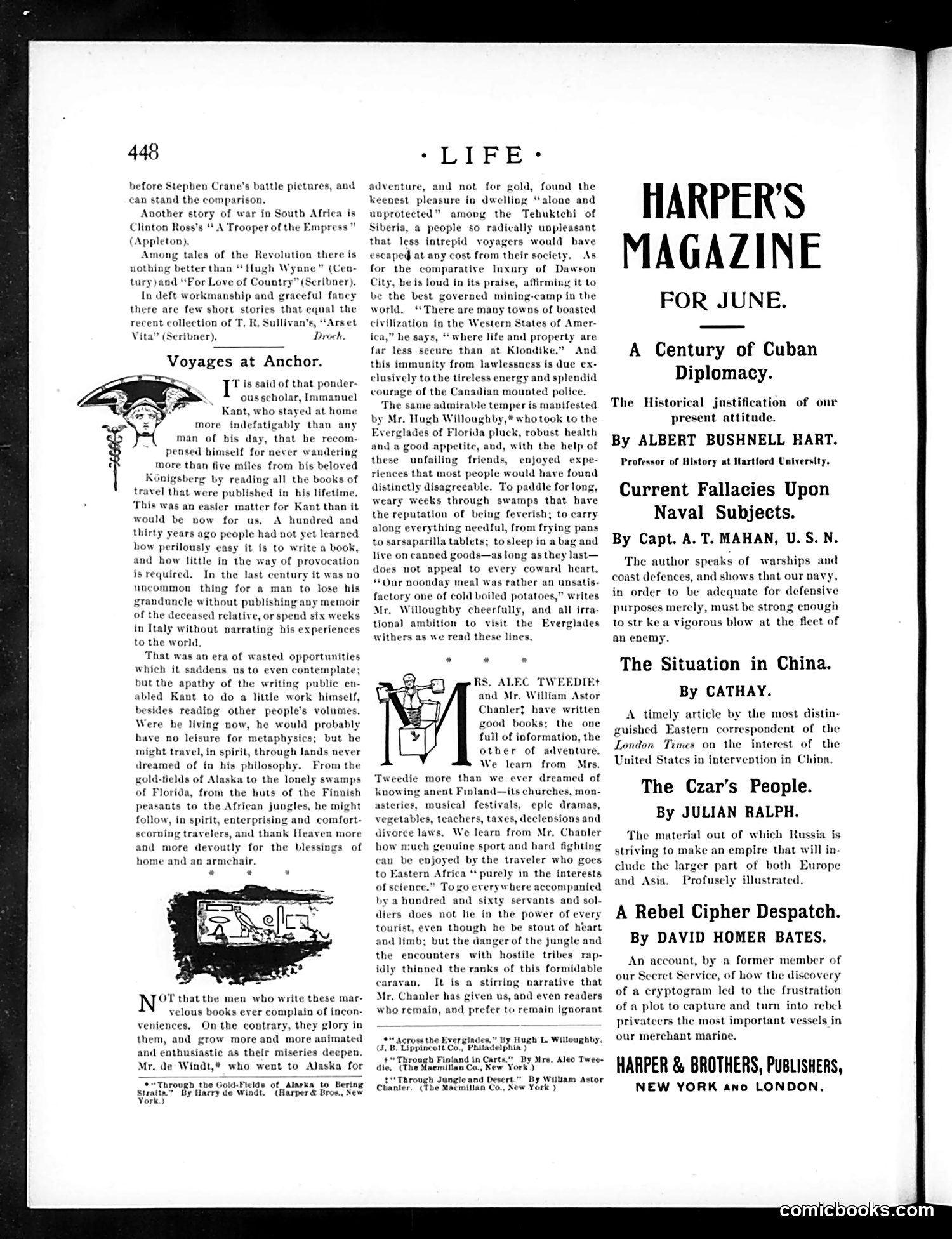
This page contains book reviews and literary commentary, not political cartoons. The main text discusses travel literature, comparing historical figures (notably philosopher Kant, who traveled only through reading) with contemporary adventurers like Harry de Windt and Hugh Willoughby who explored Alaska and Florida respectively. The satire is gentle: the reviewer mocks the modern publishing glut—how easy it's become to write and publish books about travel adventures—contrasting this with Kant's era when travel narratives were rarer and more valued. The reviewer also humorously notes that these modern adventurers seem to *enjoy* their hardships (sleeping in bags, eating canned goods in disease-ridden swamps), viewing deprivation as noble rather than unpleasant. The right-hand page advertises Harper's Magazine for June, promoting articles on Cuban diplomacy, Chinese affairs, naval subjects, and Russian society. The decorative header features a classical caduceus symbol.
📄 Transcribed text from this page (OCR, searchable)
Machine-transcribed from the original scan — historical spelling and the odd misread are preserved.
448 before Stephen Crane’s battle pictures, an can stand the comparison. Another story of war in South Africa is Clinton Ross's “A Trooper of the Empress ” (Appleton), Among tales of the Revolution there is nothing better than “Hugh Wynne” (Cen- tury)and “For Love of Country” (Scribner), In deft workmanship and graceful fancy there are few short stories that equal the recent collection of T. R. Sullivan's, “Ars et Vita” (Scribner), Droch. Voyages at Anchor. I’ is said of that ponder- ous scholar, Immanuel — Kant, who stayed at home i more indefatigably than any man of bis day, that he recom- pensed himself for never wandering more than five miles from his beloved Konigsberg by reading all the books of travel that were published in his lifetime. This was an easier matter for Kant than it would be now for us, A hundred and thirty years ago people had not yet learved how perilously easy it is to write a book, and how little in the way of provocation is required. In the last century it was no uncommon thing for a man to lose his granduncle without publishing any memoir of the deceased relative, or spend six weeks in Italy without narrating his experiences to the world. That was an era of wasted opportunities which it saddens us to even contemplate; but the apathy of the writing public en- abled Kant to do a little work himself, besides reading other people's volumes. Were he living now, he would probably bave no leisure for metaphysics; but he might travel, in spirit, through lands never dreamed of in his philosophy, From the -tields of Alaska to the lonely swamps of Florida, from the huts of the Finnish peasants to the African jungles, he might follow, in spirit, enterprising and comfort- scorning travelers, and thank Heaven more and more devoutly for the blessings of home and an arme! OT thatthe men who write these mar- velous books ever complain of incon- veniences, On the contrary, they glory in them, and grow more and more animated and enthusiastic as their miseries deepen. Mr. de Windt,* who went to Alaska for * "Through the Gold-Fielde of Alaska to Bering Straits.” By Harry de Windt, (Harper & Bros, New York.) *LIFE: adventure, aud not for gold, found the keenest pleasure in dwelling “alone and unprotected” among the Tebuktchi of Siberia, a people so radically unpleasant that less intrepid voyagers would have escaped at any cost from their society, As for the comparative Inxury of Dawson City, be is loud in its praise, affirming it to be the best governed mining-camp in the world. “There are many towns of boasted civilization in the Western States of Amer- ica,” he says, ‘where life and property are far less secure than at Klondike.” And this immunity from lawlessness is due ex- clusively to the tireless energy and splendid courage of the Canadian mounted polic The same admirable temper is manifested by Mr. Hugh Willoughby,® who took to the Everglades of Florida pluck, robust health and a good appetite, and, with the help of these unfailing friends, enjoyed expe- riences that most people would have found distinetly disagreeable. To paddle for long, weary weeks through swamps that have the reputation of being feverish; to carry along everything needful, from frying pans to sarsaparilla tablets; to sleep in abag and live on canned goods—as long as they last— does not appeal to every coward heart, ‘Our noonday meal was rather an unsatis- factory one of cold boiled potatoes,” writes Mr, Willoughby cheerfully, and all irra- tional ambition to visit the withers as we read these lines, Everglades * * » ALEC TWEEDIE+ and Mr. William Astor Chanler} have written good books; the one full of information, the other of adventure, We learn from Mrs. Tweedie more than we ever dreamed of knowing anent Finland—its churches, mon- asteries, musical festivals, epic dramas, vegetables, teachers, taxes, declensions and divorce laws. We learn from Mr, Chanler how n:uch genuine sport and hard fighting can be enjoyed by the traveler who goes to Eastern Africa ‘purely in the interests of science.” To go every where accompanied by a hundred and sixty servants and sol- diers does not le in the power of every tourist, even though he be stout of heart and limb; but the danger of the jungle and the encounters with hostile tribes rap- idly thinned the ranks of this formidable caravan, It is a stirring narrative that Mr. Chanler has given us, and even readers who remain, and prefer to remain ignorant + Across the Everglades.” By Hugh L. Willoughby. (J.B. Lippincott Co., Philadelphia ) +“ Through By Mre. Alec Twees die, (The Mae ork) Through Jungle and Desert.” By William Astor banter. (The Macmillan Co., New York ) HARPER'S MAGAZINE FOR JUNE. A Century of Cuban Diplomacy. The Historical justification of our present attitude. By ALBERT BUSHNELL HART. Professor of History at Hartford University. Current Fallacies Upon Naval Subjects. By Capt. A. T. MAHAN, U.S. N. ‘The author speaks of warships and coast defences, and shows that our navy, in order to be adequate for defensive purposes merely, must be strong enough to str ke a vigorous blow at the fleet of an enemy. The Situation in China. By CATHAY. A timely article by the most distin- guished Eastern correspondent of the London Times on the interest of the United States in intervention in China The Czar’s People. By JULIAN RALPH. The material out of which Russia is striving to make an empire that will in- clude the larger part of both Europe and Asia. Profuscly illustrated. A Rebel Cipher Despatch. By DAVID HOMER BATES. An account, by a former member of our Sceret Service, of how the discove of a cryptogram led to the frustration of a plot to capture and turn into rebel privateers the most important vessels in our merchant marine. HARPER & BROTHERS, PuBLisHErs, NEW YORK ano LONDON,