
Life, 1898-05-26 · page 14 of 24
Life — May 26, 1898 — page 14: what you’re looking at
What you’re looking at
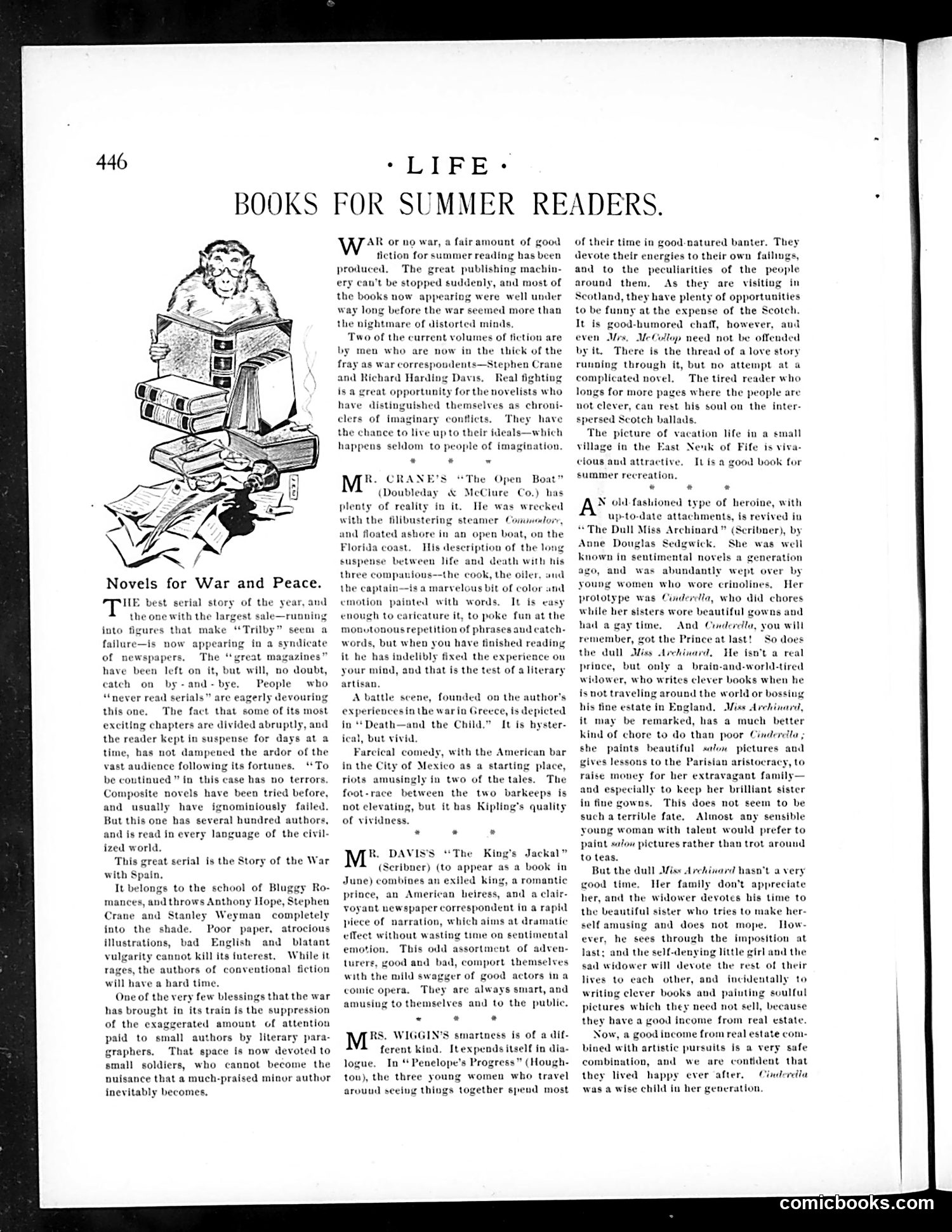
This page reviews summer fiction of 1898, notably during the Spanish-American War. The illustration shows a figure reading multiple books—a visual pun on "summer reading." **Key satirical point**: The opening section mocks how the actual Spanish-American War has become the most gripping "serial story" in America, surpassing even popular novels like *Trilby*. Life jokes that this real conflict, with its suspenseful delays and massive audience, has inadvertently become better entertainment than published fiction—written by "several hundred authors" (war correspondents and newspapers). **Literary references reviewed**: - Stephen Crane's *The Open Boat* (based on his shipwreck experience) - Richard Harding Davis's *The King's Jackal* - Works featuring war and adventure themes The satire suggests that actual war news has eclipsed conventional fiction, while also acknowledging that combat reporting by established novelists (Crane, Davis) lends literary credibility to their accounts of real events versus imagined conflicts.
📄 Transcribed text from this page (OCR, searchable)
Machine-transcribed from the original scan — historical spelling and the odd misread are preserved.
BOOKS Novels for War and Peace. ILE best serial story of the year, and the one with the largest sale—running into figures that make ‘Trilby” failu appearing in a syndicate of newspapers. The “great magazines have been left on it, but will, no doubt, catch and-bye. People who 1 serials” are eagerly devouring The fact that some of its most exciting chapters are divided abruptly, and the reader kept in suspense for days at a time, has not dampened the ardor of the vast audience following its fortunes. “To be coutinued ” in this case has no terrors. Composite novels have been tried before, and usually have ignomintously failed. Bat this one has several hundred authors, and is read in every language of the civil- ized world. This great serial is the Story of the War with Spain, It belongs to the school of Bluggy Ro- mances, and throws Anthony Hope, Stephen Crane and Stanley Weyman completely into the shade. Poor paper, atrocious illustrations, bad English and blatant vulgarity cannot kill its futerest, While it es, the authors of conventional fiction will have a hard time, One of the very few blessings that the war has brought in its train {s the suppression of the exaggerated amount of attention paid to small authors by literary para- graphers. That space is now devoted to small soldiers, who cannot become the nuisance that a much-praised minor author inevitably becomes. seem a now on by “never rea this one. *LIFE: FOR SUMMER READERS. wt or no war, a fairamount of good fiction for summer reading has been produced. The great publishing machin- ery can’t be stopped suddenly, and most of the books now appearing were well under way long before the war seemed more than the nightmare of distorted minds, Two of the current volumes of fiction are by men who are now in the thick of the fray as war correspoudents—Stephen Crane and Richard Hardir eal fighting is a great opportunity forthe novelists who have distinguished themselves as chroni- clers of imaginary conflicts. They have the chance to live upto their ideals—which happens seldom to people of imagination. Me: CRANE’S “The Open Boat (Doubleday & MeClure Co.) has plenty of reality in it. He was wrecked with the filibustering steamer Corset and floated ashore in an open boat, on the Florida coast. His description of the long suspense between life and death with his three companious-the cook, the oiler, aud the captain—is a marvelous bit of color and emotion painted with words. It ) enough to caricature it, to poke fun at the monotonous repetition of phrases aud catch- words, but when you have finished reading it he has indelibly fixed the experience ou your mind, and that is the test of a literary artisan, A battle scene, founded on the author's experiences in the warin Greece, is depicted in **Death—and the Child.” ical, but vivid. Farcical comedy, with the American bar in the City of Mexico as a starting place, riots amusingly in two of the tales. The foot-race between the two barkeeps is not clevating, but it has Kipling’s quality of vividness. M* DAVIS'S “The King’s Jackal” (Scribner) (to appear as a book in June) combines an exiled king, a romantic prince, an American heiress, and a clair- voyant newspaper correspondent in a rapid piece of narration, which aims at dramatic effect without wasting time on sentimental emotion, This odd assortment of adven- turers, good and bad, comport themselves with the mild swagger of good actors ina comic opera. They are always smart, and amusing to themselves and to the public, Davis. is cusy It is hyster- RS. WIGGIN’S smartness is of a dif- ferent kind. Itexpends itself in dia- logue. In “ Penelope's Progress” (Hough- tou), the three young women who travel around sceing things together spend most of their time in good-natured banter. They devote their energies to their own failings, and to the peculiarities of the people around them, As they are visiting in Scotland, they have plenty of opportunities to be funny at the expense of the Scotch. It is good-humored chaff, however, aud even Mrs, MeCollop need not be offended by it. There is the thread of a love story running through it, but no attempt at a complicated novel, The tired reader who longs for more pages where the people are not clever, can rest his soul on the inter- spersed Scotch ballads. The picture of vacation life in a small village in the East Neuk of Fife is viva- cious aud attractive. It is a good book for summer recreation. * * * A \ old: fashioned type of heroine, with up-to-date attachments, is revived in “The Dull Miss Archinard ® (Scribner), by Anne Douglas Sedgwick. She was well known in sentimental novels neration go, and was abundantly wept over by young women who wore crinolines, Her prototype was Cinderela, who did chores while ber sisters wore beautiful gowns and had a gaytime, And Condereila, you will remember, got the Prince at last! the dull Miss Archinard, He isn’t a real prince, but only a brain-and-world-tired widower, who writes clever books when he is not traveling around the world or bossing his tine estate in England, Miss Archinard, it may be remarked, has a much better kind of chore to do than poor Cinderela ; she paints beautiful salon pictures and gives lessons to the Parisian aristocracy, to raise money for her extravagant family and especially to keep her brilliant sister in fine gowns. This does not seem to be such aterrible fate, Almost any sensible young woman with talent would prefer to paint slow pictures rather than trot around to teas. But the dull Miss Archinard hasn't a very good time. Her family don't appreciate her, and the widower devotes bis time to the beautiful sister who tries to make her- self amusing and does not mope. How- ever, he sees through the imposition at last; and the self-denying little girl and the sad widower will devote the rest of their lives to each other, and incidentally to writing clever books aud paiuting soulful pictures which they need not sell, because they have a good income from real estate Now, a good income from real estate com- bined with artistic pursuits is a very safe combination, and are contident that they lived happy ever after, Ciudereiia was a wise child iu her generation. So does we comicbooks.com