
Life, 1898-05-26 · page 8 of 24
Life — May 26, 1898 — page 8: what you’re looking at
What you’re looking at
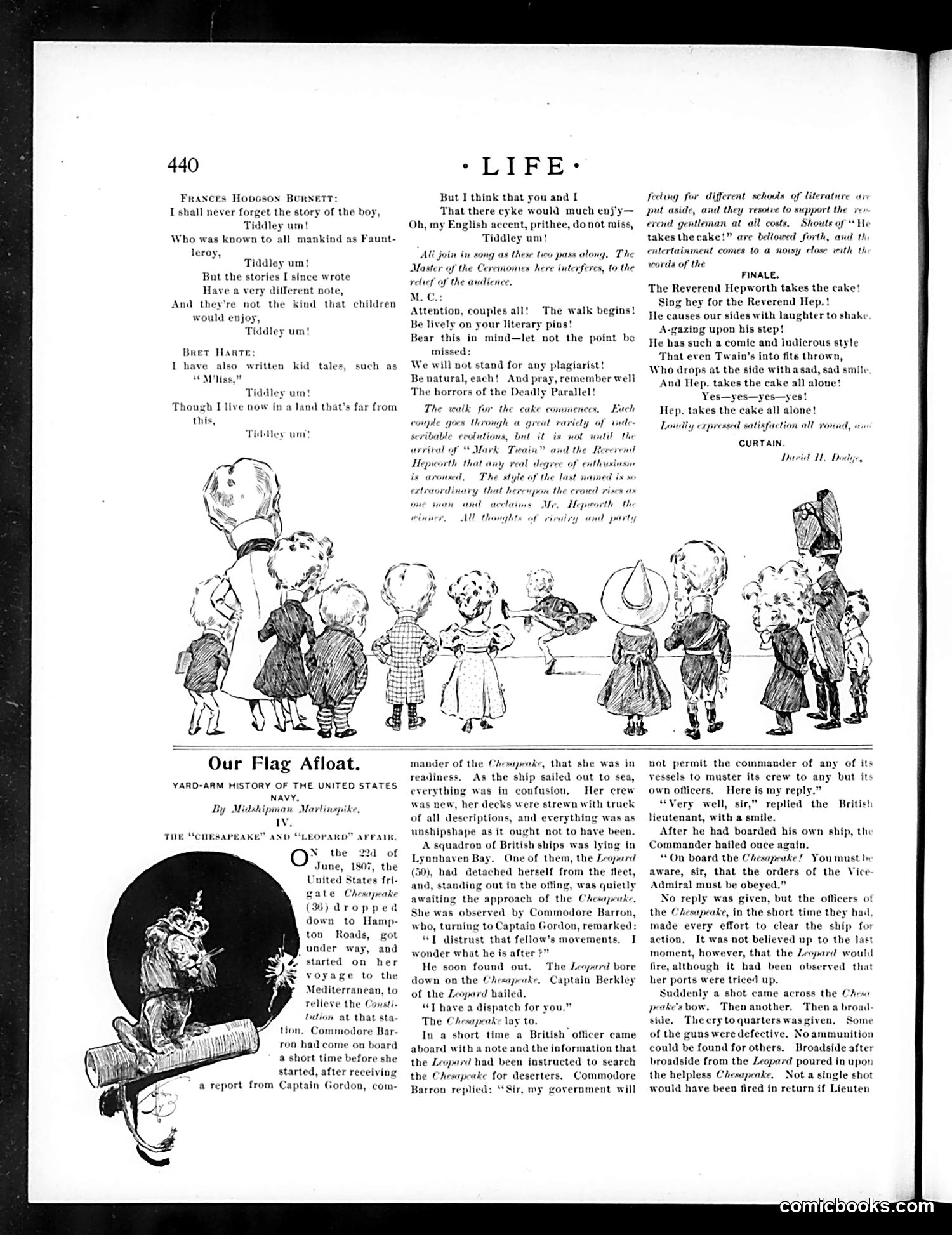
This page combines literary commentary with historical narrative. The top section features a dialogue among **Frances Hodgson Burnett, Bret Harte**, and others debating children's literature—specifically whether "Tiddley um!" represents quality writing. The speakers critique works by Mark Twain and Reverend Hypoeth, praising their comic, engaging style that captivates audiences. Below is "Our Flag Afloat," a historical account of the USS Chesapeake during the War of 1812. It describes a naval encounter where a British ship's crew attempted to board the American vessel, resulting in confusion and failed coordination. The text emphasizes the chaotic nature of early 19th-century naval warfare and British-American tensions during this period. A decorative naval emblem illustrates the historical narrative.
📄 Transcribed text from this page (OCR, searchable)
Machine-transcribed from the original scan — historical spelling and the odd misread are preserved.
440 Fraxces Hoposoy Burxett I shall never forget the story of the boy, Who was known to all mankind as Faunt- leroy, Tiddley um! But the stories I since wrote Have a very different note, And they're not the kind that children would enjoy, Tiddley um! Bret Harte: I have also written ‘M'liss,” kid tales, such as Tiddley um! Though [ live now in a land that’s far from this, Tiddley un > LIFE: But I think that you and I That there cyke would much en, Ob, my English accent, prithee, donot miss, Tiddley um! in song as these two pass along, The eres, to the Ali joi Maste rele of the audience. M.C.: Attention, couples all! The walk begins! Be lively on your literary pins! Bear this in mind—let not the point be missed: We will not stand for any plagiarist! Be natural, each! And pray, remember well The horrors of the Deadly Parallel! The waik for the cake commences, the Ceremomes here int Euch couple goes through a great rariety of vies seribable evolutions, but it is not until the Wop Mark Twain” and the R th that any reat degree of enthw Hepw e style of the last named ix extraordinary that herenpon the evowd Hepreorth the AU thenghts of vieairy and party one nun and acclaims Me, feciing for different schools of literature ave put aside, and they resotve to support the rer ercnd gentleman at ait costs. Shouts of + He takes the cake!” are bellowed forth, and 11 entertainment comes to a nowy close with th words of the FINALE, The Reverend Hepworth takes the cake! Sing hey for the Reverend Hep.! He causes our sides with laughter to shake sazing upon his step! He has such a comic and ludicrous style That even Twain's into fits thrown, Who drops at the side with asad, sad smile And Hep. takes the cake all aloue! Yes—yes—yes—yes! Hep. takes the cake all alone! Lonaly expressed satisfaction all vonndl, CURTAIN. David H. Doki, Our Flag Afloat. YARD-ARM HISTORY OF THE UNITED STATES NAVY, By Midshipman Marlinspike. IV. THE “CHESAPEAKE” AND “LEOPARD” APFAUR. N the June, 186 United ate Chesipeake )droppead down to Hamp- ton Roads, got under way, and “started on her voyage to the Mediterranean, to relieve the Consti- tution at that sta- Commodore Bar- ron had come on board a short time before she started, after receiving a report from Captain Gordon, com- tion, nder of the Chesapeake, that she was in As the ship sailed out to sea, was in confusion, Her crew new, her decks were strewn with truck of all descriptions, and everything was as unshipshape as it ought not to have been, A squadron of British ships was lying in Lynnhaven Bay. One of them, the Leopard 50), had detached herself from the fleet, and, standing out in the offing, was quietly awaiting the approach of the Chestprake, She was observed by Commodore Barron, who, turning to Captain Gordon, remarked: “T distrust that fellow’s movements, I wonder what he is after *” He soon found out. The Leopard bore down on the Chesapeake, Captain Berkley of the Leopard hailed. “T have a dispatch for you.” The Chesapeake lay to. In a short time a British’ officer came aboard with a note and the information that the Leopard had been instructed to search the Chessprake for deserters. Commodore Barron replied: “Sir, my government will not permit the commander of any of its vessels to muster its crew to any but its own officers. Here is my reply.” “Very well, sir,” replied the lieutenant, with a smile. After he had boarded his own ship, the Commander hailed once again, “On board the Chesapeake! You must be aware, sir, that the orders of the Vice- Admiral must be obeyed.” No reply was given, but the ofticers of the Chesapeake, in the short time they had made every effort to clear the ship for action, It was not believed up to the last moment, however, that the Leopard would fire, although it had been observed that her ports were triced up. Suddenly a shot came across the Chest ke's bow. Then another. Then a broad- The ery to quarters was given. of the guns were defective. No ammunition could be found for others. Broadside after broadside from the Leopard poured in upon the helpless Chesapeake, Nota single shot would have been fired in return if Lieuten British ome