
Life, 1898-05-26 · page 9 of 24
Life — May 26, 1898 — page 9: what you’re looking at
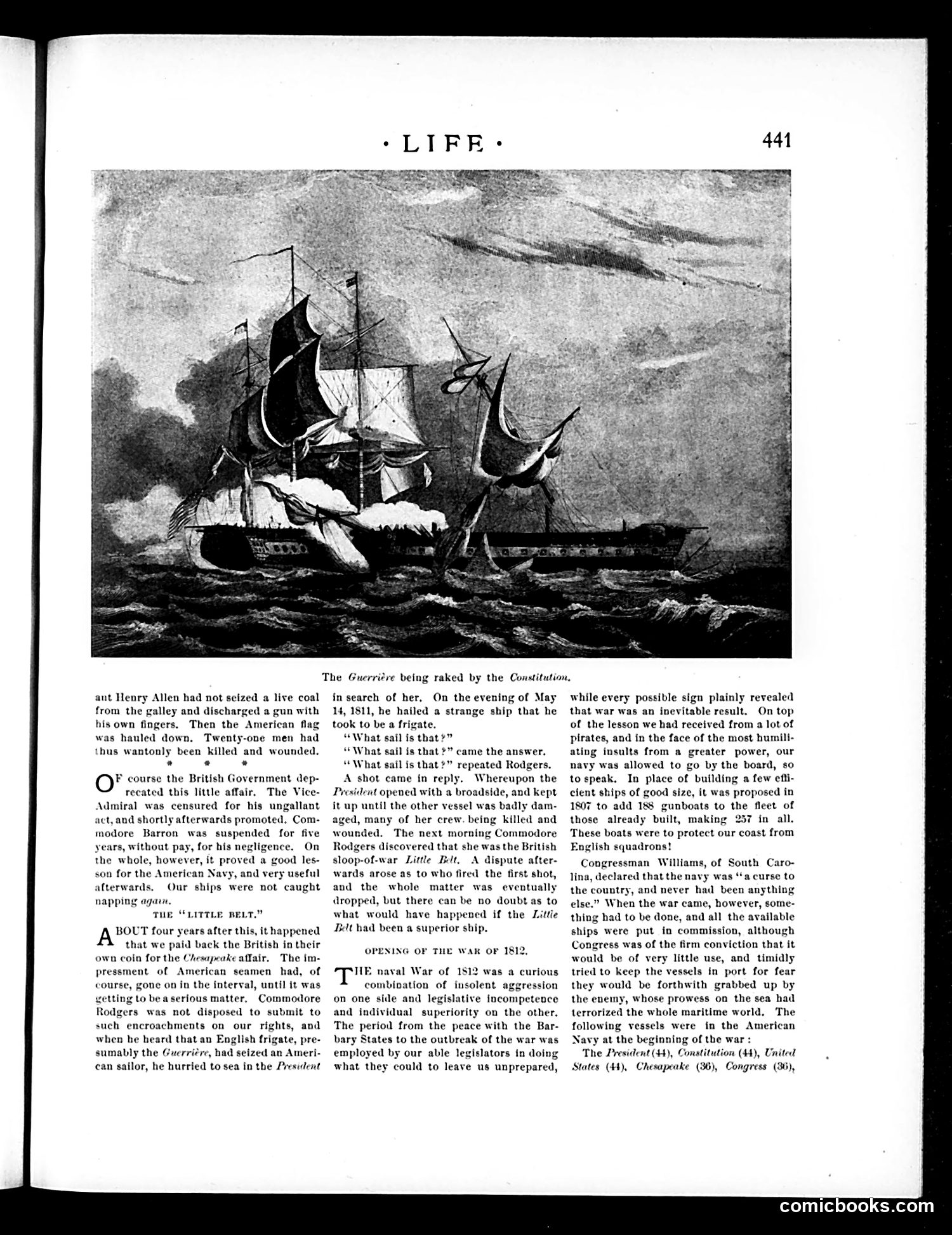
What you’re looking at
This page illustrates the naval Battle of the Guerrière and Constitution during the War of 1812. The engraving shows the British ship *Guerrière* being "raked" (fired upon from an advantageous angle) by the American frigate *Constitution*. The text describes how American Captain Henry Allen encountered a British vessel on May 14, 1811, which proved to be the *Little Belt*—a minor engagement that foreshadowed larger conflicts. The main narrative details Commodore Rodgers discovering the British ship-of-war *Little Belt*, ultimately leading to the opening engagements of the 1812 war. The article emphasizes American naval superiority and patriotic pride in American warship capability, presenting this victory as proof of American naval prowess against British maritime dominance.
📄 Transcribed text from this page (OCR, searchable)
Machine-transcribed from the original scan — historical spelling and the odd misread are preserved.
ant Henry Allen had not seized a live coal from the galley and discharged a gun with his own fingers, Then the American flag was hauled down. Twenty-one men had thus wantonly been killed and wounded. * * * F course the British Government dep- recated this little affair, The Vice- Admiral was censured for his ungallant act, and shortly afterwards promoted. Com- modore Barron was suspended for five rs, without pay, for his negligence. On the whole, however, it proved a good les- son for the American Navy, and very useful afterwards, Our ships were not caught napping again. THE “LITTLE BELT.” Att four years after this, ithappened that we paid back the British in their own coin for the Chesapeake affair. The im- pressment of American seamen had, of course, gone on in the interval, until it was getting to be a serious matter, Commodore Rodgers was not disposed to submit to such encroachments on our rights, and when he heard that an English frigate, pre- sumably the Guerriére, had seized an Ameri- can sailor, he hurried to sea in the President The Guerritre being raked by the Constitution, in search of her. On the evening of May 14, 1811, he hailed a strange ship that he took to be a frigate. “What sail is that?” “What sail is that ?” came the answer, “What sail is that?” repeated Rodgers. A shot came in reply. Whereupon the resident opened with a broadside, and kept it up until the other vessel was badly dam- aged, many of her crew. being killed and wounded. The next morning Commodore Rodgers discovered that she was the British sloop-of-war Little Delt. A dispute after- wards arose as to who fired the first shot, and the whole matter was eventually dropped, but there can be no doubt as to what would have happened if the Little Bat had been a superior ship. OPENING OF THE WAK OF 1812, “THE naval War of 1512 was a curious combioation of insolent aggression on one side and legislative incompetence and individual superiority on the other. The period from the peace with the Bar- bary States to the outbreak of the war was employed by our able legislators in doing what they could to leave us unprepared, while every possible sign plainly revealed that war was an inevitable result. On top of the lesson we had received from a lot of pirates, and in the face of the most humili- ating insults from a greater power, our navy was allowed to go by the board, so to speak. In place of building a few efti- cient ships of good size, it was proposed in 1807 to add 188 gunboats to the fleet of those already built, making 257 in all. These boats were to protect our coast from English squadrons! Congressman Williams, of South Caro- lina, declared that the navy was ‘‘a curse to the country, and never had been anything else.” When the war came, however, some- thing had to be done, and all the available ships were put in commission, although Congress was of the firm conviction that it would be of very little use, and timidly tried to keep the vessels in port for fear they would be forthwith grabbed up by the enemy, whose prowess on the sea had terrorized the whole maritime world, The following vessels were in the American Navy at the beginning of the war : The President (44), atitution (44), United States (44), Chesapeake (36), Congress (36), comicbooks.com