
A complete issue · 20 pages · 1898
Life — April 28, 1898
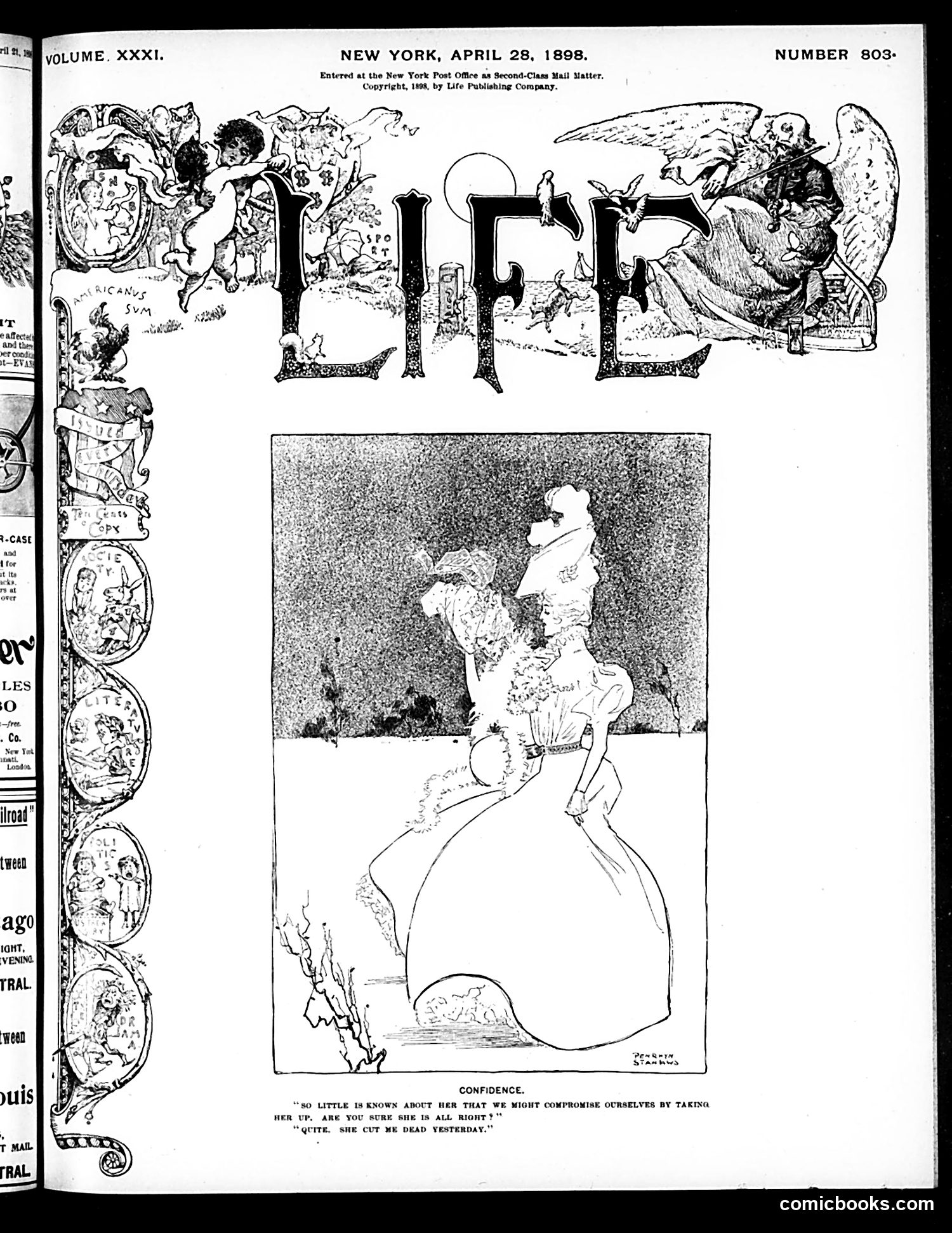
This satirical cartoon depicts a woman perched precariously atop a large spherical bomb or explosive device, balancing a man on her head. The caption reads: "So little is known about her that we might compromise ourselves by taking her up. Are you sure she is all right? Quite. She cut me dead yesterday." The cartoon likely references contemporary anxieties about women's roles and respectability during the 1890s. The "confidence" of the title appears ironic—the figures maintain precarious balance despite obvious danger, suggesting false assurance or reckless decisions. The dialogue implies gossip and social judgment regarding a woman's character and reputation. Without additional context, the specific identity remains unclear, though it likely comments on social scandal or political controversy of 1898.
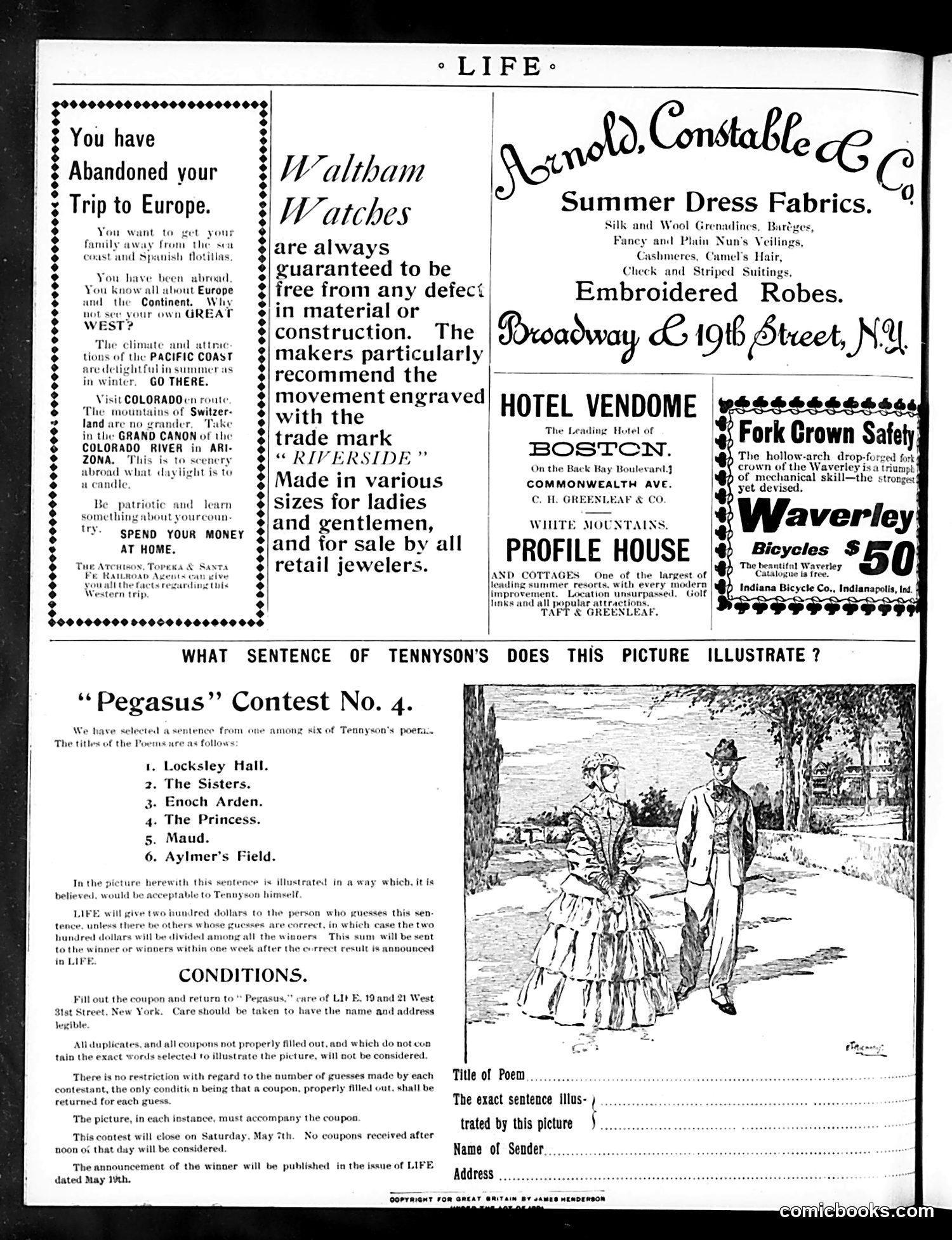
This page is primarily **advertising and a literary contest**, not political satire. The main content is "Pegasus" Contest No. 4, a reader competition asking which Tennyson poem a provided illustration matches. The image shows a Victorian-era couple in a rural setting—a woman in an elaborate dress and a man in period clothing walking together outdoors. The page is surrounded by period advertisements (Waltham Watches, Arnold Constable fabric, Hotel Vendome, Waverley Bicycles). There is **no political cartoon or satire evident**. This appears to be a straightforward literary engagement feature typical of Life magazine's early 20th-century content, designed to encourage reader participation and demonstrate cultural knowledge of classic poetry.
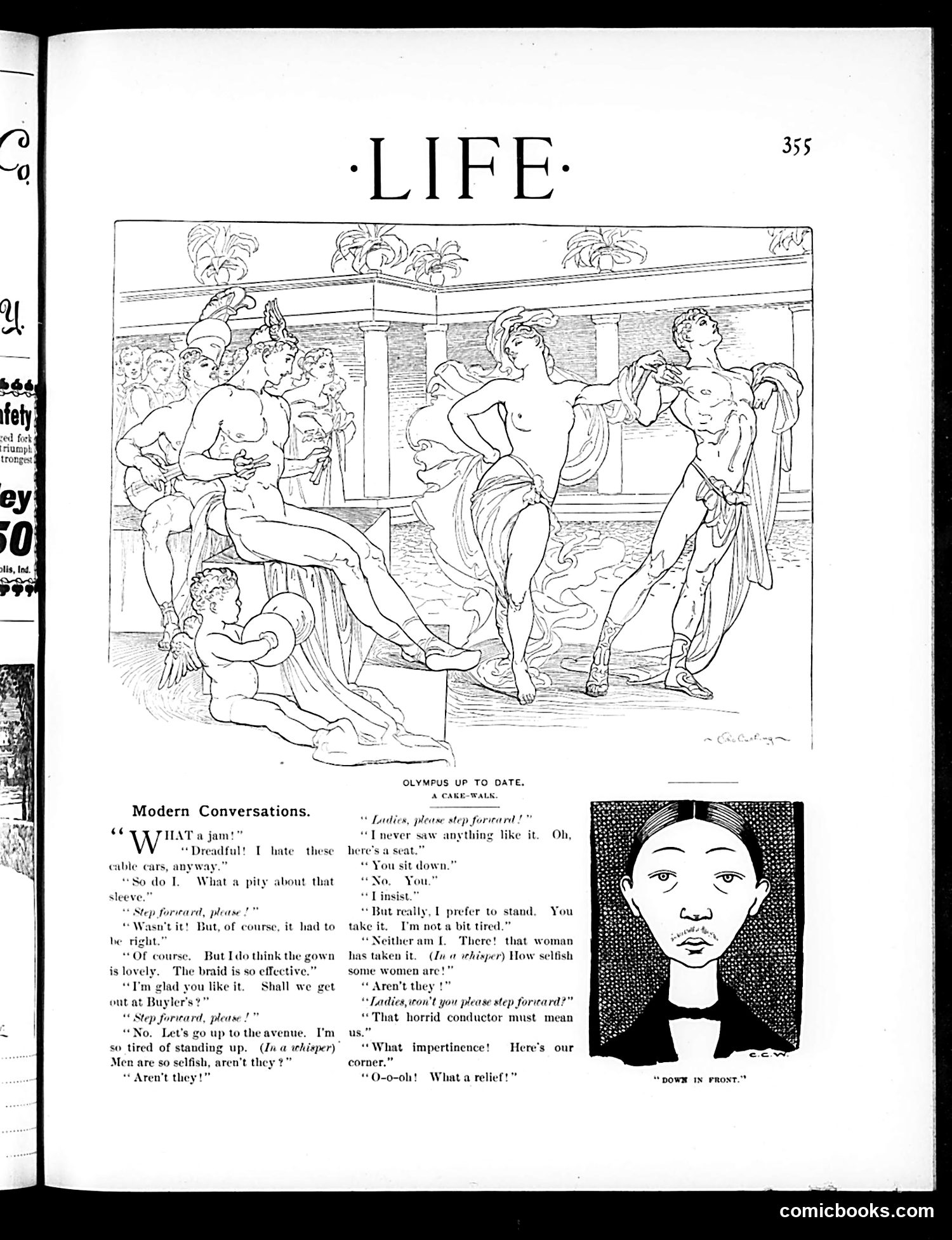
This page contains two satirical pieces: **"Olympus Up to Date"** (top illustration) depicts classical Greek gods and goddesses in a modern setting, apparently a crowded public transit car or social venue. The satire mocks how even mythological figures can't escape contemporary urban annoyances—crowding, rudeness, and discomfort. **"Modern Conversations"** (text below) presents a dialogue between men and women discussing cable cars, standing room, and seating—mundane urban transit complaints. The satire targets gender relations, showing men as selfish ("Men are so selfish, aren't they?") and women frustrated by male entitlement to comfort. **"Down in Front"** (portrait right) appears to be a separate comic commentary, likely referencing theater etiquette complaints. Overall, the page satirizes modern urban life's indignities affecting everyone.
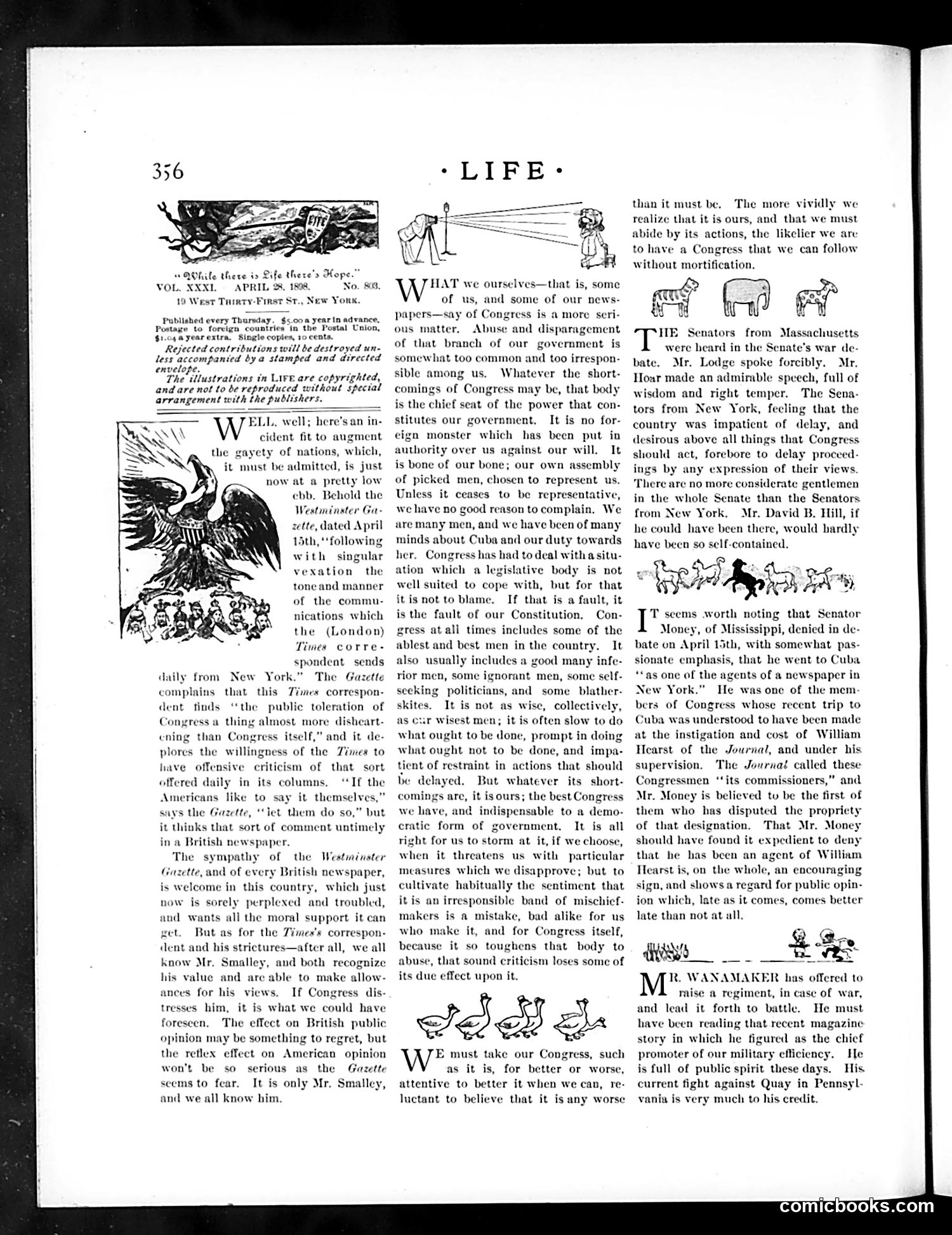
This page critiques Congress's handling of Cuban affairs and William Hearst's role in media sensationalism. The main editorial argues that Congress, despite public criticism, deserves some credit—including "some of the ablest and best men in the country." The text attacks the *Times* and *Westminster Gazette* for constant disparagement of Congress, while defending American legislators against British newspaper criticism. A secondary item mentions William Hearst's recent magazine story portraying himself as a military efficiency promoter, sarcastically noting he "must have been reading last recent magazine story." The small illustrations (birds, animals, sheep) appear decorative rather than symbolic. The page's primary purpose is defending Congress against press attacks while mocking Hearst's self-aggrandizement regarding military matters.
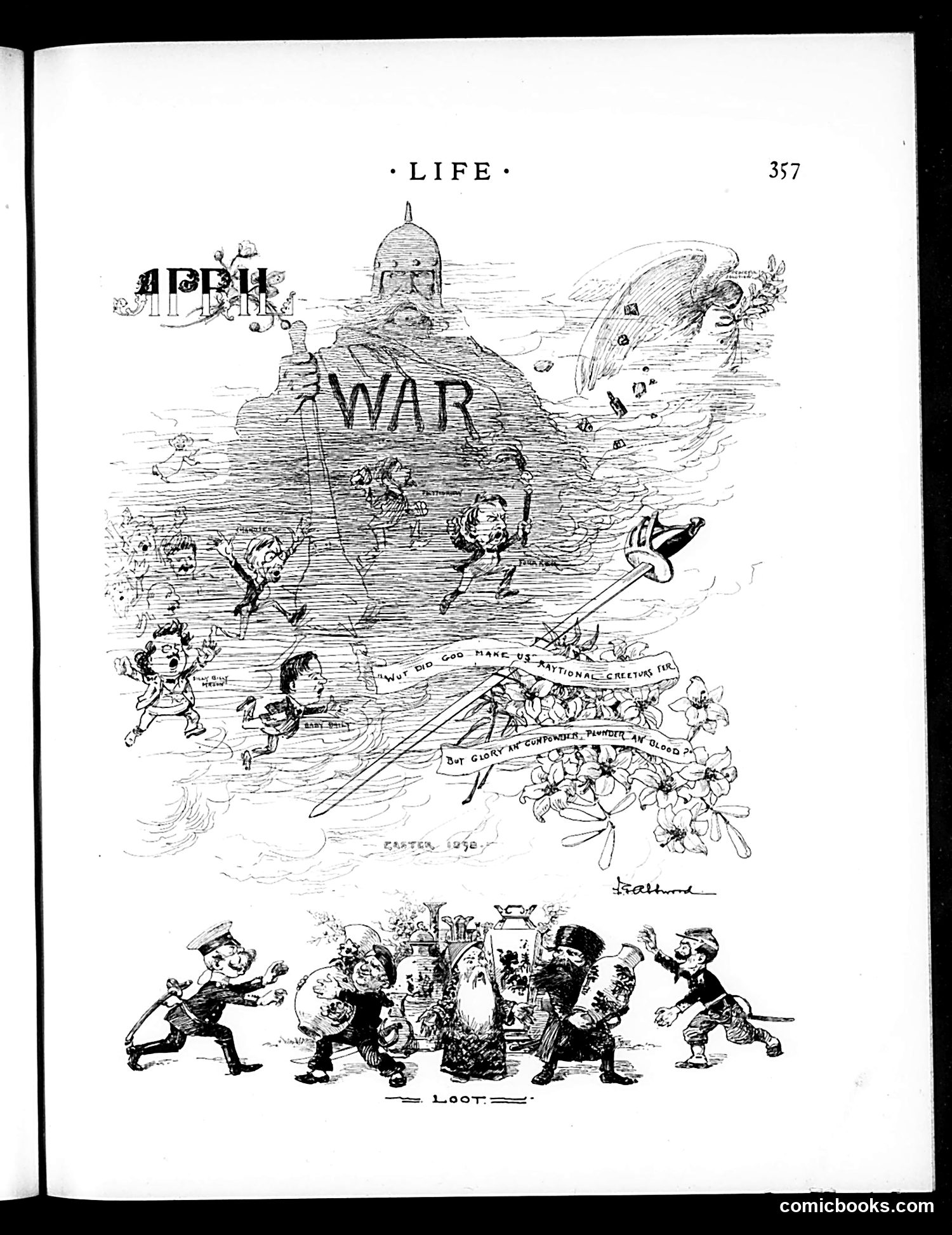
This is a satirical cartoon commenting on World War I, likely from 1918. The central image depicts "War" as a destructive force—a massive, menacing figure looming over humanity. Small figures representing civilians and soldiers flee in panic, while text fragments reference "national creation" and "glory in conquest." The bottom section titled "Loot" shows caricatured figures (likely representing warring nations or political leaders) fighting over spoils and treasures, including what appears to be a globe. This satirizes how nations competed for territorial and economic gains through warfare. The overall message critiques war's devastation to civilian life and the hollow rewards nations pursued through conflict—a common anti-war theme in American satire during WWI's final year.
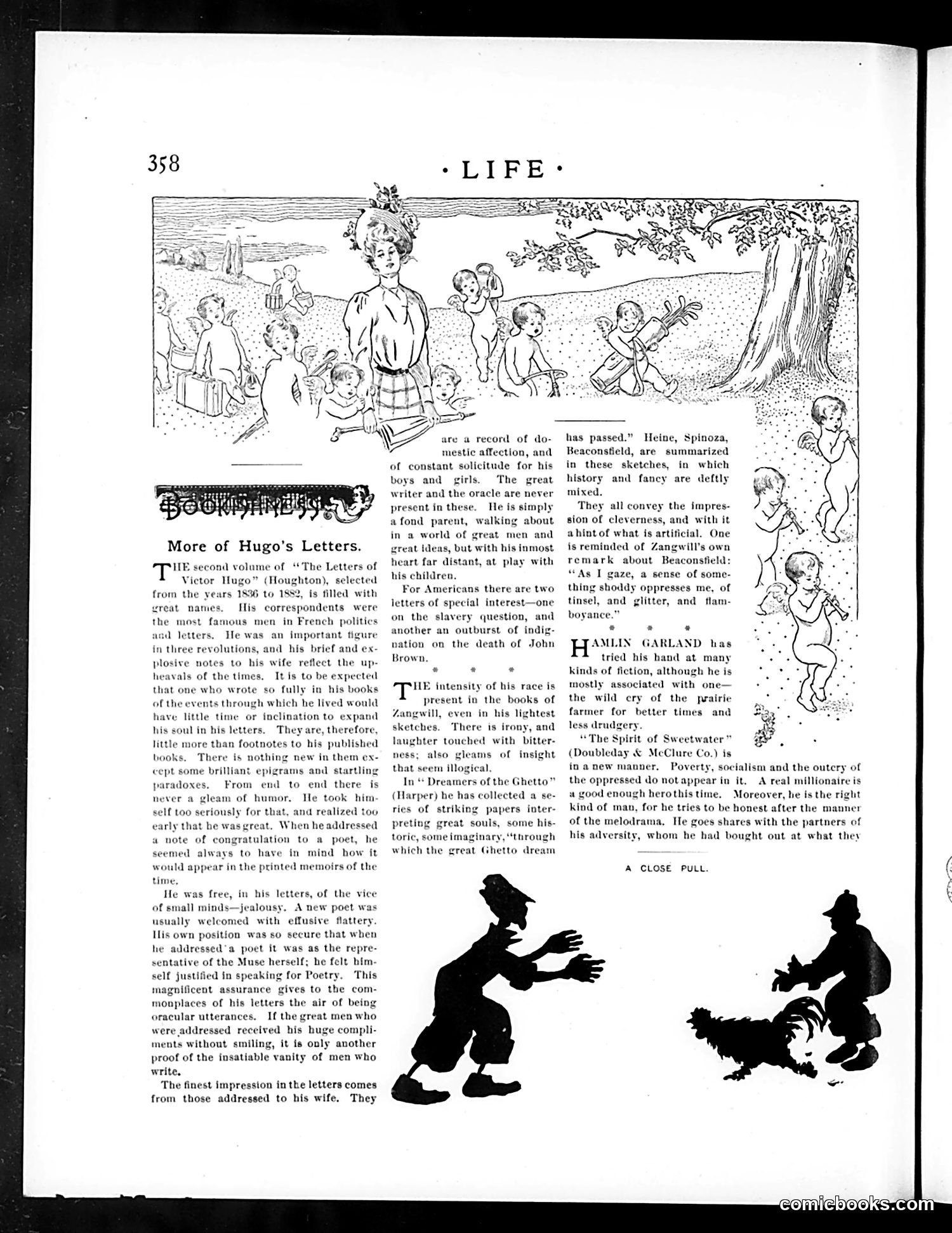
The page primarily contains a literary article titled "More of Hugo's Letters," discussing Victor Hugo's correspondence from 1836-1882. The text praises Hugo's letters as historically significant records of French political upheaval and revolution. Below the article is a silhouette illustration captioned "A CLOSE PULL," showing two figures (appearing to be caricatured men in confrontational poses) engaged in some kind of physical struggle or competition. Without additional context on the specific date or issue, the silhouette's exact political reference is unclear—it may reference a contemporary political or social conflict, though the cartoon's precise target cannot be definitively determined from the image alone. The page is primarily text-focused rather than satirical cartooning.
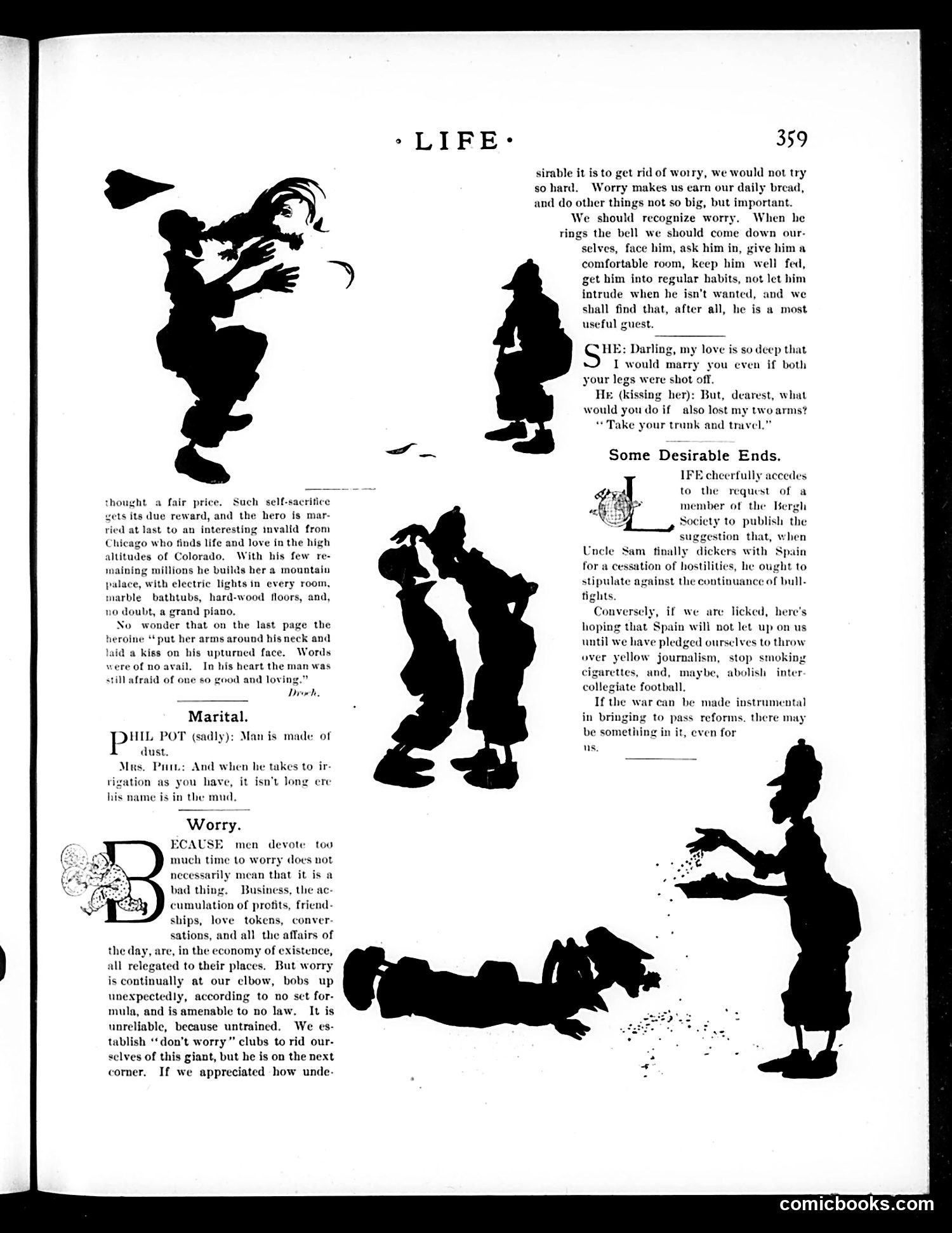
This page contains three separate satirical pieces: **"Marital"** mocks the disillusionment of marriage, with a husband and wife exchanging cynical observations about dust and mud—suggesting marriage reduces people to degradation. **"Worry"** argues that excessive worry, though common, is irrational and uncontrollable. The text advocates accepting worry as inevitable rather than futilely trying to eliminate it through "don't worry" clubs. **"Some Desirable Ends"** appears to be editorial commentary on Spain (likely referencing Spanish-American War tensions or political instability). It humorously suggests Uncle Sam should extract concessions from Spain in exchange for ceasing hostilities, while also satirizing American demands like ending yellow journalism and collegiate football. The silhouette illustrations accompany each section, depicting domestic scenes and political figures engaged in the described activities.
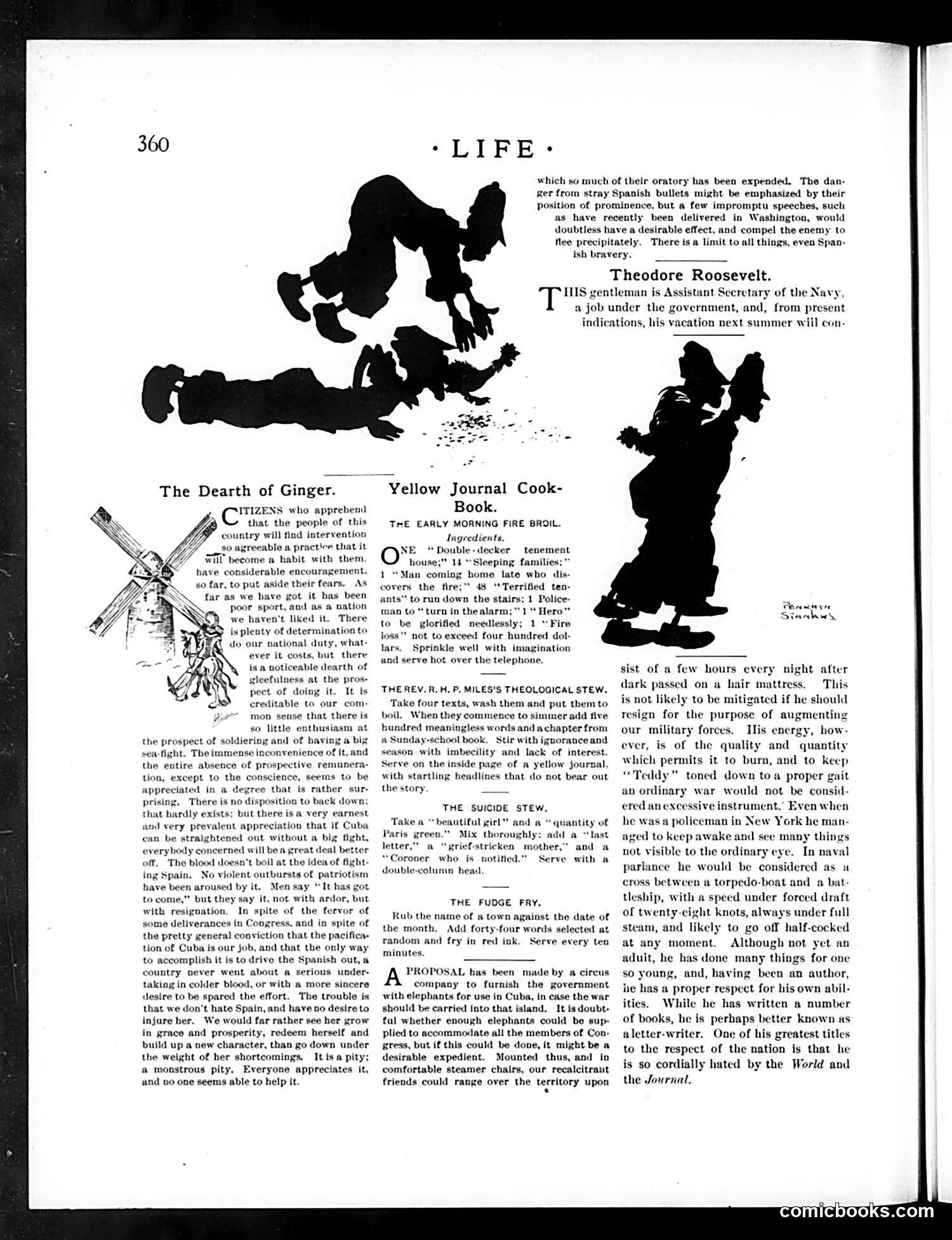
This silhouette cartoon depicts a figure energetically leaping or falling, illustrating the phrase "The Dearth of Ginger." The accompanying text criticizes Spain's apparent lack of military initiative and vigor during what appears to be a conflict. The satirist argues that Spain, despite its reputation, has shown little determination or enthusiasm in combat—there's "no little enthusiasm at the prospect of soldiering" and "the gloominess occasioned by the entire absence of prospective remuneration." The cartoon uses "ginger" (meaning energy or liveliness) as metaphor for Spanish military spirit. The text suggests this weakness reflects poorly on Spain's character, mocking both Spanish soldiers and national pride. The silhouette's exaggerated tumbling posture emphasizes the satirical point about Spain's apparent lack of military vigor or purpose.
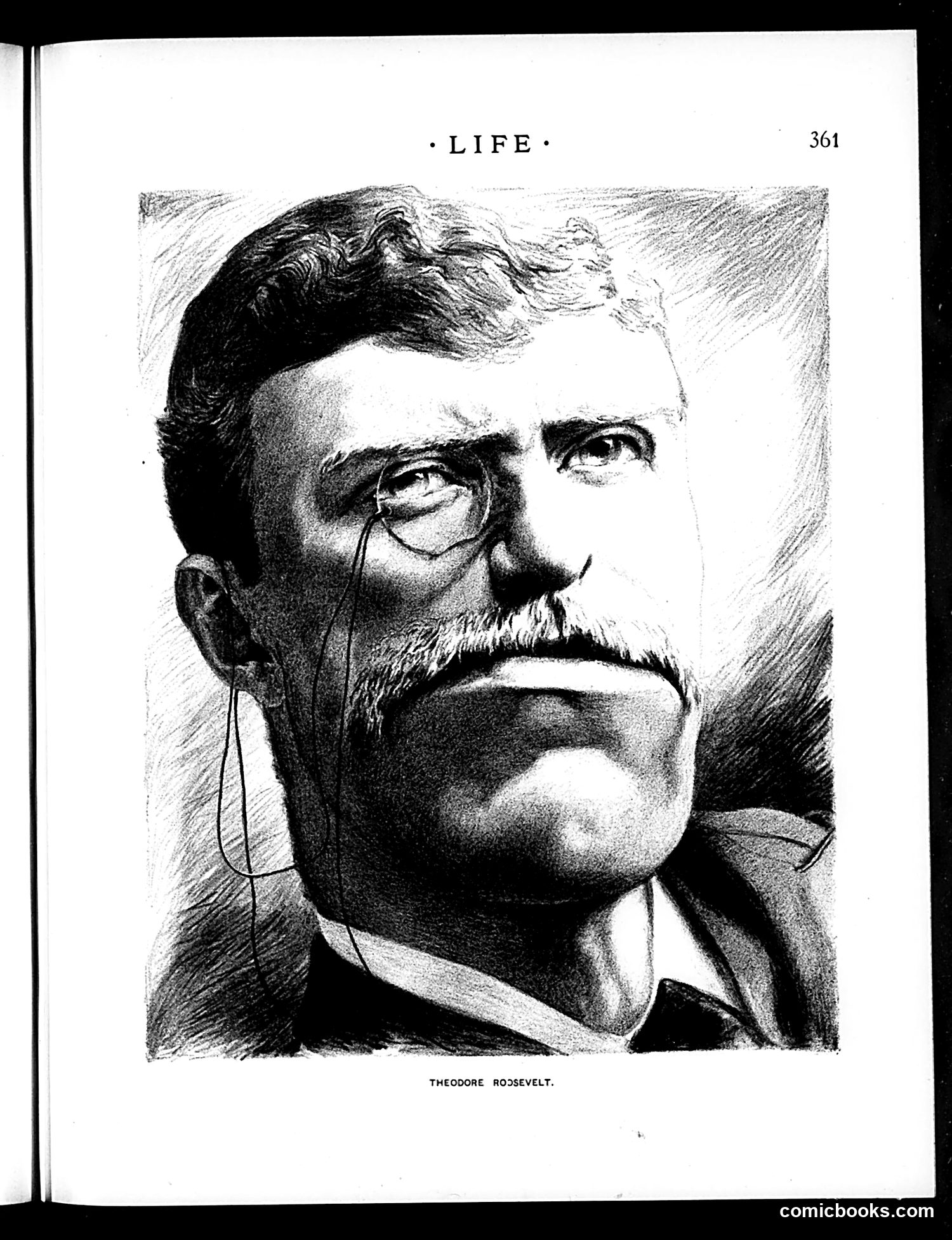
This page from *Life* magazine (page 361) features a portrait labeled "THEODORE ROOSEVELT." It's a detailed sketch showing a man wearing glasses and formal attire with a distinctive mustache, rendered in black ink with cross-hatching for shading. Without additional text or satirical elements visible on this page, this appears to be a straightforward portrait rather than a political cartoon. The image captures Roosevelt's recognizable features—particularly his prominent facial hair and spectacles—which were distinctive markers of his appearance during his presidency or public career. The page itself contains no visible commentary, captions providing context, or satirical elements that would indicate the intended joke or critique.
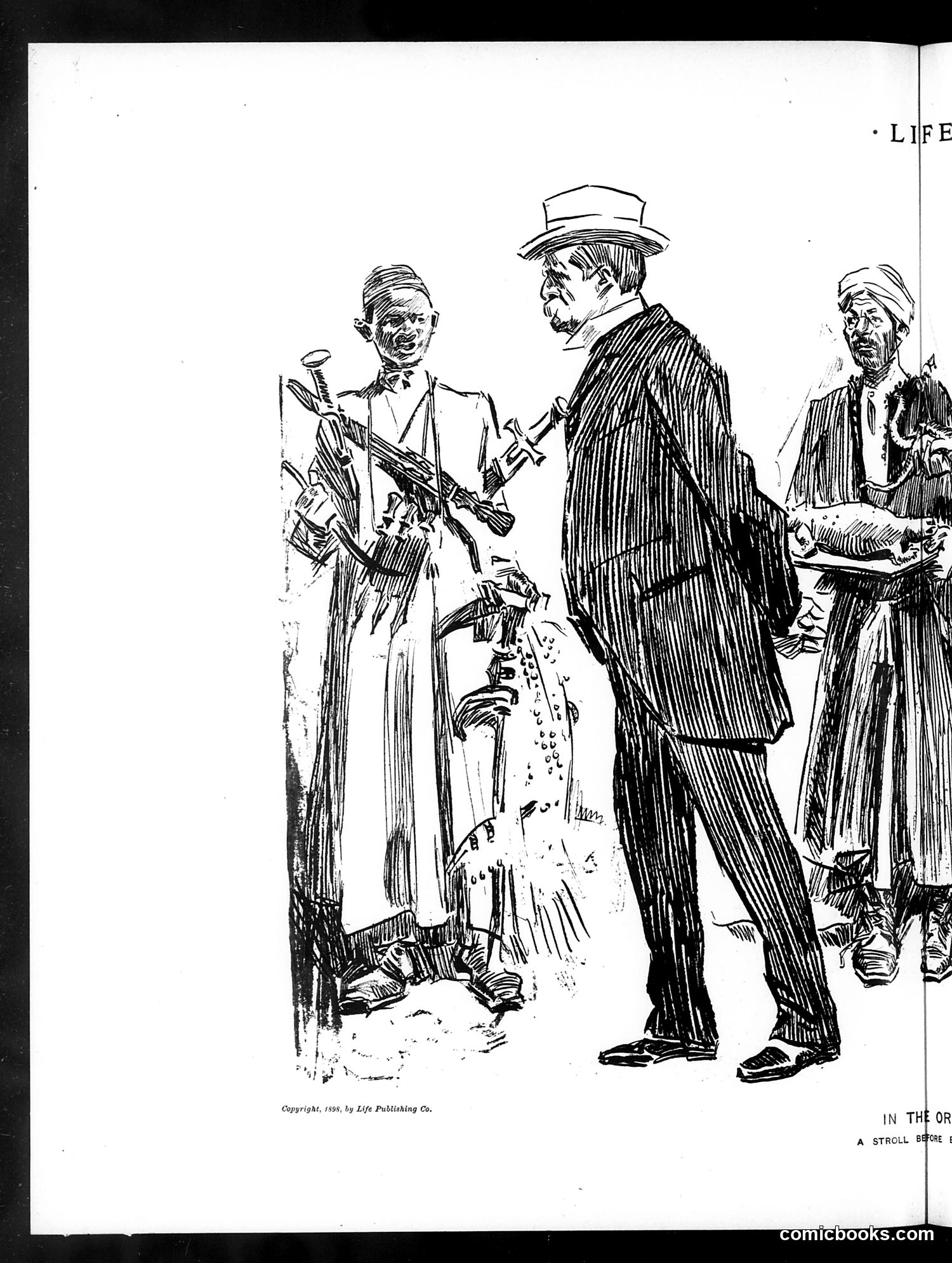
This appears to be a satirical scene from Life magazine (copyright 1899). The cartoon depicts a well-dressed man in a suit and captain's hat conversing with armed soldiers or workers carrying rifles and tools. The title "A Stroll Before Dinner" suggests an ironic commentary on casual normalcy amid militarization. The specific context remains unclear without additional publication details, but the imagery—juxtaposing a gentleman's leisurely walk against armed men—likely critiques either military expansion, labor unrest, or imperialist activities common in 1899 America. The formal dress versus utilitarian weaponry creates satirical contrast, suggesting the cartoon comments on how military or industrial violence was normalized in everyday society during this period.
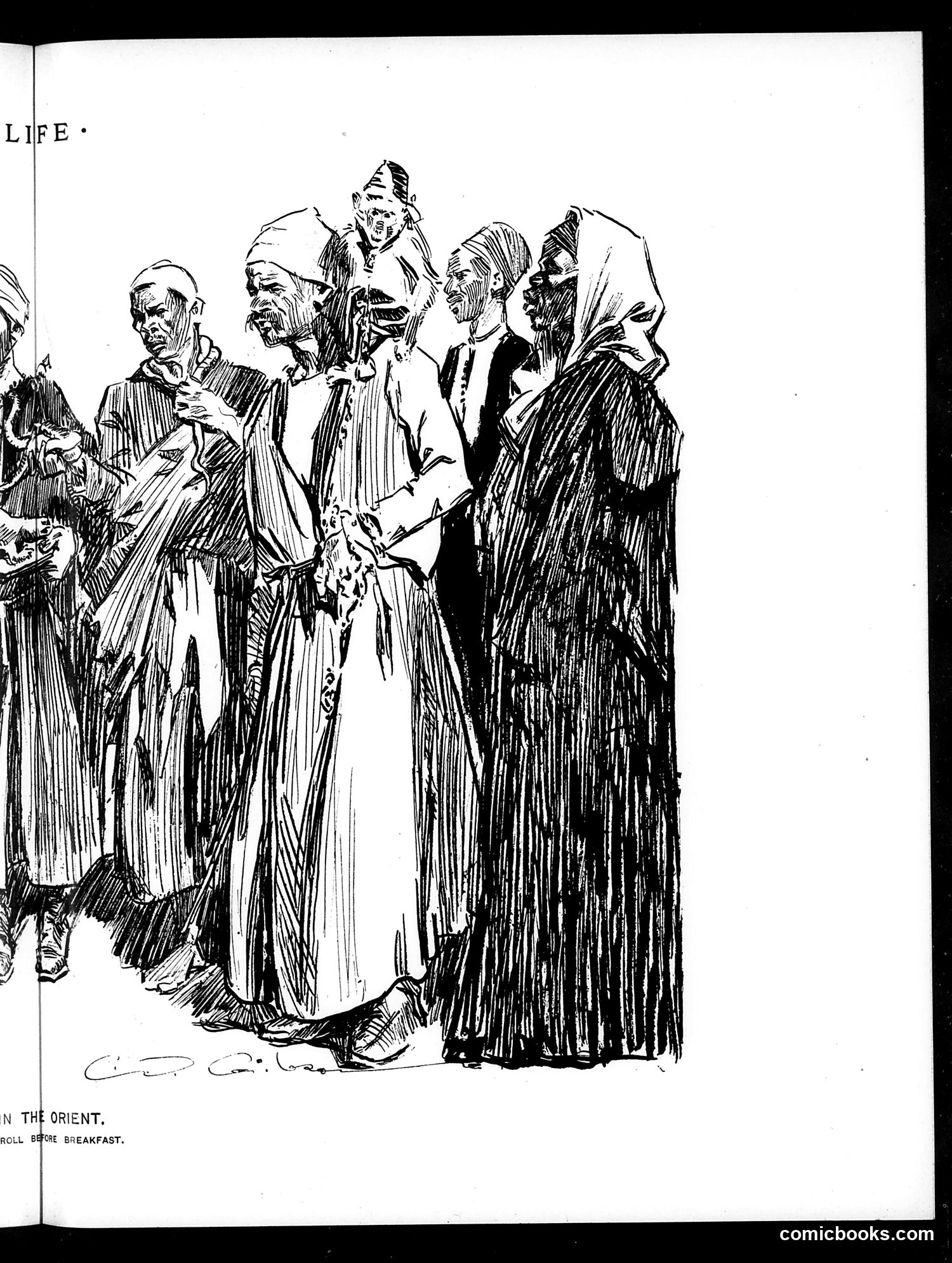
This pen-and-ink illustration depicts a group of figures in Oriental dress gathered together, appearing to share a meal or social moment. The caption reads "In the Orient" with a subtitle referencing "Roll Before Breakfast." The cartoon satirizes Western perceptions of Eastern customs and dining practices. The exaggerated facial features and caricatured expressions reflect period stereotyping common in early 20th-century American satire. The specific reference to "roll before breakfast" likely jokes about unfamiliar or exotic food customs encountered by Western travelers in Asia. Without additional context or byline visible, the precise satirical target remains somewhat unclear, though it appears to mock Western attitudes toward Oriental culture through comedic depiction of cultural difference.
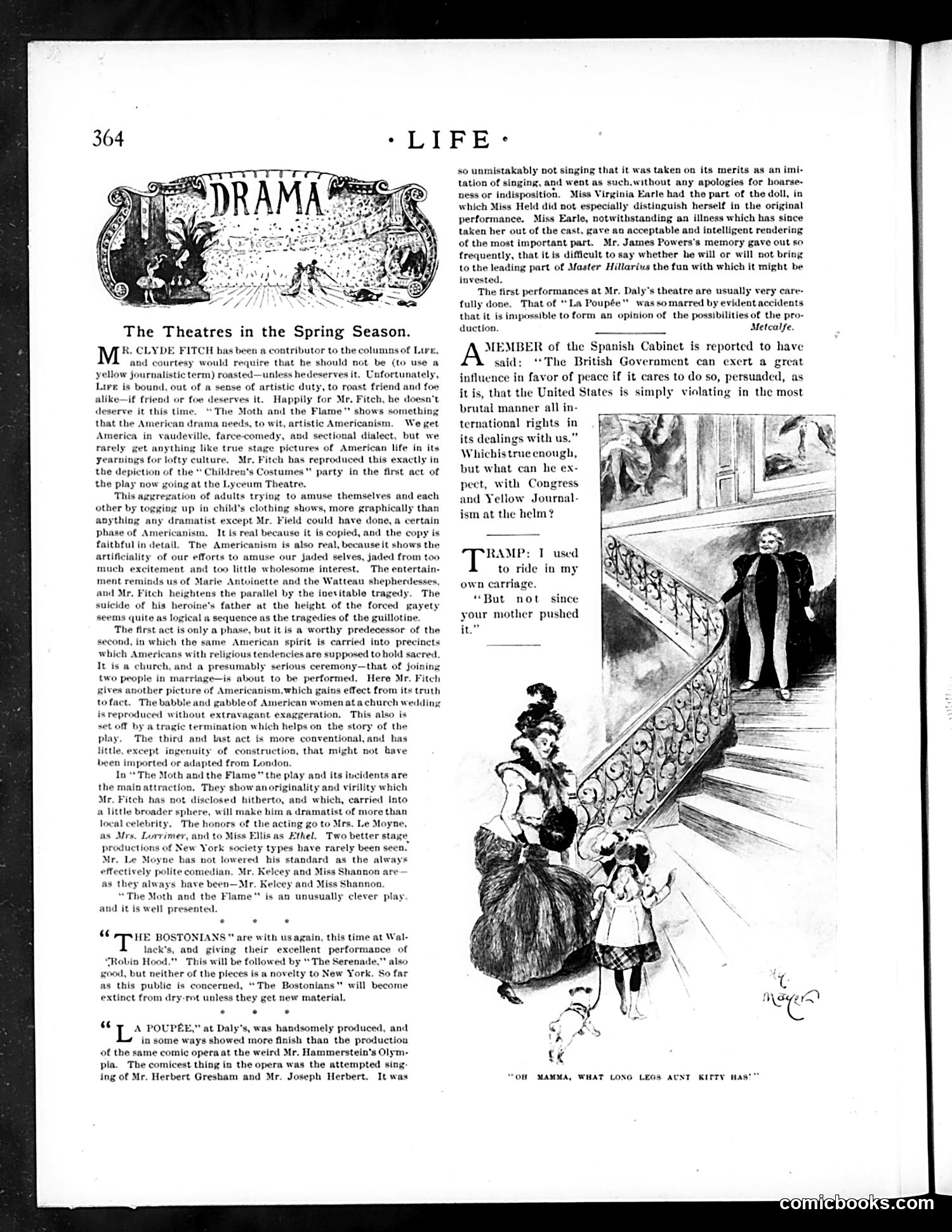
This is a theater review page from *Life* magazine discussing Broadway productions. The main cartoon illustrates a dialogue between a tramp and an elegant woman, captioned "OH MAMMA, WHAT LONG LEGS AUNTY KITTY HAS!" The humor depends on the child's innocent misinterpretation of adult social conventions—the "aunty" is likely a woman of questionable reputation or the child is observing something scandalous about fashionable dress or behavior. The page reviews several plays including *"The Moth and the Flame,"* *"La Poupée,"* and *"The Bostonians."* The text criticizes American theatrical productions for imitating London imports rather than developing original American drama, while praising certain performances and character work.
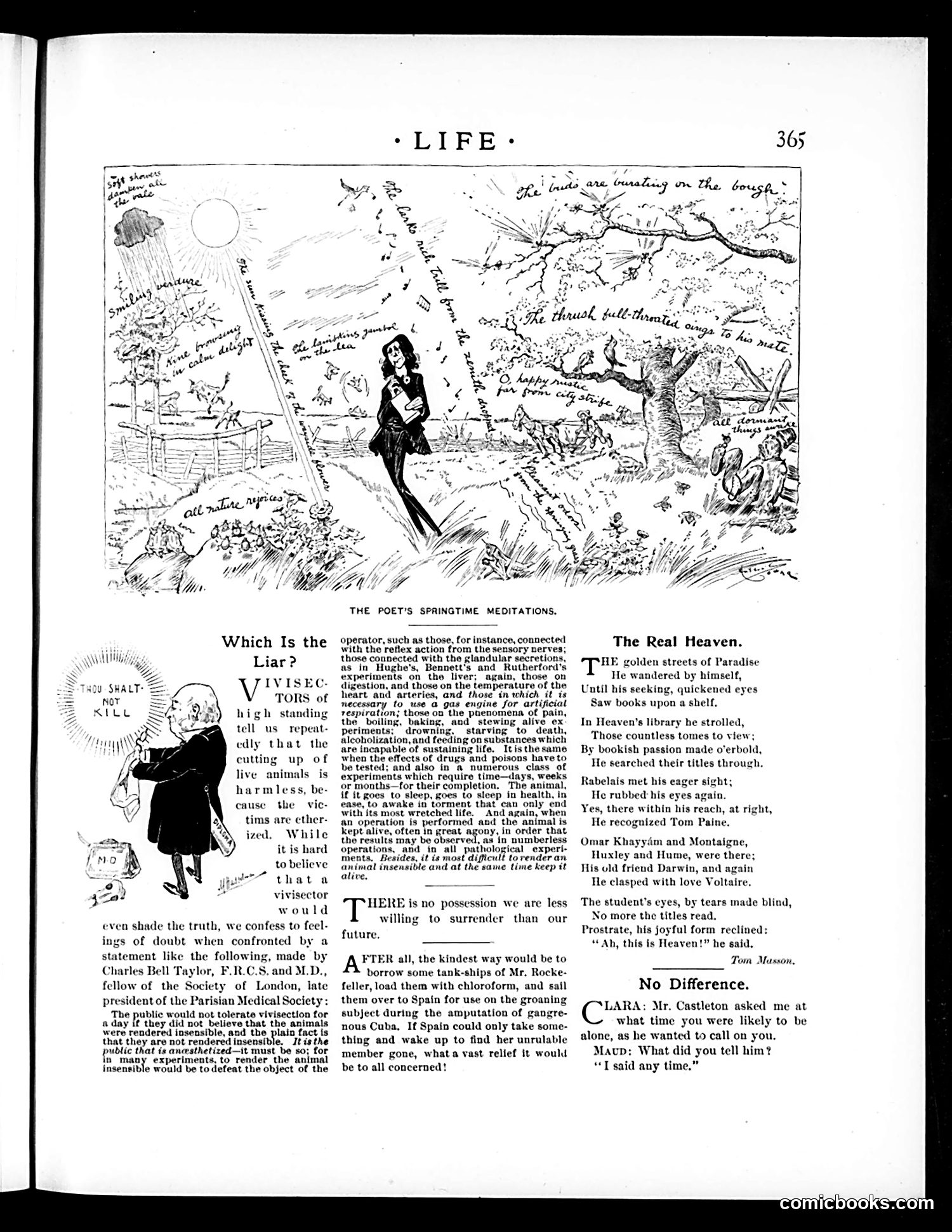
**"Which Is the Liar?"** — This cartoon critiques animal vivisection (live animal experimentation). Medical authorities claim test animals are anesthetized, making the practice humane. However, the page quotes Dr. Bell Taylor arguing the opposite: animals often *cannot* be anesthetized without defeating experimental purposes (testing nerve reflexes, poison effects, etc.). The satire suggests the public is the one being "anesthetized"—kept ignorant—while animals actually suffer. The cartoon depicts this hypocrisy. **"The Real Heaven"** — A sentimental poem about a student in Heaven's library discovering banned books: Rabelais, Tom Paine, Darwin, Voltaire, Omar Khayyam. The satire celebrates intellectual freedom and challenges to authority, implying these thinkers are censored or condemned on Earth. **"No Difference"** — A brief joke playing on the double meaning of "call on": Clara interprets Castleton's request innocuously, but Maud's answer ("any time") carries suggestive implications about availability. The page reflects early 20th-century Progressive-era concerns: animal welfare, intellectual censorship, and sexual propriety.
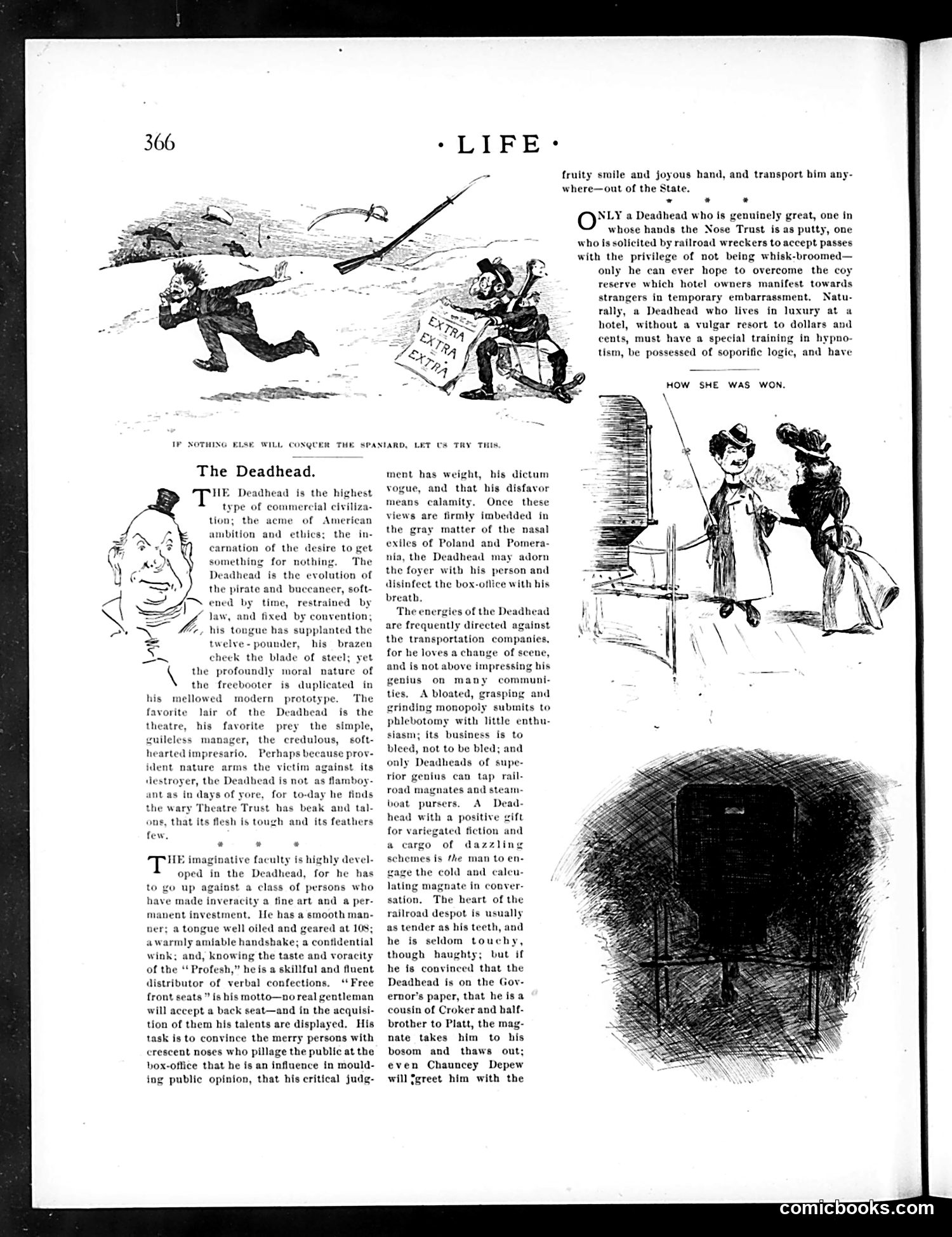
This satirical piece mocks the "Deadhead"—a figure who obtains free theater tickets, hotel stays, and transportation by exploiting his supposed influence on public opinion and personal charm rather than paying. The text describes him as the evolution of the pirate, using smooth talk ("tongue well oiled"), flattery, and fabricated connections to manipulate theater managers, railroad magnates, and hotel owners into providing free services. His tactics include claiming friendship with political figures like Richard Croker and Boss Platt, or threatening to damage reputations through critical judgment. The accompanying illustrations show Deadheads in action—depicted as somewhat disreputable characters—and a section titled "How She Was Won" suggesting women use similar tactics. The satire targets both the Deadhead's shamelessness and the easily-duped business owners who fear his influence, exposing Gilded Age commercial culture's vulnerability to manipulation and bluffing.
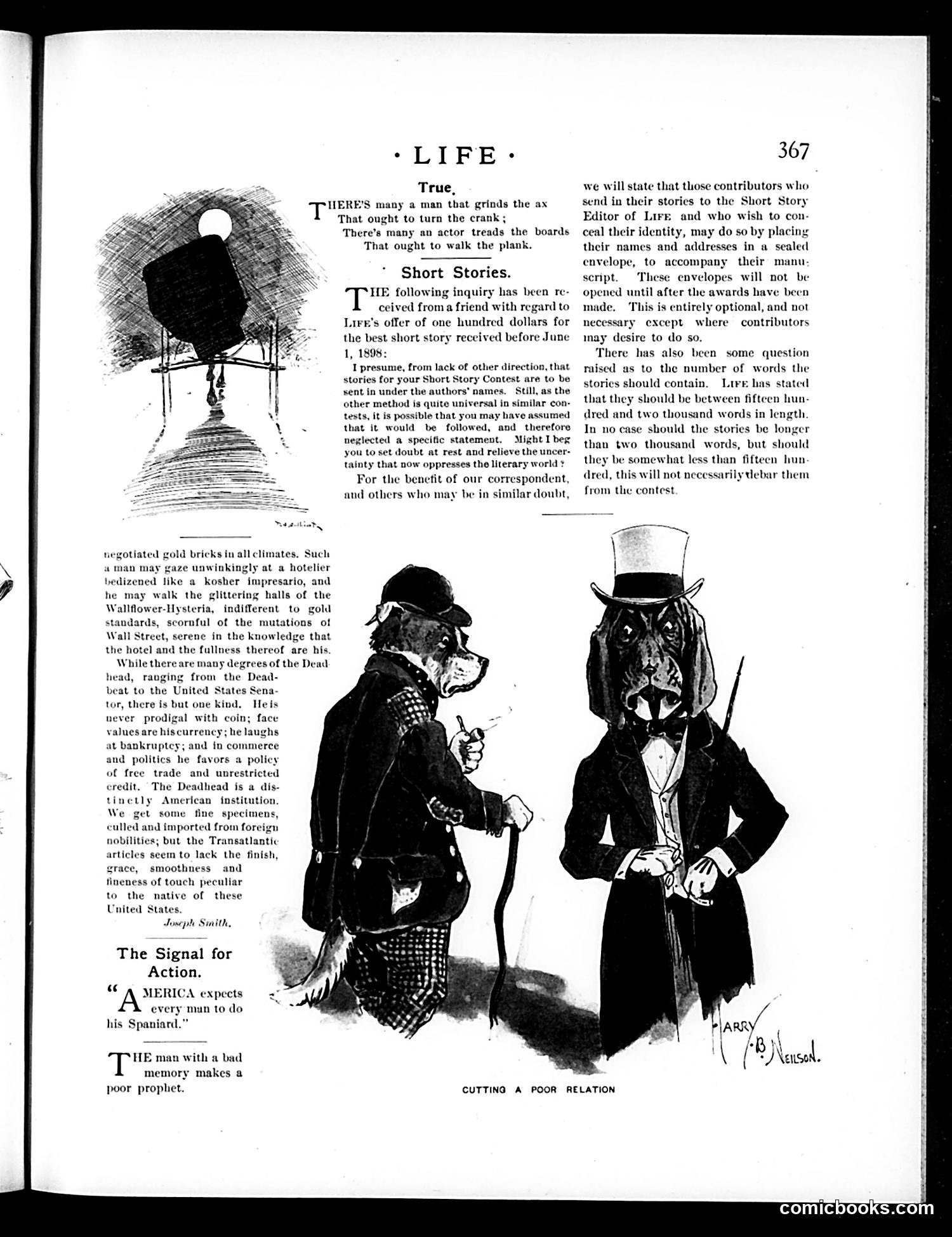
This page from Life (circa 1898) contains satirical commentary and a short-story contest announcement rather than political cartoons. **"The Signal for Action"** section mocks American expectations and character types, particularly "Deadheads"—people who exploit hospitality and avoid paying debts. The text describes them as uniquely American: comfortable swindlers indifferent to financial consequences, favoring "free trade and unrestricted credit." This appears to satirize late-19th-century attitudes about financial responsibility and American exceptionalism. **The cartoon titled "Cutting a Poor Relation"** depicts two well-dressed men in top hats. The figure on the right appears to be dismissing or severing ties with the figure on the left—visually representing the phrase "cutting" someone (ending a relationship). This likely satirizes wealthy Americans' treatment of poor relatives, a common social concern of the era. The page also announces Life's $100 short-story contest, with practical guidelines about anonymity and word limits (1,500-2,000 words).
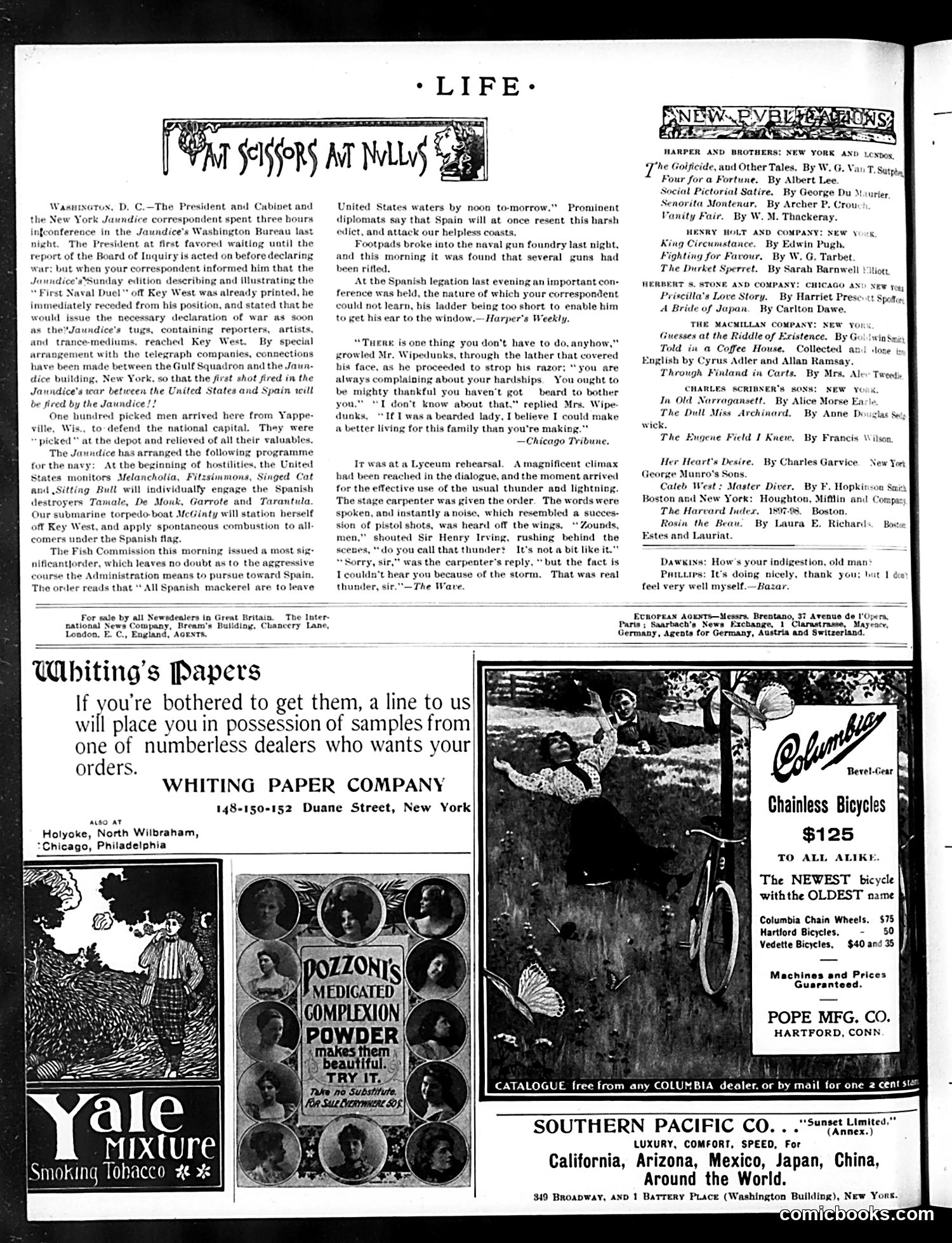
This page satirizes American jingoism during the Spanish-American War period (appears to be 1898). **The Main Cartoon ("At Scissors at Nulls"):** The satire mocks the *Jaundice* (a fictional newspaper parody of the sensationalist press) for essentially dictating war policy. The cartoon suggests that the President and Cabinet defer to the newspaper's war plans—the President won't declare war until the *Jaundice* publishes its "First Naval Duel" edition. It absurdly claims the newspaper controls naval operations at Key West. **Key Satirical Points:** - Press influence on foreign policy - American military unpreparedness ("helpless coasts," stolen gun foundry) - Casual mockery of diplomatic proceedings (correspondent too short to eavesdrop at Spanish legation) - Even comic orders about Spanish mackerel being "enemies" The page ridicules how newspapers manufactured war enthusiasm while the actual military and government appeared incompetent or beholden to media sensationalism. The remaining page content is mostly advertisements and unrelated humor pieces.
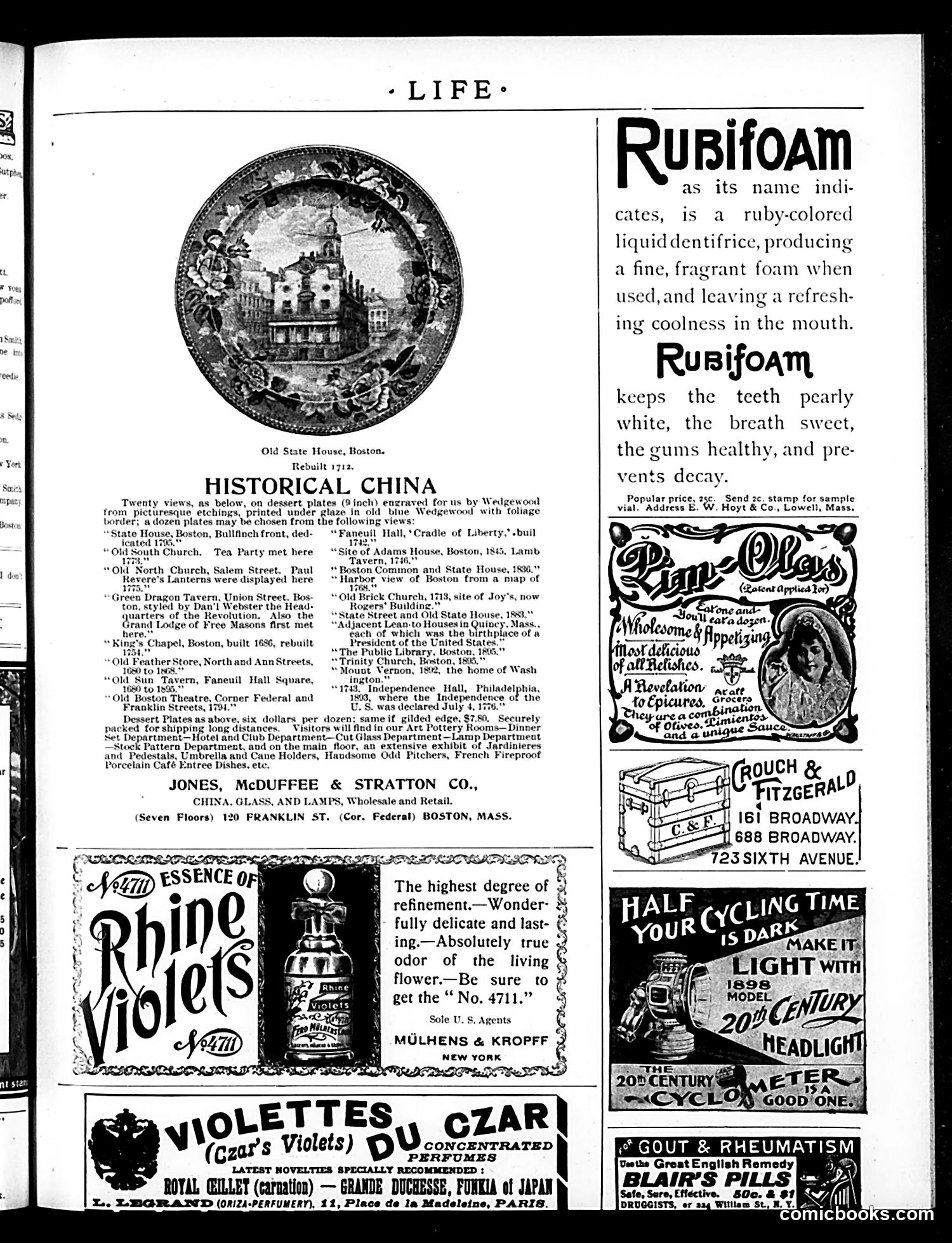
This page is primarily **advertising**, not satirical content. It features: 1. **Historical China plates** — A Wedgewood dealer advertises decorative dessert plates featuring Boston Revolutionary War sites (Old State House, Faneuil Hall, Paul Revere's Lanterns location, Independence Hall). This appeals to American patriotism and collecting trends of the era. 2. **Product advertisements** including Rubifoam (toothpaste), Rhine Violets perfume, Violettes du Czar perfume, and other consumer goods (luggage, bicycle headlights, pills). The "Historical China" section is the dominant content—essentially a catalog with patriotic imagery meant to market expensive dishware to affluent readers by emphasizing American historical significance and craftsmanship. There is **no political cartoon or satire** visible on this page. It represents early 20th-century *Life* magazine functioning partly as an advertising vehicle while maintaining its middle-class, historically-conscious editorial positioning.
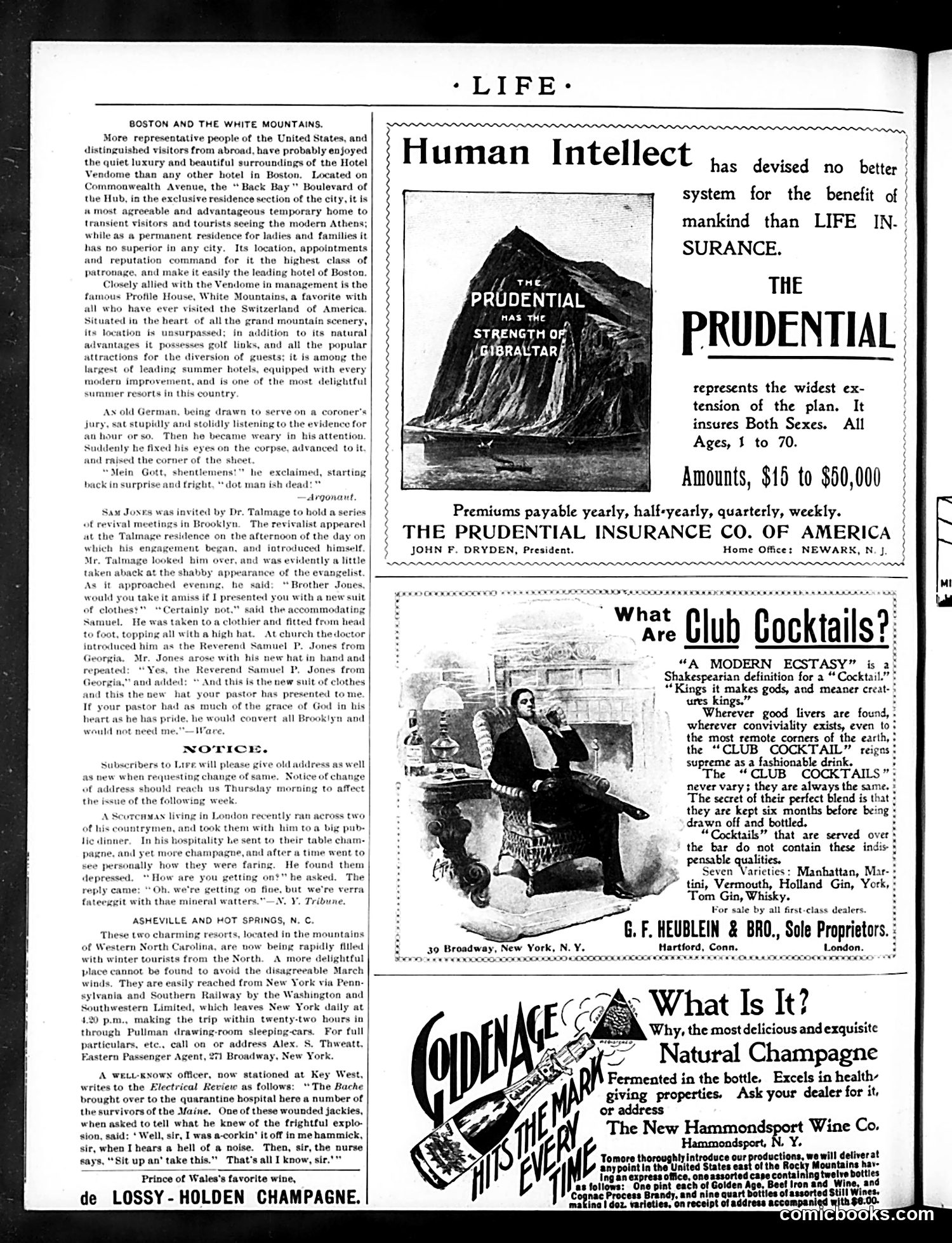
This page is primarily **advertising and travel promotion** rather than political satire. The dominant content includes: **Travel Advertisements:** - Hotel Vendome in Boston and Profile House in the White Mountains - Asheville and Hot Springs, North Carolina resorts - These promote upscale leisure destinations for wealthy Americans **Product Advertisements:** - The Prudential Insurance Company ("strength of Gibraltar") - G.F. Heurlein & Bro. cocktail mixers - Coinage Natural Champagne **Humorous Anecdotes:** The page includes brief comedic stories: a German juror declaring a corpse dead; evangelist Sam Jones receiving new clothes from Dr. Talmage; a Scotsman complaining about mineral water. **"What Are Club Cocktails?"** This section humorously defines cocktails as a "Modern Ecstasy," suggesting they're fashionable drinks gaining popularity among social elites. Overall, this represents *early 20th-century* consumer culture advertising targeting affluent readers—no significant political satire is evident.
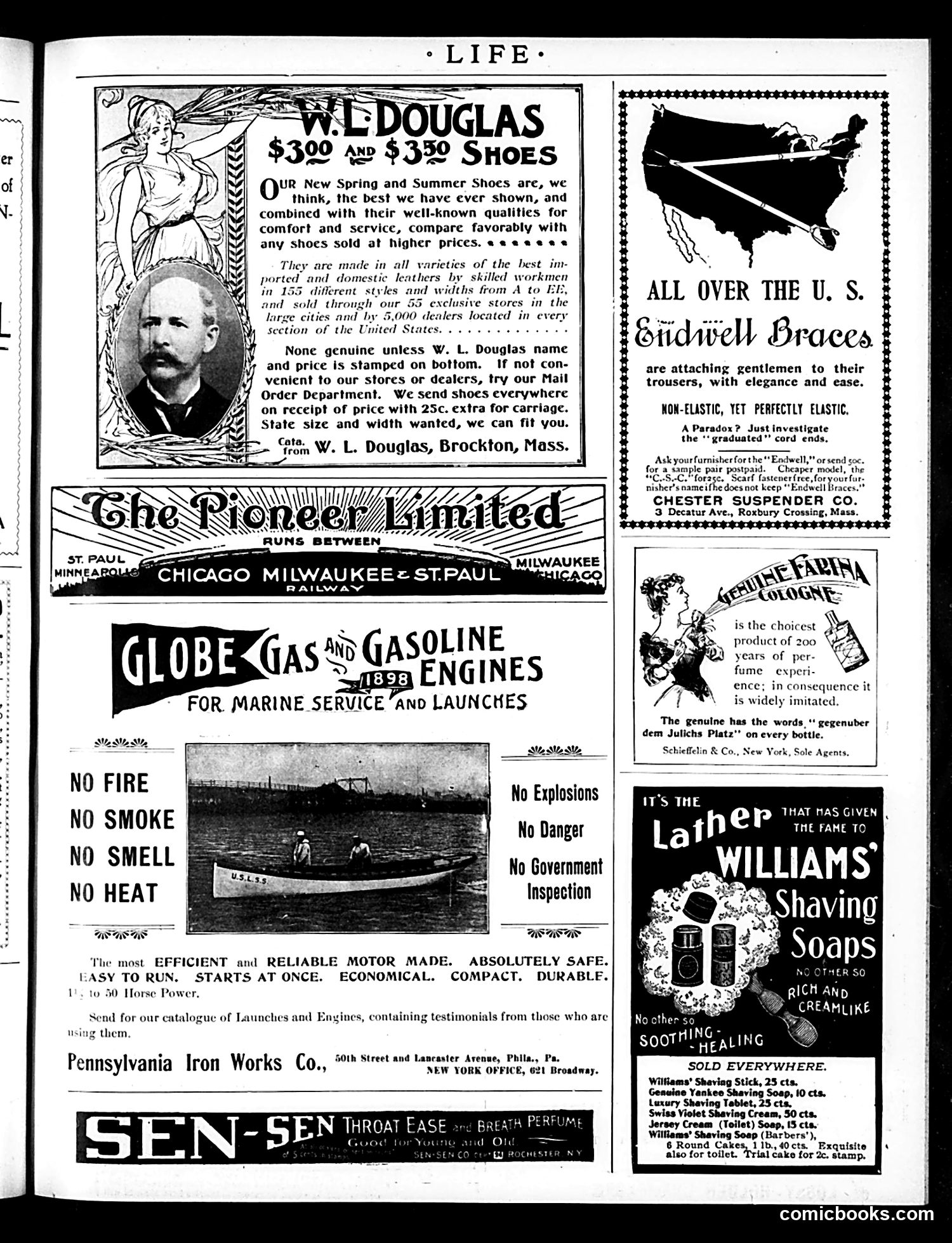
This page contains **no political cartoons or satire**—it is purely a collection of advertisements typical of early 20th-century American magazines. The ads feature: - **W.L. Douglas shoes** ($3.00-$3.30), emphasizing quality and mail-order availability across the U.S. - **Globe Gas and Gasoline Engines** for marine use, marketed as safe alternatives lacking "fire, smoke, smell" and requiring "no government inspection"—appealing to buyers skeptical of regulation - **Endwell Braces** (suspenders) with a paradoxical sales pitch about "graduated cord ends" - **Williams' Shaving Soaps** and toiletries - **Genuine Farina Cologne**, warning against imitations - **Sen-Sen** throat lozenges The page reflects early industrial-era consumer culture: mail-order convenience, emerging motorized transportation, grooming products, and brand-name consciousness. No satire or political commentary is evident.
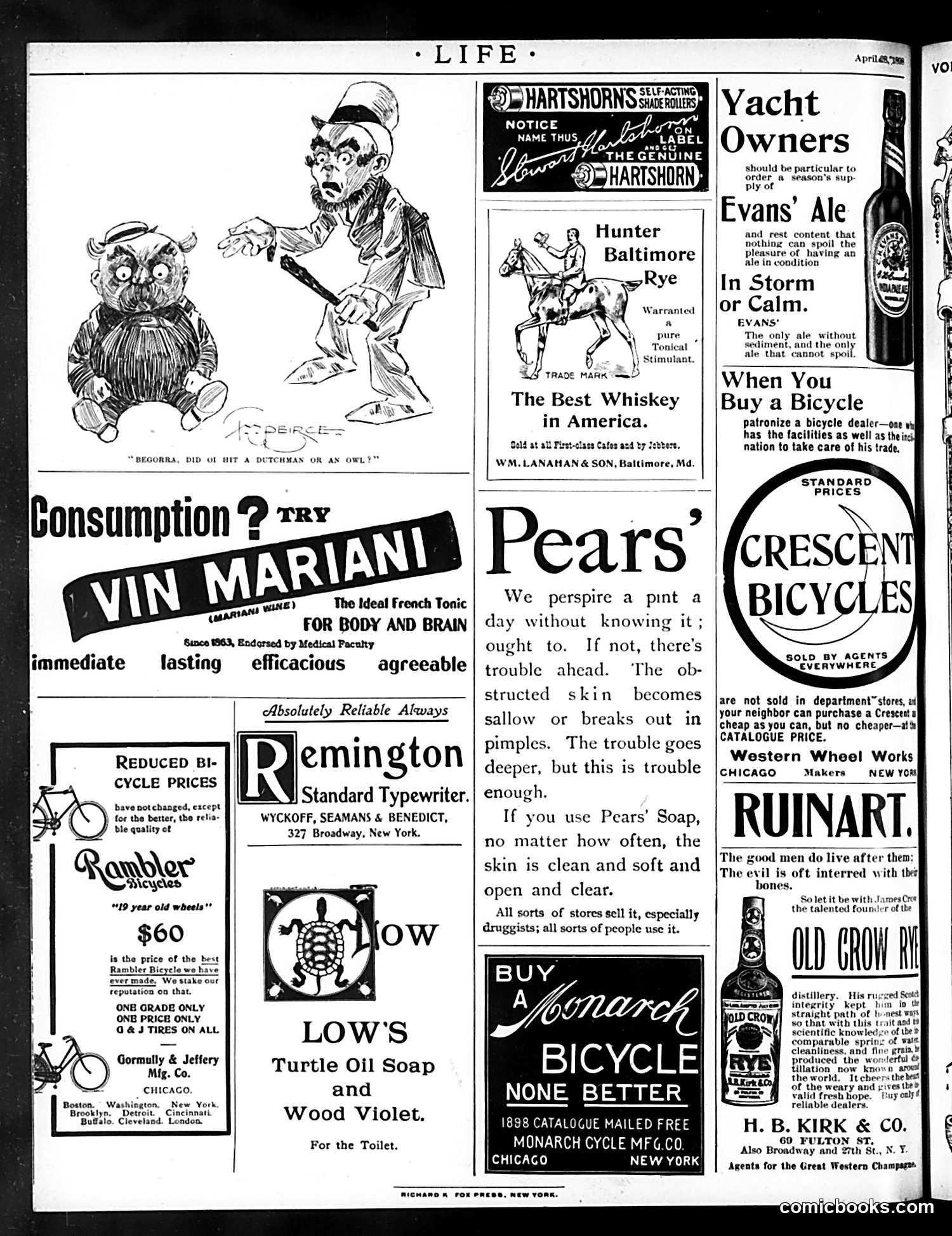
## The Political Cartoon The cartoon at top left depicts two caricatured Irish figures—one sitting (labeled "Begorra"), one standing with a club. The caption reads: "BEGORRA, DID OI HIT A DUTCHMAN OR AN OWL?" **Context**: This satirizes Irish immigrants through crude ethnic stereotyping. "Begorra" is a stage-Irish exclamation. The joke relies on portraying Irish people as violent, drunk, and stupid—common prejudices of the 1890s. The figure can't distinguish what he hit with his weapon, mocking Irish intelligence and suggesting casual violence. ## Page Content The remainder is **advertising**—mostly for bicycles (Crescent, Rambler, Monarch), typewriters, soap, whiskey, and patent medicines (Vin Mariani tonic, Hartshorn's ammonia). One ad notes Pears' Soap keeps skin "clean and soft," addressing period anxieties about hygiene and complexion. The cartoons and ads reflect late-Victorian commercial culture and casual ethnic ridicule considered acceptable entertainment.