
Life, 1898-04-28 · page 12 of 20
Life — April 28, 1898 — page 12: what you’re looking at
What you’re looking at
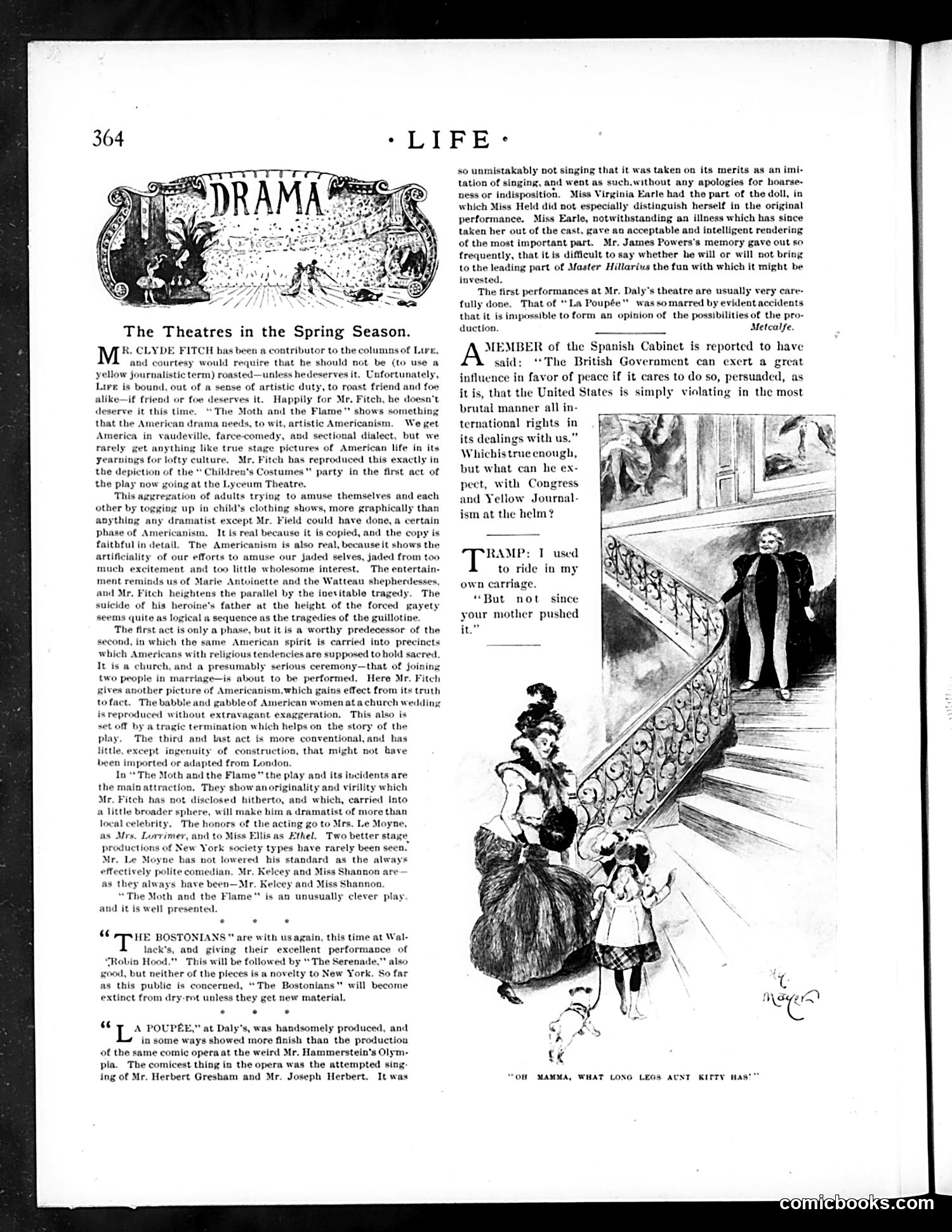
This is a theater review page from *Life* magazine discussing Broadway productions. The main cartoon illustrates a dialogue between a tramp and an elegant woman, captioned "OH MAMMA, WHAT LONG LEGS AUNTY KITTY HAS!" The humor depends on the child's innocent misinterpretation of adult social conventions—the "aunty" is likely a woman of questionable reputation or the child is observing something scandalous about fashionable dress or behavior. The page reviews several plays including *"The Moth and the Flame,"* *"La Poupée,"* and *"The Bostonians."* The text criticizes American theatrical productions for imitating London imports rather than developing original American drama, while praising certain performances and character work.
📄 Transcribed text from this page (OCR, searchable)
Machine-transcribed from the original scan — historical spelling and the odd misread are preserved.
*LIFE: The Theatres in the Spring Season. R. CLYDE FITCH has been a contributor to the columns of Lure, and courtesy would require that he should not be (to use a yellow journalistic term) roasted—unless hedeserves it. Unfortunately, Live is bound, out of a sense of artistic duty, to roast friend and foe a if friend or foe deserves it. Happily for Mr. Fitch, he doesn’t deserve it this time, “The Moth and the Flame” shows something that the American drama needs, to wit, artistic Americanism, We get America in vaudeville, farce-comedy, and sectional dialect, but we rarely get anything like true stage pictures of American life in its yearnings for lofty culture, Mr. Fitch has reproduced this exactly in the depiction of the * Children's Costumes" party in the first act of the play now going at the Lyceum Theatre. This aggregation of adults trying to amuse themselves and each other by togging up in child's clothing shows, more graphically than anything any dramatist except Mr. Field could have done, a certain phase of Americanism. It is real because it is copied, and the copy is faithful in detail, The Americanism is also real, because it shows the artificiality of our efforts to amuse our jaded selves, jaded fre much excitement and too little wholesome interest. The enter ment reminds us of Marie Antoinette and the Watteau shephert aud Mr. Fitch heightens the parallel by the inevitable tragedy. suicide of his heroine's father ut the height of the forced seems quite as logical a sequence as the tragedies of the guillotine. The first act is only a phase, but it is a worthy predecessor of the second, in which the same American spirit is carried into precincts which Americans with religious tendencies are supposed to hold sacred, It is a church, and a presumably serious ceremony—that of joining two people in marriage—is about to be performed. Here Mr. Fitch gives another picture of Americanism, which gains effect from its truth tofact. The babble and gabbleof American women ata church wedding isreproduced without extravagant exaggeration, This also ic termination which helps on the story of th The third and last act {s more conventional, and has little, except ingenuity of construction, that might not bave been imported or adapted from London. In “ The Moth and the Flame” the play and it dents are the mainattraction, They show anoriginality and virility which Mr. Fitch has not disclosed hitherto, and which, carried {nto a little broader sphere, will make him a dramatist of more than local celebrity, ‘The honors of the acting go to Mrs. Le Moyne. as Mrs. Lurrimer, and to Miss Ellis as Ethel. Two better stag: productions of New York society types have rarely been seen. Mr. Le Moyne bas not lowered his standard as the alwa effectively polite comedian, Mr. Kelcey and Miss Shannon are as th s have been—Mr. Kelcey and Miss Shannon. “The Moth and the Flame” is an unusually clever play and it is well presented. y alway (€ FAHE BOSTONIANS ™ are with us again, this time at Wal- lack's, and giving their excellent performan “Robin Hood." This will be followed by * The Serenade good, but neither of the pieces is a novelty to New York. So far as this public is concerned, “The Bostonians" will become extinct from dry-rot unless they get new material, o 6 6 SCT 4 POUPEE,” at Daly's, was handsomely produced, and in some ways showed more finish than the productiou of the same comic opera at the weird Mr. Hammerstein's Olym- pia. The comicest thing in the opera was the attempted sing- ing of Mr. Herbert Gresham and Mr. Joseph Herbert. It was so unmistakably not singing that it was taken on its merits as an imi- tation of singing, and went as such,without any apologies for hoarse- ness or indisposition. Miss Virginia Earle had the part of the doll, in which Miss Held did not especially distinguish herself in the original performance. Miss Earle, notwithstanding an illness which has since taken her out of the cast, gave an acceptable and intelligent rendering of the most important part. Mr. James Powers’s memory gave out so frequently, that it is diMcult to say whether he will or will not bring to the leading part of Master Hillarius the fun with which it might be invested. The first performances at Mr. Daly's theatre are usually very care- fully done. That of “La Poupée" was somarred by evident accidents that it is impossible to form an opinion of the possibilities of the pro- duction, Metcalfe. [EMBER of the Spanish Cabinet is reported to have said: ‘*The British Government can exert a great influence in favor of peace if it cares to do so, persuaded, as it is, that the United States is simply violating in the most brutal manner all in- ternational rights in 5 dealings with us. Whichistrue cnough, but what can he ey pect, with Congre: and Yellow Journal- ism at the helm? i I “RAMP: T used to ride in my own carriage. “But not since your mother pushed “OH MAMMA, WHAT LONG LEGS ACNT KITTY Has'”