
Life, 1898-04-28 · page 4 of 20
Life — April 28, 1898 — page 4: what you’re looking at
What you’re looking at
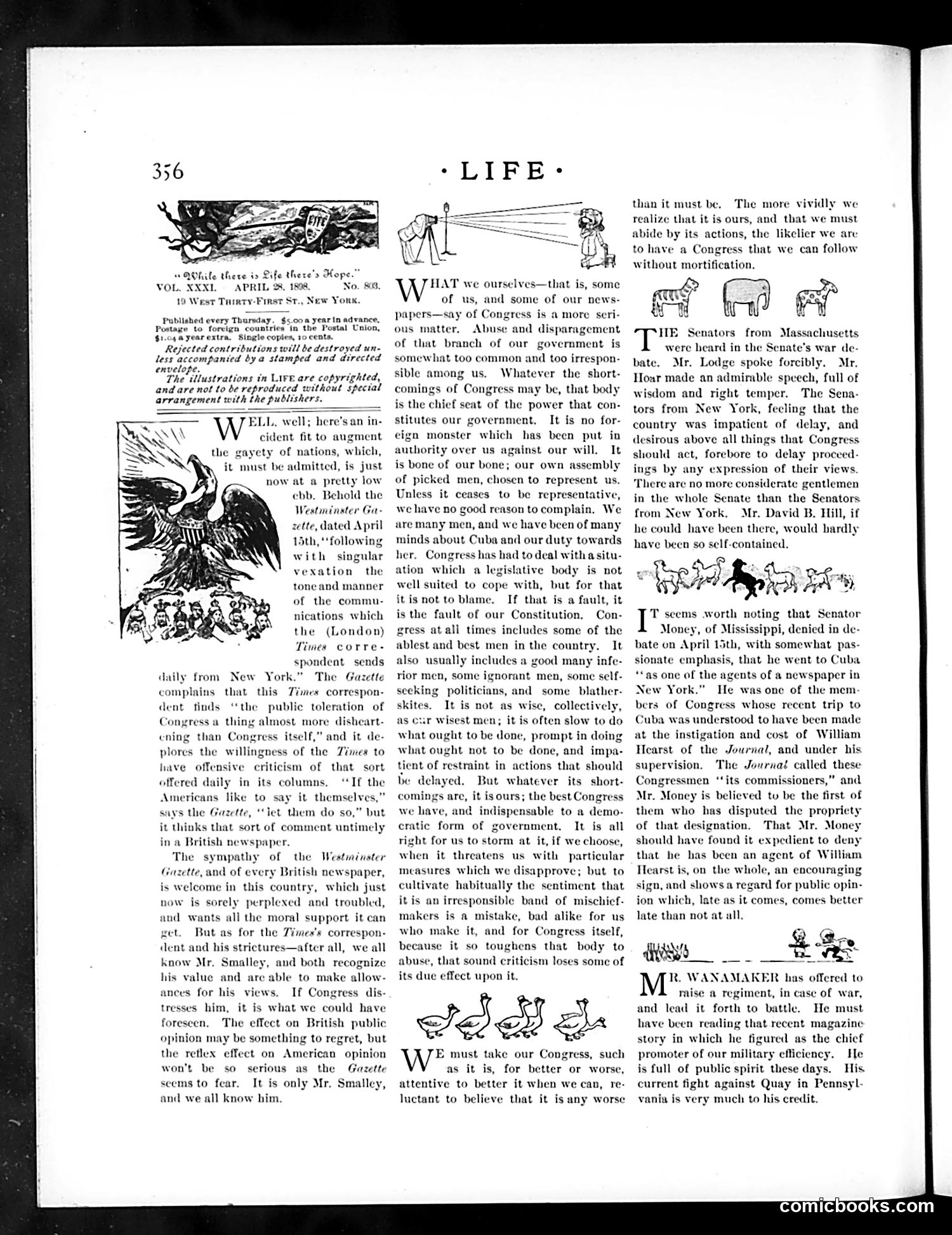
This page critiques Congress's handling of Cuban affairs and William Hearst's role in media sensationalism. The main editorial argues that Congress, despite public criticism, deserves some credit—including "some of the ablest and best men in the country." The text attacks the *Times* and *Westminster Gazette* for constant disparagement of Congress, while defending American legislators against British newspaper criticism. A secondary item mentions William Hearst's recent magazine story portraying himself as a military efficiency promoter, sarcastically noting he "must have been reading last recent magazine story." The small illustrations (birds, animals, sheep) appear decorative rather than symbolic. The page's primary purpose is defending Congress against press attacks while mocking Hearst's self-aggrandizement regarding military matters.
📄 Transcribed text from this page (OCR, searchable)
Machine-transcribed from the original scan — historical spelling and the odd misread are preserved.
ile there is Life there's APRIL 2, 1808. 19 West Trirty-Finst St., New You. Published every Thursday. $5.00. year in advance. tage to foreign countries in the Postal Union, arextra. Single copies, 10 cents, Rejected contributions will be destroyed un- less accompanied bya stamped and directed envelope. The illustrations in Live are copyrighted, and are not to be reproduced without special arrangement with the publishers. ELL, well; here's an in- cident fit to augment e gayety of nations, which, it must be admitted, is just now at a pretty low ebb, Behold the Westminster Ga- zette, dated April 1th, “following with singular vexation the toneand manner of the commu- nications which the (London) Times corre+ spondent sends daily from New York.” The Gazette complains that this Times correspon- dent finds ‘the public toleration of Congress a thing almost more disheart- ening than Congress itself,” and it de- plores the willingness of the Zimes to have offensive criticism of that sort offered daily in its columns. ‘If the Americans like to say it themselves,” says the Gazette, ‘let them do so,” but it thinks that sort of comment untimely in a British newspaper. The sympathy of Gazette, and of evi the Weatininster y British newspaper, is welcome in this country, which just now is sorely perplexed and troubled, and wants all the moral support it can get. But as for the Times's correspon- dent and his strictures—after all, we all know Mr. Smalley, and both recognize his value and are able to make allow- ances for his v If Congress dis- tresses him, it is what we could have foreseen. The effect on British public opinion may be something to regret, but the retlex effect on American opinion won't be so serious as the Gazette It is only Mr. Smalley, PWS. seems to fear. and we all know HAT we ourselves—that is, some of us, and some of our news- papers—say of Cor i ous matter, ess is a more Abuse and disparagement of that branch of our government is somewhat too common and too irrespon- sible among us. Whatever the short- comings of Congress may be, that body is the chief seat of the power that con- stitutes our government, It is no for- eign monster which has been put in uthority over us against our will, It is bone of our bone; our own assembly of picked men, chosen to represent us. Unless it ceases to be representative, we have no good reason to complain. We are many men, and we have been of many minds about Cuba and our duty towards her. Congress has had to deal witha situ- ation which a legislative body is not well suited to cope with, but for that itis notto blame, If that is a fault, it is the fault of our Constitution, Con- gress atall times includes some of the ablest and b men inthe country. It also usually includes a good many infe- rior men, some ignorant men, some self- seeking politicians, and some blather- skites. It is not as wise, collectively, as cur wisest men; it is often slow to do what ought to be done, prompt in doing what ought not to be done, and impa- tient of restraint in actions that should be delayed. But whatever its short- comings are, it is ours; the best Congress we have, and indispensable to a demo- cratic form of government. It is all right for us to storm at it, if we choose, when it threatens us with particular measures which we disapprove; but to ultivate habitually the sentiment that itis an irresponsible band of mischief- makers is a mistake, bad alike for us who make it, and for Congress itself, because it so toughens that body to abuse, that sound criticism loses some of its due effect upon it. 23 s- E must take our Congress, such as it is, for better or worse, attentive to better it when we can, re- luctant to believe that it is any worse than it must be, The more vividly we realize that it is ours, and that we must abide by its actions, the likelier we are to have a Congress that we can follow without mortification. HE Senators from Massachusetts were heard in the Senate's war de- bate. Mr. Lodge spoke forcibly, Mr, Hour made an admirable speech, full of wisdom and right temper. The Sena- tors from New York, fecling that the country was impatient of delay, and desirous above all things that Congress should act, forebore to delay proceed- ings by any expression of their views. There are no more considerate gentlemen in the whole Senate than the Senators from New York, Mr. David B. Hill, if he could have been there, would hardly have been so self-contained. ie Apia as T seems worth noting that Senator Money, of Mississippi, denied in de- bate on April 15th, with somewhat pas- sionate emphasis, that he went to Cuba “*as one of the agents of a newspaper in New York.” He was one of the mem. bers of Congress whose recent trip to Cuba was understood to have been made at the instigation and cost of William Hearst of the Journal, and under his supervision. The Journat called these Congressmen ‘‘its commissioners,” and Mr. Money is believed to be the first of them who has disputed the propriety of that designation. That Mr. Money should have found it expedient to deny that he has been an agent of William Hearst is, on the whole, an encouraging sign, and shows a regard for public opin- ion which, late as it comes, comes better late than not at all. ae me R. WANAMAKER has offered to raise a regiment, in c of war, and lead it forth to battle. He must have been reading that recent magazine story in which he figured as the chief promoter of our military efficiency. He is full of public spirit these days. His current fight against Quay in Penns vania is very much to his credit, comicbooks.com