
Life, 1898-04-28 · page 6 of 20
Life — April 28, 1898 — page 6: what you’re looking at
What you’re looking at
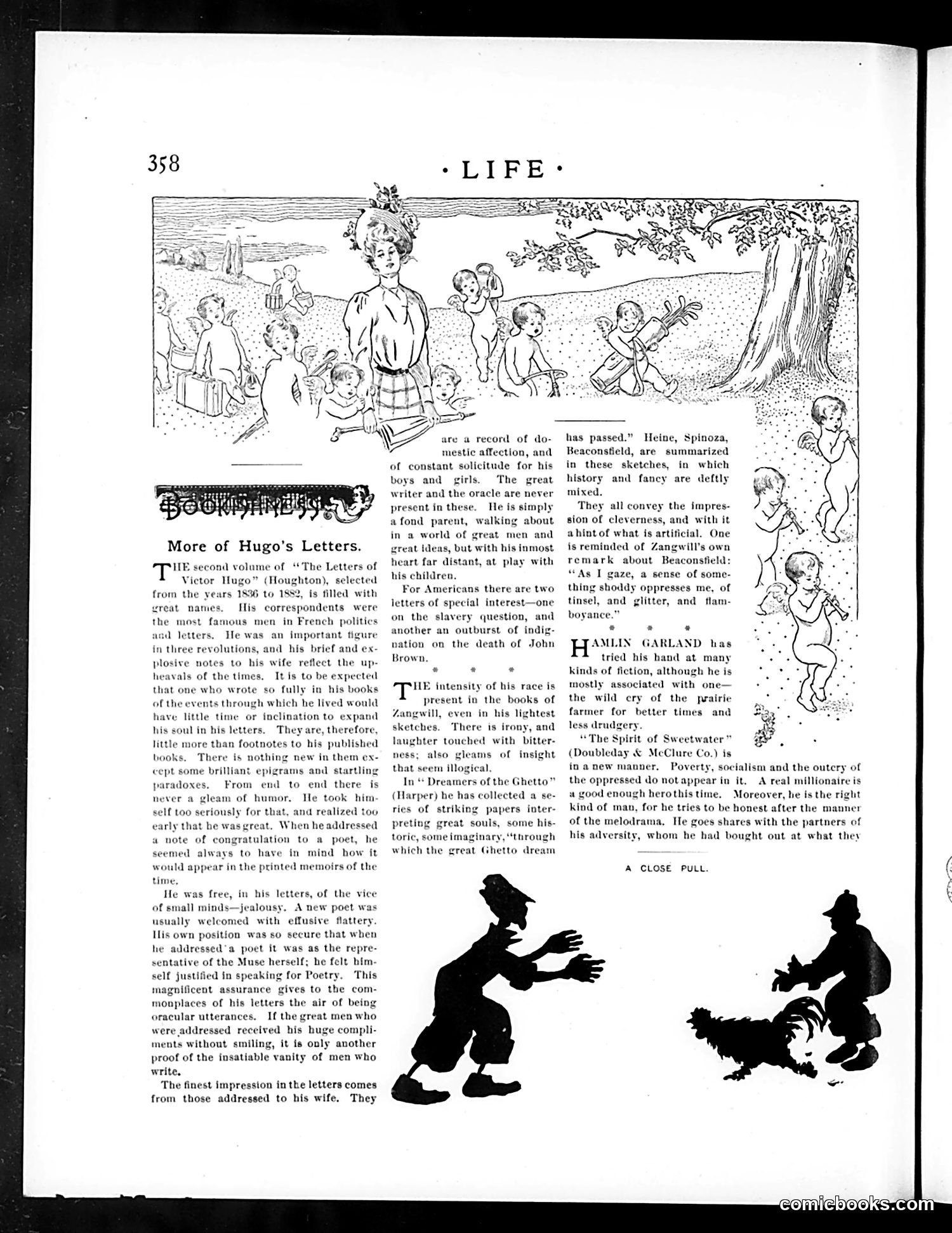
The page primarily contains a literary article titled "More of Hugo's Letters," discussing Victor Hugo's correspondence from 1836-1882. The text praises Hugo's letters as historically significant records of French political upheaval and revolution. Below the article is a silhouette illustration captioned "A CLOSE PULL," showing two figures (appearing to be caricatured men in confrontational poses) engaged in some kind of physical struggle or competition. Without additional context on the specific date or issue, the silhouette's exact political reference is unclear—it may reference a contemporary political or social conflict, though the cartoon's precise target cannot be definitively determined from the image alone. The page is primarily text-focused rather than satirical cartooning.
📄 Transcribed text from this page (OCR, searchable)
Machine-transcribed from the original scan — historical spelling and the odd misread are preserved.
More of Hugo's Letters. ITE second volume of “The Letters of Victor Hugo” (Houghton), selected from the years 1836 to 1882, is filled with ureat nam flis correspondents were the most famous men in French politics and letters, He was an important tigure in three revolutions, and his brief and ex- plosive notes to his wife reflect the up- heavals of the times, It is to be expected that one who wrote so fully in his books of the even have little time or inclination to ex his soul in his letters. little more than footnotes to his publ books. There is nothing new in them ex- cept some brilliant epigrams and star From end to end there is ever a gleam of humor, He took him self too seriously for th a realized es . When he addressed of congratulation to a poet, he always to in mind how it would appear in the printed memoirs of the time, He was free, in his letters, of the vice of small minds—jealousy. A new poet was welcomed with effusive flattery Ilis own position was so secure that when he addressed’a poet it was as the repre- sentative of the Muse herself; he felt bim- self justified in speaking for Poetry. This magnificent assurance gives to the com- monplaces of his letters the air of being oracular utterances. If the great men who were addressed receives ompli- ments without smiling, it is only another proof of the insatiable vanity of men who write, ‘The finest impression in the letters comes from those addressed to his wife. They through which he lived would too usually a record of do- mestic affection, and of constant solicitude for his voys and girls. The great writer and the oracle are never present in these. He is simply afond parent, walking about in a world of great men and great ideas, but with his inmost heart far distant, at play with his children. For Americans there are two letters of special interest—one on the slavery question, and another an outburst of indig- nation on the death of John Brown, * * * T! E intensity of his race is present in the books of Zangwill, even in his lightest sketches. There is irony, and laughter touched with bitter- ; also gleams of insight em illogical, In * Dreamers of the Ghetto” (Harper) be has collected a se- ries of striking papers inter- preting great souls, some his- toric, some imaginary, “through which the great Ghetto dream has passed.” Heine, Spinoza, Beaconsfield, are summarized in these sketches, in which history and fancy are deftly mixed. They all convey the impres- sion of cleverness, and with it ahintof what is artificial. One is reminded of Zangwill’s own remark about H onsfield: “As I gaze, a sense of some- thing shoddy oppresses me, of tinsel, and glitter, and fle boyan * * * AMLIN GARLAND has tried his hand at many kinds of fiction, although he is mostly associated with one— the wild cry of the prairie farmer for better times and Spirit of Sweetwater” (Doubleday & McClure Co.) is ina new manner. Poverty, soc the oppressed do not appear in it, a good enough herothis time, kind of man, for he trie: lism and the outcry of A real millionaire is Moreover, he is the right to be honest after the manner of the melodrama, He goes shares with the partners of his adversity, whom he had bought out at what they A CLOSE PULL.