
A complete issue · 26 pages · 1897
Life — November 18, 1897
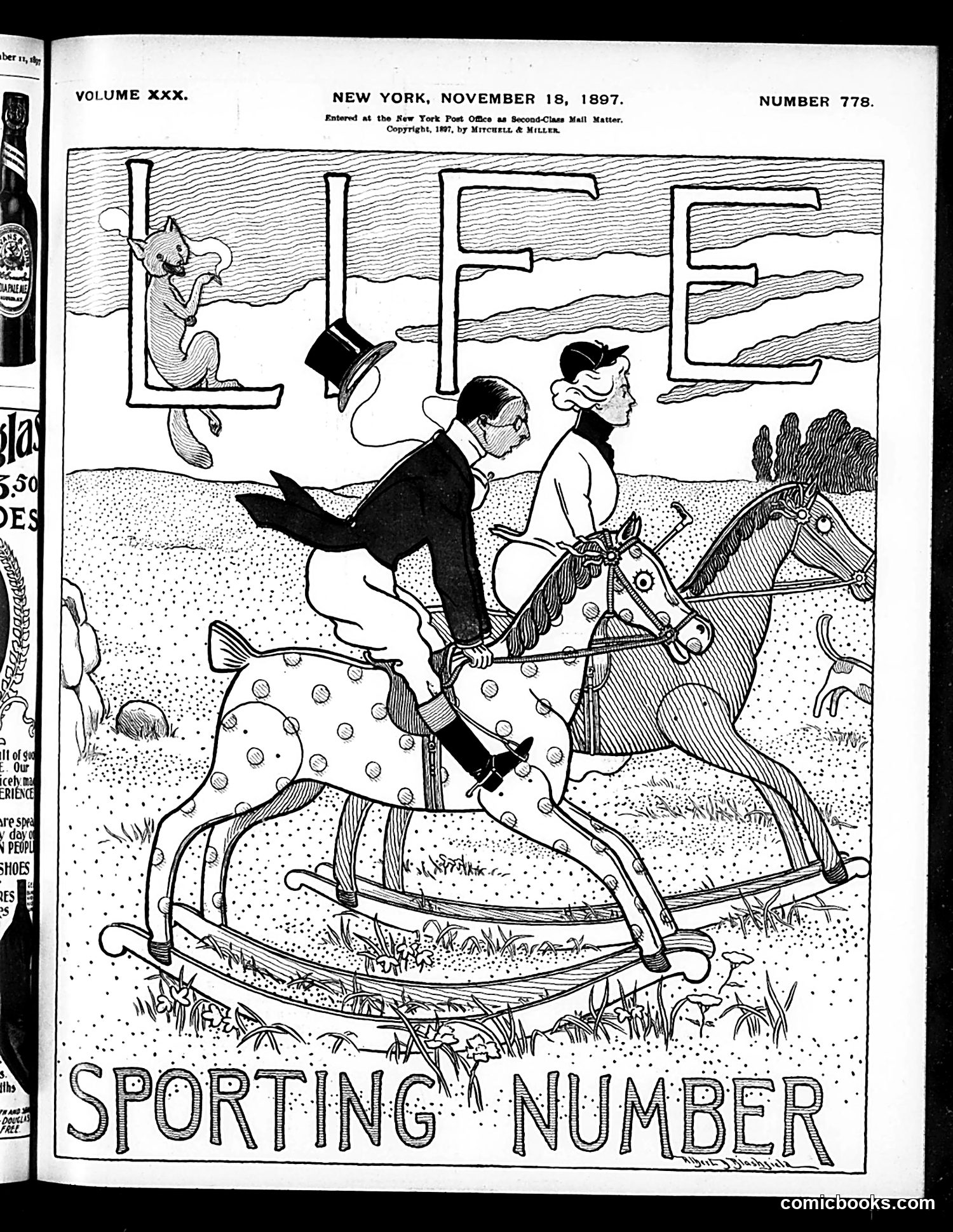
This cover illustrates the fashionable sport of rocking-horse riding among wealthy gentlemen. Two well-dressed men in top hats ride an oversized decorative rocking horse across a pastoral landscape, while a figure in the background appears to be using a similarly absurd conveyance. The satire targets the idle leisure pursuits of the upper class—depicting grown men engaged in a child's toy as if it were a legitimate "sport." The exaggerated formality (top hats, formal dress) contrasts comically with the childish activity, mocking the wealthy's tendency to treat trivial pastimes with unwarranted seriousness. This reflects late-19th-century social critique of aristocratic excess and the gap between the leisured classes and productive society.
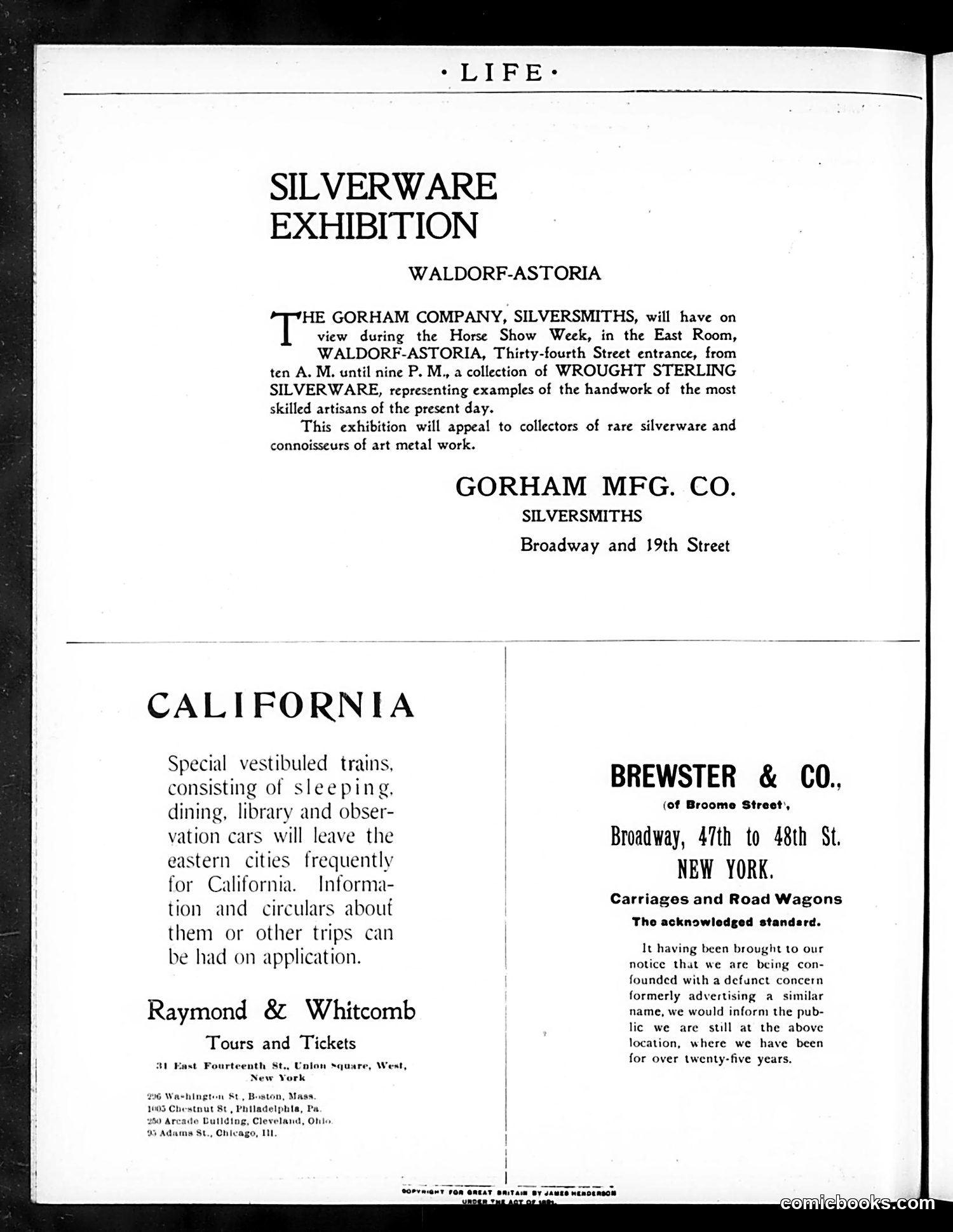
This page contains **no political cartoons or satirical content**. It is a standard advertising page from *Life* magazine featuring three distinct advertisements: 1. **Gorham Manufacturing Company** - advertising a silverware exhibition at the Waldorf-Astoria Hotel during Horse Show Week, showcasing wrought sterling silverware for collectors 2. **Raymond & Whitcomb** - promoting special train tours to California with sleeping, dining, and library cars 3. **Brewster & Co.** - advertising carriages and road wagons from their New York location, noting they've operated at the same address for over twenty-five years The page is purely commercial in nature, reflecting early 20th-century luxury goods and travel services targeting affluent readers.
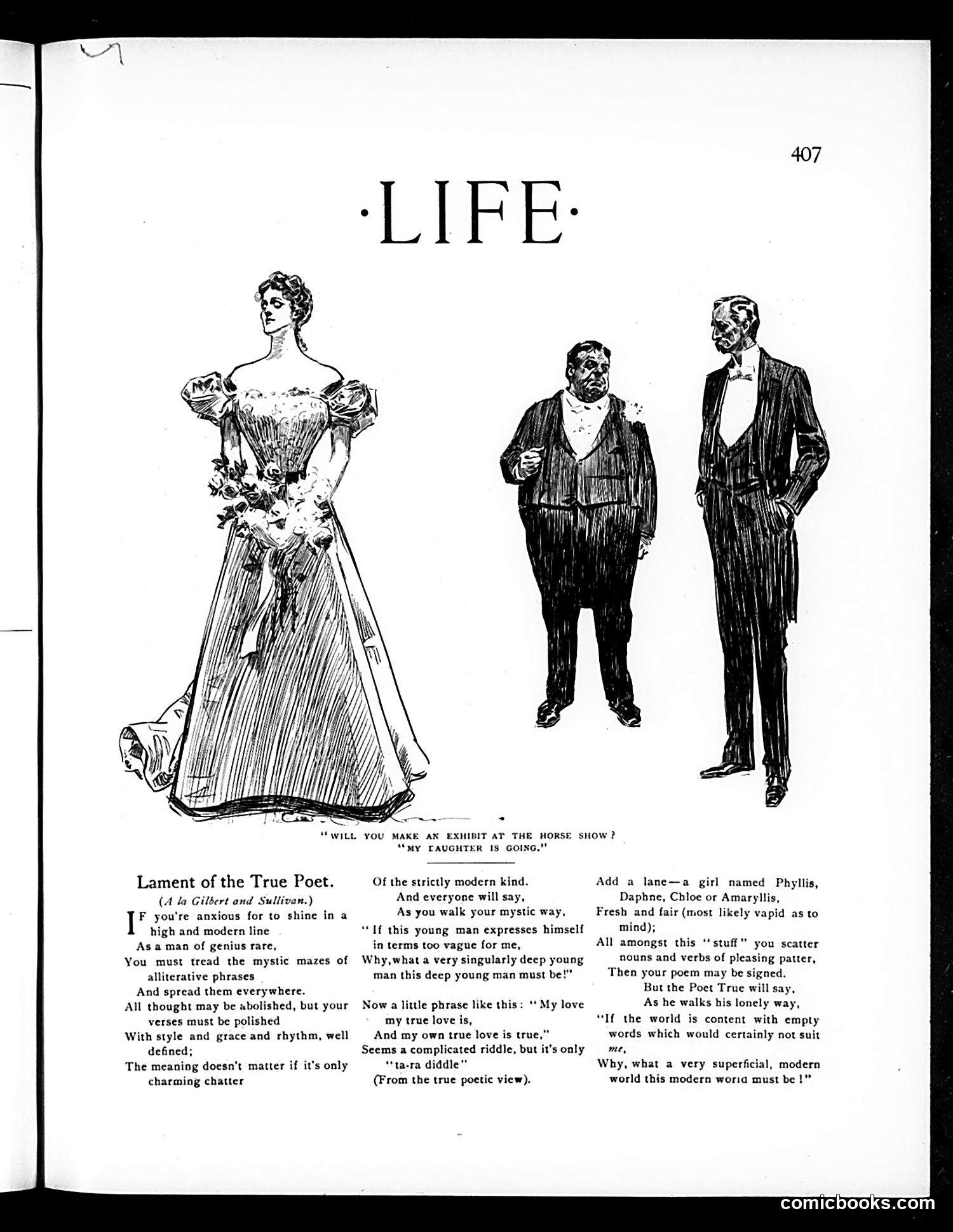
This page satirizes modern poetry and poets through three figures: an elegantly dressed woman on the left, and two men in formal attire on the right. The dialogue "'Will you make an exhibit at the horse show?' 'My daughter is going'" suggests absurdist humor about social pretension. The text "Lament of the True Poet" mocks contemporary verse as overly obscure and self-important. It criticizes modern poets for valuing vague, incomprehensible language over meaningful content—dismissing their work as "charming chatter" lacking substance. The satire suggests that fashionable modern poets prioritize style and obscurity over clarity, producing pretentious but empty verses that confuse readers while the poets congratulate themselves on their profundity.
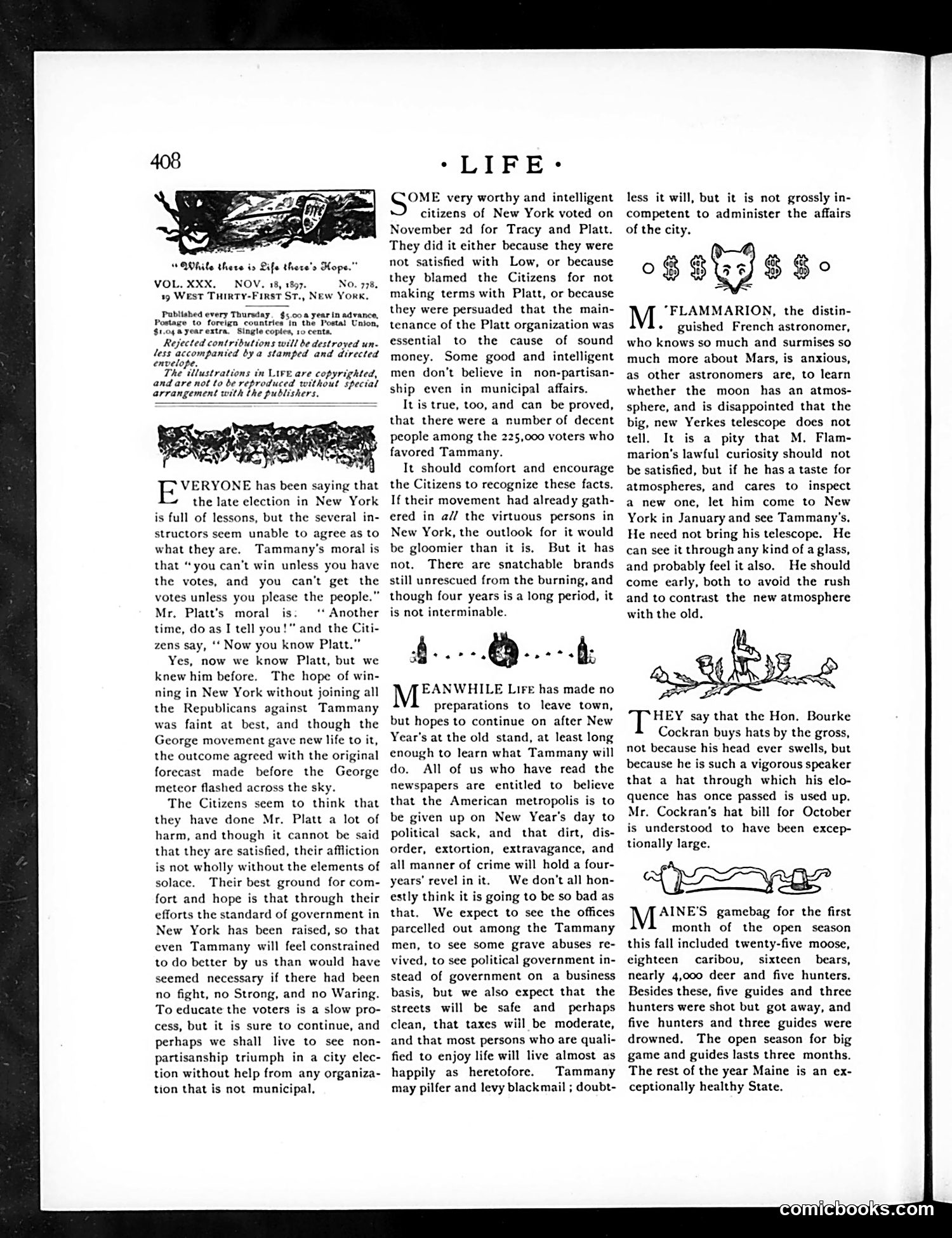
This page contains editorial commentary on New York City's recent election (November 2) involving candidates Tracy and Platt. The text criticizes voters who couldn't decide between these figures or blamed the "Citizens" organization for failing to unite against Tammany Hall (the corrupt Democratic machine). The piece mocks New York's political dysfunction, noting that even intelligent citizens couldn't agree on non-partisan municipal governance. It defends the Citizens' efforts while acknowledging Tammany's likely victory, suggesting New York's government has become so corrupted by political machines that clean governance seems impossible without organized municipal reform. The brief mentions of Flammarion (an astronomer) and Bourke Cockran (a politician) appear unrelated to the main political commentary.
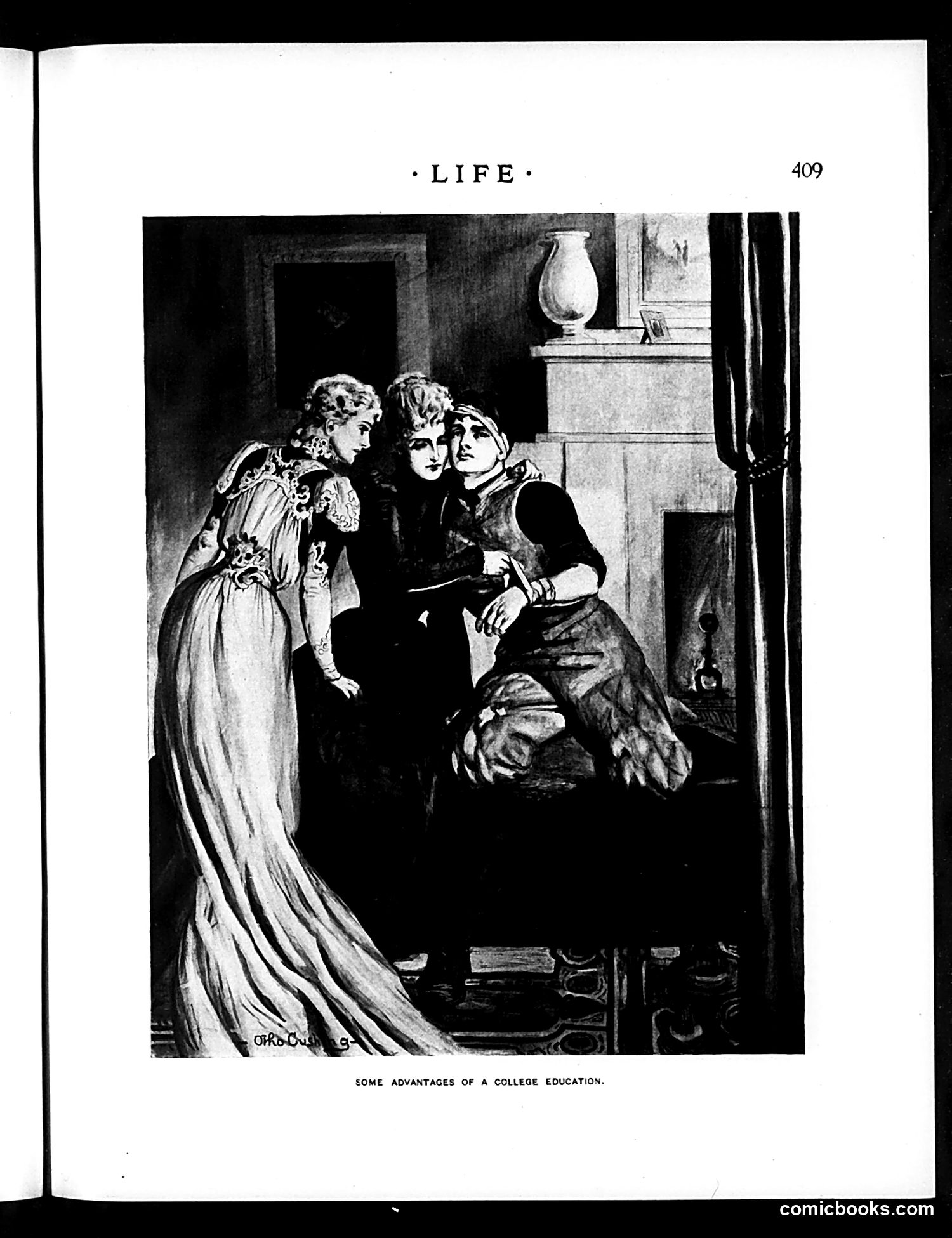
This satirical cartoon depicts three figures in an interior scene. The caption "Some Advantages of a College Education" suggests ironic commentary on higher education's supposed benefits. The image shows a woman in an elegant white gown on the left conversing with two other figures—a man and woman in darker clothing, seated. The composition and body language suggest a social interaction where education may be facilitating romantic or social advantage. The satire appears to critique the idea that college education provides practical life benefits, possibly suggesting that women's education was primarily valued for enhancing marriage prospects or social positioning rather than intellectual development. This reflects early 20th-century skepticism about women's higher education and its actual utility in society.
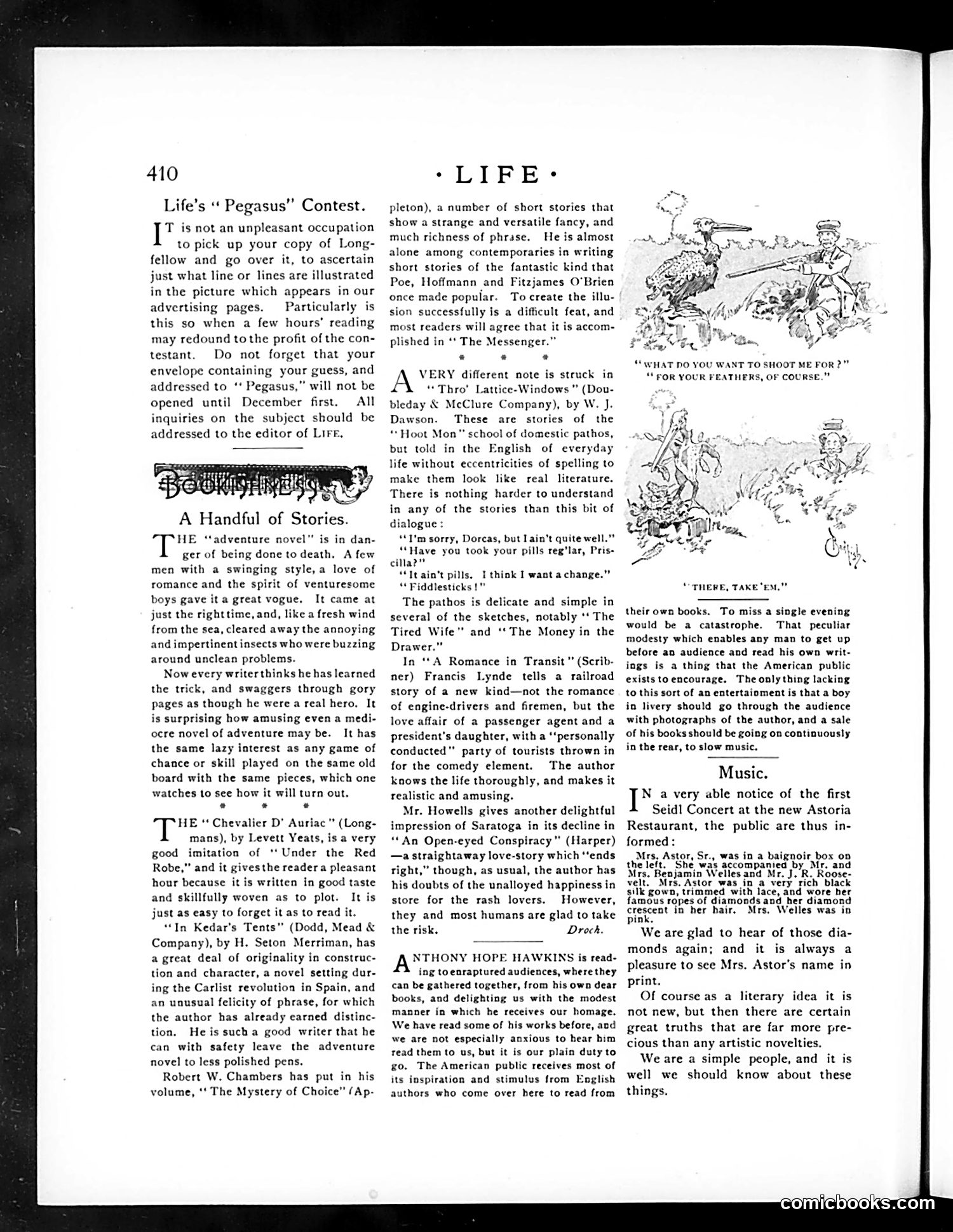
This is a literary review page from *Life* magazine, not primarily political satire. The page discusses contemporary fiction, including short stories described as having "strange and versatile fancy" in publications like *The Messenger*. The two small illustrations on the right appear to be humorous vignettes accompanying book reviews—one shows a hunting scene with the caption "WHAT DO YOU WANT TO SHOOT ME FOR? FOR YOUR FEATHERS, OF COURSE," and another captioned "THERE, TAKE 'EM!" Both seem to illustrate domestic comedies or sentimental stories being reviewed. The content focuses on literary criticism of adventure novels and romantic fiction rather than political commentary. This reflects *Life*'s dual purpose as both satirical magazine and arts/culture publication during the early 20th century.
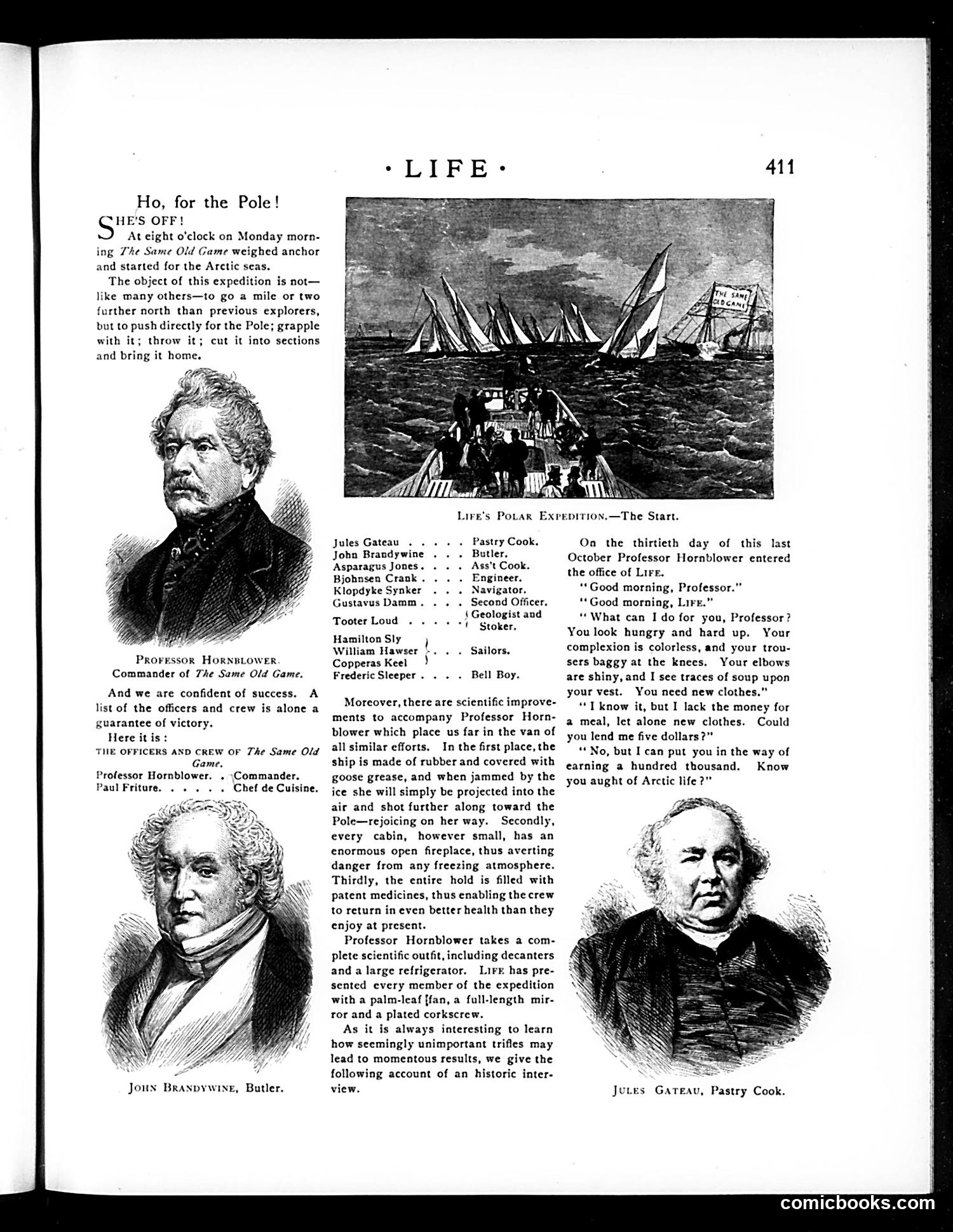
This page documents an Arctic expedition aboard *The Same Old Game*, commanded by Professor Hornblower. The article announces an unusual objective: not to advance further north than previous explorers, but to retrieve the North Pole itself—"throw it; cut it into sections and bring it home." The text is satirical commentary on the era's competitive polar exploration, mocking the obsessive race for Arctic achievement. By literalizing the Pole as a physical object to be captured and parceled out, Life ridicules the vanity and futility of such expeditions. The page includes portraits of crew members (Butler, Pastry Cook, etc.) and describes scientific equipment and provisions, maintaining the satirical pretense of a serious expedition while the absurd premise undercuts polar exploration's grandiosity.
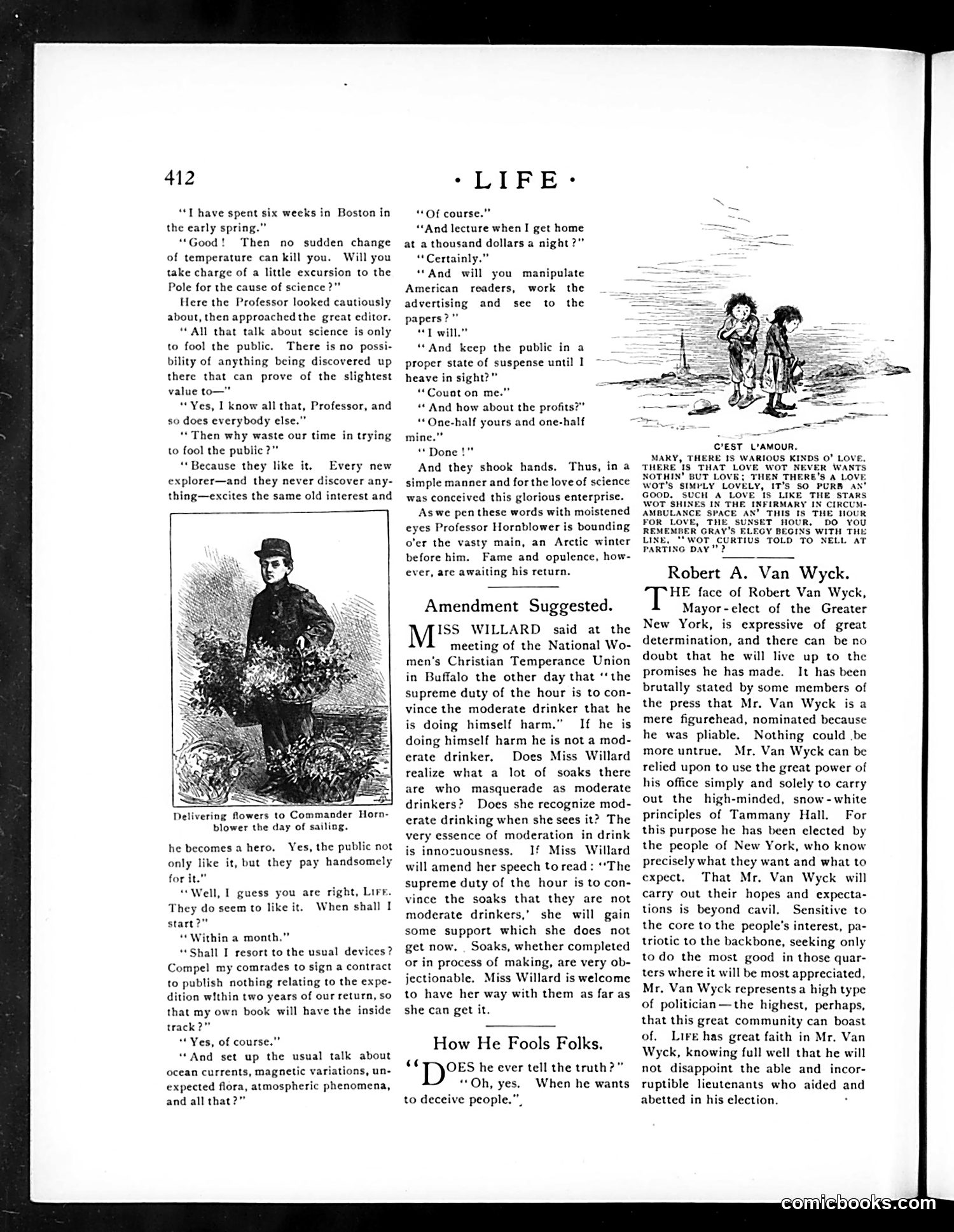
This page from *Life* magazine contains a satirical article about Professor Hornblower, an Arctic explorer who plans to publicize his expedition through American newspapers and advertising. The accompanying illustration shows a man in winter clothing delivering flowers, captioned "Delivering Flowers to Commander Hornblower the day of article[s]." The satire targets the commercialization of scientific exploration—Hornblower will lecture for "$1,000 a night" and allow newspapers to manipulate his story for profit. The joke is that modern explorers are less interested in genuine discovery than in public relations and profit-sharing arrangements. The page also includes an article praising Robert A. Van Wyck as Mayor-elect of Greater New York, and a brief piece about deception titled "How He Fools Folks."
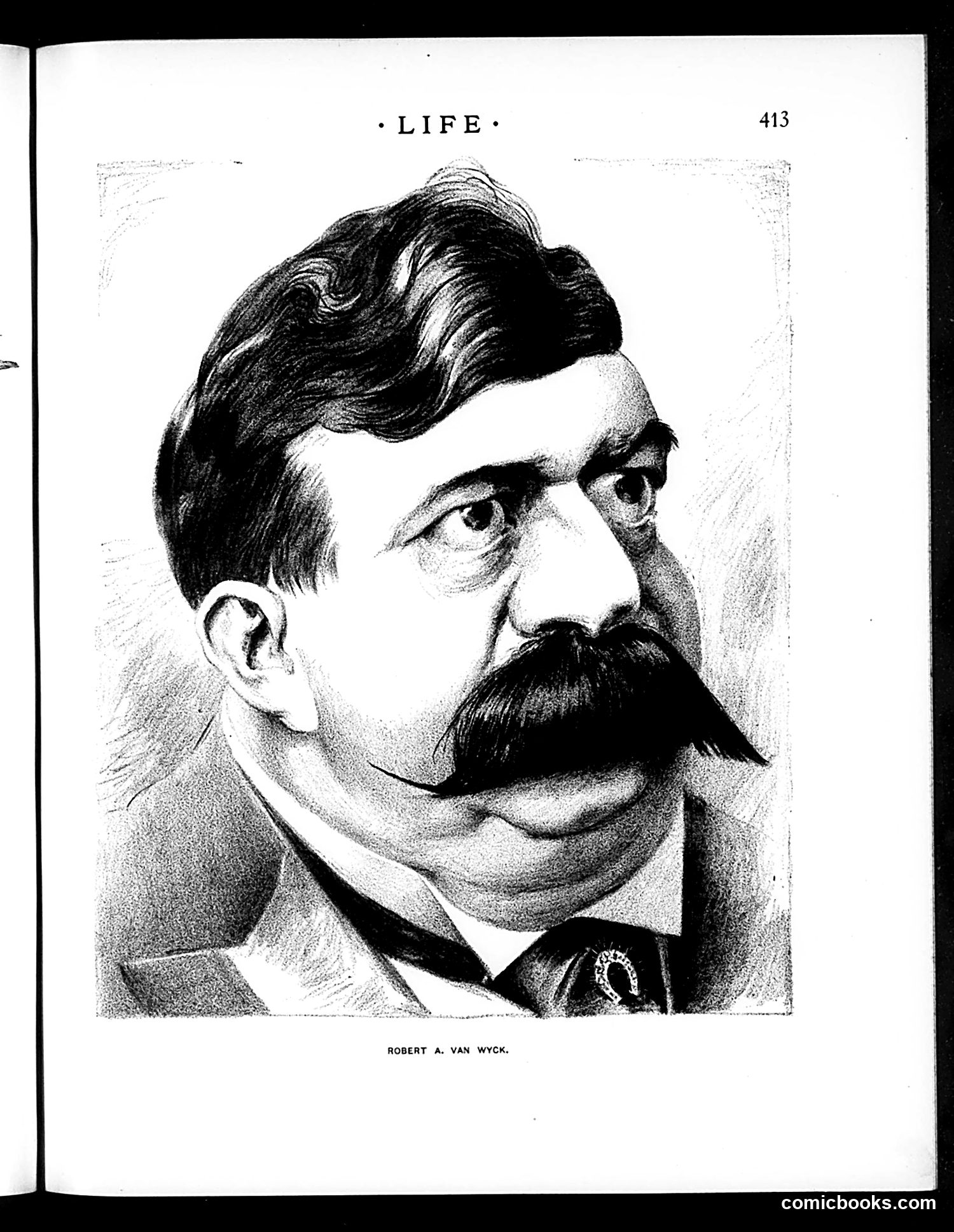
This page from *Life* magazine (page 413) features a portrait labeled "ROBERT A. VAN WYCK." The sketch is a detailed pen-and-ink caricature emphasizing the subject's distinctive features: thick, prominent mustache, swept-back dark hair, and intense gaze. The man is shown wearing formal attire with a bow tie and what appears to be a decorative pin or badge. Without additional context on the page, the specific satirical point is unclear. However, given *Life*'s tradition of political satire, this likely mocked a public figure of the era—possibly a politician or business leader—though the exact nature of the criticism cannot be determined from the portrait alone.
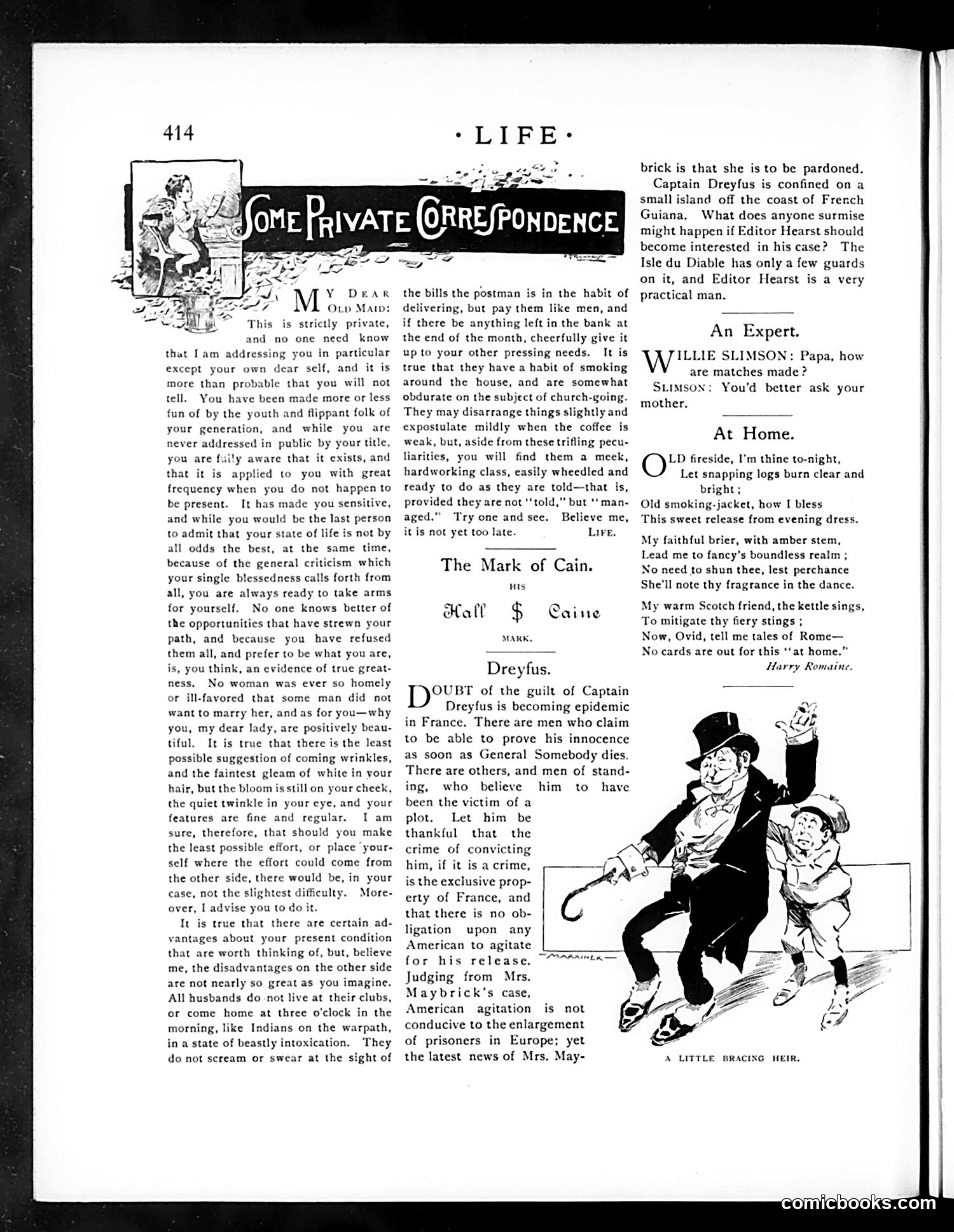
This page contains three distinct sections: 1. **"Some Private Correspondence"** — A letter-to-the-editor column addressing domestic complaints about husbands' habits (smoking, late hours, church-going). 2. **"The Mark of Cain" by Hall & Caine** — A literary piece beginning a serialized story or novel. 3. **"Dreyfus"** — A commentary on Captain Dreyfus (the French military officer at the center of the famous Dreyfus Affair). The text discusses doubts about his guilt and mentions American agitation for his release, referencing the case of Mrs. Maybrick (an American imprisoned in England). 4. **"A Little Bracing Heir"** — A cartoon showing a man with a cane and a small child, likely satirizing class relations or parenting practices of the wealthy. The page reflects turn-of-the-century concerns with European legal injustice and domestic social commentary.
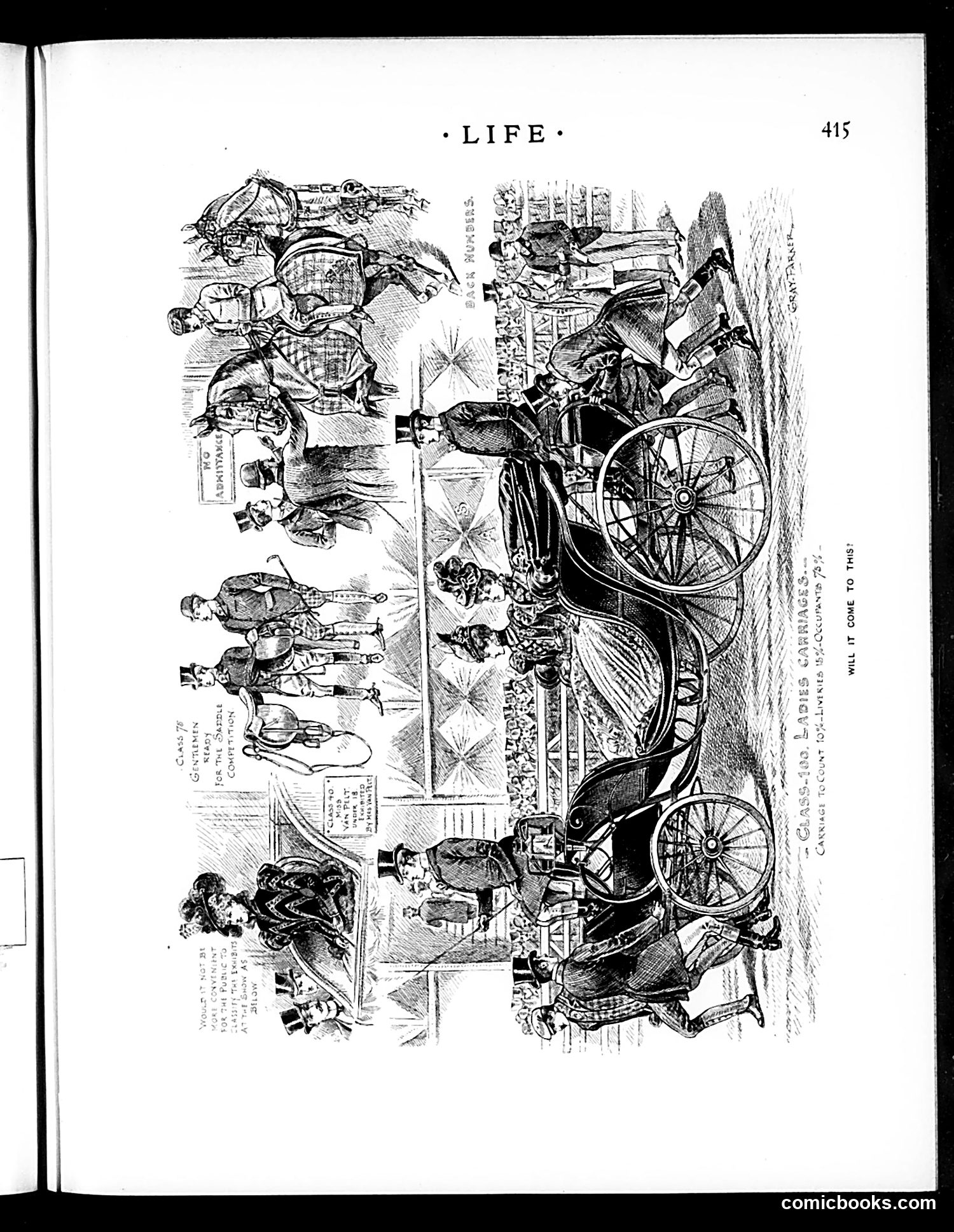
I can see this is page 415 from Life magazine, but the image is rotated and the OCR text provided is minimal/unclear. The page contains what appears to be a satirical illustration with multiple figures and detailed line-work in a Victorian-era engraving style, suggesting this is from Life's early period as a humor magazine. The illustration seems to depict a street scene with various characters, possibly including caricatured figures of social or political importance, along with carriages and period details. However, without clearer OCR text identifying the specific figures, political references, or the cartoon's title, I cannot accurately determine which historical events or personalities are being satirized. To properly explain the satire's meaning to a modern reader, I would need either legible caption text or clearer identification of the depicted figures.
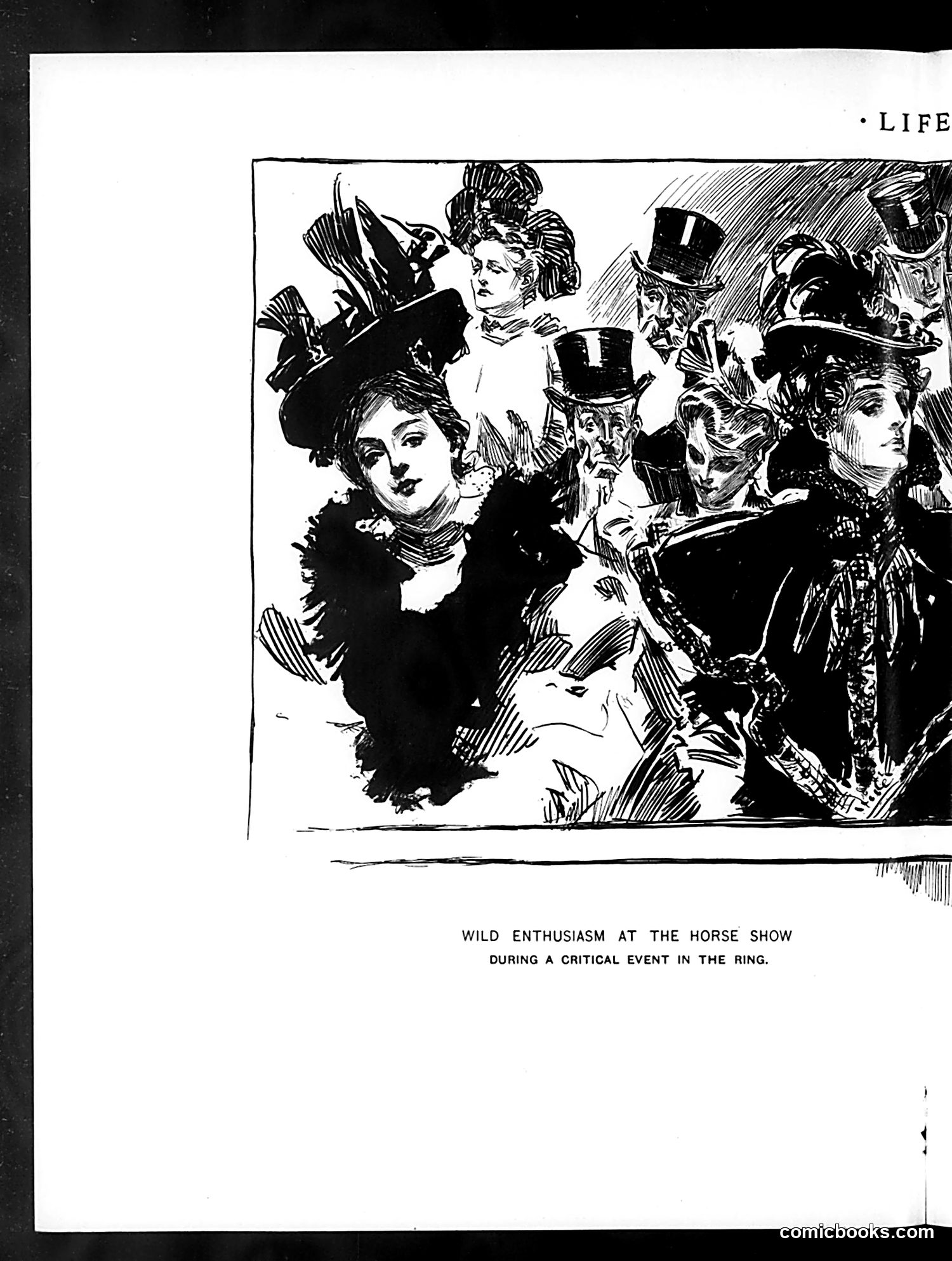
This Life magazine illustration satirizes wealthy society attendees at a prestigious horse show. The sketch depicts elaborately dressed figures in top hats and formal attire displaying exaggerated excitement "during a critical event in the ring." The satire likely targets upper-class pretension—the absurdly animated expressions and theatrical gestures of the well-dressed spectators suggest they're more invested in being seen and performing social status than in the actual equestrian competition. The women's ornate hats and the men's formal dress emphasize their focus on appearance and social position. The humor lies in mocking how such exclusive social events functioned as venues for displaying wealth and status rather than genuine interest in the horses themselves—a common Early 20th-century American critique of high society.
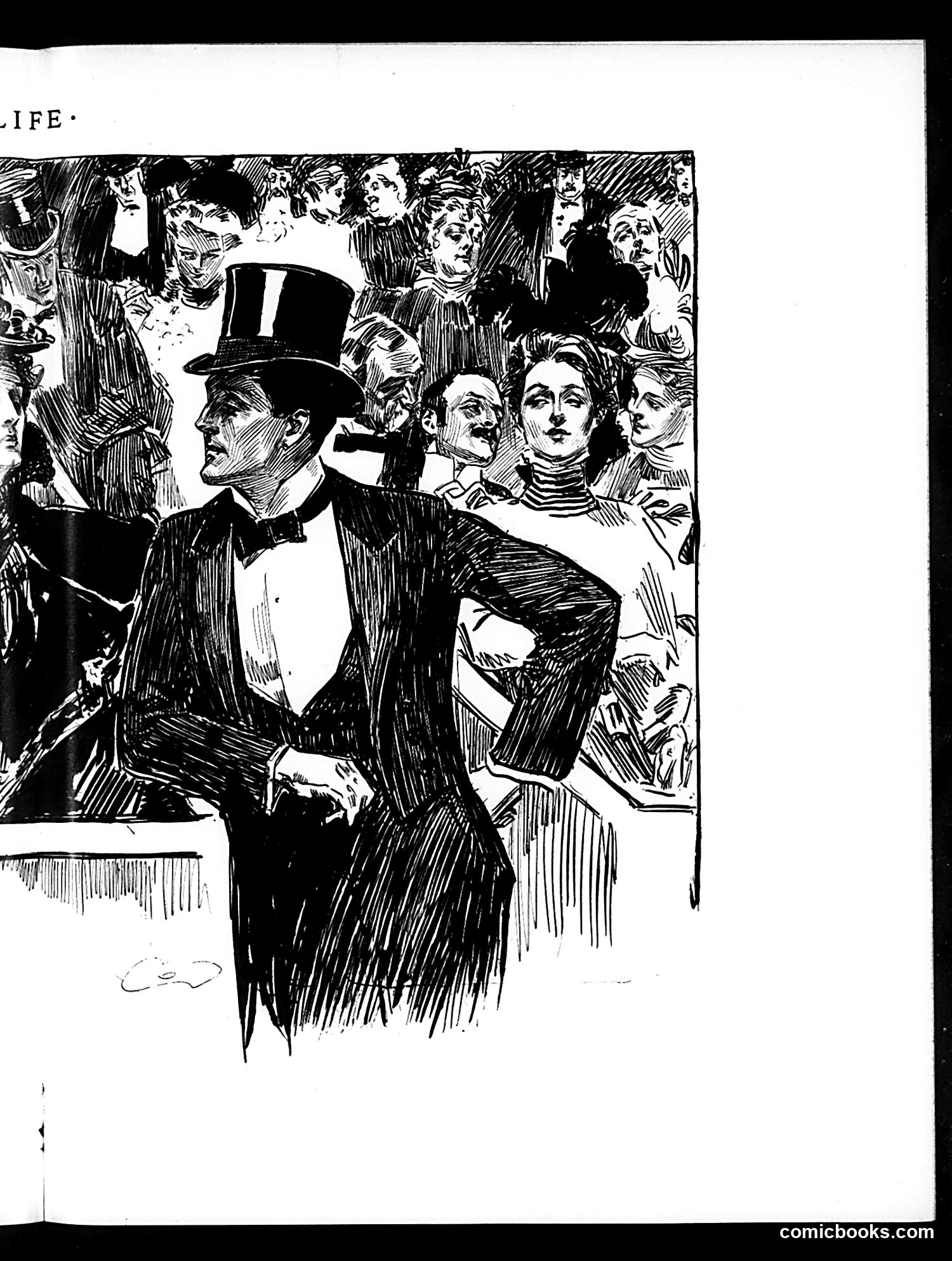
This appears to be a satirical illustration from *Life* magazine depicting a formal social scene, likely from the early 20th century. A well-dressed man in formal attire (top hat, tuxedo) stands prominently in the foreground, surrounded by a crowded gathering of various social figures. The style of dress and the formal evening setting suggest this is social satire targeting upper-class or high-society behavior. The specific figures and their identities are unclear from the image alone. The cartoon likely mocks fashionable society, pretension, or social climbing—common *Life* magazine targets. Without additional context or caption text beyond what's provided, I cannot definitively identify the specific individuals being caricatured or the exact social commentary intended.
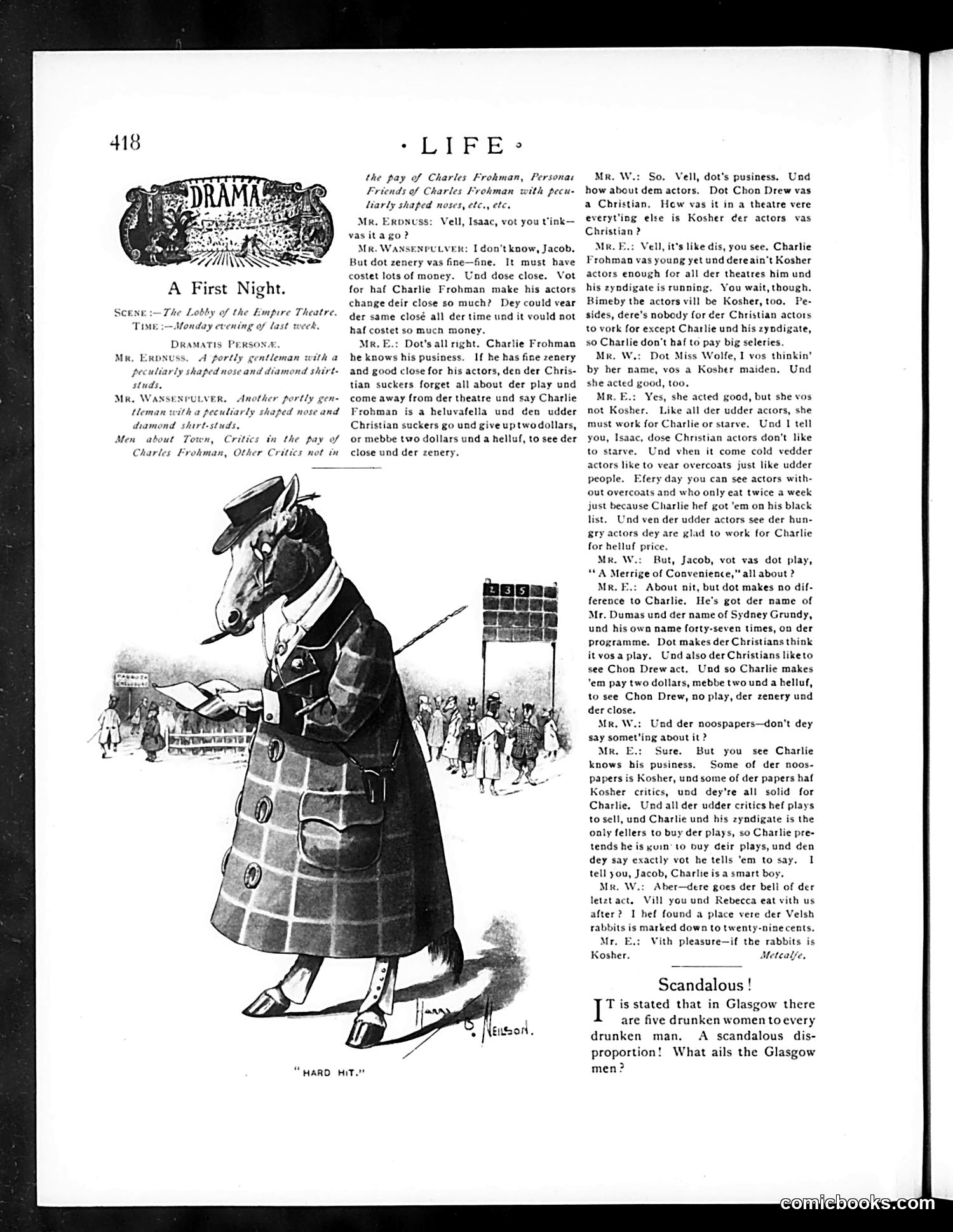
This sketch mocks **Charles Frohman**, a powerful theatrical producer, through a dialogue between two Jewish theater-goers with exaggerated accents (Messrs. Edmuss and Wansenpulver). The satire exposes Frohman's manipulation of audiences and critics: **Key targets:** - **Spectacle over substance**: Expensive sets and costumes distract audiences from poor plays - **Labor exploitation**: Christian actors, unable to find other work, accept starvation wages; Frohman deliberately avoids hiring Kosher (Jewish) actors to maintain control - **Critic corruption**: Frohman buys favorable reviews from "Kosher" papers and manipulates other critics by controlling which plays he'll produce - **Shameless self-promotion**: He plasters his name repeatedly on programs regardless of actual authorship The humor comes from the characters' blunt candor about how completely Frohman dominates Broadway through financial leverage—he's essentially a monopolist exploiting actors, critics, and audiences alike.
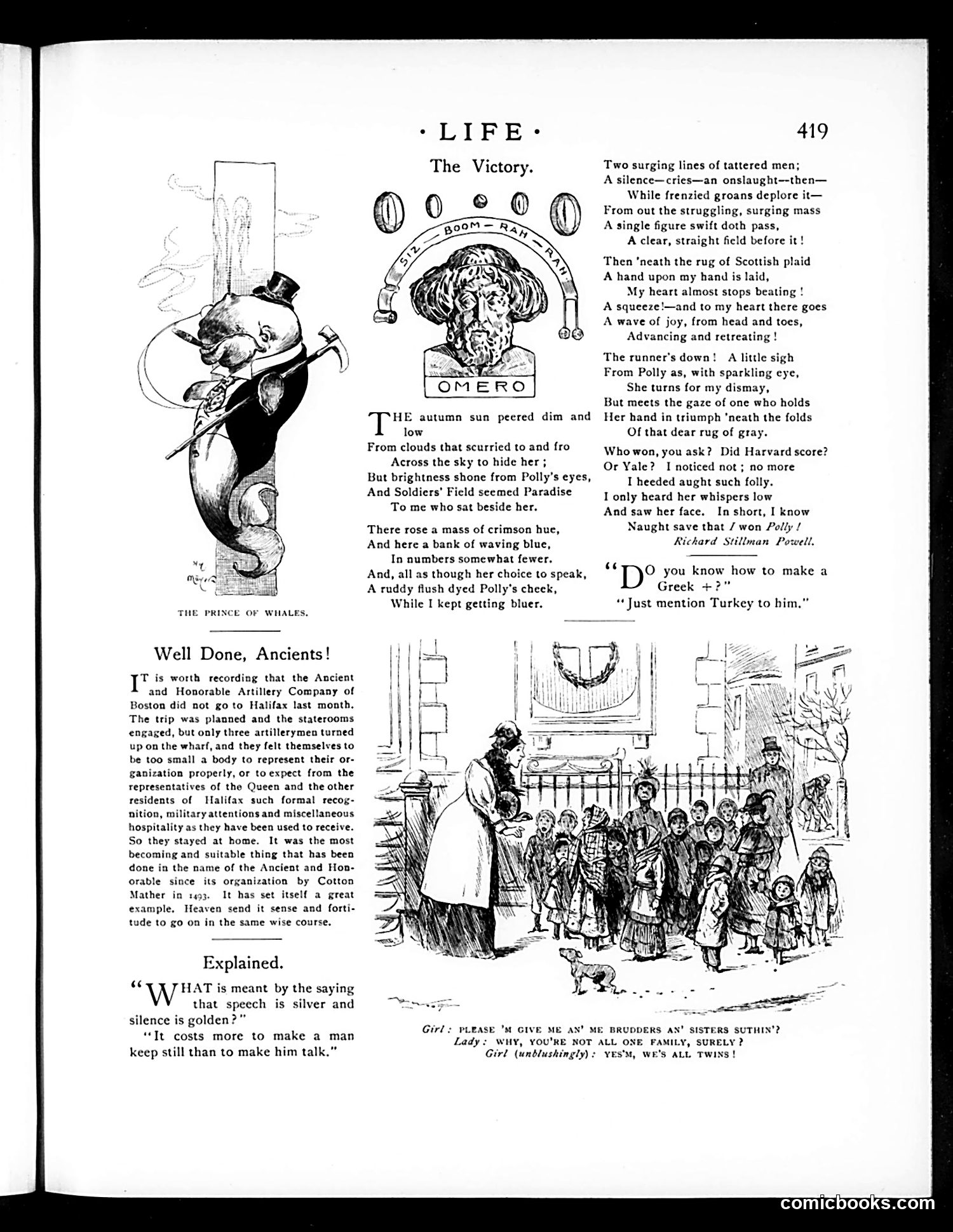
**"The Prince of Whales"** (top left): A political cartoon depicting a rotund, whale-like figure wearing a top hat—likely caricaturing a prominent public figure of the era, though the identity is unclear from the image alone. The satire appears to mock excessive wealth or pomposity. **"Well Done, Ancients!"**: A brief news item praising the Boston-based Ancient and Honorable Artillery Company for canceling a planned trip to Halifax rather than send an embarrassingly small delegation. The piece treats this as commendable restraint. **"The Victory"**: A romantic poem by Richard Stillman Powell about a young man attending a football game (likely Harvard vs. Yale, referenced in the text) with a girl named Polly. The satire's point: he's so focused on romantic moments—hand-holding under a shared blanket—that he ignores the game's actual outcome. **"Do you know how to make a Greek +?"**: A joke playing on ethnic stereotypes, suggesting mentioning Turkey (the country) provokes Greeks. **Bottom cartoon**: Depicts poor children asking a wealthy lady for bread and butter, claiming to be multiple siblings. The lady skeptically notes they're "all one family," and they claim to be "all twins"—satirizing implausible poverty narratives.
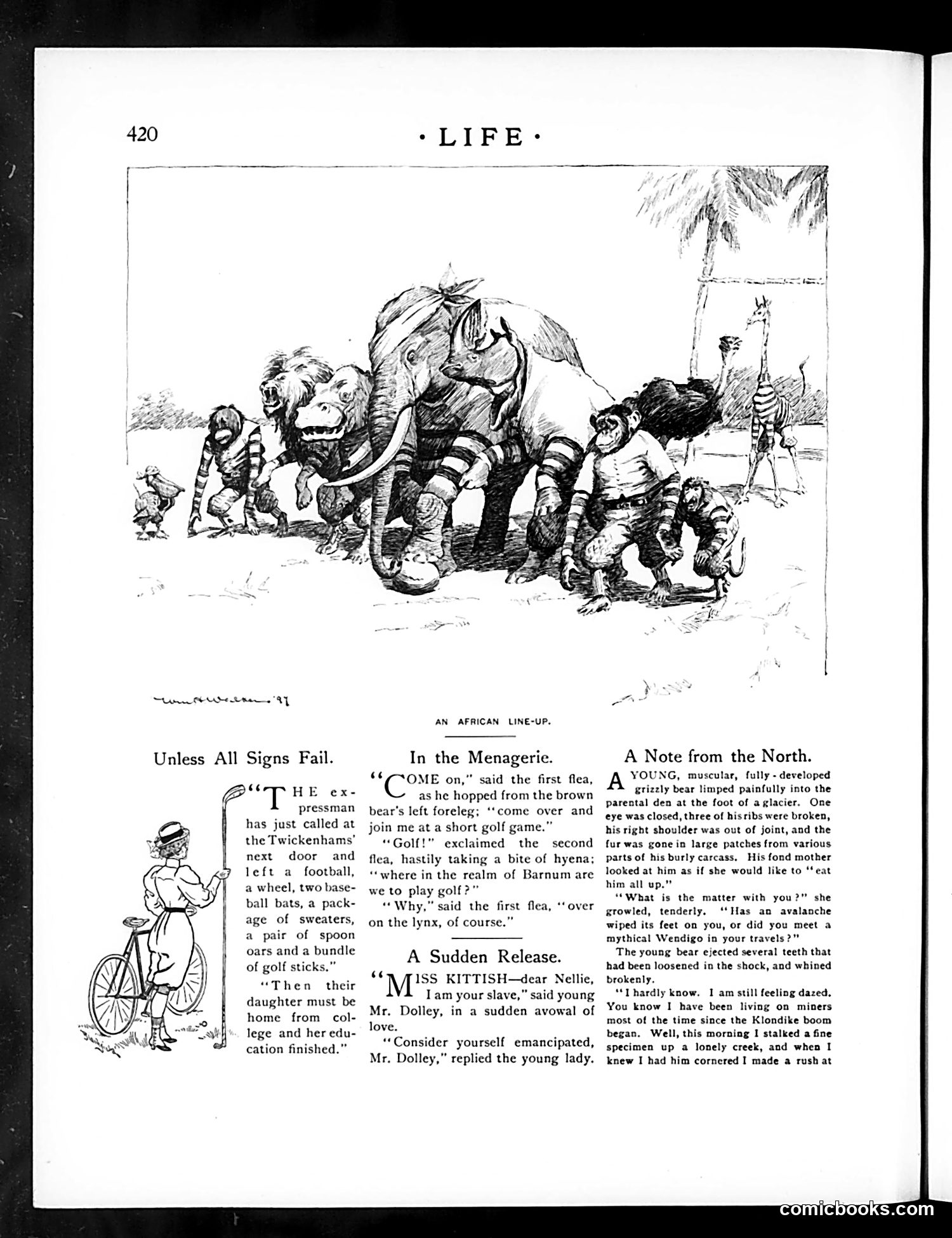
This page from *Life* magazine contains three humor pieces reflecting early 20th-century American attitudes: **"Unless All Signs Fail"** (left): A domestic joke about a college-educated daughter returning home. The satire mocks both her education and the sports/leisure culture of the era—the delivery of sporting equipment suggests her studies made her only fit for recreational pursuits, not serious work. This reflects contemporary anxieties about women's education. **"In the Menagerie"** (center): A visual pun placing fleas on zoo animals, with dialogue about playing golf "on the lynx." The humor relies on absurdist wordplay and anthropomorphization common to *Life*'s style. **"A Note from the North"** (right) and **"A Sudden Release"** (bottom right): Humorous monologues. The bear story satirizes the Klondike gold rush; the Dolley piece uses Victorian courtship language ("slave/emancipated") for comedic effect. The overall page uses exaggerated illustration and pun-based humor typical of early *Life* magazine's satirical approach to contemporary American life and fads.
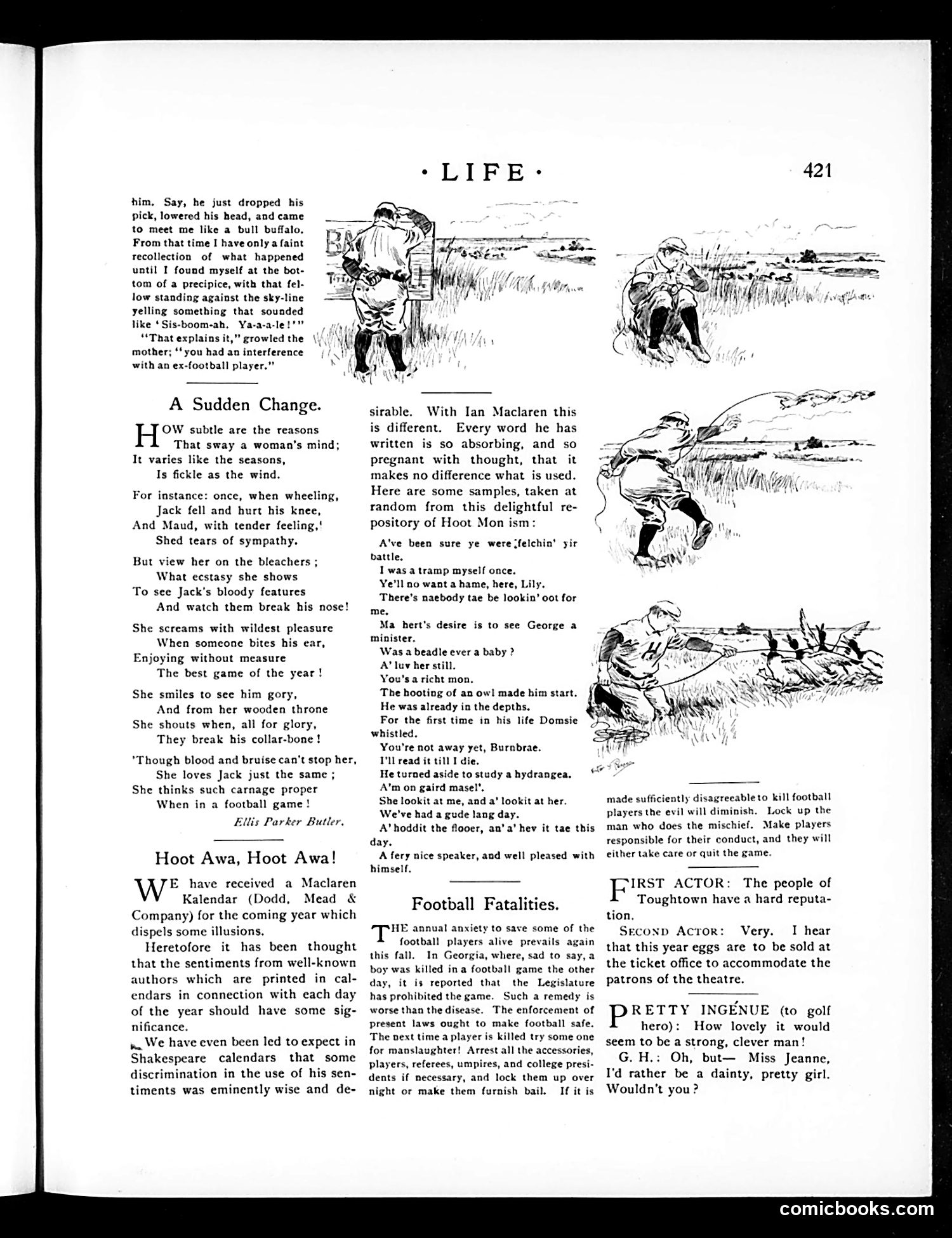
This page satirizes early 1900s American football culture through multiple pieces: **"A Sudden Change"** (Ellis Parker Butler poem): Mocks the contradictory behavior of female spectators. Women show tender sympathy when their boyfriends are injured in everyday accidents, yet enthusiastically cheer violent injuries during football games—broken collarbones, bleeding faces, bitten ears. The satire highlights the moral inconsistency: the same woman who "sheds tears of sympathy" for Jack's skinned knee "screams with wildest pleasure" watching him get hurt on the field, treating brutality as entertainment when contextualized as sport. **"Football Fatalities"** section: References an actual Georgia legislative attempt to ban football after player deaths. Life argues prosecution—charging players, referees, and administrators with manslaughter—would better deter violence than prohibition. The illustrations show period football action with characteristic rough play. The overall message critiques both the sport's inherent danger and society's enthusiasm for it despite (or because of) its violence.
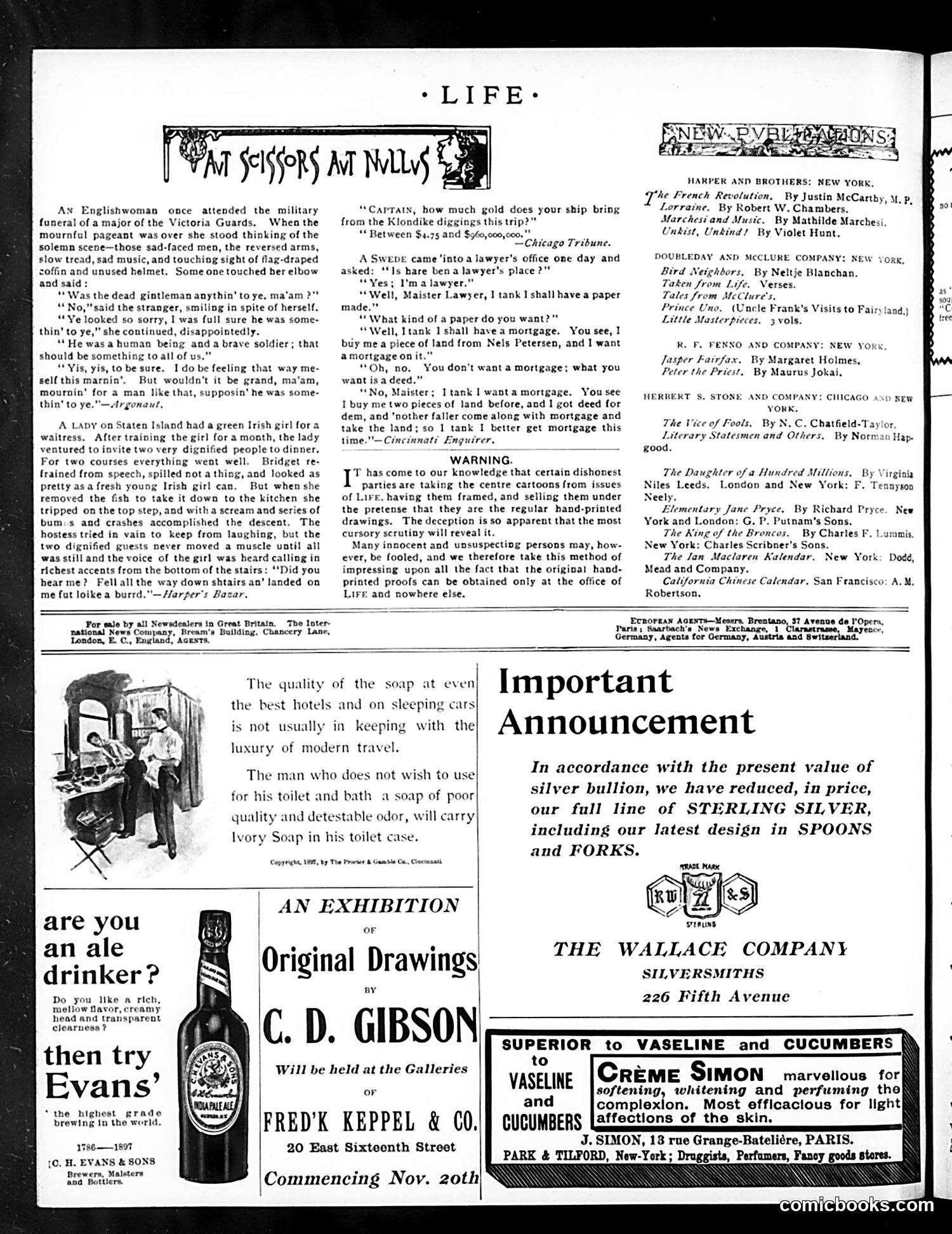
This page from *Life* magazine contains three humorous anecdotes satirizing Irish immigrant characters and their unfamiliarity with American legal/financial systems. The first two stories mock Irish servants and workers through exaggerated dialect and supposed naïveté—a common stereotype in turn-of-the-century American humor. The third joke targets a Swedish immigrant who confuses "mortgage" with "deed," having been victimized by a mortgage holder before. The satire reflects *Life*'s casual, period-typical mockery of non-Anglo immigrants as ignorant or simple-minded. These jokes rely entirely on ethnic stereotypes for humor rather than social commentary. The page also contains book advertisements, a warning about *Life* cartoon reproductions being counterfeited, and ads for various consumer products (soap, ale, silverware, cosmetics), typical of magazine content from this era.
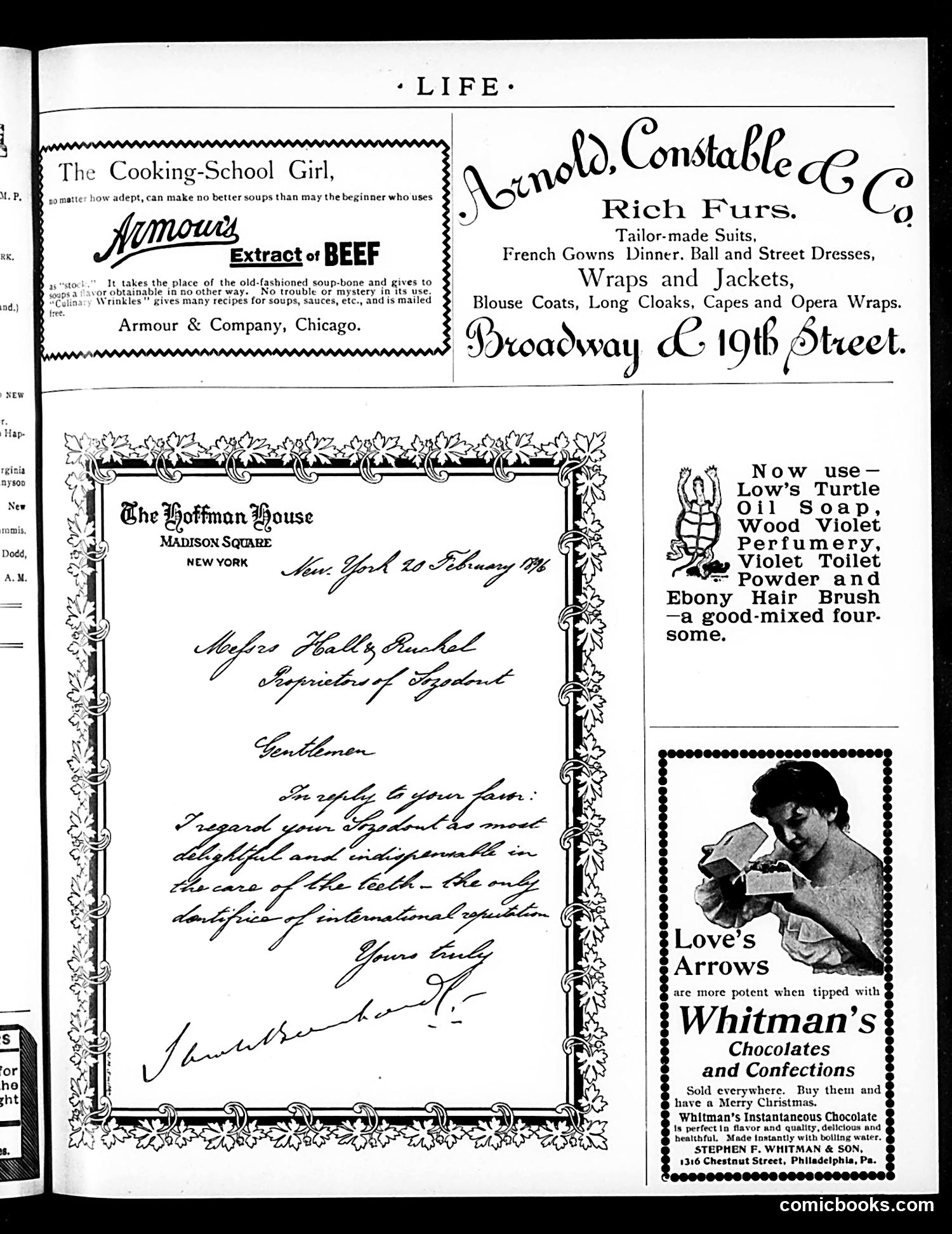
This is primarily an **advertising page** rather than a satirical cartoon page. The content consists of four distinct advertisements: 1. **Armour Extract of Beef** - promotes a convenience product claiming it replaces traditional soup-making, appealing to the "Cooking-School Girl" (suggesting early 1900s domestic science movement) 2. **Arnold, Constable & Co.** - a New York fashion house advertising women's clothing and furs 3. **The Hoffman House** - a formal letter of endorsement from a Manhattan hotel, praising the establishment (appears to be a hotel/restaurant advertisement) 4. **Low's Turtle Oil Soap** and **Whitman's Chocolates** - consumer product advertisements The page reflects **Edwardian-era consumer culture** targeting middle and upper-class readers with luxury goods, prepared foods, and beauty products. There is **no political satire** visible—this is straightforward commercial advertising typical of Life magazine's revenue model during this period.
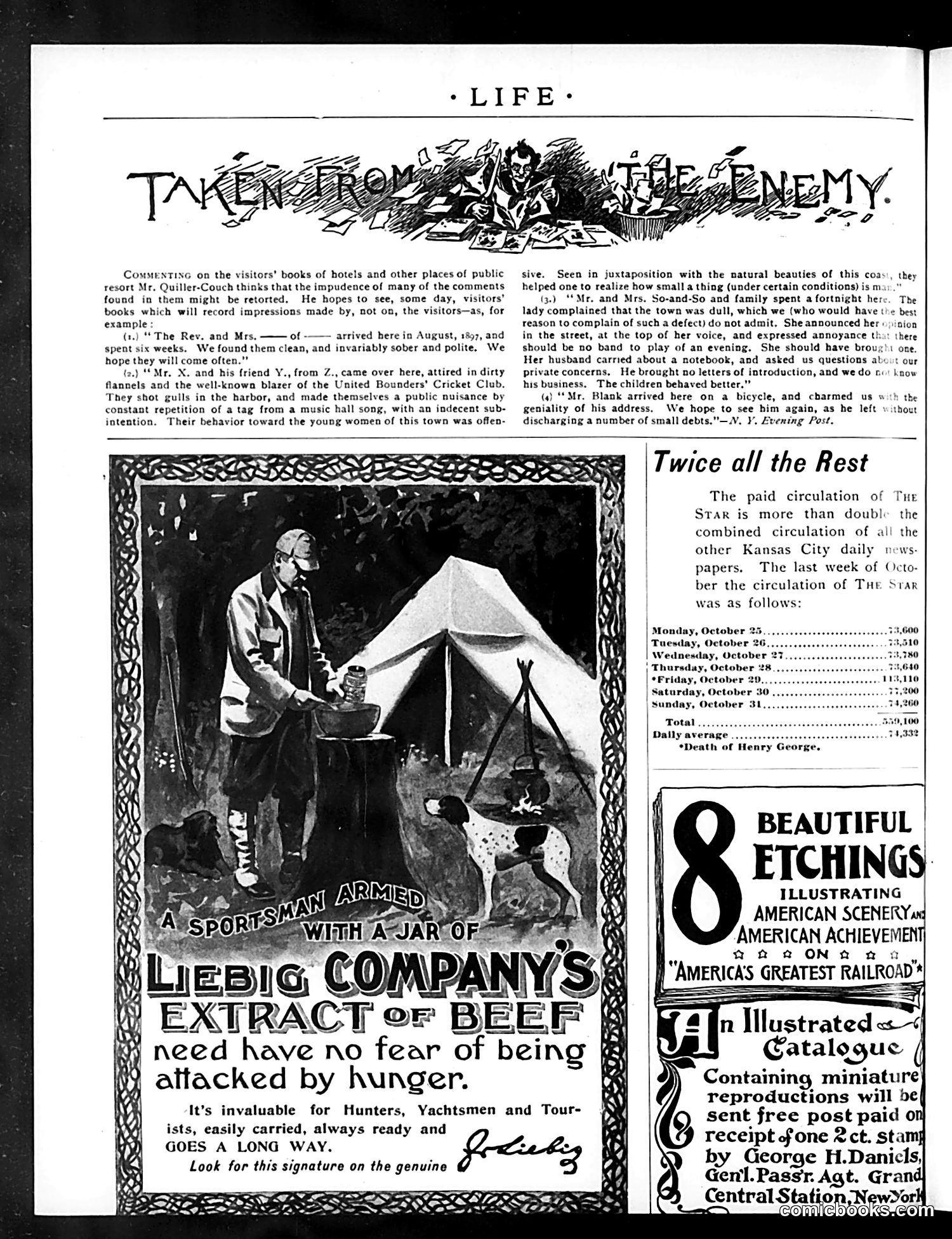
This page from *Life* magazine consists primarily of **satirical commentary and advertisements** rather than political cartooning. The main text presents **social satire** by Mr. Quiller-Couch proposing "reverse" hotel guest books—where hotels would record *their* impressions of *visitors* rather than vice versa. Through four examples, the satire mocks various types of obnoxious tourists: clergy who overstay, rowdy cricket club members who disturb public spaces, demanding wealthy women who complain about provincial entertainment, and a cyclist who leaves town without paying debts. The humor targets **class anxieties and tourism culture** of the era—exposing how wealthy or presumptuous visitors behaved badly while expecting hospitality. The final example's deadpan note about unpaid debts adds comic bite. The page also features a **Liebig beef extract advertisement** showing a sportsman camping, and announcements about newspaper circulation and etchings. The satire reflects period concerns about **social propriety, tourism's growth, and the tension between hosts and visitors**.
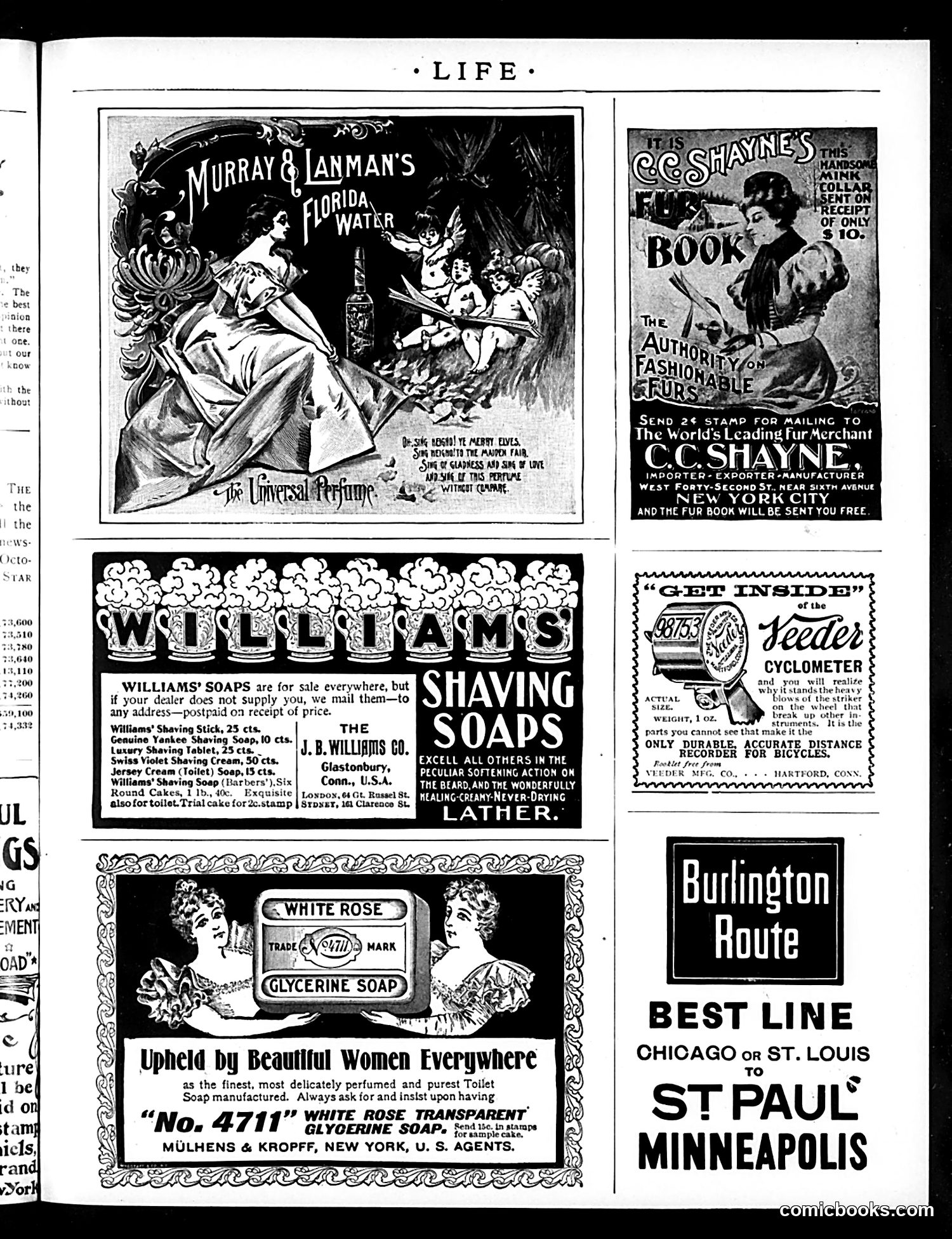
This page is primarily **advertising**, not satire or political commentary. It contains five distinct product advertisements from the early 1900s: 1. **Murray & Lanman's Florida Water** (top left): A perfume ad featuring classical imagery of women and cherubs, claiming universal appeal. 2. **C.C. Shayne's Fur Book** (top right): A mail-order catalog offer for fur fashion merchandise. 3. **Williams' Shaving Soaps** (center): Product listings for various soap formulations with company details. 4. **White Rose Glycerine Soap** (bottom left): A toilet soap advertisement emphasizing delicate perfume and purity, "upheld by beautiful women everywhere." 5. **Burlington Route** (bottom right): A railroad advertisement promoting service between Chicago/St. Louis and St. Paul/Minneapolis. The ads reflect period consumer culture: luxury toiletries marketed to middle-class audiences, mail-order retail, and transportation services. There is no political satire present—this appears to be a standard advertising page from *Life* magazine.
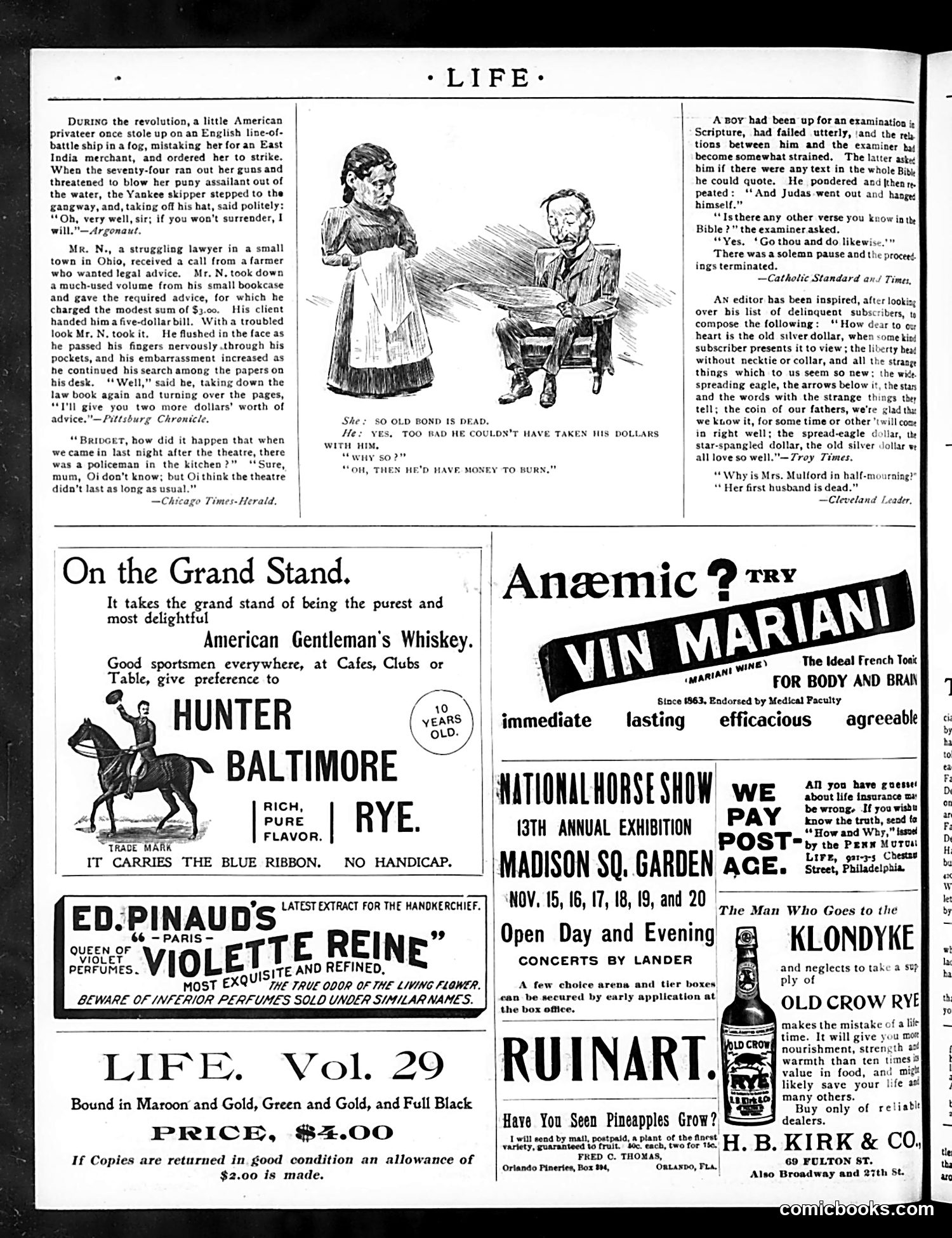
This page is primarily **advertisements and humorous anecdotes** rather than political cartoons. The three brief jokes at the top represent typical *Life* humor of the era: 1. **Revolutionary War anecdote**: A small American privateer politely surrenders to a British warship—satirizing American boldness and politeness even in defeat. 2. **Lawyer's embarrassment**: A struggling Ohio lawyer charges $3 for legal advice, receives $5, then awkwardly searches his pockets unable to make change—mocking small-town professional pretension. 3. **Theater timing**: A wife questions why a policeman appeared in their kitchen; the husband jokes the theater show was short—a domestic humor non-sequitur. The **bottom half is entirely advertisements** for whiskey (Hunter Baltimore Rye), perfume (Violet Reine), a horse show, and patent tonics like "Vin Mariani" (an early cocaine-laced wine marketed as medicinal). The page reflects *Life*'s characteristic blend of genteel satire, nostalgic Americana, and commercial promotion typical of late-19th-century American magazines.
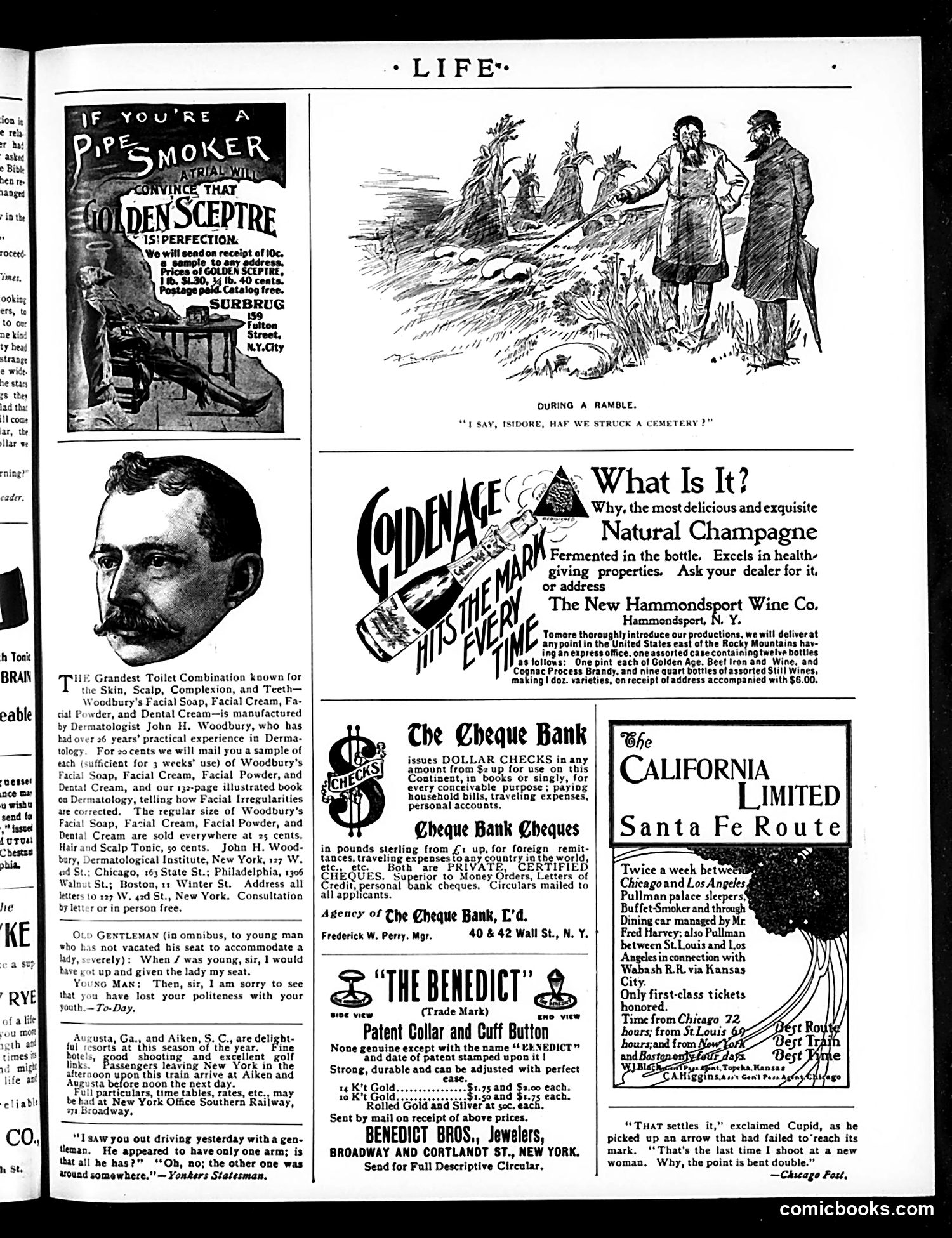
This page is primarily **advertisements with one cartoon**. The main cartoon ("During a Ramble") depicts two figures on a country walk; one asks the other, "I say, Isidore, haf we struck a cemetery?"—a mild joke playing on the appearance of the landscape (sparse vegetation, barren ground) resembling a graveyard. The page is dominated by period product ads: Woodbury's facial care line, Golden Sceptre pipe tobacco, Goldage champagne, The Cheque Bank, and Benedict Bros. jewelry. There's also a brief dialogue joke between an elderly gentleman and a young man about yielding seats to ladies on public transport—a social etiquette commentary common to the era. The content reflects early-20th-century American concerns: personal grooming standards, banking conveniences, and Victorian manners. The "Isidore" cartoon is relatively gentle humor, without sharp political or social critique—typical of Life's lighter content balancing satire elsewhere in the magazine.
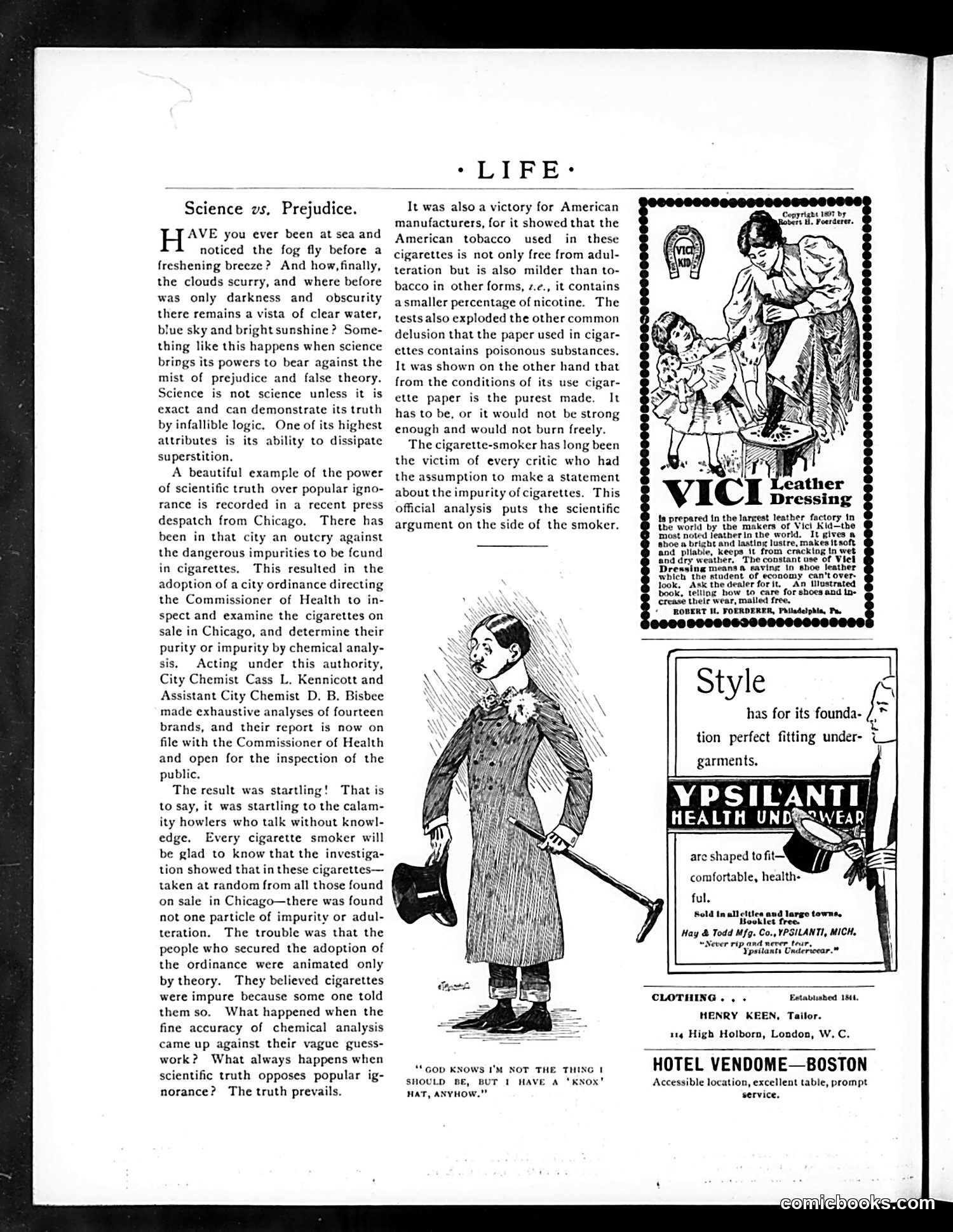
This page champions cigarette smoking against public health concerns through a satire on anti-smoking prejudice. **The Main Article:** Life celebrates Chicago's official chemical analysis of cigarettes, which found "not one particle of impurity or adulteration." The piece mockingly portrays cigarette critics as uninformed "calamity howlers" animated only by baseless theory rather than facts. The satirical point: scientific truth defeats popular ignorance—and the science supposedly proves cigarettes are safe, pure, and milder than other tobacco forms. **The Cartoon:** An illustration shows a woman holding a rifle and cane, smoking, with the caption joking she's uncertain about her appearance ("God knows I'm not the thing I should be, but I have a 'Knox' hat, anyhow"). This ridicules women's concerns about appearance while normalizing female smoking. **Context:** Published when cigarette safety was heavily debated, Life sided with tobacco manufacturers against health advocates, using scientific authority to dismiss legitimate health concerns as mere prejudice—a striking irony to modern readers aware of tobacco's actual dangers.
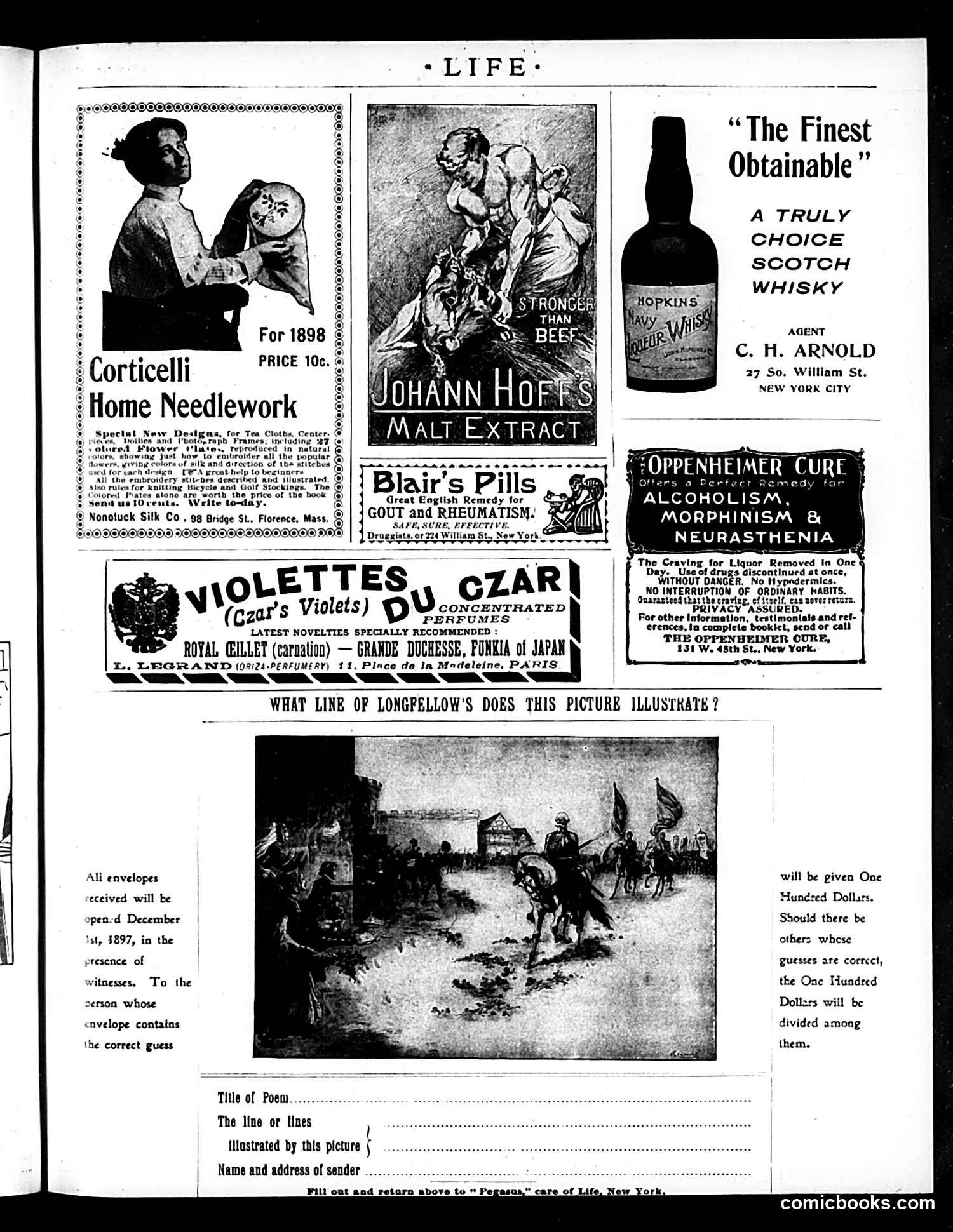
This page is primarily **advertising**, not political satire. It features commercial ads for consumer products typical of the 1890s: needlework patterns, patent medicines (Blair's Pills for gout/rheumatism, the Oppenheimer Cure for alcoholism and morphine addiction), perfumes, malt extract, and Scotch whisky. The main content is a **contest**: readers must identify which line from a Longfellow poem is illustrated by the large image below, which appears to show a riverside or harbor scene with figures and flags. Winners receive one hundred dollars (or share it if multiple correct answers exist). **Social context for modern readers**: The prevalence of morphine and alcohol addiction "cures" advertised reflects widespread substance abuse in this era, before legal regulation of such drugs. Patent medicines were unregulated and often ineffective or harmful. The Longfellow contest suggests *Life* engaged readers through interactive puzzles and prize competitions—a common magazine strategy of the period.
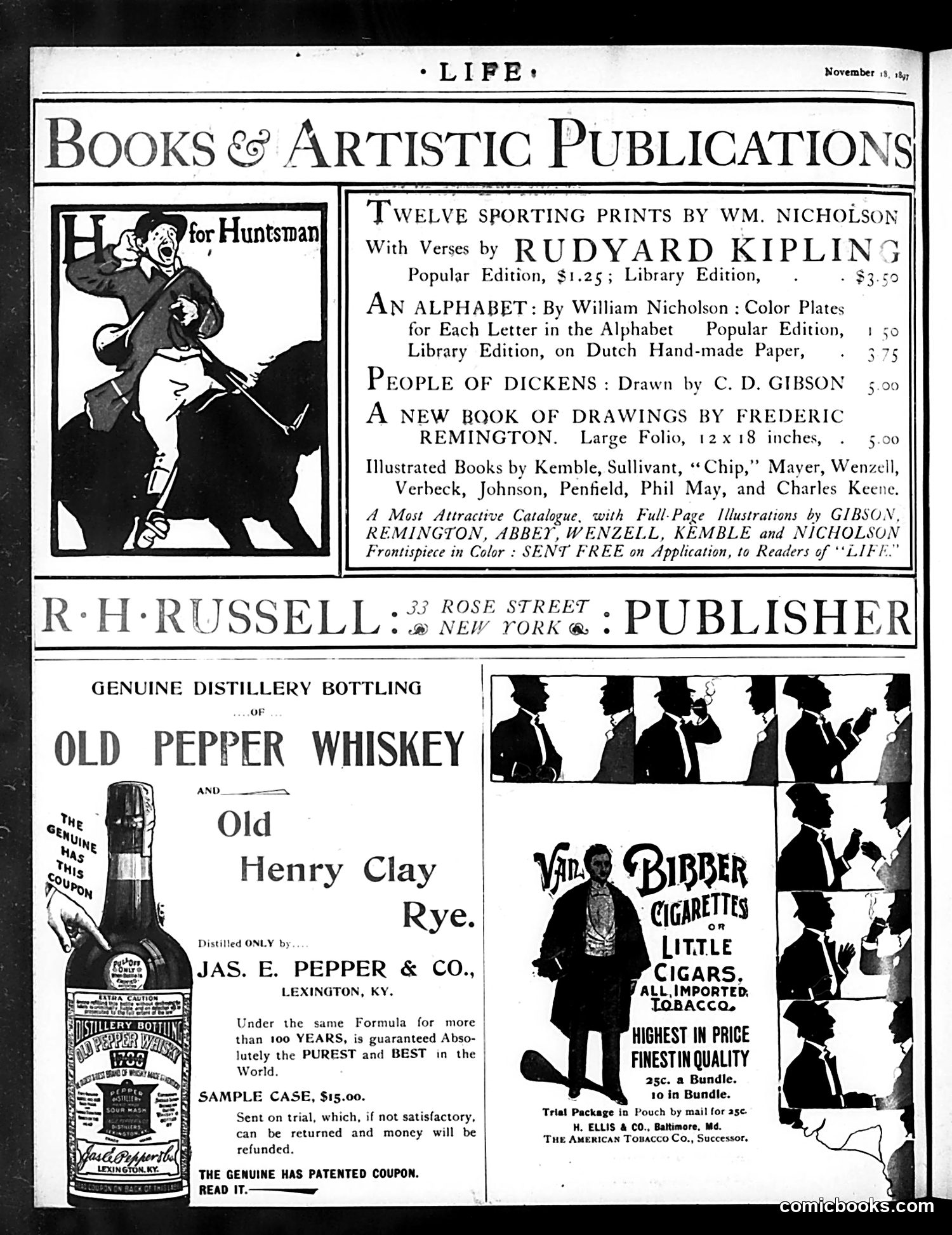
This is primarily an **advertising and book promotion page** with no political satire. The left side features a cartoon illustration titled "H—for Huntsman," showing a figure on horseback in hunting attire—likely a generic sporting scene rather than a specific political reference. The page advertises: - **Books by prominent illustrators** (Remington, Gibson, Kipling) from publisher R.H. Russell - **Old Pepper Whiskey and Old Henry Clay Rye** from a Kentucky distillery, marketed as using a 100-year formula - **Vade Bibber Cigarettes**, advertised as "highest in price, finest in quality" The silhouette series on the right appears to be a decorative element showing various profile figures in conversation—typical Victorian-era design filler with no apparent satirical intent. This is a straightforward commercial page reflecting late-19th-century advertising and publishing.