
Life, 1897-11-18 · page 6 of 26
Life — November 18, 1897 — page 6: what you’re looking at
What you’re looking at
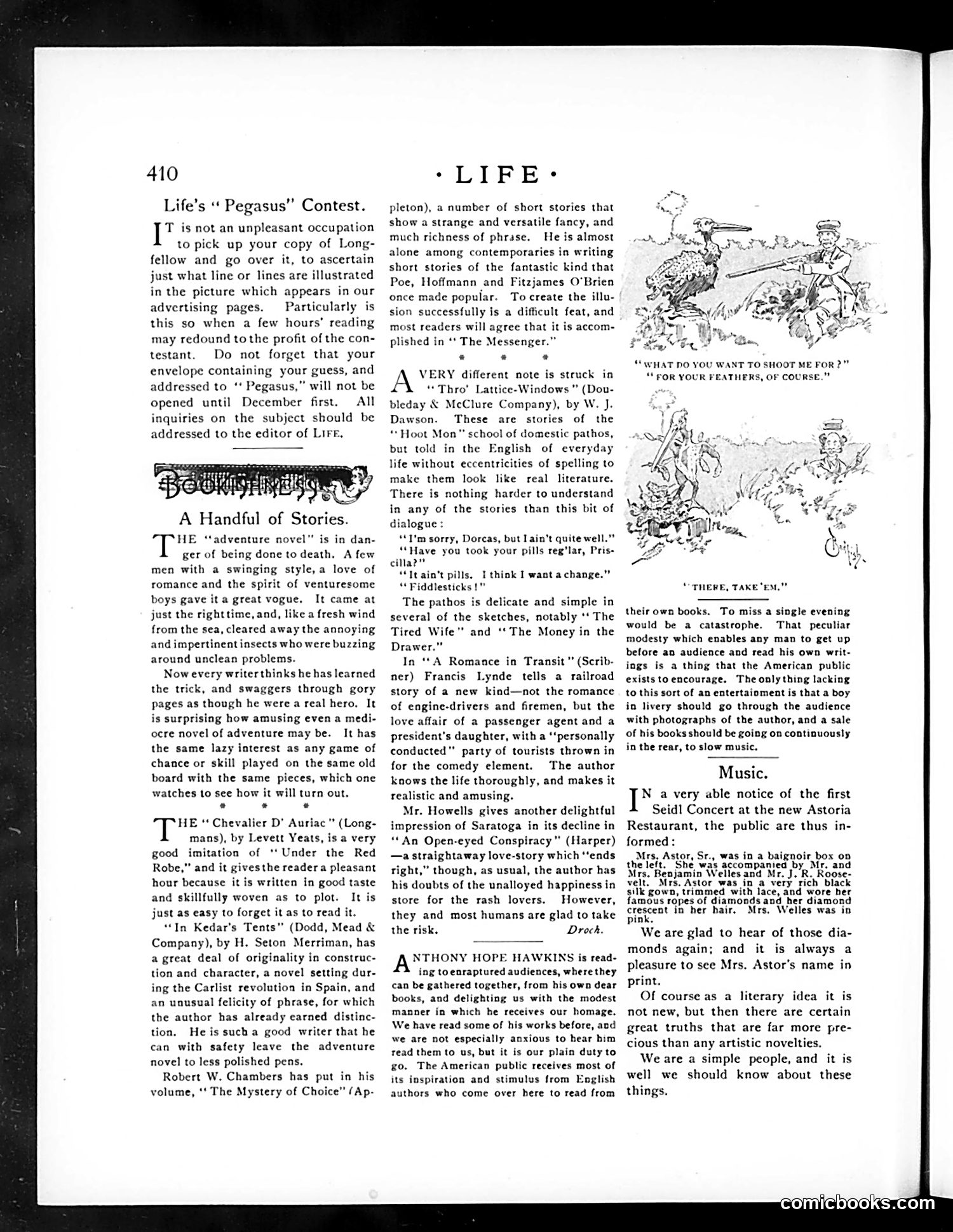
This is a literary review page from *Life* magazine, not primarily political satire. The page discusses contemporary fiction, including short stories described as having "strange and versatile fancy" in publications like *The Messenger*. The two small illustrations on the right appear to be humorous vignettes accompanying book reviews—one shows a hunting scene with the caption "WHAT DO YOU WANT TO SHOOT ME FOR? FOR YOUR FEATHERS, OF COURSE," and another captioned "THERE, TAKE 'EM!" Both seem to illustrate domestic comedies or sentimental stories being reviewed. The content focuses on literary criticism of adventure novels and romantic fiction rather than political commentary. This reflects *Life*'s dual purpose as both satirical magazine and arts/culture publication during the early 20th century.
📄 Transcribed text from this page (OCR, searchable)
Machine-transcribed from the original scan — historical spelling and the odd misread are preserved.
410 Life’s « Pegasus” Contest. T is not an unpleasant occupation to pick up your copy of Long- fellow and go over it, to ascertain just what line or lines are illustrated in the picture which appears in our advertising pages. Particularly is this so when a few hours’ reading may redound tothe profit of the con- testant. Do not forget that your envelope containing your guess, and addressed to ‘‘ Pegasus,” will not be opened until December first. All inquiries on the subject should be addressed to the editor of LIFE, HE ‘‘adventure novel” is in dan- ger of being done to death. A few men with a swinging style, a love of romance and the spirit of venturesome boys gave ita great vogue. It came at just the righttime, and, like a fresh wind from the sea, cleared away the annoying and impertinent insects who were buzzing around unclean problems. Now every writerthinks he has learned the trick, and swaggers through gory pages as though he were a real hero. It is surprising how amusing even a medi- ocre novel of adventure may be. It has the same lazy interest as any game of chance or skill played on the same old board with the same pieces, which one watches to see how it will turn out, ° * * HE ** Chevalier D’ Auriac " (Long- mans), by Levett Yeats, is a very good imitation of ‘* Under the Red Robe,” and it givesthe readera pleasant hour because it is written in good taste and skillfully woven as to plot. It is just as easy to forget it as to read it. “In Kedar's Tents" (Dodd, Mead & Company), by H. Seton Merriman, has agreat deal of originality in construc- tion and character, a novel setting dur- ing the Carlist revolution in Spain, and an unusual felicity of phrase, for which the author has already earned distinc- tion. He is sucha good writer that he can with safety leave the adventure novel to less polished pens. Robert W. Chambers has put in his volume, ‘! The Mystery of Choice” /Ap- *LIFE: pleton), a number of short stories that show a strange and versatile fancy, and much richness of phrase. He is almost alone among contemporaries in writing short stories of the fantastic kind that Poe, Hoffmann and Fitzjames O'Brien once made popular. To create the illu- sion successfully is a difficult feat, and most readers will agree that it is accom- plished in ‘* The Messenger.” * * * ERY different note is struck in ‘Thro’ Lattice-Windows ” (Dou- bleday & McClure Company), by W. J. Dawson. These are stori of the “Hoot Mon" school of domestic pathos, but told in the English of everyday life without eccentricities of spelling to make them look like real literature. There is nothing harder to understand in any of the stories than this bit of dialogue : “I'm sorry, Doreas, but Lain’t quite well.” Have you took your pills reg'lar, Pris- Naz” It ain't pills. 1 think I want achange.” “ Fiddlesticks !"" The pathos is delicate and simple in several of the sketches, notably ‘t The Tired Wife” and ‘‘The Money in the Drawer.” In **A Romance in Transit" (Scrib- ner) Francis Lynde tells a railroad story of a new kind—not the romance of engine-drivers and firemen, but the love affair of a passenger agent and a president's daughter, with a ‘personally conducted" party of tourists thrown in for the comedy element. The author knows the life thoroughly, and makes it realistic and amusing. Mr. Howells gives another delightful impression of Saratoga in its decline in “An Open-eyed Conspiracy" (Harper) —a straightaway love-story which ‘ends right,” though, as usual, the author has his doubts of the unalloyed happiness in store for the rash lovers. However, they and most humans are glad to take the risk. Droch. ANTHONY HOPE HAWKINS is read- ing to enraptured audiences, where they can be gathered together, from his own dear books, and delighting us with the modest manner in which he receives our homage. We have read some of his works before, and we are not especially anxious to hear bim read them to us, but it is our plain duty to go, The American public receives most of its inspiration and stimulus from English authors who come over here to read from “WHAT DO YOU WANT TO SHOOT ME FOR?” “FOR YOUR FEATHERS, OF COURSE.” their own books. To miss a single evening would be a catastrophe. That peculiar modesty which enables any man to get up before an audience and read his own writ- ings is a thing that the American public exists toencourage. The only thing lacking to this sort of an entertaioment is that a boy in livery should go through the audience with photographs of the author, and a sale of his books should be going on continuously in the rear, to slow music, Music. [* a very able notice of the first Seidl Concert at the new Astoria Restaurant, the public are thus in- formed: Mrs, Astor, Sr., was in a baignoir box on the left. She was accompanied by Mr. and Mrs, Benjamin Welles and Mr. J, R. Roose- velt. Mrs, Astor was in a very rich black silk gown, trimmed with lace, and wore her famous ropes of diamonds and her diamond crescent in her hair. Mrs. Welles was in pink We are glad to hear of those dia- monds again; and it is always a pleasure to see Mrs. Astor's name in print. Of course as a literary idea it is not new, but then there are certain great truths that are far more pre- cious than any artistic novelties. We are a simple people, and it is well we should know about these things.