
A complete issue · 20 pages · 1897
Life — July 22, 1897
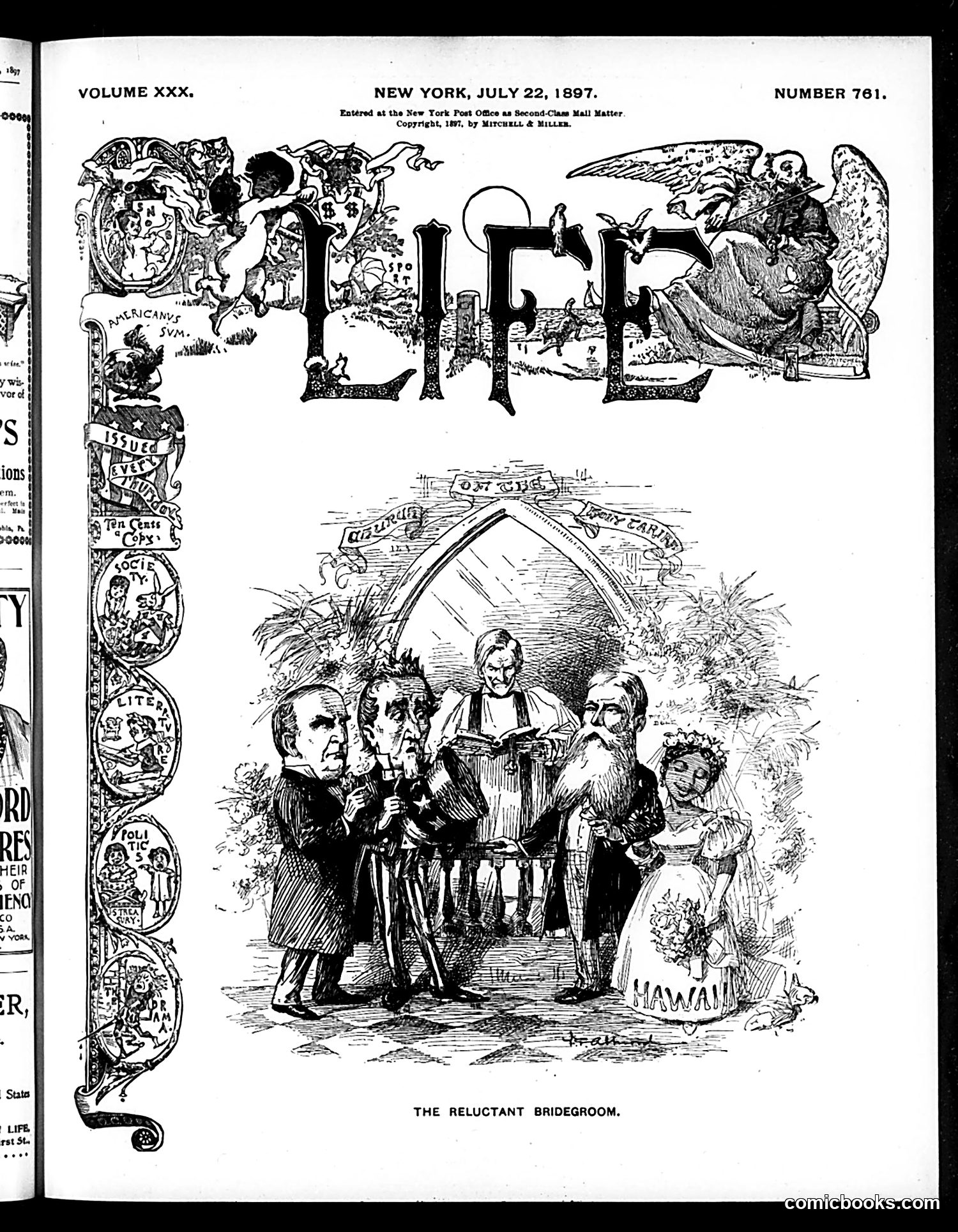
This 1897 *Life* magazine cartoon satirizes American reluctance regarding the annexation of Hawaii. The image shows a wedding ceremony where a man (representing the United States) is being pressured into marriage with a woman labeled "Hawaii." The clergy and witnesses appear to be pushing the union forward despite the groom's apparent hesitation. The satire critiques the imperialist expansion debate of the 1890s. Many Americans opposed Hawaii's annexation as an overreach of federal power and colonial ambition, while expansionists promoted it. The "reluctant bridegroom" metaphor suggests the U.S. government was being coerced into territorial acquisition against public sentiment—depicting annexation as an unwanted obligation rather than a willing engagement.
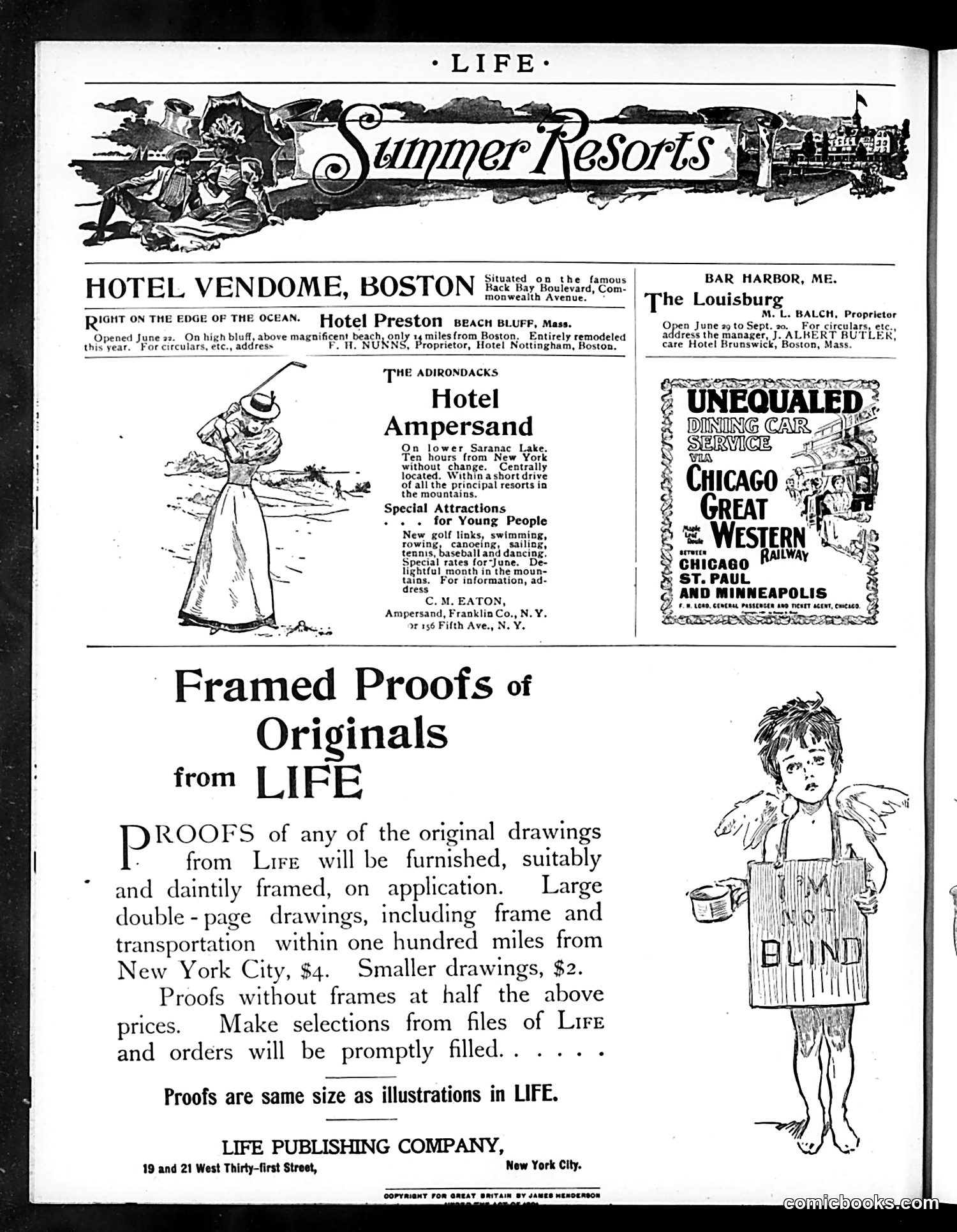
This page is primarily **advertising**, not satire or political commentary. It features vacation and travel promotions typical of early 20th-century Life magazine: - **Hotel Vendome** (Boston), **Hotel Preston** (Beach Bluff, Mass.), and **Hotel Ampersand** (Adirondacks) advertise summer accommodations with amenities like golf, swimming, and boating. - A **railroad advertisement** promotes the Chicago Great Western Railway's dining car service. - The **lower section** offers framed proofs of original Life magazine illustrations for purchase ($2-$4), appealing to readers who wanted to own artwork from the publication. The small illustration of a blindfolded child is a generic decoration for the railway ad, not political commentary. This is essentially a commercial page showcasing leisure destinations and merchandise available to affluent readers.
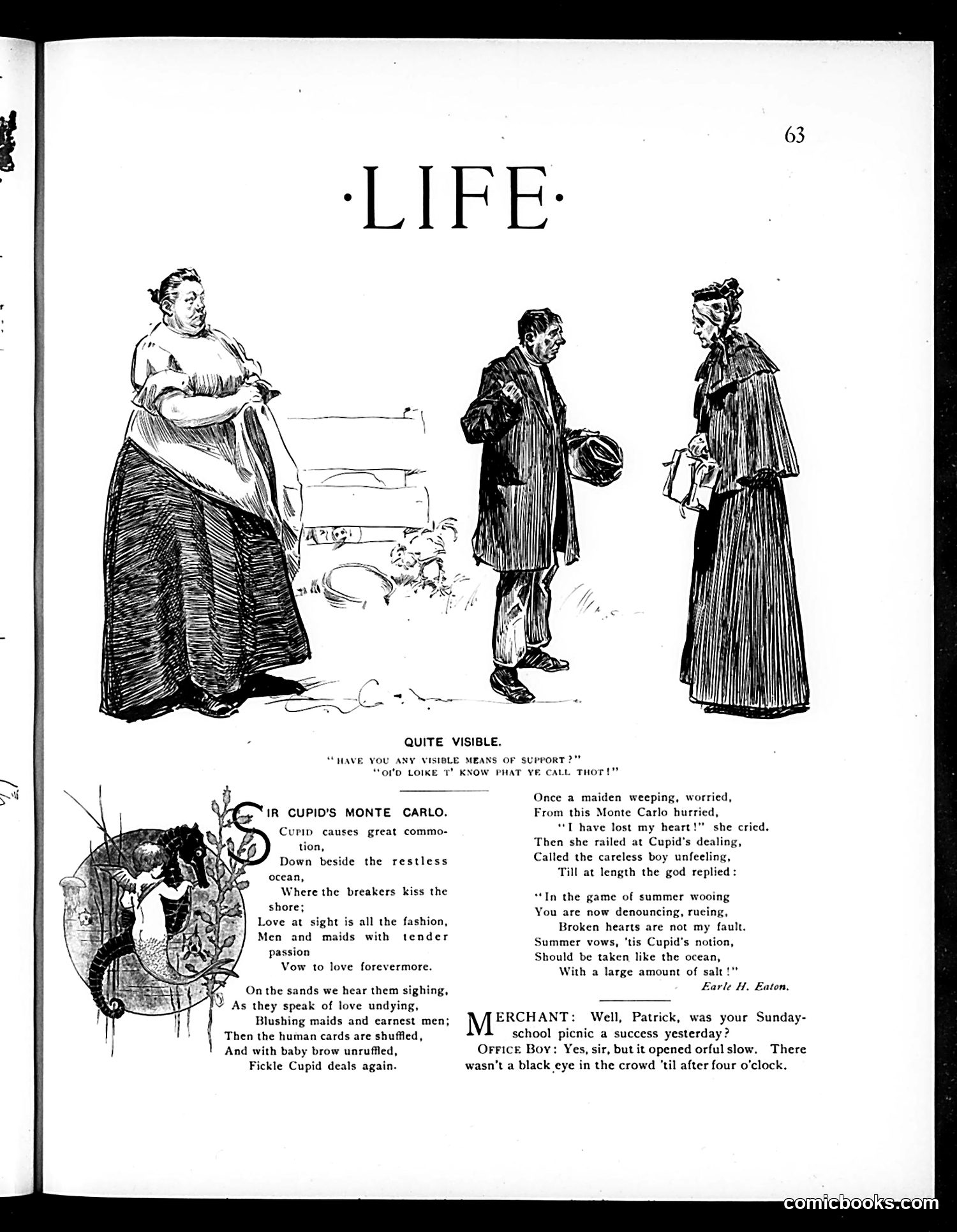
**"Quite Visible" Cartoon:** The top illustration satirizes a woman seeking financial support. She asks a man "Have you any visible means of support?" — a legal requirement for respectability at the time. The man's evasive posture suggests he lacks steady employment or income, making him an unsuitable match. This mocks both social class anxiety and the era's obsession with proving financial stability before marriage. **"Sir Cupid's Monte Carlo" Poem:** This poem critiques casual romantic dalliances, using gambling ("Monte Carlo") as metaphor. It suggests young men treat love frivolously, leaving "broken hearts" without consequence. The verse laments that summer romances lack sincerity. **Office Boy Joke:** The merchant-office boy dialogue provides light comic relief about a church picnic gone wrong.
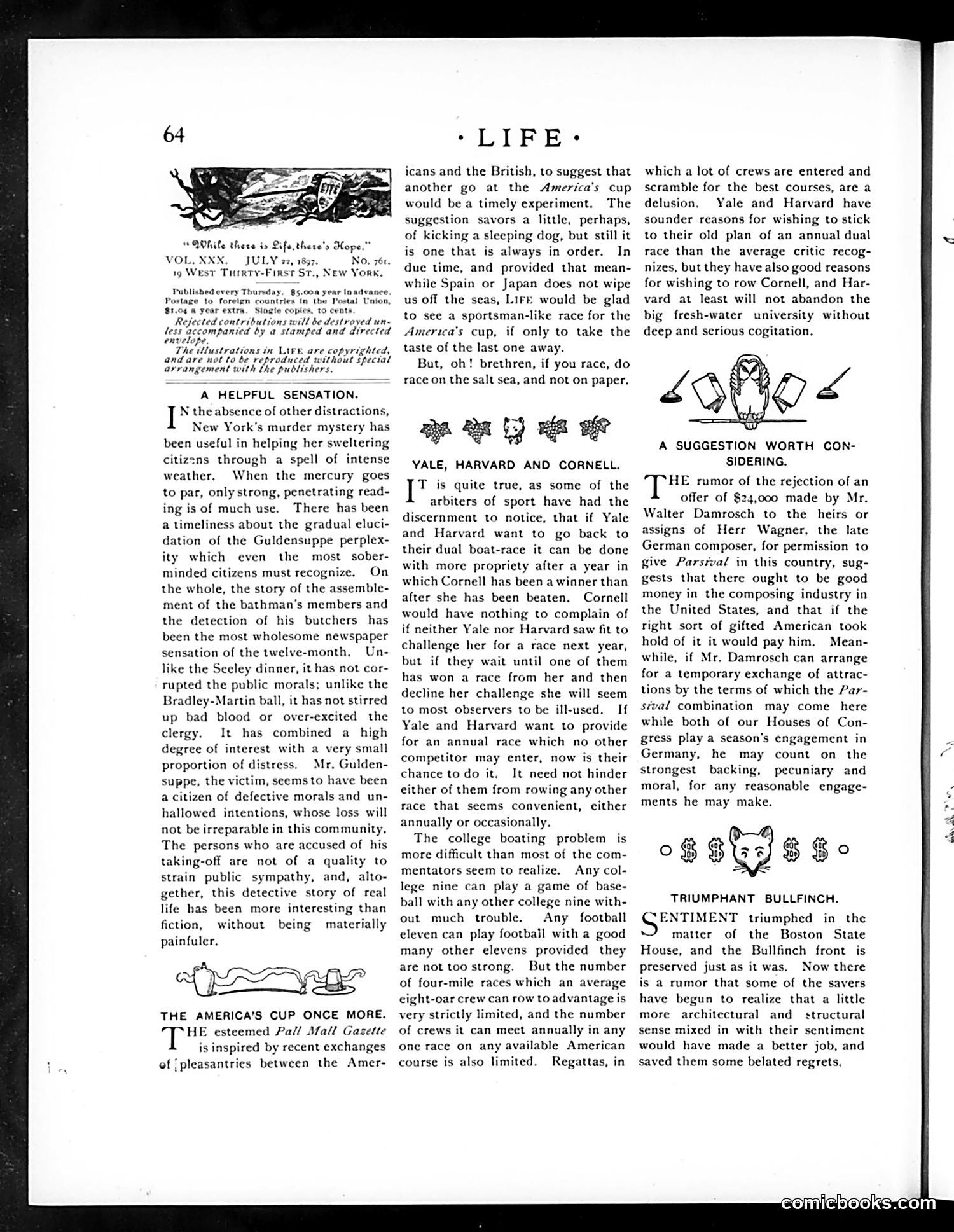
This page contains three distinct satirical sections about contemporary issues: 1. **"A Helpful Sensation"** discusses New York's "Guldensupple perplexity"—apparently a murder mystery that captivated the public during hot weather, serving as distraction from the heat. 2. **"Vale, Harvard and Cornell"** satirizes elite college rowing competitions. The piece criticizes Yale and Harvard's proposal to resume their traditional dual boat-race, arguing that college sports should focus on participatory athletics rather than exclusive high-stakes racing. 3. **"A Suggestion Worth Considering"** references a rejected $24,000 offer from Walter Damrosch (a prominent conductor) to heirs of Richard Wagner, suggesting American composers deserved patronage instead. 4. **"Triumphant Bullfinch"** notes Boston State House preservation as "better late than never."
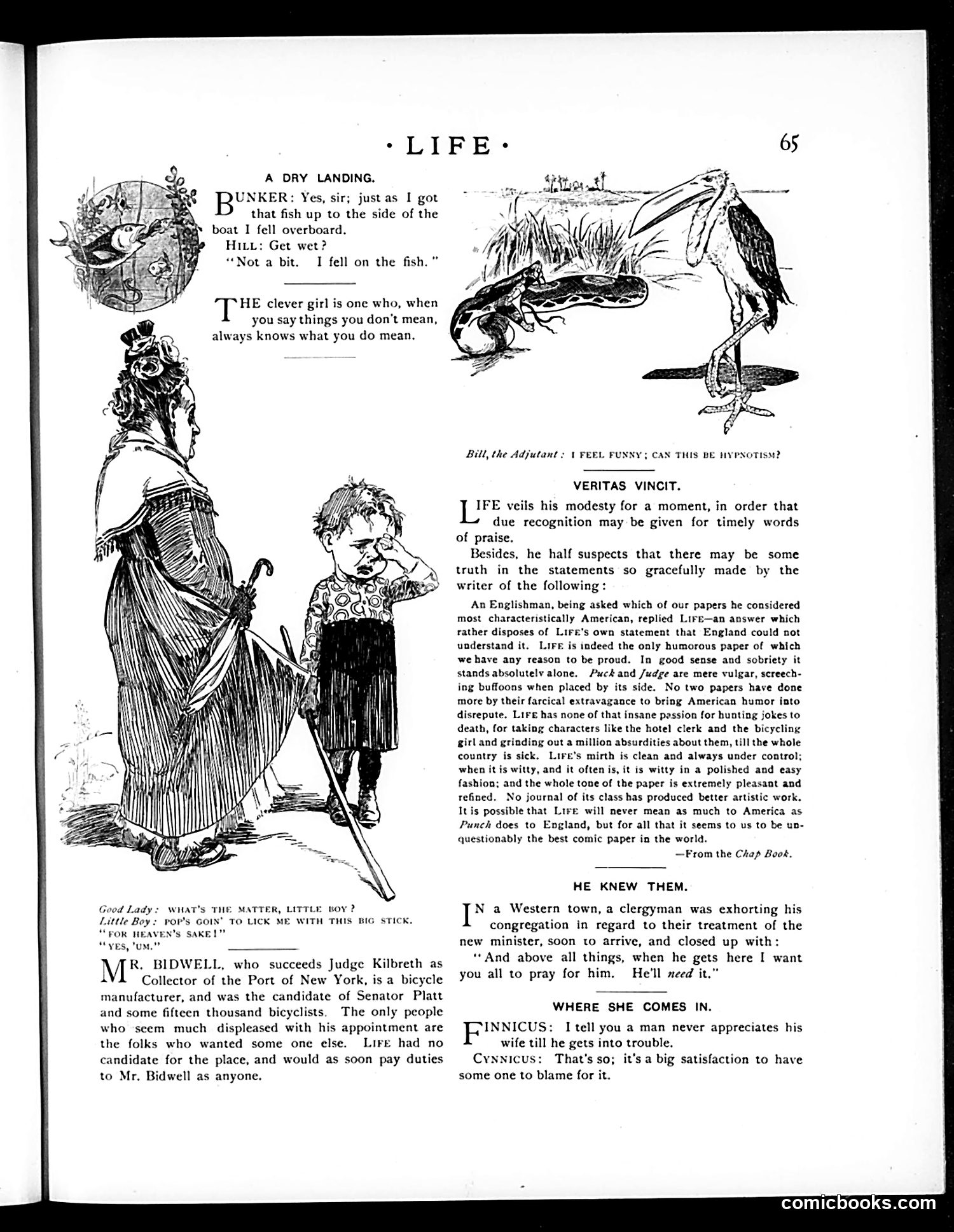
This page contains several satirical anecdotes and illustrations typical of Life's humor format: **"A Dry Landing"** mocks the difference between what people say and mean—a woman claims she "fell on the fish" rather than admitting she fell overboard. **"Veritas Vincit"** is a self-promotional section praising Life's humor as distinctly American, comparing it favorably to British competitors *Punch* and *Judge*. It claims Life's satire is cleaner and more refined. **"He Knew Them"** and **"Where She Comes In"** are brief joke exchanges about a Western clergyman and marital dynamics. **The illustrations** show period clothing and social scenes. A notable item discusses **Mr. Bidwell**, a bicycle manufacturer appointed Port of New York Collector—apparently a controversial political appointment that Life satirizes. The page exemplifies turn-of-the-century American satirical magazine humor: domestic comedy, light social commentary, and political jabs at appointments.
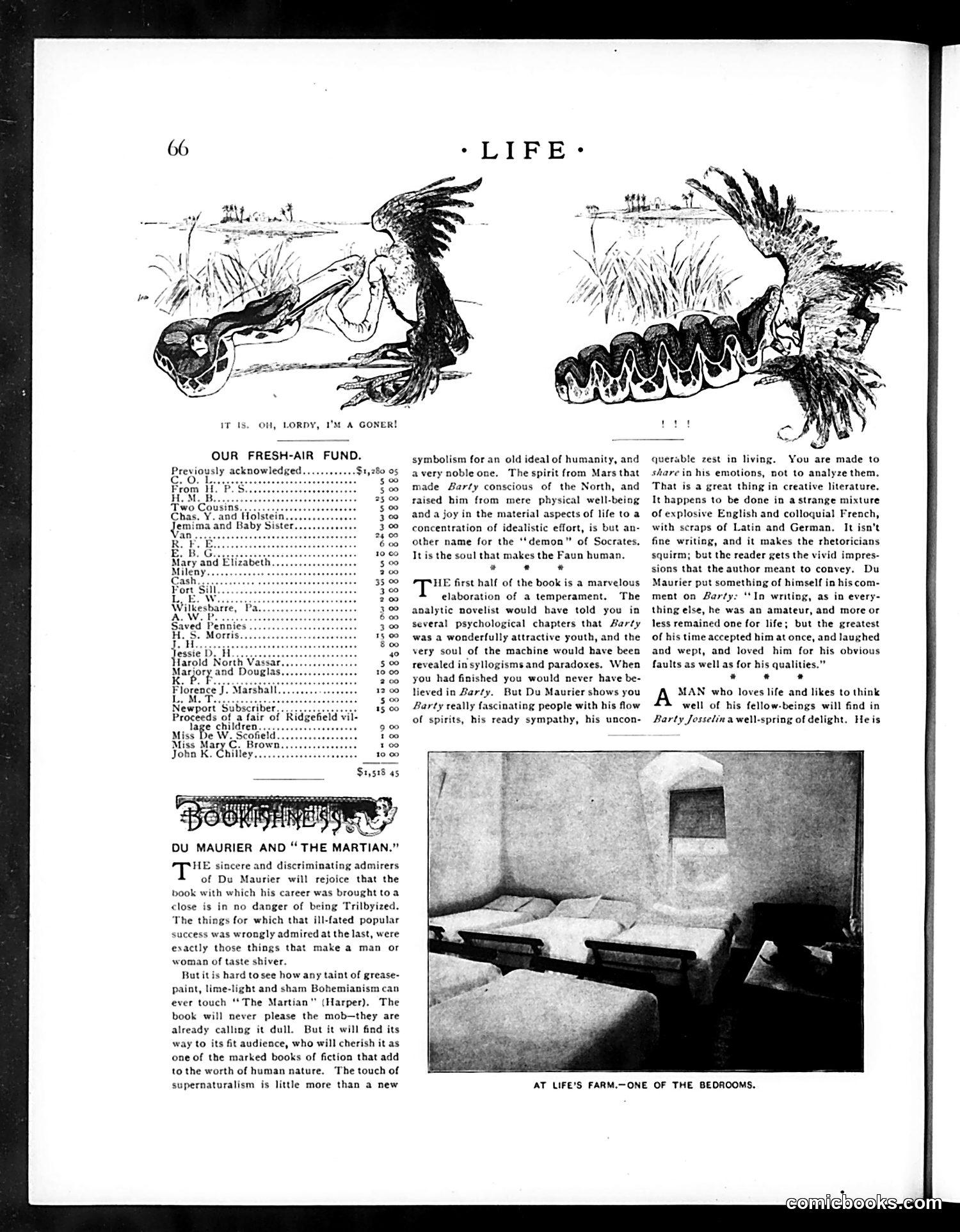
The two cartoons at top depict birds (likely geese or similar waterfowl) in exaggerated, comedic poses with captions "IT IS, OH, LORDY, I'M A GONER!" The humor appears to rely on anthropomorphized animals expressing human distress—a common satirical device in Life magazine. Below is a "Fresh-Air Fund" subscription list showing donations for providing outdoor recreation to urban children—a genuine charitable cause, not satire. The lower section discusses Du Maurier's novel "Barty," praising its characterization and human interest while critiquing "The Martian" (also by Du Maurier) as overly fantastical and commercially compromised. The photograph shows a sparse bedroom, captioned "At Life's Farm—One of the Bedrooms," likely illustrating the Fresh-Air Fund's modest accommodations. The page mixes light humor, charitable advocacy, and literary criticism typical of Life's satirical magazine format.
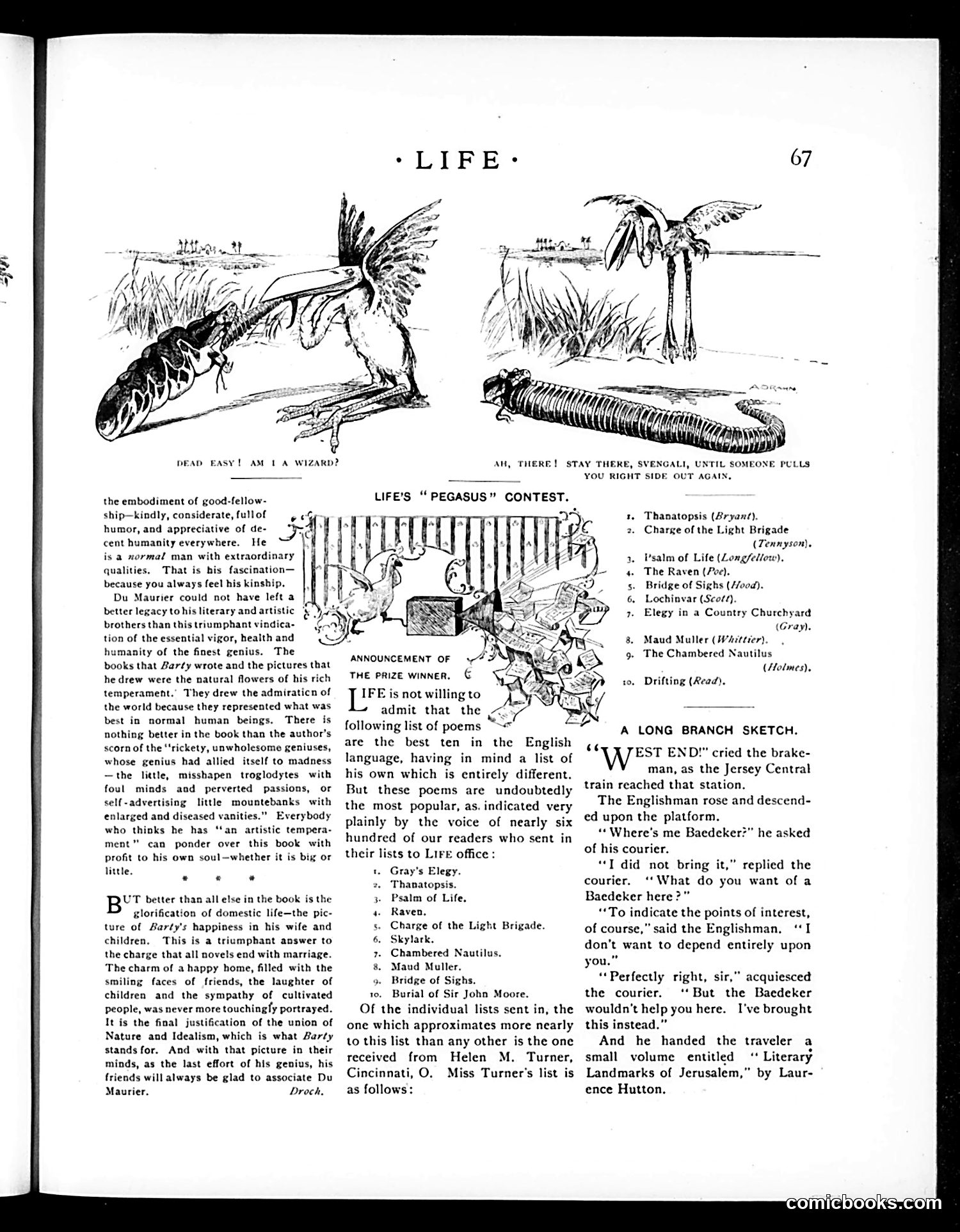
This page contains two main elements: **Top illustrations**: Two whimsical drawings of fantastical creatures (appearing to be imaginative, flying beings) with captions suggesting magical or absurd scenarios ("Read easy! Am I a wizard?" and "Ah, there! Stay there, Severgali, until someone pulls you right side out again."). These appear to be humorous spot illustrations rather than political satire. **Main content**: Text discussing *Life's* "Pegasus" poetry contest, announcing the ten most popular poems submitted by readers. The piece celebrates the domestic subject matter in Barrie's writing, praising how his depictions of "happiness in his wife and children" and "the smiling faces of friends" represent genuine human values. A short fiction piece titled "A Long Branch Sketch" follows, featuring dialogue between a courier and a brakeman at a train station. This appears to be a literary/cultural page rather than political commentary.
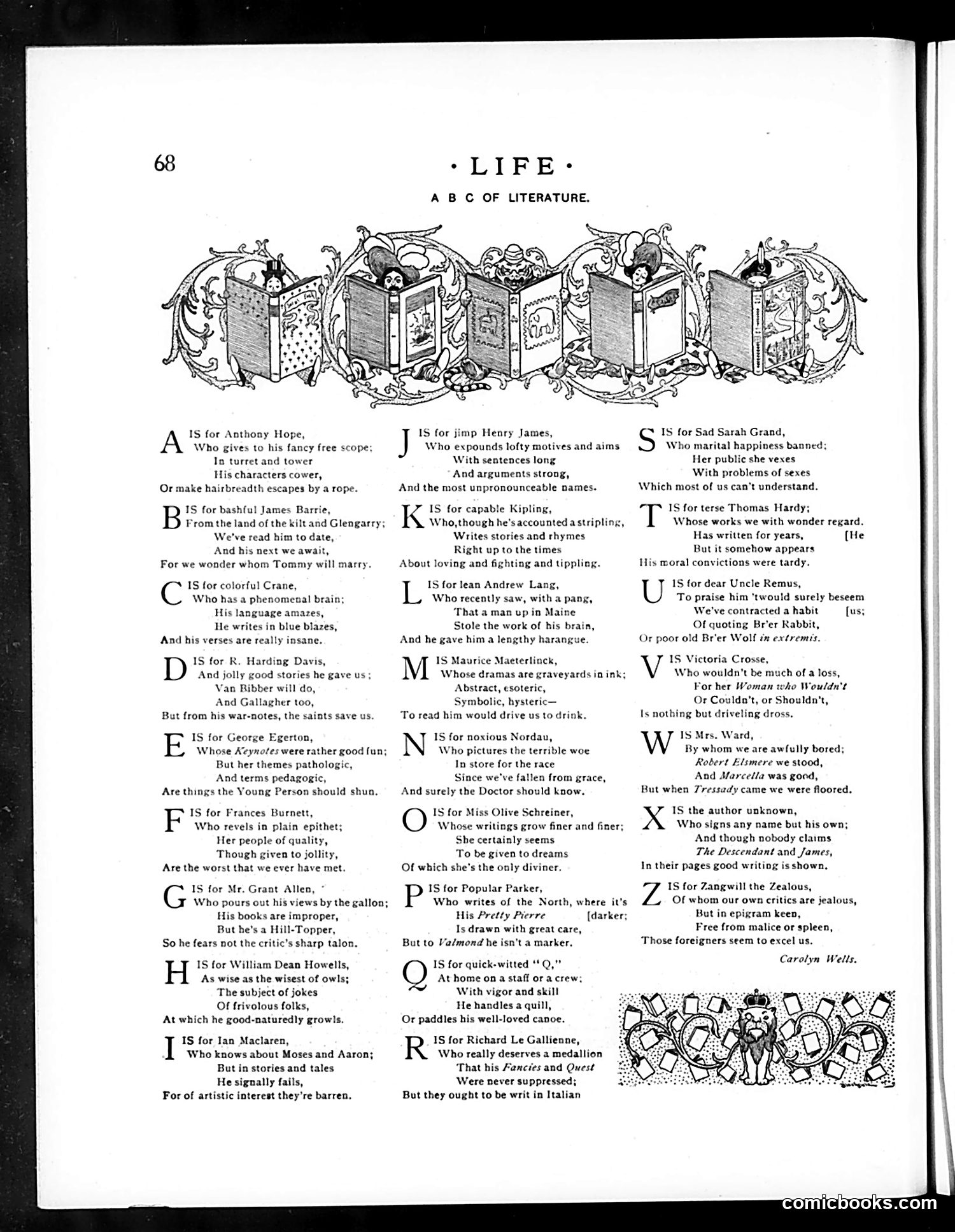
This page presents an alphabetical satirical guide to contemporary literary figures, likely from the early 1900s. Each letter pairs a famous author with a humorous couplet critiquing their work or reputation. The satire targets recognizable names like Thomas Hardy (terse), Henry James (incomprehensible prose), and Rudyard Kipling (writes fighting stories). The jokes work through exaggeration: authors are reduced to single defining characteristics—Olive Schreiner's mysticism, Maurice Maeterlinck's obscurity, George Bernard Shaw's socialism. The ornamental header shows anthropomorphic owls reading books, reinforcing the "literature" theme. The format mocks both pretentious literary criticism and the authors themselves, suggesting Life's readers would recognize these figures as contemporary cultural fixtures worthy of good-natured ridicule.
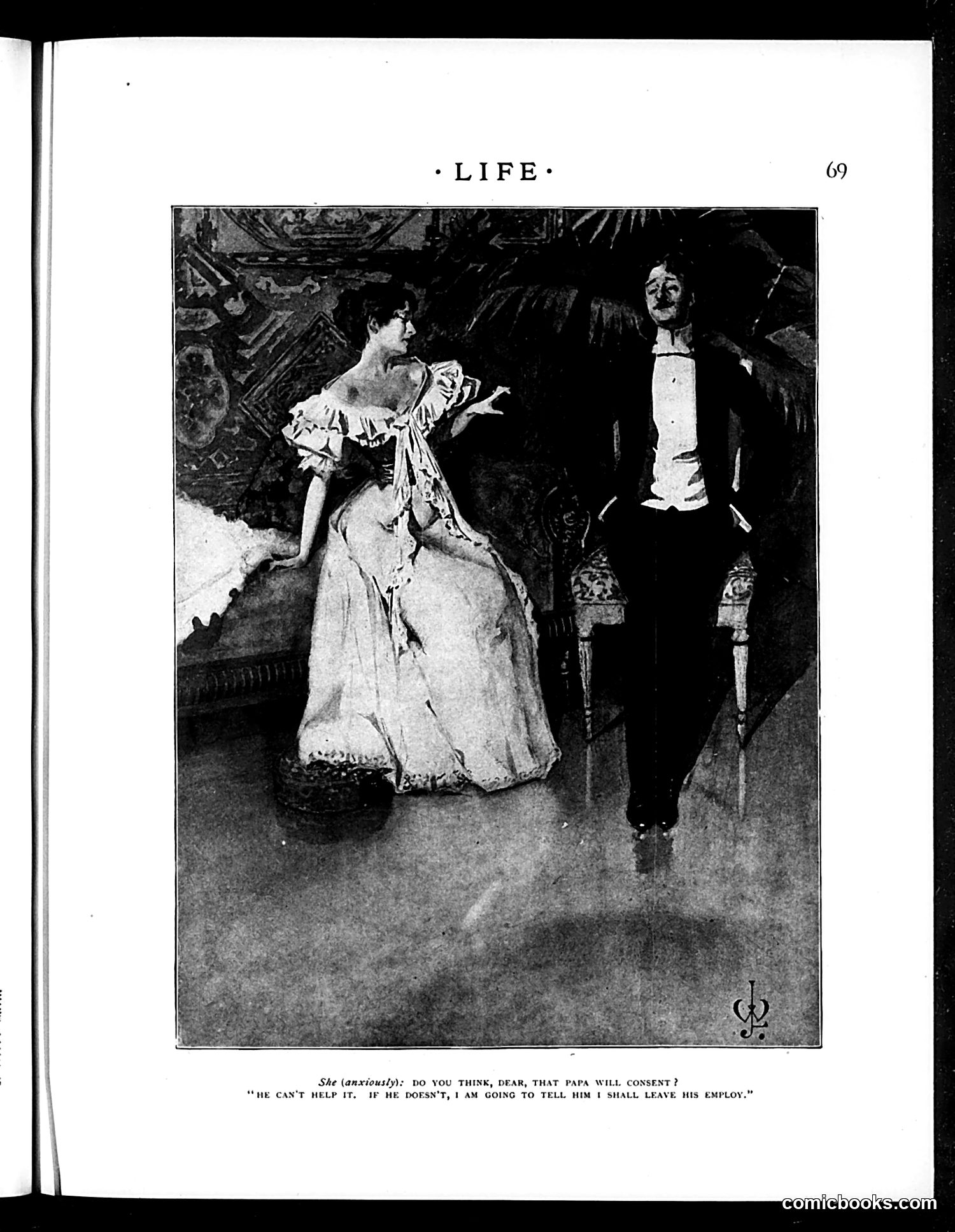
This illustration from *Life* magazine depicts a dramatic domestic scene. A woman in an elegant white gown, appearing anxious, speaks to a man in formal evening wear (tuxedo). The caption reveals the satirical point: the woman asks if her father will consent to something, adding that if he refuses, she'll leave her employer's house. The man responds that he "can't help it" and will tell the father she should depart. This appears to be satirizing the rigid social conventions and power dynamics of early 20th-century courtship, where young women had little autonomy and fathers controlled major life decisions. The humor lies in the woman's ultimatum being ineffectual—the man simply accepts the consequences rather than capitulating to her demands, highlighting how limited her actual leverage was in such hierarchical relationships.
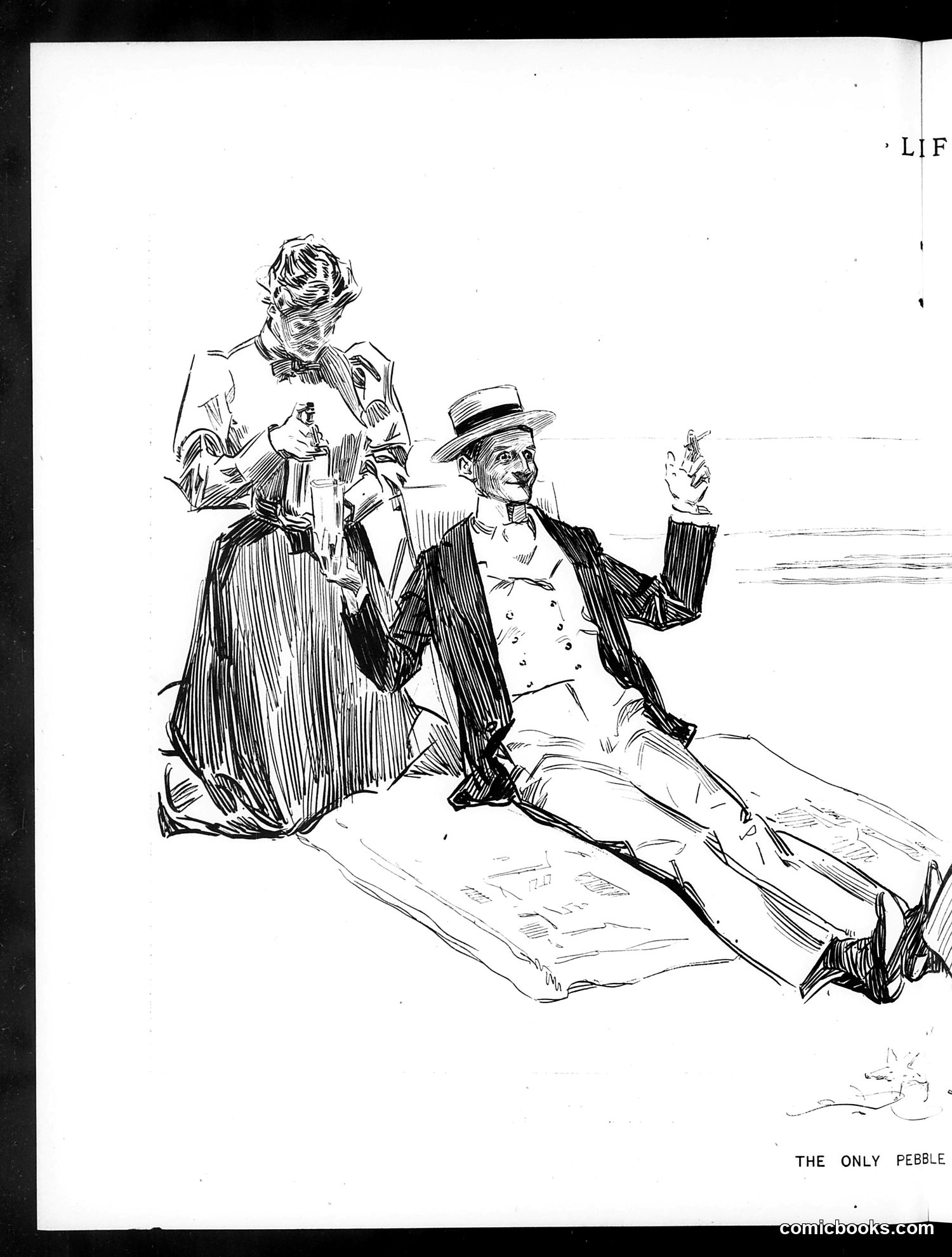
This cartoon depicts two figures examining what appears to be architectural plans or documents spread on the ground. The standing woman holds a drink and wears formal attire with an elaborate hat, while the seated man in a straw hat gestures expressively. The title "The Only Pebble" suggests a reference to the saying "you're not the only pebble on the beach"—meaning one shouldn't assume they're uniquely special or indispensable. The satire likely comments on romantic or social rivalry, with the woman and man appearing to be in some kind of romantic or social competition. The formal dress and leisurely setting suggest upper-class society. Without additional context from the magazine's date or accompanying text, the specific social critique remains unclear, though it appears to mock assumptions of exclusivity or importance in social hierarchies.
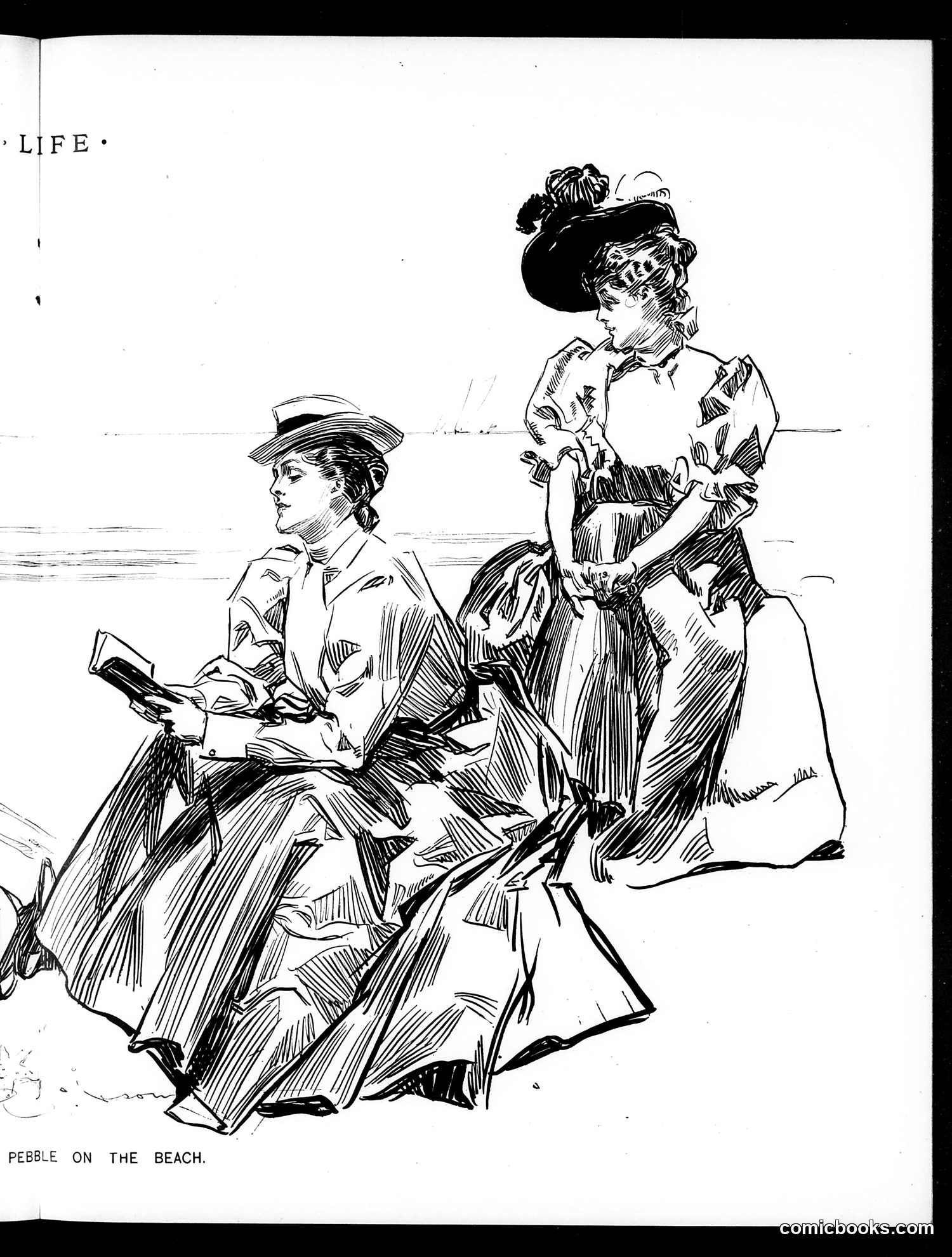
This illustration from *Life* magazine shows two fashionably dressed women at the beach. The seated woman holds what appears to be a book or document, while the standing woman gestures expressively. Both wear elaborate early-1900s attire with large hats, fitted jackets, and long skirts—impractical beachwear by modern standards. The caption "Pebble on the Beach" likely satirizes either their pretentious fashion choices at a casual seaside setting, or comments on women's social gatherings and idle pursuits. The detailed rendering of their clothing suggests the humor derives from the contrast between fashionable dress codes and the informal beach environment. Without additional context, the specific social critique remains unclear.
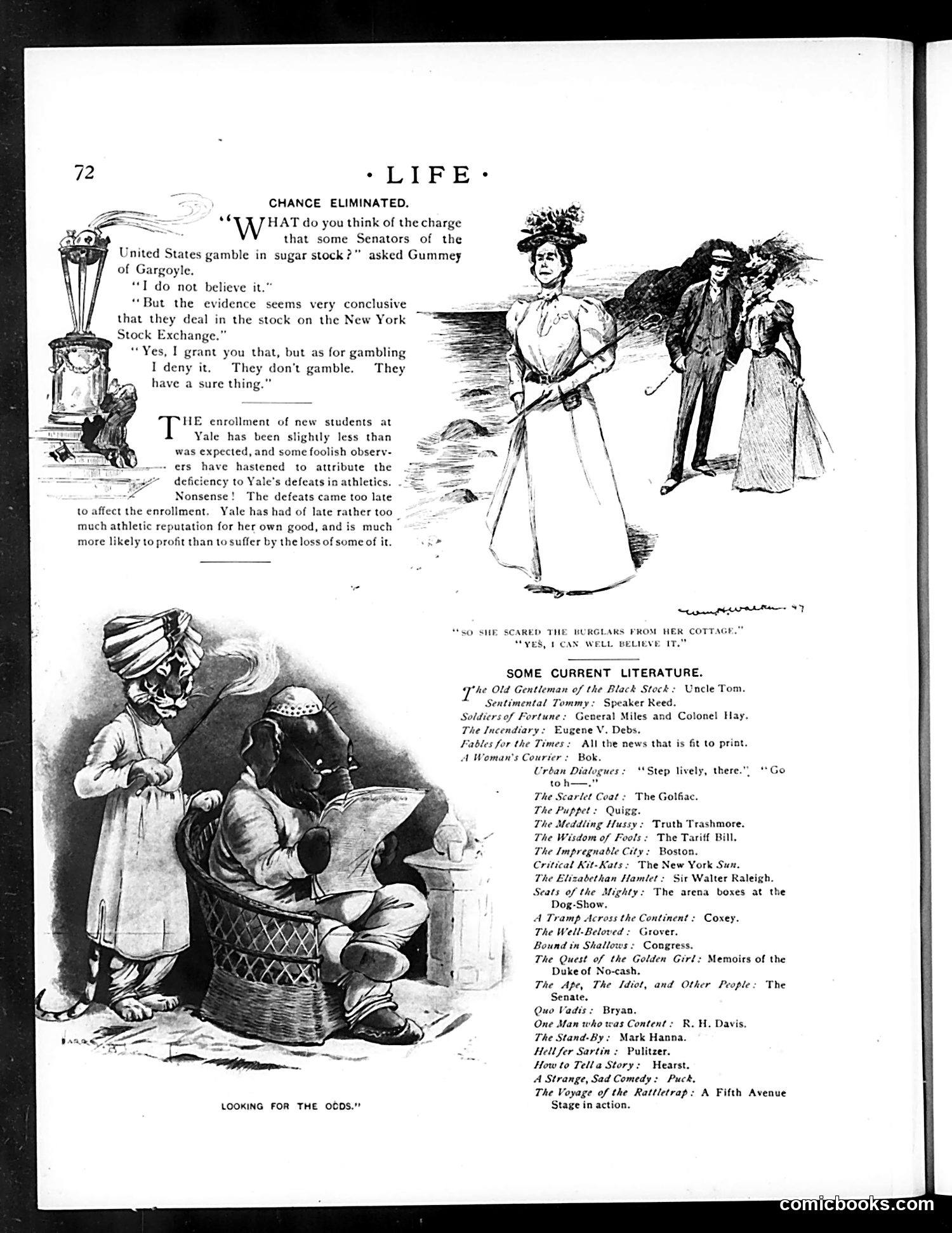
**Top Cartoon:** Gummey of Gargoyle questions whether U.S. Senators gamble in sugar stocks. A colleague insists they don't gamble—"they have a sure thing," implying senators have inside information or rigged advantages in stock trading that eliminate genuine risk. This satirizes political corruption and insider trading. **Bottom Cartoon:** Titled "Looking for the Odds," depicts someone searching through papers, likely referencing the same theme of trying to find profitable opportunities through privileged access rather than legitimate market conditions. **Middle Section:** Discusses Yale's declining athletic enrollment, suggesting defeats hurt recruitment more than institutional reputation. **Literature List:** Contemporary book titles and plays from the period. The overall message: senators operate with unfair advantages unavailable to ordinary investors.
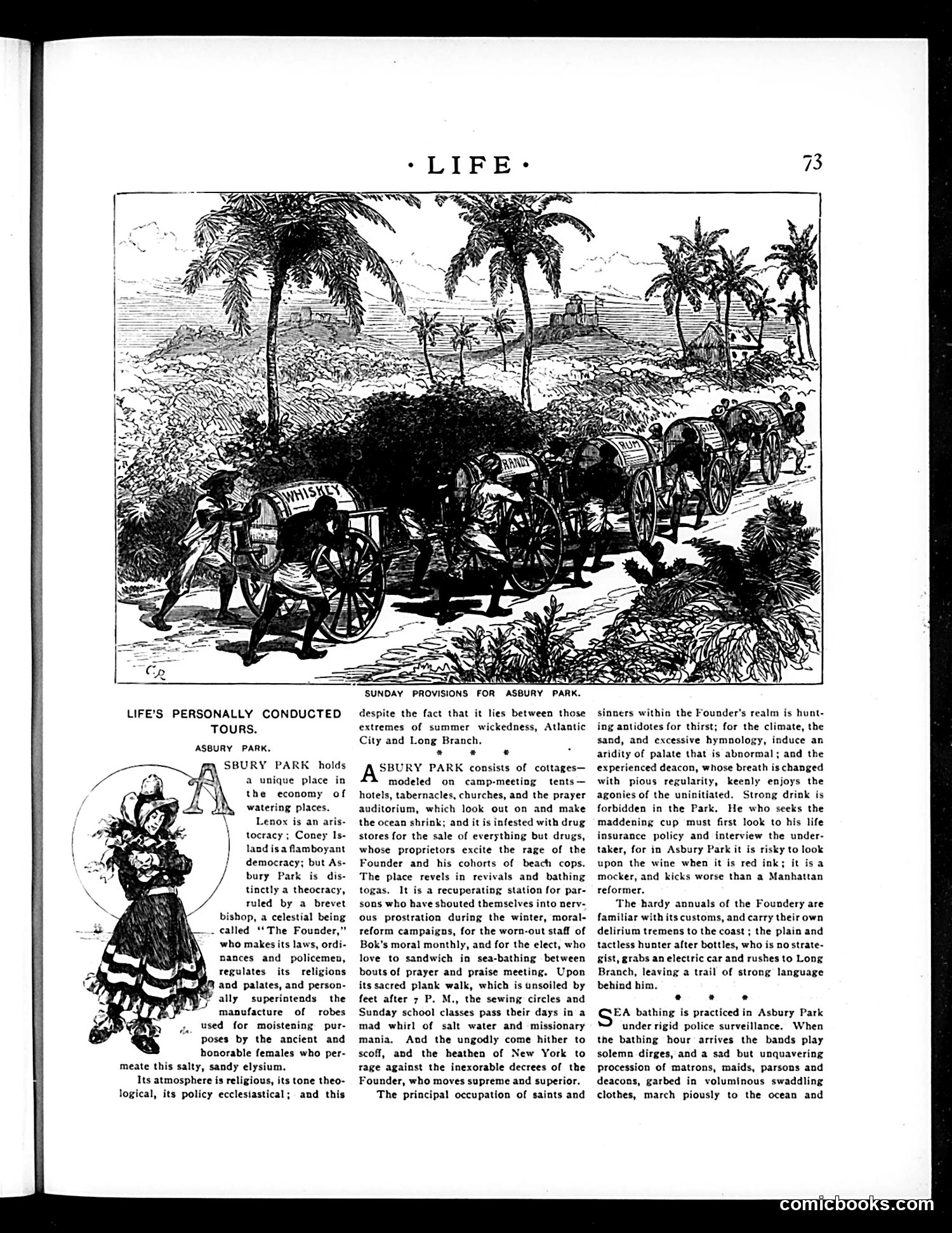
This satirical article mocks Asbury Park, New Jersey as an oppressively religious resort town ruled by its "Founder"—a theocratic dictator controlling laws, police, and moral conduct. The tone is relentlessly critical. The satire targets the town's hypocrisy: despite being a "recuperating station" for exhausted clergy and moral reformers, it's infested with drug stores (implying drug use), and visitors desperately seek alcohol despite prohibition. The description of mandatory bathing processions in "voluminous swaddling clothes" and the 7 P.M. curfew on the boardwalk ridicules the suffocating puritanism. The engraving shows supply wagons labeled "Whiskey" and "Brandy" being transported through palm-lined streets—a direct visual joke about the contradiction between the town's moral pretensions and actual vice. The piece attacks Asbury Park as a fake spirituality masking repression and hypocrisy.
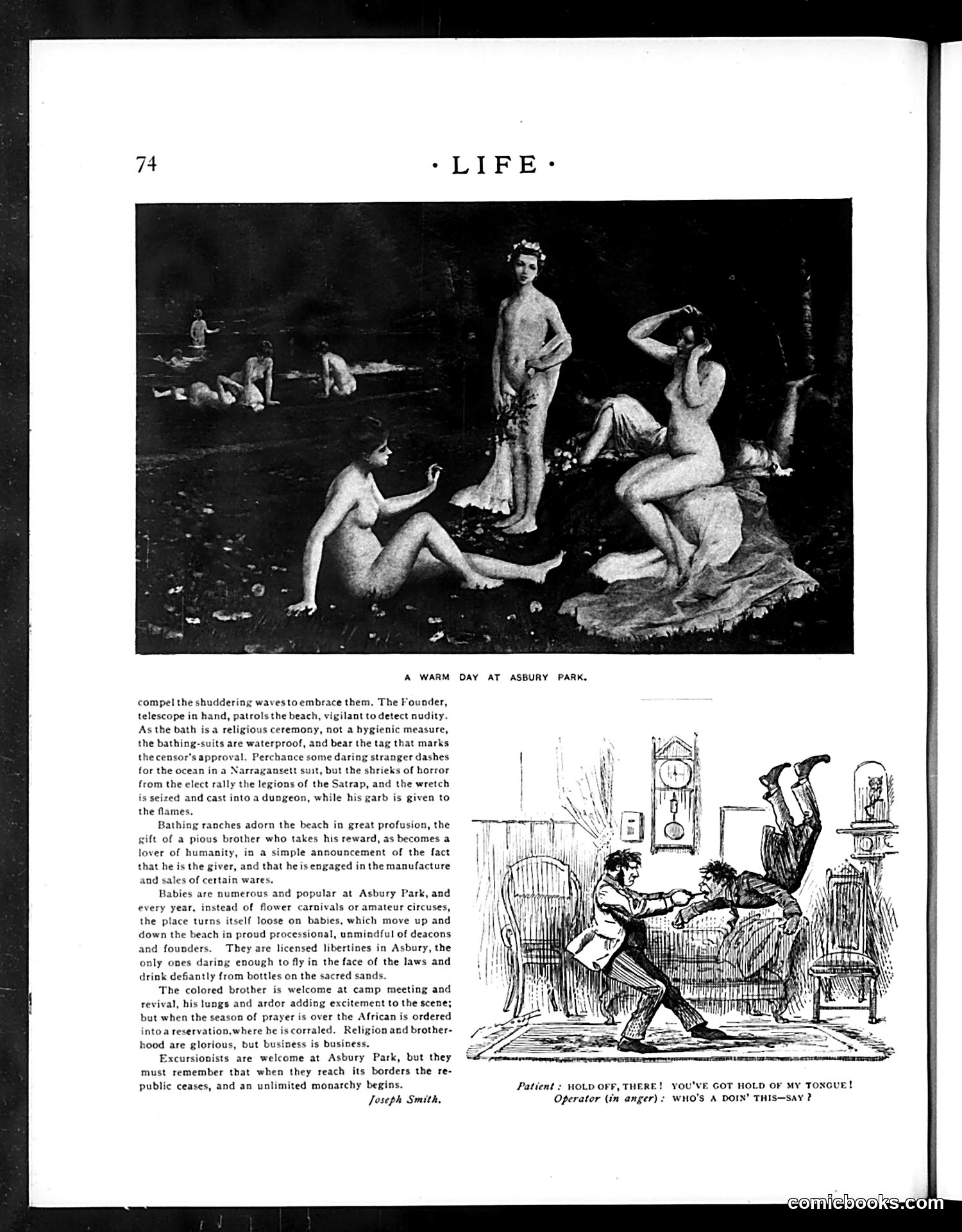
This page satirizes **Asbury Park, New Jersey**, a beach resort with strict moral governance. The top illustration depicts the beach under heavy religious surveillance—the "Founder" patrols to prevent nudity, bathing suits are waterproof and censorship-approved, and rule-breakers face punishment. The text mocks the hypocrisy: rigid moral control coexists with commercialism (a "pious brother" profits from bathing facilities). Most strikingly, the satire exposes racial discrimination—Black visitors are welcomed during revival meetings for their enthusiasm but then segregated into "reservations" when business matters. Babies, ironically, are the only ones permitted to break rules. The bottom cartoon (unrelated) depicts a patient struggling with a dentist or doctor, complaining about tongue control. The author, Joseph Smith, uses Asbury Park as a microcosm of American contradictions: religious authoritarianism, profit-driven moralism, and racial segregation masked as piety.
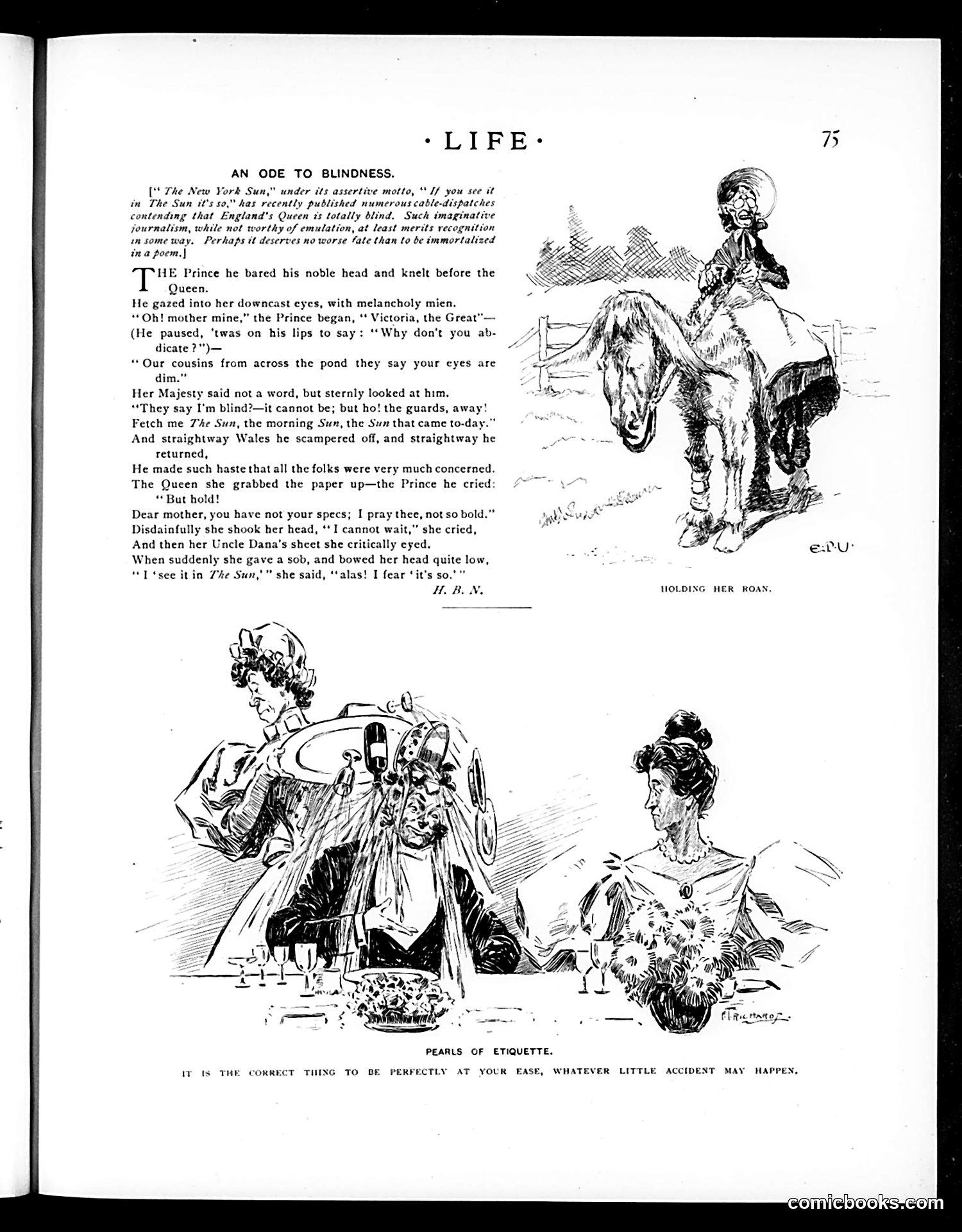
This page satirizes **The New York Sun's** false reporting that Queen Victoria was blind. The poem mocks both the Sun's sensationalism and its motto "If you see it in The Sun it's so." The joke: Queen Victoria, despite having perfect vision, reads The Sun's absurd claims about her blindness and becomes so distressed that she ironically weeps—making the false report seem validated. The satire targets the Sun's irresponsible "yellow journalism," which published unverified cable-dispatches from England as fact. The lower cartoon ("Pearls of Etiquette") appears unrelated, depicting a woman maintaining composure amid a mishap—likely another satire on social pretension. **Key context for modern readers:** This reflects late-19th-century press criticism of sensationalist newspapers that prioritized striking headlines over accuracy. The Sun's motto—essentially "if we print it, it's true"—was itself a satirical target of Life magazine's editorial perspective.
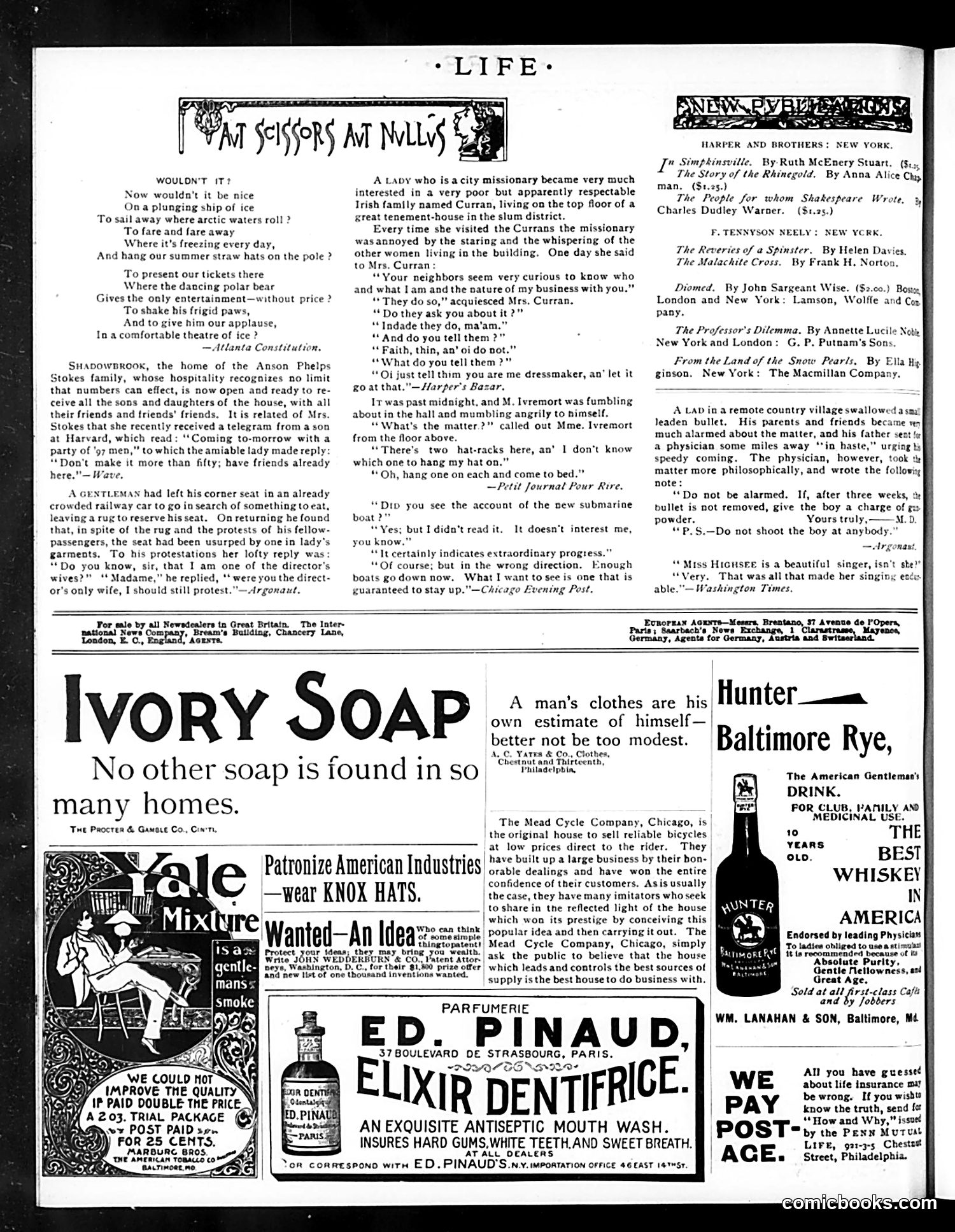
This page is primarily **humorous anecdotes and advertisements** rather than political cartoons. The main content consists of five short joke stories: 1. **Arctic vacation fantasy** — Satirizes the appeal of exotic travel 2. **Hospitality anecdote** — Jokes about the Stokes family's famous generosity 3. **Train seat dispute** — Mocks a woman using status ("director's wife") to claim a seat; a man refuses to defer 4. **Irish missionary story** — Gentle humor about class differences and how Mrs. Curran avoids gossip by telling neighbors the lady is her dressmaker 5. **Submarine joke** — Dark humor wishing submarines would stay afloat instead of sinking The page also includes advertisements (Ivory Soap, Knox Hats, Hunter Baltimore Rye whiskey) and book announcements. **Context**: This reflects *Life* magazine's era of light, social satire rather than sharp political commentary. The humor targets class pretension, gender dynamics, and everyday absurdities familiar to turn-of-the-century readers.
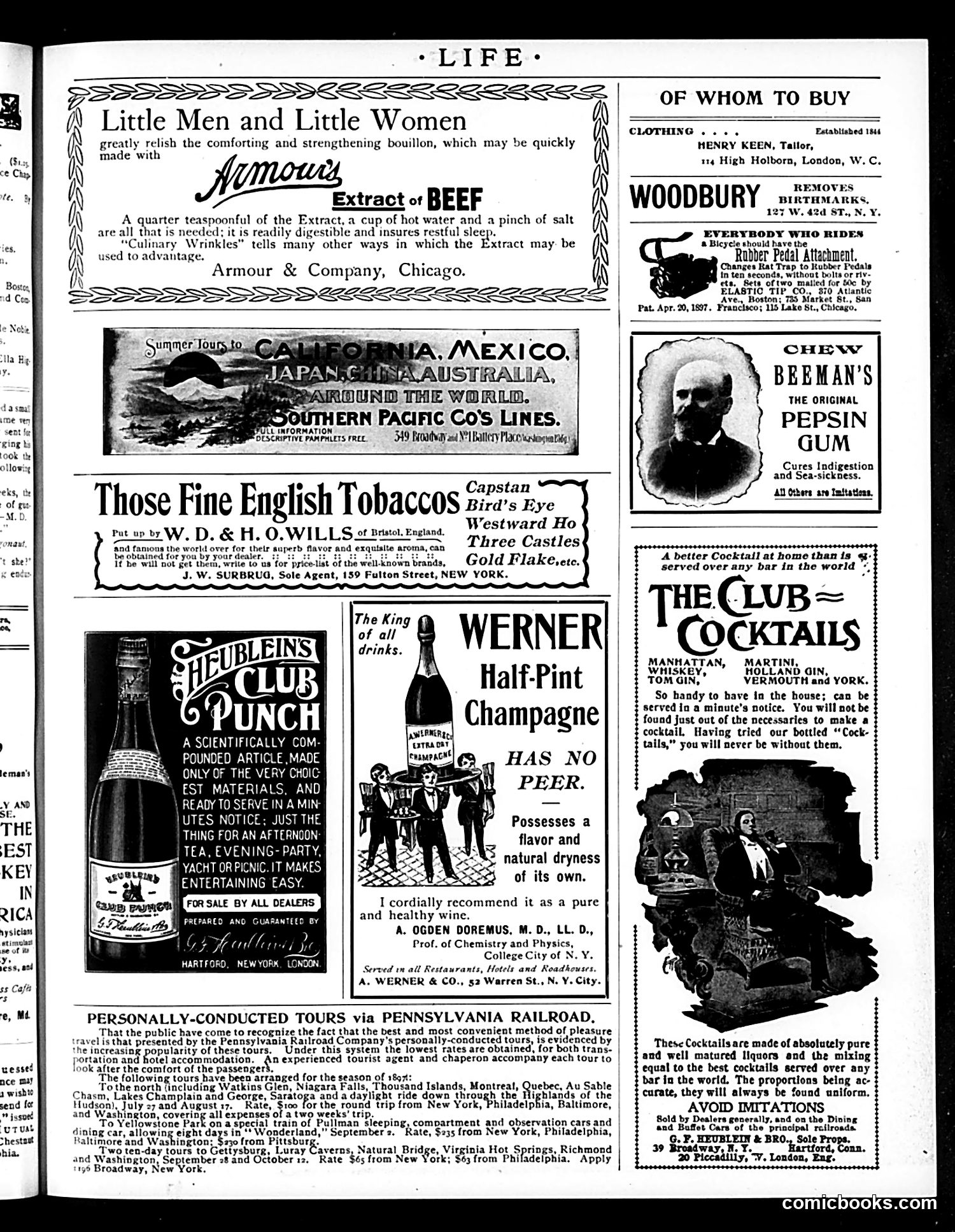
This page is primarily **advertising**, not satirical content. It's from Life magazine's commercial section and contains vintage product advertisements from the 1890s. Key ads include: - **Armour's Beef Extract**: marketed for children ("Little Men and Little Women") as a nutritious, sleep-inducing bouillon - **Fine English Tobaccos** by W.D. & H.O. Wills: cigarette brands like "Capstan" and "Gold Flake" - **Heublein's Club Punch**: a pre-made cocktail concentrate - **Werner's Half-Pint Champagne**: endorsed by a chemistry professor as "pure and healthy" - **The Club Cocktails**: claiming superiority to bar drinks - **Pennsylvania Railroad tours**: vacation packages to Yellowstone, Niagara Falls, etc. There is **no visible political satire or cartoon** on this page. The layout, endorsements (including a fake academic credential), and unregulated health claims reflect late-Victorian advertising practices that would be illegal today—notable mainly for their casual approach to product safety and credibility.
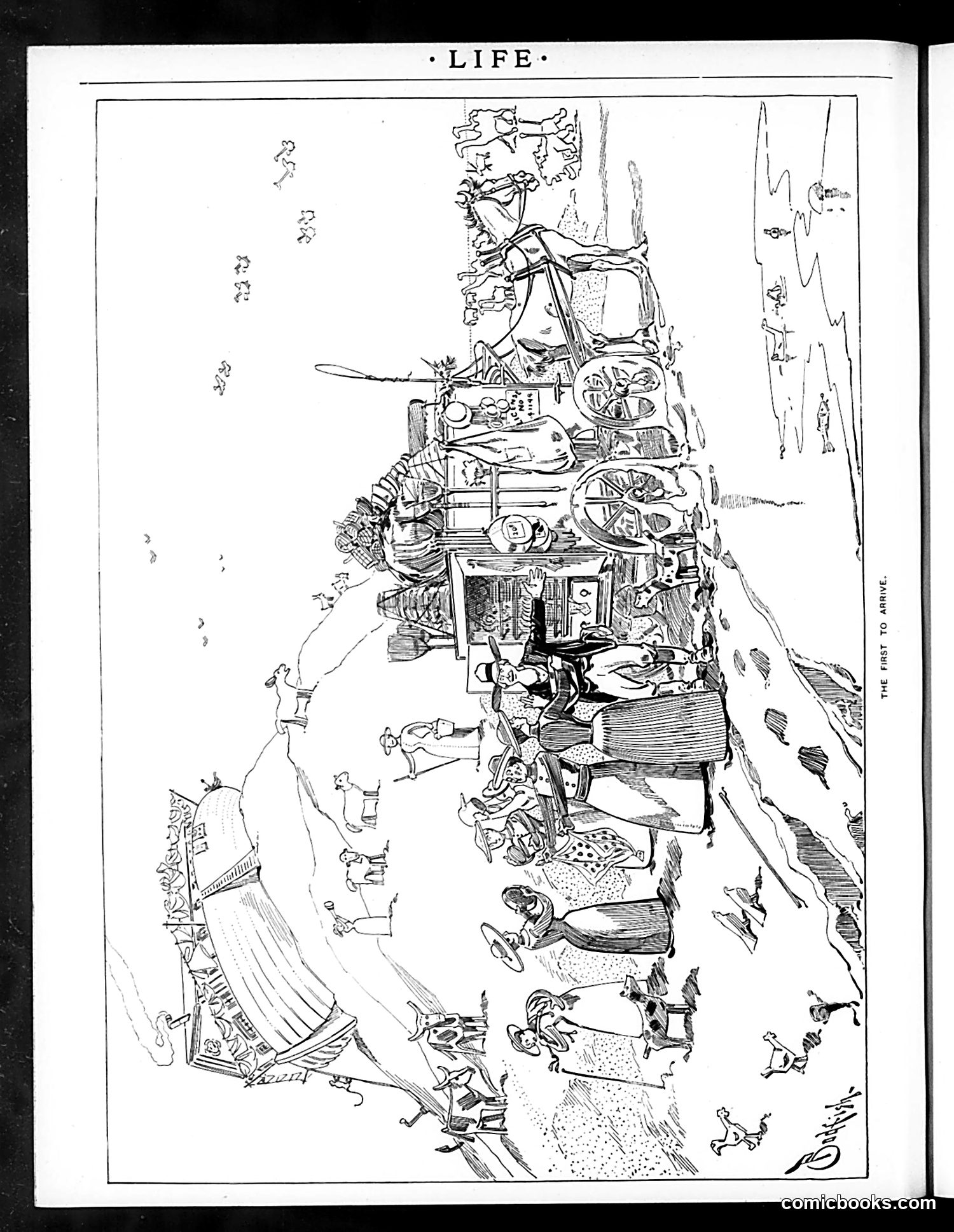
This is a satirical illustration titled "The First to Arrive" from *Life* magazine. The cartoon depicts a chaotic scene at what appears to be a fashionable social gathering or event venue. The drawing shows numerous figures in period dress crowded around elaborate furnishings and decorative elements. The satire appears to target the social pretensions and frantic behavior of wealthy attendees rushing to be first at a prestigious social occasion. The detailed linework captures the tumultuous, almost violent competition among elegantly-dressed guests jostling for position and attention. The crowded composition and overlapping figures emphasize the absurdity of this status-conscious scramble. Without additional context or visible publication date, the specific event being mocked remains unclear, but the cartoon critiques the vanity and social climbing characteristic of the Gilded Age or early 20th-century high society.
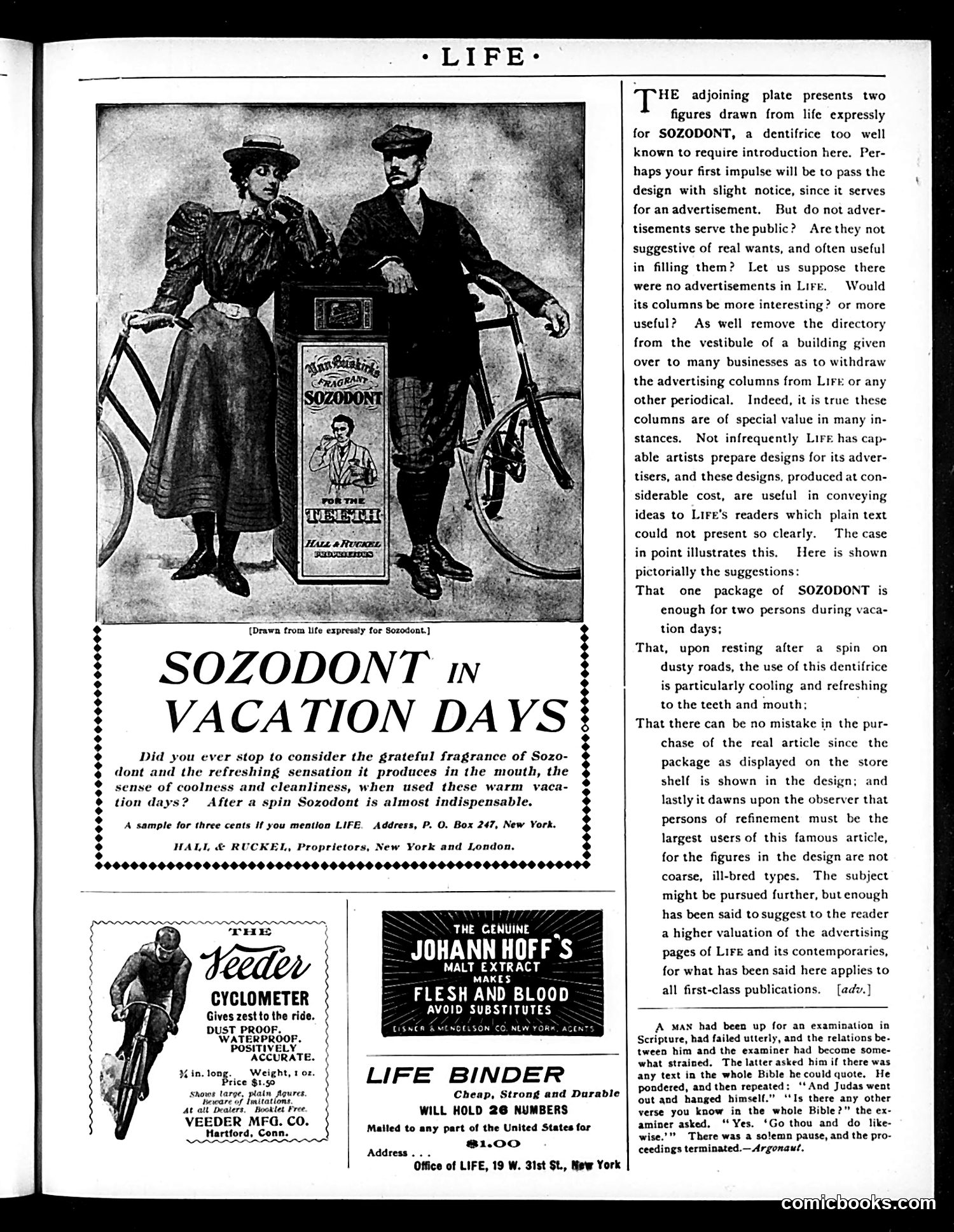
This page is primarily **advertising content**, though it includes editorial commentary defending ads' value to readers. The main illustration shows a **well-dressed couple with bicycles**, promoting **Sozodont toothpaste**. The satire is subtle: Life's editorial argues that advertisements aren't mere commercial clutter but can be artistically designed and socially useful. The Sozodont ad exemplifies this—its elegant figures supposedly convey that "persons of refinement" use the product, while the image suggests toothpaste is "almost indispensable" after dusty vacation rides. The page's argument is meta: Life defends its own advertising space by claiming quality ads inform and educate readers better than plain text could. The page also includes other period **advertisements** (a bicycle cyclometer, malt extract, magazine binder) and an unrelated humor piece about a Scripture exam fail, typical of Life's magazine format. The overall message: advertising can be legitimate editorial content when produced with artistic care.
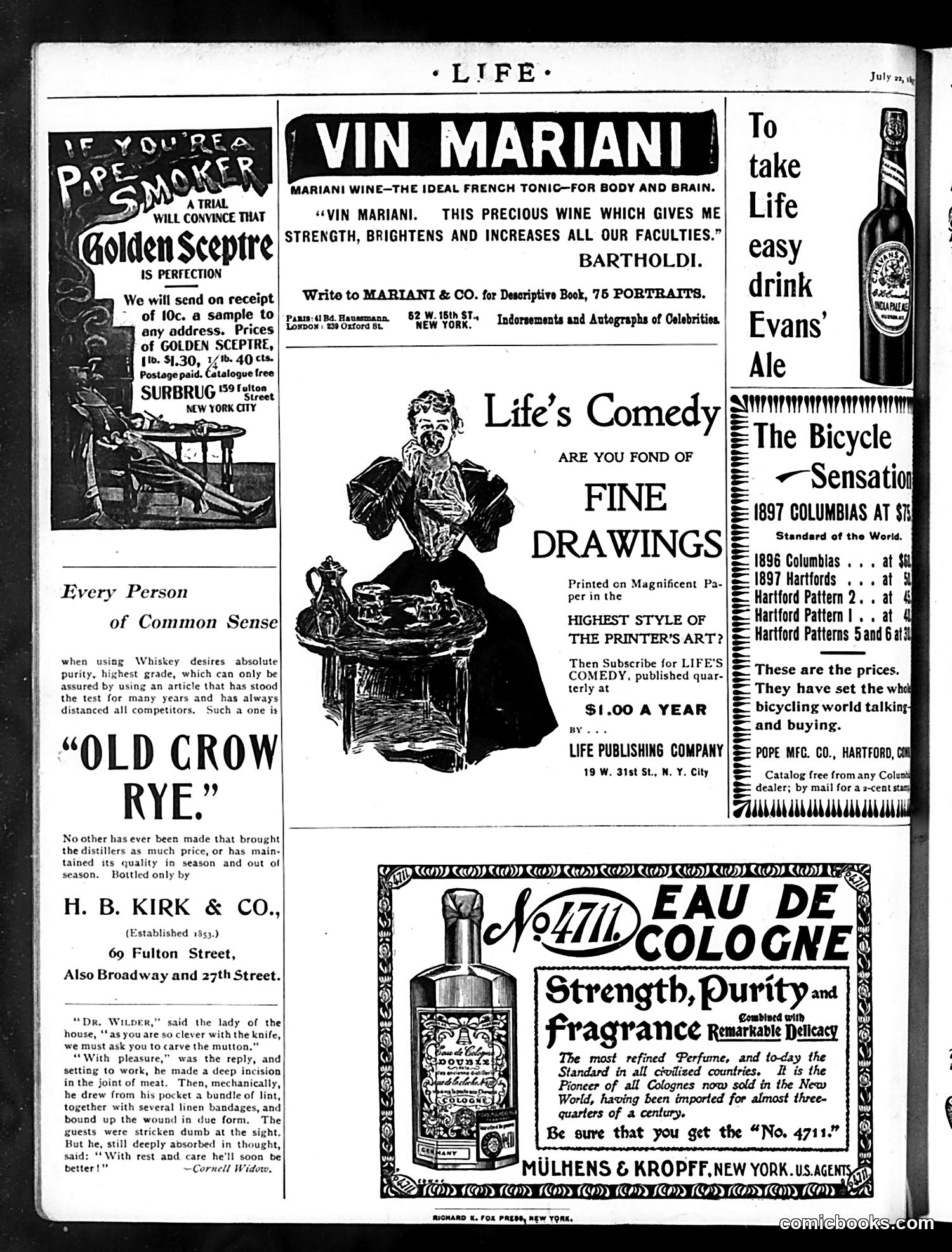
This page is primarily **advertising**, with one humor piece. The main content includes: **"Life's Comedy" Cartoon**: A caricatured doctor treats a carving knife wound on a roast of meat as though it were a human injury—wrapping it in bandages and lint from his medical kit. The joke plays on absent-mindedness: a surgeon so absorbed in his profession that he automatically treats inanimate objects as patients. **Advertisements**: The page features period products—whiskey ("Old Crow Rye"), French wine tonic ("Vin Mariani," endorsed by the famous Statue of Liberty sculptor Bartholdi), bicycle models (Pope Manufacturing Company), and eau de cologne. These ads reflect late-Victorian consumer culture and patent medicines marketed with health claims. **Notable**: Vin Mariani was a cocaine-infused wine popular in this era—its endorsement by a celebrity (Bartholdi) demonstrates how such products were legitimized before regulations restricted them. The page reflects 1890s American advertising practices and humor sensibilities.