
Life, 1897-07-22 · page 6 of 20
Life — July 22, 1897 — page 6: what you’re looking at
What you’re looking at
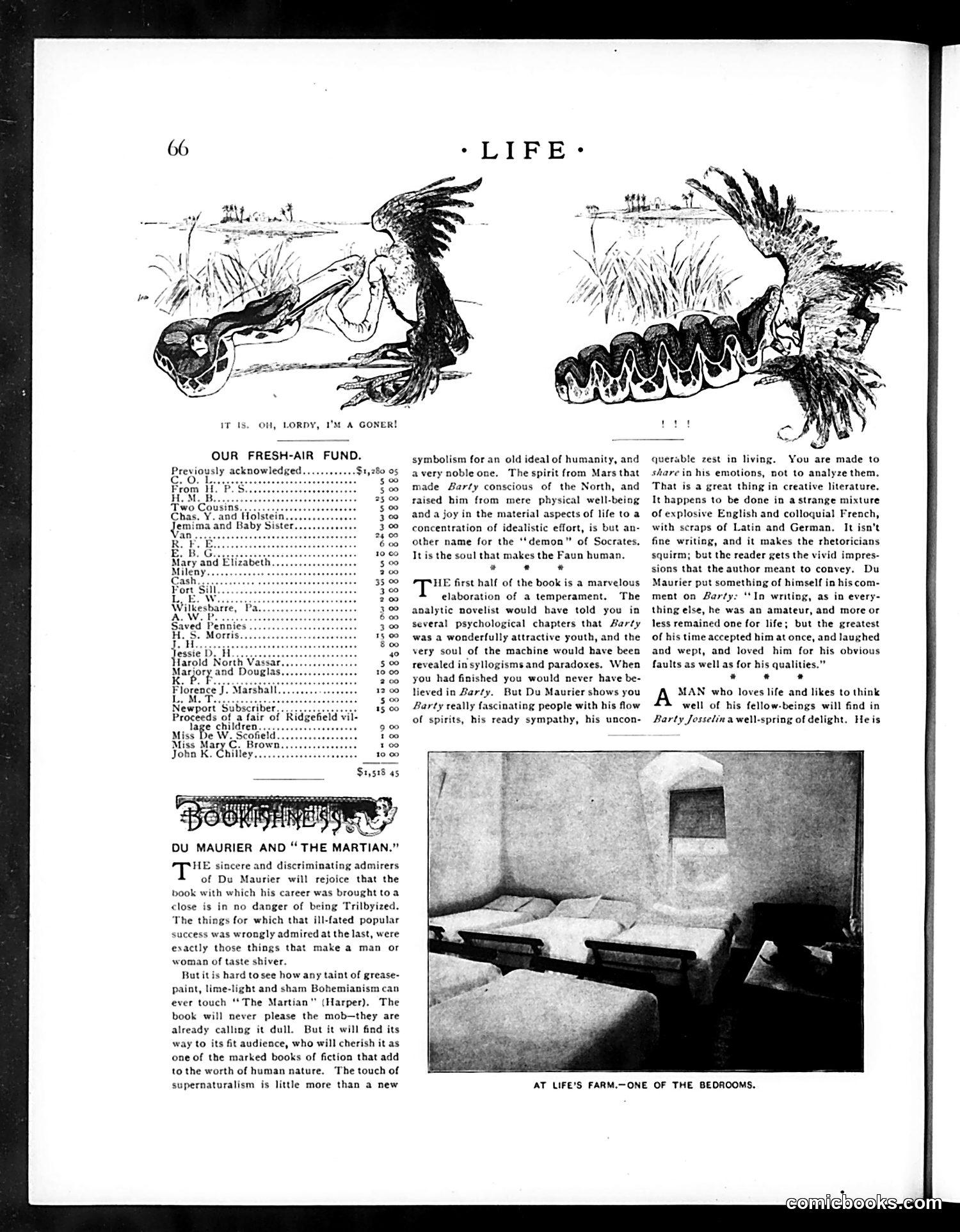
The two cartoons at top depict birds (likely geese or similar waterfowl) in exaggerated, comedic poses with captions "IT IS, OH, LORDY, I'M A GONER!" The humor appears to rely on anthropomorphized animals expressing human distress—a common satirical device in Life magazine. Below is a "Fresh-Air Fund" subscription list showing donations for providing outdoor recreation to urban children—a genuine charitable cause, not satire. The lower section discusses Du Maurier's novel "Barty," praising its characterization and human interest while critiquing "The Martian" (also by Du Maurier) as overly fantastical and commercially compromised. The photograph shows a sparse bedroom, captioned "At Life's Farm—One of the Bedrooms," likely illustrating the Fresh-Air Fund's modest accommodations. The page mixes light humor, charitable advocacy, and literary criticism typical of Life's satirical magazine format.
📄 Transcribed text from this page (OCR, searchable)
Machine-transcribed from the original scan — historical spelling and the odd misread are preserved.
OU, LORDY, I'M A GONER! OUR FRESH-AIR FUND. oie acknowledged. Two Cousins. Chas. Y. and Hoistein iat ima and Baby Sister E. x ilkesbarre, Li Jed pennies 5 & H. S. Morris. JoH. Newport bscribe Proceeds of a fair of Ridgefield vil- lage children. Miss De W. Scofield Miss Mary C. Brown John K. Chilley... DU MAURIER AND “THE MARTIAN.” HE sincere and discriminating admirers of Du Maurier will rejoice that the book with which his career was brought toa close is in no danger of being Trilbyized. The things for which that ill-fated popular success was wrongly admired at the last, were exactly those things that make a man or woman of taste shiver. But it is hard to see how any taint of grease- paint, lime-light and sham Bohemianism can ever touch “*The Martian" (Harper), The book will never please the mob—they are already calling it dull. But it find its way to its fit audience, who will cherish it as one of the marked books of fiction that add to the worth of human nature. The touch of supernaturalism is little more than a new symbolism for an old ideal of humanity, and avery noble one. The spirit from Mars that made Barty conscious of the North, and raised him from mere physical well-being and a joy in the material aspects of life to a concentration of idealistic effort, is but an- other name for the ‘‘demon” of Socrates, It is the soul that makes the Faun human. * * . HE first half of the book is a marvelous elaboration of a temperament. The analytic novelist would have told you in several psychological chapters that Barty was a wonderfully attractive youth, and the very soul of the machine would have been revealed in syllogisms and paradoxes. When you had finished you would never have be- lieved in Barty. But Du Maurier shows you Barty really fascinating people with his flow of spirits, his ready sympathy, his uncon- querable zest in living. You are made to share in his emotions, not to analyze them, That is a great thing in creative literature. It happens to be done in a strange mixture of explosive English and colloquial French, with scraps of Latin and German. It isn’t fine writing, and it makes the rhetoricians squirm; but the reader gets the vivid impres- sions that the author meant to convey, Du Maurier put something of himself in hiscom- ment on Barty: ‘In writing, as in every- thing else, he was an amateur, and more or less remained one for life; but the greatest of his time accepted him at once, and laughed and wept, and loved him for his obvious faults as well as for his qualities.” * * * MAN who loves life and likes to think well of his fellow-beings will find in Barty Josselin a well-spring of delight. He is AT LIFE'S FARM.—ONE OF THE BEDROOMS.