
Life, 1897-07-22 · page 7 of 20
Life — July 22, 1897 — page 7: what you’re looking at
What you’re looking at
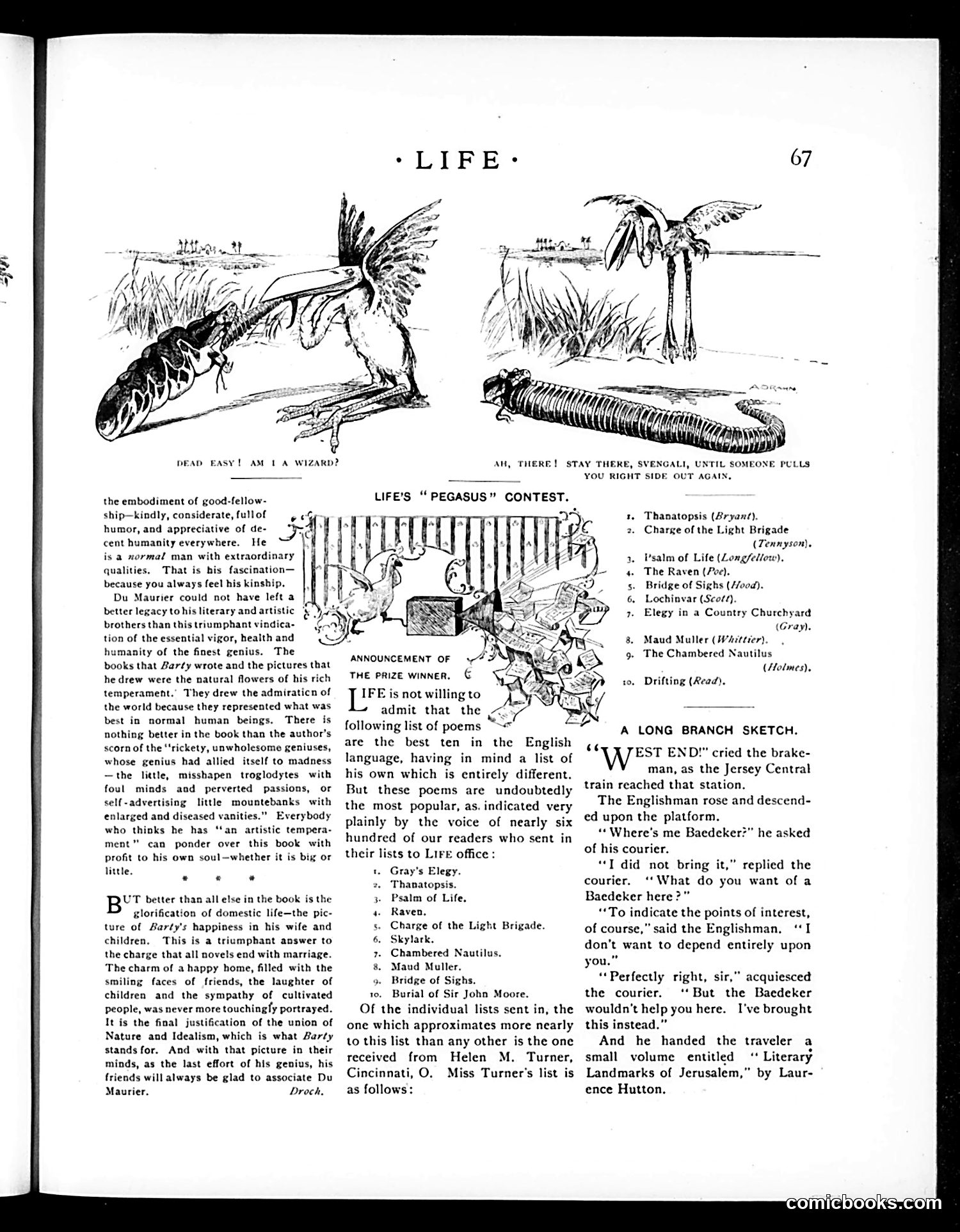
This page contains two main elements: **Top illustrations**: Two whimsical drawings of fantastical creatures (appearing to be imaginative, flying beings) with captions suggesting magical or absurd scenarios ("Read easy! Am I a wizard?" and "Ah, there! Stay there, Severgali, until someone pulls you right side out again."). These appear to be humorous spot illustrations rather than political satire. **Main content**: Text discussing *Life's* "Pegasus" poetry contest, announcing the ten most popular poems submitted by readers. The piece celebrates the domestic subject matter in Barrie's writing, praising how his depictions of "happiness in his wife and children" and "the smiling faces of friends" represent genuine human values. A short fiction piece titled "A Long Branch Sketch" follows, featuring dialogue between a courier and a brakeman at a train station. This appears to be a literary/cultural page rather than political commentary.
📄 Transcribed text from this page (OCR, searchable)
Machine-transcribed from the original scan — historical spelling and the odd misread are preserved.
DEAD EASY! AM LA WIZARD? the embodiment of good-fellow- ship—kindly, considerate, fullof humor, and appreciative of de- cent humanity everywhere. He is a normal man with extraordinary qualities. That is his fascination— because you always feel his kinship, Du Maurier could not have left a better legacy to his literary and artistic ‘ brothers than this triumphant vindica- tion of the essential vigor, health and humanity of the finest genius. The books that Barty wrote and the pictures that he drew were the natural flowers of his rich temperament.’ They drew the admiraticn of the world because they represented what was best in normal human beings. There is nothing better in the book than the author's scorn of the “rickety, unwholesome geniuses, whose genius had allied itself to madness —the little, misshapen troglodytes with foul minds aod perverted passions, or self-advertising little mountebanks with enlarged and diseased vanities.” Everybody who thinks he has ‘an artistic tempera- ment’ can ponder over this book with profit to his own soul—whether it is big or little. * ® . UT better than all else in the book is the glorification of domestic life—the pic- ture of Barty's happiness in his wife and children. ‘This is a triumphant answer to the charge that all novels end with marriage. The charm of a happy home, filled with the smiling faces of friends, the laughter of children and the sympathy of cultivated people, was never more touchingfy portrayed. It is the final justification of the union of Nature and Idealism, which is what Barty stands for. And with that picture in their minds, as the last effort of his genius, his friends will always be glad to associate Du Maurier. Droch. AM, THERE! “ PEGASUS” CONTEST. ANNOUNCEMENT OF THE PRIZE WINNER, [2 is not willing to admit that the following list of poems are the best ten in the English language, having in mind a list of his own which is entirely different. But these poems are undoubtedly the most popular, as. indicated very plainly by the voice of nearly six hundred of our readers who sent in their lists to Lire office : Gray's Elegy. ‘Thanatopsis. Psalm of Life, Raven, Charge of the Light Brigade. Skylark, Chambered Nautilus. Maud Muller. Bridge of Sighs. Burial of Sir John Moore. Of the individual lists sent in, the one which approximates more nearly to this list than any other is the one received from Helen M. Turner, Cincinnati, O. Miss Turner's list is as follows: 10. STAY THERE, SVENGALI, UNTIL SOMEONE PULLS YOU RIGHT SIDE OUT AGAIN, 1, Thanatopsis (Bryant). Charge of the Light Brigade (Tennyson). Psalm of Life (Longfellow). The Raven (Foe). Bridge of Sighs (//ood). Lochinvar (Scott). Elegy in a Country Churchyard (Gray). . Maud Muller (Whittier). . The Chambered Nautilus (Holmes), Drifting (Read). A LONG BRANCH SKETCH. EST END!" cried the brake- man, as the Jersey Central train reached that station. The Englishman rose and descend- ed upon the platform. “Where's me Baedeke of his courier. “I did not bring it,” replied the courier, ‘What do you want of a Baedeker here?” “To indicate the points of interest, of course,” said the Englishman, ‘‘1 don’t want to depend entirely upon you. “Perfectly right, sir,” acquiesced the courier. ‘‘But the Baedeker wouldn't help you here. I've brought this instead.” And he handed the traveler a small volume entitled ‘‘ Literary Landmarks of Jerusalem,” by Laur- ence Hutton. “ce he asked