
A complete issue · 32 pages · 1897
Life — May 27, 1897
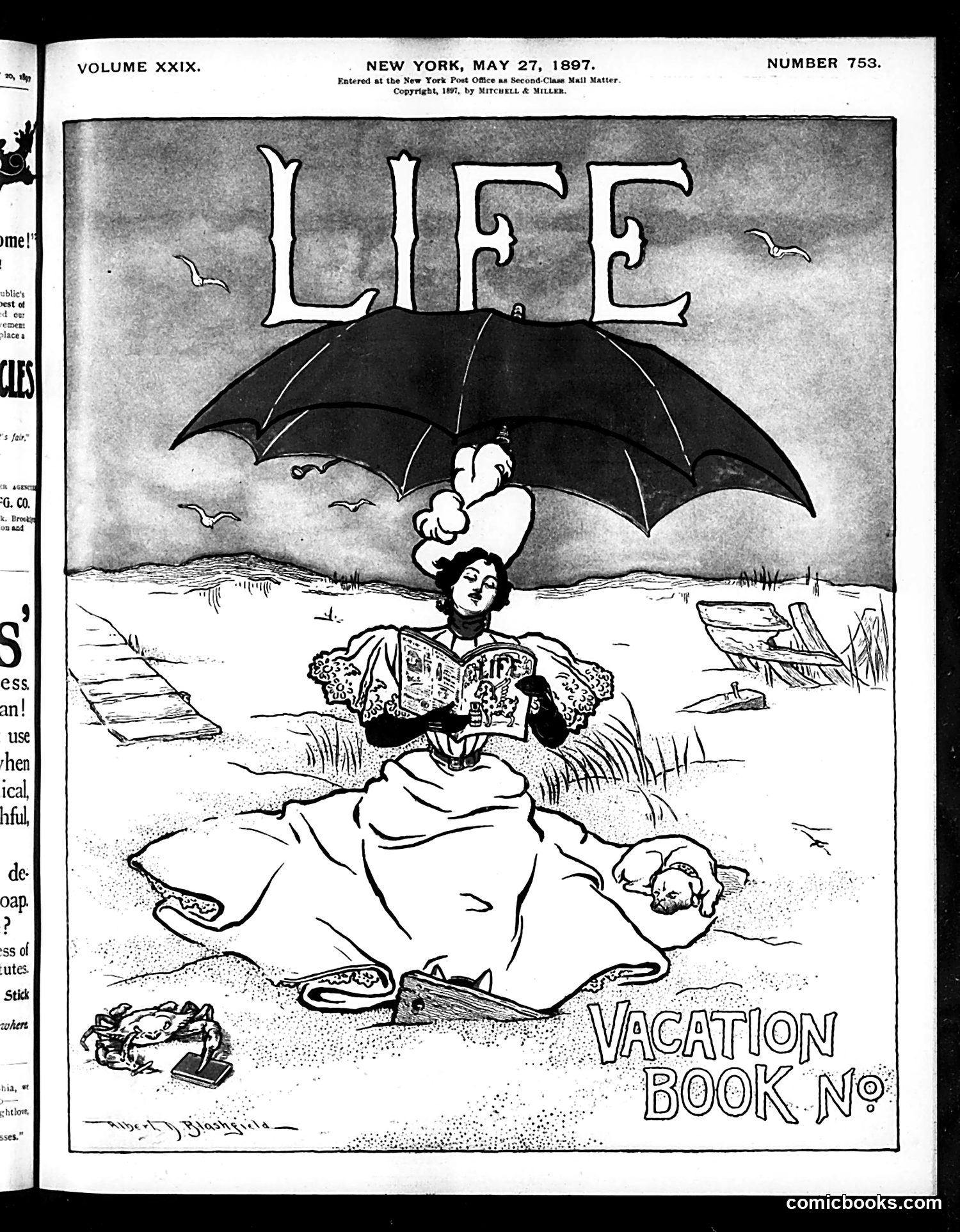
This May 27, 1897 *Life* magazine cover depicts a woman reading outdoors during rainy weather. She sits under a large umbrella in what appears to be a modest beach or seaside setting, surrounded by scattered belongings and a small dog. The satire likely targets vacation aspirations of the era: the woman attempts leisure and relaxation through reading, yet is thwarted by poor weather—rain, wind, and uncomfortable conditions. Her elaborate Victorian dress and fashionable hat seem impractical for the dreary circumstances. The "Vacation Book" title suggests this illustrates the gap between romanticized vacation fantasies promoted in popular media and the often disappointing reality experienced by middle-class Americans seeking seaside getaways in the 1890s.
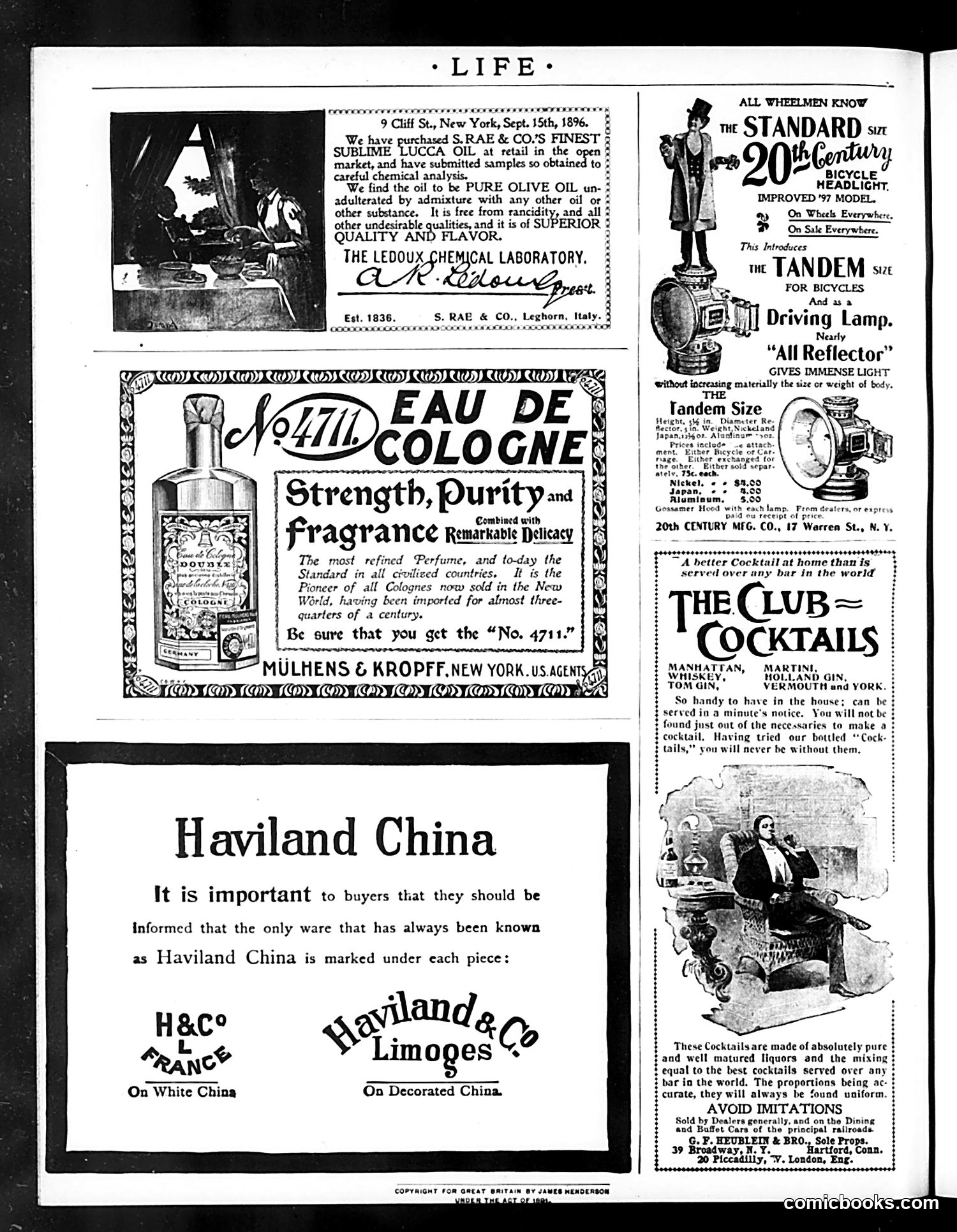
This page is predominantly **advertising** rather than editorial content or satire. The advertisements include: - **Ledoux Chemical Laboratory** promoting pure olive oil - **Eau de Cologne No. 4711** cologne - **Bicycle accessories** (headlights and tandem driving lamps) — reflecting the 1890s bicycle craze - **Haviland China** dinnerware - **Club Cocktails** bottled spirits The small illustration at top-left appears to be a generic scene, possibly related to the olive oil product. The cocktails advertisement includes a period illustration of men socializing. There is **no apparent political cartoon or satire** on this page. It represents typical late-19th-century Life magazine advertising aimed at affluent readers.
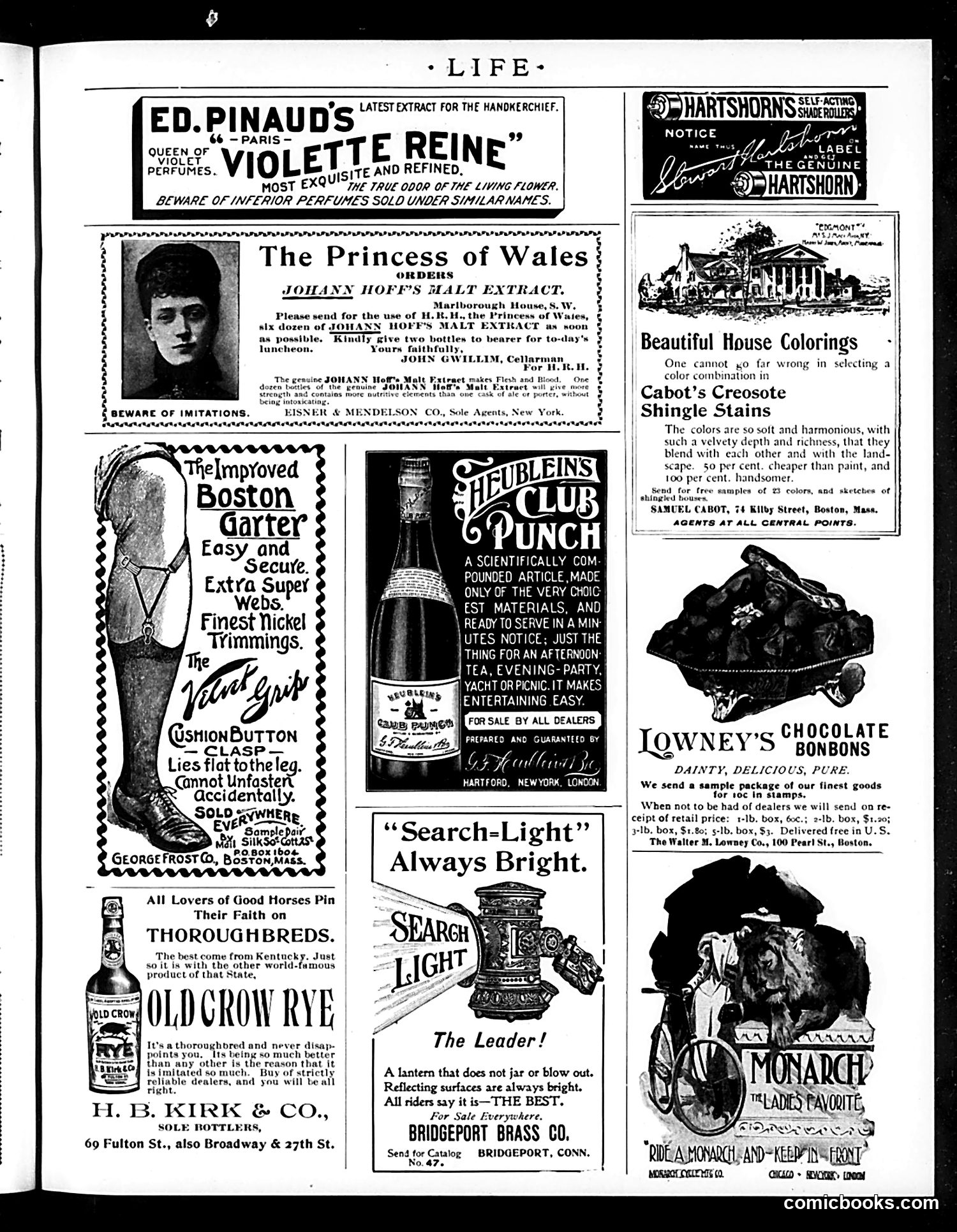
This page is **primarily advertising** with no political cartoons or satirical commentary visible. The advertisements showcase early 20th-century consumer goods: perfumes (Ed. Pinaud's "Violette Reine"), malt extract (Johann Hoff's, endorsed by the Princess of Wales), garters, punch, chocolates, whiskey, lanterns, and bicycle accessories. One ad references the **Princess of Wales** as an endorser—a common marketing practice of the era, capitalizing on royal prestige to sell products. The "Search-Light" lantern ad includes the phrase "The Leader!" suggesting competitive product positioning rather than political commentary. The "Old Crow Rye" whiskey ad mentions Kentucky thoroughbreds, appealing to upper-class consumers. These are straightforward commercial advertisements typical of Life magazine's revenue model, not satirical content.
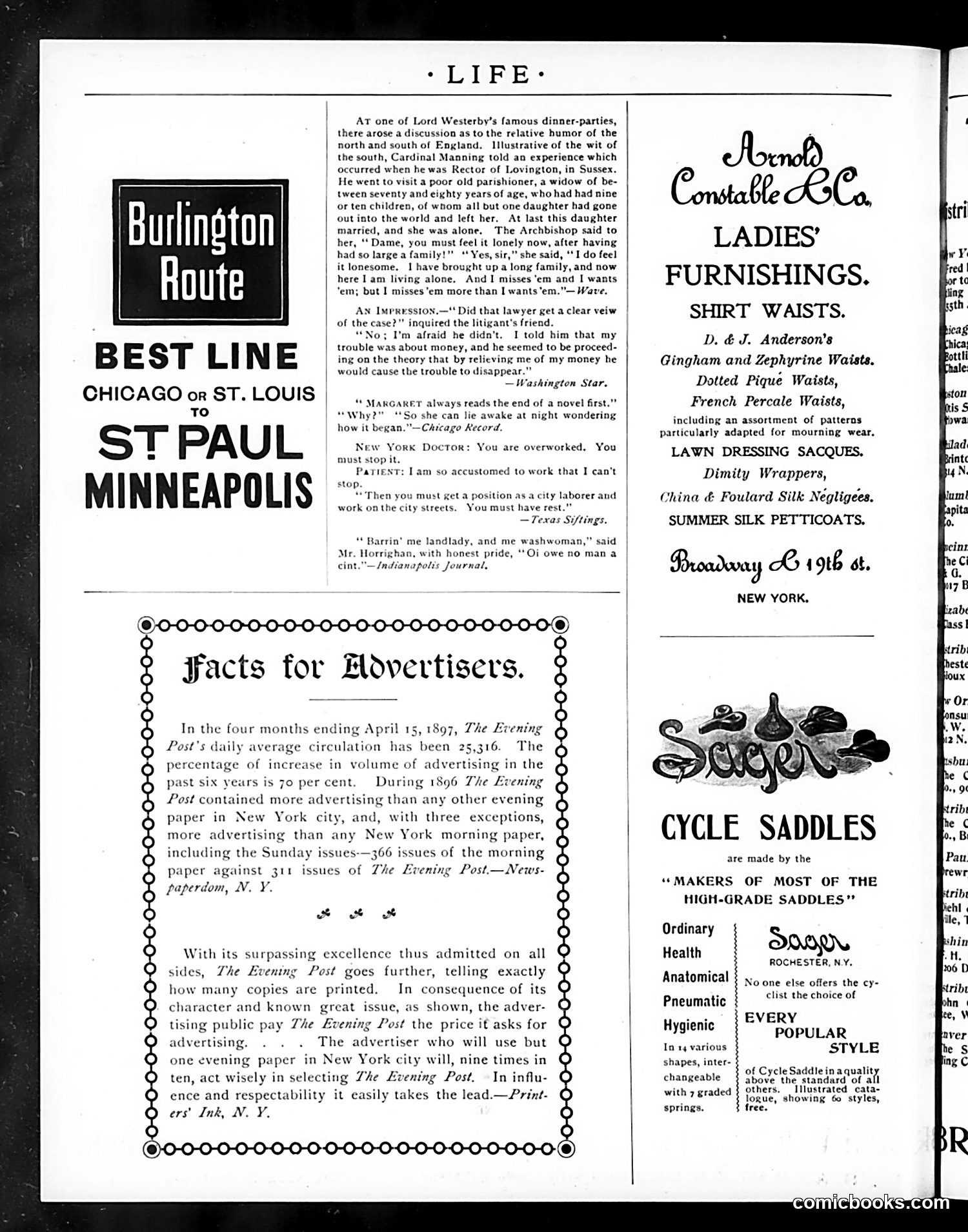
This page is **primarily advertisements** with minimal satirical content. The left side features ads for the Burlington Route railroad and "Facts for Advertisers" promoting *The Evening Post* newspaper's circulation statistics. The right side contains commercial advertisements for Arnold Constable & Co. (ladies' clothing and furnishings) and Sager cycle saddles. There are **no political cartoons** on this page. The only satirical content appears to be brief, untributed anecdotes in the top-left section—humorous stories about English regional differences and various one-liners about work and marriage. These appear to be filler content typical of *Life* magazine's satirical approach, but lack sufficient context to determine specific references or figures. This is a standard mixed advertising/editorial page from late 19th-century *Life*.
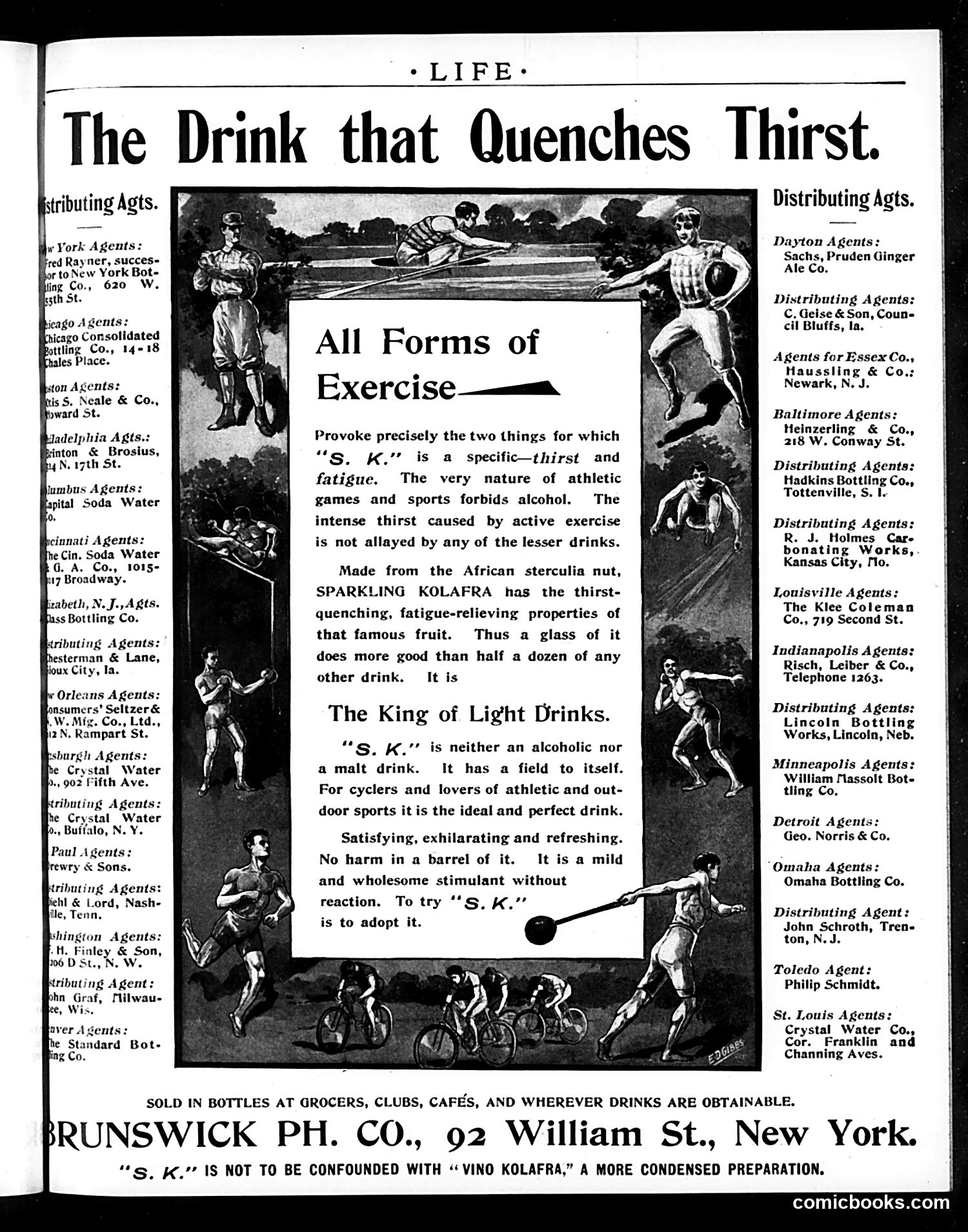
This is primarily a **commercial advertisement**, not political satire. It promotes "Sparkling Kolafra," a beverage made from African sterculia nuts, positioned as an ideal drink for athletes and active people. The page features illustrated athletes engaged in various sports (cycling, rowing, running, baseball) to emphasize that Kolafra quenches thirst and relieves fatigue without alcohol—marketed as superior to "lesser drinks." The ad claims it's "The King of Light Drinks." The extensive list of distributing agents across major American cities (New York, Chicago, Philadelphia, etc.) indicates this was a nationally marketed product. There is **no political satire or commentary** present. This is straightforward early 20th-century product advertising using athletic imagery to appeal to health-conscious consumers.
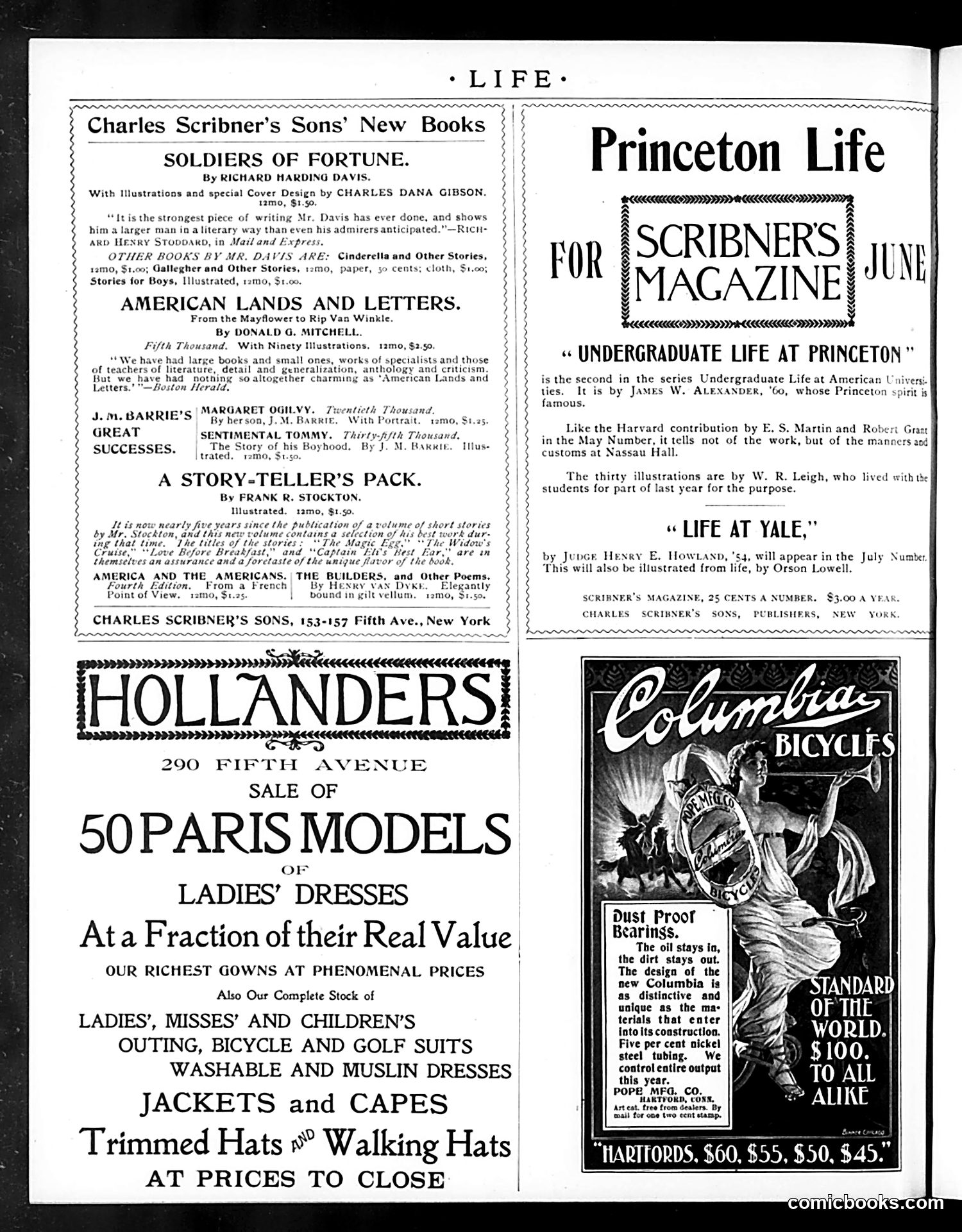
This page is **primarily advertising**, not satirical content. It contains several advertisements from the early 1900s: 1. **Charles Scribner's Sons** promotes new books and *Scribner's Magazine*, featuring articles on "Undergraduate Life at Princeton" and "Life at Yale" 2. **Hollanders** (290 Fifth Avenue) advertises a clearance sale of 50 Paris models of ladies' dresses at reduced prices, plus related clothing items 3. **Columbia Bicycles** features an allegorical female figure (Liberty or Columbia) promoting their bicycles as "Standard of the World" at $100 The content reflects early 20th-century consumer culture—publishing, fashion, and manufacturing. There is **no political cartoon or satire evident** on this page; it's a commercial compilation typical of *Life* magazine's advertising sections.
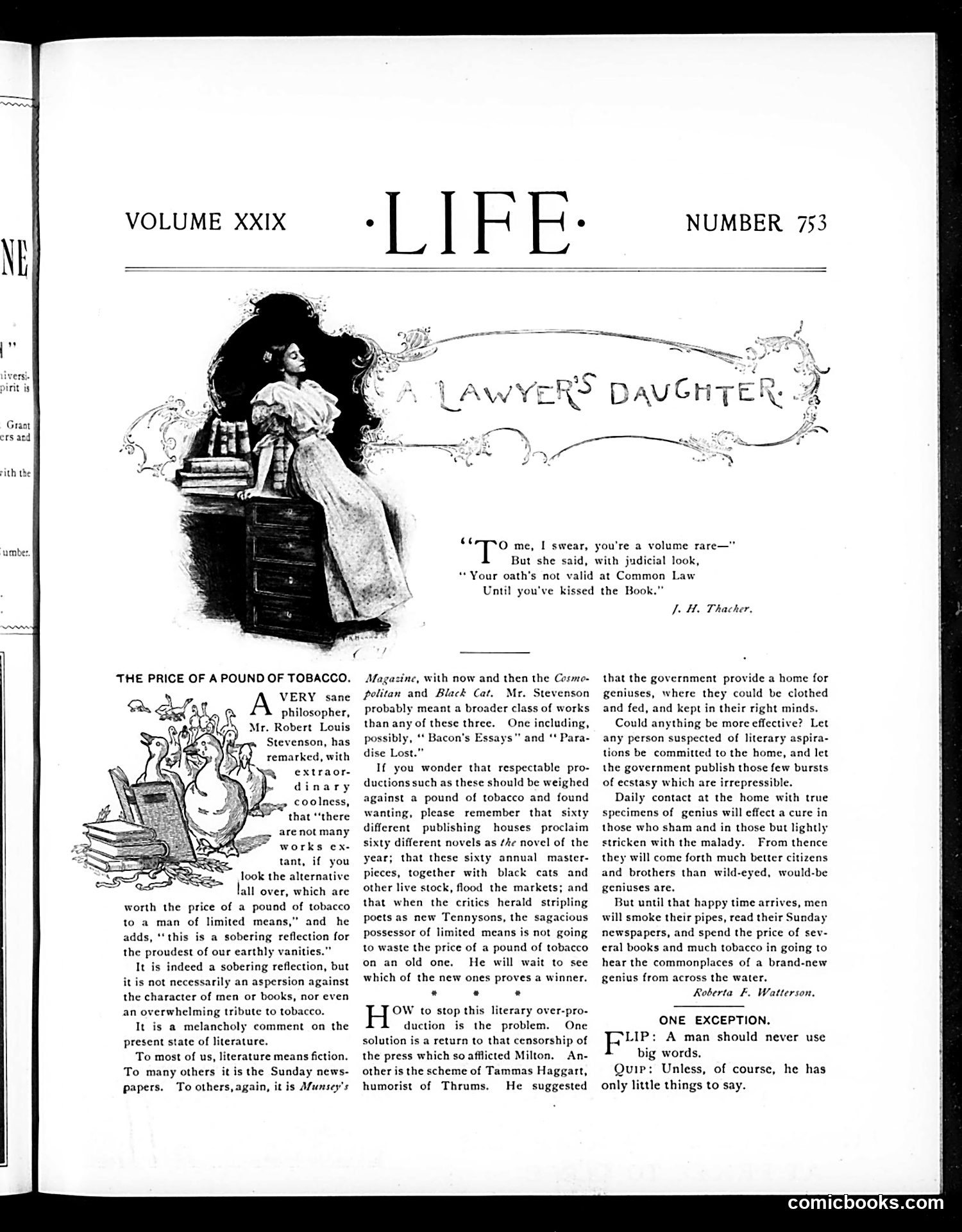
This page features a satirical article titled "The Price of a Pound of Tobacco" by Robert Louis Stevenson commentary. The main cartoon depicts a woman at a desk—"A Lawyer's Daughter"—with an accompanying literary quote suggesting she's testing a suitor's worthiness. The article critiques literary overproduction in the publishing industry, arguing that too many books flood markets annually. Stevenson is quoted comparing the value proposition: respectable literature shouldn't be judged "against a pound of tobacco" for men of limited means. The satire attacks both excessive publishing and the suggestion that serious literature competes unfavorably with everyday commodities for working-class audiences' attention and money.
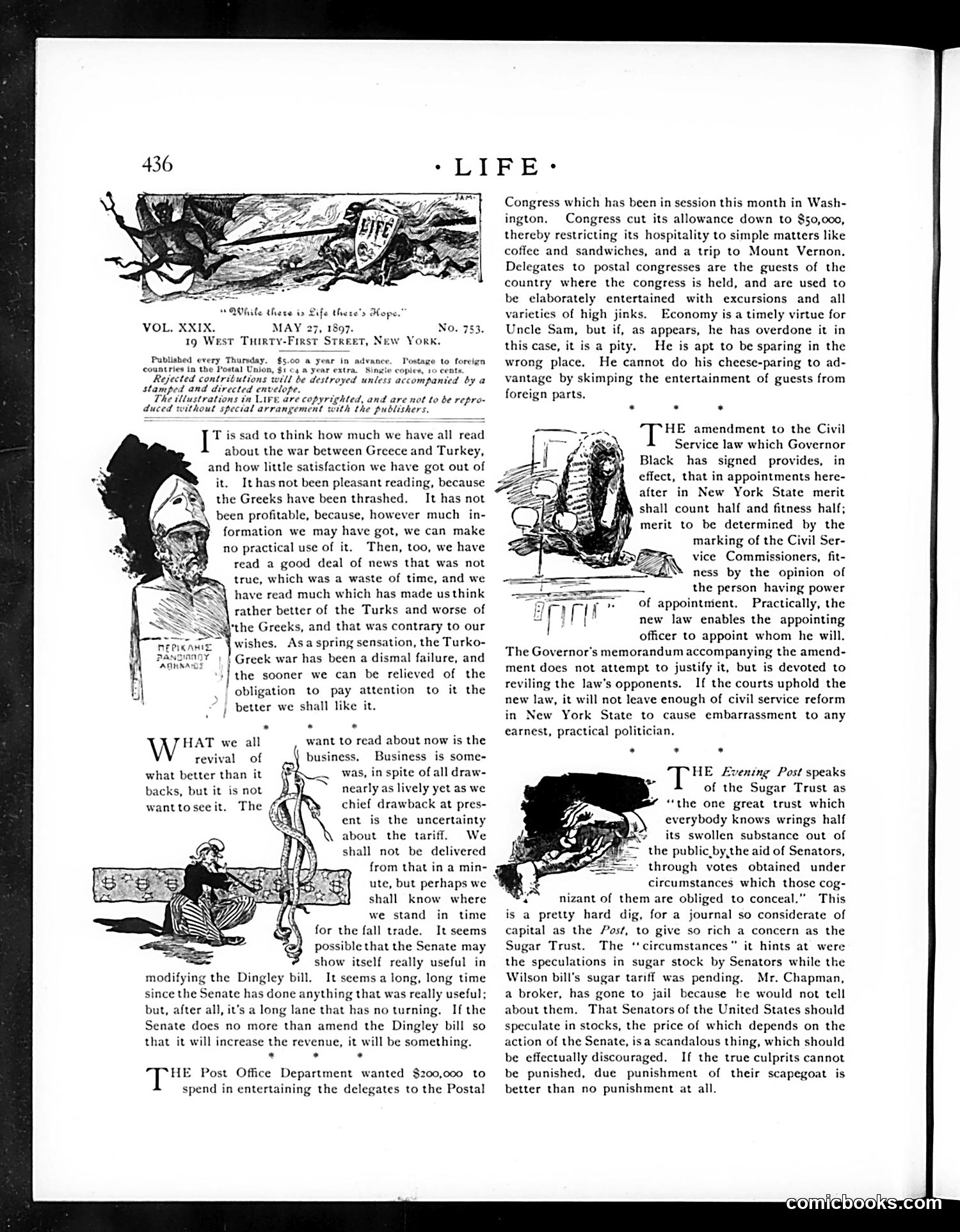
This page contains three separate editorial commentaries with accompanying illustrations: 1. **Greece-Turkey War**: The opening article discusses recent news coverage of the Greco-Turkish conflict, criticizing sensationalism while acknowledging public interest. 2. **Business Revival & Tariff Reform**: An illustration shows a figure (likely representing business or the economy) entangled with a caduceus (symbol of commerce). The text argues the Senate should pass the Dingley tariff bill to increase revenue and support trade. 3. **Post Office Extravagance & Sugar Trust Scandal**: Critiques the Post Office Department's $300,000 budget for entertaining postal delegates as wasteful. The *Evening Post* is cited regarding corruption in the Sugar Trust, where senators allegedly speculated in sugar stocks during tariff negotiations—a "scandalous" abuse of power. The page reflects late-1890s concerns: protectionist economics, government waste, and senatorial corruption.
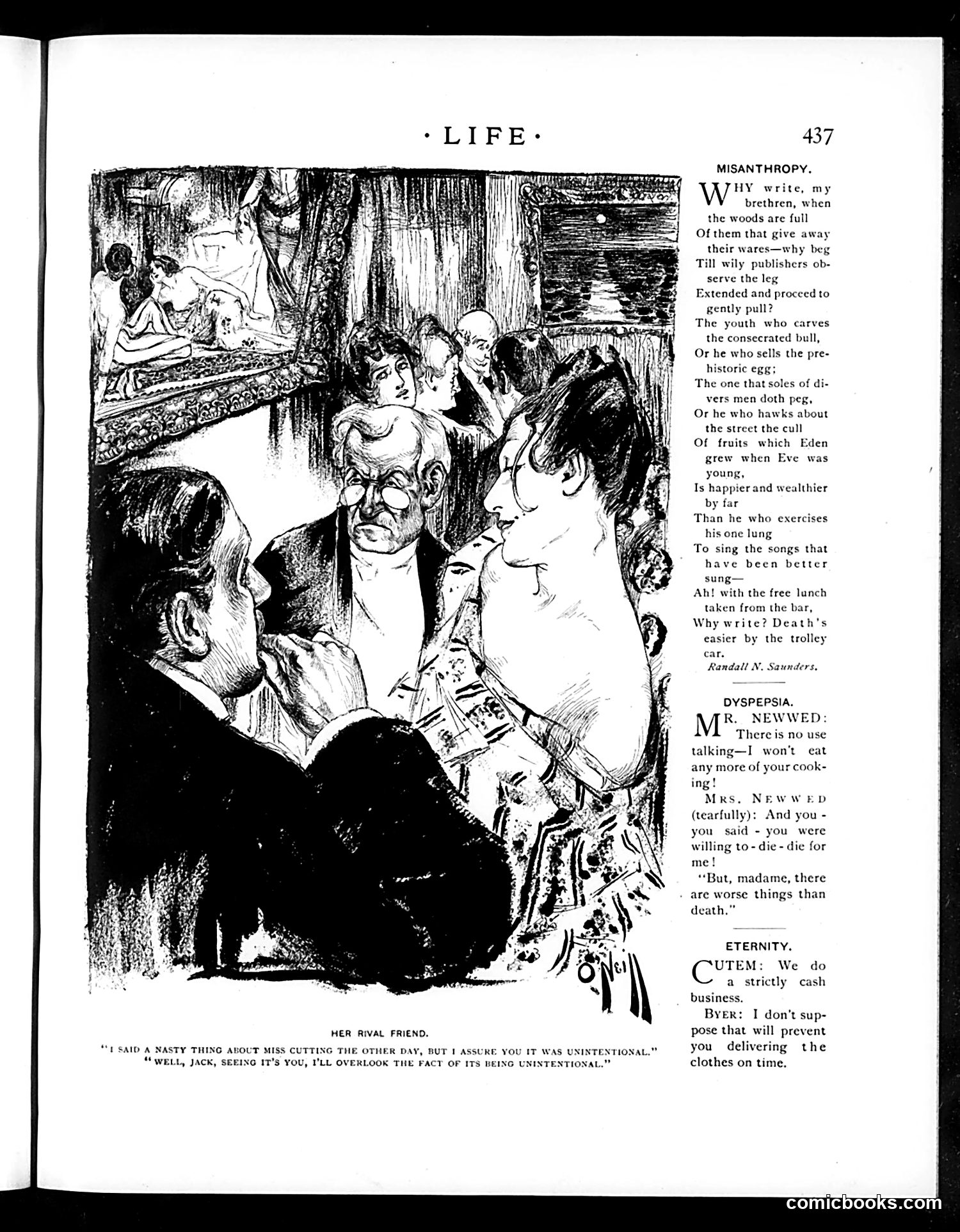
This page contains three separate satirical pieces: **"Her Rival Friend"** (main illustration): Shows a social scene where a woman confronts another about cutting her, with the caption suggesting the slight was "unintentional." The satire mocks insincere social apologies—pretending rudeness was accidental when it clearly wasn't. **"Misanthropy"** (poem by Randall N. Saunders): Cynical verses about human misery and degradation, contrasting those who sell themselves with those who sing for free. It suggests death is preferable to life's indignities. **"Dyspepsia" and "Eternity"** (brief dialogues): Quick satirical exchanges—one about a wife refusing to cook anymore, the other about a tailor's strictly cash business. The page reflects early 20th-century *Life* magazine's humor: social pretense, domestic discord, and class commentary through sharp, brief scenarios.
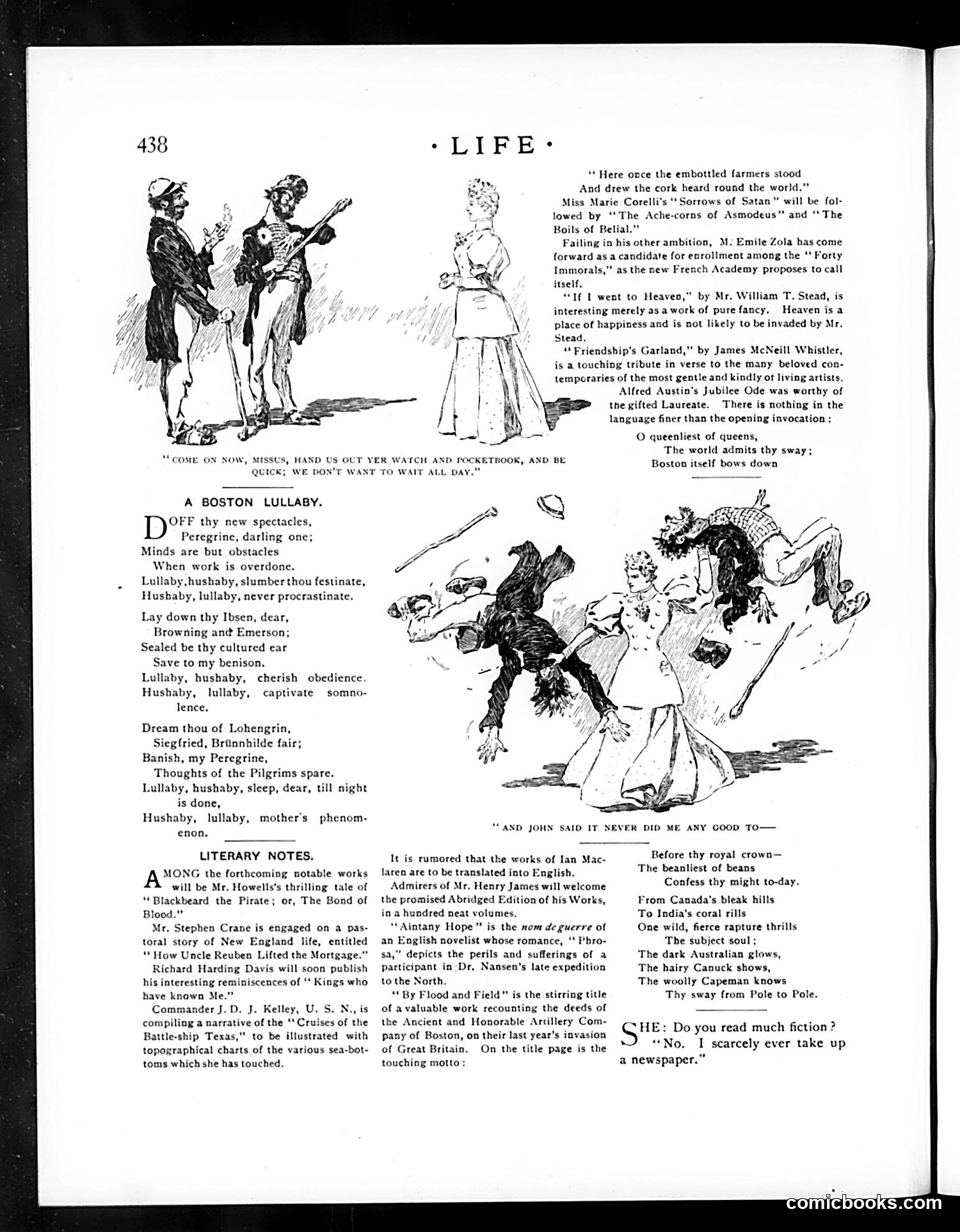
This page contains literary commentary and two unrelated illustrations rather than political cartoons. **Top illustration**: Two men in period dress appear to be from a literary work, with a quoted caption about a woman being asked to produce a watch and pocketbook—likely illustrating a scene from discussed fiction. **Bottom illustration**: Shows a woman in Victorian dress being attacked or knocked down by a black dog or similar animal, captioned "AND JOHN SAID IT NEVER DID ME ANY GOOD TO—," suggesting domestic comedy about a wife's misadventure. **Literary Notes section**: Discusses forthcoming publications including works by Howells, Crane, and Harding, plus an "Aintany Hope" novel. The final dialogue joke presents a woman claiming she never reads newspapers—typical period humor about feminine disinterest in current events. The page is primarily book criticism, not political satire.
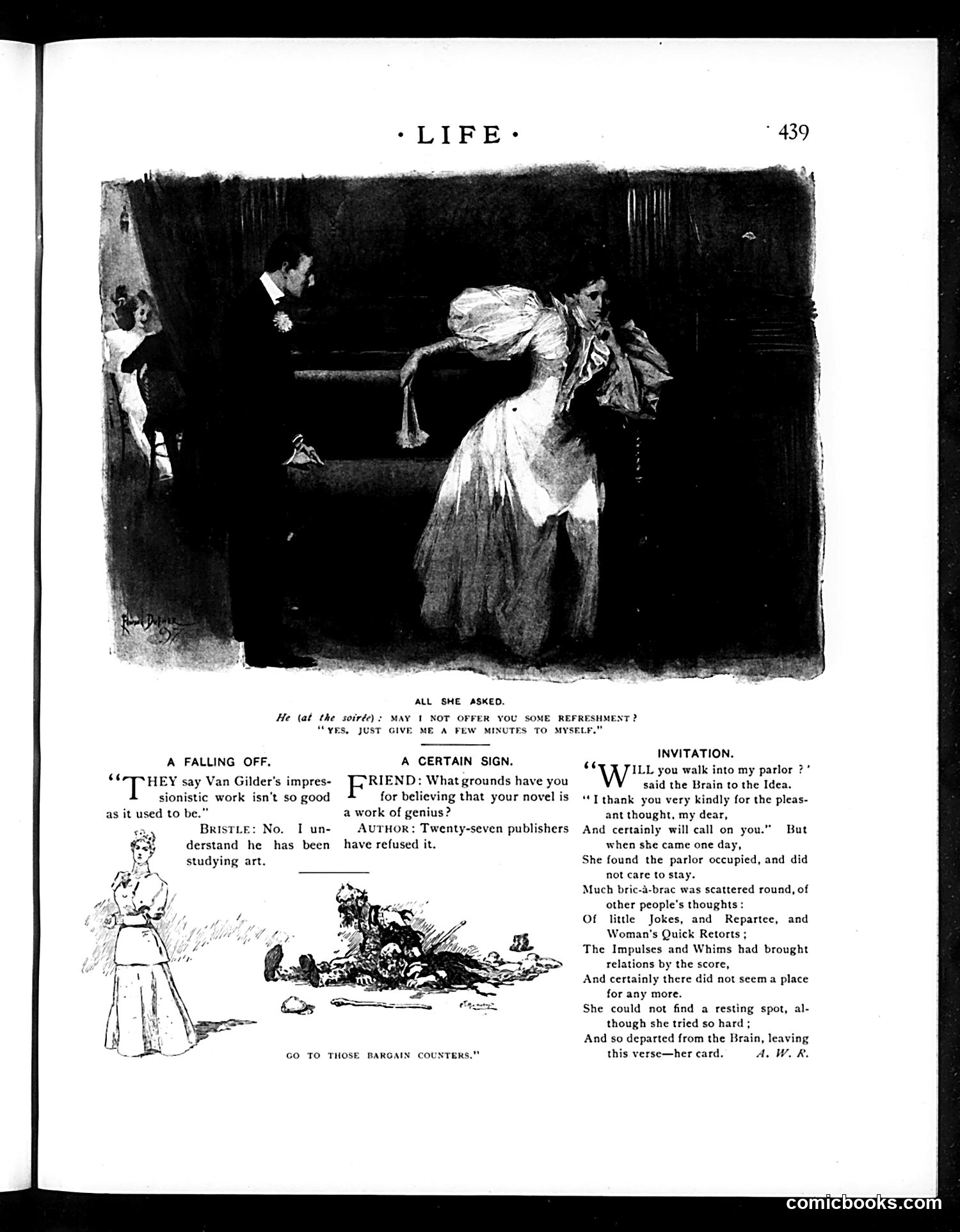
This page contains three separate satirical pieces lampooning literary pretension and social affectation: **"A Falling Off"** mocks Van Gilder's (likely a contemporary artist or critic) claimed mastery of impressionism, suggesting his work has declined in quality. **"A Certain Sign"** jokes that twenty-seven publishers rejecting a novel proves it's a work of genius—satirizing the contrarian belief that critical rejection validates artistic merit. **"Invitation"** depicts a woman reluctantly visiting an intellectually pretentious parlor where conversation centers on obscure literary references ("Impulses and Whims," "Woman's Quick Retorts"). Finding no comfortable place in this affected environment, she leaves her calling card and departs—a commentary on the exhausting artificiality of fashionable literary society. The page mocks both artistic self-delusion and social pretense among the educated classes.
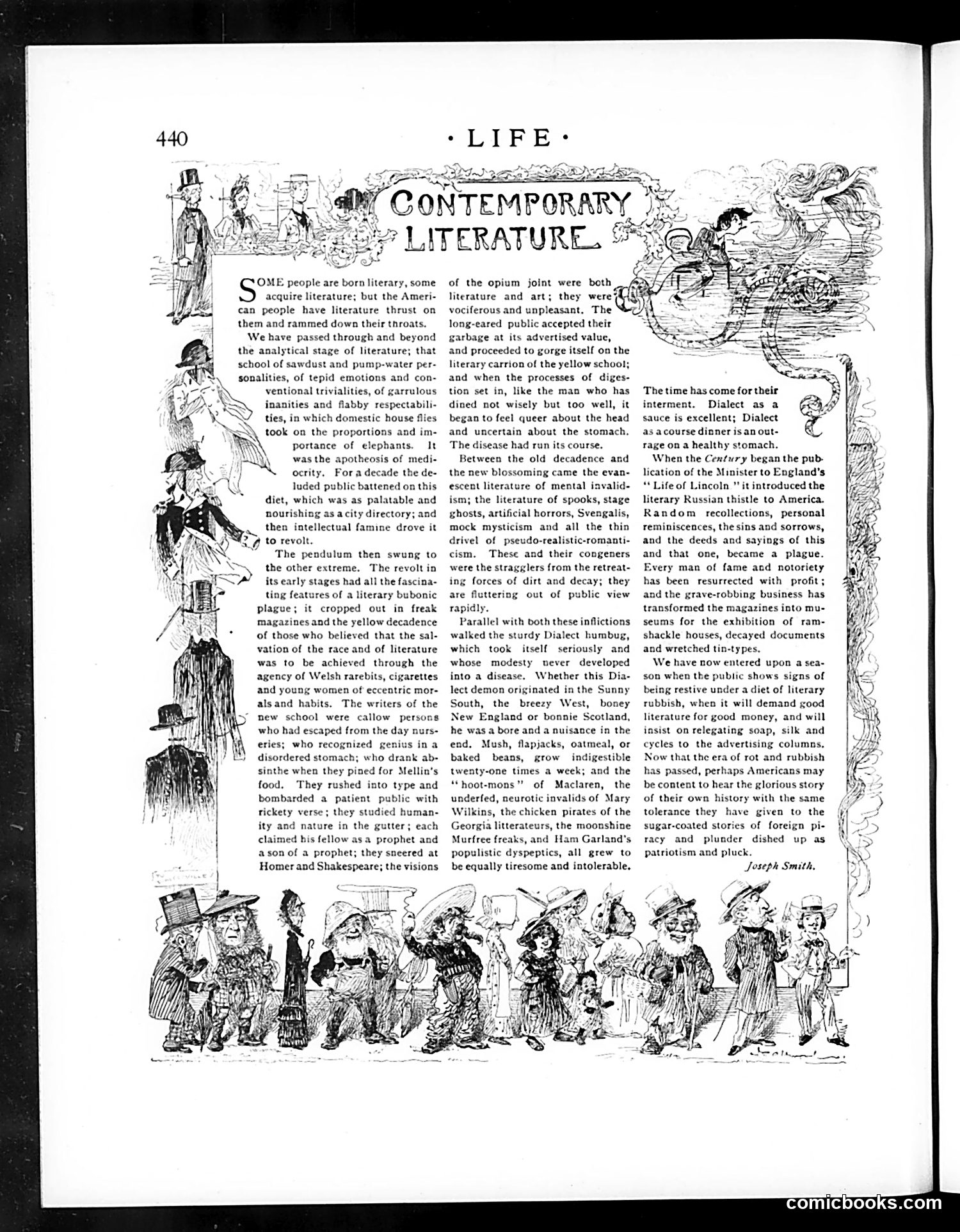
This page satirizes low-quality popular literature of the era. The article criticizes writers who produced sensationalist fiction—"pseudo-realistic-romanticism," stage ghosts, artificial horrors, and Dialect stories—targeting mass audiences rather than literary merit. The left margin illustrations show various crude character types (appears to include ethnic caricatures common to period satire). The bottom illustration depicts a motley parade of literary characters and authors, likely representing the parade of mediocre personalities populating popular magazines. The article names specific targets: "Dialect humbug," stories of "Mush, flap-jacks, oatmeal," and references Mary Wilkins, Georgia literature, and Ham Garland—suggesting regional/folk literature was considered particularly offending to literary taste. The overall message: American mass-market literature had become intellectually degraded and commercially driven rather than artistically serious.
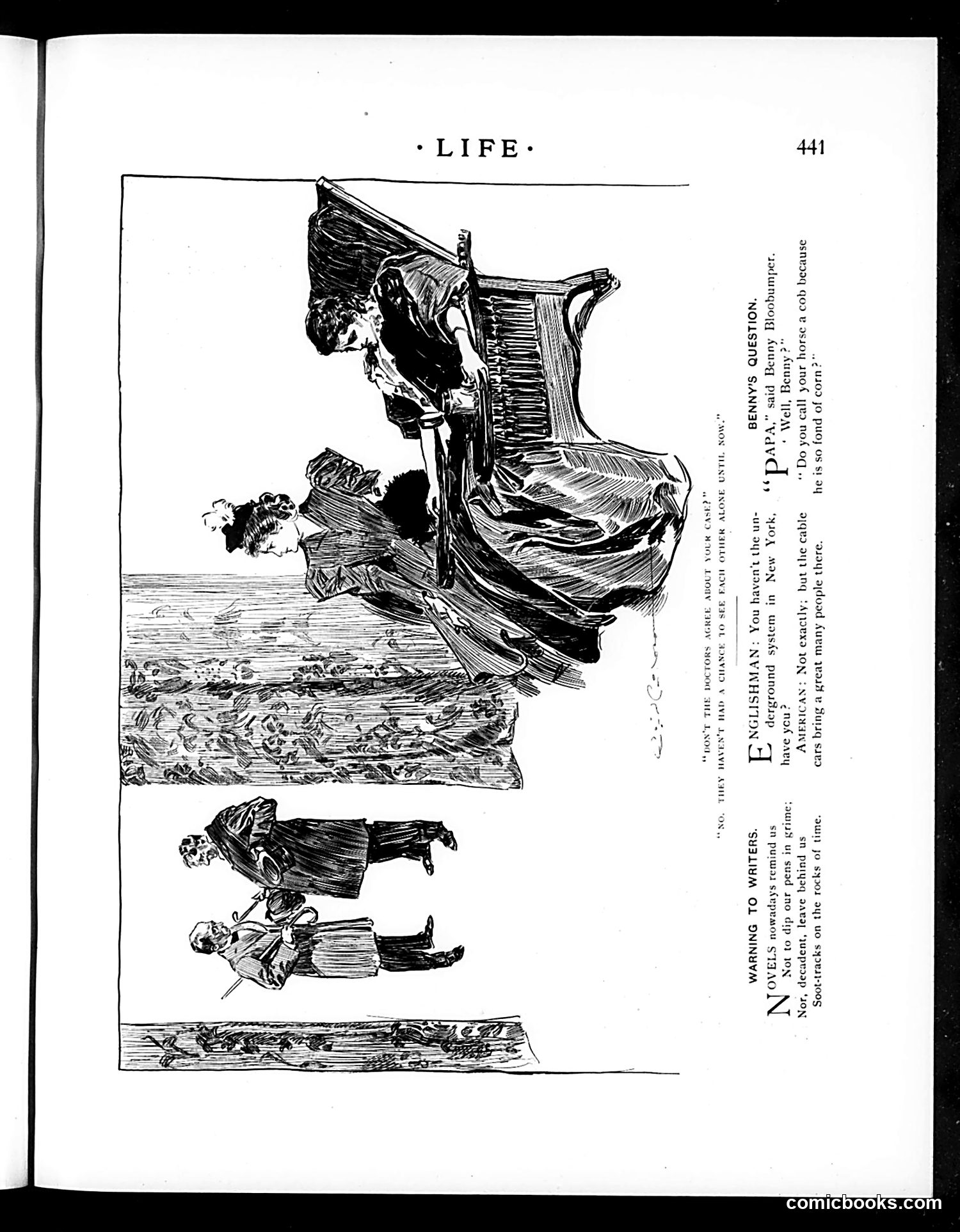
This page features a satirical cartoon titled "Benny's Question" with accompanying text "Warning to Writers." The illustration shows a domestic scene where a woman reclines on a chair while a man stands nearby, and below are two smaller figures (likely servants or children). The cartoon appears to satirize social pretension or marital dynamics of the era. The "Warning to Writers" section critiques societal attitudes, specifically addressing how people discuss uncomfortable truths. The text references concerns about "great many people" and "Socialism" being discussed openly, suggesting the cartoon mocks either bourgeois hypocrisy or anxieties about radical political ideas gaining traction. The exact OCR text is largely corrupted and illegible, making precise interpretation difficult. However, the visual composition—showing class distinctions through figure positioning and domestic setting—suggests commentary on either marriage, class consciousness, or social propriety during what appears to be the early 20th century. Without clearer text, the specific satirical target remains unclear, though it likely reflects period anxieties about social change.
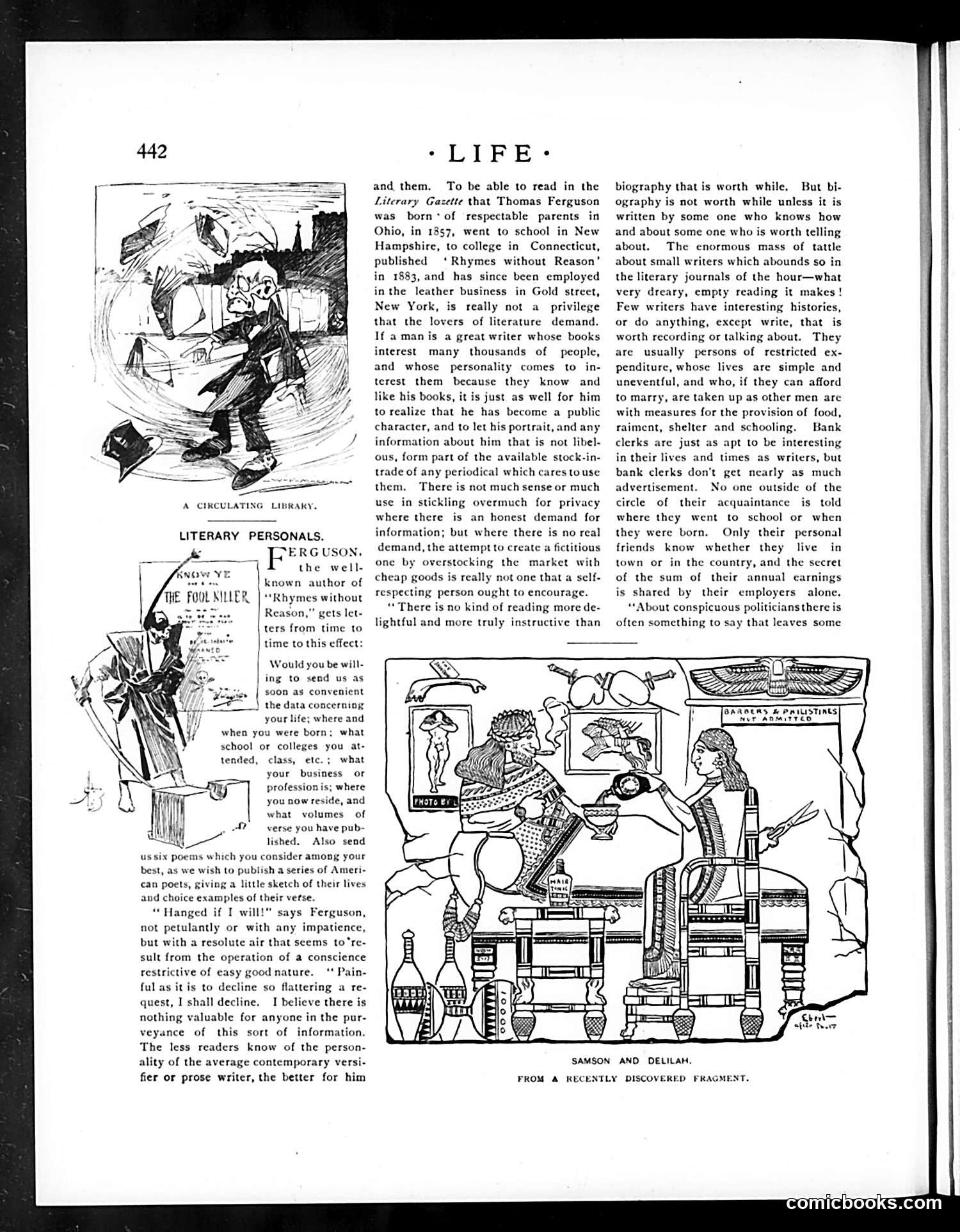
This page presents two distinct pieces of satirical content: **"Literary Personals"** (main text): Author Ferguson refuses to submit biographical data to magazines seeking writer profiles. The satire mocks the era's obsession with publishing trivial "life data" about minor literary figures. Ferguson argues that biography is only worthwhile when the subject is genuinely significant; most writers lead unremarkable lives no more interesting than bank clerks. The piece ridicules magazines for manufacturing demand for celebrity gossip by flooding the market with cheap biographical content about unimportant authors. **"Samson and Delilah"** (bottom illustration): A crude, humorous sketch depicting the biblical scene with grotesque, exaggerated figures. The caption credits it as "from a recently discovered fragment," a joke implying this is some ancient artistic rediscovery—clearly absurd given the cartoonish style. This appears to mock pretentious art scholarship or biblical commentary of the era. Both pieces share satirical targets: intellectual pretension and the media's pursuit of trivial information.
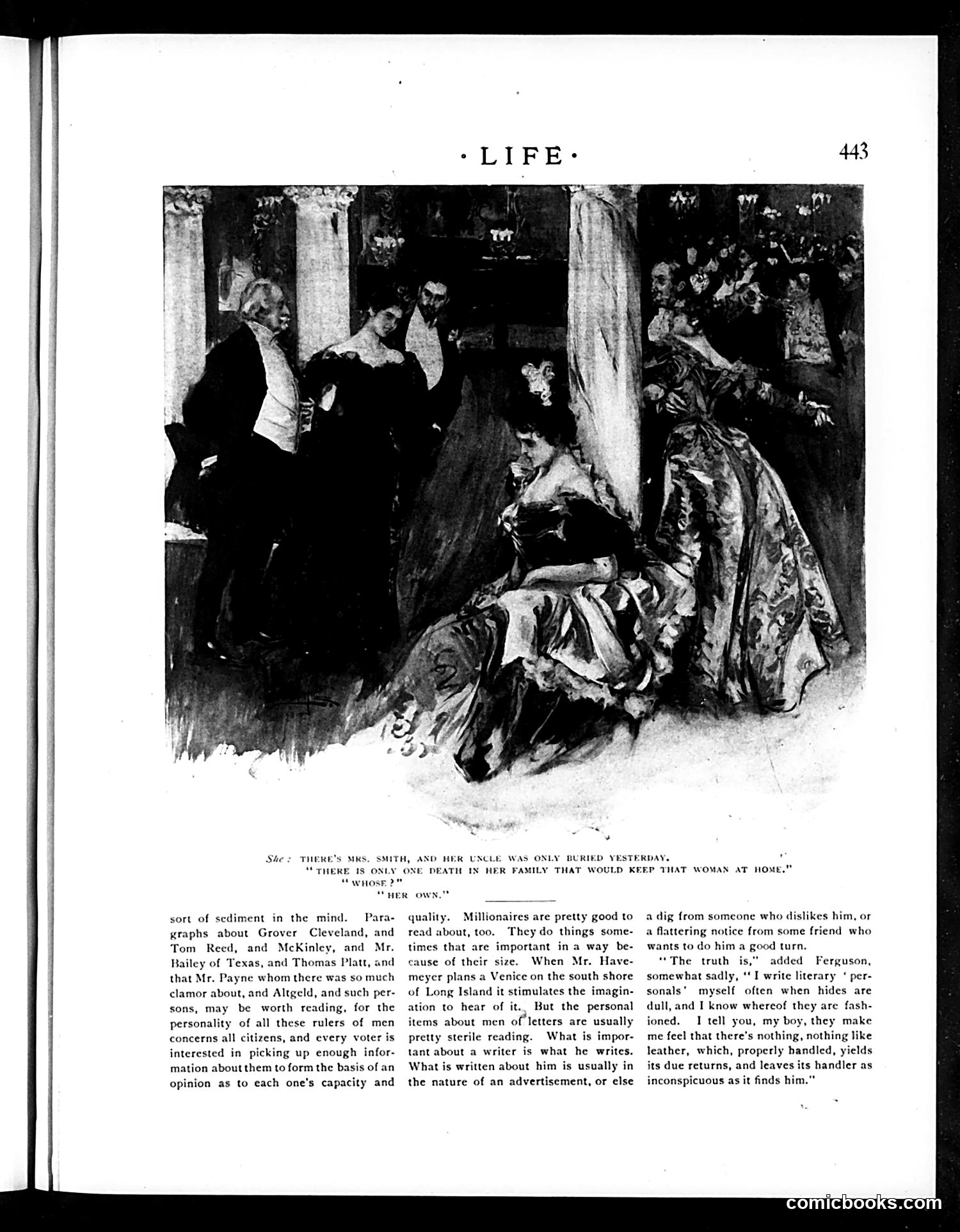
This page combines an illustration with a literary discussion about biographical writing. The image depicts a funeral scene—a woman in elaborate dress seated while mourners gather around her, with the caption noting "There's Mrs. Smith, and her uncle was only buried yesterday" and commenting that only death in the family would keep such a woman at home. The text discusses what's worth reading about public figures. It argues that biographical details about politicians (naming Cleveland, McKinley, and others) matter because voters need to understand leaders' capacities. However, it dismisses "personal items" about writers as "sterile reading"—essentially gossip masquerading as journalism. A character named Ferguson defends writing such pieces cynically, comparing the work to leather-handling: profitable but ultimately unremarkable. The satire targets the superficiality of celebrity gossip columns and the hollowness of biographical puffery in magazines.
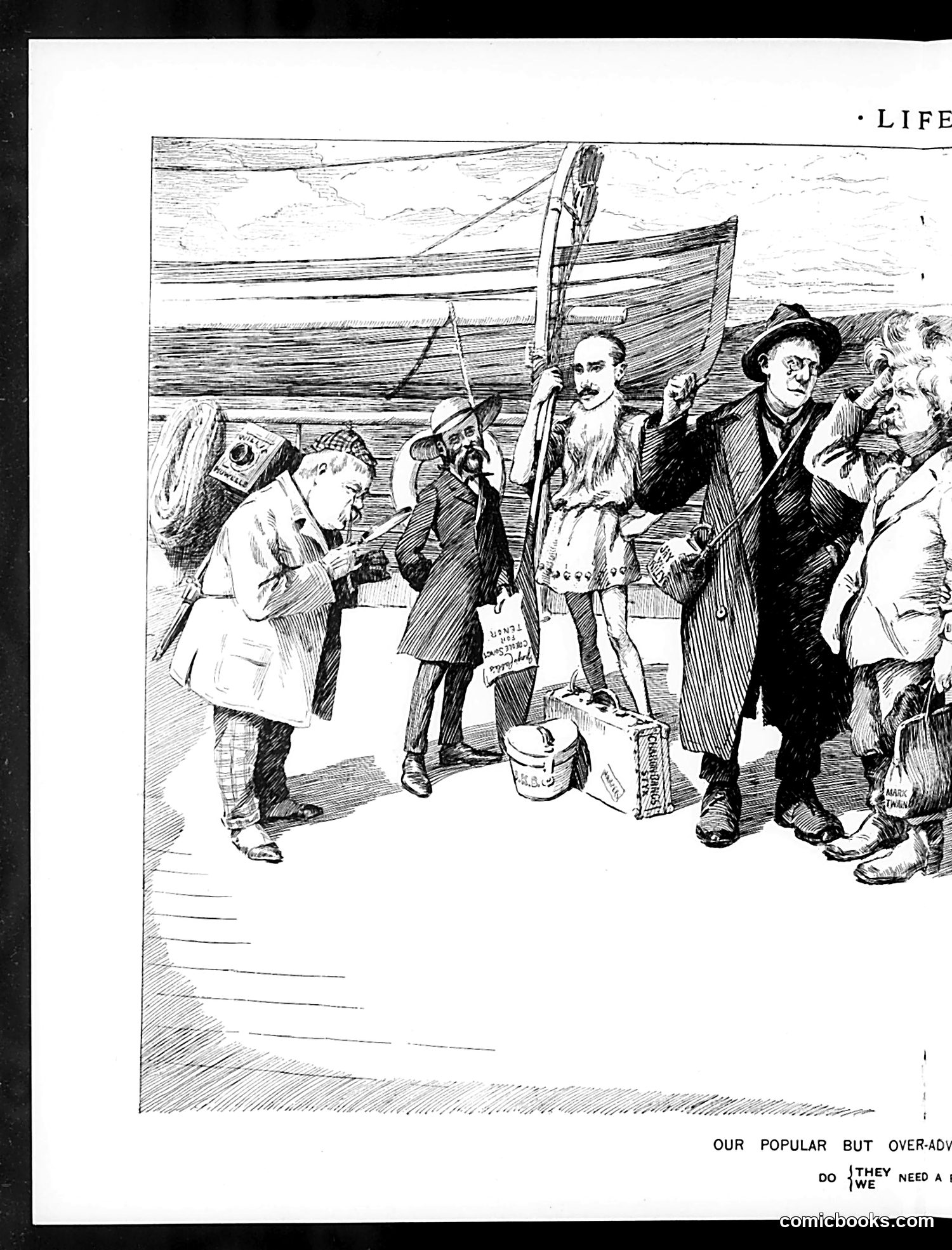
This appears to be a satirical cartoon from *Life* magazine depicting immigrants or laborers at what looks like a dock or port. The partially visible caption at the bottom reads "OUR POPULAR BUT OVER-ADV..." and references something about whether "THEY" need a particular thing (text is cut off). The cartoon shows several men in period clothing gathered around cargo and supplies, with boats visible in the background. The style and setting suggest this addresses immigration policy or labor issues, likely critiquing either excessive promotion of immigration or concerns about immigrant workers. Without the complete caption text visible, I cannot definitively identify the specific political debate or figures being referenced, though the composition suggests commentary on either immigration promotion or labor concerns of the era.
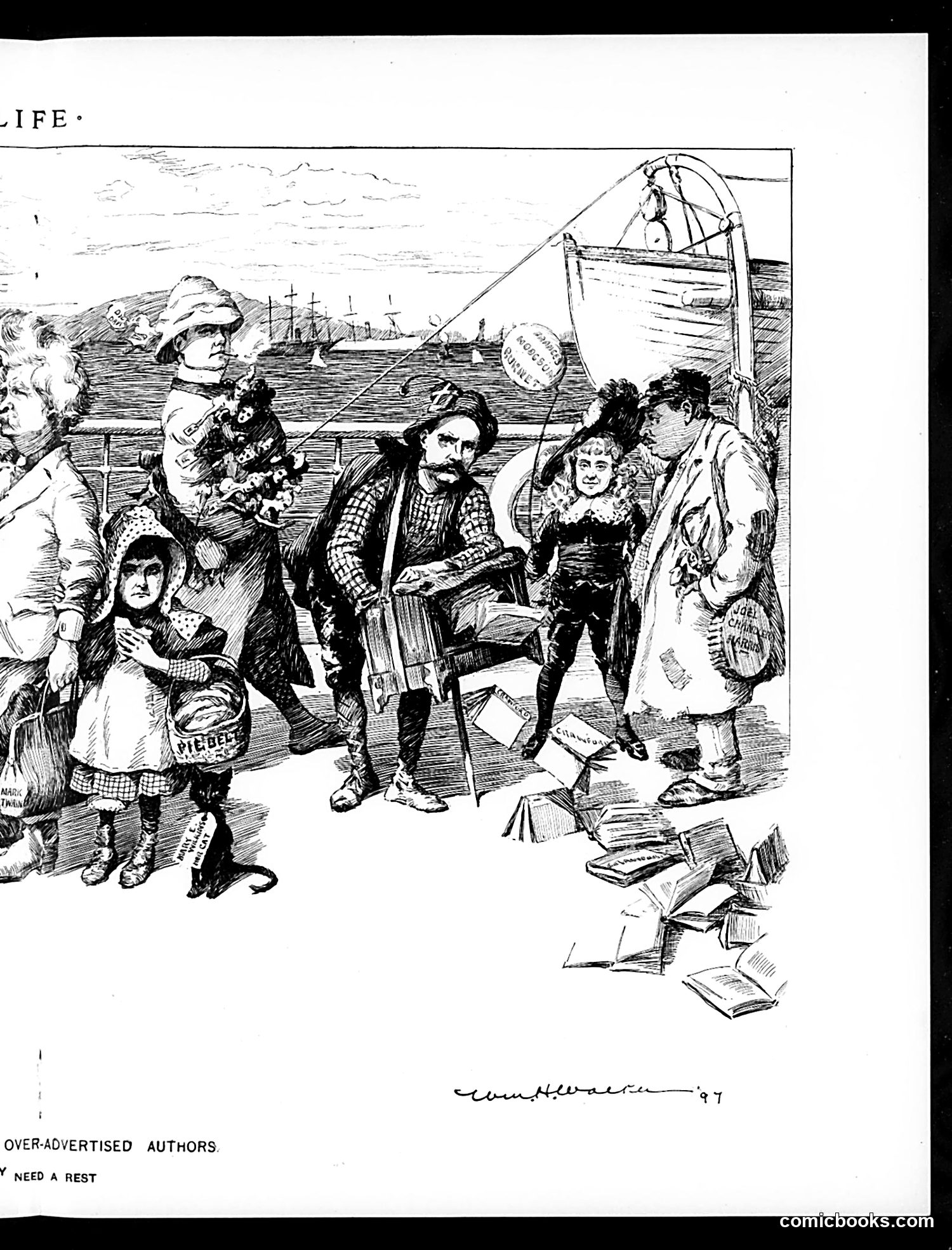
This satirical cartoon depicts a disheveled male author surrounded by various people at what appears to be a dock or waterfront. The scattered books and papers at his feet suggest literary output. The caption "Over-Advertised Authors / Need a Rest" indicates the cartoon critiques authors who have been heavily promoted through advertising. The crowded scene—with children, well-dressed figures, and various onlookers—suggests the overwhelming attention and demands placed on popular writers. The author's exhausted appearance contrasts with the bustling activity around him, satirizing how commercial promotion and public attention can exhaust creative figures. The cartoon likely comments on the publishing industry's aggressive marketing practices and their toll on writers during this period.
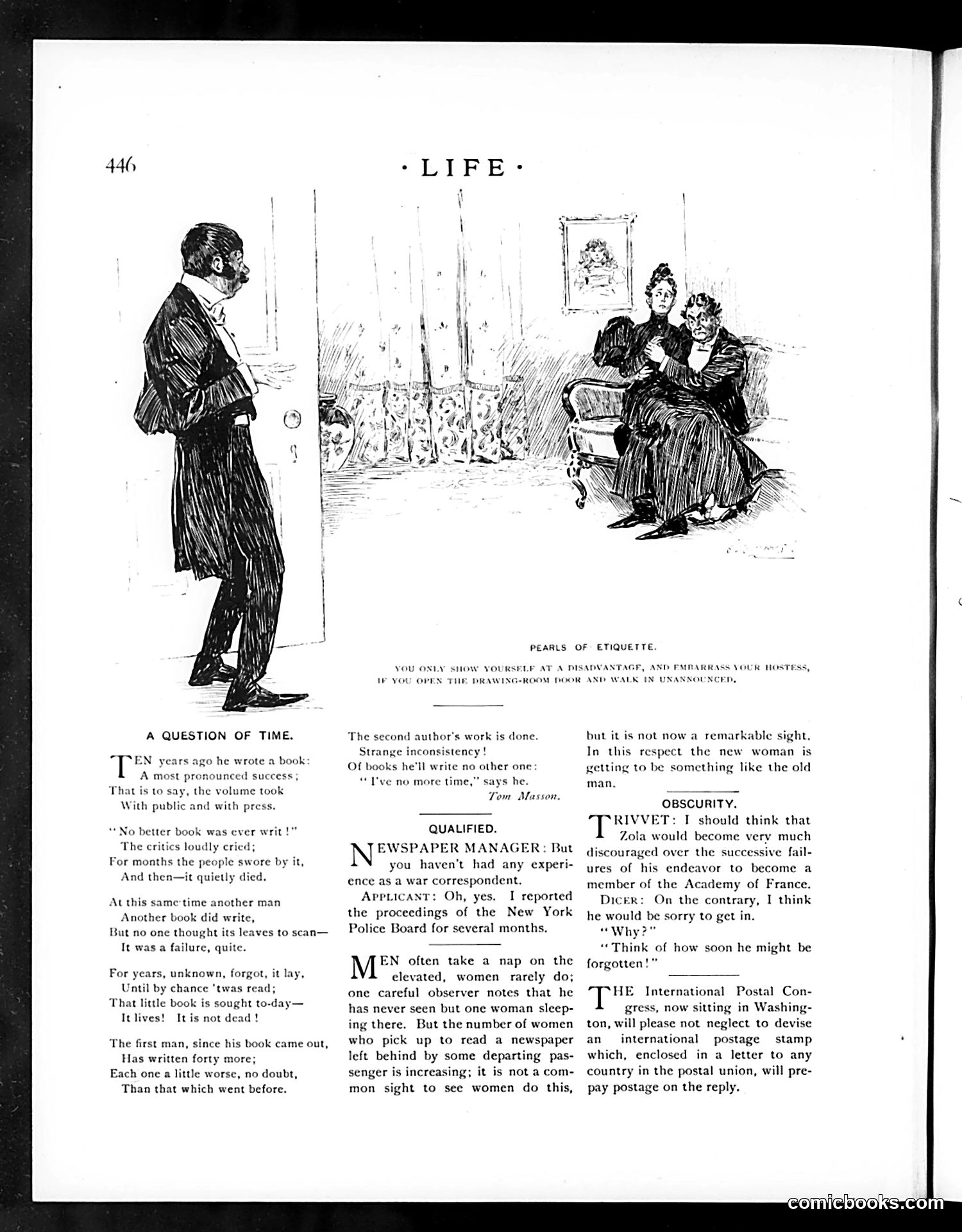
This page contains several satirical vignettes about literary success, social etiquette, and contemporary figures. **"A Question of Time"** contrasts two authors: one whose acclaimed debut was followed by forty increasingly mediocre books, versus another whose initially ignored work eventually achieved lasting success. The satire mocks prolific but declining writers versus those who wisely stop while ahead. **"Pearls of Etiquette"** warns against entering a drawing room unannounced—a jab at social pretension and proper Victorian conduct. **"Qualified"** jokes that reporting on the New York Police Board qualifies someone as a war correspondent—mocking the absurdity of credential inflation. **"Obscurity"** references the French author Émile Zola's repeated failures to join the Academy of France, suggesting that obscurity might actually benefit his legacy by preventing people from forgetting him. The remaining snippets comment on gender observations (women reading newspapers on trains) and propose an international postage stamp. The page exemplifies *Life*'s satirical approach to contemporary literary, social, and bureaucratic pretensions.
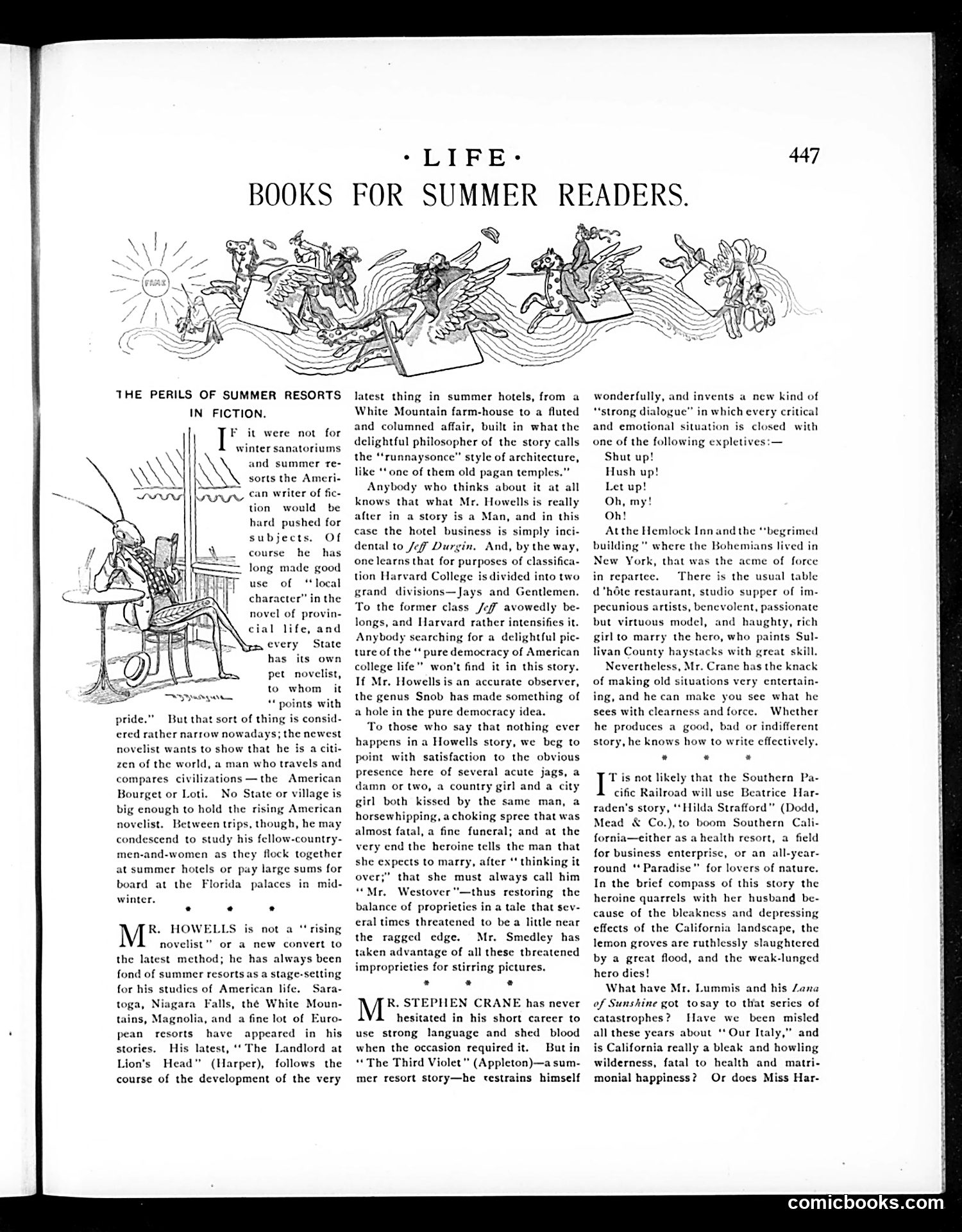
This page reviews summer resort fiction—a popular literary genre. The satirical commentary mocks American novelists who use summer hotels as convenient settings to study "local character" and demonstrate cosmopolitan sophistication. The article discusses three authors: 1. **William Dean Howells** ("The Landlord at Lion's Head"): Praised for accurately depicting American life, though his "pure democracy of college life" reveals snobbishness exists even at Harvard. The review notes he includes dramatic elements (profanity, romance, violence) to enliven his typically quiet narratives. 2. **Stephen Crane** ("The Third Violet"): Criticized for restraint—his "strong dialogue" consists merely of repetitive phrases like "Shut up!" rather than genuine force. The review mocks his Bohemian artist characters and their predictable romantic entanglements. The accompanying illustrations show winged figures carrying manuscript pages, satirizing how writers treat resort settings as literary factories. The piece playfully suggests summer resorts function as convenient fictional laboratories for American authors seeking material.
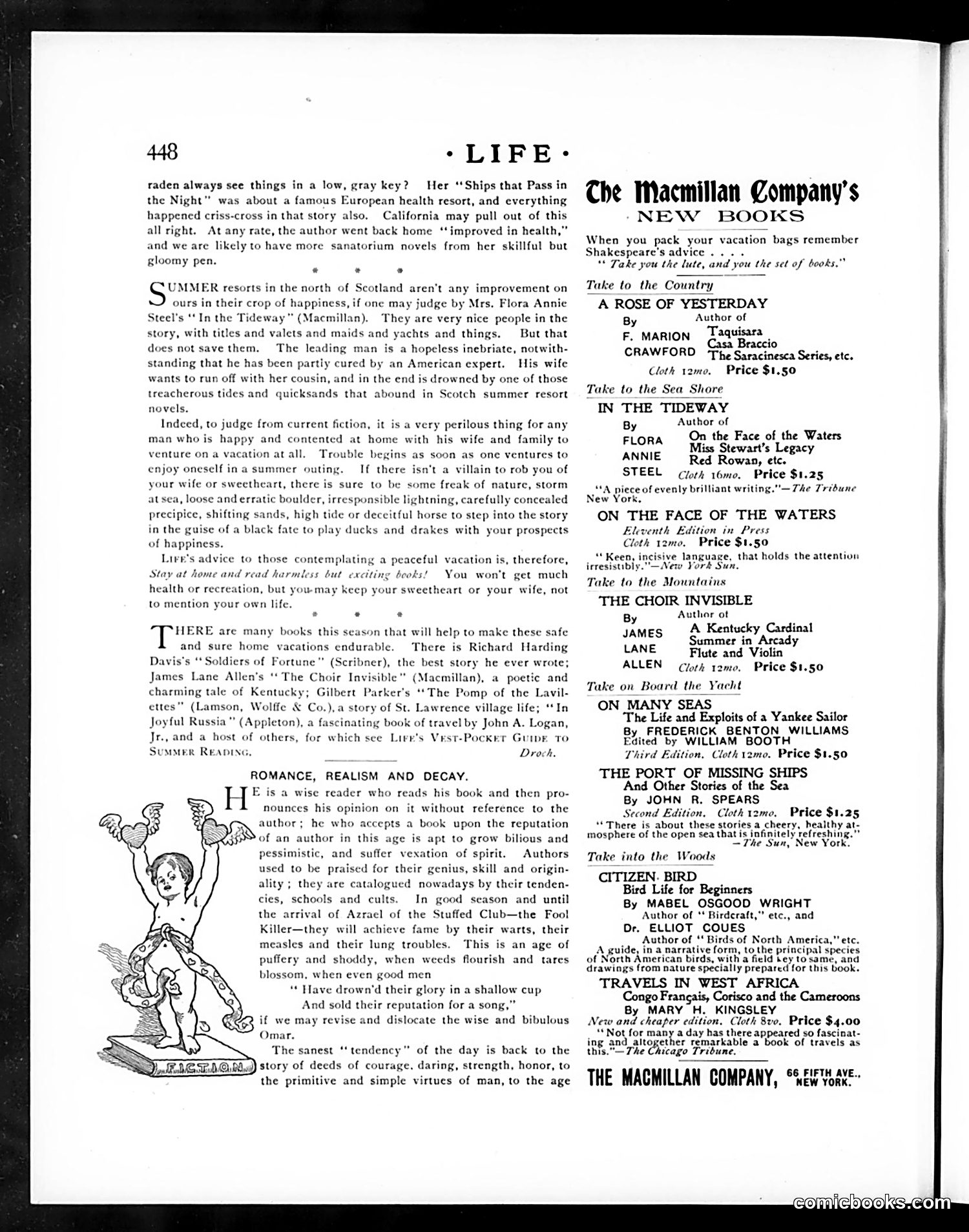
This page is primarily **book advertising and literary criticism**, not political satire. The main content discusses summer vacation novels and their tendency toward melodrama and tragedy. The critic (writing under the pseudonym "Droch") satirizes contemporary fiction's obsession with disaster: protagonists on vacations face drowning, infidelity, storms, and mysterious accidents. The joke is that **vacation stories are uniformly catastrophic**—the critic advises readers to simply stay home and read books instead of risking actual travel. The small decorative illustration (cherub-like figure) is generic ornamental art, not a political cartoon. The criticism reflects **fin-de-siècle literary trends**: the prevalence of "realistic" novels focused on human weakness and decay, versus older romance traditions celebrating virtue and courage. The critic advocates returning to stories emphasizing "primitive and simple virtues of man" over contemporary pessimism and "puffery." The page concludes with advertisements for Macmillan Company books, including titles by Richard Harding Davis and James Lane Allen.
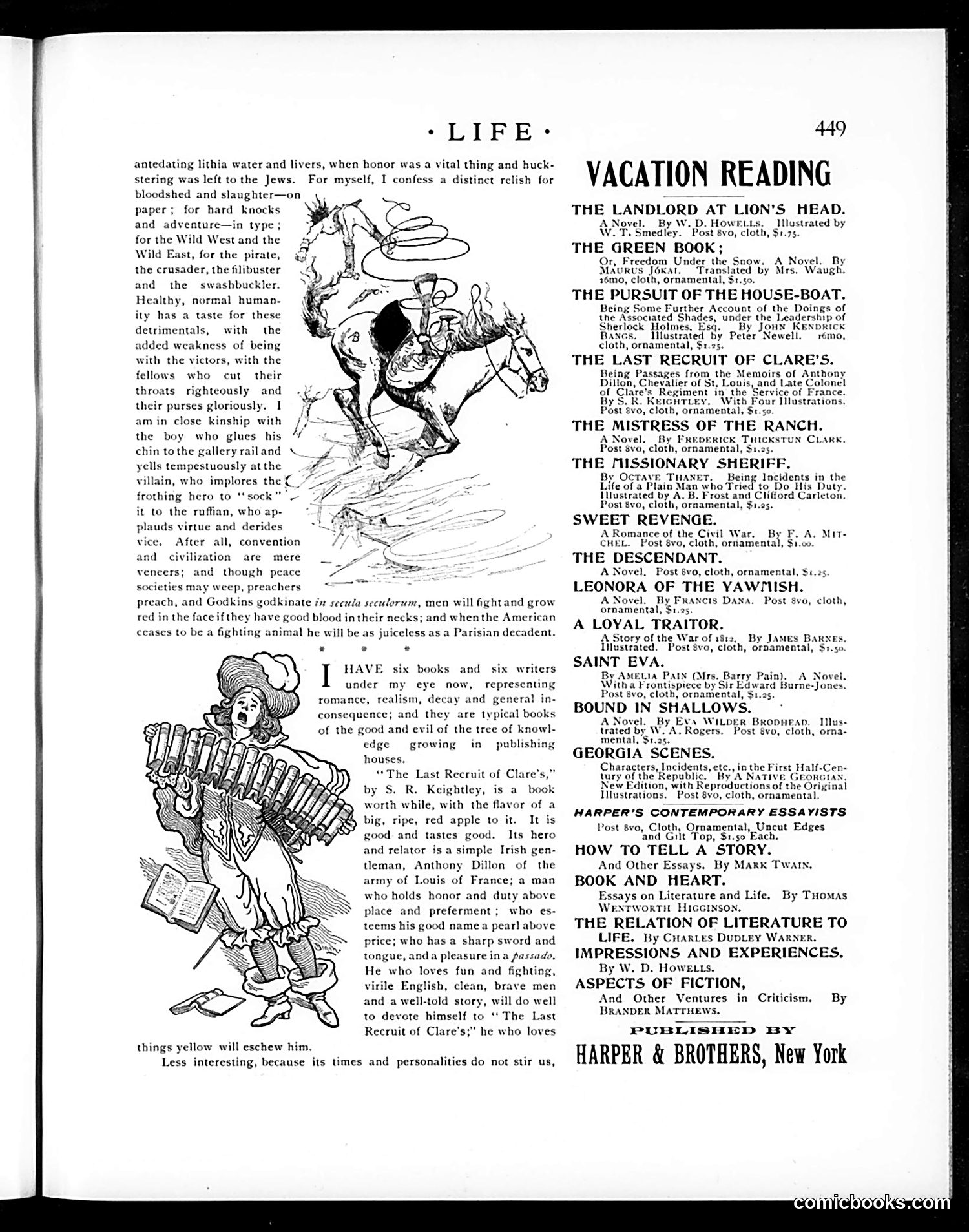
This page combines a personal essay on reading tastes with vacation book recommendations. The left column contains the author's frank confession that he enjoys tales of "bloodshed and slaughter—on paper," adventure stories featuring pirates, crusaders, and swashbucklers. He argues this reflects healthy human nature: even respectable people enjoy witnessing "virtue" triumph over "vice" through action, like boys cheering heroes in theaters. The right column then lists 16 books for summer reading, organized by title and publisher (Harper & Brothers). The essay specifically praises *"The Last Recruit of Clare's"* by S.R. Keightley—a novel about an honorable Irish gentleman in the French army—as exemplifying the "good and evil" of contemporary publishing. The cartoons (a mounted figure and a costumed character) humorously illustrate the swashbuckling adventure genre being discussed. The overall message: quality literature satisfies readers' natural appetite for excitement and moral clarity.
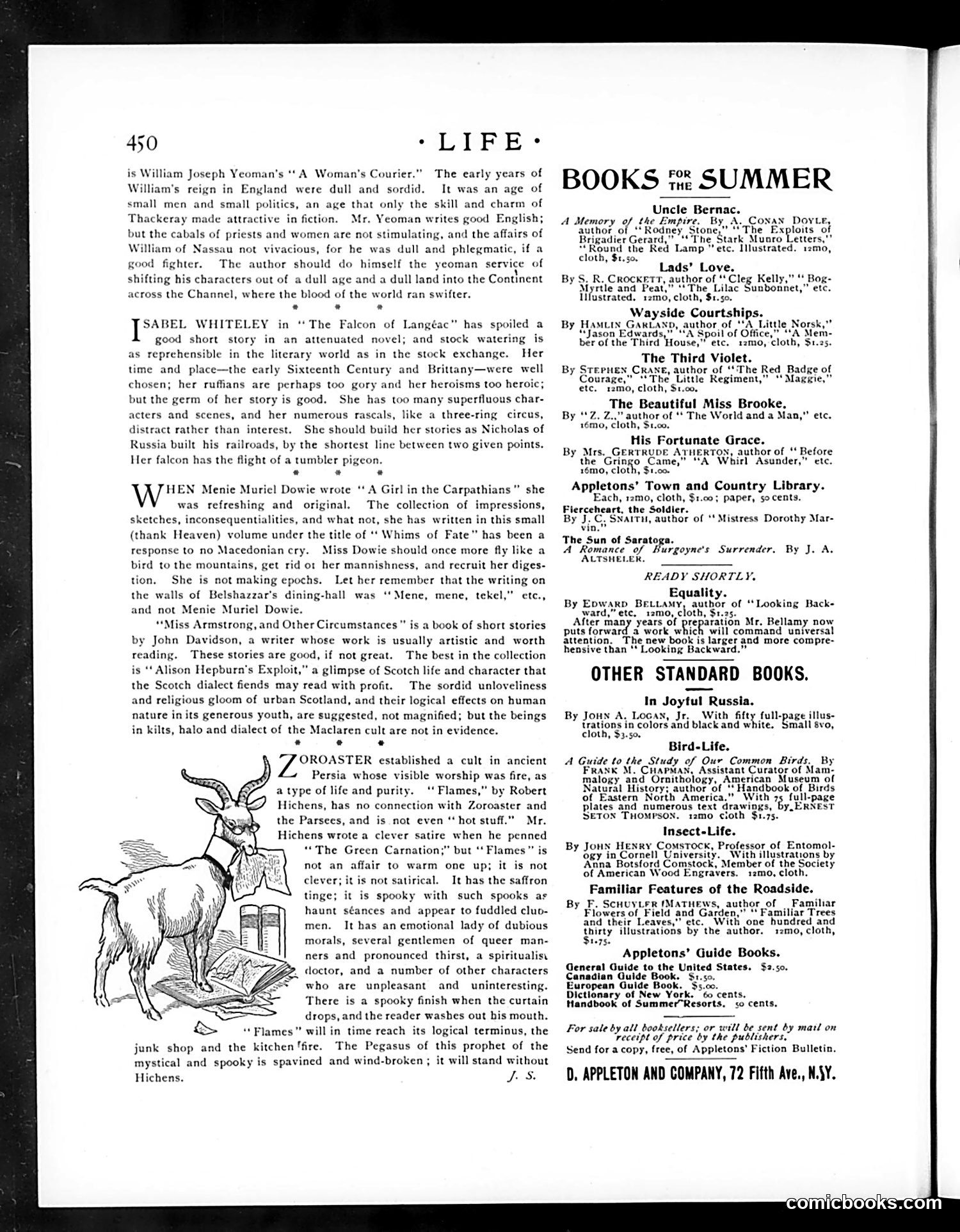
This is a **book review section** from *Life* magazine, not a political cartoon page. The small illustration of a goat or horned creature is decorative, accompanying a review of Robert Hichens' novel "Flames." The reviews are literary criticism of contemporary books. The critics use sharp, witty language to evaluate authors like William Joseph Yeoman, Isabel Whiteley, and Menie Muriel Dowie—judging their prose, plotting, and characterization. The tone is satirical: the reviewer mocks Hichens' "Flames" as spiritually empty despite its supernatural pretensions, comparing his literary talent to a worn-out horse ("spavined and wind-broken"). The page concludes with advertisements for summer reading, including *Uncle Bernac* (a Conan Doyle historical novel) and various reference works. **This is essentially a 19th-century book review column**, not satire about public figures or political events.
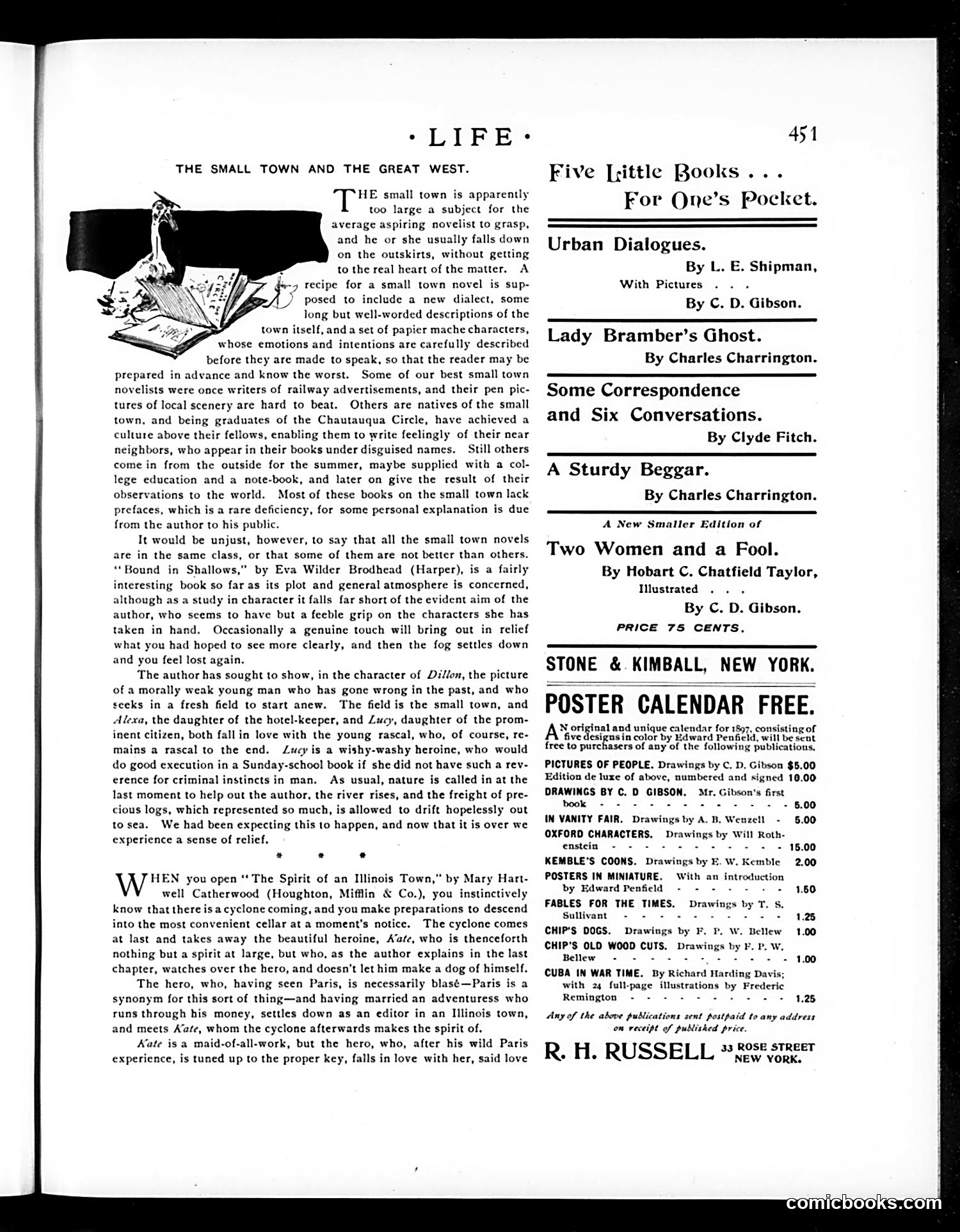
This page is primarily **book reviews and advertisements**, not political satire. The content critiques early American small-town novels as a literary genre. The small illustration at top left shows scattered books and papers, accompanying a meta-commentary on small-town fiction writing. The author mocks the formula: authors (often former railway ad writers or Chautauqua Circle graduates) stuff their novels with dialect, elaborate descriptions, and cardboard characters while claiming authenticity. Two specific novels are reviewed: - *Bound in Shallows* by Eva Wilder Brodhead—criticized for weak characterization despite genuine moments - *The Spirit of an Illinois Town* by Mary Hartwell Catherwood—mocked for its melodramatic reliance on a cyclone plot device and a "spirit" heroine The satire targets not politics but **pretentious rural American literature**: authors attempting profundity while recycling tired tropes and clichés. The page otherwise contains book advertisements from Stone & Kimball publishers.
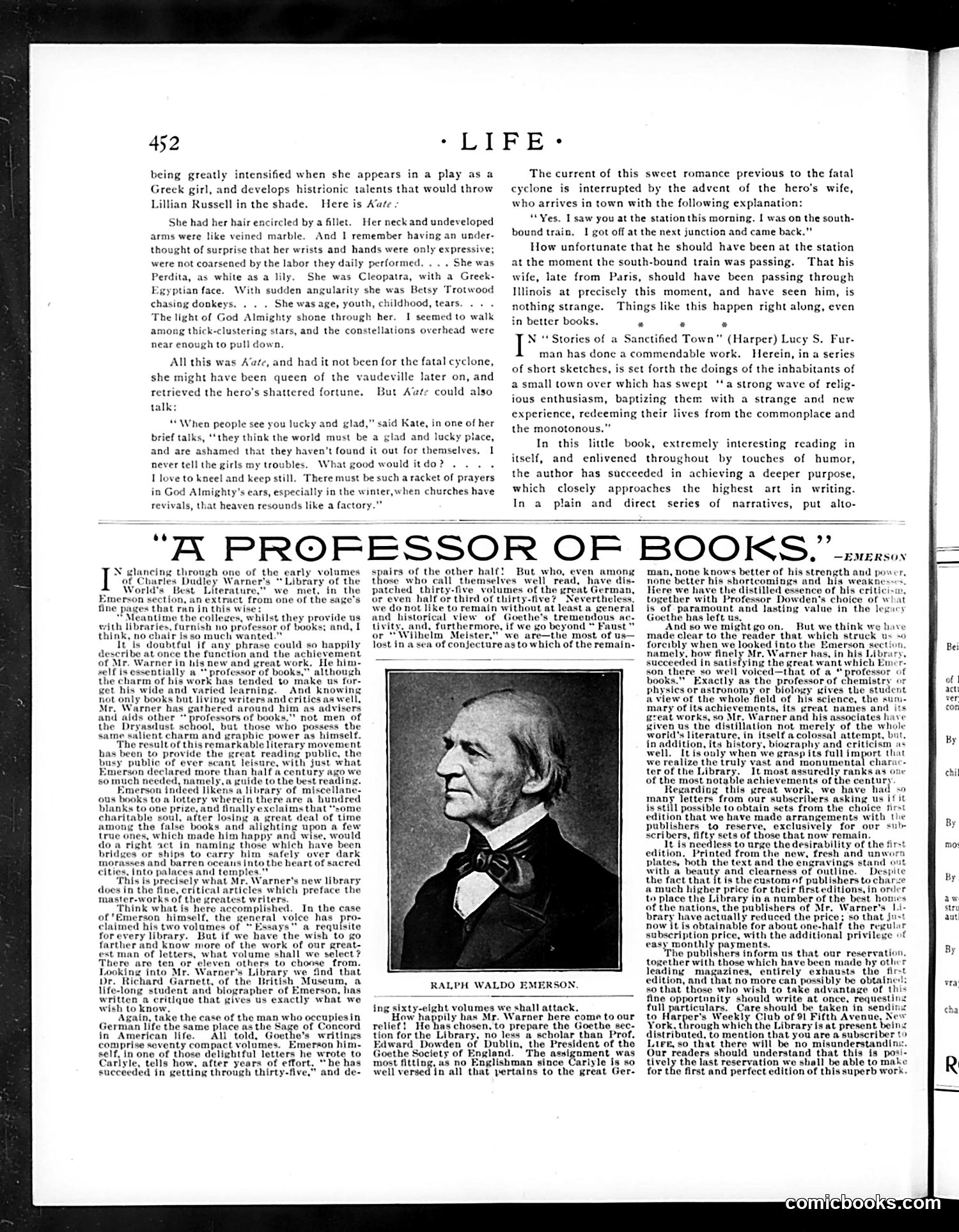
This page reviews Ralph Waldo Emerson's idea of a needed "professor of books" — someone to guide readers through literature. The article argues that **Charles Dudley Warner**, pictured here, has fulfilled this role through his "Library of the World's Best Literature." The piece praises Warner for gathering not dusty academics but living critics and writers as advisers. It emphasizes that Warner himself possesses both scholarly knowledge and appealing charm—he's made literary curation accessible rather than pedantic. The satire is gentle: the page contrasts Emerson's 1800s lament about colleges lacking book guidance with Warner's modern achievement in providing exactly that service through his comprehensive library project. The central argument celebrates Warner as the intellectual bridge between great literature and the general reading public—making him the "professor" Emerson said America needed.
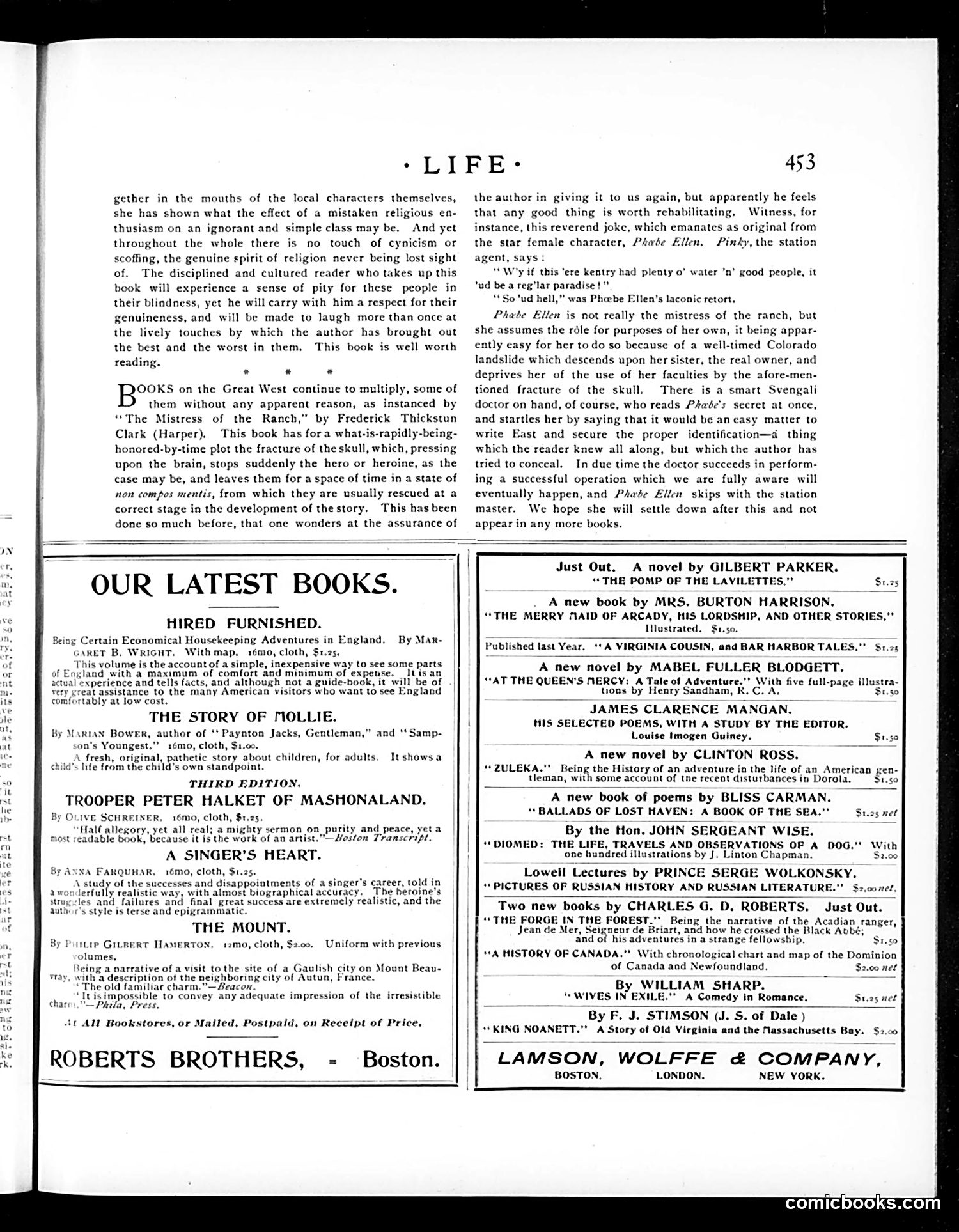
This page is primarily **book advertising and literary reviews**, not political satire or cartoons. The main content consists of: 1. **A book review** of "The Mistress of the Ranch" by Frederick Thickstun Clark, which the reviewer criticizes for recycling a tired plot device (a skull fracture causing temporary incapacity). The satire here targets the author's apparent lack of originality. 2. **A quoted joke** from the novel showing crude dialect humor—a character named Phoebe Ellen responds to another's comment that the region would be "a reg'lar paradise" with water and good people by saying "So'ud hell." This reflects late 19th-century popular fiction's reliance on rustic vernacular humor. 3. **Book advertisements** for publishers Roberts Brothers (Boston) and Lamson, Wolcott & Company, listing recent publications on various subjects. The page contains **no political cartoons or caricatures**—it's a typical late-Victorian periodical's advertising/review section showcasing contemporary literature.
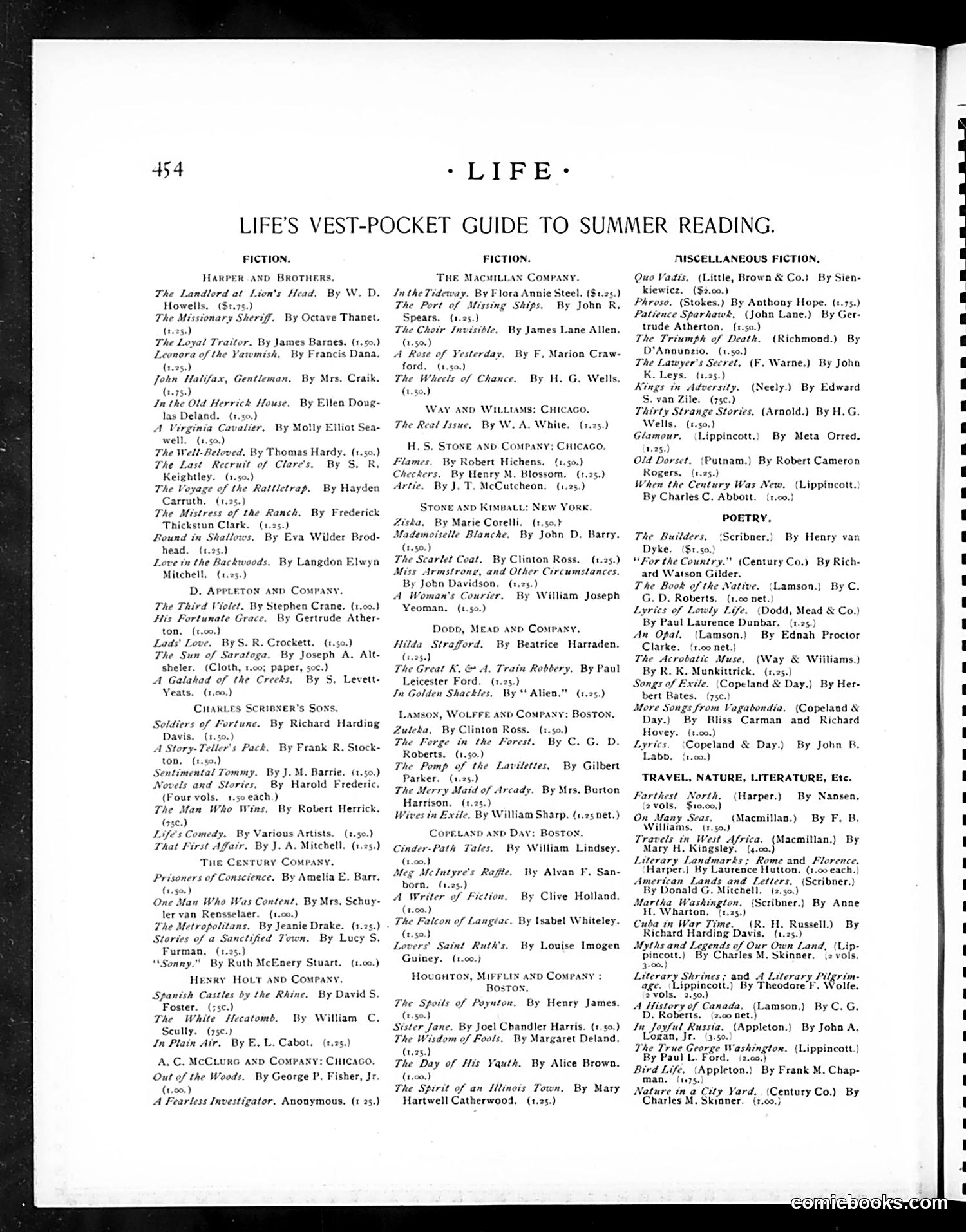
This page is not a cartoon or satirical content—it's a **book catalog**, specifically "Life's Vest-Pocket Guide to Summer Reading" from the magazine *Life*. The page lists fiction titles available for summer reading, organized by publisher (Harper and Brothers, D. Appleton and Company, Charles Scribner's Sons, The Century Company, Henry Holt and Company, etc.). Each entry includes the book's title, author, and price in dollars. Notable authors listed include W.D. Howells, Thomas Hardy, Stephen Crane, J.M. Barrie, Richard Harding Davis, and Marie Corelli—popular contemporary writers of the 1890s-early 1900s era. This is a practical consumer guide, not satirical commentary. It reflects what educated American readers considered worthwhile summer entertainment during this period.
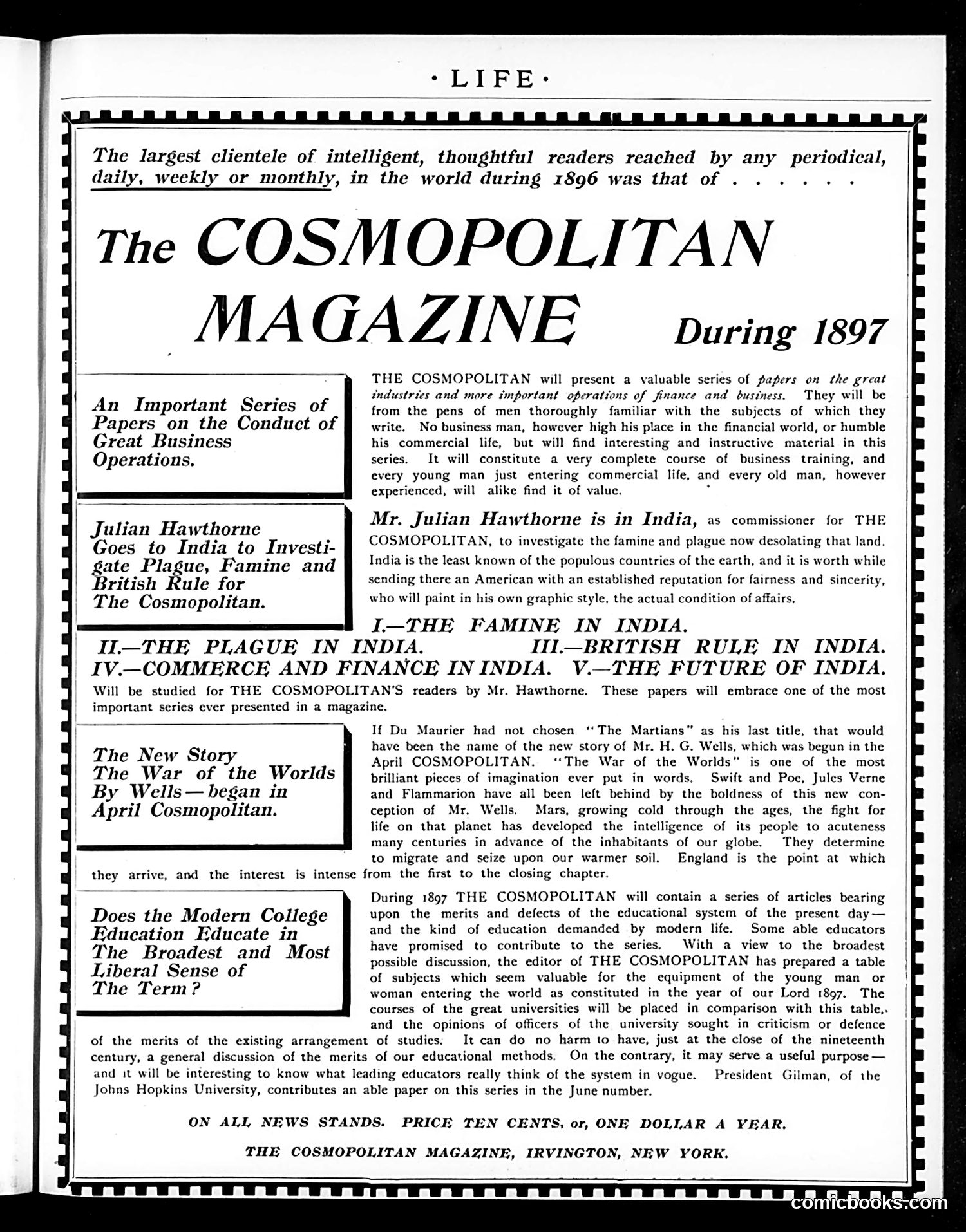
This is primarily an **advertisement page** for *The Cosmopolitan Magazine*, not a political cartoon. It announces the magazine's 1897 content to potential readers. Key advertised features include: 1. **Julian Hawthorne's India series**: The famous author will investigate the contemporary Indian famine and plague under British rule—timely topics for American readers interested in colonial affairs and humanitarian crises. 2. **H.G. Wells's "The War of the Worlds"**: Beginning in April, this serialization of Wells's science-fiction novel is prominently promoted as groundbreaking imaginative fiction. 3. **Educational reform debate**: Articles examining whether modern college curricula adequately prepare students, featuring contributions from university presidents like Johns Hopkins's Daniel Coit Gilman. The page emphasizes *Cosmopolitan*'s claim to reach "the largest clientele of intelligent, thoughtful readers" and positions itself as essential reading for serious, educated Americans—both for business knowledge and cultural sophistication.
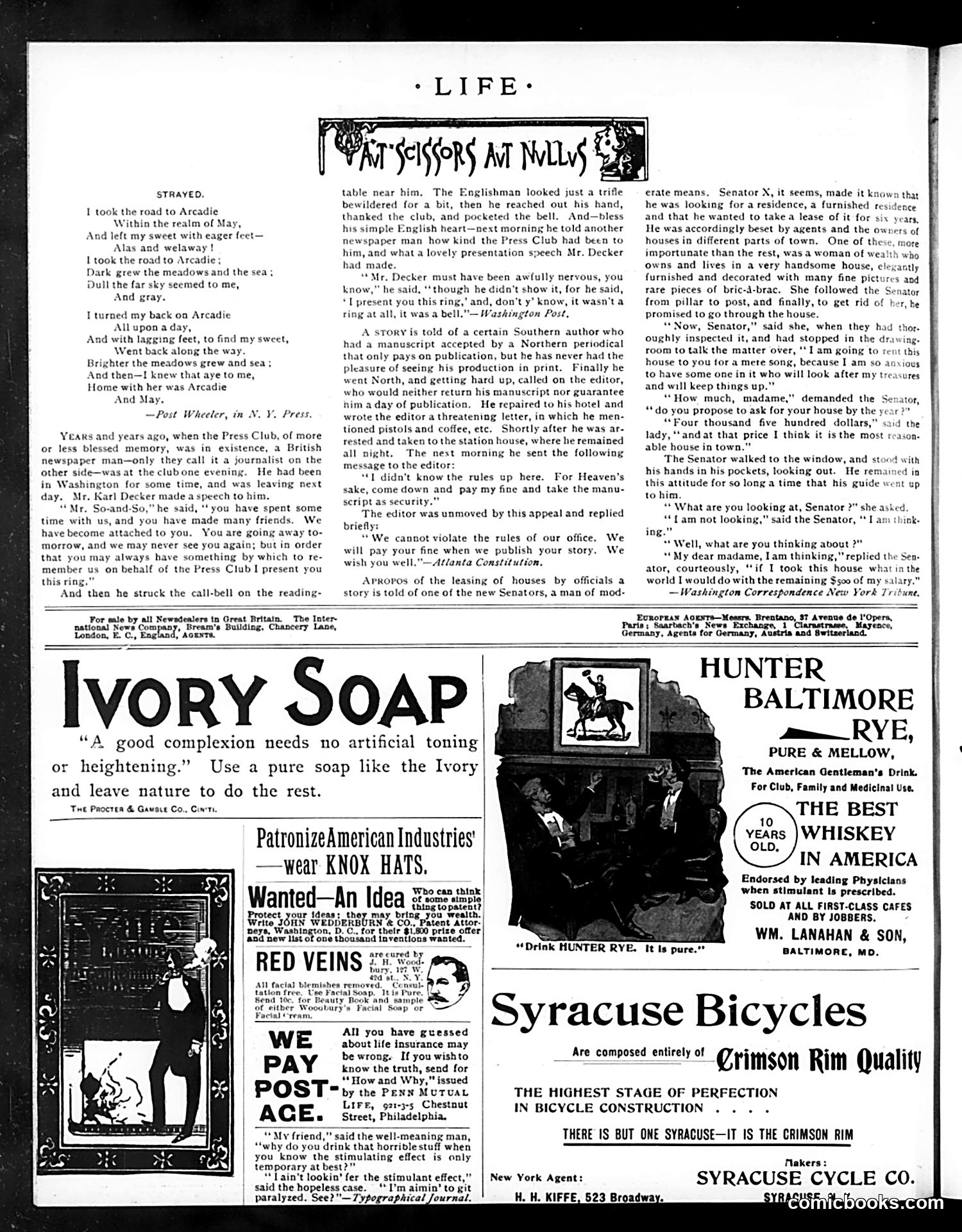
This page contains humorous anecdotes rather than political cartoons. The main content includes three satirical stories: 1. **The Press Club Ring Story**: An English journalist is presented with what he believes is a valuable ring as a farewell gift from the Press Club, only to discover the next morning it was actually a bell. The humor lies in his polite misinterpretation. 2. **The Southern Author's Threat**: A writer whose manuscript remains unpublished threatens an editor with violence over nonpayment, then tries to use his manuscript as bail money—satirizing the desperation of struggling writers. 3. **The Senator's House Rental**: A woman leasing her house to a Senator at bargain rates, expecting he'll maintain it properly, gets outmaneuvered when he promises to rent it "by the year" at minimal cost. The page also contains period advertisements for Ivory Soap, Hunter Baltimore Rye whiskey, and Syracuse Bicycles. The satire targets journalistic absurdity, publishing industry exploitation, and political opportunism.
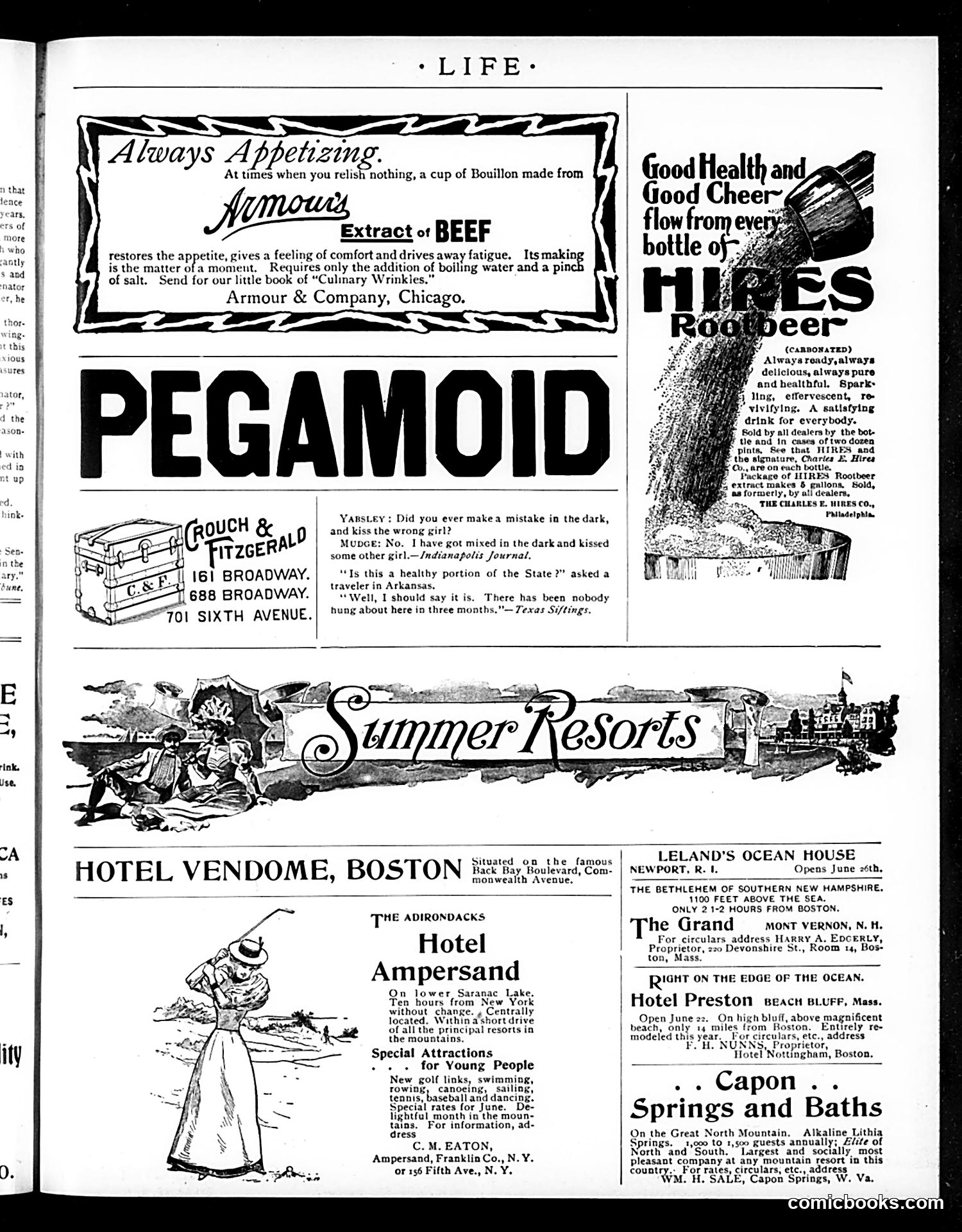
This page is primarily **advertising**, not political satire. It contains: **Main Advertisements:** - Armour's Extract of Beef (top) — a health tonic promising appetite restoration and fatigue relief - Pegamoid (large central ad) — unclear product purpose - Hires Root Beer — carbonated beverage marketed as healthful and refreshing - Crouch & Fitzgerald luggage - Multiple summer resort hotels (Vendome, Hotel Ampersand, various New England destinations) **Humor Elements:** Three brief joke exchanges scattered between ads, unrelated to politics: - A joke about kissing wrong girls in the dark - A joke about Arkansas being "healthy" because no one stays sick there long These are typical genteel period humor — mildly risqué or observational jokes, not satirical commentary. **Historical Context:** This reflects early 1900s American consumer culture: patent medicines/tonics marketed with quasi-medicinal claims, resort tourism promotion, and mild social humor. There is no discernible political cartoon or satire on this page.
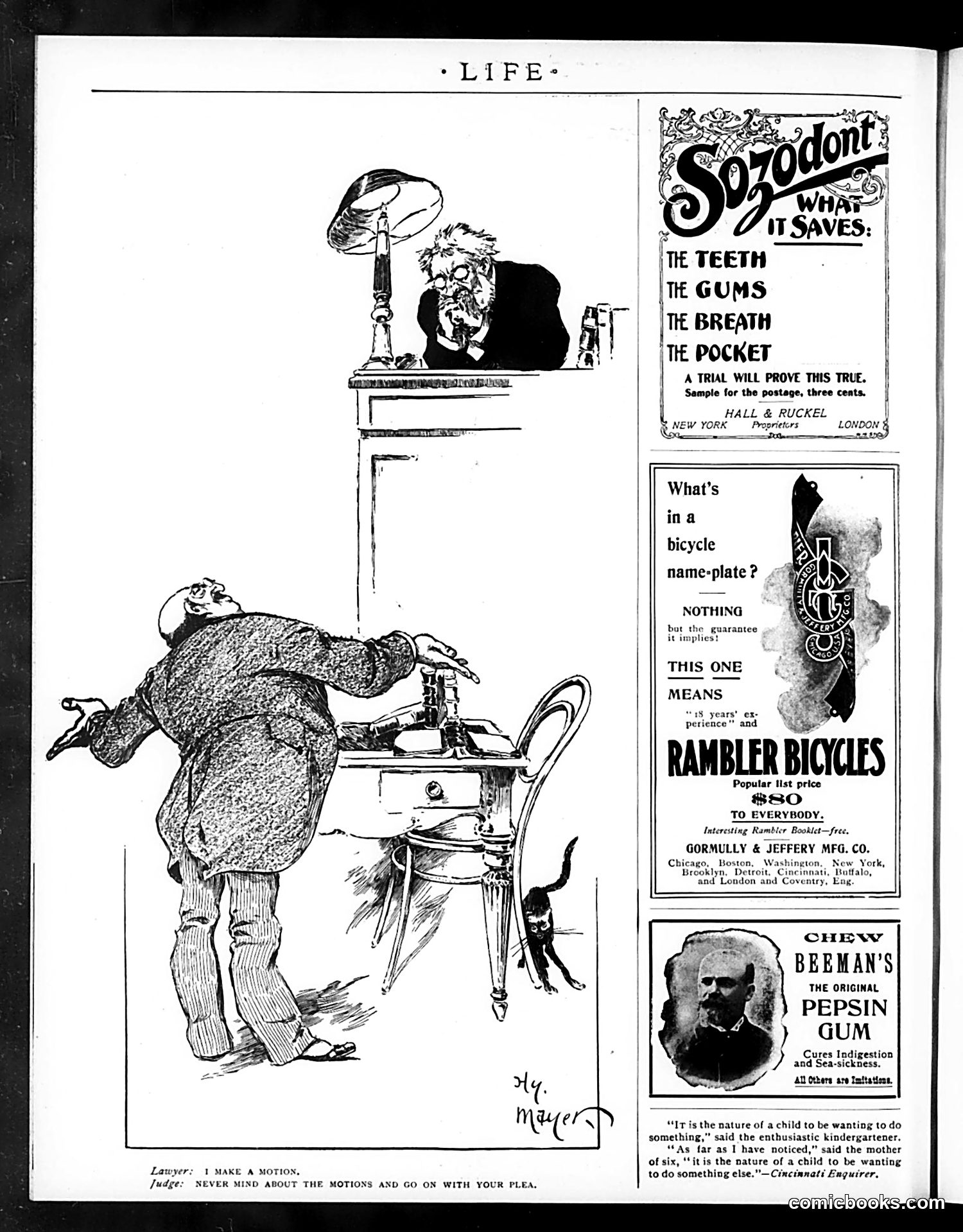
This page contains a political cartoon and period advertisements. The main cartoon depicts a courtroom scene where a lawyer makes a motion and the judge dismissively tells him to skip the procedural theatrics and get to his actual plea—satirizing lawyers' tendency to engage in unnecessary legal formality and verbose motions rather than addressing substance. The surrounding advertisements are typical of early 20th-century products: Sozodont toothpaste, Rambler bicycles, and Beeman's pepsin gum. These ads emphasize dubious health claims common to the era (gum "cures indigestion," toothpaste "saves" teeth and breath). Below is a humorous anecdote contrasting a kindergarten teacher's idealism about children wanting to do things with a pragmatic mother's observation that children actually want to do *something else*—a jab at naive educational philosophy versus parental reality. The cartoonist is signed as Cesare Maccari.
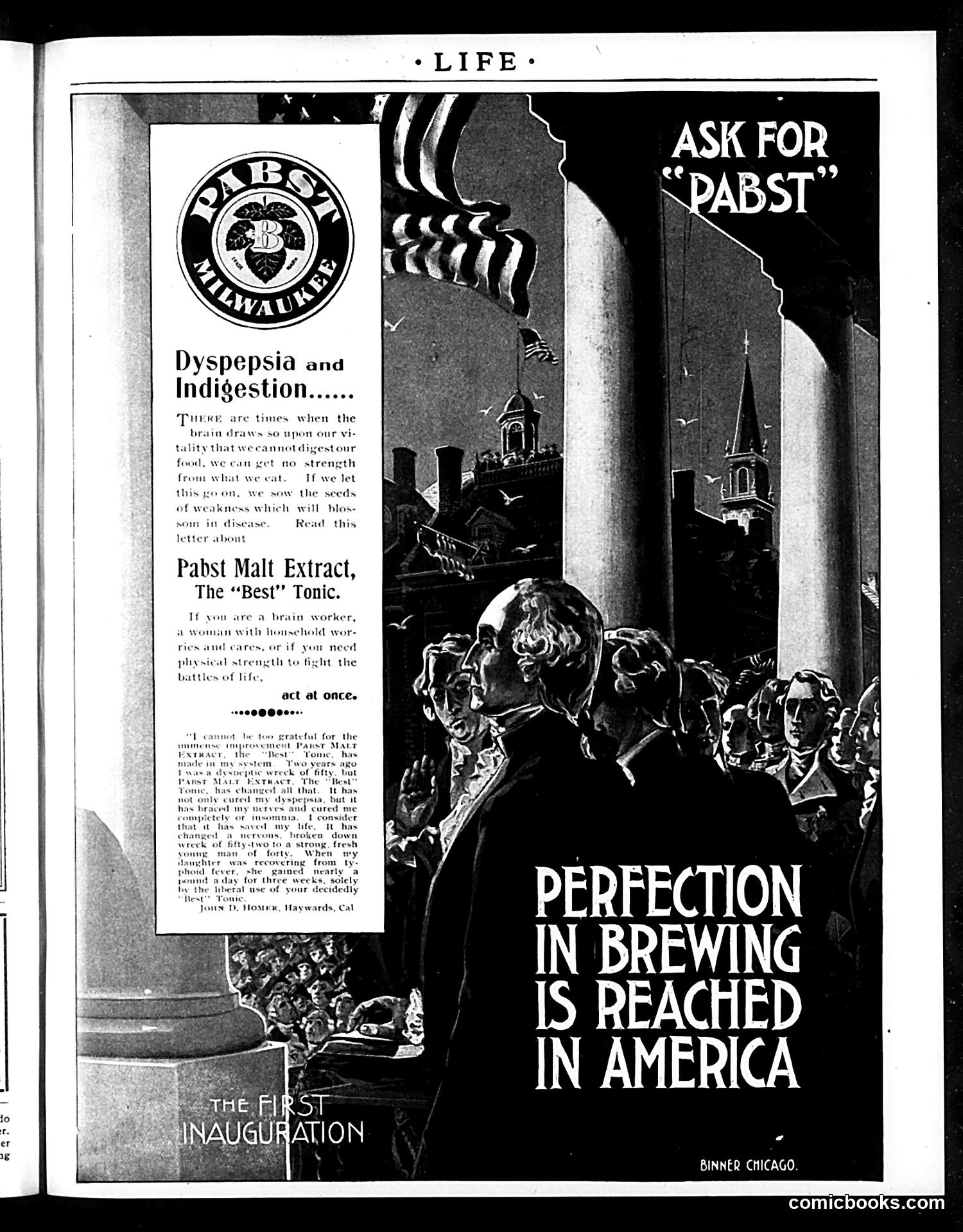
This is primarily a **Pabst beer advertisement**, not political satire. The page combines two marketing messages: **Left side:** A testimonial ad for Pabst Malt Extract, claiming it cures "dyspepsia and indigestion" and provides strength for "brain workers" and those with "household worries." A customer testimonial describes dramatic health improvements from the tonic. **Right side:** A dramatic illustration showing a crowd of people (appears to be workers or immigrants) looking toward a city skyline with church spires, accompanied by the text "PERFECTION IN BREWING IS REACHED IN AMERICA" and credited to "DINNER CHICAGO." The juxtaposition suggests Pabst is positioning itself as an American success story and health product. The crowd imagery appeals to working-class consumers, while the "perfection in brewing" claim asserts American manufacturing superiority—likely reflecting early 20th-century nationalist marketing during a period of American industrial growth.
This page is purely **advertising copy**, not a cartoon or satirical content. It's a travel agency advertisement for Raymond & Whitcomb, a prominent 19th-century tour operator with offices across major American cities (New York, Boston, Philadelphia, Cleveland, Chicago). The text promotes their travel services—offering advice on destinations, climate, accommodations, and transportation—while emphasizing they provide railroad and steamship tickets at competitive rates worldwide. The ornamental border is typical period design. There is no political commentary, caricature, or satirical message here. It's straightforward commercial promotion in *Life* magazine (dated May 27, though the year is partially obscured), representing how magazines funded themselves through advertisements during this era.