
Life, 1897-05-27 · page 8 of 32
Life — May 27, 1897 — page 8: what you’re looking at
What you’re looking at
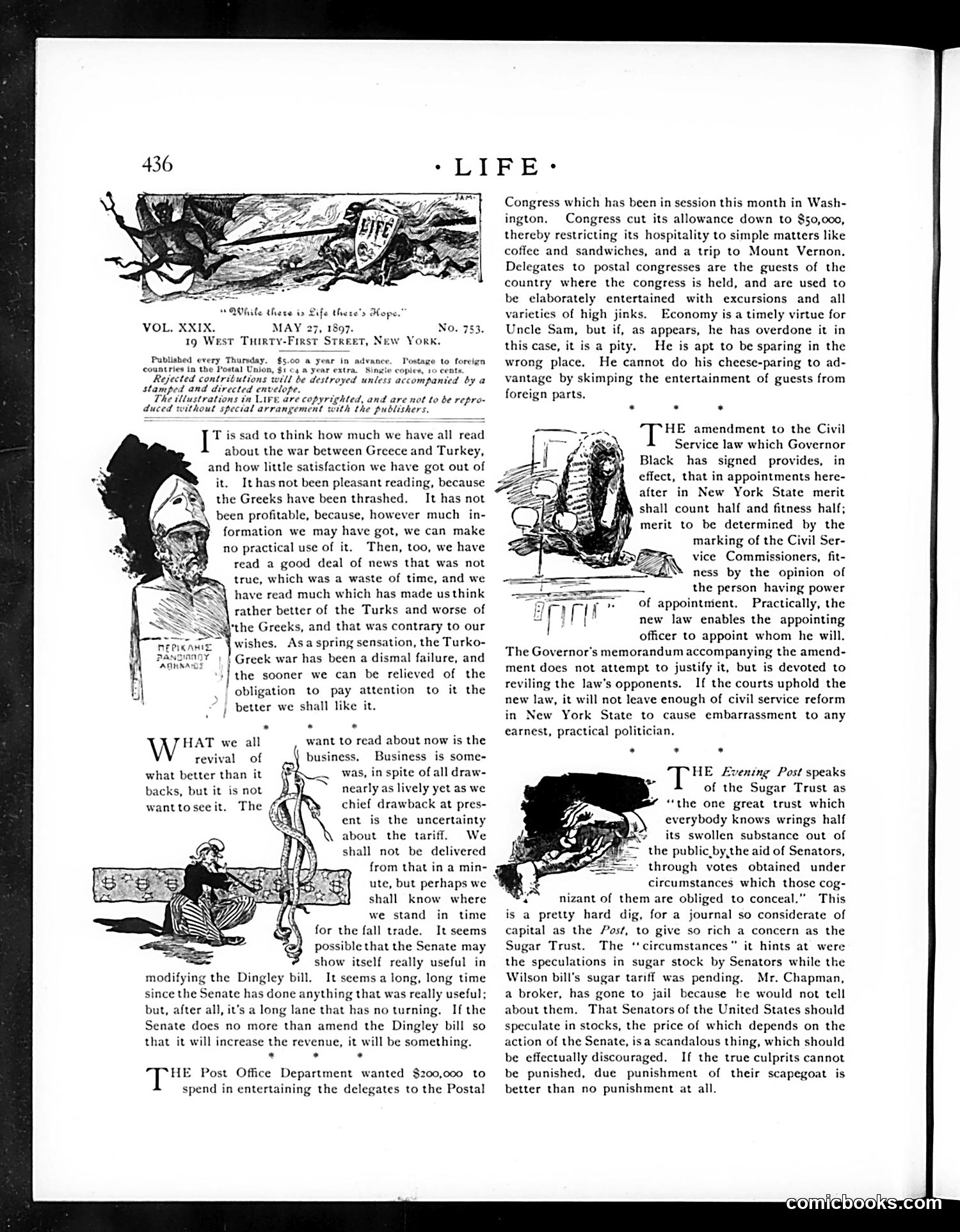
This page contains three separate editorial commentaries with accompanying illustrations: 1. **Greece-Turkey War**: The opening article discusses recent news coverage of the Greco-Turkish conflict, criticizing sensationalism while acknowledging public interest. 2. **Business Revival & Tariff Reform**: An illustration shows a figure (likely representing business or the economy) entangled with a caduceus (symbol of commerce). The text argues the Senate should pass the Dingley tariff bill to increase revenue and support trade. 3. **Post Office Extravagance & Sugar Trust Scandal**: Critiques the Post Office Department's $300,000 budget for entertaining postal delegates as wasteful. The *Evening Post* is cited regarding corruption in the Sugar Trust, where senators allegedly speculated in sugar stocks during tariff negotiations—a "scandalous" abuse of power. The page reflects late-1890s concerns: protectionist economics, government waste, and senatorial corruption.
📄 Transcribed text from this page (OCR, searchable)
Machine-transcribed from the original scan — historical spelling and the odd misread are preserved.
“While Mere is & MAY 27, 1897. No. 753. T THirty-First Street, New York. Published every Thursday. $5.00 a year in advance. Tostage to foreign countries in the Postal Union, $1ca a year extra. Singie cop ente Rejected contributions will be destroyed unless accompanied by a stamped and directed envelope. The illustrations in Live are copyrighted, and are not to be repro- duced without special arrangement with the publishers. T is sad to think how much we have all read about the war between Greece and Turkey, and how little satisfaction we have got out of it. Ithas not been pleasant reading, because the Greeks have been thrashed. It has not been profitable, because, however much in- formation we may have got, we can make no practical use of it. Then, too, we have read a good deal of news that was not true, which was a waste of time, and we have read much which has made usthink rather better of the Turks and worse of wi'the Greeks, and that was contrary to our wishes. Asa spring sensation, the Turko- Greek war has been a dismal failure, and the sooner we can be relieved of the obligation to pay attention to it the better we shall like it. . . . want to read about now is the of siness. Business is some- was, in spite of all draw- nearly as lively yet as we chief drawback at pres- ent is the uncertainty about the tariff. We shall not be delivered from that in a min- V HAT we all revival what better than it backs, but it is not wanttoseeit. The ute, but perhaps we * shall know where we stand in time for the fall trade. It seems possible that the Senate may show itself really useful in modifying the Dingley bill. It seems a long, long time since the Senate has done anything that was really useful; but, after all, it’s a long lane that has no turning. If the Senate does no more than amend the Dingley bill so that it will increase the revenue, it will be something. * . . HE Post Office Department wanted $200,000 to spend in entertaining the delegates to the Postal Congress which has been in session this month in Wash- ington. Congress cut its allowance down to $50,000, thereby restricting its hospitality to simple matters like coffee and sandwiches, and a trip to Mount Vernon. Delegates to postal congresses are the guests of the country where the congress is held, and are used to be elaborately entertained with excursions and all varieties of high jinks. Economy is a timely virtue for Uncle Sam, but if, as appears, he has overdone it in this case, it is a pity. He is apt to be sparing in the wrong place. He cannot do his cheese-paring to ad- vantage by skimping the entertainment of guests from foreign parts. . . . HE amendment to the Civil Service law which Governor Black has signed provides, in effect, that in appointments here- after in New York State merit shall count half and fitness half; merit to be determined by the marking of the Civil Ser- R - vice Commissioners, fit- LAWN jae ness by the opinion of ——— the person having power a of appointmient. Practically, the new law enables the appointing officer to appoint whom he will. The Governor's memorandum accompanying the amend- ment does not attempt to justify it, but is devoted to reviling the law's opponents. If the courts uphold the new law, it will not leave enough of civil service reform in New York State to cause embarrassment to any earnest, practical politician, HE L£vening Post speaks of the Sugar Trust as “the one great trust which everybody knows wrings half its swollen substance out of the public by,the aid of Senators, through votes obtained under circumstances which those cog- nizant of them are obliged to conceal.” This is a pretty hard dig, for a journal so considerate of capital as the Post, to give so rich a concern as the Sugar Trust. The ‘‘circumstances” it hints at were the speculations in sugar stock by Senators while the Wilson bill's sugar tariff was pending. Mr. Chapman, a broker, has gone to jail because ke would not tell about them. That Senators of the United States should speculate in stocks, the price of which depends on the action of the Senate, isa scandalous thing, which should be effectually discouraged. If the true culprits cannot be punished, due punishment of their scapegoat is better than no punishment at all.