
Life, 1897-05-27 · page 7 of 32
Life — May 27, 1897 — page 7: what you’re looking at
What you’re looking at
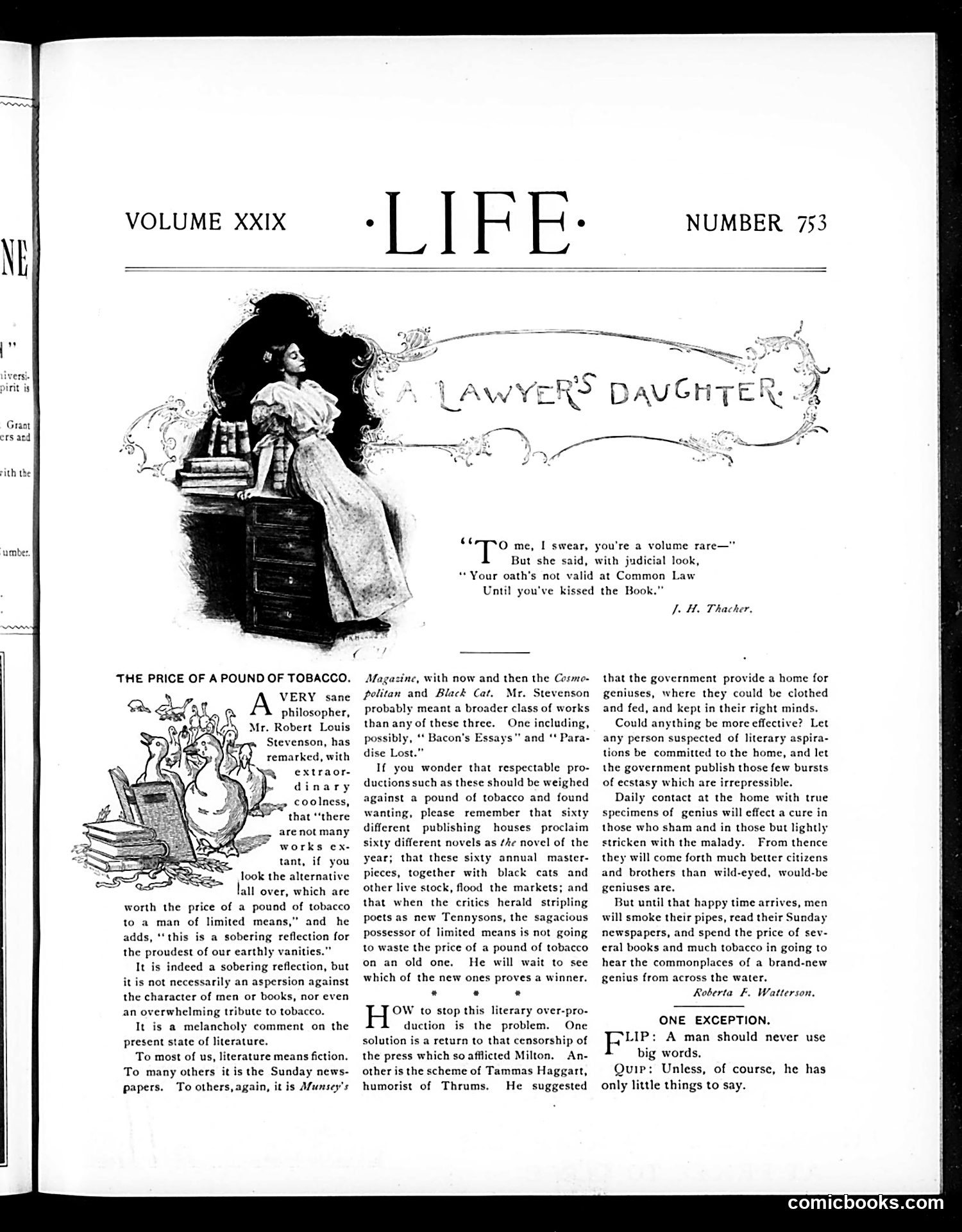
This page features a satirical article titled "The Price of a Pound of Tobacco" by Robert Louis Stevenson commentary. The main cartoon depicts a woman at a desk—"A Lawyer's Daughter"—with an accompanying literary quote suggesting she's testing a suitor's worthiness. The article critiques literary overproduction in the publishing industry, arguing that too many books flood markets annually. Stevenson is quoted comparing the value proposition: respectable literature shouldn't be judged "against a pound of tobacco" for men of limited means. The satire attacks both excessive publishing and the suggestion that serious literature competes unfavorably with everyday commodities for working-class audiences' attention and money.
📄 Transcribed text from this page (OCR, searchable)
Machine-transcribed from the original scan — historical spelling and the odd misread are preserved.
ers ard rith the ‘THE PRICE OF A POUND OF TOBACCO. VERY sane philosopher, Mr. Robert Louis Stevenson, has remarked, with extraor- dinary ancy coolness, 7" that “there are not many works ex- tant, if you look the alternative lal over, which are worth the price of a pound of tobacco to a man of limited means,” and he adds, ‘‘this is a sobering reflection for the proudest of our earthly vanities.” It is indeed a sobering reflection, but it is not necessarily an aspersion against the character of men or books, nor even an overwhelming tribute to tobacco. It is a melancholy comment on the present state of literature. To most of us, literature means fiction. To many others it isthe Sunday news- papers. To others, again, it is Munsey's oc O me, I swear, you're a volume rare—" But she said, with judicial look, “Your oath’s not valid at Common Law Until you've kissed the Book.” Magazine, with now and then the Cosmo- politan and Black Cat. Mr. Stevenson probably meant a broader class of works than any of these three. One including, possibly, “ Bacon's Essays" and ‘ Para- dise Lost.” If you wonder that respectable pro- ductions such as these should be weighed against a pound of tobacco and found wanting, please remember that sixty different publishing houses proclaim sixty different novels as ¢Ae novel of the year; that these sixty annual master- pieces, together with black cats and other live stock, flood the markets; and that when the critics herald stripling poets as new Tennysons, the sagacious possessor of limited means is not going to waste the price of a pound of tobacco on an old one. He will wait to see which of the new ones proves a winner. * * * OW to stop this literary over-pro- duction is the problem. One solution is a return to that censorship of the press which so afflicted Milton. An- other is the scheme of Tammas Haggart, humorist of Thrums. He suggested Jo H. Thacker, that the government provide a home for geniuses, where they could be clothed and fed, and kept in their right minds. Could anything be more effective? Let any person suspected of literary aspira- tions be committed to the home, and let the government publish those few bursts of ecstasy which are irrepressible. Daily contact at the home with true specimens of genius will effect a cure in those who sham and in those but lightly stricken with the malady. From thence they will come forth much better citizens and brothers than wild-eyed, would-be geniuses are, But until that happy time arrives, men will smoke their pipes, read their Sunday newspapers, and spend the price of sev- eral books and much tobacco in going to hear the commonplaces of a brand-new genius from across the water. Roberta F. Watterson, ONE EXCEPTION. LIP: A man should never use big words. Quip: Unless, of course, he has only little things to say. comicbooks.com