
Life, 1897-05-27 · page 14 of 32
Life — May 27, 1897 — page 14: what you’re looking at
What you’re looking at
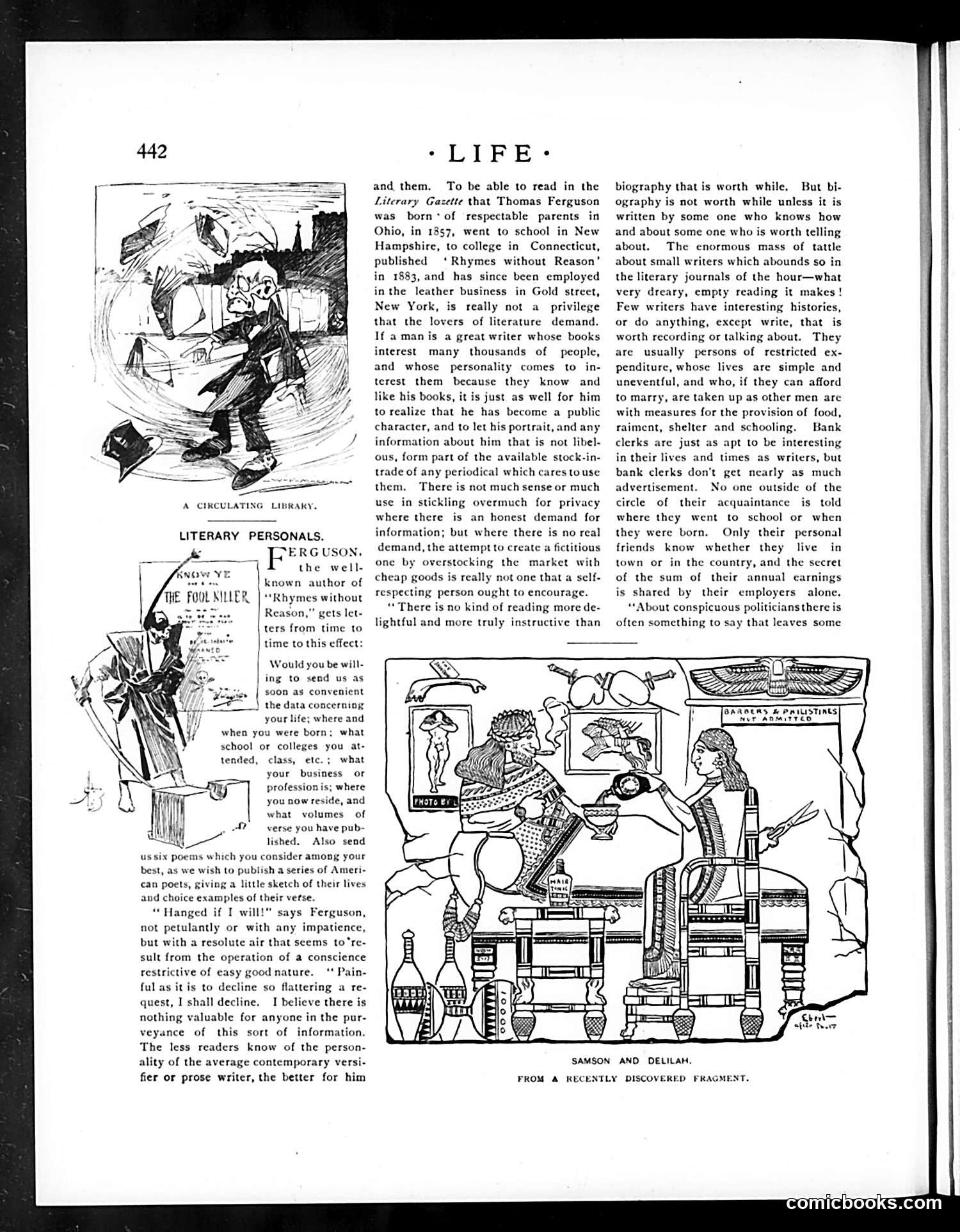
This page presents two distinct pieces of satirical content: **"Literary Personals"** (main text): Author Ferguson refuses to submit biographical data to magazines seeking writer profiles. The satire mocks the era's obsession with publishing trivial "life data" about minor literary figures. Ferguson argues that biography is only worthwhile when the subject is genuinely significant; most writers lead unremarkable lives no more interesting than bank clerks. The piece ridicules magazines for manufacturing demand for celebrity gossip by flooding the market with cheap biographical content about unimportant authors. **"Samson and Delilah"** (bottom illustration): A crude, humorous sketch depicting the biblical scene with grotesque, exaggerated figures. The caption credits it as "from a recently discovered fragment," a joke implying this is some ancient artistic rediscovery—clearly absurd given the cartoonish style. This appears to mock pretentious art scholarship or biblical commentary of the era. Both pieces share satirical targets: intellectual pretension and the media's pursuit of trivial information.
📄 Transcribed text from this page (OCR, searchable)
Machine-transcribed from the original scan — historical spelling and the odd misread are preserved.
A CIRCULATING LIBRAKY, LITERARY PERSONALS. 4 ERGUSON, | the well- ° known author of THE FOUL NILLER “Rhymes without Reason,” gets let- ters from time to | time to this effect: Would you be will- ing to send us as soon as convenient the data concerning your life; where and when you were born; what school or colleges you at- tended, class, etc.; what your business or profession is; where you now reside, and what volumes of verse you have pub- lished. Also send us six poems which you consider among your best, as we wish to publish a series of Ameri- can poets, giving a little sketch of their lives and choice examples of their verse. “Hanged if I will!” says Ferguson, not petulantly or with any impatienc: but with a resolute air that seems to*re- sult from the operation of a conscience restrictive of easy good nature.‘ Pain- ful as it is to decline so flattering a re- quest, I shall decline. I believe there is nothing valuable for anyone in the pur- veyance of this sort of information. The less readers know of the person- ality of the average contemporary versi- fier or prose writer, the better for him * LIFE: and them. To be able to read in the Literary Gazette that Thomas Ferguson was born’ of respectable parents in Ohio, in 1857, went to school in New Hampshire, to college in Connecticut, published ‘Rhymes without Reason’ in 1883, and has since been employed inthe leather business in Gold street, New York, is really not a_ privilege that the lovers of literature demand. If aman is a great writer whose books interest many thousands of people, and whose personality comes to in- terest them because they know and like his books, it is just as well for him to realize that he has become a public character, and to let his portrait, and any information about him that is not libel- ous, form part of the available stock-in- trade of any periodical which cares touse them. There is not much sense or much use in stickling overmuch for privacy where there is an honest demand for information; but where there is no real demand, the attempt to create a fictitious one by overstocking the market with cheap goods is really not one that a self- respecting person ought to encourage. “There is no kind of reading more de- lightful and more truly instructive than biography that is worth while. But bi- ography is not worth while unless it is written by some one who knows how and about some one who is worth telling about. The enormous mass of tattle about small writers which abounds so in the literary journals of the hour—what very dreary, empty reading it makes! Few writers have interesting histories, or do anything, except write, that is worth recording or talking about. They are usually persons of restricted ex- penditure, whose lives are simple and uneventful, and who, if they can afford to marry, are taken up as other men are with measures for the provision of food, raiment, shelter and schooling. Bank clerks are just as apt to be interesting in their lives and times as writers, but bank clerks don't get nearly as much advertisement. No one outside of the circle of their acquaintance is told where they went to school or when they were born. Only their personal friends know whether they live in town or in the country, and the secret of the sum of their annual earnings is shared by their employers alone. “About conspicuous politicians there is often something to say that leaves some Cori site tere SAMSON AND DELILAH. FROM A RECENTLY DISCOVERED FRAGMENT.