
Life, 1897-05-27 · page 12 of 32
Life — May 27, 1897 — page 12: what you’re looking at
What you’re looking at
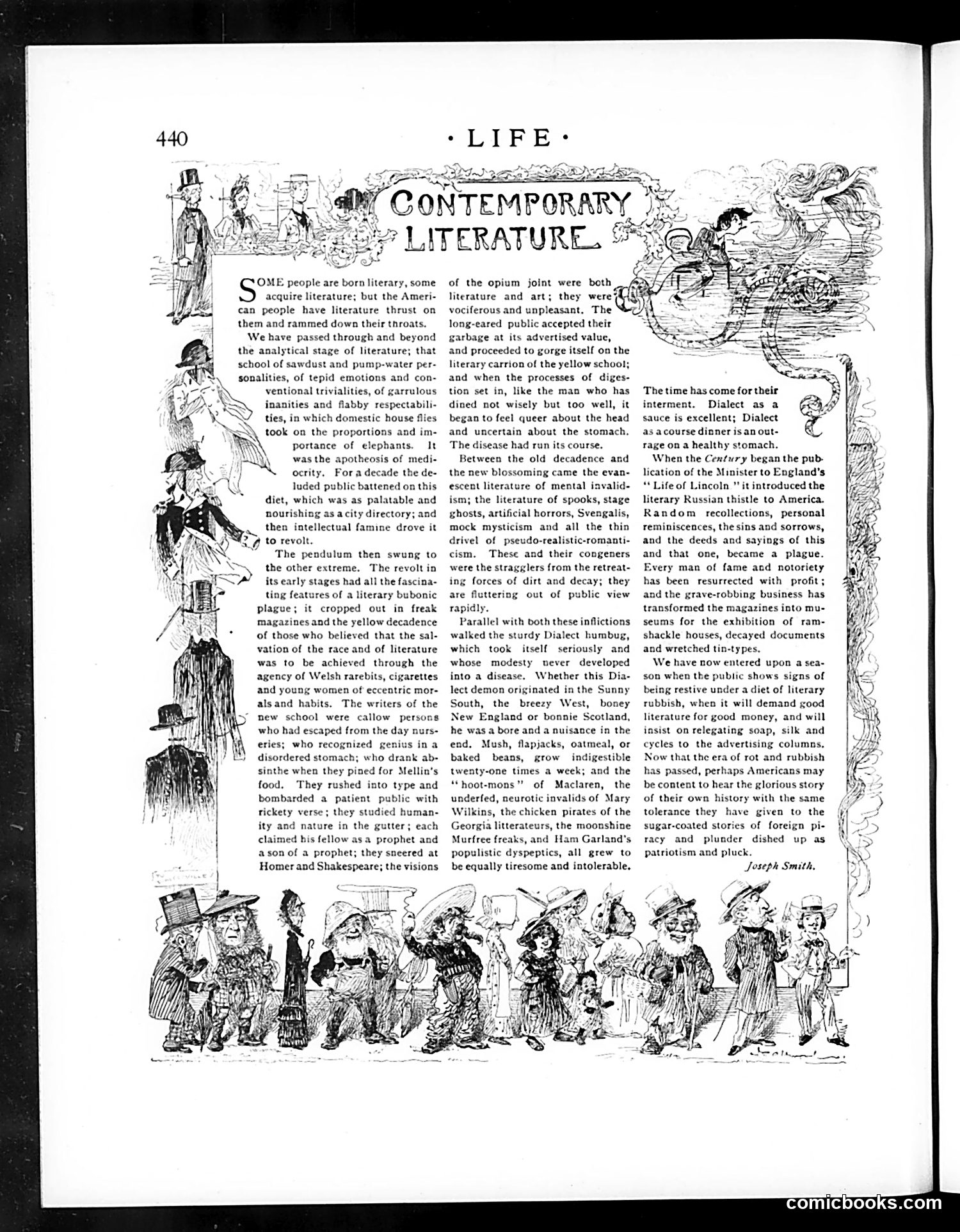
This page satirizes low-quality popular literature of the era. The article criticizes writers who produced sensationalist fiction—"pseudo-realistic-romanticism," stage ghosts, artificial horrors, and Dialect stories—targeting mass audiences rather than literary merit. The left margin illustrations show various crude character types (appears to include ethnic caricatures common to period satire). The bottom illustration depicts a motley parade of literary characters and authors, likely representing the parade of mediocre personalities populating popular magazines. The article names specific targets: "Dialect humbug," stories of "Mush, flap-jacks, oatmeal," and references Mary Wilkins, Georgia literature, and Ham Garland—suggesting regional/folk literature was considered particularly offending to literary taste. The overall message: American mass-market literature had become intellectually degraded and commercially driven rather than artistically serious.
📄 Transcribed text from this page (OCR, searchable)
Machine-transcribed from the original scan — historical spelling and the odd misread are preserved.
Nes ITERATURE & OME people are born literary, some acquire literature; but the Ameri- can people have literature thrust on them and rammed down their throats. We have passed through and beyond the analytical stage of literature; that school of sawdust and pump-water per- sonalities, of tepid emotions and con- ventional trivialities, of garrulous inanities and flabby respectabili- ties, in which domestic house flies took on the proportions and im- portance of elephants. It was the apotheosis of medi- ocrity, Fora decade the de- luded public battened on this diet, which was as palatable and nourishing as acity directory; and then intellectual famine drove it The pendulum then swung to the other extreme. The revolt in its early stages had all the fascina- ting features of a literary bubonic plague; it cropped out in freak magazines and the yellow decadence of those who believed that the sal- vation of the race and of literature was to be achieved through the agency of Welsh rarebits, cigarettes and young women of eccentric mor- alsand habits. The writers of the new school were callow persons who had escaped from the day nurs- eries; who recognized genius in a disordered stomach; who drank ab- sinthe when they pined for Mellin's food. They rushed into type and bombarded a patient public with rickety verse; they studied human- ity and nature in the gutter; each claimed bis fellow asa prophet and ason of a prophet; they sneered at Homer and Shakespeare; the visions of the opium joint were both literature and art; they were? vociferous and unpleasant. The long-eared public accepted their garbage at its advertised value, and proceeded to gorge itself on the literary carrion of the yellow school; and when the processes of diges- tion set in, like the man who has dined not wisely but too well, it began to feel queer about the head and uncertain about the stomach, The disease had run its course. Between the old decadence and the new blossoming came the evan- escent literature of mental invalid- ism; the literature of spooks, stage ghosts, artificial horrors, Svengalis, mock mysticism and all the thin drivel of pseudo-realistic-romanti- cism. These and their congeners were the stragglers from the retreat- ing forces of dirt and decay; they are fluttering out of public view rapidly. Parallel with both these inflictions walked the sturdy Dialect humbug, which took itself seriously and whose modesty never developed into a disease. Whether this Dia- lect demon originated in the Sunny South, the breezy West, boney New England or bonnie Scotland, he was a bore and a nuisance in the end, Mush, flapjacks, oatmeal, or baked beans, grow indigestible twenty-one times a week; and the “‘hoot-mons” of Maclaren, the underfed, neurotic invalids of Mary Wilkins, the chicken pirates of the Georgia litterateurs, the moonshine Murfree freaks, and Ham Garland's populistic dyspeptics, all grew to be equally tiresome and intolerable, 2) \ Mm C Bokcre FOR he ) The time has come for their interment. Dialect as a sauce is excellent; Dialect as acourse dinner isan out- rage ona healthy stomach. When the Century began the pub- lication of the Minister to England's “Life of Lincoln " it introduced the literary Russian thistle to America. Random recollections, personal reminiscences, the sins and sorrows, and the deeds and sayings of this and that one, became a plague. Every man of fame and notoriety has been resurrected with profit; and the grave-robbing business has transformed the magazines into mu- seums for the exhibition of ram- shackle houses, decayed documents and wretched tin-types. We have now entered upon a sea- son when the public shows signs of being restive under a diet of literary rubbish, when it will demand good literature for good money, and will insist on relegating soap, silk and cycles to the advertising columns, Now that the era of rot and rubbish has passed, perhaps Americans may be content to hear the glorious story of their own history with the same tolerance they have given to the sugar-coated stories of foreign pi- racy and plunder dished up as patriotism and pluck. Joseph Smith, comicbooks.com