
Life, 1897-05-27 · page 23 of 32
Life — May 27, 1897 — page 23: what you’re looking at
What you’re looking at
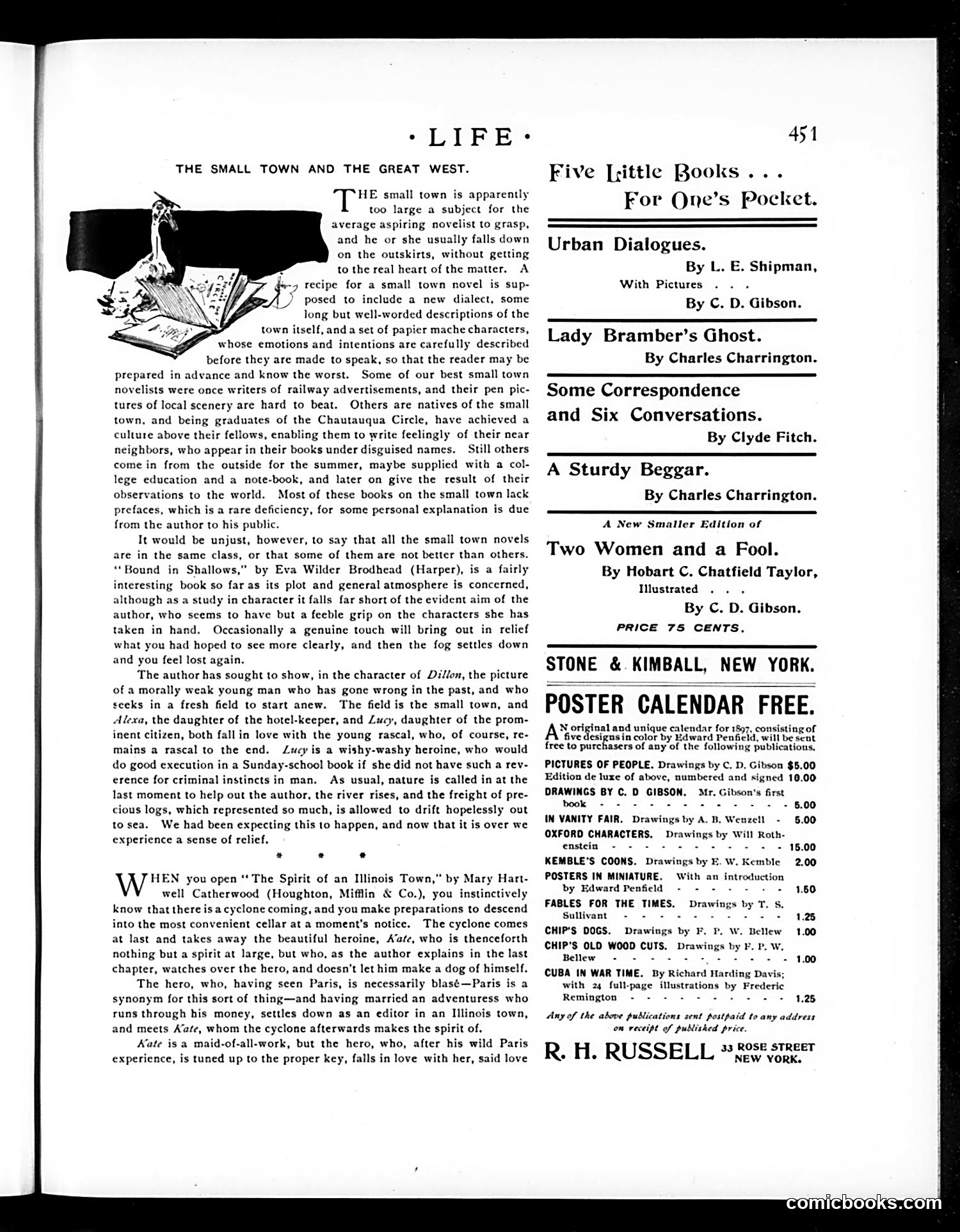
This page is primarily **book reviews and advertisements**, not political satire. The content critiques early American small-town novels as a literary genre. The small illustration at top left shows scattered books and papers, accompanying a meta-commentary on small-town fiction writing. The author mocks the formula: authors (often former railway ad writers or Chautauqua Circle graduates) stuff their novels with dialect, elaborate descriptions, and cardboard characters while claiming authenticity. Two specific novels are reviewed: - *Bound in Shallows* by Eva Wilder Brodhead—criticized for weak characterization despite genuine moments - *The Spirit of an Illinois Town* by Mary Hartwell Catherwood—mocked for its melodramatic reliance on a cyclone plot device and a "spirit" heroine The satire targets not politics but **pretentious rural American literature**: authors attempting profundity while recycling tired tropes and clichés. The page otherwise contains book advertisements from Stone & Kimball publishers.
📄 Transcribed text from this page (OCR, searchable)
Machine-transcribed from the original scan — historical spelling and the odd misread are preserved.
* LIFE: THE SMALL TOWN AND THE GREAT WEST. HE small town is apparently too large a subject for the average aspiring novelist to grasp, and he or she usually falls down on the outskirts, without getting to the real heart of the matter. A f-> recipe for a small town novel is sup- Sy posed to include a new dialect, some long but well-worded descriptions of the town itself, anda set of papier mache characters, whose emotions and intentions are carefully described before they are made to speak, so that the reader may be prepared in advance and know the worst. Some of our best small town novelists were once writers of railway advertisements, and their pen pic- tures of local scenery are hard to beat. Others are natives of the small town, and being graduates of the Chautauqua Circle, have achieved a culture above their fellows, enabling them to write feelingly of their near neighbors, who appear in their books under disguised names. Still others come in from the outside for the summer, maybe supplicd with a col- lege education and a note-book, and later on give the result of their observations to the world. Most of these books on the small town lack prefaces, which is a rare deficiency, for some personal explanation is due from the author to his public. It would be unjust, however, to say that all the small town novels are in the same class, or that some of them are not better than others. ‘Bound in Shallows,” by Eva Wilder Brodhead (Harper), is a fairly interesting book so far as its plot and general atmosphere is concerned, although as a study in character it falls far short of the evident aim of the author, who seems to have but a feeble grip on the characters she has taken in hand. Occasionally a genuine touch will bring out in relief what you had hoped to see more clearly, and then the fog settles down and you feel lost again. The author has sought to show, in the character of Dillon, the picture of a morally weak young man who has gone wrong in the past, and who secks in a fresh field to start anew. The field is the small town, and Alexa, the daughter of the hotel-keeper, and Lucy, daughter of the prom- inent citizen, both fallin love with the young rascal, who, of course, re- mains a rascal to the end. Lucy is a wishy-washy heroine, who would do good execution in a Sunday-school book if she did not have such a rev- erence for criminal instincts in man. As usual, nature is called in at the last moment to help out the author, the river rises, and the freight of pre- cious logs, which represented so much, is allowed to drift hopelessly out tosea, We had been expecting this to happen, and now that it is over we experience a sense of relief. * * * HEN you open “* The Spirit of an Illinois Town,” by Mary Hart- well Catherwood (Houghton, Mifflin & Co.), you instinctively know that there is acyclone coming, and you make preparations to descend into the most convenient cellar at a moment's notice. The cyclone comes at last and takes away the beautiful heroine, A’afe, who is thenceforth nothing but a spirit at large, but who, as the author explains in the last chapter, watches over the hero, and doesn’t let him make a dog of himself. The hero, who, having seen Paris, is necessarily blasé—Paris is a synonym for this sort of thing—and having married an adventuress who runs through his money, settles down as an editor in an Illinois town, and meets A’ate, whom the cyclone afterwards makes the spirit of, Kate is a maid-of-all-work, but the hero, who, after his wild Paris experience, is tuned up to the proper key, falls in love with her, said love 451 Five |sittle Books... For One’s Pocket. Urban Dialogues. By L. E. Shipman, With Pictures . By C. D. Gibson. Lady Bramber’s Ghost. By Charles Charrington. Some Correspondence and Six Conversations. By Clyde Fitch. A Sturdy Beggar. By Charles Charrington. A New Smaller Edition of Two Women and a Fool. By Hobart C. Chatfield Taylor, Illustrated . . . By C. D. Gibson. PRICE 75 CENTS. STONE & KIMBALL, NEW YORK. POSTER CALENDAR FREE. N original and unique calendar for 1897, consisting of five designs in color by Edward Penfield, will be sent free to purchasers of any of the following publications, PICTURES OF PEOPLE. Drawings by C. D. Gibson $5.00 Edition de luxe of above, numbered and signed 10.00 DRAWINGS BY C. D GIBSON, Mr. Gibson's first book IN VANITY FAIR. Drawings by A.B, Wenzell - 5.00 OXFORD CHARACTERS. Drawings by Will Roth- KEMBLE'S COONS. Drawings by E POSTERS IN MINIATURE. With an introduction by Edward Penfield - - - - - + FABLES FOR THE TIMES. Drawings by T. s. Sullivant - - - 2-2 7 eee CHIP'S DOGS. Drawings by F. P. W. Bellew CHIP'S OLD WOOD CUTS. Drawings by F. Pp. W. CUBA IN WAR TIME. By Richard Harding Davis with 24 full-page illustrations by Frederic Remington - - - - - + + + 16.00 W. Kemble 2.00 1.60 1.25 1.00 1.00 1.25 Any of the above publications sent postpaid to any address on receipt of published price. R. H. RUSSELL *® 2088 streer NEW YORK.