
Life, 1897-05-27 · page 24 of 32
Life — May 27, 1897 — page 24: what you’re looking at
What you’re looking at
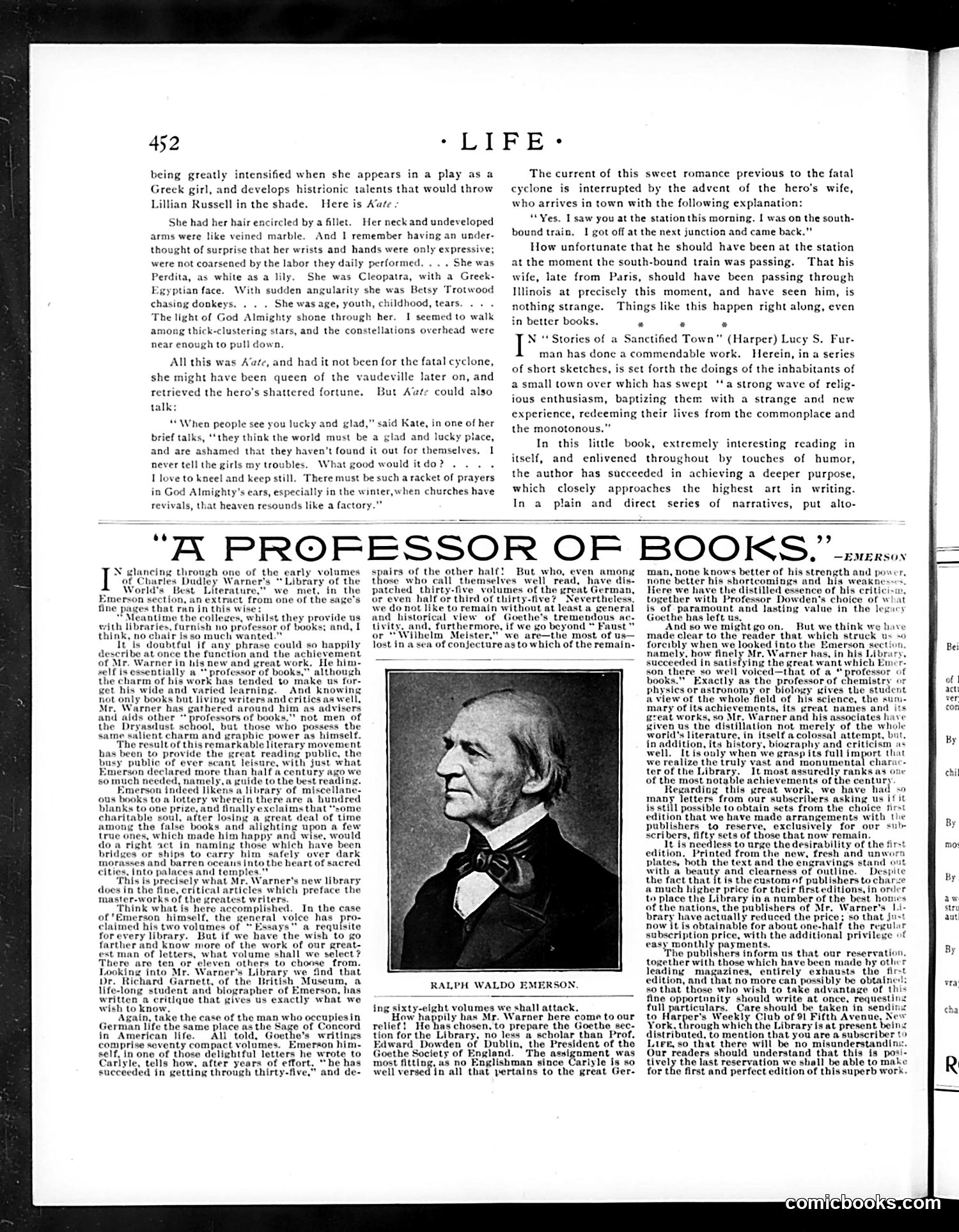
This page reviews Ralph Waldo Emerson's idea of a needed "professor of books" — someone to guide readers through literature. The article argues that **Charles Dudley Warner**, pictured here, has fulfilled this role through his "Library of the World's Best Literature." The piece praises Warner for gathering not dusty academics but living critics and writers as advisers. It emphasizes that Warner himself possesses both scholarly knowledge and appealing charm—he's made literary curation accessible rather than pedantic. The satire is gentle: the page contrasts Emerson's 1800s lament about colleges lacking book guidance with Warner's modern achievement in providing exactly that service through his comprehensive library project. The central argument celebrates Warner as the intellectual bridge between great literature and the general reading public—making him the "professor" Emerson said America needed.
📄 Transcribed text from this page (OCR, searchable)
Machine-transcribed from the original scan — historical spelling and the odd misread are preserved.
452 being greatly intensified when she appears in a play as a Greek girl, and develops histrionic talents that would throw Lillian Russell in the shade. Here is Aate She had her hair encircled by a fillet. Her neck and undeveloped arms were like veined marble. And I remember having an under- thought of surprise that her wrists and hands were only expressive; were not coarsened by the labor they daily performed. . . . She was Perdita, as white as a lily. She was Cleopatra, with a Greek- Sgyptian face. With sudden angularity she was Betsy Trotwood chasing donkeys. . . . She was age, youth, childhood, tears The light of God Almighty shone through her. I seemed to walk among thick-clustering stars, and the constellations overhead were h to pull down, All this was A’ae, and had it not been for the fatal cyclone, she might have been queen of the vaudeville later on, and retrieved the hero’s shattered fortune, But Aite could also talk: “When people see you lucky and glad,” said Kate, in one of her brief talks, ‘they think the world must be a glad and lucky place, and are ashamed that they haven't found it out for themselves. 1 never tell the girls my troubles. What good would itdo? . . . I love to kneel and keep still. There must be such a racket of prayers in God Almighty’s ears, especially in the winter, when churches have revivals, that heaven resounds like a factory.” *> LIFE: The current of this sweet romance previous to the fatal cyclone is interrupted by the advent of the hero's wife, who arrives in town with the following explanation: “Yes. I saw you at the station this morning. I was on the south- bound train, I got off at the next junction and came back.” How unfortunate that he should have been at the station at the moment the south-bound train was passing. That his wife, late from Paris, should have been passing through Illinois at precisely this moment, and have seen him, is nothing strange. Things like this happen right along, even in better books. . * ° I N “Stories of a Sanctified Town” (Harper) Lucy S. Fur- man has done a commendable work. Herein, in a series of short sketches, is set forth the doings of the inhabitants of a small town over which has swept ‘a strong wave of relig- ious enthusiasm, baptizing them with a strange and new experience, redeeming their lives from the commonplace and the monotonous.” In this little book, extremely interesting reading in itself, and enlivened throughout by touches of humor, the author has succeeded in achieving a deeper purpose, which closely approaches the highest art in writing. In a plain and direct series of narratives, put alto- glancing through one of the early volumes ‘of Charles Dudley Warner's “Library of the 4 World's Best Literature,” we met, in the Emerson section, an extract from one of the sage’s fine pages that ran in this wise: “Meantime the colleges, whilst they provide us ith libraries, furnish no professor of books; and, I think, no chair isso much wanted.” It'is doubtfal if any phrase could so happily describe at once the function and the achievement of Mr. Warner in his new and great work, He him- self is essentially a “* professor of books,” although the charm of his work has tended to make us for- get his wide and learning. And knowing hot only books but living writers and critics as well, Mr, Warner has gathered around him as advisers and aids other “ professors of books." not men of the Dryasdust school, but those who possess the same salient charm and graphic power as himself. The resultof this remarkable literary movement has been to provide the great reading public, the busy public of ever scant leisure, with just what Emerson declared more than half a century ago we so much needed, namely,a guide to the best reading. Emerson indeed likens a library of miscellane. ous books to a lottery wherein there are a hundred blanks to one prize, and finally exclaims that “some charitable soul, after losing a great deal of time among the false books and alighting upon a few true ones, which made him happy and wise, would doa right act in naming those which have been bridges or ships to carry him safely over dark morasses and barren oceans into the heart of sacred cities, Into palaces and temples.”* ‘This is precisely what Mr. Warner's new library does in the fine, critical articles which preface the master-works of the greatest writers. Think what is here accomplished. In the case of Emerson himself, the general voice has pro- claimed his two volumes of “Essays” a requisite forevery library. But if we have the wish to go farther and know more of the work of our great- est man of letters, what volume shall we select ? There are ten or eleven others to choose from. Looking into Mr. Warner's Library we find that Dr. Richard Garnett, of the British Museum, a life-long student and biographer of Emerson, has written a critique that gives us exactly what we wish to know Again, take the case of the man who occupiesin German life the same place as the Sage of Concord in American life. All told, Goethe's writings comprise seventy compact volumes. Emerson him- self, in one of those delightful letters he wrote to Carlyle, tells how, after years of effort, “he has succeeded in getting through thirty-five,” and de- spairs of the other half! But who, even among those who call themselves well read, have dis- patched thirty-five volumes of the great German, or even half or third of thirty-five? ‘evertheless, we do not like to remain without at least a general and historical view of Goethe's tremendous ac. ‘. and, furthermore, if we go beyond ™ Faust ™ or “Wilhelm Meiste we are—the most of us— lost in a sea of conjecture as to which of the remain- RALPH WALDO EMERSON, ing sixty-elght volumes we shall attack, How happily has Mz. Warner here come to our relief! He has chosen, to prepare the Goethe sec- tion for the Library, no less a scholar than Prof. Edward Dowden of Dublin, the President of tho Goethe Society of England. The assignment was most fitting, as no Englishman since Cariyle is so well versed in all that pertains to the great Ger- “Ty PROFESSOR OF BOOKS.” smn man, none knows better of his strength and power, none better his shortcomings and his weakn Here we have the distilled essence of his critici-c together with Professor Dowden’s choice of is of paramount and lasting value in the le Goethe has left us, And 0 we might goon, But we think we have made clear to the reader that which struck us -0 forcibly when we looked into the Emerson section. namely, how finely Mr. Warner has, in his Library. succeeded in satisfying the great want which Emer. son there so well voiced—that of a “professor of books, actly as the professor of chemistry or physics or astronomy or biology gives the student a view of the whole field of his science, the sun mary of its achievements, its great names and its reat works, so Mr, Warner and his associates have given us the distillation not merely of the who world’s literature, in itself a colossal attempt, bi in addition, its history, biography and criticism as well. It is ouly when we grasp its full import that we realize the truly vast and monumental charac- ter of the Library. It most assuredly ranks as ov of the most notable achievements of the century Regarding this great work, we have many letters from our subscribers asking us if it is still possible to obtain sets from the choice frst edition that we have made arrangements with te publishers to reserve, exclusively for ovr sul scribers, fifty sets of those that now remain. It is needless to urge the desirability of the fir-t edition, Printed from the new, fresh and unworn plates, both the text and the engravings stand out with a beauty and clearness of outline. | Despite the fact that {t is the custom of publishers to cha a much higher price for their firsteditions, in order ty place the Library in a number of the best hones of the nations, the publishers of Mr. Warner's | brary have actually reduced the price; so that ju~ now it is obtainable for about one-half the regular subscription price, with the additional privilege of easy monthly payinents, , "The publishers inform us that our reservat together with those which have been made by other leading magazines, entirely exbausts the fir-t edition, and that no more can possibly be obtaines!: so that'those who wish to take advantage of this fine opportunity should write at once, requesting full particulars. Care should be taken in sending to Harper's Weekly Club of 91 Fifth Avenue, N York, through which the Library is at present bein distributed, to mention that you are a subscriber to Liee, so that there will be no misunderstandin:. Our readers should understand that this is posi- tively the last reservation we shall be able to make for the first and perfect edition of this superb work.