
A complete issue · 20 pages · 1897
Life — May 20, 1897
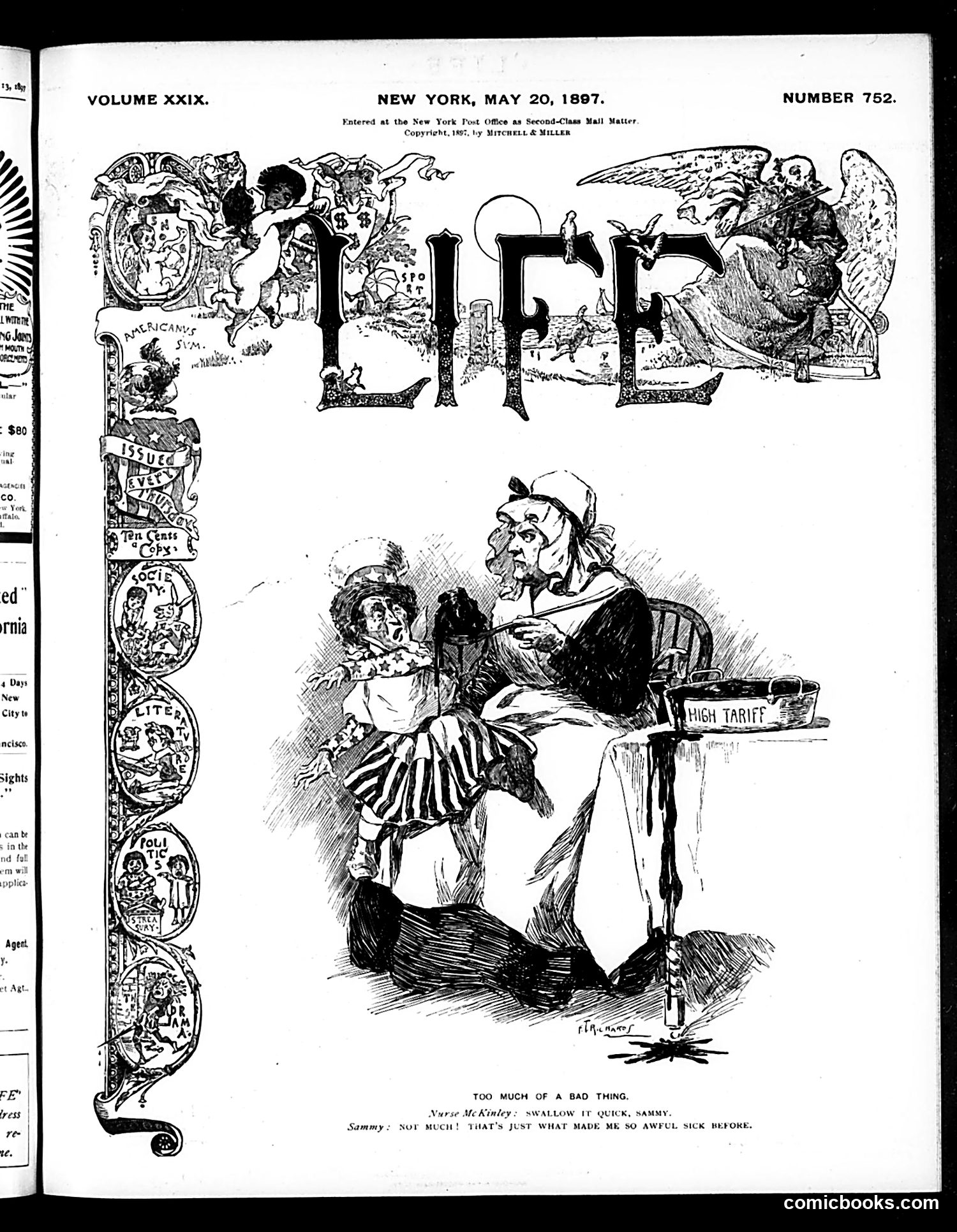
This cartoon satirizes the **high tariff policy** affecting American commerce. An older man (likely representing a politician or tariff advocate) force-feeds a sickly child labeled "Sammy" (representing American business or the public) from a spoon marked "HIGH TARIFF." The child protests the excessive dose, saying "SWALLOW IT QUICK, SAMMY," while Sammy responds "NOT MUCH! THAT'S JUST WHAT MADE ME SO AWFUL SICK BEFORE." The satire critiques how protective tariffs, intended to help American industry, instead made the economy ill—and continuing this policy would worsen the problem. The cartoon suggests tariffs were a failed remedy being recklessly reapplied.
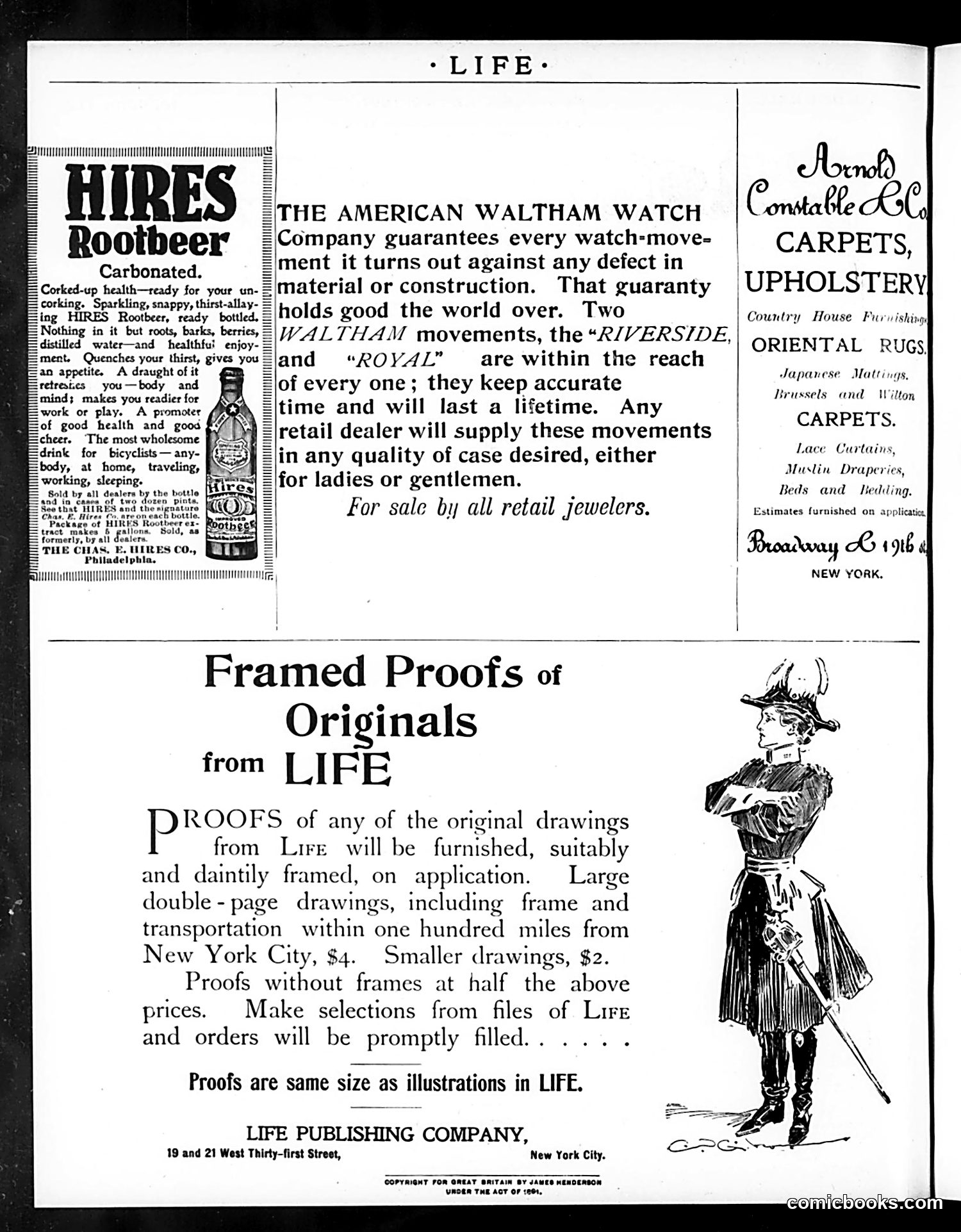
This page is primarily **advertising**, not political satire. It contains three ads: 1. **Hires Rootbeer** (left): A carbonated beverage pitched as healthful and refreshing for various activities—bicycling, work, home leisure. 2. **American Waltham Watch Company** (center): Promotes reliable watch movements ("Riverside" and "Royal") guaranteed against defects, available through retail jewelers. 3. **Arnold Constable & Co.** (right): A New York furnishings company offering carpets, upholstery, Oriental rugs, curtains, and bedding. Below these is a **self-promotional notice** from Life Publishing Company offering framed proofs of original drawings from the magazine for home display, priced $2-$4 depending on size and framing. The illustrated figure appears to be decorative period costume, not a specific political reference.
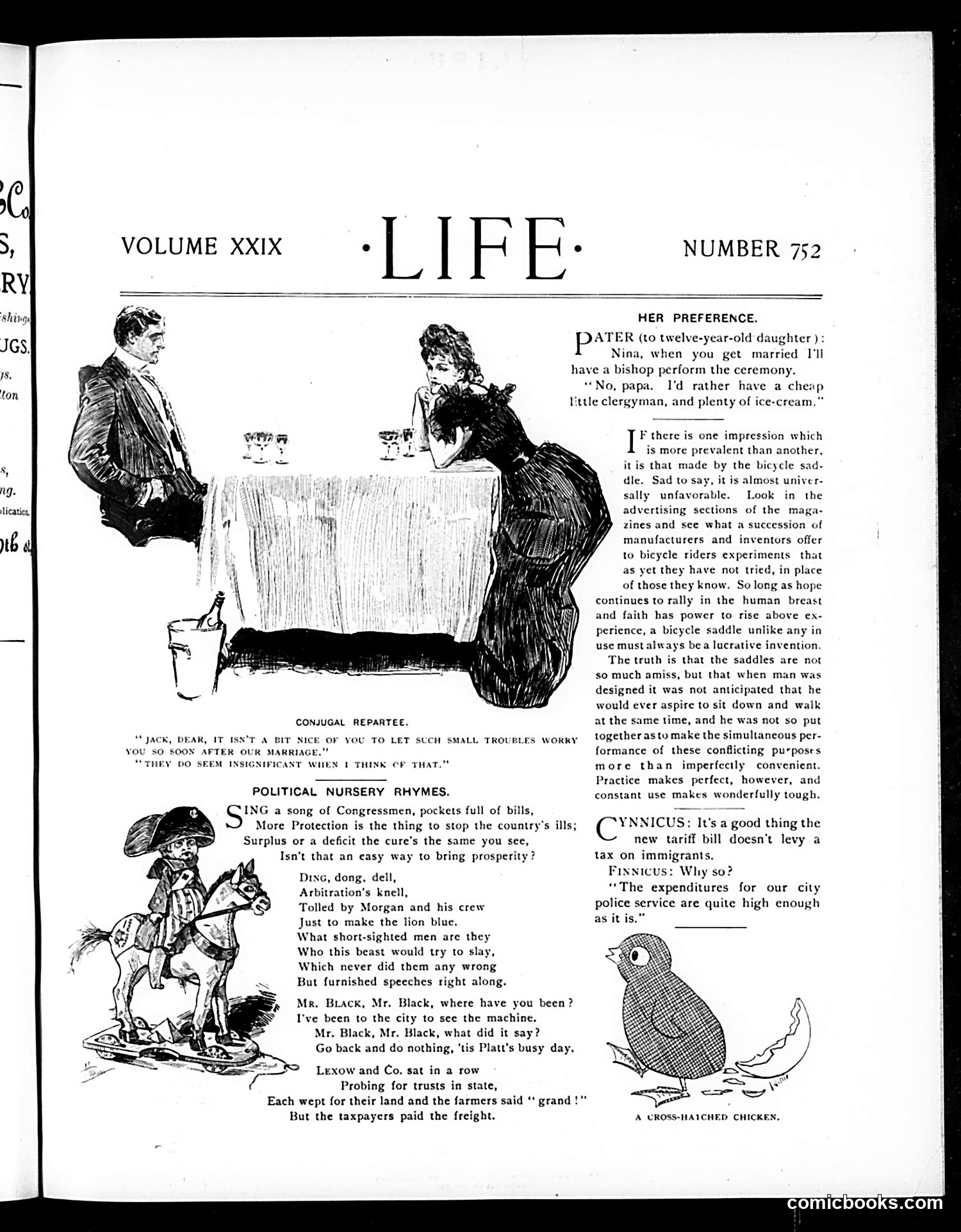
**"Her Preference"** (top cartoon): A woman declines a formal church wedding, preferring "a cheap little clergyman, and plenty of ice-cream." This satirizes excessive Victorian wedding ceremonies and their social pretension. **"Conjugal Repartee"**: A domestic humor piece about marital squabbling over minor household troubles. **"Political Nursery Rhymes"**: Satirical verses mocking Congressional spending and protectionist tariffs. References to "Morgan and his crew" suggest criticism of wealthy industrialists and political corruption. The rhymes attack government fiscal mismanagement and special interests favoring the wealthy while farmers and taxpayers bear costs. **"Cynicus" dialogue**: Brief satirical exchange about municipal police expenditures and immigration taxation policy. The page combines domestic humor with biting political-economic critique typical of Life's satirical agenda.
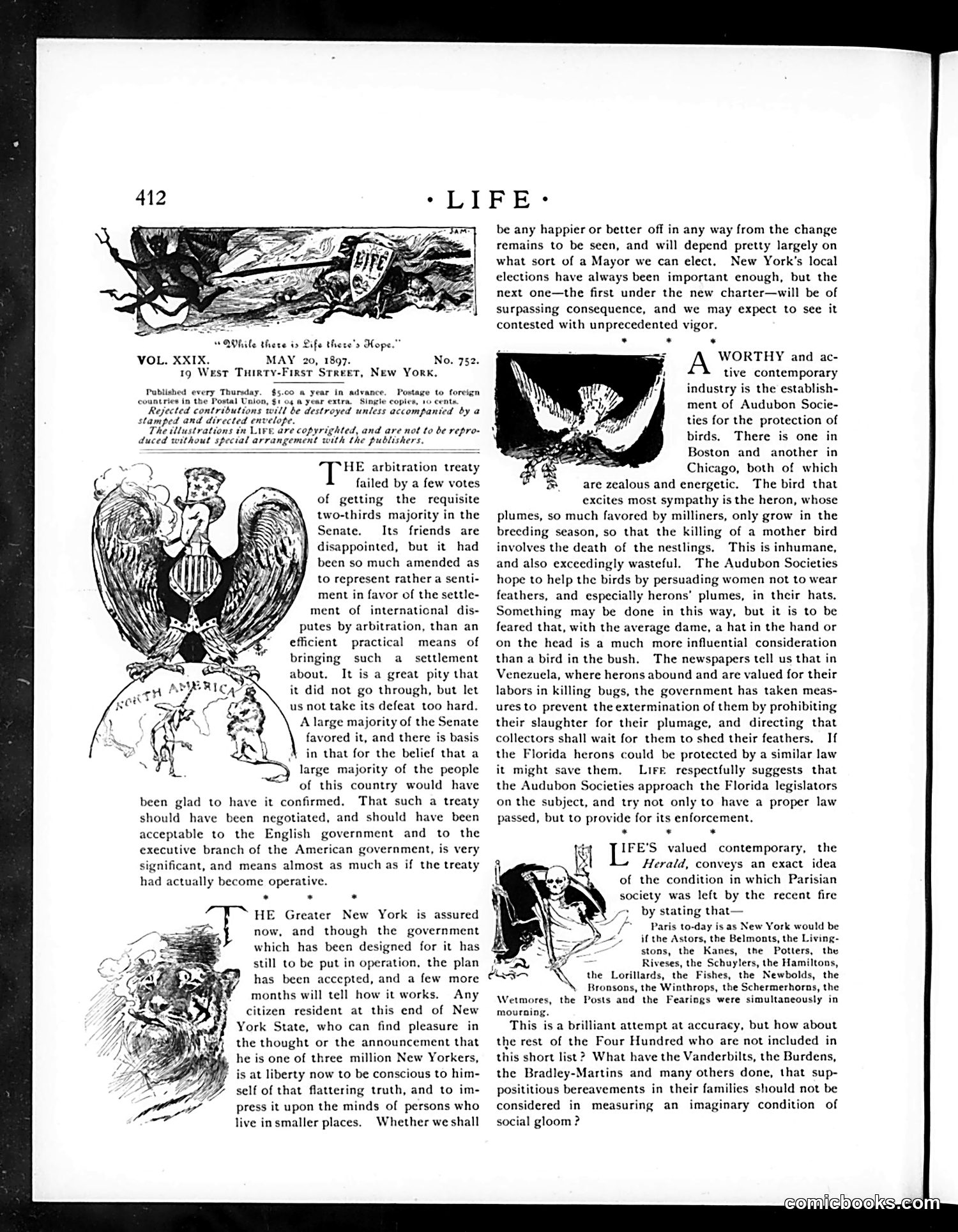
**The Main Cartoon (Top Left):** Shows an eagle labeled "WITH AMERICA" appearing dejected or defeated, relating to the failed arbitration treaty discussed in the text. The cartoon critiques the Senate's rejection of an international arbitration treaty by a narrow margin—it fell short of the two-thirds majority required for passage. **The Point:** The cartoonist satirizes American isolationism and the Senate's reluctance to embrace international dispute resolution. The drooping eagle symbolizes national disappointment that America missed an opportunity for progressive diplomacy and peaceful conflict settlement with other nations. **Context:** This reflects early 20th-century debates between internationalists and isolationists regarding America's role in global affairs.
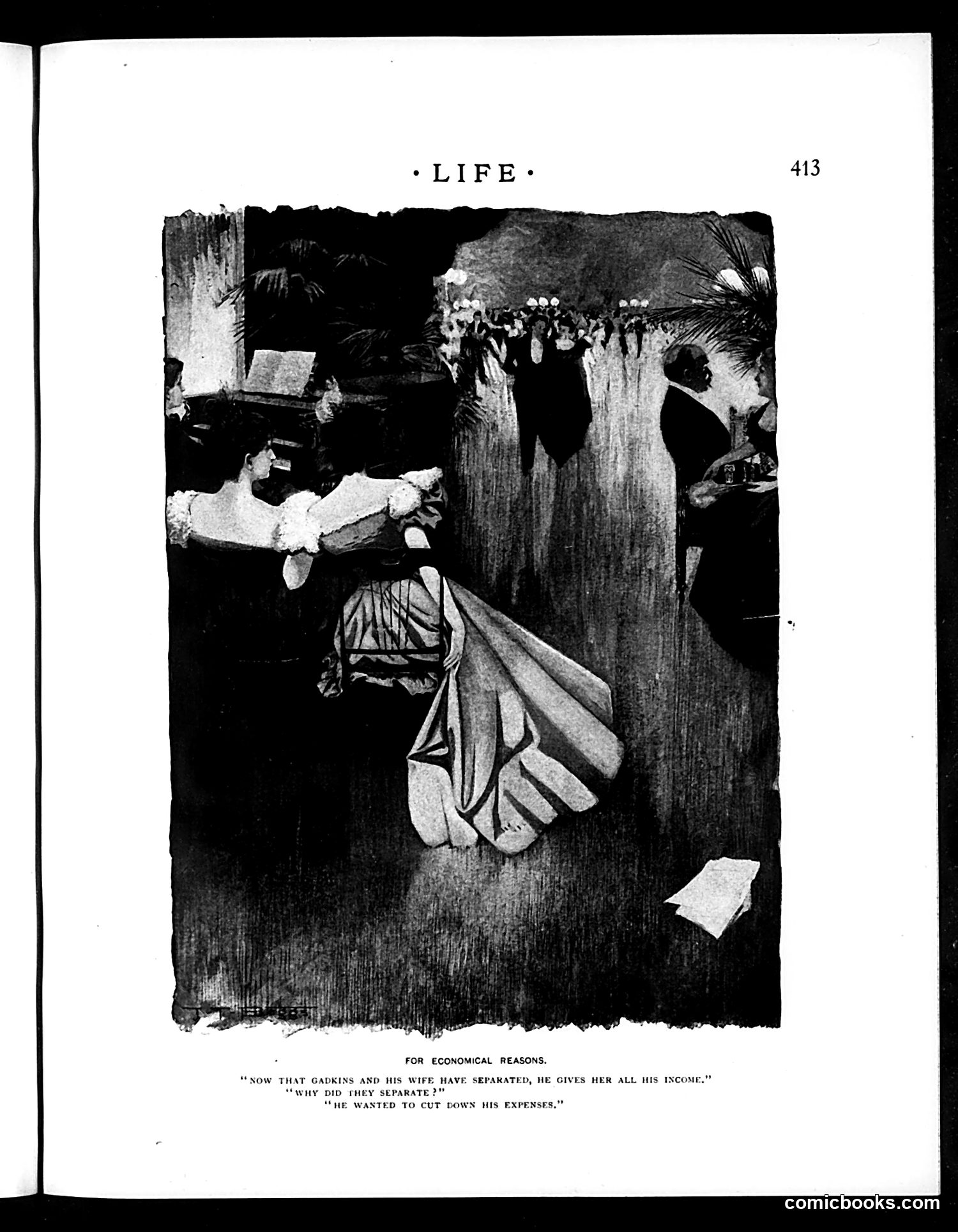
This satirical cartoon depicts a domestic separation motivated by financial concerns rather than marital discord. The caption explains the scenario: a husband has separated from his wife to give her his entire income, enabling him to "cut down his expenses." The humor lies in the absurdity of the logic—by living apart, the man apparently believes he reduces household costs despite now maintaining two separate residences. The illustration shows the wife in an evening gown at what appears to be a social gathering, while the husband stands apart, suggesting the arrangement allows him to live more modestly while she maintains appearances. The satire critiques either marital economics, taxation strategies, or both—possibly referencing contemporary legal/financial arrangements around spousal support or property division during separations.
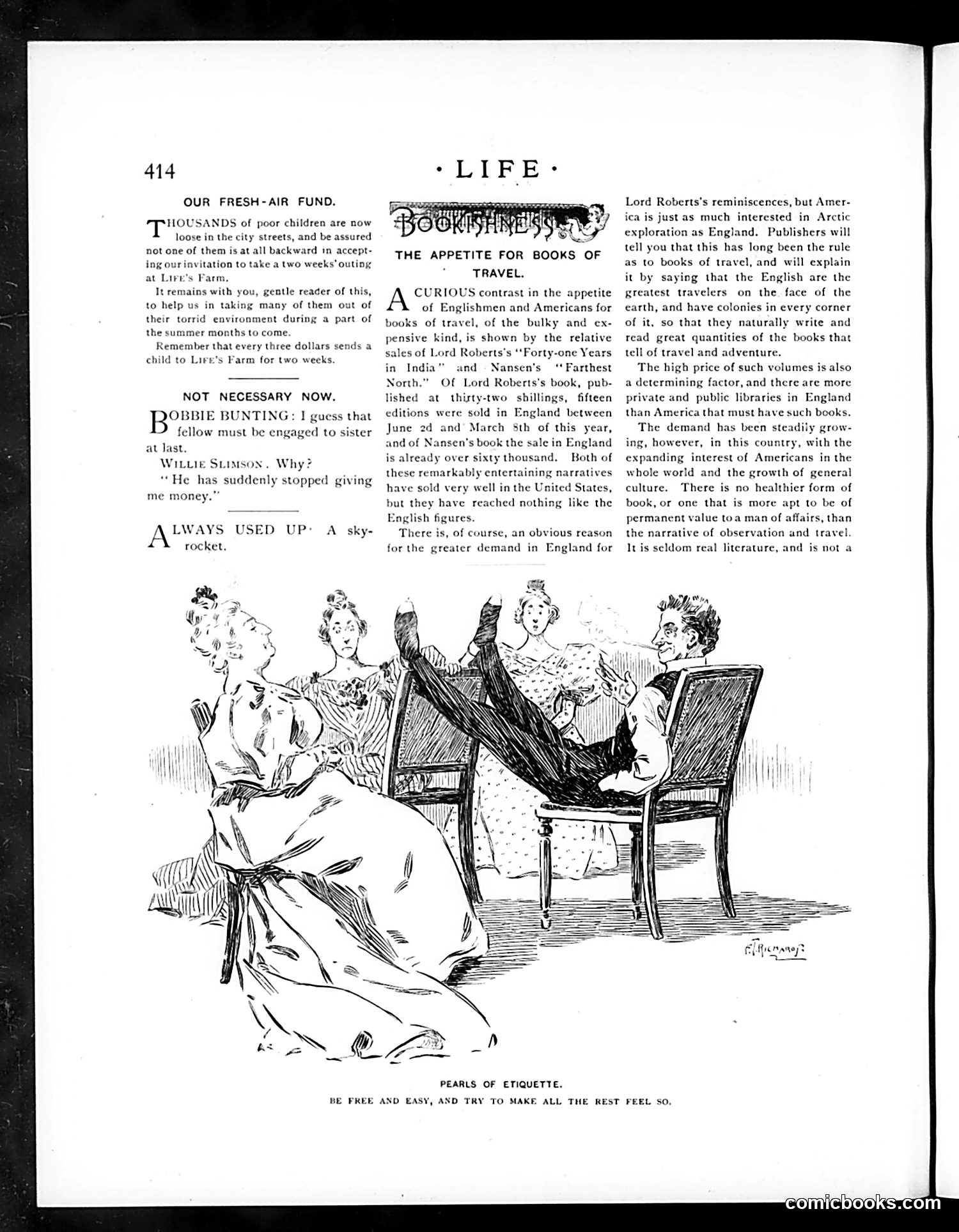
This Life magazine page (page 414) contains three distinct sections: **"Our Fresh-Air Fund"** and **"Not Necessary Now"** are brief humor pieces about charity and relationships—not politically significant. **"The Appetite for Books of Travel"** is the substantive content. It discusses contrasting book sales between England and America, noting Lord Robert's "Forty-one Years in India" and Nansen's "Farthest North" sold well in England but poorly in America. The article attributes England's greater demand for travel narratives to their imperial colonies and worldly interests, while Americans are developing similar interests. **The illustration** labeled "Pearls of Etiquette" depicts five well-dressed figures in a social setting—appears to be satirizing upper-class social behavior, though the specific joke remains unclear from the image alone. The page reflects early 20th-century Anglo-American cultural differences regarding literature and imperial expansion.
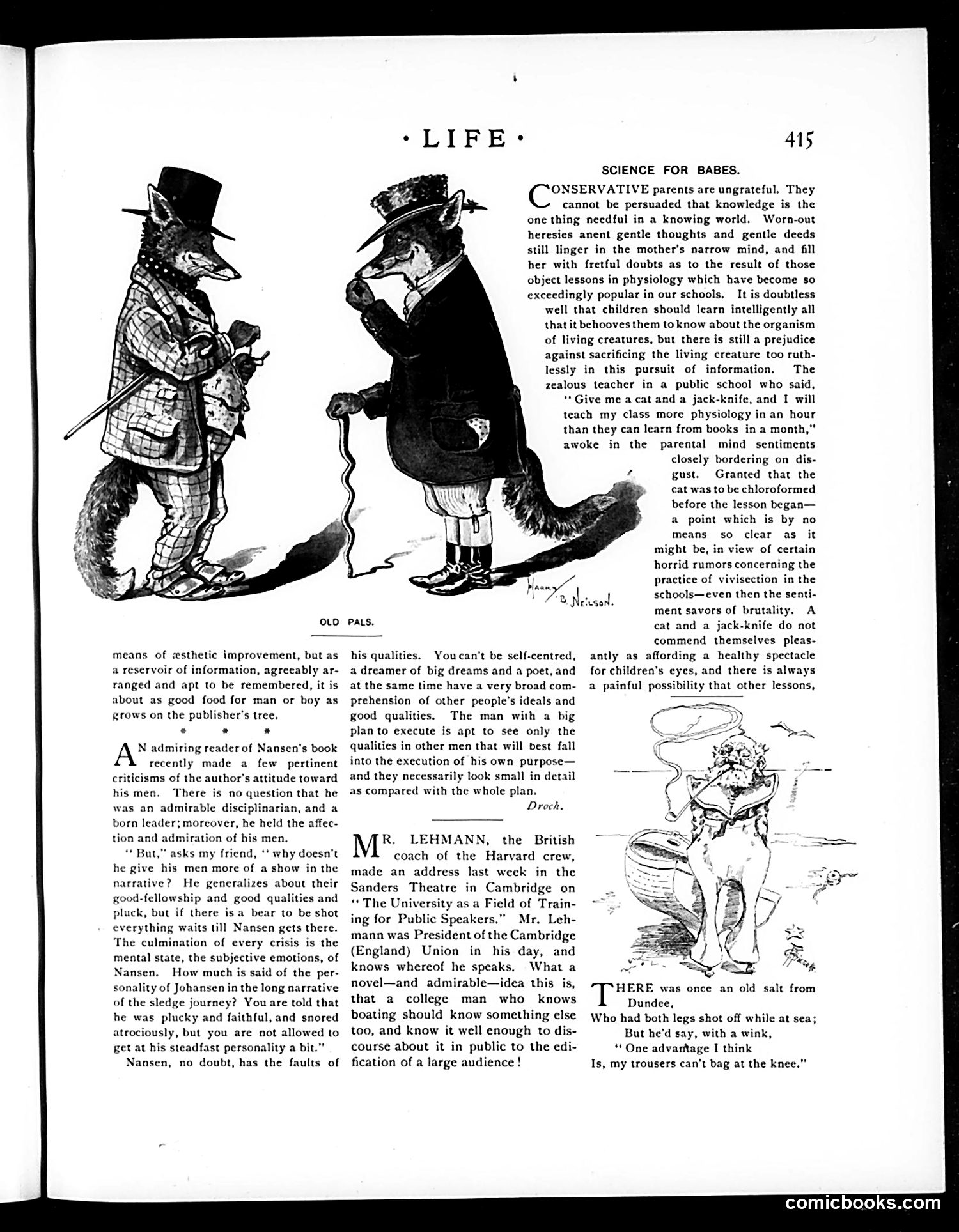
This satirical cartoon depicts two anthropomorphized animals—likely a fox and a badger or similar creature—dressed as distinguished gentlemen in top hats and formal wear, walking together. The caption "Old Pals" suggests former colleagues or associates. The accompanying article "Science for Babes" criticizes conservative parents who resist teaching physiology and anatomy in schools, fearing it encourages animal vivisection. The text mentions a teacher's controversial statement about teaching "a cat and a jack-knife" for practical anatomy lessons. The cartoon likely satirizes this educational debate, using animal characters to mock either the resistance to science education or the extremist methods some proposed. The "old pals" may represent competing philosophies about education and scientific knowledge.
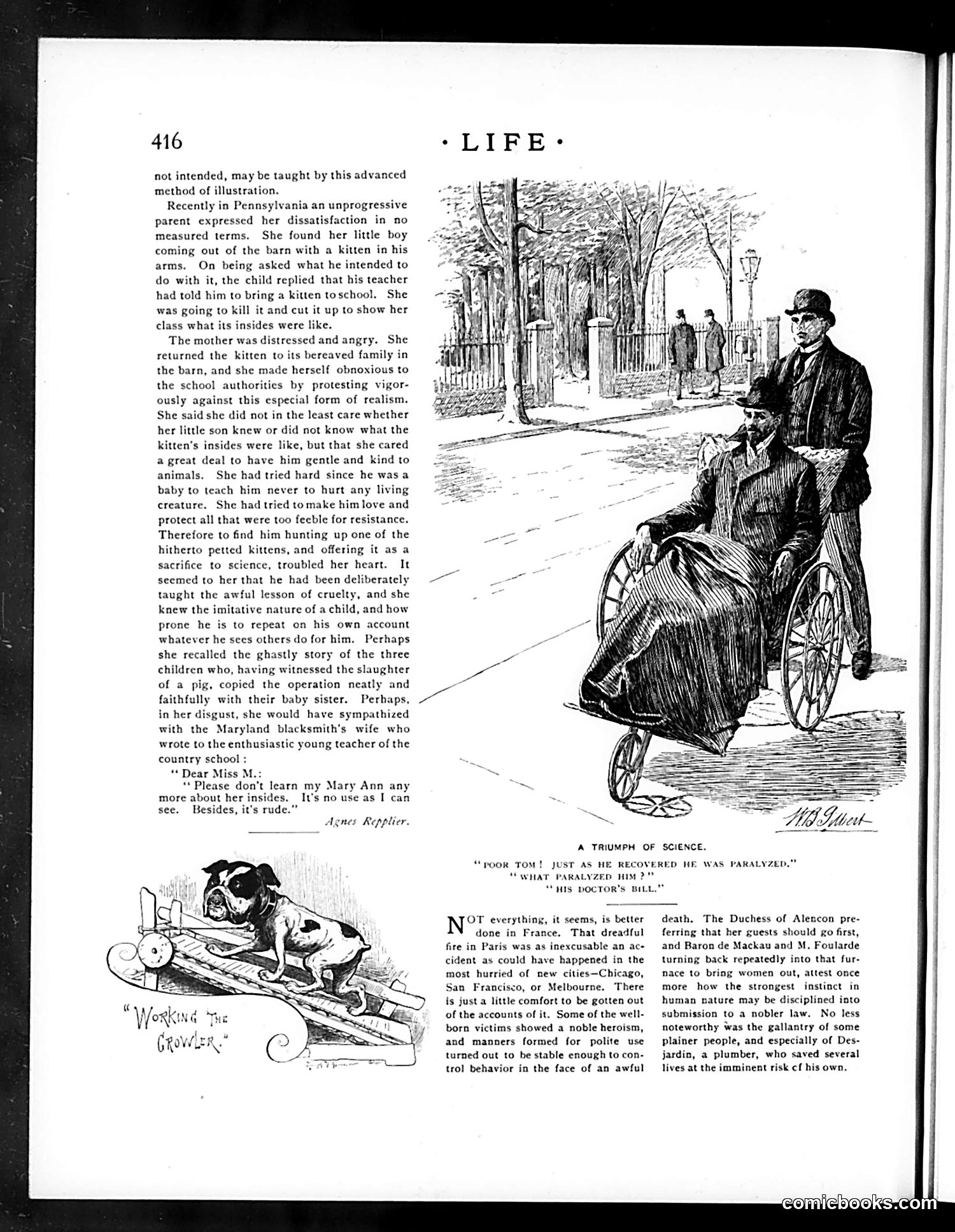
The page contains two satirical illustrations commenting on education and child development: **Upper illustration** ("A Triumph of Science"): Shows a woman on a bicycle encountering a man. The caption references a child's medical recovery, with dialogue about a doctor's bill. This appears to satirize the emerging field of scientific pedagogy—the accompanying text describes a Pennsylvania mother's complaint that progressive teaching methods encouraged her son to harm animals in the name of "science." **Lower illustration** ("Working the Growler"): Depicts a dog pulling a cart, likely referencing working-class urban life and the use of animals in labor. The page's main satirical point critiques overly literal or misapplied "scientific" teaching methods that could inadvertently teach children cruelty rather than genuine scientific understanding. The text emphasizes tension between progressive education and traditional moral values.
This page contains two satirical sketches labeled "Oil Broadsides." The cartoons mock oil industry figures through exaggerated caricature and physical comedy. The top illustration depicts a rotund man in formal dress being physically thrown or falling, suggesting the chaotic nature of oil business dealings. The bottom sketch shows multiple figures in what appears to be a comedic pile or struggle, likely representing competing oil interests or financial conflicts. The accompanying text references oil broadsides—attacks or criticisms—targeting the industry's practices. The sketches use physical humor and grotesque caricature typical of early-20th-century satirical cartooning to mock oil barons and their competitive, often underhanded business tactics. Without clearer text legibility, specific individuals targeted remain unclear, but the cartoons critique the oil industry's perceived greed and ruthlessness.
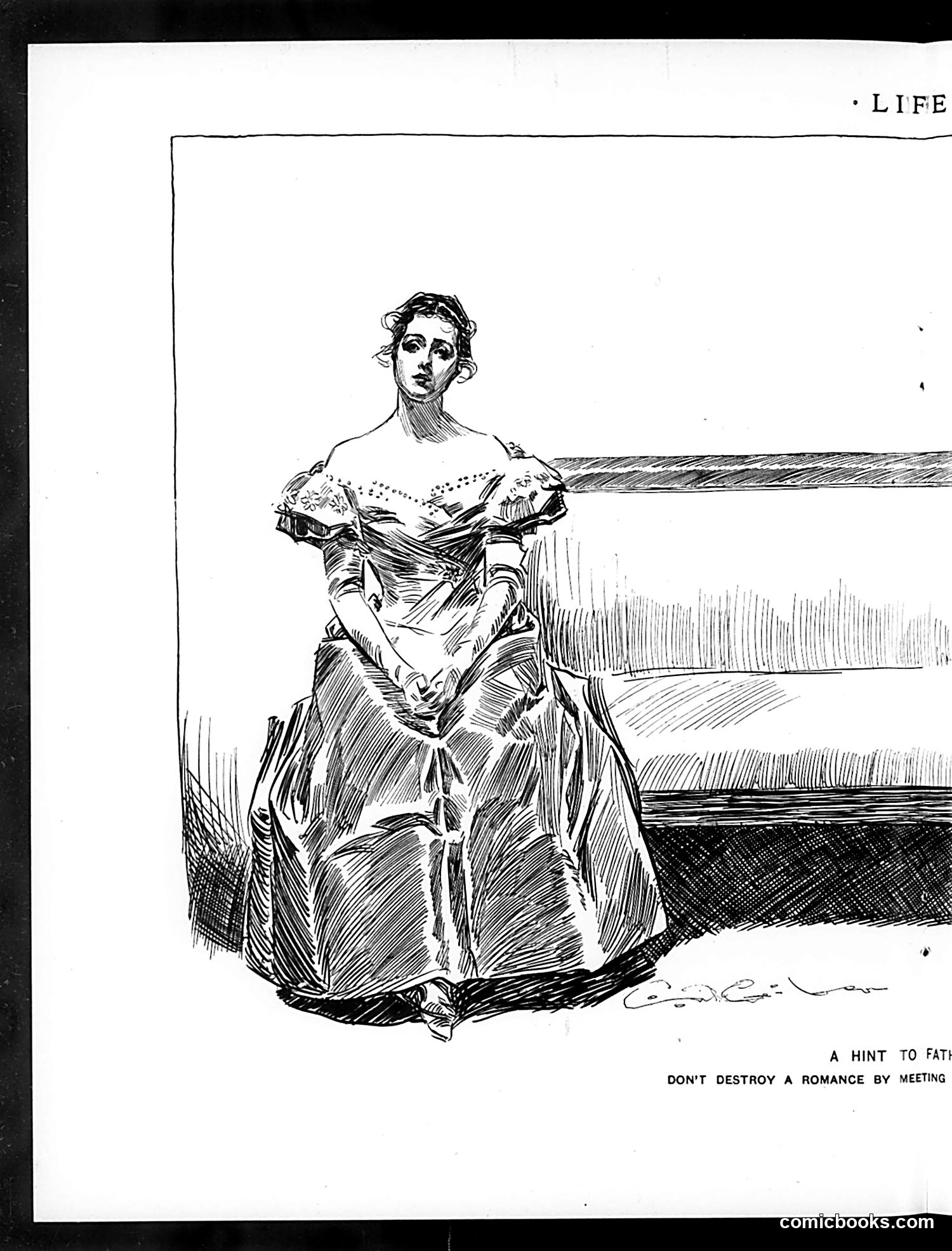
This is a satirical illustration from *Life* magazine showing a woman in an elegant Edwardian-era gown with puffed sleeves, gazing pensively into the distance. The caption reads: "A HINT TO FATHERS: DON'T DESTROY A ROMANCE BY MEETING..." The joke targets parental interference in courtship. The satire suggests that fathers who actually *meet* their daughters' romantic suitors tend to ruin the romance—presumably because the real man fails to live up to the idealized image the woman has constructed in her imagination. By remaining unseen and mysterious, the suitor maintains romantic appeal; direct acquaintance exposes reality and disappoints. This reflects common Edwardian anxieties about courtship, parental authority, and the gap between romantic fantasy and mundane reality.
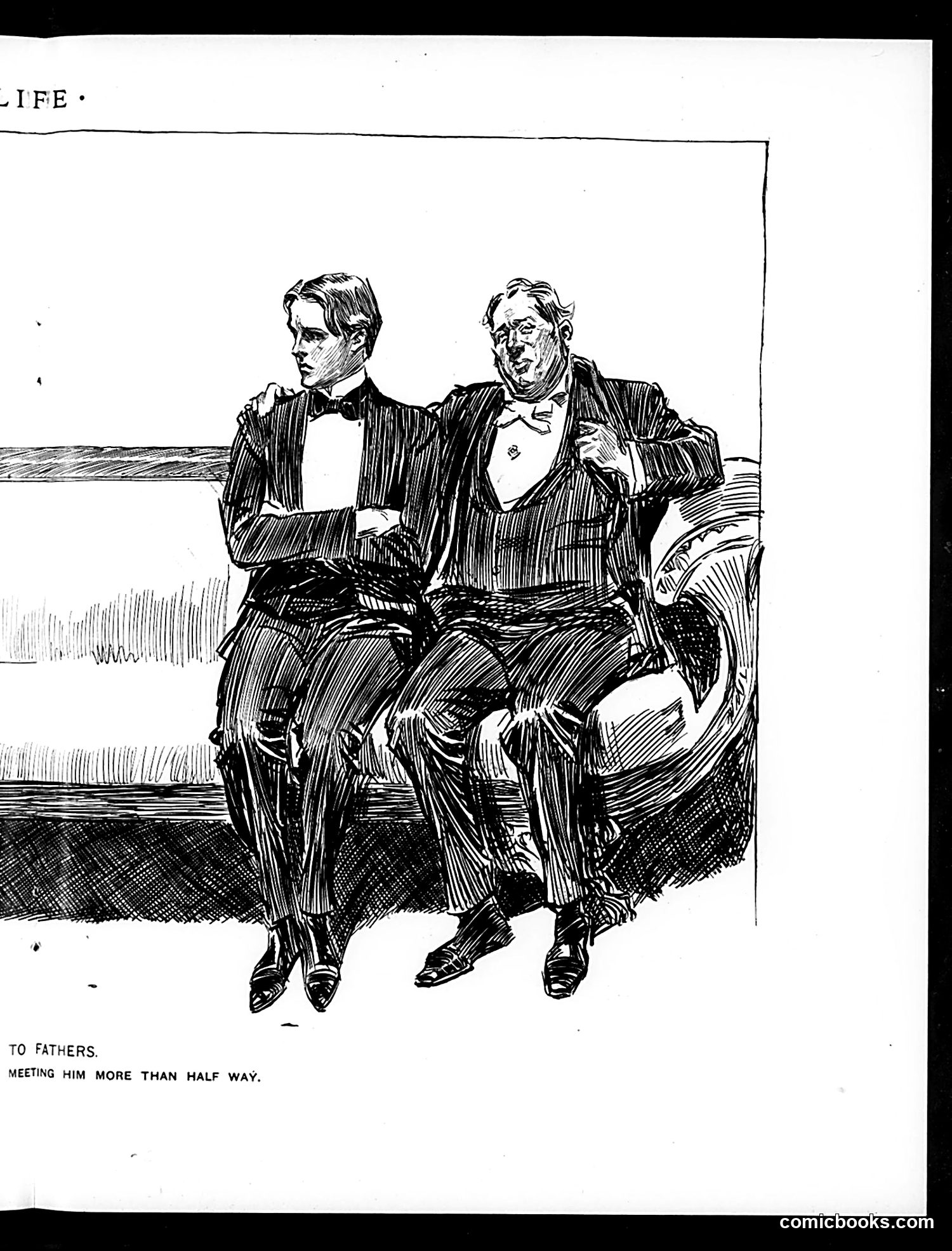
This is a satirical illustration titled "To Fathers: Meeting Him More Than Half Way." The image shows two men in formal evening wear seated together on what appears to be a couch or bench. The man on the left is younger; the man on the right is older and gestures while speaking. The caption suggests this depicts a father-son interaction, with the phrase "meeting him more than half way" implying compromise or concession. The satire likely comments on parental indulgence or a father yielding too readily to his son's wishes or behavior—a common theme in early-20th-century Life magazine commentary on family dynamics and generational tensions. The formal setting and dress suggest upper-class concerns about proper conduct and paternal authority.
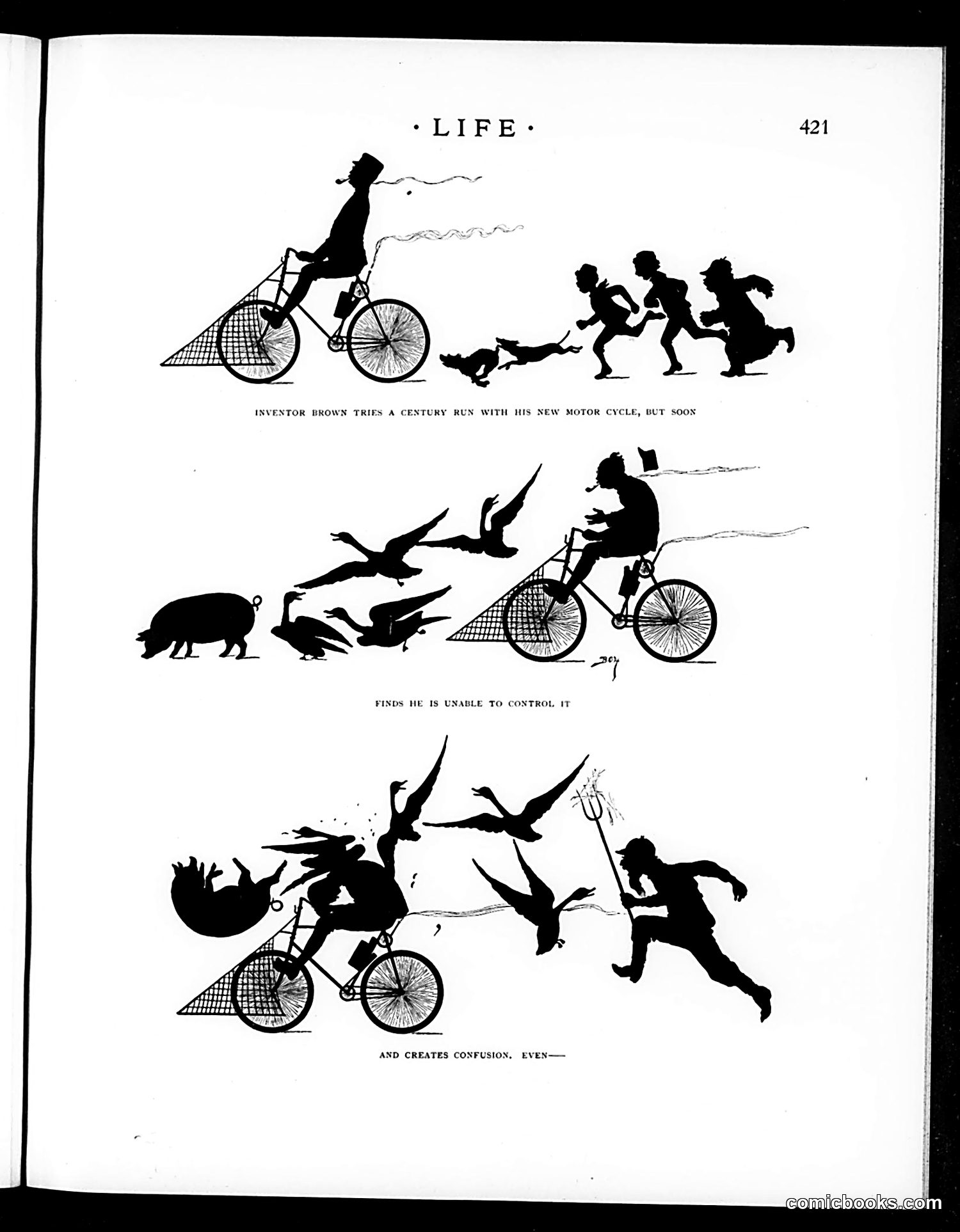
This is a humorous three-panel sequence satirizing an inventor named Brown and his new motorized bicycle. The comic depicts a slapstick narrative: **Panel 1:** Brown confidently attempts a "century run" (100-mile journey) on his motor cycle, but immediately loses control, scattering pedestrians and a dog in chaos. **Panel 2:** He careens through a barnyard, unable to manage the vehicle as animals scatter wildly. **Panel 3:** The chaos culminates in complete mayhem—multiple people are flung into the air. The satire mocks both early motor vehicle technology (unreliable and dangerous) and the hubris of inventors promoting unproven innovations. It's a commentary on the hazards of new technology and the gap between technological ambition and practical safety—concerns as relevant to early 1900s audiences as modern discussions about experimental vehicles remain today.
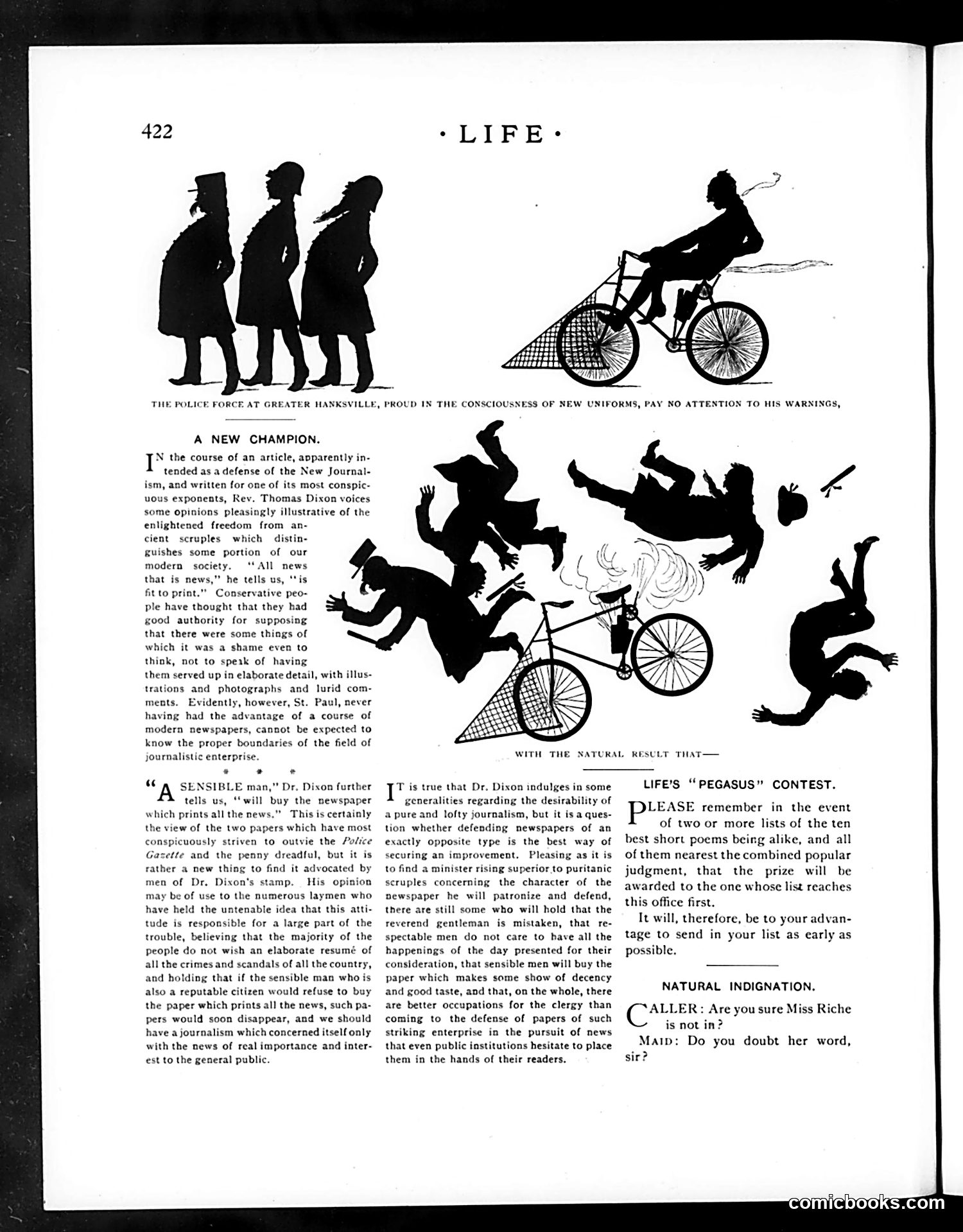
This page satirizes **Rev. Thomas Dixon**, a prominent clergyman who defended "New Journalism"—sensationalist newspapers that published crime, scandal, and lurid details under the motto "all news that is news is fit to print." The cartoons mock Dixon's position: the top illustration shows a bicycle rider ignoring police warnings (representing Dixon dismissing traditional moral scruples), while the chaotic middle image depicts cyclists crashing spectacularly, symbolizing the social chaos Life argues results from sensationalist papers. The text criticizes Dixon for defending newspapers that rivaled the *Police Gazette* in sensationalism, arguing that respectable citizens and clergy should oppose rather than champion such publications. Life's satire targets the hypocrisy of a minister endorsing "lofty journalism" while defending papers of "striking enterprise" that even public institutions hesitate to distribute publicly. The page presents a conservative critique of emerging mass-market media ethics.
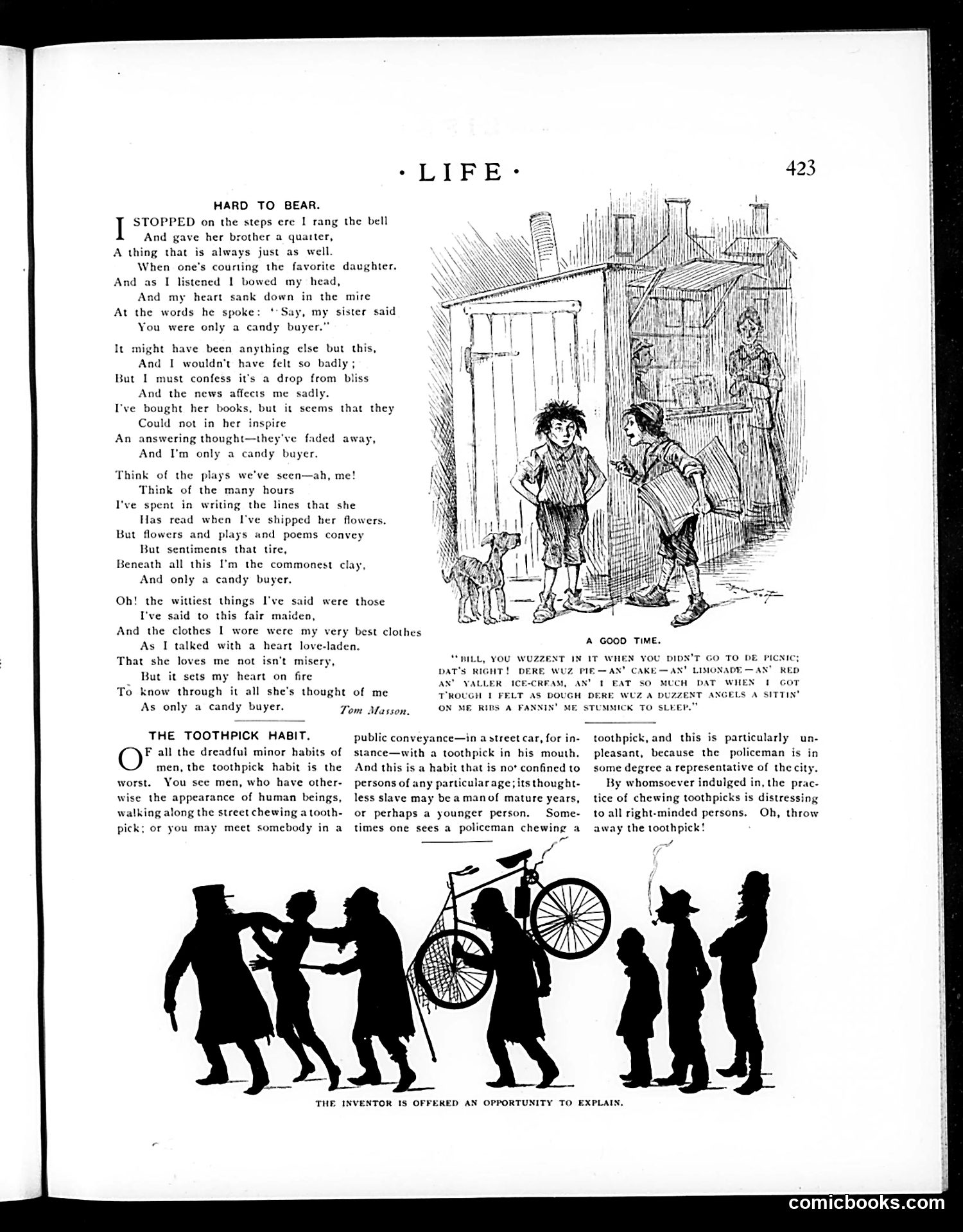
This page contains two satirical pieces from *Life* magazine: **"Hard to Bear"** is a romantic comedy poem by Tom Masson. A young man courting a woman is devastated to learn from her brother that she views him merely as "a candy buyer"—someone who gives her sweets but lacks substance or serious romantic potential. The humor lies in his indignation: despite attending plays, writing poetic notes accompanying flowers, and dressing well, he's been reduced to a shallow gift-giver in her eyes. **"The Toothpick Habit"** is social satire criticizing men—particularly in public transportation—who chew toothpicks. The author considers this habit vulgar and undignified, especially offensive when practiced by authority figures like policemen, who should set better examples. The silhouette cartoon shows a bicycle inventor awkwardly surrounded by people, captioned "The Inventor Is Offered an Opportunity to Explain"—likely mocking an inventor confronted about an unwanted product or consequence. Both pieces reflect early-20th-century concerns with manners, propriety, and courtship conventions.
This page contains a satirical short story mocking overwrought melodrama and naive frontier justice. The main narrative follows Major Skadgers's daughter Birdie, allegedly "kidnapped" by Speckled Lightning, a Kiowa chief. The rescue party arrives to find Birdie—described as thirty-seven years old—calmly holding the chief's scalp, having apparently killed him herself. The joke targets Victorian sensationalism: readers expecting a tragic "damsel in distress" rescue story instead get a capable woman who doesn't need saving. The accompanying anecdote about an ignorant new coroner who literally sits on a corpse during an autopsy reinforces the theme of frontier incompetence and absurdity. The humor relies on subverting expectations of melodramatic newspaper fiction while satirizing both overblown military heroics and frontier bumbling.
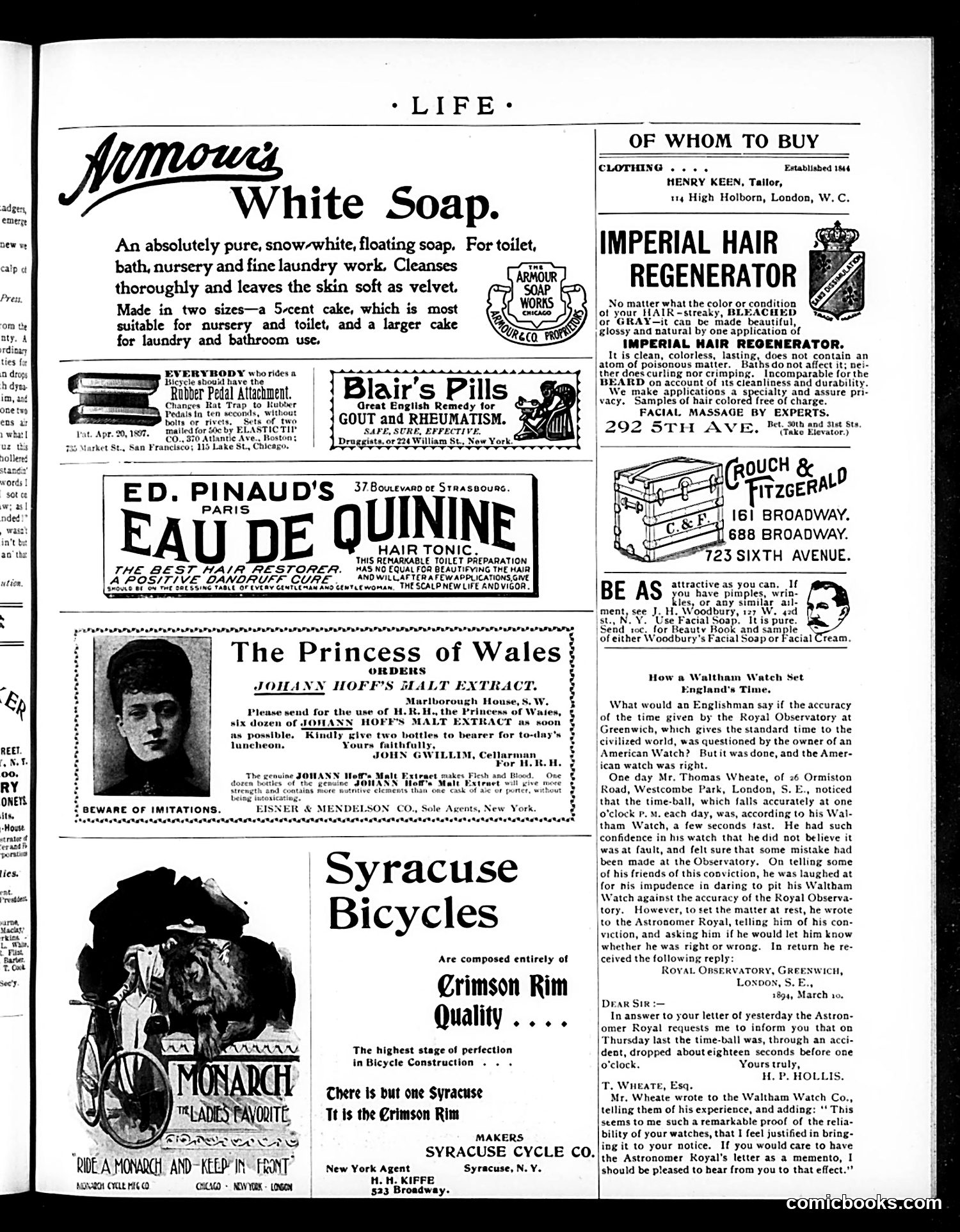
This is primarily a **advertising page from Life magazine**, not a political cartoon or satire. It contains product advertisements typical of the early 1900s, including Armour's White Soap, Blair's Pills for gout, hair tonics, and Syracuse Bicycles. The notable content is a **testimonial story** about a Waltham Watch owner named Thomas Wheate who challenged the Royal Observatory at Greenwich. The narrative humorously describes how Wheate's American watch proved more accurate than England's official timekeeping authority—a subtle jab at American manufacturing superiority over British standards. This was likely meant to appeal to nationalist pride and demonstrate American product quality. The page also features an advertisement for "The Princess of Wales" malt extract, using royal endorsement as a selling strategy. Overall, the page reflects early 20th-century advertising practices and consumer culture rather than political satire.
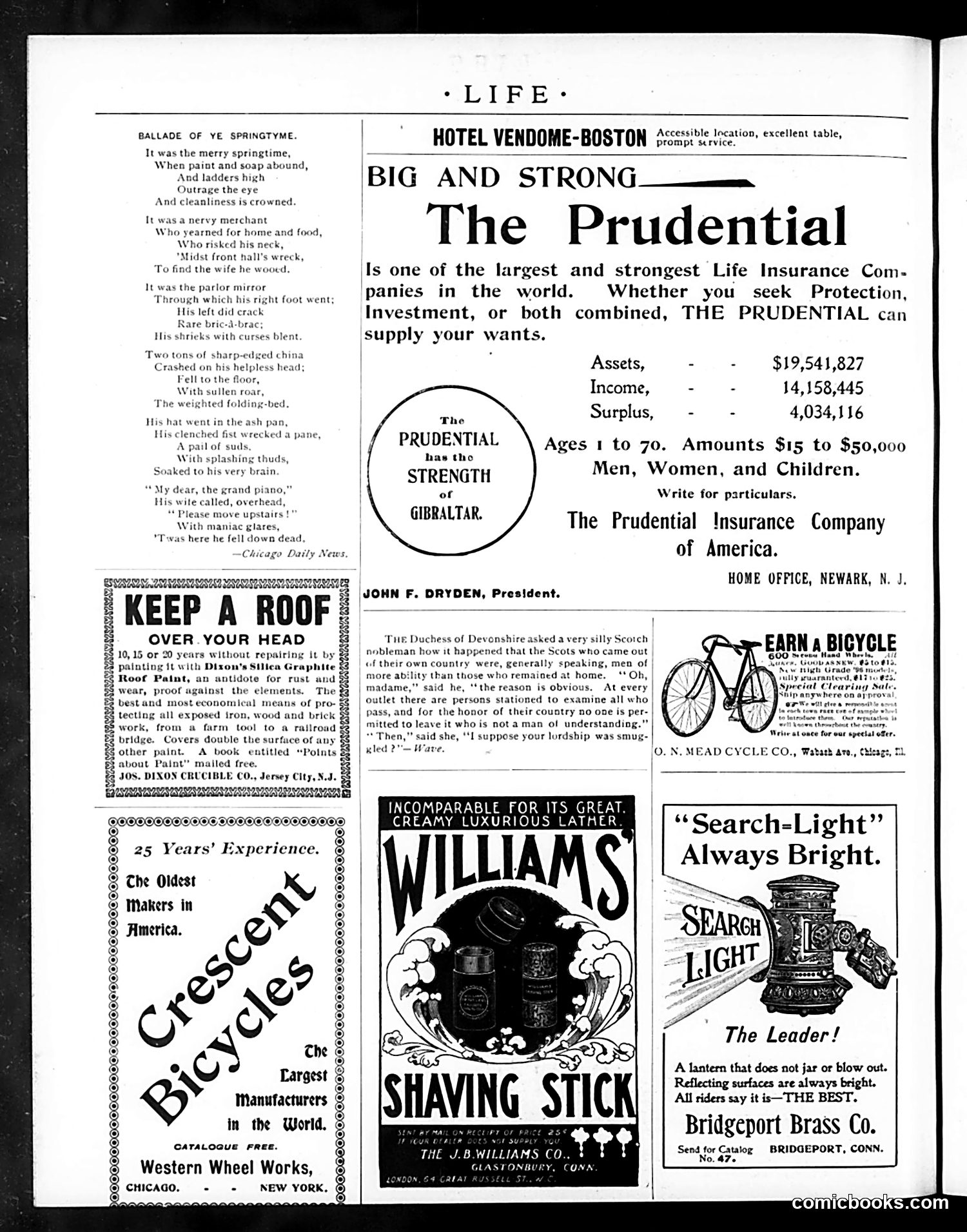
This page is primarily **advertisements and a poem**, not political satire. The main visual content includes: 1. **"Ballade of Ye Springtime"** (left): A humorous poem about spring cleaning mishaps—a husband searching for his wife during the chaos of spring renovation and painting, culminating in a slapstick fall down the stairs. This is light satirical commentary on the annual tradition of spring home maintenance. 2. **Anecdote about Scottish emigrants** (center): A joke about why Scots who leave home are more successful than those who stay—suggesting emigration screening removes the less ambitious. This is mild social commentary, not sharp political satire. 3. **Various period advertisements**: Insurance (The Prudential), roof paint, bicycles, shaving products, and lanterns dominate the page. **No identifiable political cartoons or caricatures** appear here. The content is consistent with *Life* magazine's mix of genteel humor, practical advice, and commercial advertising from the early 20th century. The satire is domestic and observational rather than explicitly political.
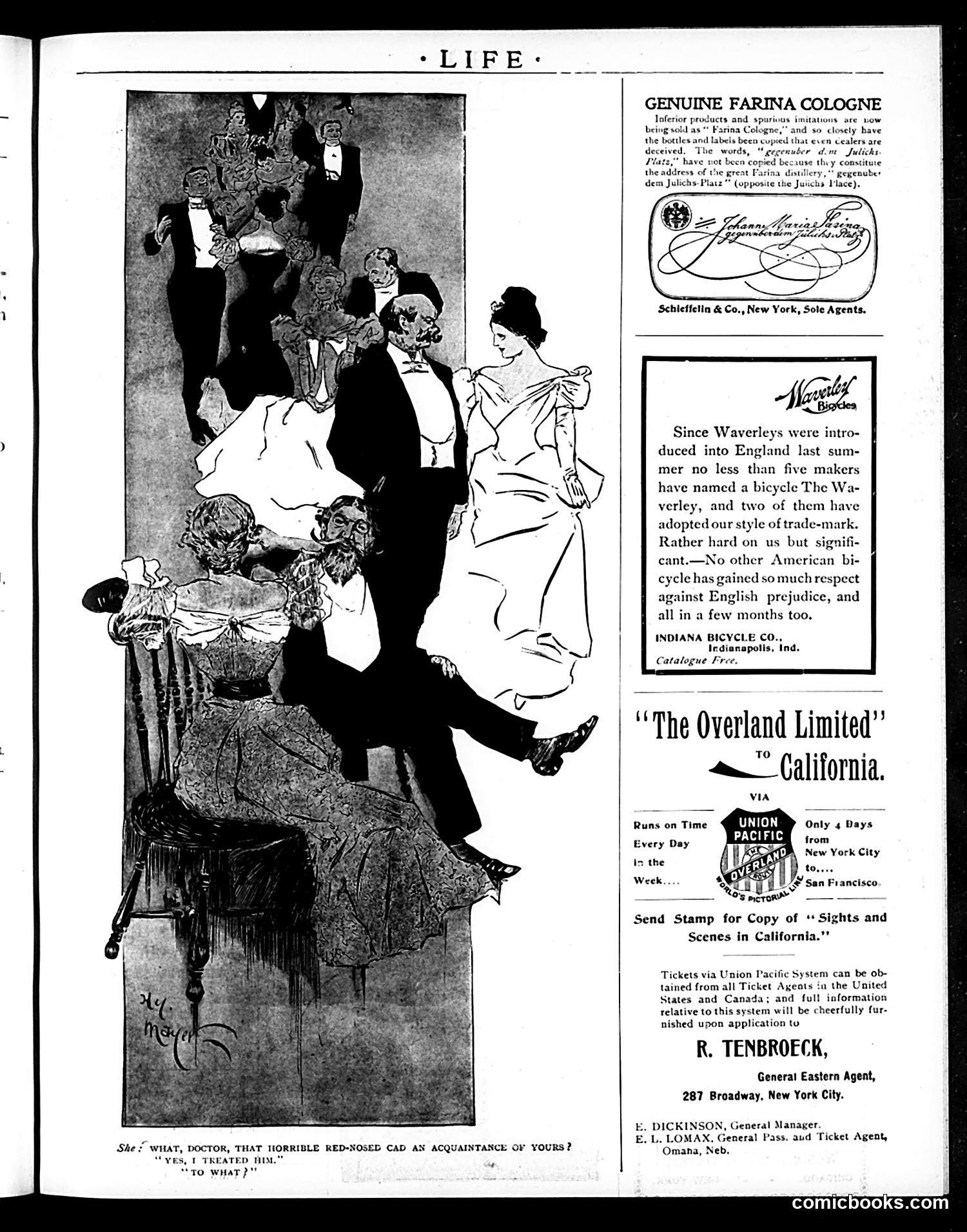
The left side features a social cartoon depicting a formal gathering where a well-dressed woman addresses a doctor about an unseemly red-nosed man in attendance. The caption reveals the punchline: the doctor treated the man's condition—the implication being venereal disease or alcoholism (indicated by the red nose, a period stereotype). The satire mocks both the "respectable" social hypocrisy of Victorian society and the doctor's candid admission of treating such patients. The right side consists entirely of advertisements: Farina Cologne (warning against counterfeit versions), Waverley bicycles (boasting their popularity despite English prejudice), Indiana Bicycles, and Union Pacific's "Overland Limited" train service to California. The page reflects Gilded Age concerns: class anxiety, medical propriety, product authenticity, and emerging transportation technologies.
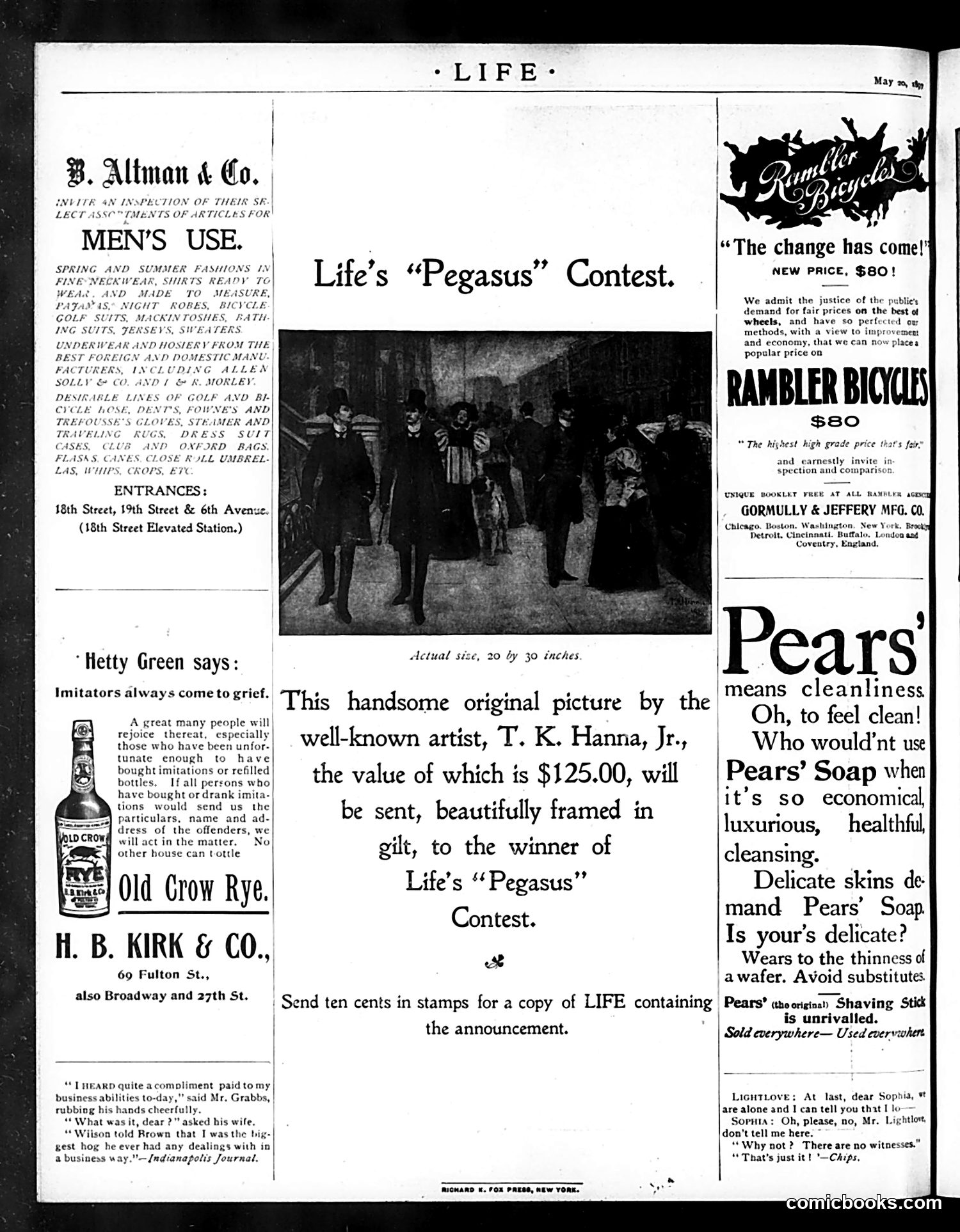
This page is primarily **advertising with a contest announcement**, not political satire. The central feature announces Life's "Pegasus Contest"—readers could win a $125 framed original artwork by artist T.K. Hanna, Jr. by sending ten cents for the contest details. The page is dominated by commercial ads for department stores (B. Altman & Co.), bicycles (Rambler), soap (Pears'), and whiskey (Old Crow Rye). There's a small humor section featuring Hetty Green (a famous wealthy businesswoman of the era) and unrelated comic anecdotes. The photograph at center shows what appears to be a formal group portrait, though its specific subject or relevance to the contest is unclear from the text provided. This is essentially a **commercial magazine page**—the "Pegasus" reference (the winged horse of mythology) likely symbolizes artistic achievement, but no deeper political or satirical meaning is evident here.