
Life, 1897-05-20 · page 6 of 20
Life — May 20, 1897 — page 6: what you’re looking at
What you’re looking at
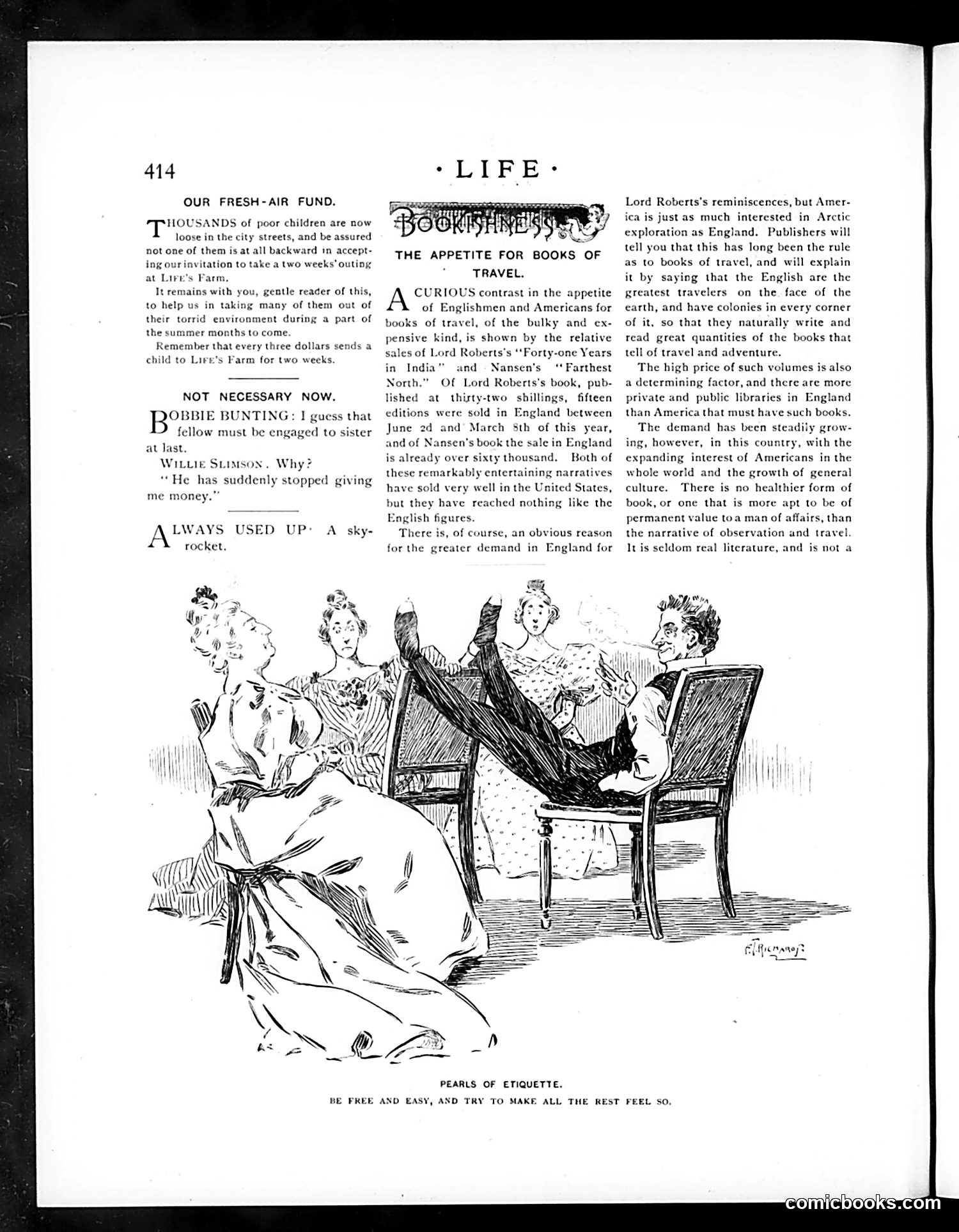
This Life magazine page (page 414) contains three distinct sections: **"Our Fresh-Air Fund"** and **"Not Necessary Now"** are brief humor pieces about charity and relationships—not politically significant. **"The Appetite for Books of Travel"** is the substantive content. It discusses contrasting book sales between England and America, noting Lord Robert's "Forty-one Years in India" and Nansen's "Farthest North" sold well in England but poorly in America. The article attributes England's greater demand for travel narratives to their imperial colonies and worldly interests, while Americans are developing similar interests. **The illustration** labeled "Pearls of Etiquette" depicts five well-dressed figures in a social setting—appears to be satirizing upper-class social behavior, though the specific joke remains unclear from the image alone. The page reflects early 20th-century Anglo-American cultural differences regarding literature and imperial expansion.
📄 Transcribed text from this page (OCR, searchable)
Machine-transcribed from the original scan — historical spelling and the odd misread are preserved.
414 OUR FRESH-AIR FUND. HOUSANDS of poor children are now loose in the city streets, and be assured not one of them is at all backward in accept- ing our invitation to take a two weeks’ outing at Lire’s Farm, It remains with you, gentle reader of this, to help us in taking many of them out of their torrid environment during a part of the summer months to come Remember that every three dollars sends a child to Lire’s Farm for two weeks. NOT NECESSARY NOW. if OBBIE BUNTING fellow must be engaged to sister at last. WILLIE Stimson. Why? “He h me money. I guess that ddenly stopped giving LWAYS USED UP: rocket. Av sky- THE APPETITE FOR BOOKS OF TRAVEL. CURIOUS contrast in the appetite of Englishmen and Americans for books of travel, of the bulky and ex- pensive kind, is shown by the relative sales of Lord Roberts's ‘Forty-one Years in India” “Farthest Of Lord Roberts's book, pub- at irty-two shillin; fifteen editions were sold in England between June 2d and March 8th of this year, nsen’s book the sale in England Both of these remarkably entertaining narratives have sold ver lin the United States, but they have reached nothing like the English figures. There for the greater demand in England for and Nansen's over sixty thousand. of course, an obvious reason Lord Roberts's reminiscences, but Amer- ica is just as much interested in Arctic exploration as England. Publishers will tell you that this has long been the rule as to books of travel, and will explain it by saying that the English are the greatest travel on the face of the earth, and have colonies in every corner of it, so that they naturally write and read great quantities of the books that tell of travel and adventure. The high price of such volumes is also a determining factor, and there are more private and public libraries in England than America that must have such books. The demand has been steadily grow- ing, however, in this country, with the expanding interest of Americans in the whole world and the growth of general culture. There is no healthier form of book, or one that is more apt to be of permanent value toa man of affairs, than the narrative of observation and travel. It is seldom real literature, and is not a PEARLS OF ETIQUETTE. E[Meranay? BE FREE AND EASY, AND TRY TO MAKE ALL THE REST FEEL so.