
Life, 1897-05-20 · page 7 of 20
Life — May 20, 1897 — page 7: what you’re looking at
What you’re looking at
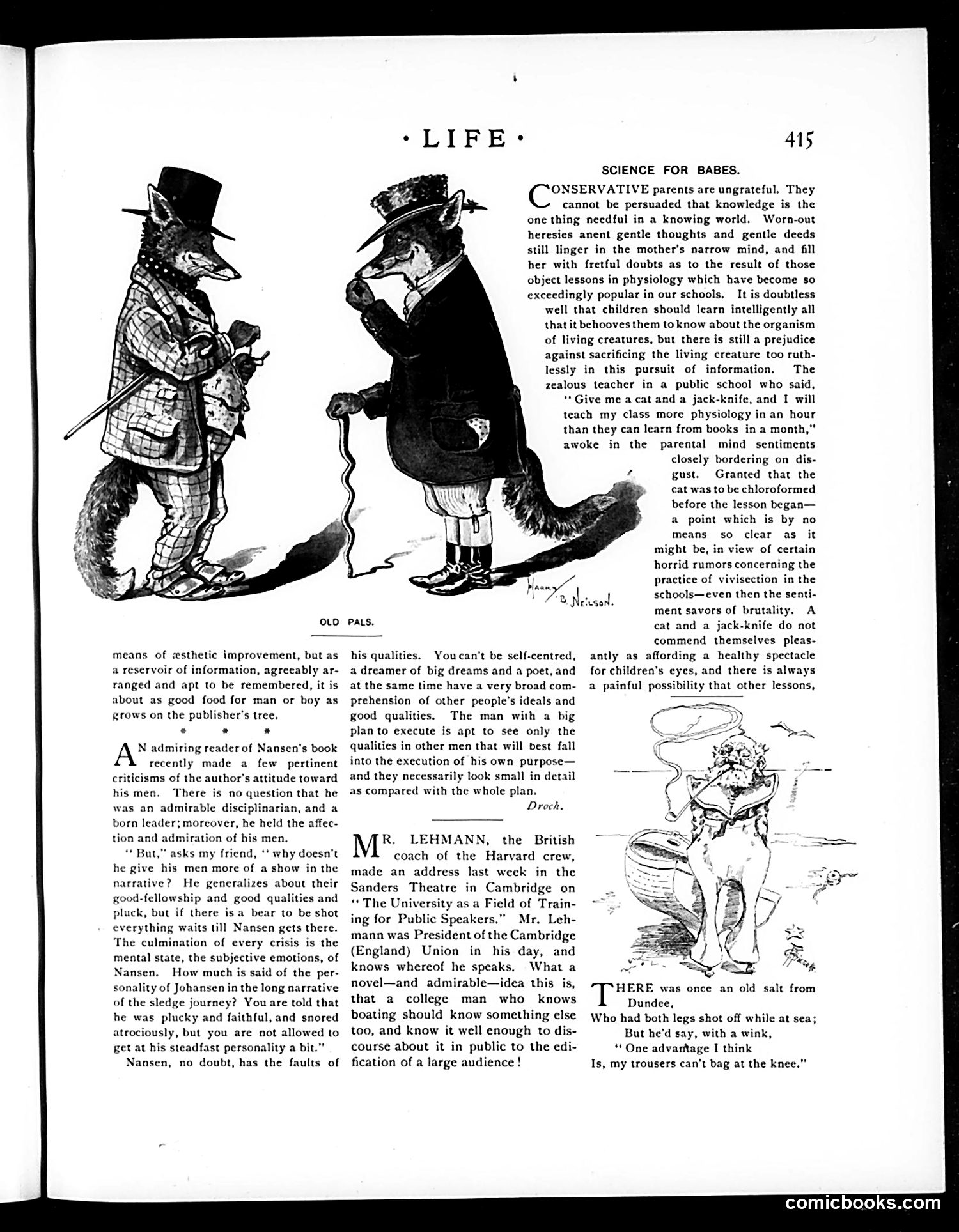
This satirical cartoon depicts two anthropomorphized animals—likely a fox and a badger or similar creature—dressed as distinguished gentlemen in top hats and formal wear, walking together. The caption "Old Pals" suggests former colleagues or associates. The accompanying article "Science for Babes" criticizes conservative parents who resist teaching physiology and anatomy in schools, fearing it encourages animal vivisection. The text mentions a teacher's controversial statement about teaching "a cat and a jack-knife" for practical anatomy lessons. The cartoon likely satirizes this educational debate, using animal characters to mock either the resistance to science education or the extremist methods some proposed. The "old pals" may represent competing philosophies about education and scientific knowledge.
📄 Transcribed text from this page (OCR, searchable)
Machine-transcribed from the original scan — historical spelling and the odd misread are preserved.
415 SCIENCE FOR BABES. ONSERVATIVE parents are ungrateful. They cannot be persuaded that knowledge is the one thing needful in a knowing world. Worn-out heresies anent gentle thoughts and gentle deeds still linger in the mother’s narrow mind, and fill her with fretful doubts as to the result of those object lessons in physiology which have become so exceedingly popular in our schools. It is doubtless well that children should learn intelligently all that it behooves them to know about the organism of living creatures, but there is still a prejudice against sacrificing the living creature too ruth- lessly in this pursuit of information. The zealous teacher in a public school who said, “*Give me a cat and a jack-knife, and I will teach my class more physiology in an hour than they can learn from books in a month,” awoke in the parental mind sentiments closely bordering on dis- gust. Granted that the cat was to be chloroformed before the lesson began— a point which is by no means so clear as it might be, in view of certain horrid rumors concerning the practice of vivisection in the schools—even then the senti- ment savors of brutality. A cat and a jack-knife do not commend themselves pleas- antly as affording a healthy spectacle for children’s eyes, and there is always a painful possibility that other lessons, WT eed OLD PALS. means of esthetic improvement, but as a reservoir of information, agreeably ar- ranged and apt to be remembered, it is about as good food for man or boy as grows on the publisher's tree. ° * * A admiring reader of Nansen's book recently made a few pertinent criticisms of the author's attitude toward his men. There is no question that he was an admirable disciplinarian, and a born leader; moreover, he held the affec- tion and admiration of his men. R. “But,” asks my friend, ‘* why doesn’t he give his men more of a show in the narrative? He generalizes about their good-fellowship and good qualities and his qualities. You can't be self-centred, a dreamer of big dreams and a poet, and at the same time have a very broad com- prehension of other people's ideals and good qualities, The man with a big plan to execute is apt to see only the qualities in other men that will best fall into the execution of his own purpose— and they necessarily look small in detail as compared with the whole plan. Droch, LEHMANN, the British coach of the Harvard crew, made an address last week in the Sanders Theatre in Cambridge on “The University as a Field of Train- pluck, but if there isa bear to be shot everything waits till Nansen gets there. The culmination of every crisis is the mental state, the subjective emotions, of Nansen. How much is said of the per- sonality of Johansen in the long narrative of the sledge journey? You are told that he was plucky and faithful, and snored atrociously, but you are not allowed to get at his steadfast personality a bit.” Nansen, no doubt, has the faults of ing for Public Speakers.” Mr. Leh- mann was President of the Cambridge (England) Union in his day, and knows whereof he speaks. What a novel—and admirable—idea this is, that a college man who knows boating should know something else too, and know it well enough to dis- course about it in public to the edi- fication of a large audience ! HERE was once an old salt from Dundee, Who had both legs shot off while at sea; But he'd say, with a wink, “One advantage I think Is, my trousers can’t bag at the knee.” comicbooks.com