
Life, 1897-05-20 · page 8 of 20
Life — May 20, 1897 — page 8: what you’re looking at
What you’re looking at
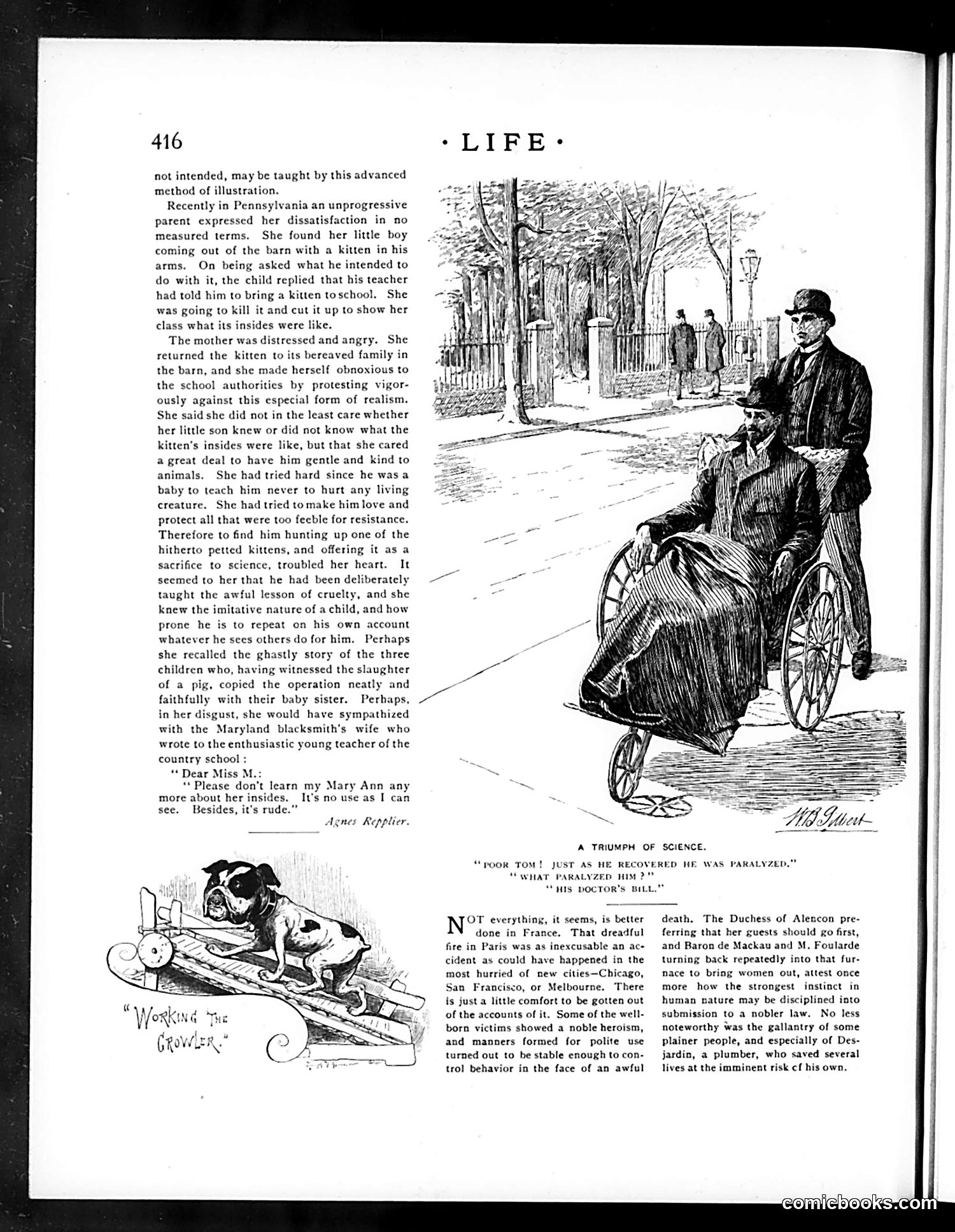
The page contains two satirical illustrations commenting on education and child development: **Upper illustration** ("A Triumph of Science"): Shows a woman on a bicycle encountering a man. The caption references a child's medical recovery, with dialogue about a doctor's bill. This appears to satirize the emerging field of scientific pedagogy—the accompanying text describes a Pennsylvania mother's complaint that progressive teaching methods encouraged her son to harm animals in the name of "science." **Lower illustration** ("Working the Growler"): Depicts a dog pulling a cart, likely referencing working-class urban life and the use of animals in labor. The page's main satirical point critiques overly literal or misapplied "scientific" teaching methods that could inadvertently teach children cruelty rather than genuine scientific understanding. The text emphasizes tension between progressive education and traditional moral values.
📄 Transcribed text from this page (OCR, searchable)
Machine-transcribed from the original scan — historical spelling and the odd misread are preserved.
416 not intended, may be taught by this advanced method of illustration. Recently in Pennsylvania an unprogressive parent expressed her dissatisfaction in no measured terms. She found her little boy coming out of the barn with a kitten in his arms. On being asked what he intended to do with it, the child replied that his teacher had told him to bring a kitten toschool, She was going to kill it and cut it up to show her class what its insides were like. The mother was distressed and angry. She returned the kitten to its bereaved family in the barn, and she made herself obnoxious to the school authorities by protesting vigor- ously against this especial form of realism. She said she did not in the least care whether her little son knew or did not know what the kitten’s insides were like, but that she cared a great deal to have him gentle and kind to animals. She had tried hard since he wasa baby to teach him never to hurt any living creature, She had tried tomake him love and protect all that were too fecble for resistance. Therefore to find him hunting up one of the hitherto petted kittens, and offering it as a sacrifice to science, troubled her heart. It seemed to her that he had been deliberately taught the awful lesson of cruelty, and she knew the imitative nature of a child, and how prone he is to repeat on his own account whatever he sces others do for him. Perhaps she recalled the ghastly story of the three children who, having witnessed the slaughter of a pig, copied the operation neatly and faithfully with their baby sister. Perhaps, in her disgust, she would have sympathized with the Maryland blacksmith's wife who wrote to the enthusiastic young teacher of the country school : “Dear Miss M.: ‘Please don’t learn my Mary Ann any more about her insides. It's no use as I can see. Besides, it's rude.” Agnes Repplier. ays. Workind A TRIUMPH OF SCIENCE. “pooR TOM! JUST AS HE RECOVERED HE WAS PARALYZED," “WHAT PARALYZED HIM?" “HIS pocTot OT everything, it seems, is better done in France, That dreadful fire in Paris was as inexcusable an ac- cident as could have happened in the most hurried of new cities—Chicago, San Francisco, or Melbourne, There is just a little comfort to be gotten out of the accounts of it, Some of the well- born victims showed a noble heroism, and manners formed for polite use turned out to be stable enough to con- trol behavior in the face of an awful *S BILL." death, The Duchess of Alencon pre- ferring that her guests should go first, and Baron de Mackau and M. Foularde turning back repeatedly into that fur- nace to bring women out, attest once more how the strongest instinct in human nature may be disciplined into submission to a nobler law. No less noteworthy was the gallantry of some plainer people, and especially of Des- jardin, a plumber, who saved several lives at the imminent risk cf his own,