
Life, 1897-05-20 · page 12 of 20
Life — May 20, 1897 — page 12: what you’re looking at
A restored page from Life, 1897-05-20. Page through the whole issue in the reader above.
📄 Transcribed text from this page (OCR, searchable)
Machine-transcribed from the original scan — historical spelling and the odd misread are preserved.
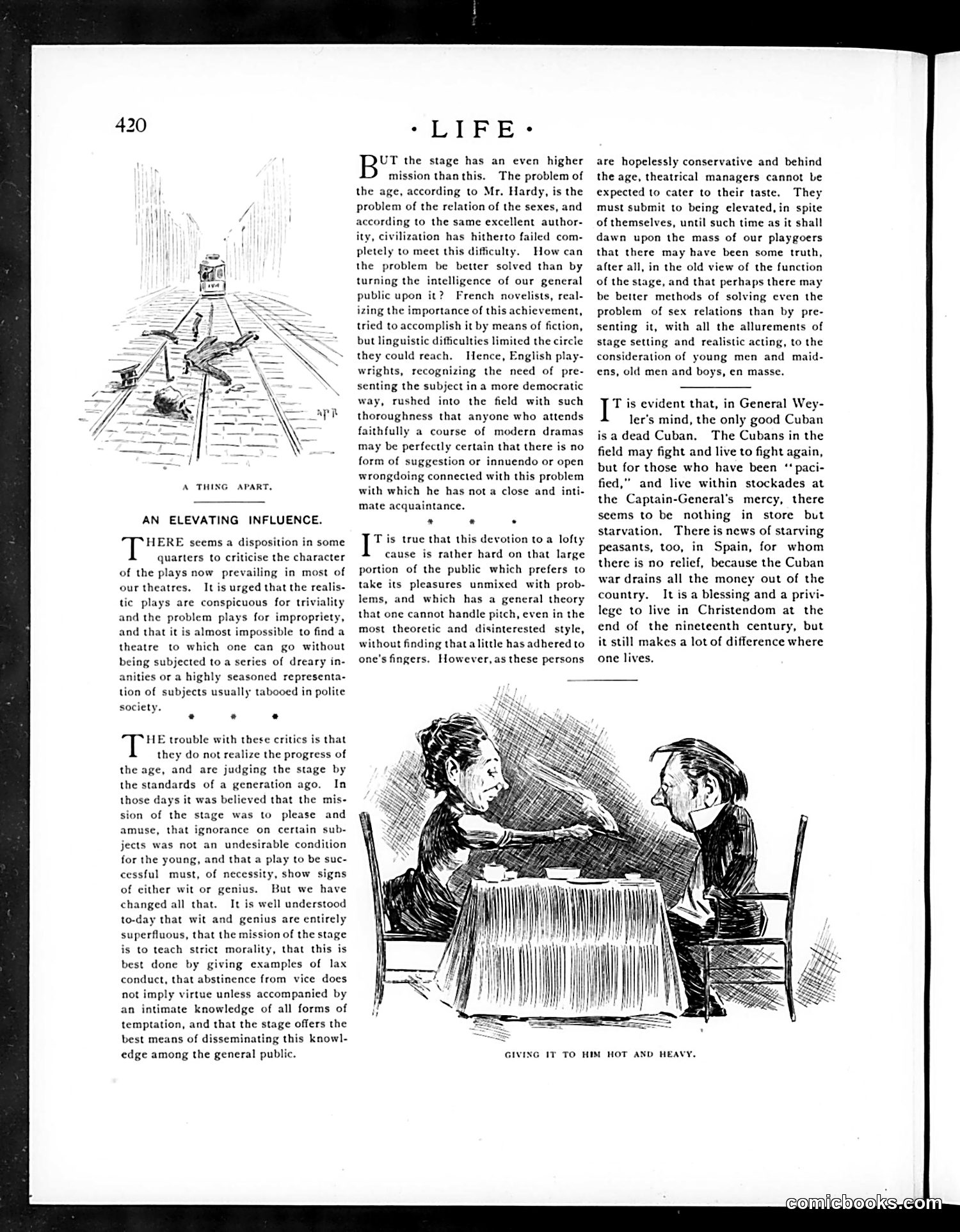
A THING APART. AN ELEVATING INFLUENCE. HERE seems a disposition in some quarters to criticise the character of the plays now prevailing in most of our theatres. It is urged that the realis- tic plays are conspicuous for triviality and the problem plays for impropriety, and that it is almost impossible to find a theatre to which one can go without being subjected to a series of dreary in- anities or a highly seasoned representa- tion of subjects usually tabooed in polite society. * * . HE trouble with these critics is that they do not realize the progress of the age, and are judging the stage by the standards of a generation ago. In those days it was believed that the n sion of the stage was to please and amuse, that ignorance on certain sub- jects was not an undesirable condition for the young, and that a play to be suc- cessful must, of necessity, show signs of cither wit or genius. But we have changed all that. It is well understood to-day that wit and genius are entirely superfluous, that the mission of the stage is to teach strict morality, that this is best done by giving examples of lax conduct, that abstinence from vice does not imply virtue unless accompanied by an intimate knowledge of all forms of temptation, and that t tage offers the best means of disseminating this knowl- edge among the general public. “LIFE: UT the stage has an even higher mission thanthis. The problem of the age, according to Mr. Hardy, is the problem of the relation of the sexes, and according to the same excellent author- ity, civilization has hitherto failed com- pletely to meet this difficulty. How can the problem be better solved than by turning the intelligence of our general public upon it? French novelists, real- izing the importance of this achievement, tried to accomplish it by means of fiction, but linguistic difficulties limited the circle they could reach. Hence, English play- wrights, recognizing the need of pre- senting the subject in a more democratic way, rushed into the field with such thoroughness that anyone who attends faithfully a course of modern dramas may be perfectly certain that there is no form of suggestion or innuendo or open wrongdoing connected with this problem with which he has not a close and inti- mate acquaintance. * * . Tis true that this devotion toa lofty cause is rather hard on that large portion of the public which prefers to take its pleasures unmixed with prob- lems, and which has a general theory that one cannot handle pitch, even in the most theoretic and disinterested style, without finding that alittle has adhered to one's fingers. However, as these persons itt are hopelessly conservative and behind the age, theatrical managers cannot be expected to cater to their taste, They must submit to being elevated, in spite of themselves, until such time as it shall dawn upon the mass of our playgoers that there may have been some truth, after all, in the old view of the function e, and that perhaps there may be better methods of solving even the problem of sex relations than by pre- senting it, with all the allurements of stage setting and realistic acting, to the consideration of young men and maid- ens, old men and boys, en masse. T is evident that, in General Wey- ler's mind, the only good Cuban isa dead Cuban, The Cubans in the field may fight and live to fight again, but for those who have been ‘‘ paci- fied,” and live within stockades at the Captain-General’s mercy, there seems to be nothing in store but starvation. There is news of starving peasants, too, in Spain, for whom there is no relief, because the Cuban war drains all the money out of the country. It is a blessing and a privi- lege to live in Christendom at the end of the nineteenth century, but it still makes a lot of difference where one lives. GIVING IT TO HIM HOT AND HEAVY.