
A complete issue · 20 pages · 1897
Life — May 13, 1897
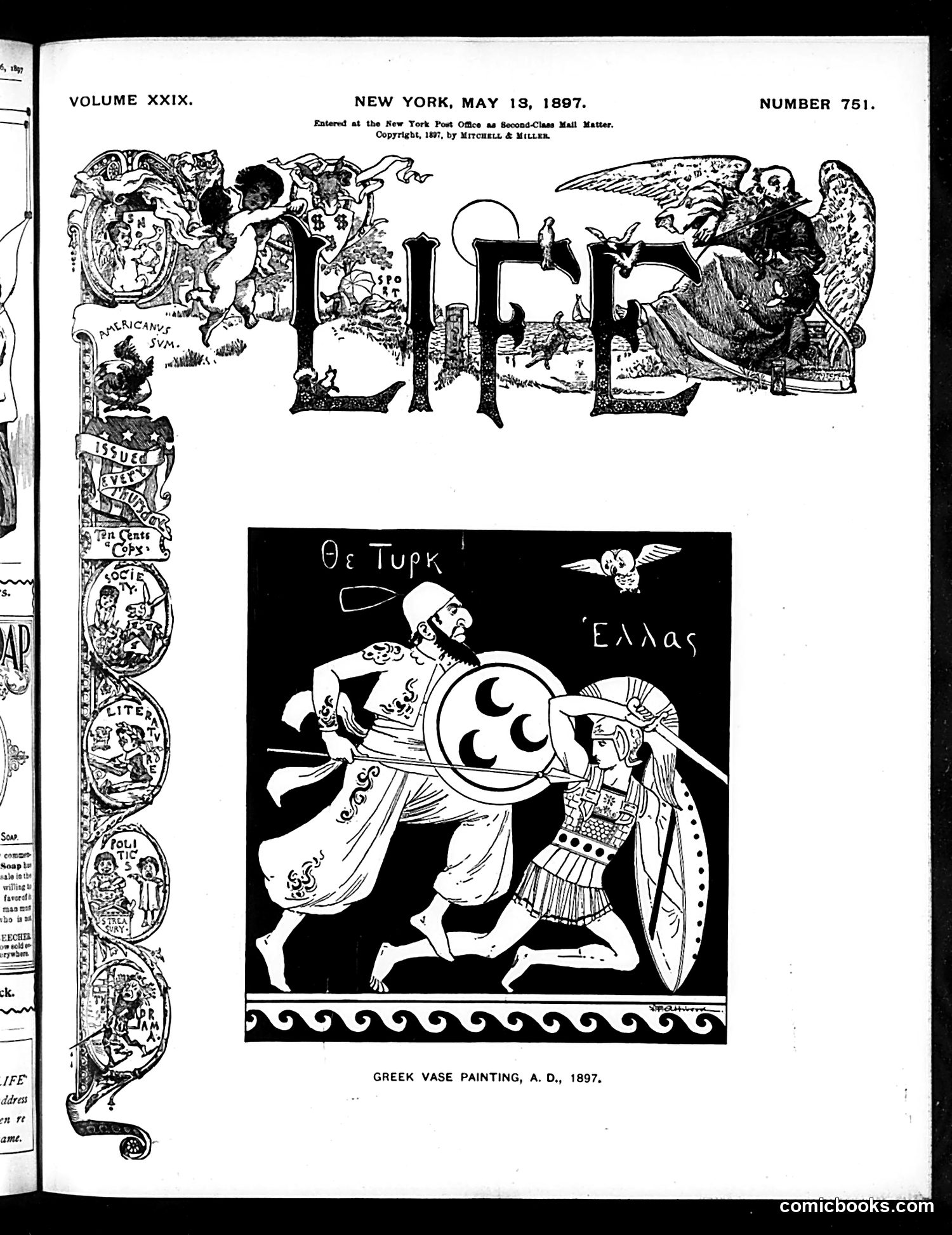
The main illustration is a Greek vase painting style depicting "O TURK" (Ottoman Turkey) and "ELLAS" (Greece). The cartoon shows a Turkish figure holding a large circular shield/moon symbol engaged with a Greek warrior figure. The image appears to reference the Greco-Turkish conflict of the 1890s, likely the 1897 Greco-Turkish War ("Thirty Days' War"). The satire presents the historical rivalry between Greece and the Ottoman Empire through the lens of ancient Greek artistic conventions—a commentary on how this modern conflict echoed ancient Mediterranean power struggles. The decorative Greek vase format itself emphasizes the classical historical continuity of their antagonism.
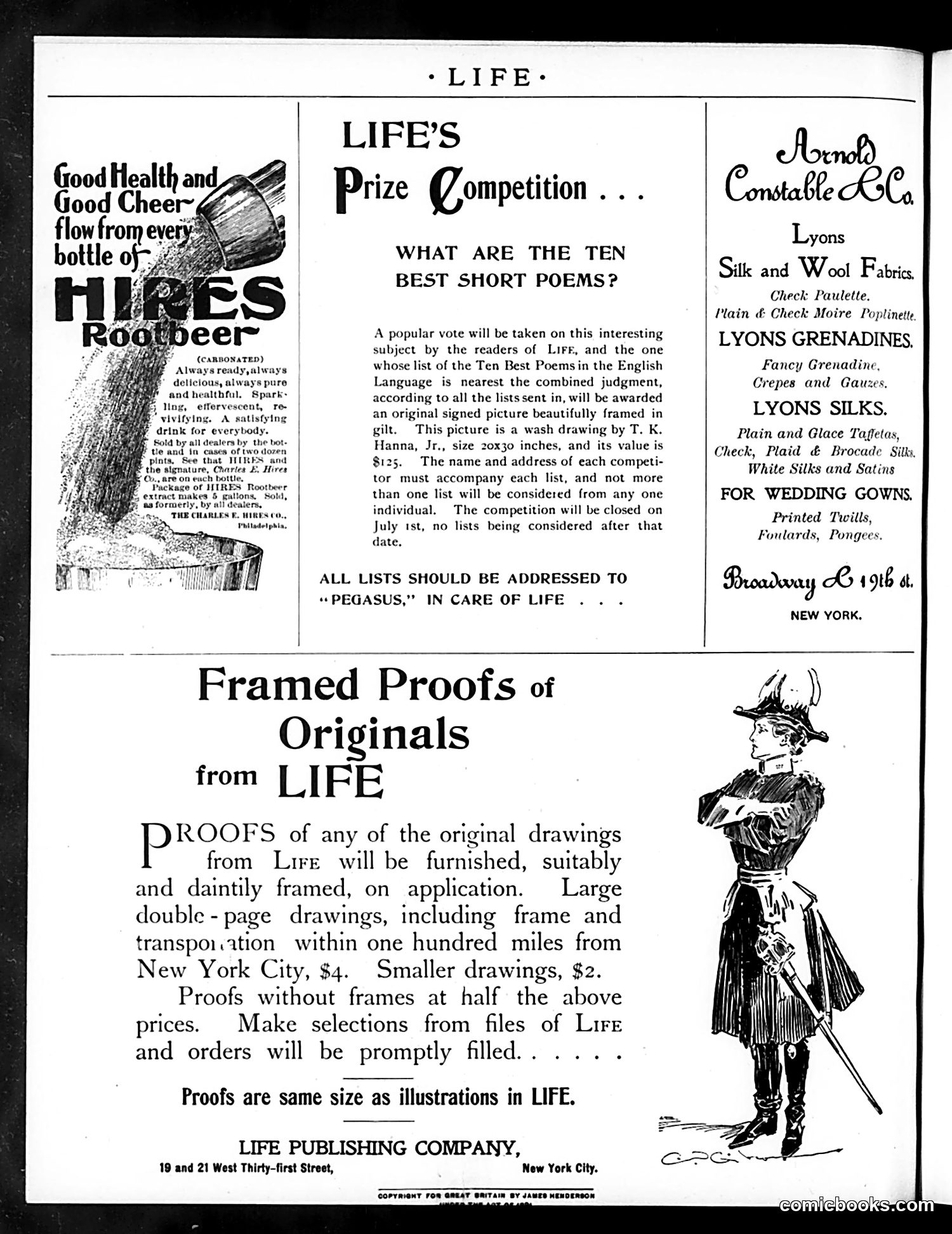
This page is primarily **advertising and editorial content** rather than political satire. The left advertisement promotes **Hires Rootbeer**, emphasizing health benefits—a common marketing angle for beverages in this era. The central section announces **Life's poetry competition**, inviting readers to vote on "The Ten Best Poems in the English Language" with prizes for winning submissions. The right column advertises **Arnold Constable & Co.**, a New York department store specializing in silk and wool fabrics for wedding gowns. The bottom section promotes **framed proofs of original drawings from Life**, available for purchase directly from the magazine's publishing office. There is **no political cartoon or satire visible**—this is a standard magazine page mixing commerce with reader engagement.
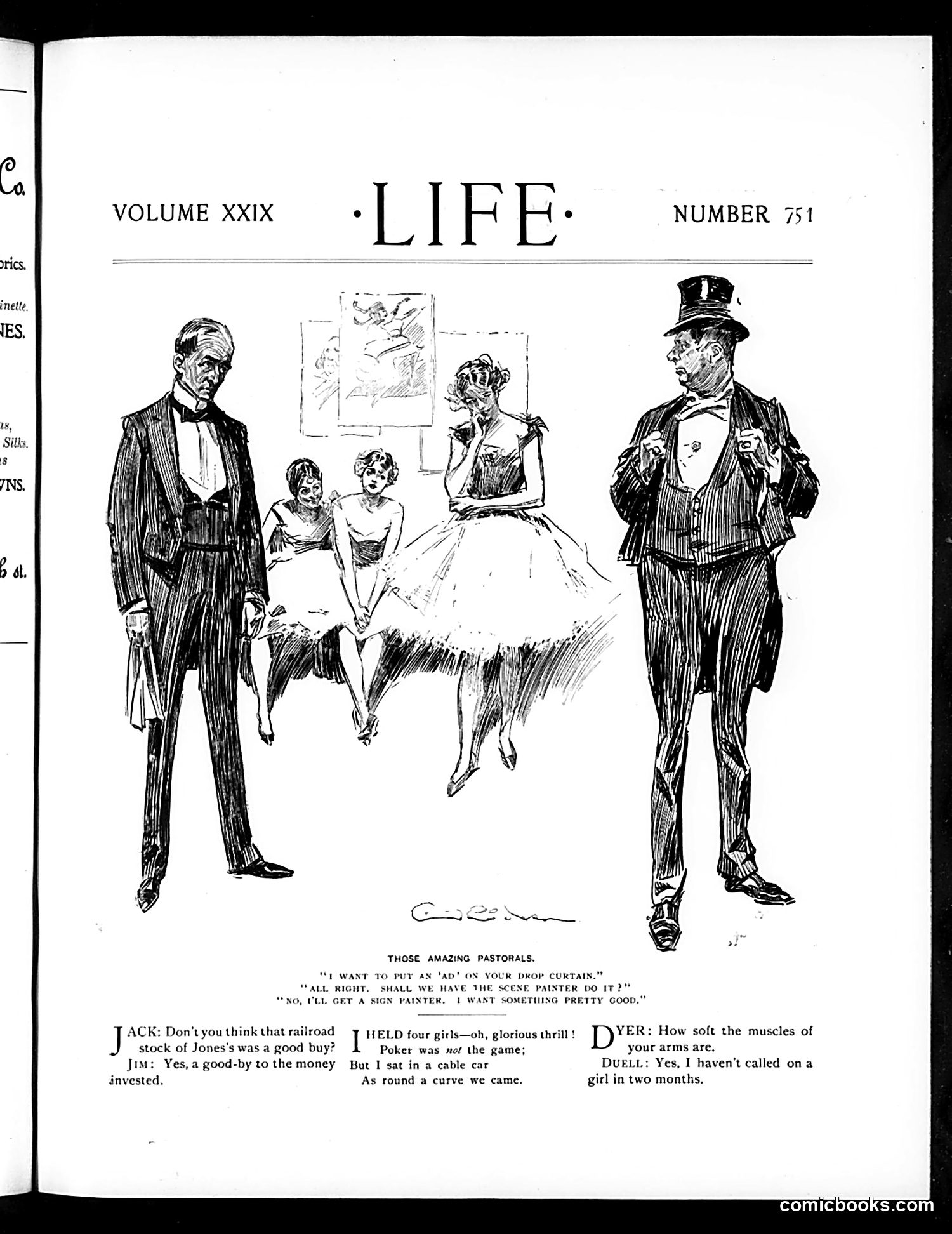
This page satirizes theatrical producers and their pretensions. The title cartoon depicts two men in formal dress flanking ballet dancers, with dialogue about painting scenery and creating "something pretty good." The satire mocks the artificial spectacle of theatrical production—specifically pastorals (idealized rural plays popular in early 20th-century theater). The producers' self-congratulatory tone about hiring a "sign painter" to create elaborate sets ridicules how theater marketed simple or cheap productions as sophisticated art. Below, brief comedic exchanges about railroad stocks and "amazing" pastorals continue the mockery of men discussing trivial matters while pretending at sophistication. The cartoon suggests theater producers prioritized appearance and marketing over genuine artistic merit.
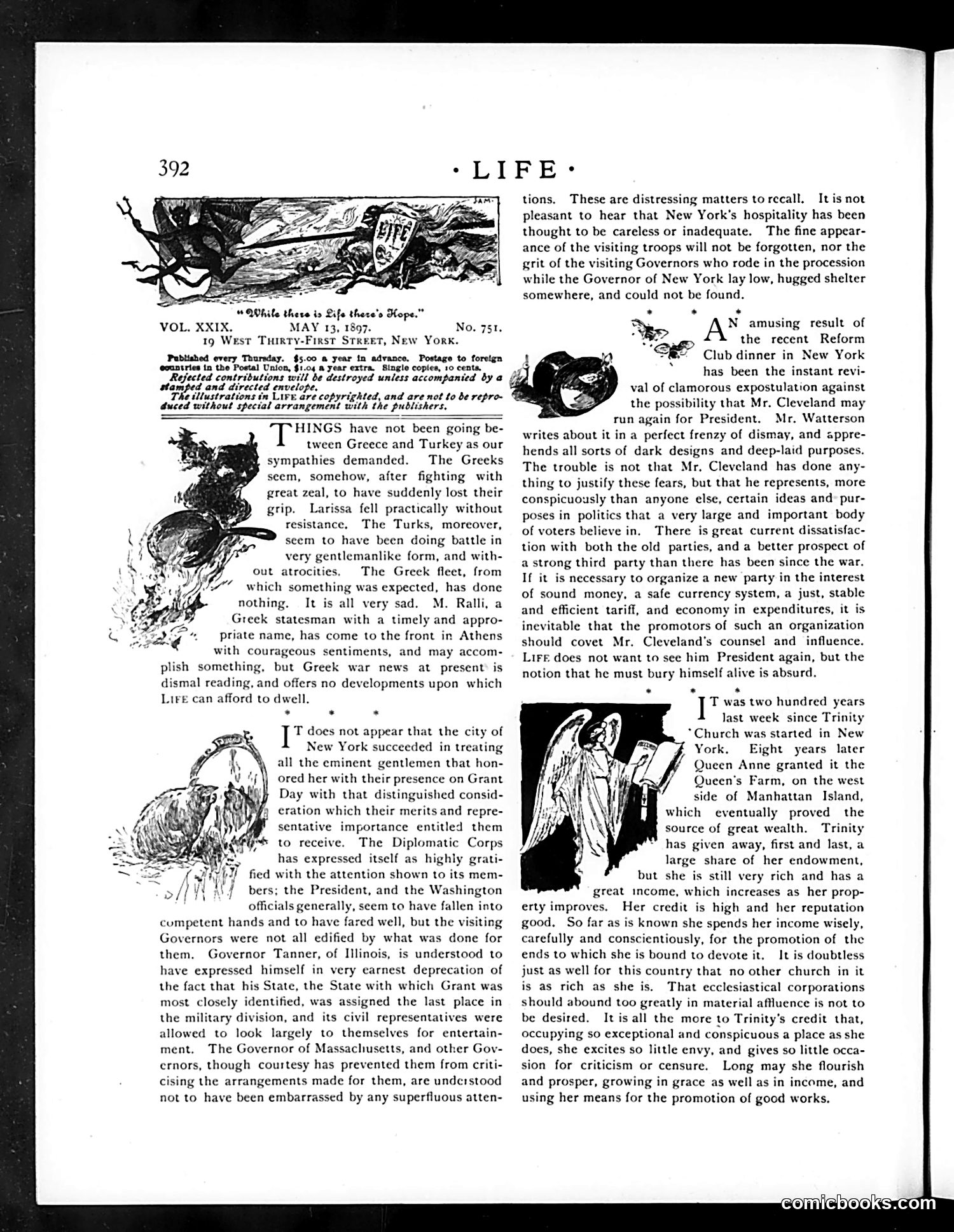
The page contains three distinct editorial cartoons and accompanying text critiquing contemporary political and diplomatic matters. The cartoons appear to satirize: 1. **Greek-Turkish conflict**: Depicts Greece and Turkey in conflict, with commentary on inadequate diplomatic response and Greek military failures. 2. **New York's hospitality**: References mishandling of visiting foreign dignitaries and governors during Grant Day celebrations, suggesting the city's reception was careless or inadequate. 3. **Cleveland's political prospects**: A detailed article mocking concerns that former President Grover Cleveland might run again, dismissing such fears as unfounded while advocating for a strong third party alternative. The satirical tone targets political incompetence, diplomatic bungling, and speculative anxiety about electoral outcomes in the 1890s political landscape.
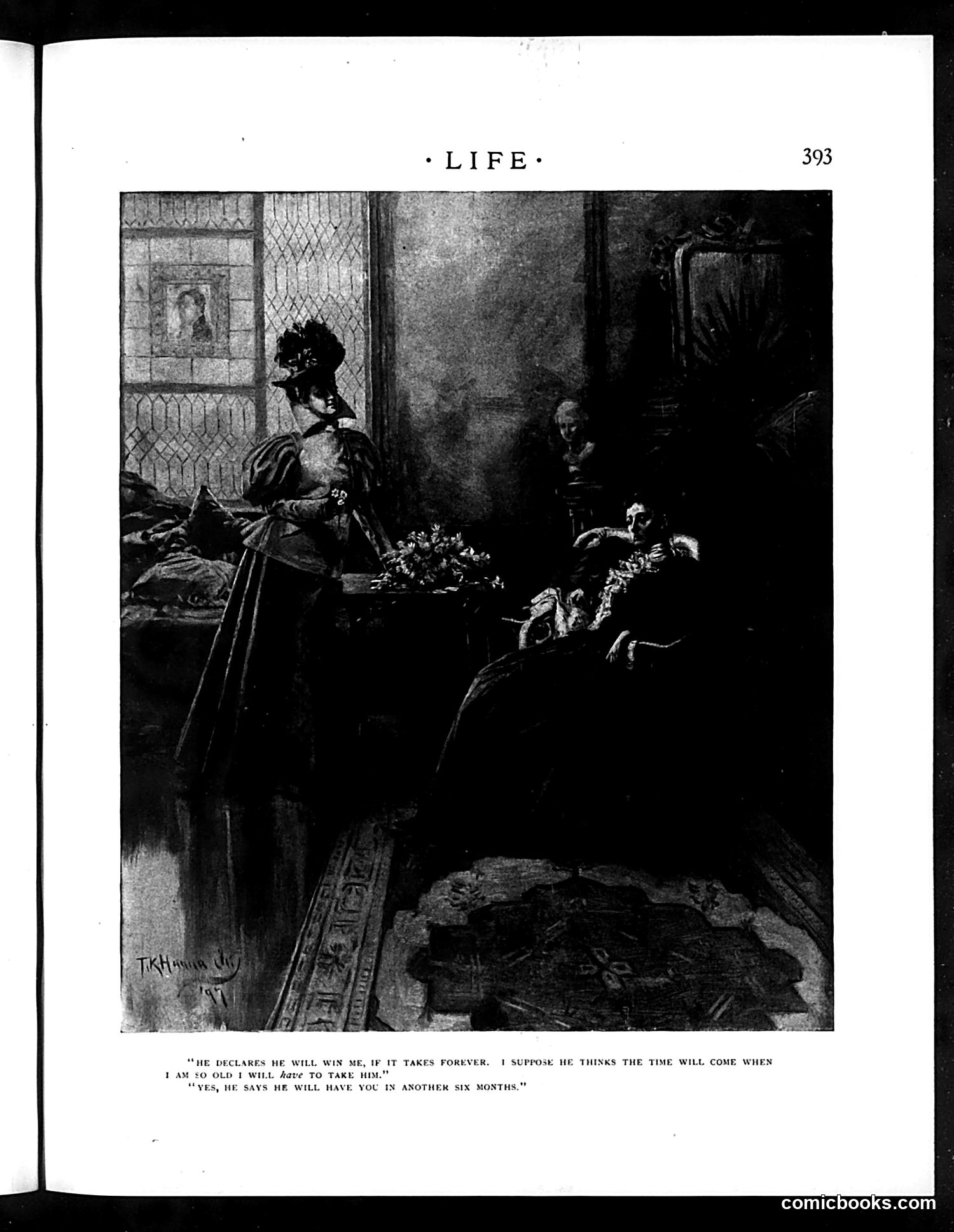
This illustration depicts an intimate interior scene from what appears to be early 20th-century Life magazine satire. A elegantly dressed woman in fashionable attire (note the elaborate hat and corseted silhouette typical of the 1900s-1910s era) is shown with a male companion in a bedroom setting. The dialogue suggests a romantic or marital negotiation: the woman states she will "win" her companion "if it takes forever," and he responds that he supposes "the time will come when I am old" he'll "take" her, with her agreeing he'll "have" her "in another six months." The satire likely mocks contemporary courtship rituals, marriage negotiations, or romantic expectations—possibly commenting on women's bargaining power or the transactional nature of romantic relationships in that era. The specific historical context or individuals referenced remain unclear without additional source material.
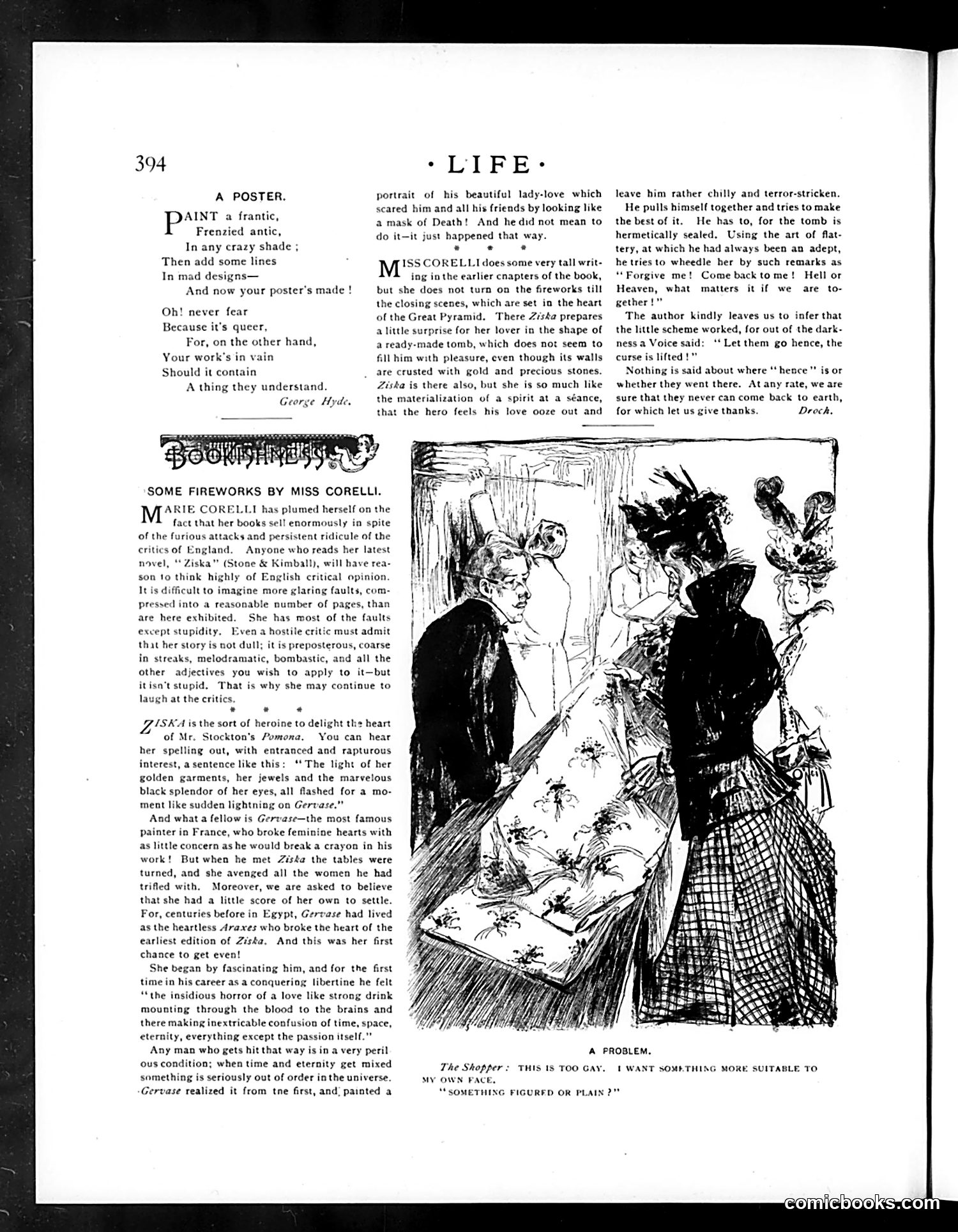
This page contains two distinct sections: **"A Poster"** (top left) is a poem by George Hyde about creating effective poster art—advocating for simplicity and clarity over cluttered design. **"Some Fireworks by Miss Corelli"** (main text) discusses novelist Marie Corelli's literary style, comparing her dramatic, sensational writing to "fireworks." The text criticizes her work as melodramatic and coarse while acknowledging her popularity with readers. **"A Problem"** (bottom illustration) shows a shopkeeper and customer in a humorous domestic scene. The caption reads: "This is too gay. I want something more suitable to my own face. Something figured or plain!" The joke appears to satirize the customer's complaint about wanting fashionable goods that match their own dull personality—poking fun at Victorian propriety and self-consciousness about appearances.
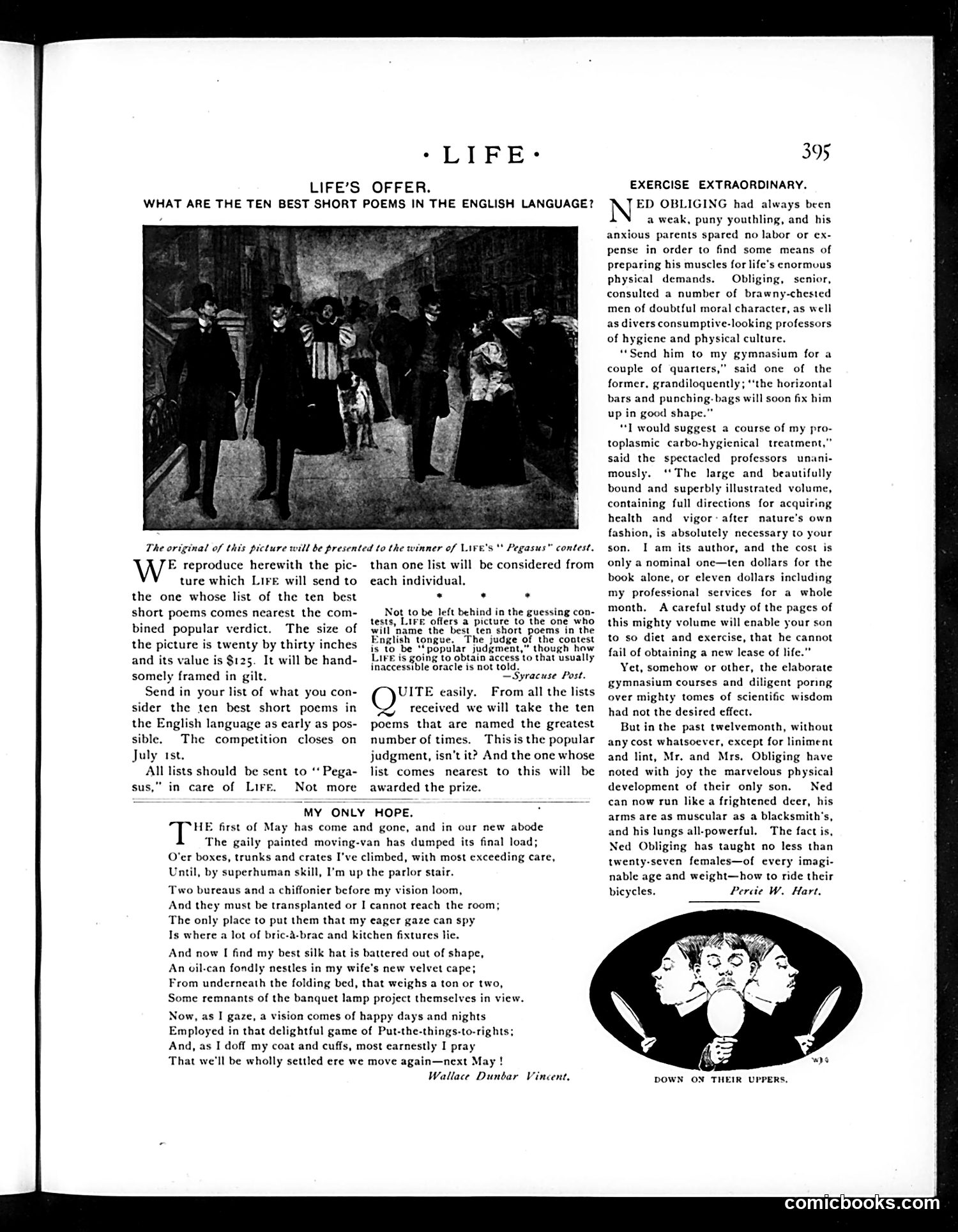
This page contains three distinct content pieces: **"Life's Offer" (top left):** A contest soliciting readers' votes on the ten best short poems in English. The accompanying photograph shows what appears to be a group of Victorian-era figures in period dress, likely illustrating a famous poem. **"My Only Hope" (center):** A humorous poem by Wallace Dunbar Vincent about moving day frustrations—crowded furniture, bulky belongings, and domestic chaos. It's relatable domestic satire with no specific political reference. **"Exercise Extraordinary" (right column):** An article praising a young man named Ned Obliging whose rigorous gymnasium training and physical conditioning have made him remarkably muscular and fit. **Bottom illustration:** A small cartoon labeled "Down on Their Uppers" showing two heads in profile, likely depicting poverty or worn-out shoes (a period idiom). The page is primarily literary and lifestyle content rather than political satire.
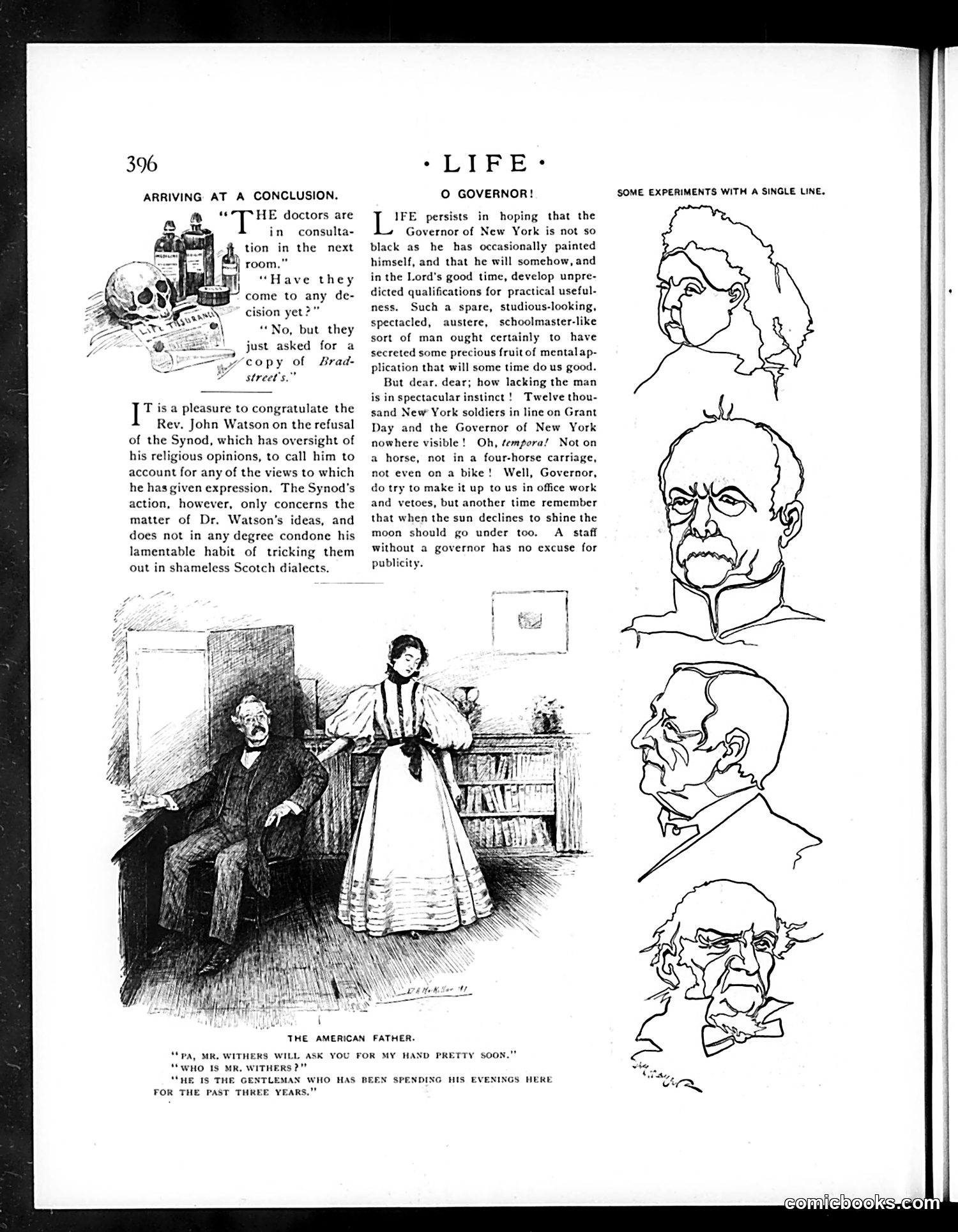
This page contains satirical commentary and sketches from a 19th-century American magazine. **"O Governor!" section**: A lengthy editorial critiques the Governor of New York for being absent during Grant Day celebrations when 12,000 soldiers marched. The writer sarcastically hopes the governor will develop "practical usefulness" and suggests he at least show up to office work occasionally. **"The American Father" cartoon**: Shows a woman asking a seated man for his hand in marriage "pretty soon." The caption reveals he's a gentleman who has spent his evenings at this location for three years—satirizing either the man's idleness or the woman's patience/presumption. **Right side**: "Some Experiments with a Single Line" displays caricature sketches—likely celebrity or political figures of the era rendered through economical line-drawing technique. The overall tone is genteel mockery typical of 19th-century satirical magazines.
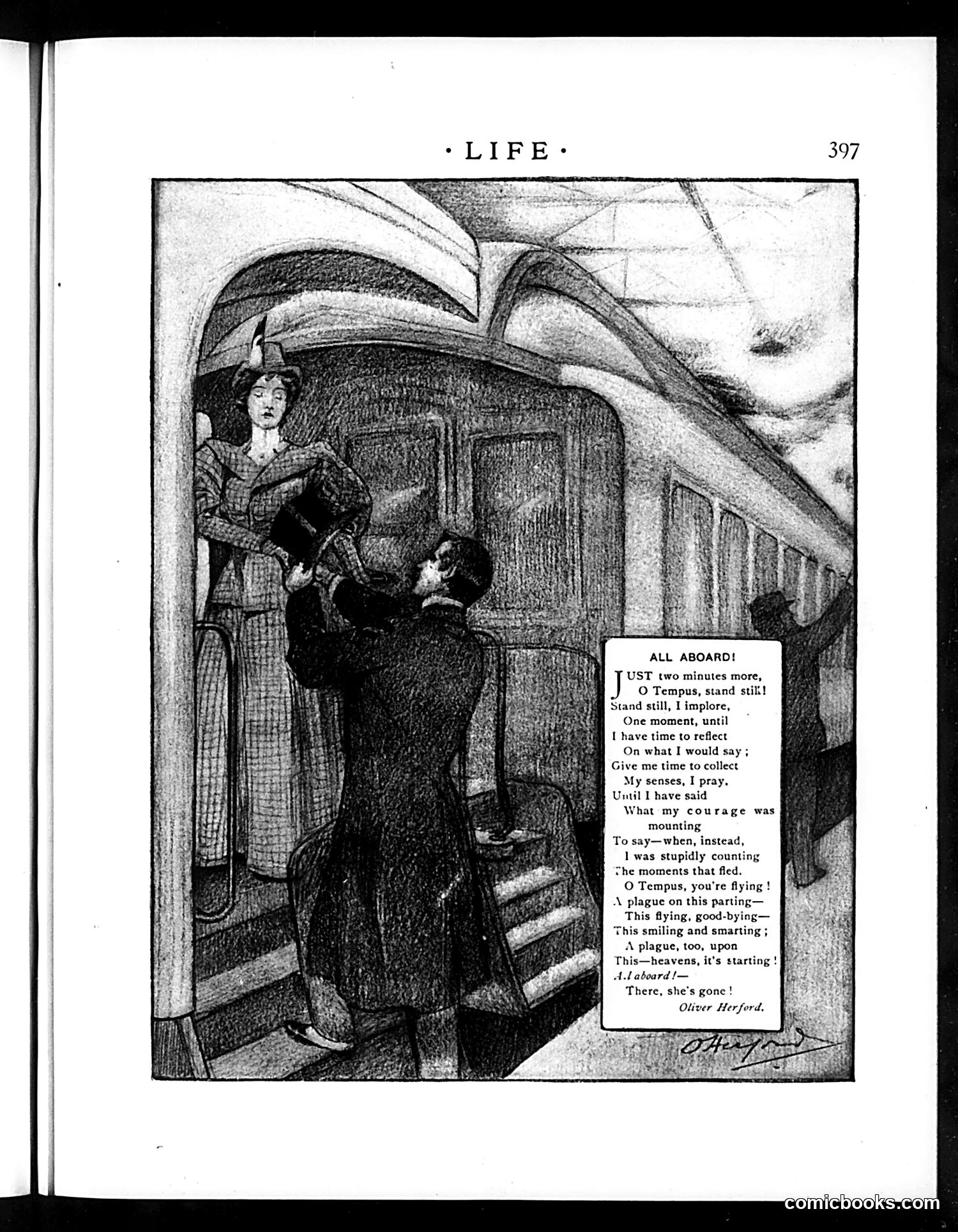
This page from *Life* magazine (page 397) shows an illustration of a woman boarding what appears to be a train or ship, with the caption "ALL ABOARD!" The accompanying poem by Oliver Herford expresses a man's emotional turmoil at her departure—he struggles to maintain composure while she leaves, his courage "mounting" as he tries to say goodbye without revealing his feelings. The satire targets the sentimental melodrama of Victorian/Edwardian courtship farewells. Herford mocks the affected emotional restraint expected of men during this era: the speaker battles to seem indifferent while internally devastated. The humor lies in the contrast between his internal anguish and his stilted, polite external behavior—a gentle satire on the repressed emotional conventions of the time.
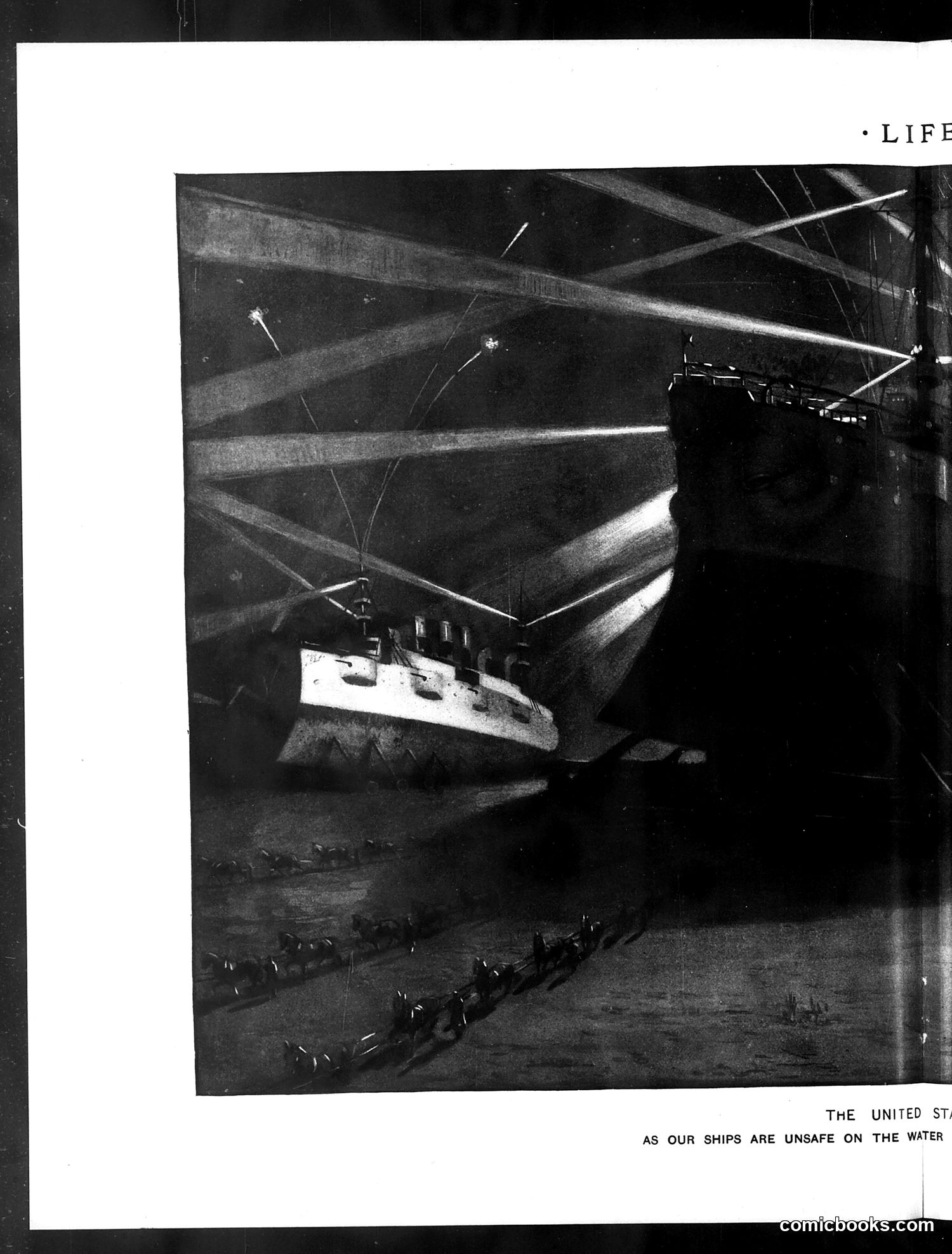
This appears to be a wartime illustration from Life magazine showing a merchant ship being attacked or threatened at sea, with searchlight beams cutting through darkness and what looks like a military vessel nearby. The caption states: "THE UNITED STA[TES]... AS OUR SHIPS ARE UNSAFE ON THE WATER" The image depicts the dangers American merchant and naval vessels faced during what appears to be World War II, likely referencing German U-boat attacks on American shipping. The dramatic lighting and dark composition emphasize the threat and vulnerability of U.S. vessels. This would have been meant to persuade American readers of the necessity of military preparedness or intervention—a common theme in wartime propaganda and editorial cartoons.
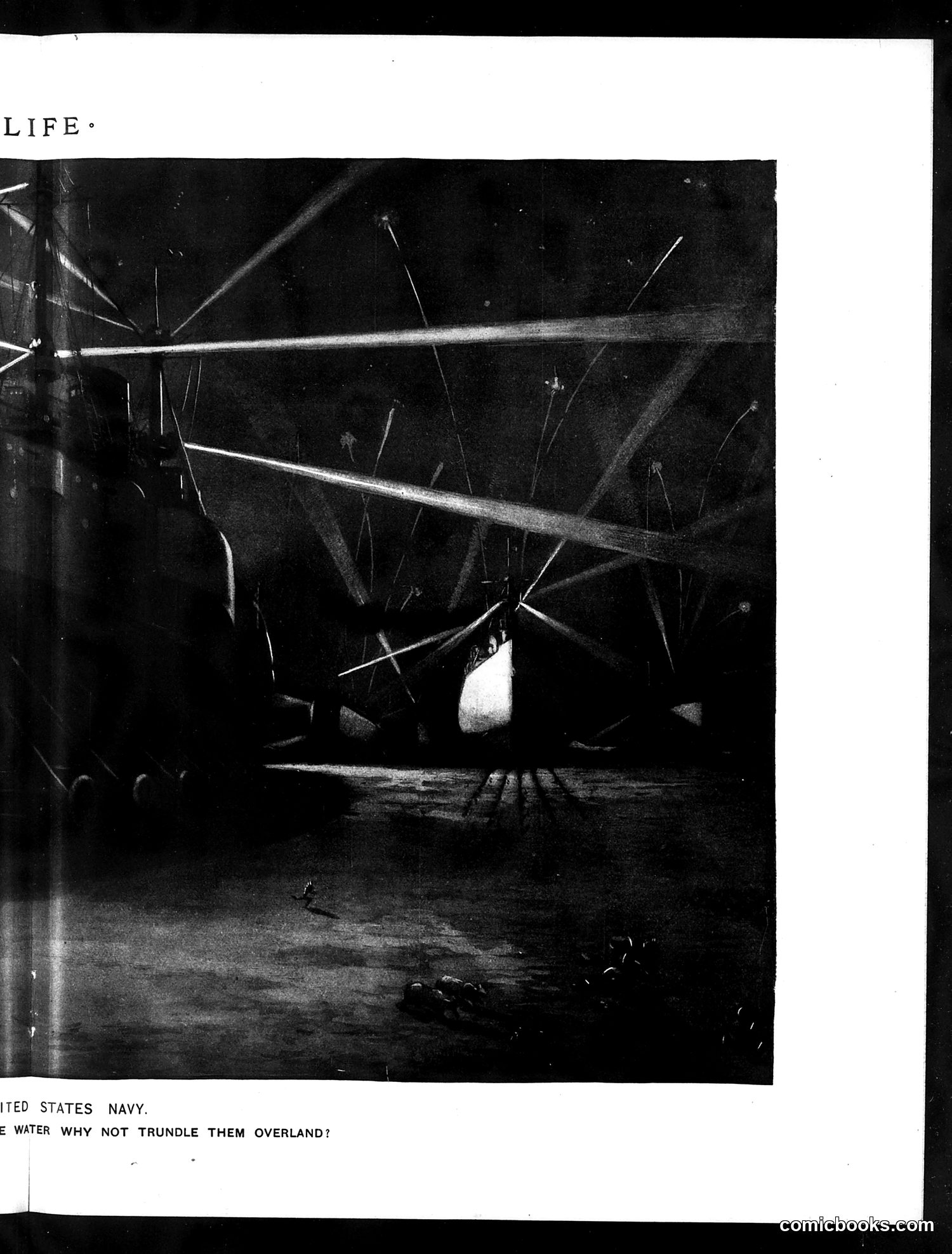
This appears to be a Life magazine page featuring a satirical illustration related to the United States Navy. The black-and-white image shows what looks like a naval vessel or structure with angular, spiky protrusions and minimal lighting—creating a somewhat ominous or industrial aesthetic. The visible text references "UNITED STATES NAVY" and includes a caption questioning "WHY NOT TRUNDLE THEM OVERLAND?" though the complete context is unclear from this partial page. Without being able to identify the specific historical period or read the full accompanying text, I cannot definitively explain what naval policy or military issue this cartoon satirizes. The spiky elements might represent defenses or weapons, but the exact satirical point—whether about naval strategy, military spending, or specific vessels—remains unclear from the image alone.
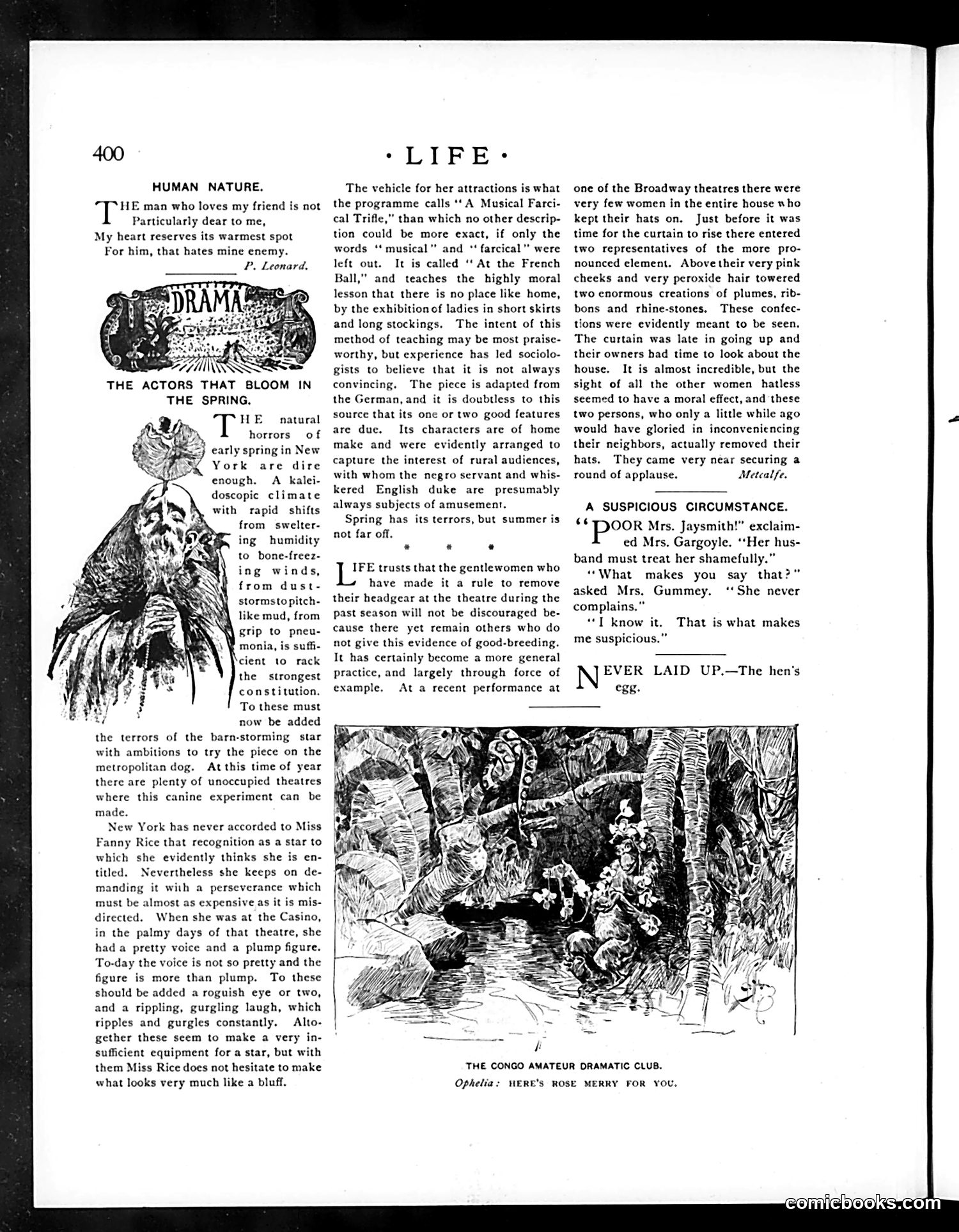
This page contains theatrical criticism and social commentary typical of Life's satirical approach. The main pieces discuss: 1. **"The Actors That Bloom in the Spring"** - A column with botanical illustration satirizing early-season theater in New York, mocking the proliferation of amateur productions. 2. **Broadway critique** - Commentary on a "Musical Farcical Trifle" called "At the French Ball," which depicts women in short skirts and long stockings. The author criticizes this as unconvincing moral instruction while acknowledging its entertainment value. 3. **"A Suspicious Circumstance"** and **"Never Laid Up"** - Brief humorous dialogues about social behavior, likely satirizing contemporary etiquette and domestic life. 4. **"The Congo Amateur Dramatic Club"** - An illustration captioned as offering "Ophelia's Here's Rose Merry for You," appearing to satirize amateur theatrical productions, possibly with racial commentary typical of the era. The overall tone mocks pretentious theater and amateur dramatics.
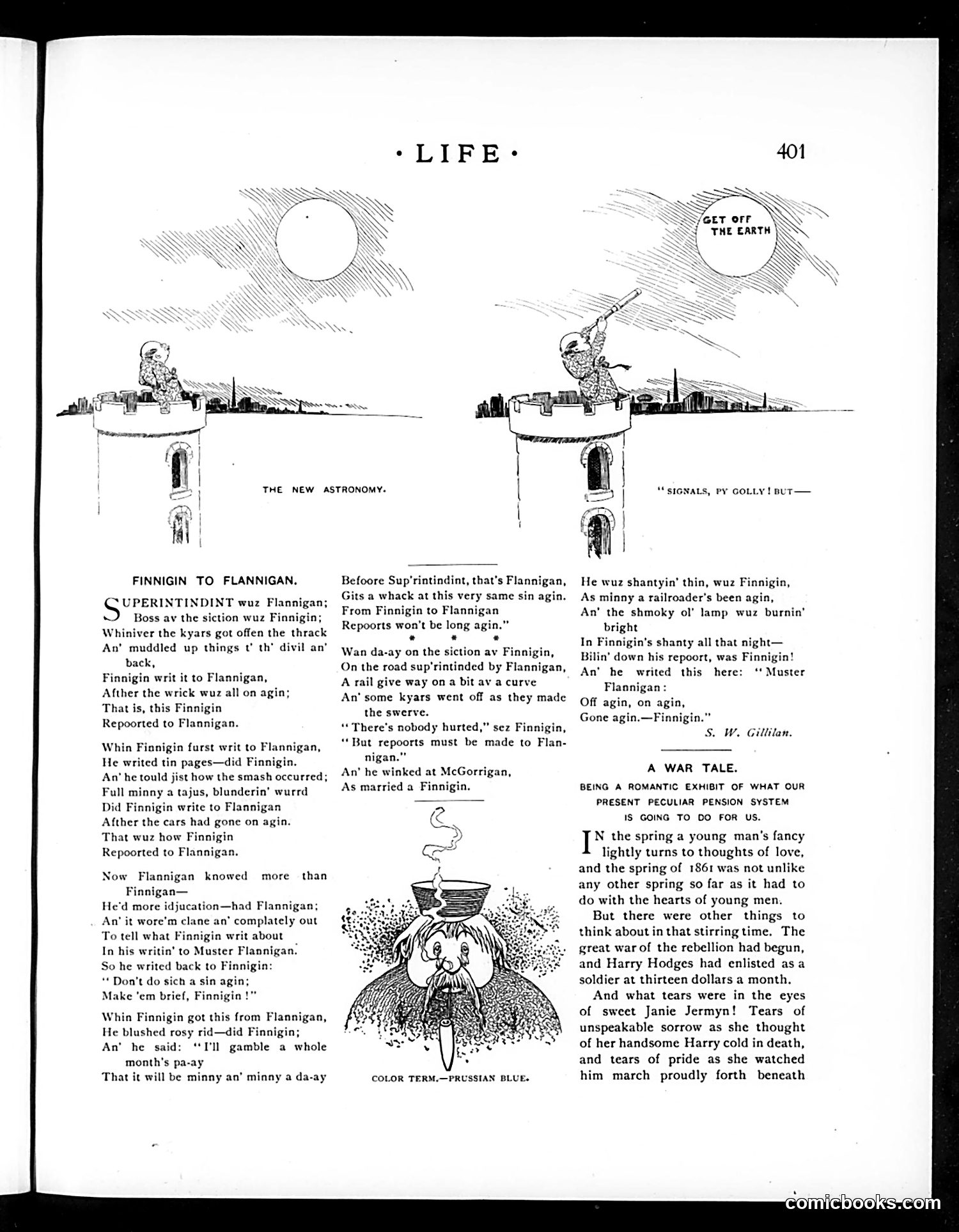
This Life magazine page contains two satirical pieces: **"The New Astronomy"** (top): A humorous poem in exaggerated Irish-immigrant dialect about railroad bureaucracy. Superintendent Flannigan receives lengthy incident reports from Section Boss Finnigin after train wrecks. When Flannigan complains the reports are too wordy, Finnigin responds with an absurdly brief replacement: "Off agin, on agin, / Gone agin." The satire mocks both verbose bureaucratic writing and the opposite extreme of unhelpful brevity. **"A War Tale"** (bottom): An opening fragment of satire about the 1861 Civil War pension system, mentioning a young soldier (Harry Hodges) enlisting at thirteen dollars monthly while his sweetheart (Janie Jermyn) watches. The subtitle indicates forthcoming criticism of how pensions will affect society—likely satirizing pension fraud or unrealistic expectations about military compensation. Both pieces use exaggeration and dialect humor typical of early 20th-century American satire.
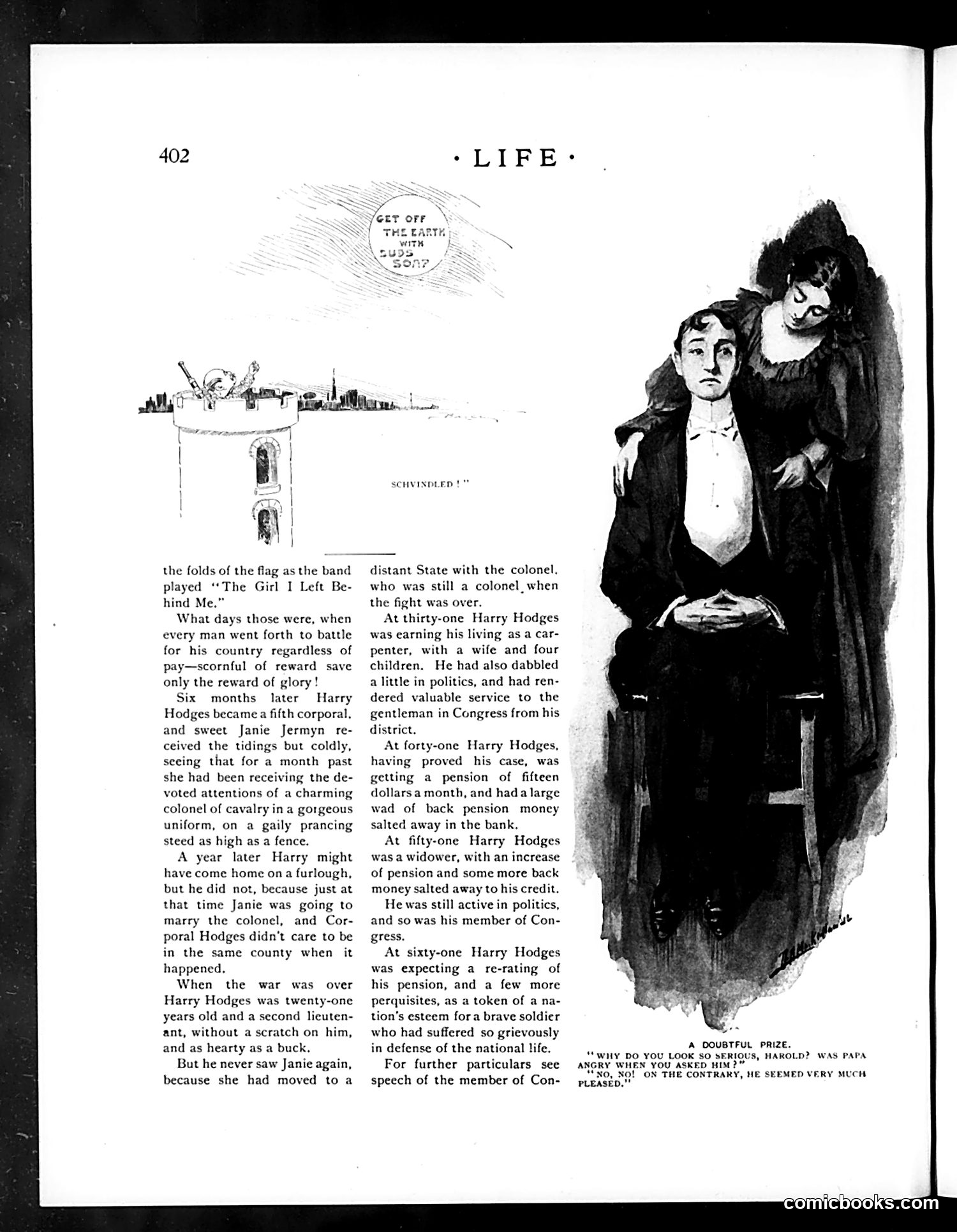
This satirical story mocks the post-Civil War treatment of veterans. Harry Hodges enlists patriotically but is jilted by Janie Jermyn, who marries a wealthy colonel. After 21 years of military service, Hodges returns as a second lieutenant—yet struggles as a carpenter supporting a family. The satire's bite: despite his sacrifice, Hodges receives only a meager $15/month pension and survives through political favors for his congressman. By age 61, he still hopes for pension increases and "perquisites"—patronage crumbs. The accompanying illustration shows a concerned young man with an older woman (likely his mother), captioned "A Doubtful Prize," with dialogue about asking father's permission—probably for marriage or engagement. This visual pun suggests that even romantic success feels uncertain and transactional in this mercenary world. The satire criticizes America's stingy veteran benefits and the patron-client political system that treats soldiers' service as currency for political machines rather than honoring genuine sacrifice.
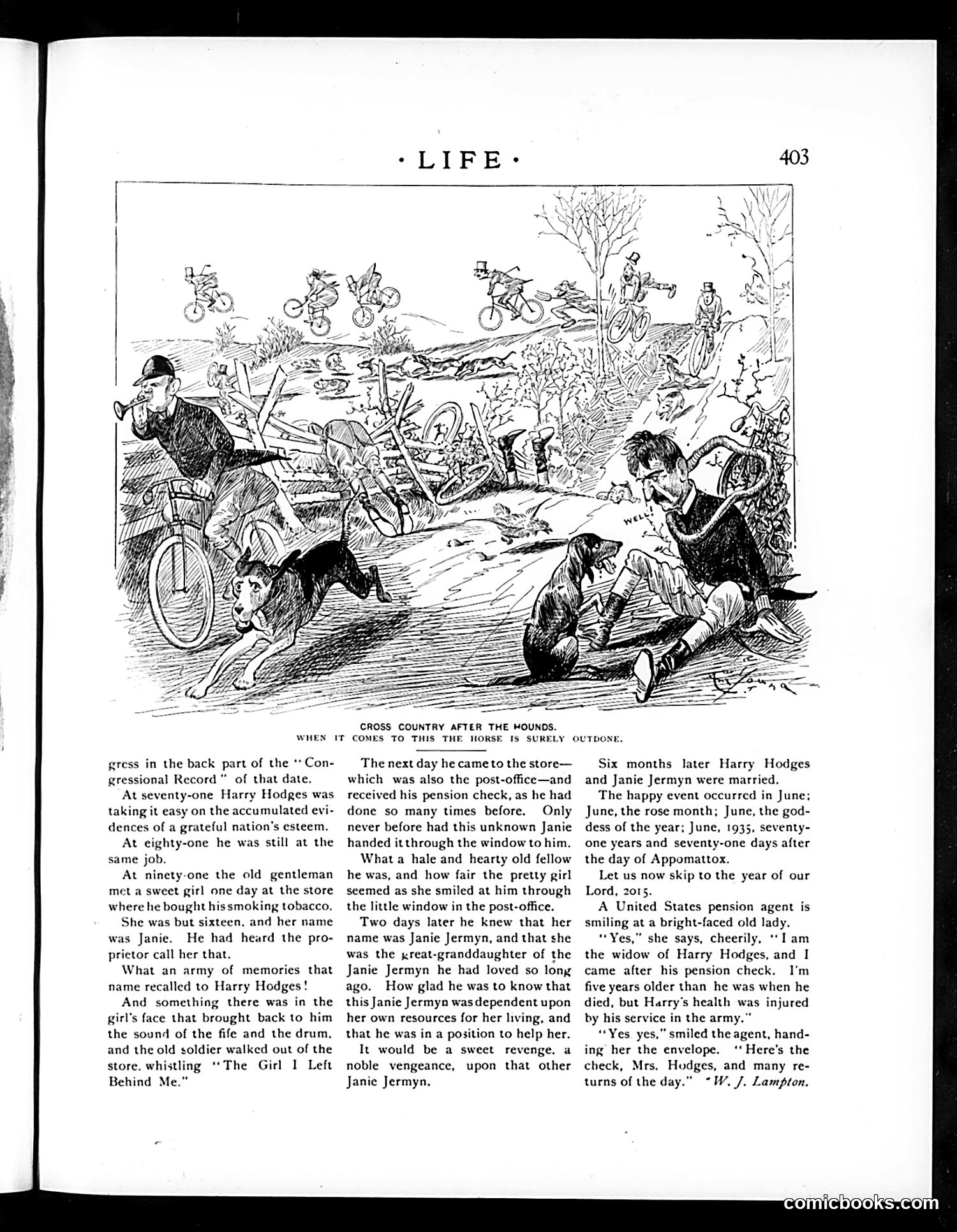
This satirical illustration depicts a chaotic bicycle race or sporting event where riders navigate rough terrain with obstacles. The caption's joke—"when it comes to this the horse is surely outdone"—mocks the bicycle as a modern invention supposedly superior to horses, yet the image shows riders struggling, falling, and colliding, suggesting bicycles are actually comical failures. The accompanying story is a sentimental narrative about an elderly Civil War pensioner (Harry Hodges, age 91) who encounters a young woman named Janie at a post office—the great-granddaughter of a lost love from his youth. They marry, and the story projects forward to 2015, where his widow collects his pension as a "widow of Harry Hodges," suggesting the joke concerns how long military pensions persist through generations. The humor combines mockery of new bicycle technology with gentle satire of romantic nostalgia and long-running government benefits.
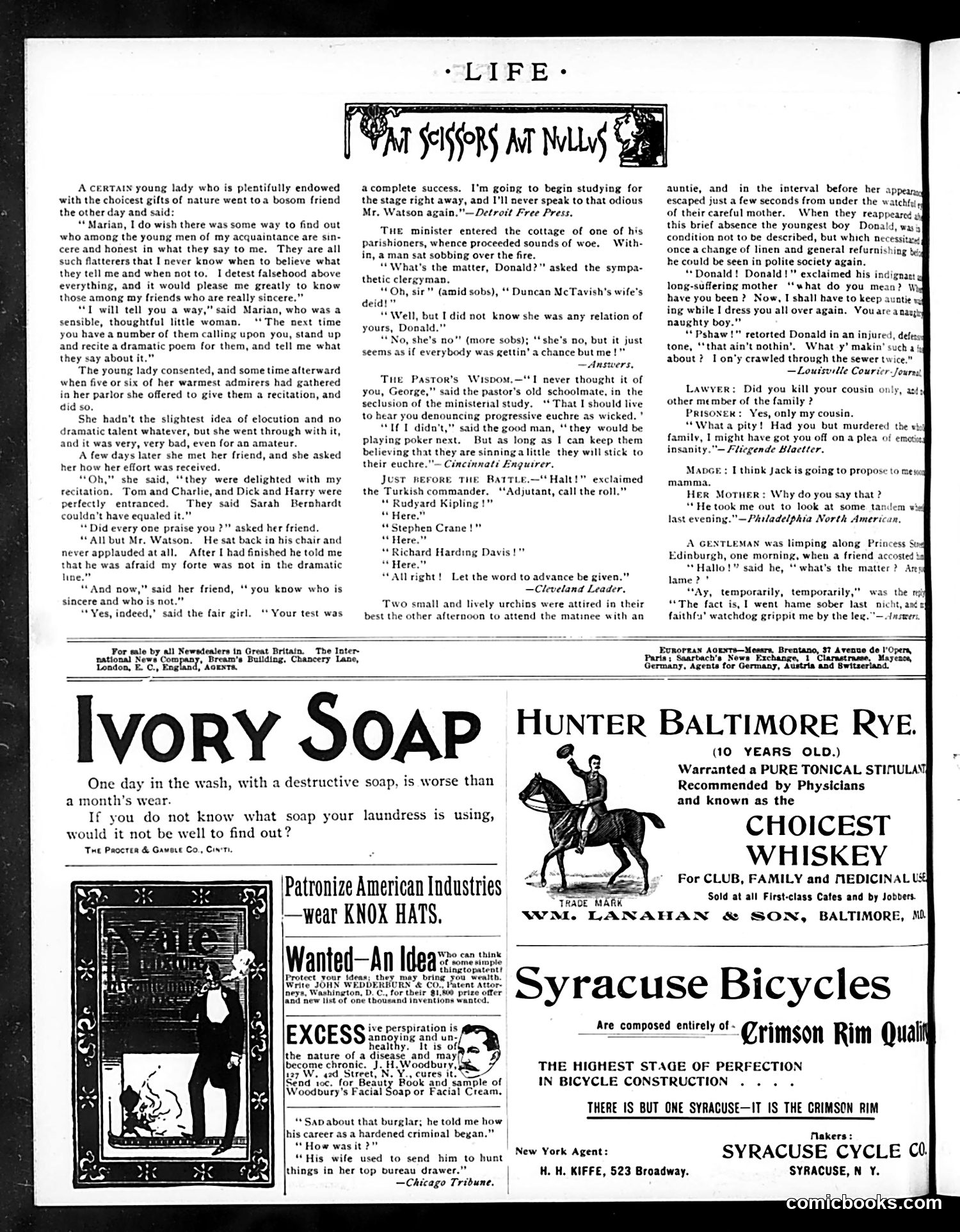
This page contains several short humorous anecdotes typical of *Life* magazine's satirical humor. The main piece, "Scissors at Nulls" (likely a play on words), tells a story about a young woman who tests suitors' sincerity by reciting bad poetry. Most flatter her dishonestly; only Mr. Watson honestly criticizes her performance—proving he's the sincere one. She then rejects him for being honest, satirizing the gap between what women claim to want (sincerity) and what they actually reward (flattery). The other brief jokes mock similar hypocrisies: a Scottish man mourning everyone's death but his own, a pastor who maintains congregation morality through selective condemnation, and a military commander calling roll with famous war correspondents' names before battle. The page is primarily **advertising**—Ivory Soap, Knox Hats, Hunter Baltimore Rye Whiskey, and Syracuse Bicycles occupy substantial space, making this a mixed editorial-commercial publication typical of early 1900s magazines.
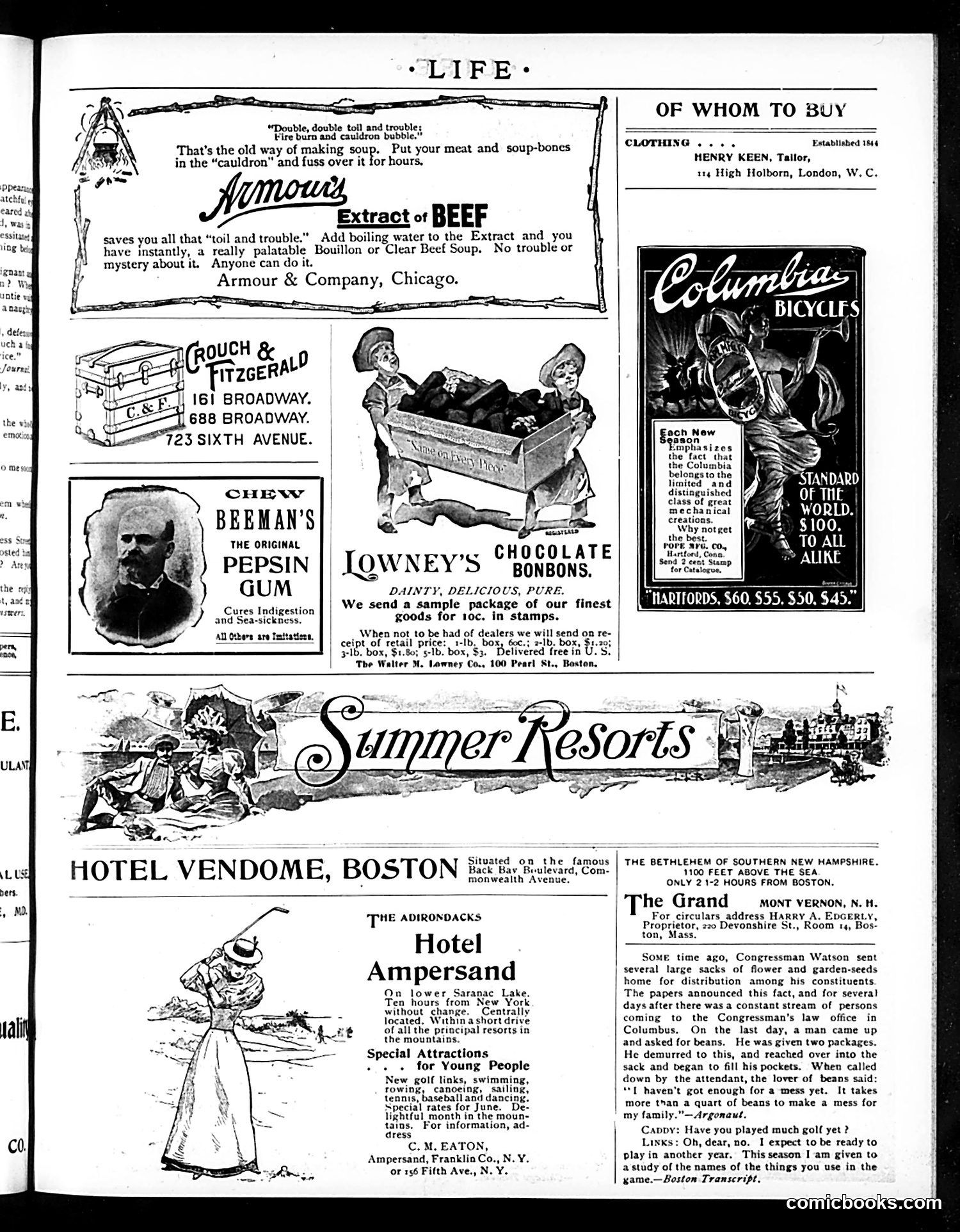
This is primarily an **advertising page** from an early 20th-century Life magazine, with one brief humorous anecdote at the bottom. The top features a **Armour Extract of Beef advertisement** that uses a "Macbeth" reference ("Double, double toil and trouble")—a literary allusion suggesting their product magically simplifies cooking, eliminating hours of labor over a cauldron. This appeals to busy households. Other ads promote consumer goods typical of the era: Beeman's Pepsin Gum (claims to cure indigestion), Lowney's Chocolate Bonbons, Columbia Bicycles, and various New England summer resorts and hotels. The humor comes in two brief jokes at bottom: one about a Congressman distributing seeds to constituents, where a voter demands extra beans; and a golf joke about a newcomer still learning golf terminology rather than playing. These are gentle, mainstream humor—not satirical commentary. The page reflects Gilded Age consumer culture and leisure advertising.
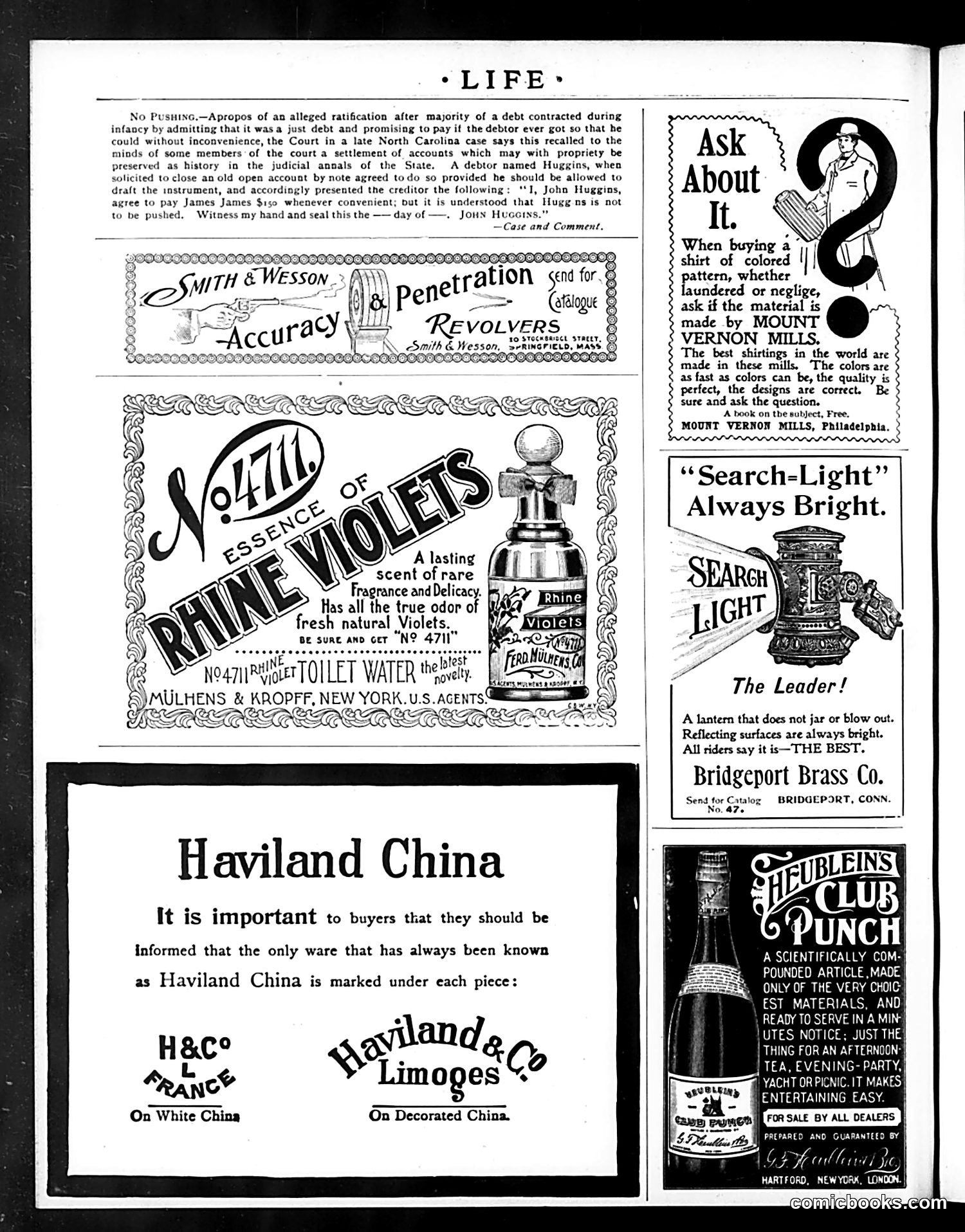
This page is primarily **advertisements** interspersed with one brief satirical anecdote. The only editorial content is "No Pushing" at the top—a humorous legal case from North Carolina. A debtor named Huggins agreed to pay a creditor named James, but inserted the condition: "it is understood that Huggins is not to be pushed," essentially creating an unenforceable debt. The satire mocks both legal absurdity and debtors who exploit contractual loopholes to avoid payment obligations. The remainder of the page contains period advertisements for consumer goods: Smith & Wesson revolvers, Noziini Rhine Violets toilet water, Haviland China (distinguishing French from decorated versions), Mount Vernon Mills shirting, Search-Light lanterns, Bridgeport Brass lanterns, and Shebleins Club Punch. These ads reflect early 20th-century consumer culture and industrial manufacturing.
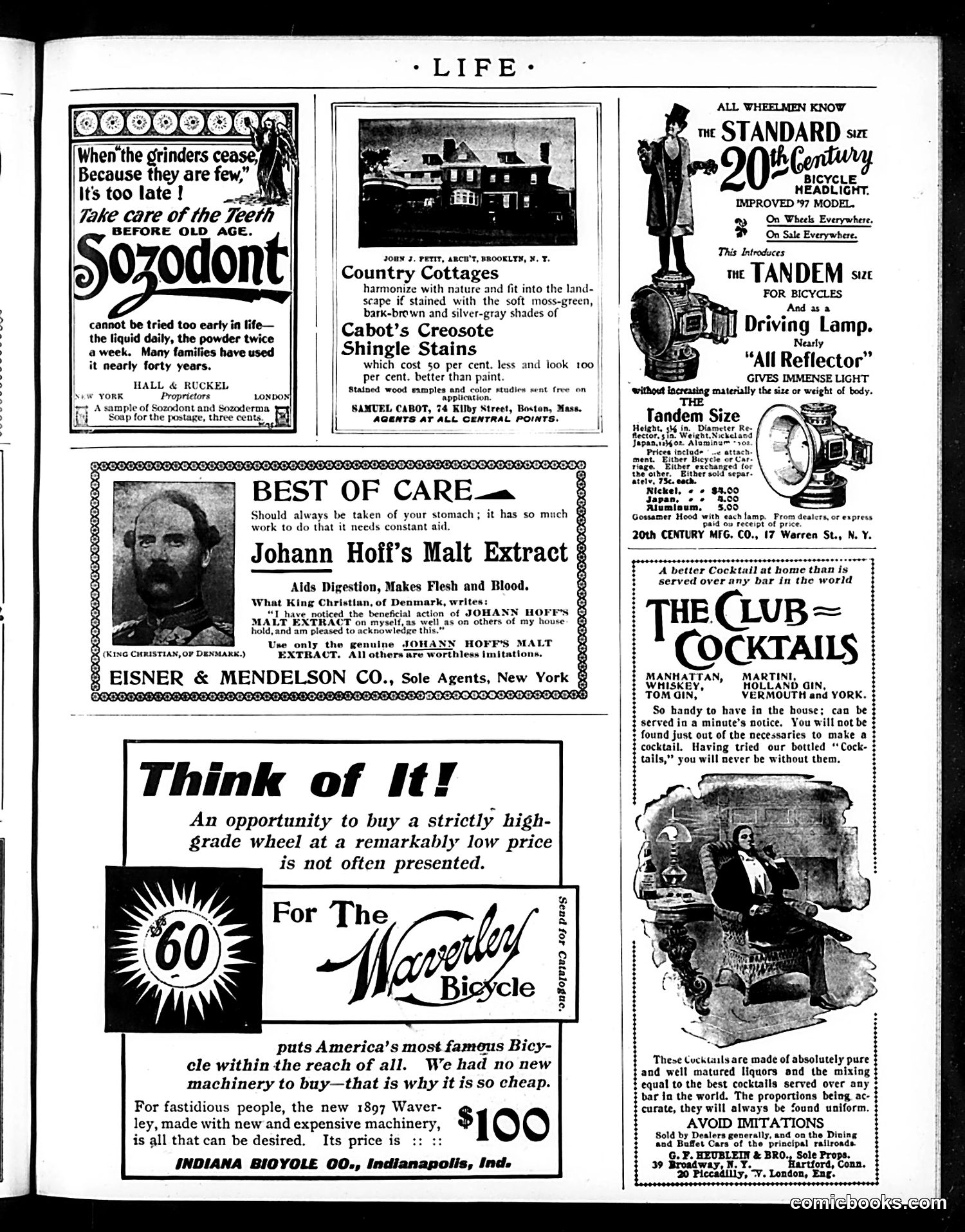
This is primarily an **advertising page** from what appears to be the 1890s, with no political cartoons or satirical commentary. The page contains various product advertisements typical of the era: - **Sozodont** toothpaste (emphasizing early dental care) - **Cabot's Creosote** wood stain for country cottages - **Johann Hoff's Malt Extract** (a digestive tonic endorsed by "King Christian of Denmark") - **Bicycles**: prominently featured are the Waverley ($100), Tandem, and Standard 20th Century models—reflecting the 1890s bicycle craze - **Bicycle accessories**: headlights and reflectors - **The Club Cocktails**: pre-mixed bottled cocktails for home use The only quasi-satirical element is the Waverley ad's heading "Think of It!"—suggesting amazement that quality bicycles could be so affordable. This reflects genuine consumer excitement during the bicycle boom. The page demonstrates late-Victorian advertising strategies: appeals to health, modernity, and aspirational living for middle-class readers.
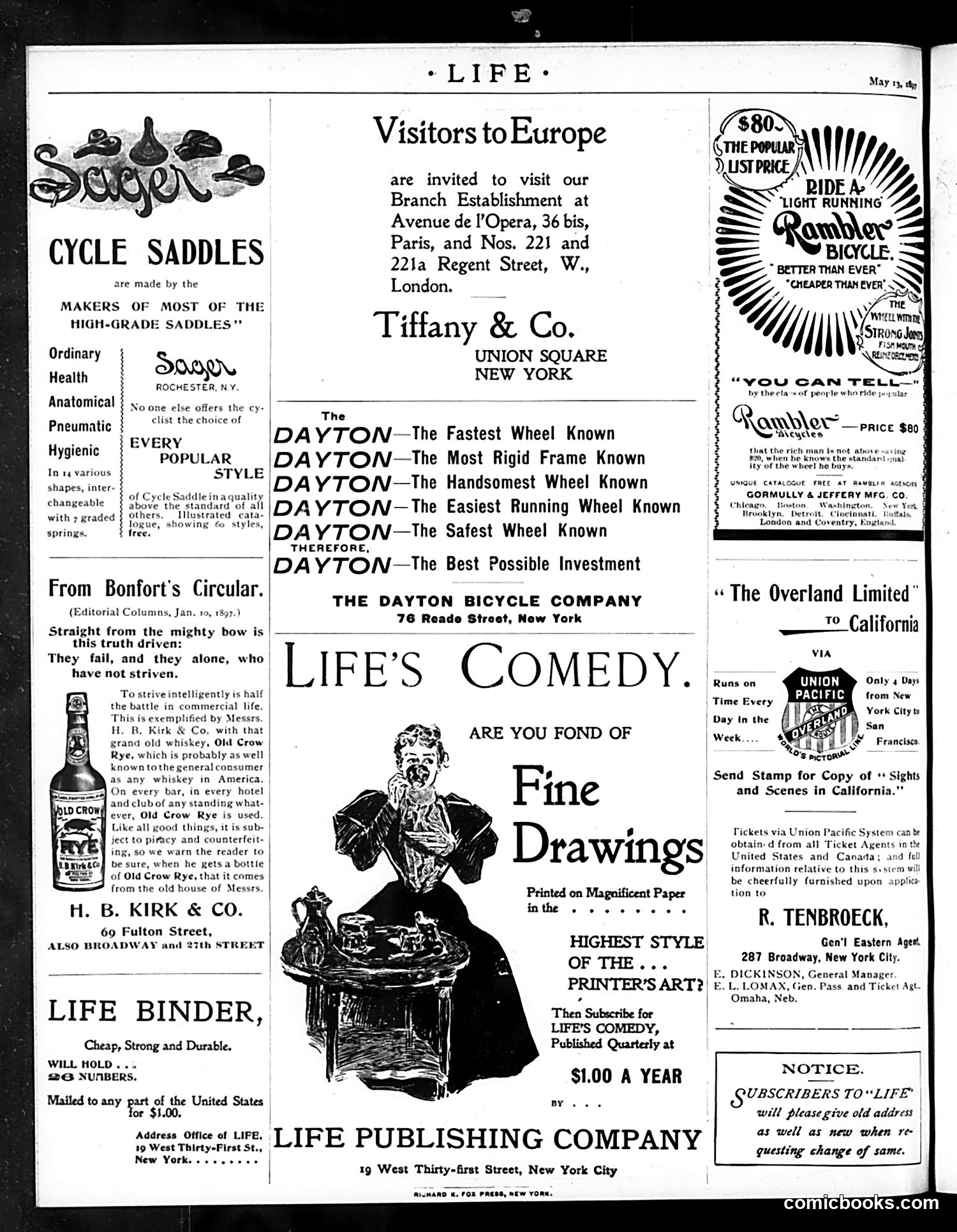
This is primarily an **advertising page** from Life's satirical magazine, not a political cartoon. The page contains multiple bicycle and product advertisements typical of the 1890s era. The central image labeled "**LIFE'S COMEDY**" depicts a caricatured figure (appears to be a wealthy or well-dressed man) emerging from or associated with a large bowl or vessel. The accompanying text promotes "Fine Drawings" printed in the "highest style of the printer's art," inviting subscription to Life's Comedy at $1.00 yearly. The joke appears to reference the magazine's own satirical content—the figure literally emerging from a vessel suggests Life magazine's comedic/satirical output. However, without additional context about contemporary figures or events referenced, the specific satire remains unclear. The page otherwise advertises cycle saddles, bicycles (Dayton and Rambler brands), Old Crow Rye whiskey, and California travel via Union Pacific Railroad—reflecting the commercial interests and consumer goods of the 1890s bicycling craze era.