
Life, 1897-05-13 · page 6 of 20
Life — May 13, 1897 — page 6: what you’re looking at
What you’re looking at
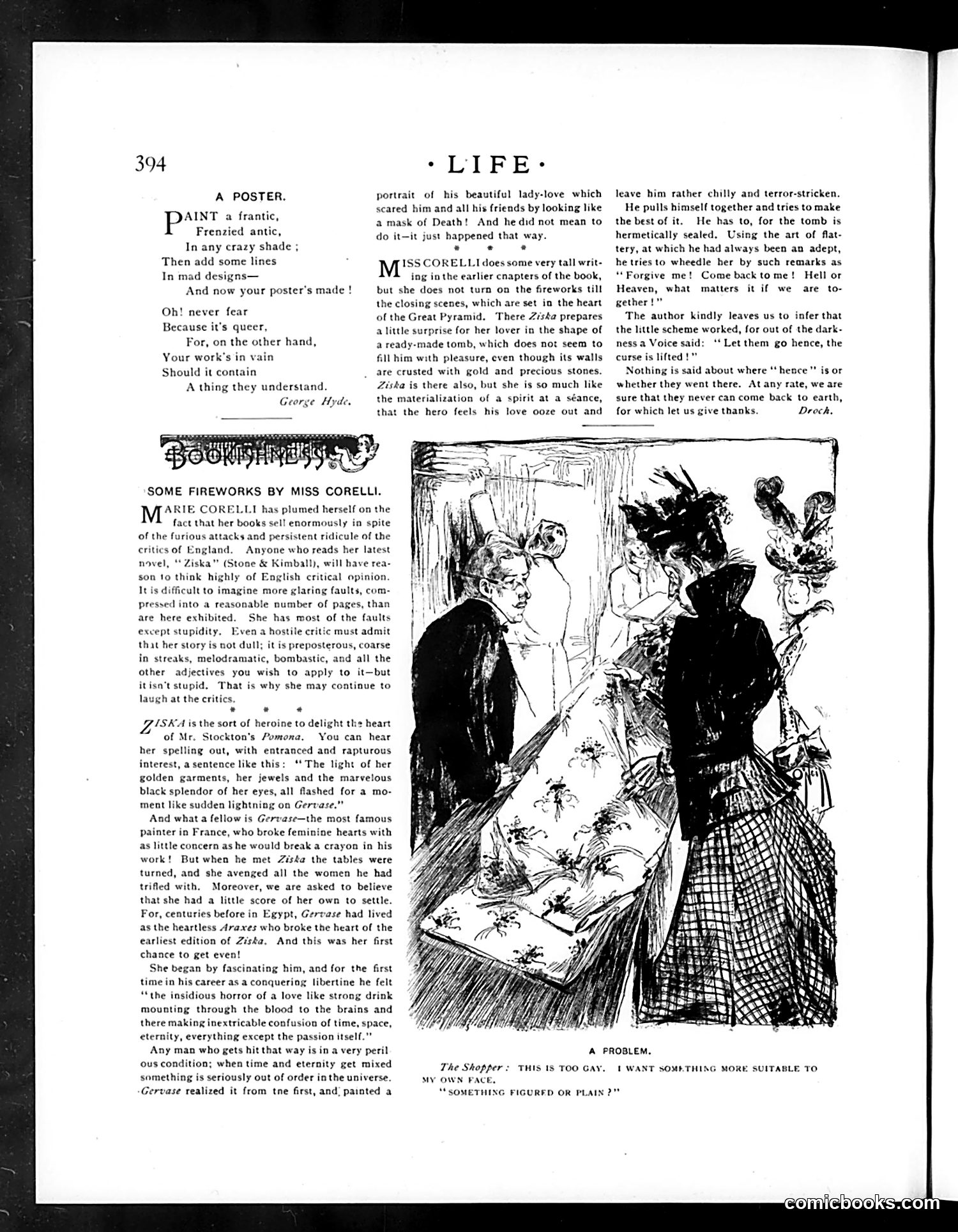
This page contains two distinct sections: **"A Poster"** (top left) is a poem by George Hyde about creating effective poster art—advocating for simplicity and clarity over cluttered design. **"Some Fireworks by Miss Corelli"** (main text) discusses novelist Marie Corelli's literary style, comparing her dramatic, sensational writing to "fireworks." The text criticizes her work as melodramatic and coarse while acknowledging her popularity with readers. **"A Problem"** (bottom illustration) shows a shopkeeper and customer in a humorous domestic scene. The caption reads: "This is too gay. I want something more suitable to my own face. Something figured or plain!" The joke appears to satirize the customer's complaint about wanting fashionable goods that match their own dull personality—poking fun at Victorian propriety and self-consciousness about appearances.
📄 Transcribed text from this page (OCR, searchable)
Machine-transcribed from the original scan — historical spelling and the odd misread are preserved.
394 A POSTER. pt a frantic, Frenzied antic, In any crazy shade ; Then add some lines In mad designs— And now your poster's made ! Oh! never fear Because it's queer, For, on the other hand, Your work's in vain Should it contain A thing they understand. George Hyde. *LIFE- portrait of his beautiful lady-love which scared him and all his friends by looking like a mask of Death! And he did not mean to do it—it just happened that way. * «© @ M' CORELLI does some very tall writ- ing in the earlier cnapters of the book, but she does not turn on the fireworks till the closing scenes, which are set in the heart of the Great Pyramid. There Ziska prepares a little surprise for her lover in the shape of a ready-made tomb, which does not seem to fill him with pleasure, even though its walls are crusted with gold and precious stones. Ziska is there also, but she is so much like the materialization of a spirit at a séance, leave him rather chilly and terror-stricken. He pulls himself together and tries to make the best of it. He has to, for the tomb is hermetically sealed. Using the art of flat- tery, at which he had always been an adept, he tries to wheedle her by such remarks as “Forgive me! Come back tome! Hell or Heaven, what matters it if we are to- gether! ‘The author kindly leaves us to infer that the little scheme worked, for out of the dark- nessa Voice said: ‘Let them go hence, the curse is lifted ! Nothing is said about where “hence” is or whether they went there. At any rate, we are sure that they never can come back to earth, that the hero feels his love ooze out and for which let us give thanks. Drech, SOME FIREWORKS BY MISS CORELLI. Matte COREL has plumed herself on the fact that her books sel! enormously in spite of the furious attacks and persistent ridicule of the critics of England. Anyone who reads her latest novel, * Ziska" (Stone & Kimball), will have rea- son to think highly of English critical opinion. It is difficult to imagine more glaring faults, com- pressed into a reasonable number of pages, than are here exhibited. She has most of the faults except stupidity, Even a hostile critic must admit that her story is not dull; it is preposterous, coarse in streaks, melodramatic, bombastic, and all the other adjectives you wish to apply to it—but it isn't stupid. That is why she may continue to laugh at the critics, * * * GSKA is the sort of heroine to delight the heart of Mr. Stockton's Pomona, You can hear her spelling out, with entranced and rapturous interest, a sentence like this: ‘The light of her golden garments, her jewels and the marvelous black splendor of her eyes, all flashed for a mo- ment like sudden lightning on Gervase.” And what a fellow is Gervase—the most famous painter in France, who broke feminine hearts with as little concern as he would break a crayon in his work! But when he met Zista the tables were turned, and she avenged all the women he had trifled with. Moreover, we are asked to believe that she had a little score of her own to settle. For, centuries before in Egypt, Gervase had lived as the heartless Araxes who broke the heart of the earliest edition of Zista. And this was her first chance to get even! She began by fascinating him, and for the first time in his career as a conquering libertine he felt ‘*the insidious horror of a love like strong drink mounting through the blood to the brains and there making inextricable confusion of time, space, eternity, everything except the passion itself." Any man who gets hit that way is in a very peril ous condition; when time and eternity get mixed something is seriously out of order in the universe. Gervase realized it from tne first, and: painted a A PROBLEM. The Shopper : MY OWN FACE. “SOMETHING FIGURFD OR PLAIN ?"* THIS 18 TOO GAY. 1 WANT SOMPTHING MORE SUITABLE TO