
Life, 1897-05-13 · page 4 of 20
Life — May 13, 1897 — page 4: what you’re looking at
What you’re looking at
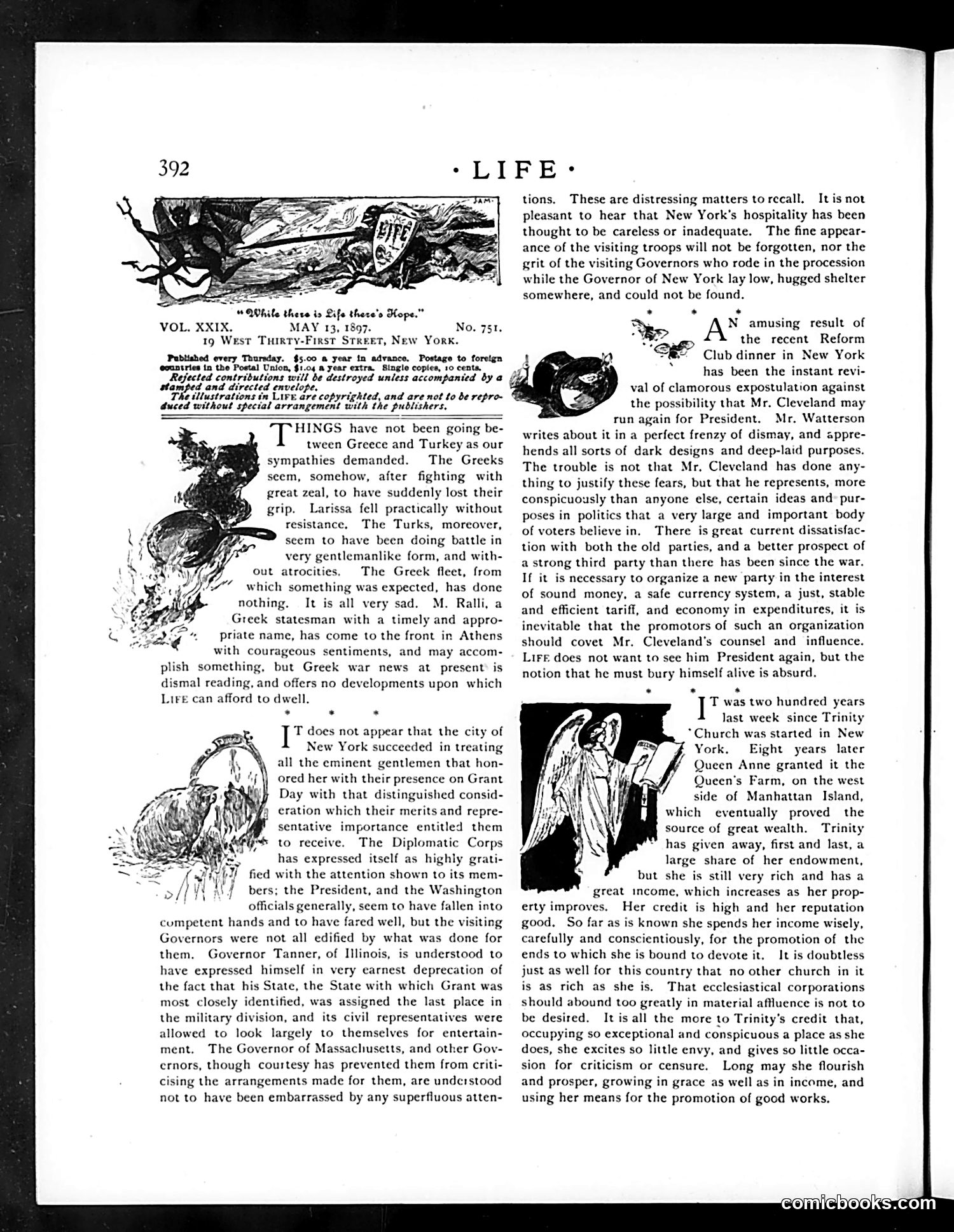
The page contains three distinct editorial cartoons and accompanying text critiquing contemporary political and diplomatic matters. The cartoons appear to satirize: 1. **Greek-Turkish conflict**: Depicts Greece and Turkey in conflict, with commentary on inadequate diplomatic response and Greek military failures. 2. **New York's hospitality**: References mishandling of visiting foreign dignitaries and governors during Grant Day celebrations, suggesting the city's reception was careless or inadequate. 3. **Cleveland's political prospects**: A detailed article mocking concerns that former President Grover Cleveland might run again, dismissing such fears as unfounded while advocating for a strong third party alternative. The satirical tone targets political incompetence, diplomatic bungling, and speculative anxiety about electoral outcomes in the 1890s political landscape.
📄 Transcribed text from this page (OCR, searchable)
Machine-transcribed from the original scan — historical spelling and the odd misread are preserved.
*LIFE: VOL. XXIX. MAY 13, 1897. No. 751. 19 West Tuirty-First Street, New York. Published every Thursday. $5.00 a year in advance. Postage to foreign eountries in the Postal Union, $1.04 a year extra. Single copies, 10 cents, Rejected contributions will be destroyed unless accompanied by a stamped and directed envelope, The illustrations in Live are copyrighted, and are not to be repro- duced without special arrangement with the publishers, HINGS have not been going be- tween Greece and Turkey as our sympathies demanded. The Greeks seem, somehow, after fighting with great zeal, to have suddenly lost their grip. Larissa fell practically without resistance. The Turks, moreover, seem to have been doing battle in very gentlemanlike form, and with- atrocitit The Greek fleet, from which something was expected, has done nothing. It is all very sad. M. Ralli, a Greek statesman with a timely and appro- priate name, has come to the front in Athens with courageous sentiments, and may accom- plish something, but Greek war news at present is dismal reading, and offers no developments upon which Lire can afford to dwell. . . . T does not appear that the city of New York succeeded in treating all the eminent gentlemen that hon- ored her with their presence on Grant Day with that distinguished consid- eration which their merits and repre- sentative importance entitled them to receive. The Diplomatic Corps has expressed itself as highly grati- fied with the attention shown to its mem- the President, and the Washington ials generally, seem to have fallen into competent hands and to have fared well, but the ng Governors were not all edified by what was done for them. Governor Tanner, of Illinois, is understood to have expressed himself in very earnest deprecation of the fact that his State, the State with which Grant was most closely identified, was assigned the last place in the military division, and its civil representatives were allowed to look largely to themselves for entertain- ment. The Governor of Massachusetts, and other Gov- ernors, though courtesy has prevented them from criti- cising the arrangements made for them, are undcrstood not to have been embarrassed by any superfluous atten- vey be tions. These are distressing matters torccall. It is not pleasant to hear that New York's hospitality has been thought to be careless or inadequate. The fine appear- ance of the visiting troops will not be forgotten, nor the grit of the visiting Governors who rode in the procession while the Governor of New York lay low, hugged shelter somewhere, and could not be found. . N amusing result of the recent Reform Club dinner in New York has been the instant revi- val of clamorous expostulation against the possibility that Mr. Cleveland may run again for President. Mr, Watterson writes about it in a perfect frenzy of dismay, and appre- hends all sorts of dark designs and deep-laid purposes. The trouble is not that Mr. Cleveland has done any- thing to justify these fears, but that he represents, more conspicuously than anyone else, certain ideas and: pur- poses in politics that a very large and important body of voters believe in, There is great current dissatisfac- tion with both the old parties, and a better prospect of a strong third party than there has been since the war. If it is necessary to organize a new party in the interest of sound money, a safe currency system, a just, stable and efficient tariff, and economy in expenditures, it is inevitable that the promotors of such an organization should covet Mr. Cleveland's counsel and influence. LiFe does not want to see him President again, but the notion that he must bury himself alive is absurd. . * T was two hundred years last week since Trinity “Church was started in New York. Eight years later Queen Anne granted it the Queen's Farm, on the west side of Manhattan Island, which eventually proved the source of great wealth. Trinity has given away, first and last, a large share of her endowment, but she is still very rich and has a great income, which increases as her prop- erty improves. Her credit is high and her reputation good. So far as is known she spends her income wisely, carefully and conscientiously, for the promotion of the ends to which she is bound to devote it. It is doubtless just as well for this country that no other church in it is as rich as she is. That ecclesiastical corporations should abound too greatly in material affluence is not to be desired. It is all the more to Trinity's credit that, occupying so exceptional and conspicuous a place as she does, she excites so little envy, and gives so little occa- sion for criticism or censure. Long may she flourish and prosper, growing in grace as well as in income, and using her means for the promotion of good works.