
Life, 1897-05-13 · page 13 of 20
Life — May 13, 1897 — page 13: what you’re looking at
What you’re looking at
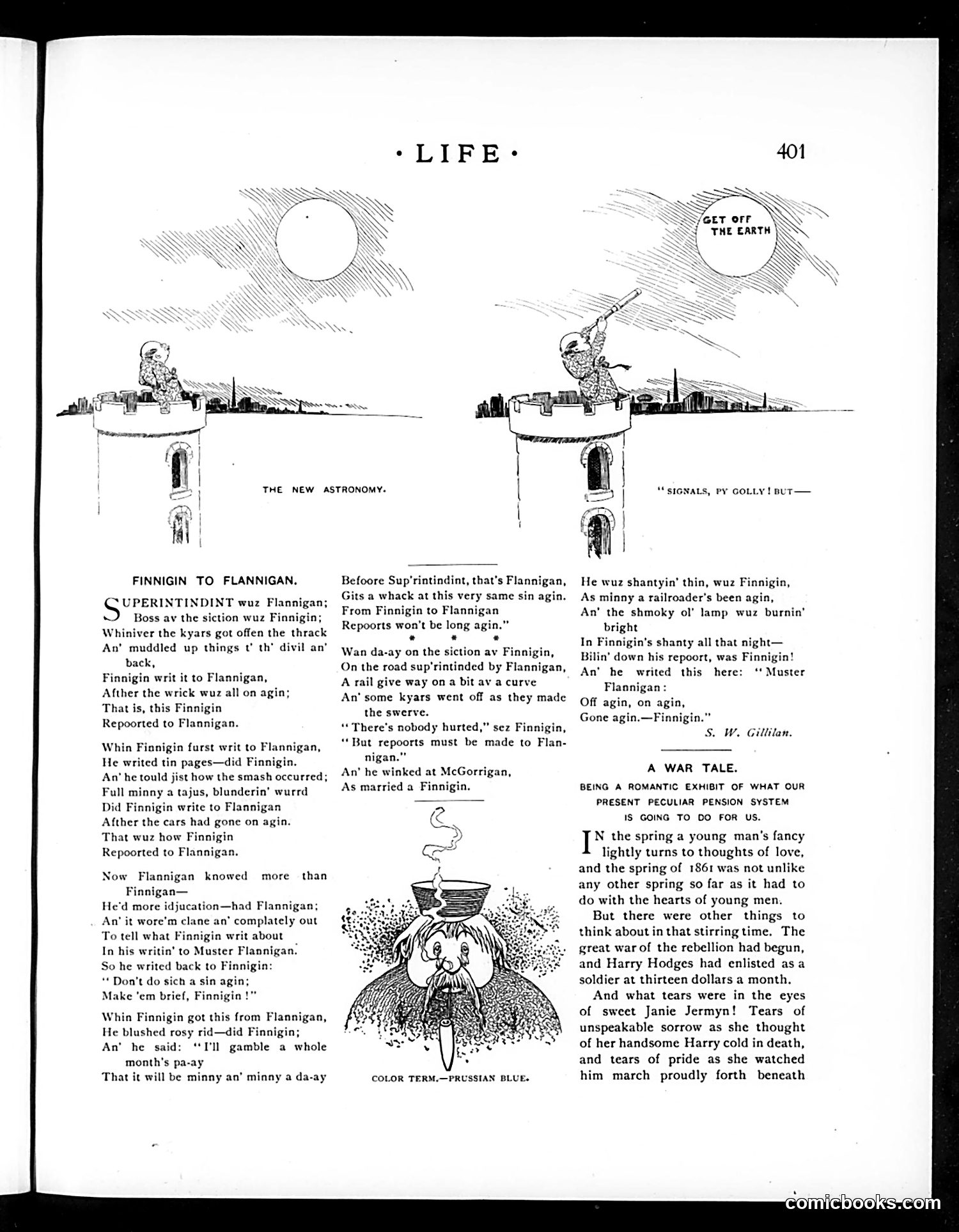
This Life magazine page contains two satirical pieces: **"The New Astronomy"** (top): A humorous poem in exaggerated Irish-immigrant dialect about railroad bureaucracy. Superintendent Flannigan receives lengthy incident reports from Section Boss Finnigin after train wrecks. When Flannigan complains the reports are too wordy, Finnigin responds with an absurdly brief replacement: "Off agin, on agin, / Gone agin." The satire mocks both verbose bureaucratic writing and the opposite extreme of unhelpful brevity. **"A War Tale"** (bottom): An opening fragment of satire about the 1861 Civil War pension system, mentioning a young soldier (Harry Hodges) enlisting at thirteen dollars monthly while his sweetheart (Janie Jermyn) watches. The subtitle indicates forthcoming criticism of how pensions will affect society—likely satirizing pension fraud or unrealistic expectations about military compensation. Both pieces use exaggeration and dialect humor typical of early 20th-century American satire.
📄 Transcribed text from this page (OCR, searchable)
Machine-transcribed from the original scan — historical spelling and the odd misread are preserved.
THE NEW ASTRONOMY. FINNIGIN TO FLANNIGAN. ~ UPERINTINDINT wuz Flannigan; . Boss av the siction wuz Finnigin; Whiniver the kyars got offen the thrack An’ muddled up things t th’ divil an’ back, Finnigin writ it to Flannigan, Afther the wrick wuz all on agin; That is, this Finnigin Repoorted to Flannigan. Whin Finnigin furst writ to Flannigan, He writed tin pages—did Finnigin. An’ he tould jist how the smash occurred; Full minny a tajus, blunderin’ wurrd Did Finnigin write to Flannigan Afther the cars had gone on agin. That wuz how ii Repoorted to Flannigan. Now Flannigan knowed more than Finnigan— He'd more idjucation—had Flannig An’ it wore'm clane an’ complately out To tell what Finnigin writ about In his writin’ to Muster Flanigan. So he writed back to Finnigin: ** Don’t do sich a sin agin; Make ‘em brief, Finnigin !" Whin Finnigin got this from Flannigan, He blushed rosy rid—did Finnigin; he said: “I'll gamble a whole month's pa-ay That it will be minny an’ minny a da-ay An’ Befoore Sup'rintindint, that’s Flannigan, Gits a whack at this very same sin agin. From Finnigin to Flannigan Repoorts won't be long agin.” * * * Wan da-ay on the siction av Finnigin, On the road sup'rintinded by Flannigan, A rail give way ona bit av a curve An’ some kyars went off as they made the swerve. ‘There's nobody hurted,” sez Finnigin, ‘*But repoorts must be made to Flan- nigan.” An’ he winked at McGorrigan, As married a Finnigin, COLOR TERM.—PRUSSIAN BLUE. ‘SIGNALS, PY GOLLY ! BUT— He wuz shantyin’ thin, wuz Finnigin, As minny a railroader’s been agin, An’ the shmoky ol’ lamp wuz burnin’ bright In Finnigin’s shanty all that night— Bilin’ down his repoort, was Finnigin! An’ he writed this here: ‘‘ Muster Flannigan: Off agin, on agin, Gone agin.—Finnigin.” S. W. Gillilan, A WAR TALE. BEING A ROMANTIC EXHIBIT OF WHAT OUR PRESENT PECULIAR PENSION SYSTEM 1S GOING TO DO FOR US. I N the spring a young man’s fancy lightly turns to thoughts of love, and the spring of 1861 was not unlike any other spring so far as it had to do with the hearts of young men. But there were other things to think about in that stirring time. The great war of the rebellion had begun, and Harry Hodges had enlisted as a soldier at thirteen dollars a month. And what tears were in the eyes of sweet Janie Jermyn! Tears of unspeakable sorrow as she thought of her handsome Harry cold in death, and tears of pride as she watched him march proudly forth beneath