
Life, 1897-05-13 · page 14 of 20
Life — May 13, 1897 — page 14: what you’re looking at
What you’re looking at
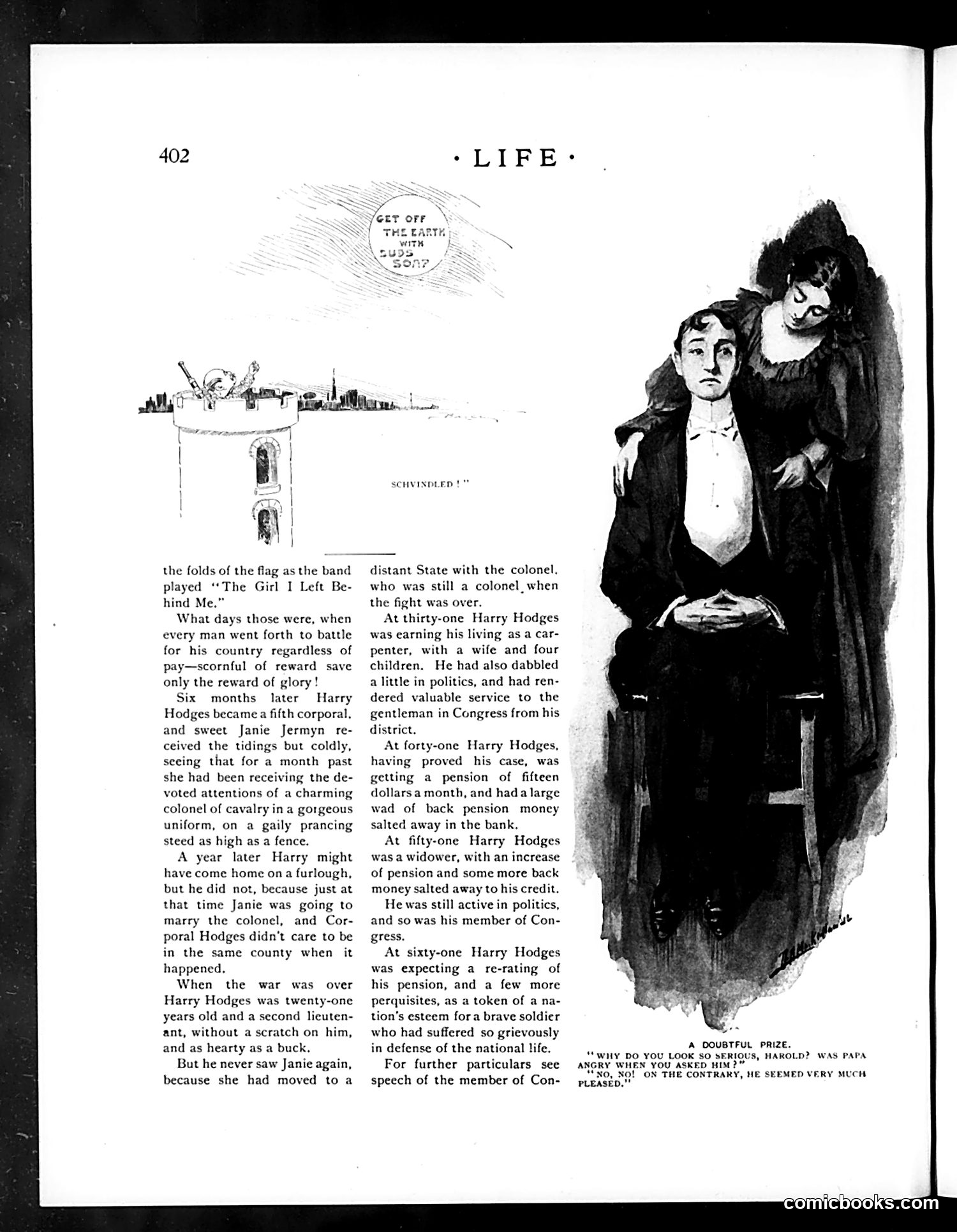
This satirical story mocks the post-Civil War treatment of veterans. Harry Hodges enlists patriotically but is jilted by Janie Jermyn, who marries a wealthy colonel. After 21 years of military service, Hodges returns as a second lieutenant—yet struggles as a carpenter supporting a family. The satire's bite: despite his sacrifice, Hodges receives only a meager $15/month pension and survives through political favors for his congressman. By age 61, he still hopes for pension increases and "perquisites"—patronage crumbs. The accompanying illustration shows a concerned young man with an older woman (likely his mother), captioned "A Doubtful Prize," with dialogue about asking father's permission—probably for marriage or engagement. This visual pun suggests that even romantic success feels uncertain and transactional in this mercenary world. The satire criticizes America's stingy veteran benefits and the patron-client political system that treats soldiers' service as currency for political machines rather than honoring genuine sacrifice.
📄 Transcribed text from this page (OCR, searchable)
Machine-transcribed from the original scan — historical spelling and the odd misread are preserved.
the folds of the flag as the band played “The Girl I Left Be- hind Me.” What days those were, when every man went forth to battle for his country regardless of pay—scornful of reward save only the reward of glory! Six months later Harry Hodges became a fifth corporal, and sweet Janie Jermyn re- ceived the tidings but coldly, seeing that for a month past she had been receiving the de- voted attentions of a charming colonel of cavalry in a gorgeous uniform, on a gaily prancing steed as high as a fence. A year later Harry might have come home ona furlough, but he did not, because just at that time Janie was going to marry the colonel, and Cor- poral Hodges didn’t care to be in the same county when it happened, When the war was over Harry Hodges twenty-one years old and a second licuten- ant, without a scratch on him, and as hearty as a buck. But he never saw Janie again, because she had moved to a SCHVINDLED 1" distant State with the colonel, who was still a colonel, when the fight was over. At thirty-one Harry Hodges was earning his living as a car- penter, with a wife and four children. He had also dabbled a little in politics, and had ren- dered valuable service to the gentleman in Congress from his district. At forty-one Harry Hodges, having proved his case, was getting a pension of fifteen dollars a month, and hada large wad of back pension money salted away in the bank, At fifty-one Harry Hodges was a widower, with an increase of pension and some more back money salted away to his credit. He was still active in politics, and so was his member of Con- gress. At sixty-one Harry Hodges was expecting a re-rating of his pension, and a few more perquisites, as a token of a na- tion’s estcem fora brave soldier who had suffered so grievously in defense of the national life. For further particulars see speech of the member of Con- A DOUBTFUL PRIZE. “WHY DO YOU LOOK SO SERIOUS, HAROLD? WAS PAPA ANGRY WH EN YOU ASKED HIM? ON THE CONTRARY, HE SEEMED VERY MUCH