
A complete issue · 20 pages · 1897
Life — April 22, 1897
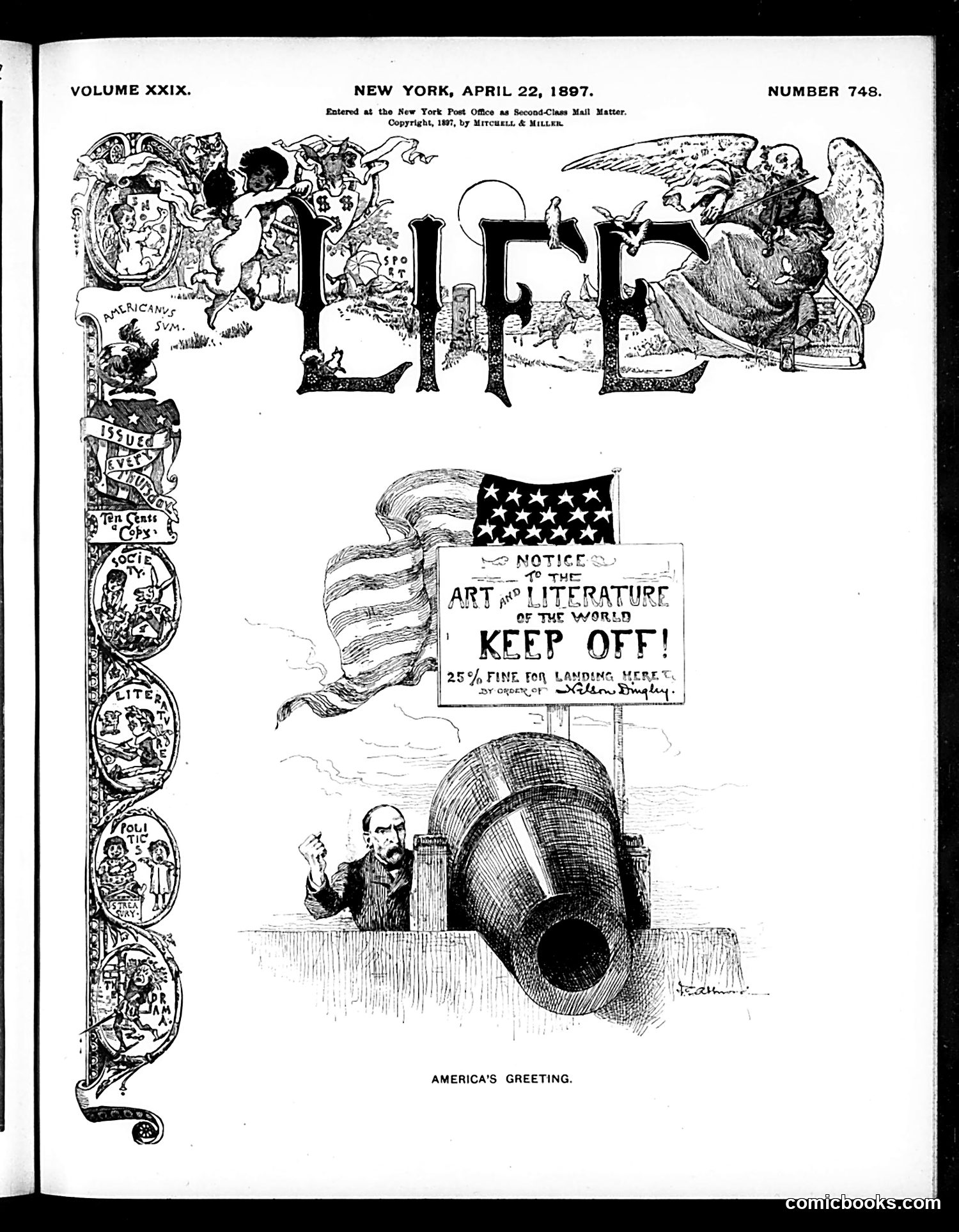
This satirical cartoon depicts America as a cannon-wielding guard protecting "the Art and Literature of the World" behind a "Keep Off!" sign. The sign warns of a "25% fine for landing here"—likely referencing recent American tariff policies protecting domestic industries. The figure manning the cannon appears to represent American protectionism or isolationism. The large cannon itself symbolizes American military/economic power being used defensively. The ornate left border with classical medallions suggests Old World culture being kept at arm's length. The satire critiques American trade barriers and cultural gatekeeping in the 1890s—suggesting America was using economic force to exclude foreign competition while simultaneously guarding itself as a bastion of civilization. The "fine for landing" makes the protectionist policy explicit.
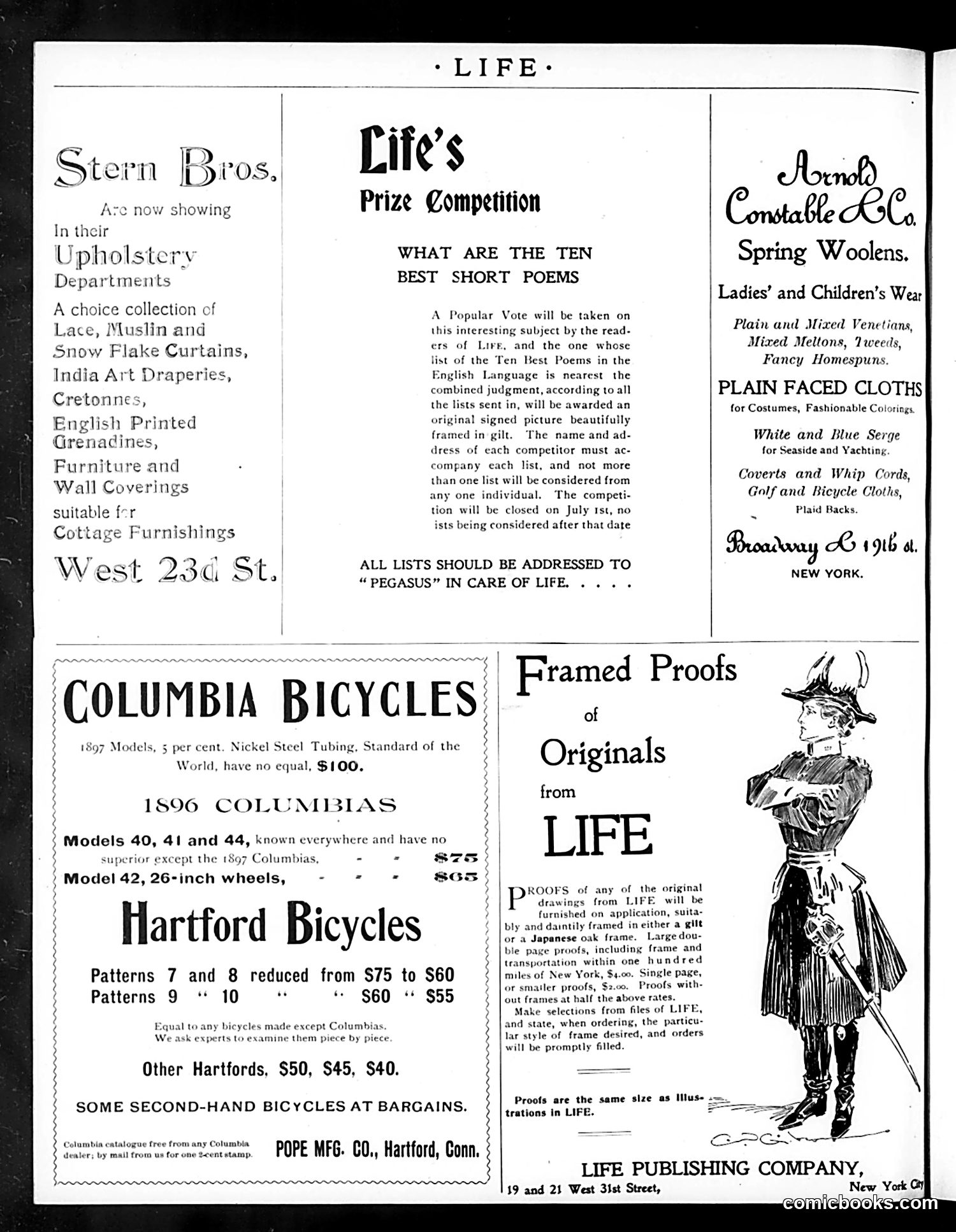
This page is **primarily advertising** with no political cartoons or satirical content. The advertisements include: - **Stern Bros.** (upholstery and home furnishings) - **Arnold Constable & Co.** (spring woolens and clothing) - **Columbia and Hartford Bicycles** (1896-1897 models with prices) - **Life Publishing Company** (offering framed proofs of original drawings) The only illustration is a **fashionable woman in 1890s dress** accompanying the framed proofs advertisement—a decorative image typical of period advertising, not satire. The page's primary purpose is commercial: Life magazine, like modern publications, sold advertising space. The "Prize Competition" section announces a poetry contest for readers, but contains no satirical commentary or political reference requiring historical context.
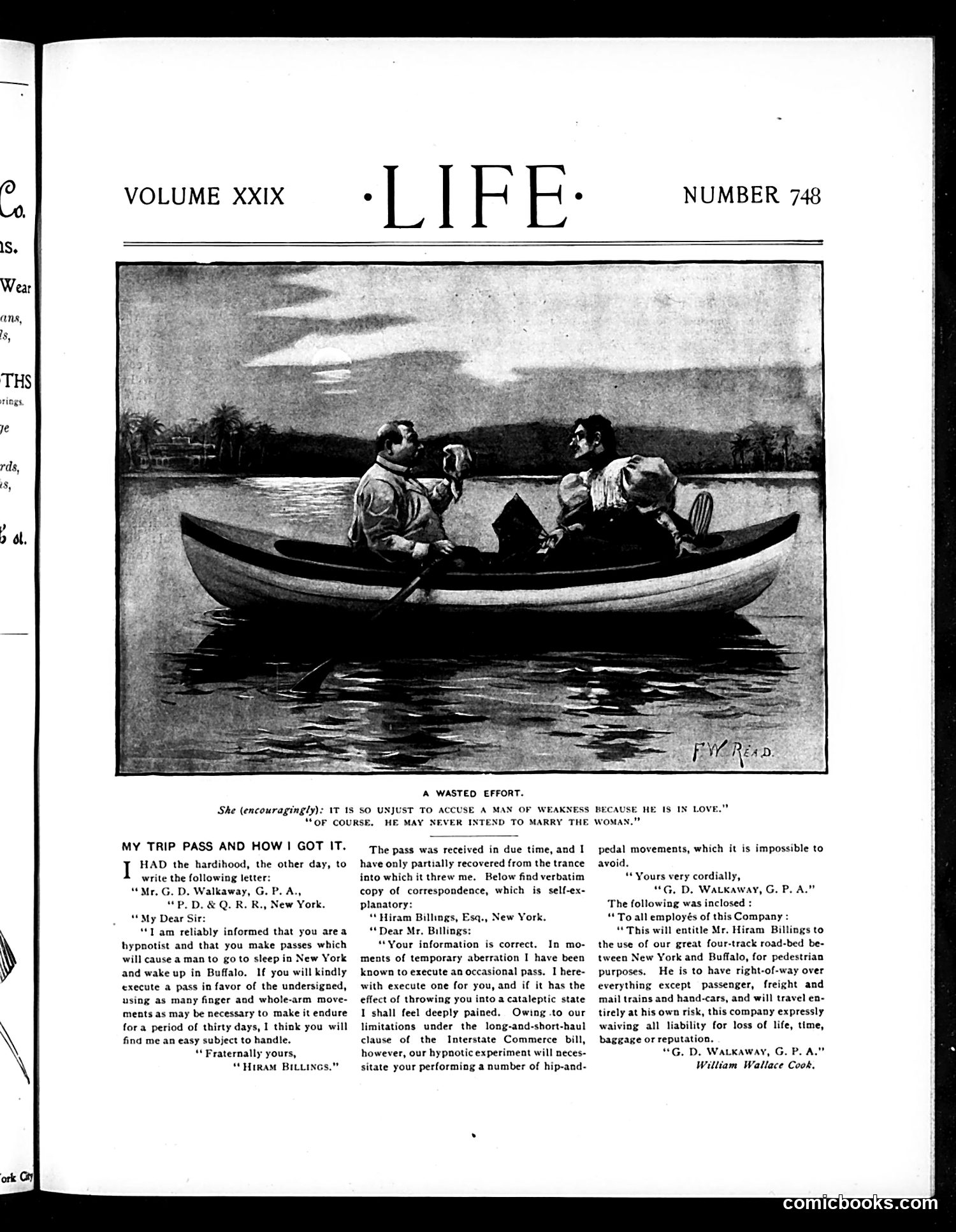
This cartoon depicts a couple in a rowboat, illustrating the caption: "She (encouraging): 'It is so unjust to accuse a man of faithlessness because he is in love.' Of course, he may never intend to marry the woman.'" The satire mocks the rationalization of infidelity. The woman in the boat is attempting to reassure the man that being "in love" with someone doesn't necessarily mean he's being unfaithful to her—a logical contradiction she's cheerfully endorsing. The joke targets both her willingness to accept this twisted reasoning and the absurdity of the argument itself. This reflects early-20th-century attitudes toward courtship and marriage, satirizing the mental gymnastics people use to justify romantic duplicity. The title "A Wasted Effort" suggests her reassurance is futile.
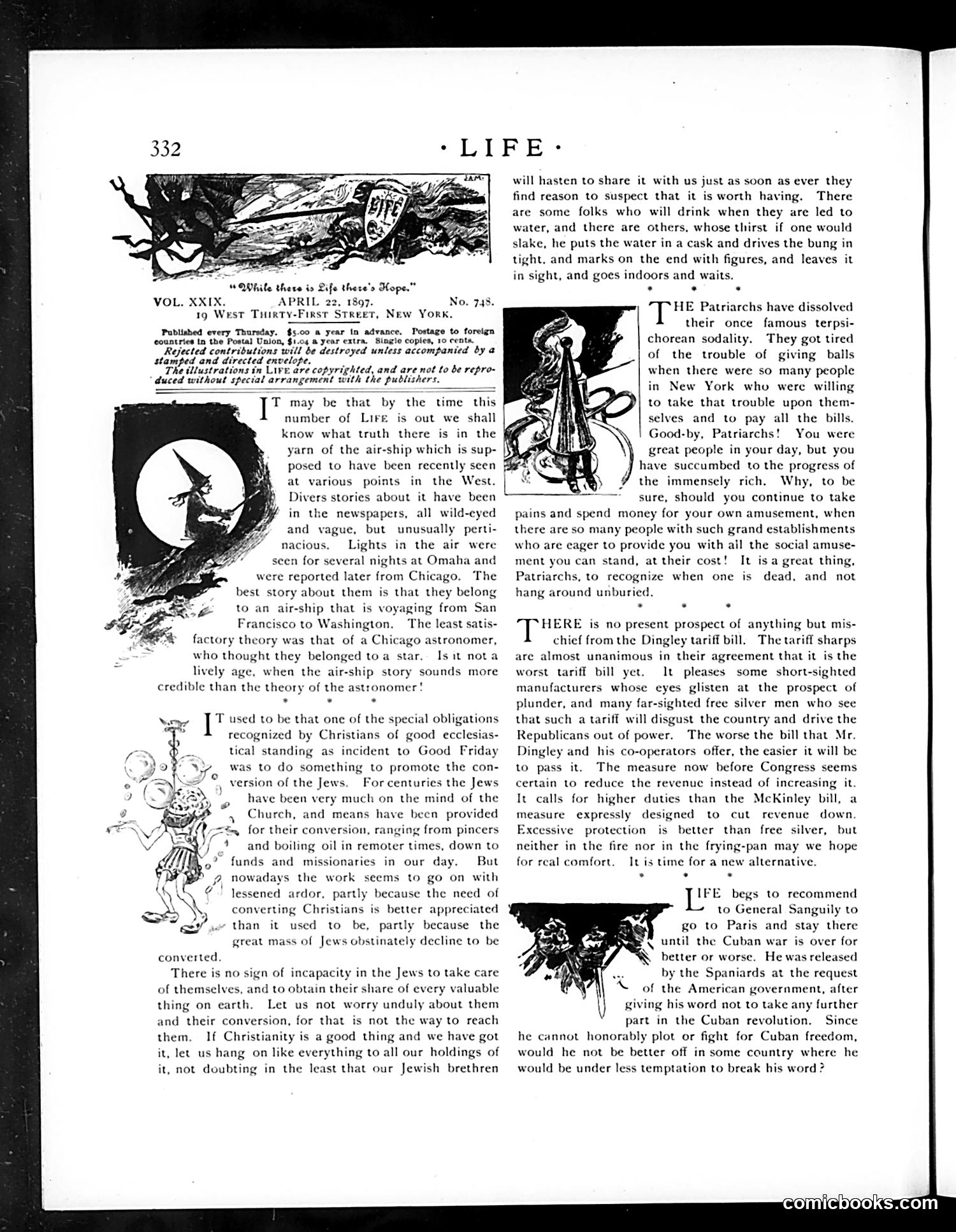
**Top cartoon ("While there is Life there's Hope"):** Shows a figure inside a large circular vessel or container, likely depicting someone trapped or confined—possibly related to air-ship experimentation mentioned in the text below. **Main text discusses:** Air-ship sightings reported in western cities (Omaha, Chicago). The author dismisses these as unreliable accounts, suggesting the "best story" involves an air-ship traveling from San Francisco to Washington, though the Chicago astronomer's theory lacks credibility. **Lower cartoons:** Appear to satirize religious conversion efforts toward Jewish people and debates about Christian missionary work—the text critiques whether forced conversion is actually an effective or ethical approach. The page reflects 1890s fascination with emerging aviation technology alongside skepticism about its credibility.
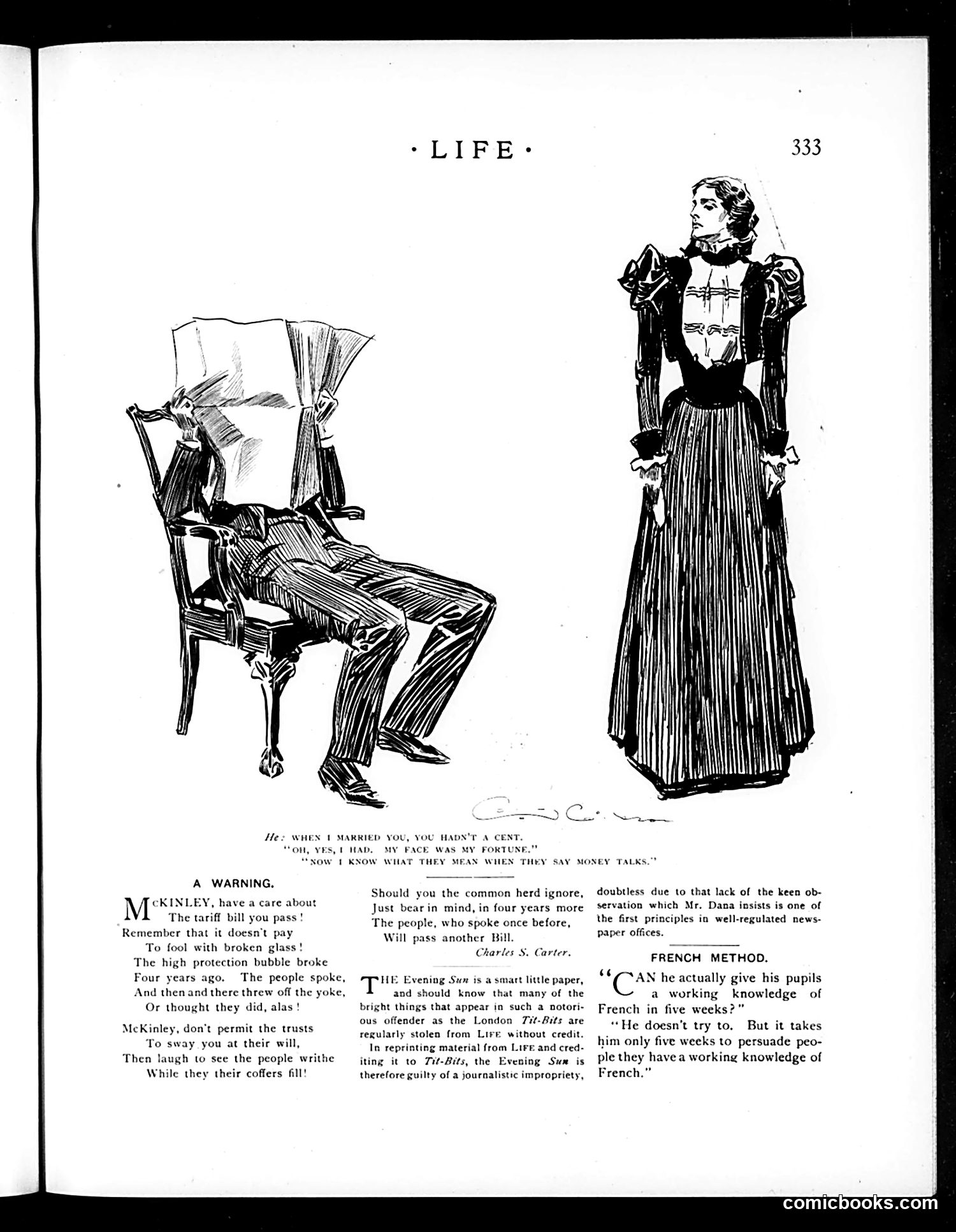
This page contains three separate satirical pieces about money, journalism, and language instruction. **"A Warning"** critiques McKinley (likely President William McKinley) for trusting the public despite a previous scandal four years prior when "the people spoke" about a bill. The verse warns that the public's will is unreliable—"their coffers fill" while people suffer. **"French Method"** mocks the absurdity of claiming someone can learn French in five weeks, sarcastically contrasting the claim with the reality that it "takes him only five weeks to persuade people they have a working knowledge of French." The illustration shows a well-dressed couple, likely depicting class commentary about wealth and social pretension during the Gilded Age era.
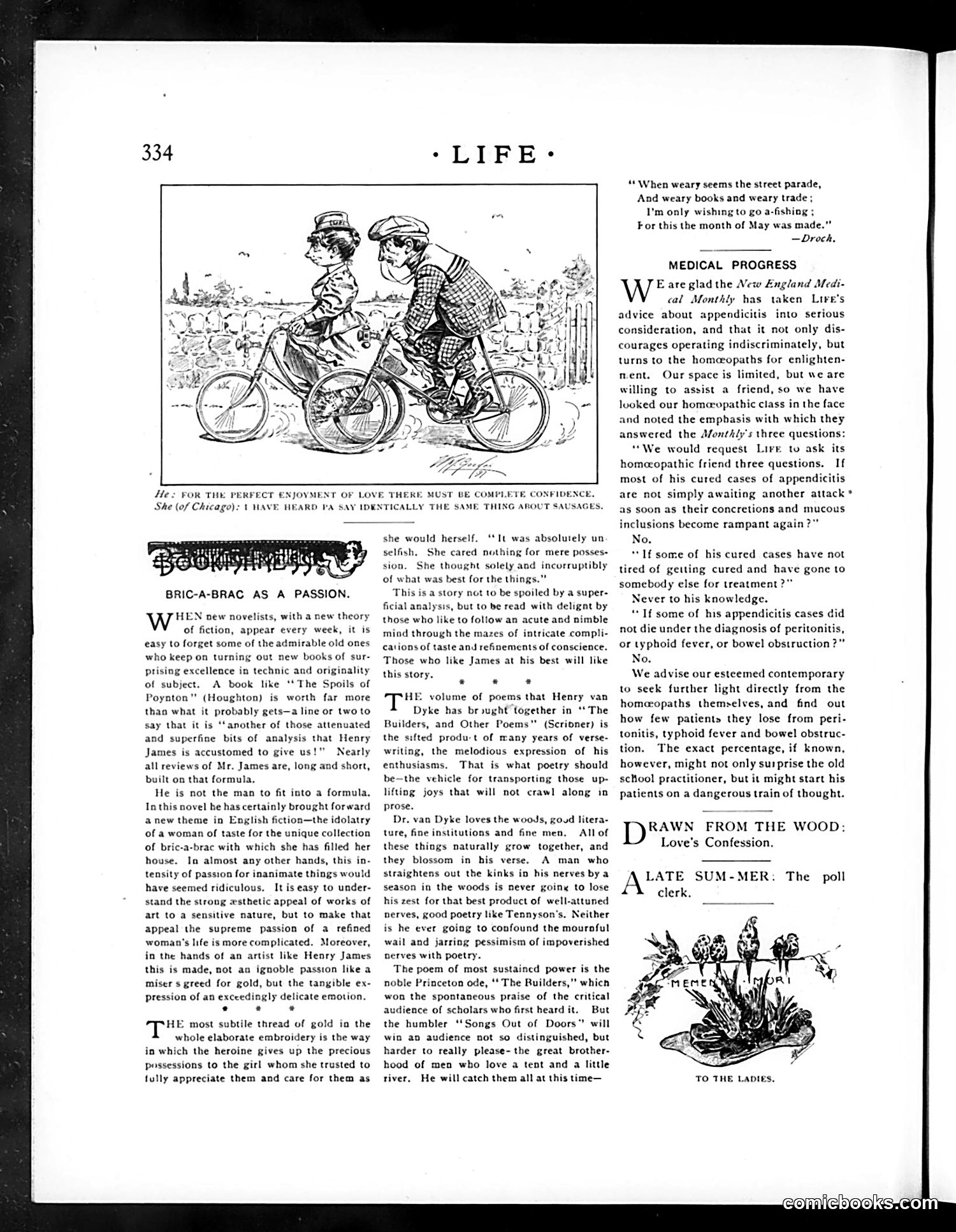
The main illustration shows two cyclists riding together with the caption: "FOR THE PERFECT ENJOYMENT OF LOVE THERE MUST BE COMPLETE CONFIDENCE. She of Chicago: 'I HAVE HEARD PA SAY IDENTICALY THE SAME THING ABOUT SAUSAGES.'" This is a joke about trust in relationships, playing on a double meaning. The woman from Chicago references her father's statement about sausages—implying that just as people shouldn't know what goes into sausages (willful ignorance makes them more palatable), romantic partners similarly benefit from not knowing certain truths about each other. It's satirizing naive notions of love while also poking fun at Chicago's famous meatpacking industry. The humor relies on the audience understanding the colloquial wisdom about not scrutinizing sausage-making.
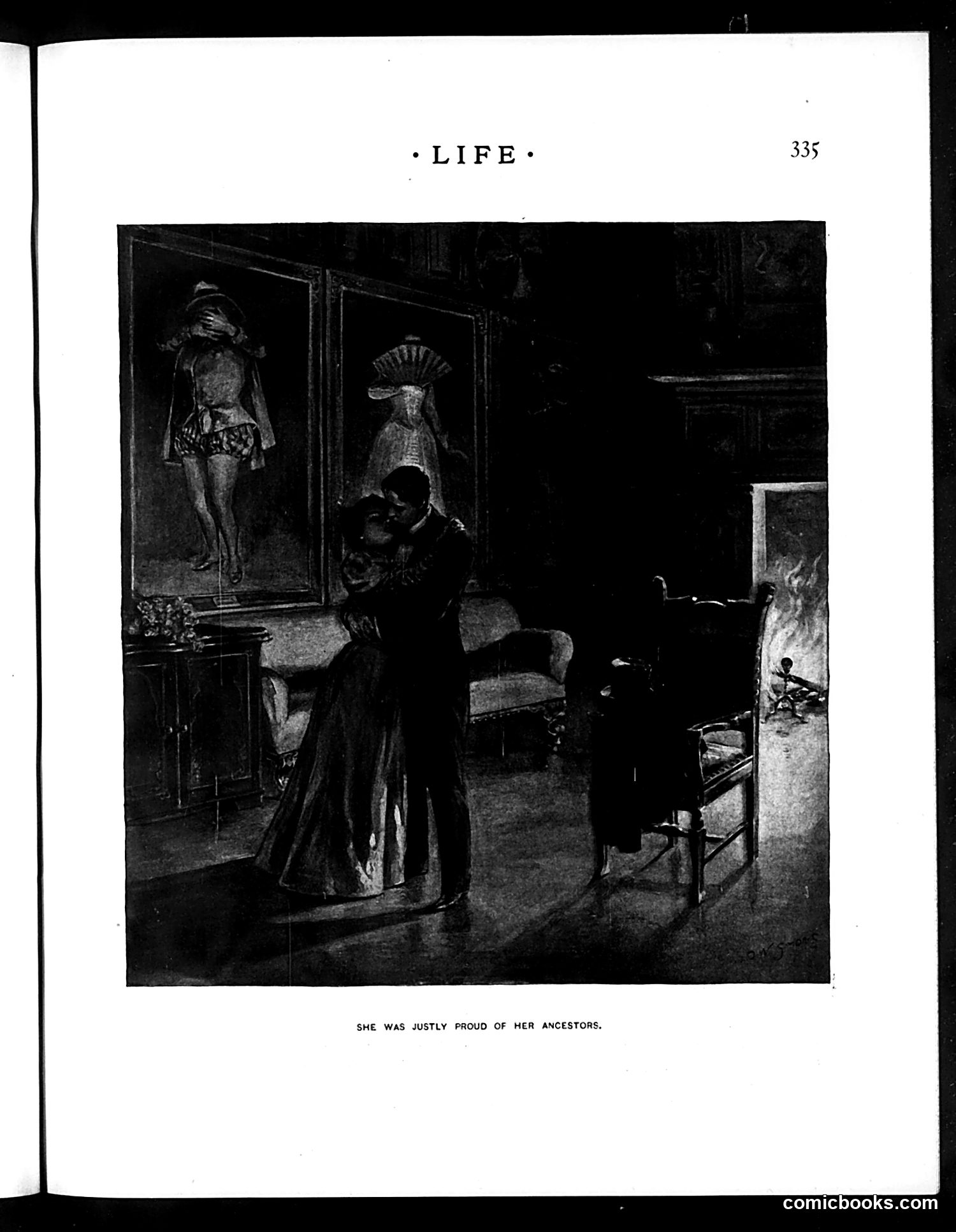
This is a satirical illustration from *Life* magazine (page 335) depicting a scene titled "She Was Justly Proud of Her Ancestors." The cartoon shows a woman in an interior room gazing at two portrait paintings on the wall—one depicting what appears to be a Roman or classical soldier in armor, the other a figure in ornate headgear. A seated man observes her admiration. The satire likely mocks nouveau riche pretension or social climbing: the woman displays pride in aristocratic or distinguished ancestry through displayed portraits, while the seated observer's expression suggests skepticism about the authenticity of these claims. The joke appears to be that her pride in ancestors may be unwarranted or fabricated—a common target of *Life's* social satire about American class aspirations and genealogical vanity.
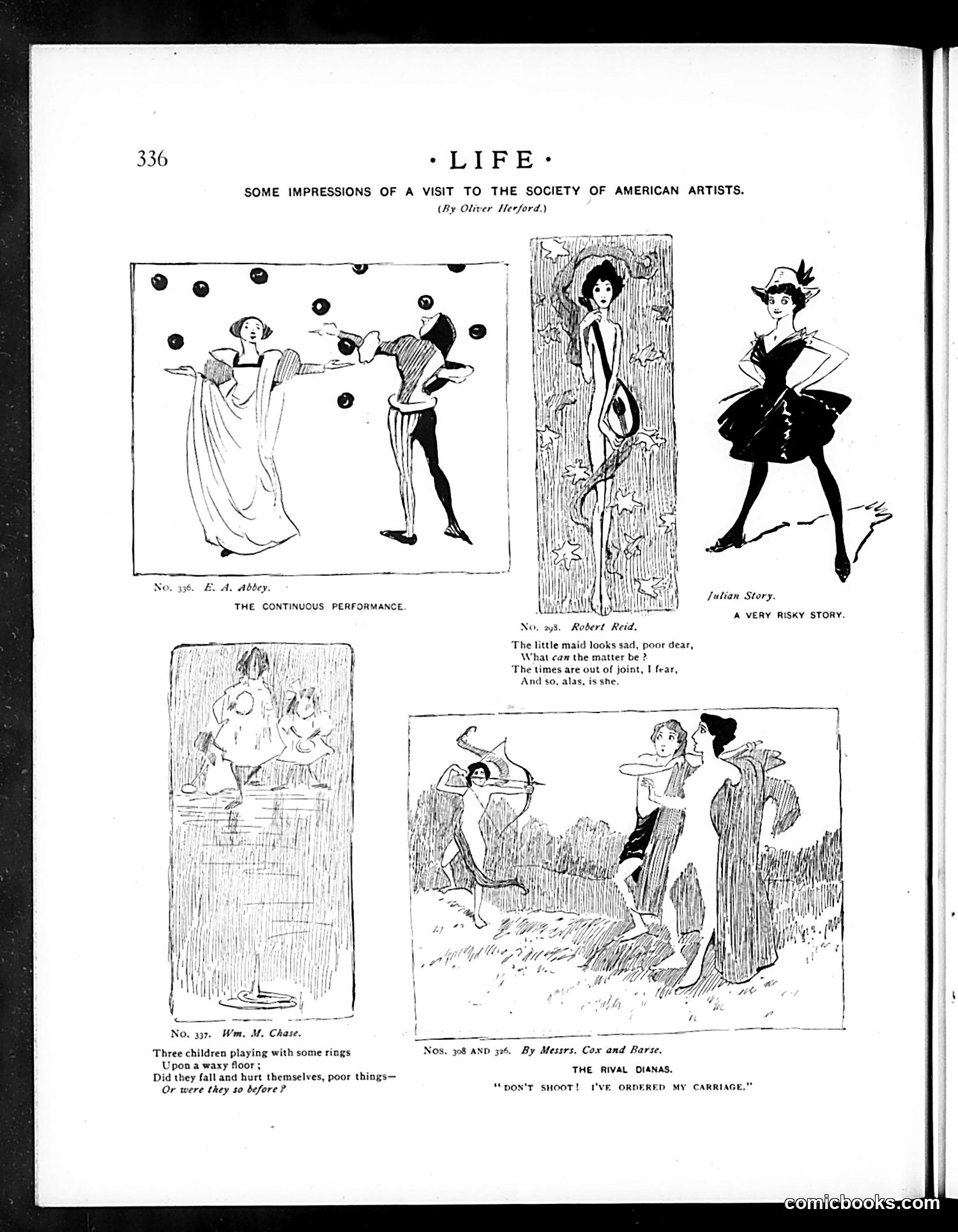
This page presents humorous satirical sketches titled "Some Impressions of a Visit to the Society of American Artists," credited to Oliver Herford. The sketches mock various artistic personalities and pretensions: 1. **"The Continuous Performance"** (E.A. Abbey) shows a theatrical figure juggling while dramatically posing—satirizing affected artistic behavior. 2. **"A Very Risky Story"** (Julian Story) depicts a fashionably dressed woman in an exaggerated pose, likely mocking sensationalist or risqué artistic subjects. 3. **"Three children playing with some rings"** (Wm. M. Chase) shows children in water, with accompanying sardonic verse questioning their safety. 4. **"The Rival Dianas"** (Cox and Barre) depicts Cupid and figures in a landscape, satirizing romantic or mythological subject matter. The overall tone ridicules contemporary American artists as pretentious, overly dramatic, and concerned with theatrical effect over substance.
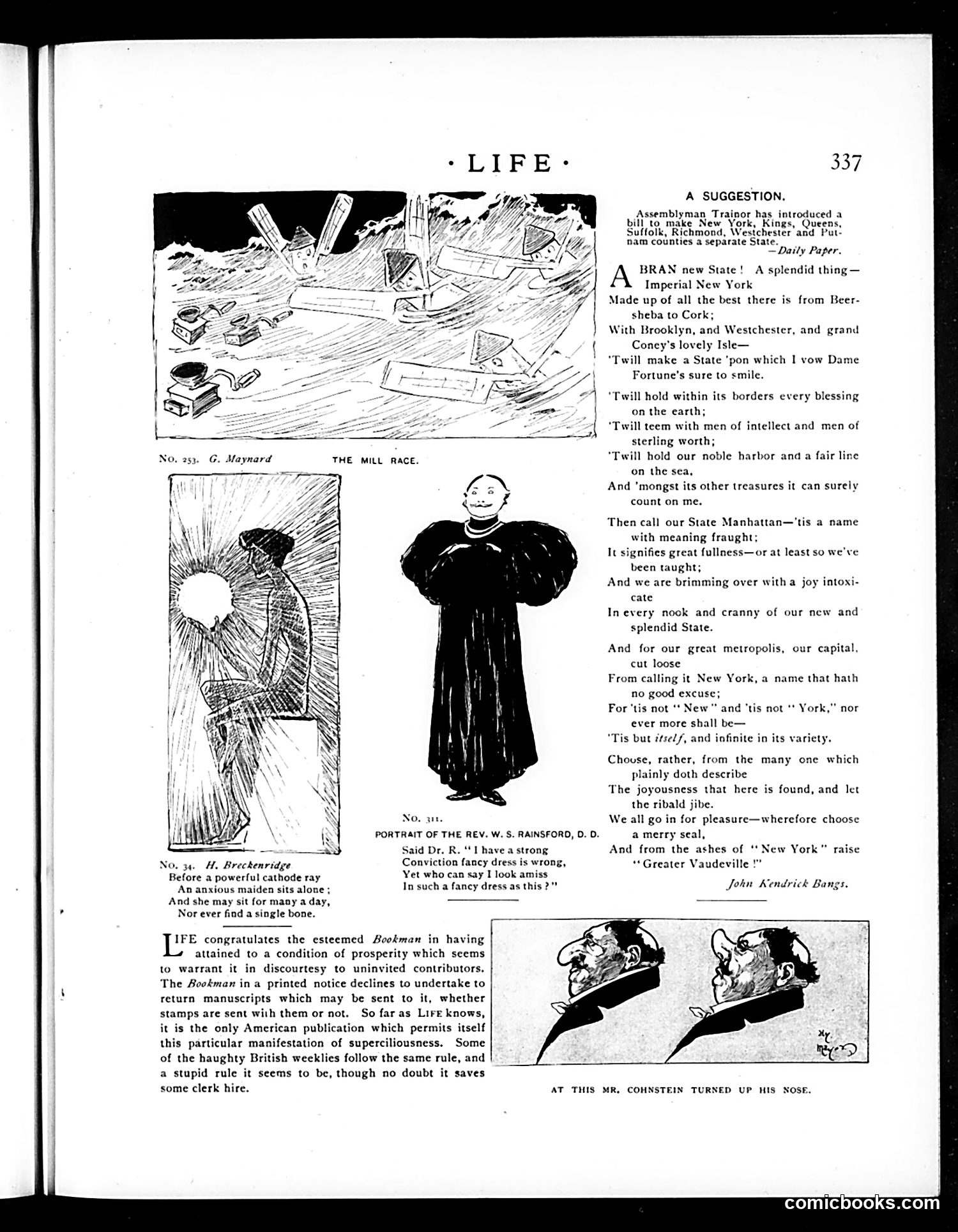
This page contains three distinct elements: 1. **"The Mill Race"** (top): An illustration of an industrial mill scene with scattered building materials and equipment—appears to be social commentary on industrial development or labor conditions. 2. **"A Suggestion"** (right): A poem by John Kendrick Bangs proposing a new name for New York State, replacing "New York" with "Greater Vaudeville." The satire critiques New York as merely a place of entertainment and frivolity rather than serious substance. 3. **Rev. W.S. Rainsford portrait and quote** (center): Shows a clergyman discussing "fancy dress," suggesting contemporary social debates about appropriate clothing and morality. 4. **Bottom cartoon**: Two figures in what appears to be a social or financial mishap, captioned "At this Mr. Connstein turned up his nose." The page primarily mocks contemporary American social pretensions and material excess.
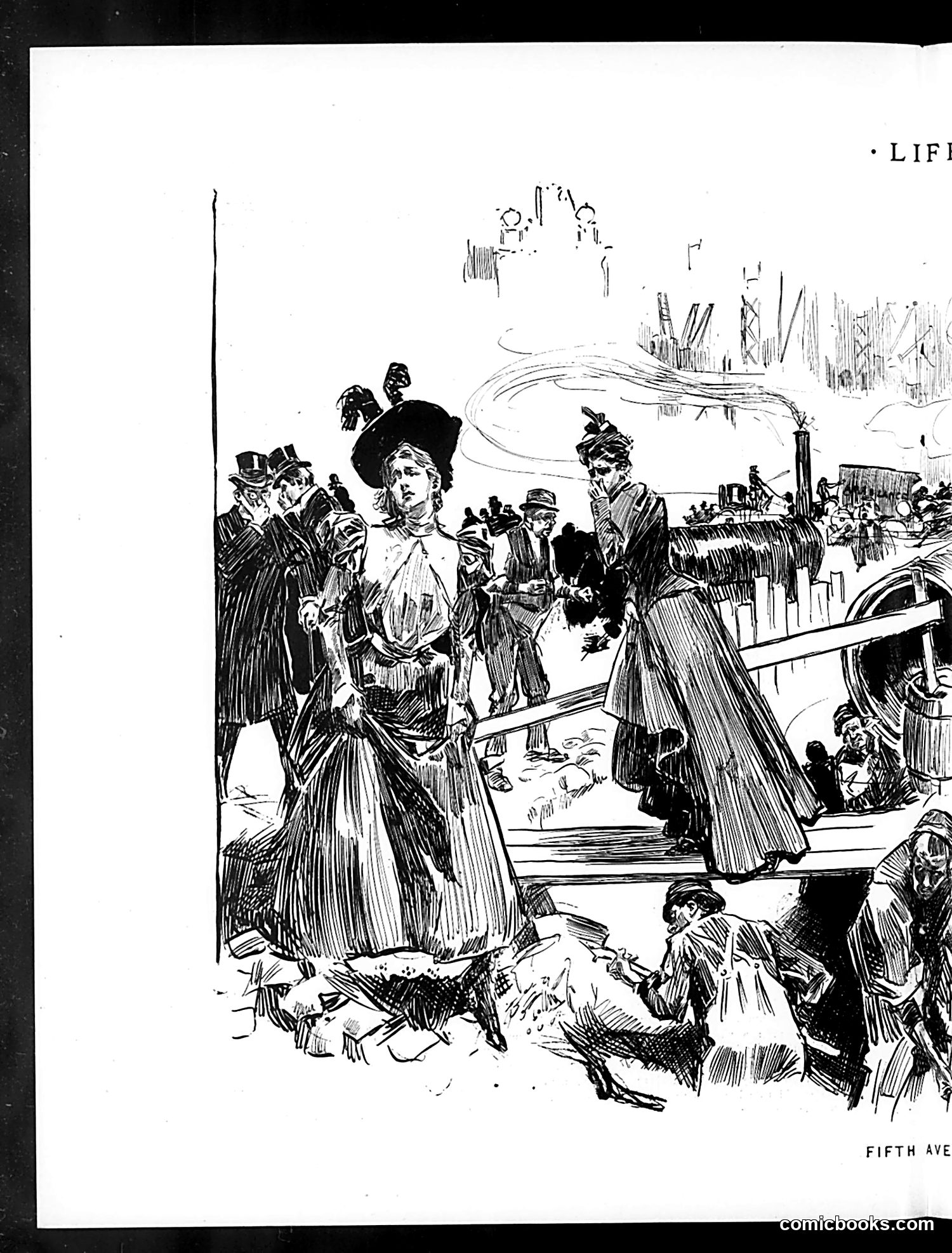
This appears to be a satirical illustration depicting a wealthy woman prominently displayed on Fifth Avenue in New York City, surrounded by admirers and onlookers. The woman's elaborate dress and the formal attire of those around her suggest upper-class society. The satire likely critiques the conspicuous consumption and social pretension of the wealthy elite during this era. The positioning of the woman—almost as if on display or parade—mocks how the affluent used public spaces like Fifth Avenue to showcase their status and fashion. The gathered crowd of observers suggests both admiration and the performative nature of high-society life. Without a visible caption or date, the specific target remains unclear, though the style suggests early 20th-century American social commentary on class and wealth.
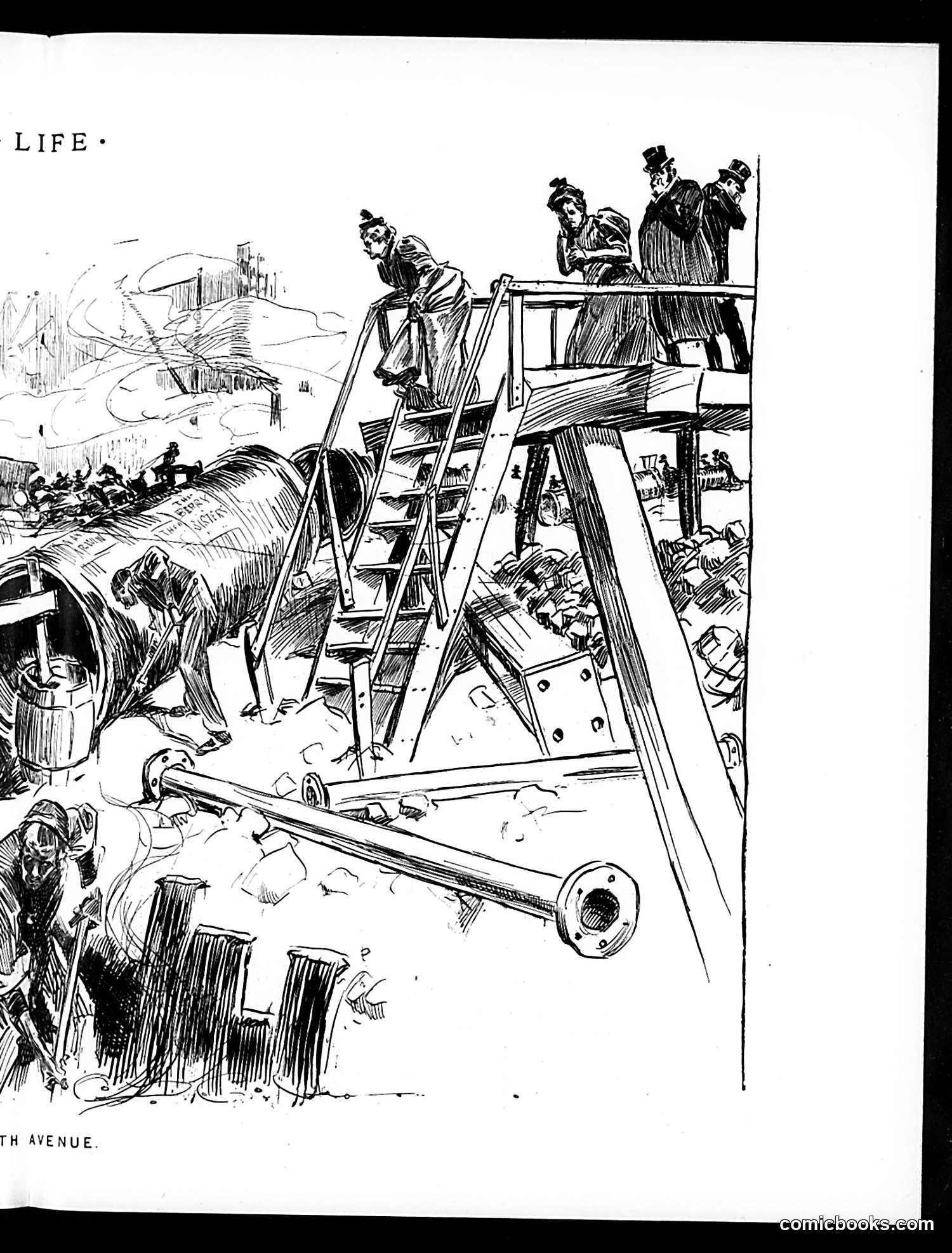
This satirical cartoon depicts wealthy industrialists or financiers (identifiable by their top hats and formal dress) observing large industrial pipes and construction equipment from an elevated platform. The scene appears to mock the disconnect between elite businessmen and the actual labor and infrastructure that supports their wealth. The figures at the top peer down at the massive pipes and machinery below, suggesting they view industrial operations and workers from a distance—literally and figuratively. The satirical point appears to be that wealthy capitalists benefit from and control vast industrial enterprises while remaining removed from the actual work and its consequences. The text reference to "TH AVENUE" (likely Fifth Avenue) reinforces the contrast between elite Manhattan residences and working-class industrial reality. Without clearer dating, the specific targets remain unclear, though this reflects broader Progressive-era critiques of industrial capitalism.
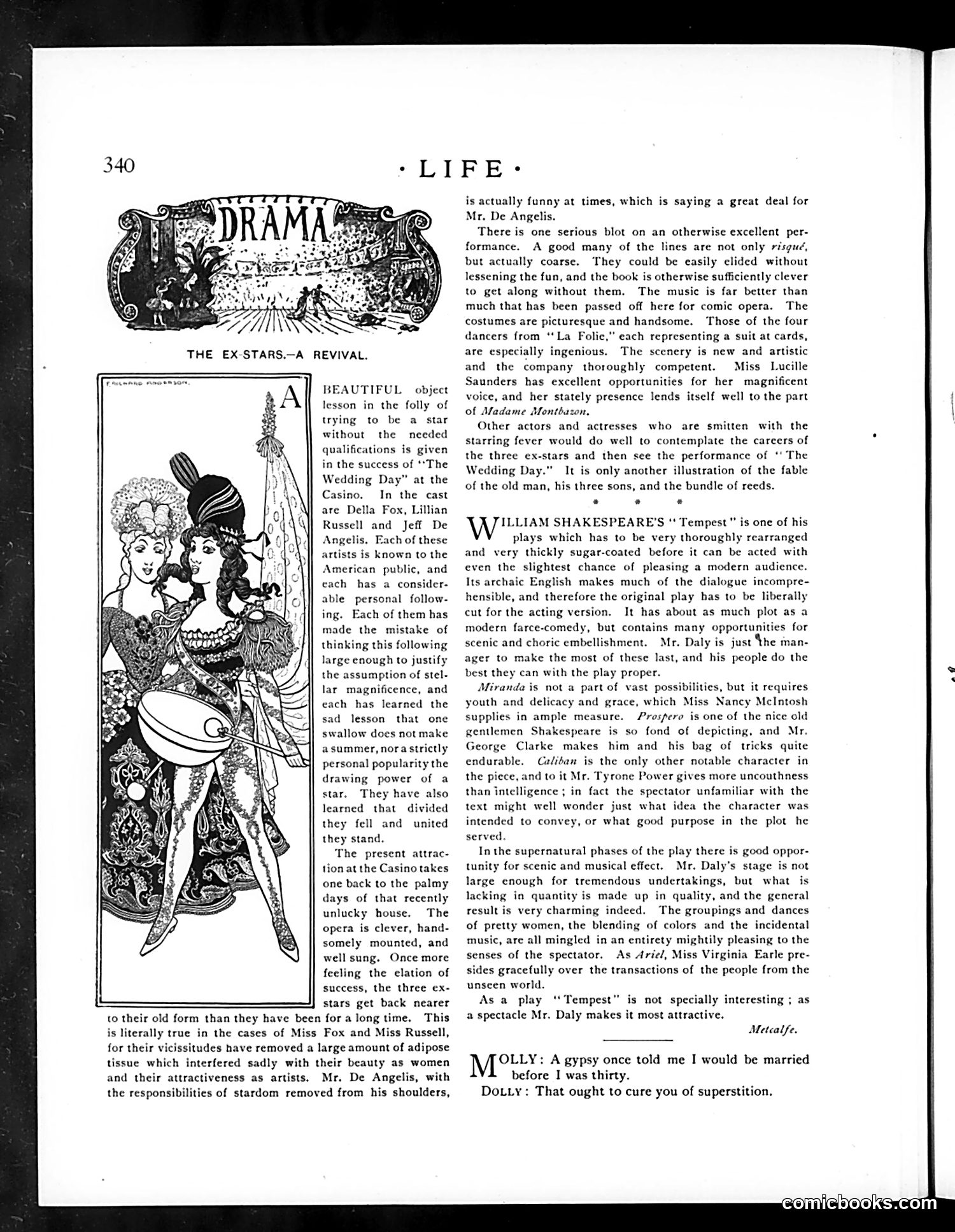
This page reviews theatrical productions. The main illustration depicts two elaborately costumed female performers from "The Ex Stars—A Revival," likely representing Della Fox and Lillian Russell, who were prominent American entertainers of the era. The review notes these famous actresses have "removed a large amount of adipose tissue," sarcastically crediting their weight loss to renewed career success. The text also reviews Shakespeare's "Tempest" and mentions a joke about superstition. The satire targets aging performers attempting comebacks and comments on how female entertainers' appearance remained subject to public scrutiny and commentary, even as their professional accomplishments were acknowledged.
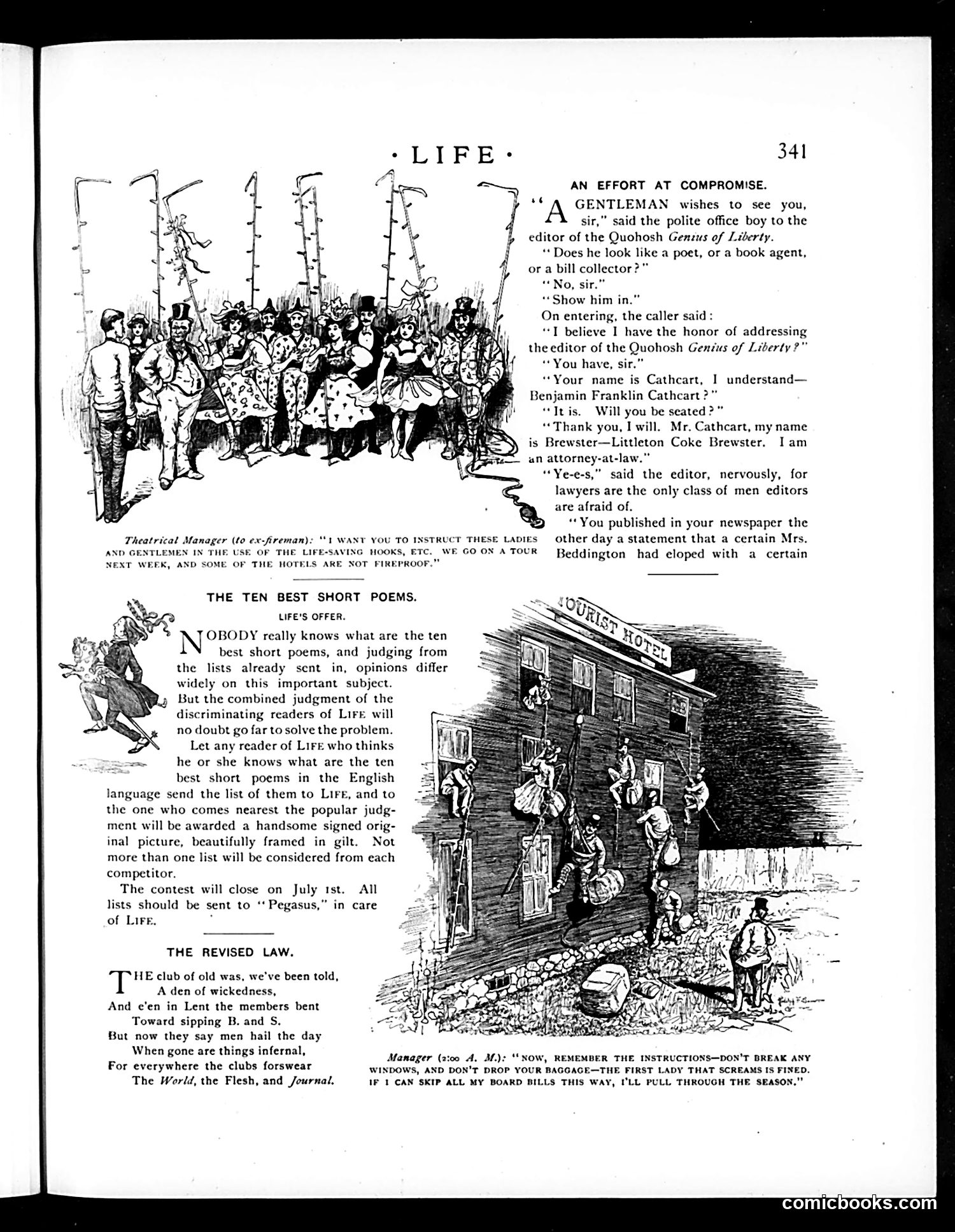
This page from *Life* magazine contains three distinct satirical pieces: **"An Effort at Compromise"** (top): A lawyer named Brewster visits a newspaper editor to discuss a published statement about a Mrs. Beddington eloping. The joke turns on the editor's nervousness—he admits lawyers are "the only class of men editors are afraid of." This satirizes the legal liability editors faced from defamation suits, a common concern of the era. **"The Ten Best Short Poems"** (middle): *Life* solicits reader submissions for the ten greatest short poems in English, offering a framed picture as prize. This mocks the subjective nature of literary taste and likely parodies similar contests magazines ran. **"The Revised Law"** (bottom): A poem about clubs (private gentlemen's clubs) that once served alcohol freely ("sipping B. and S."—brandy and soda) but now claim moral reform. This satirizes Prohibition-era hypocrisy or temperance movement claims. The theatrical cartoons are unrelated gags about safety instructions and theatrical management.
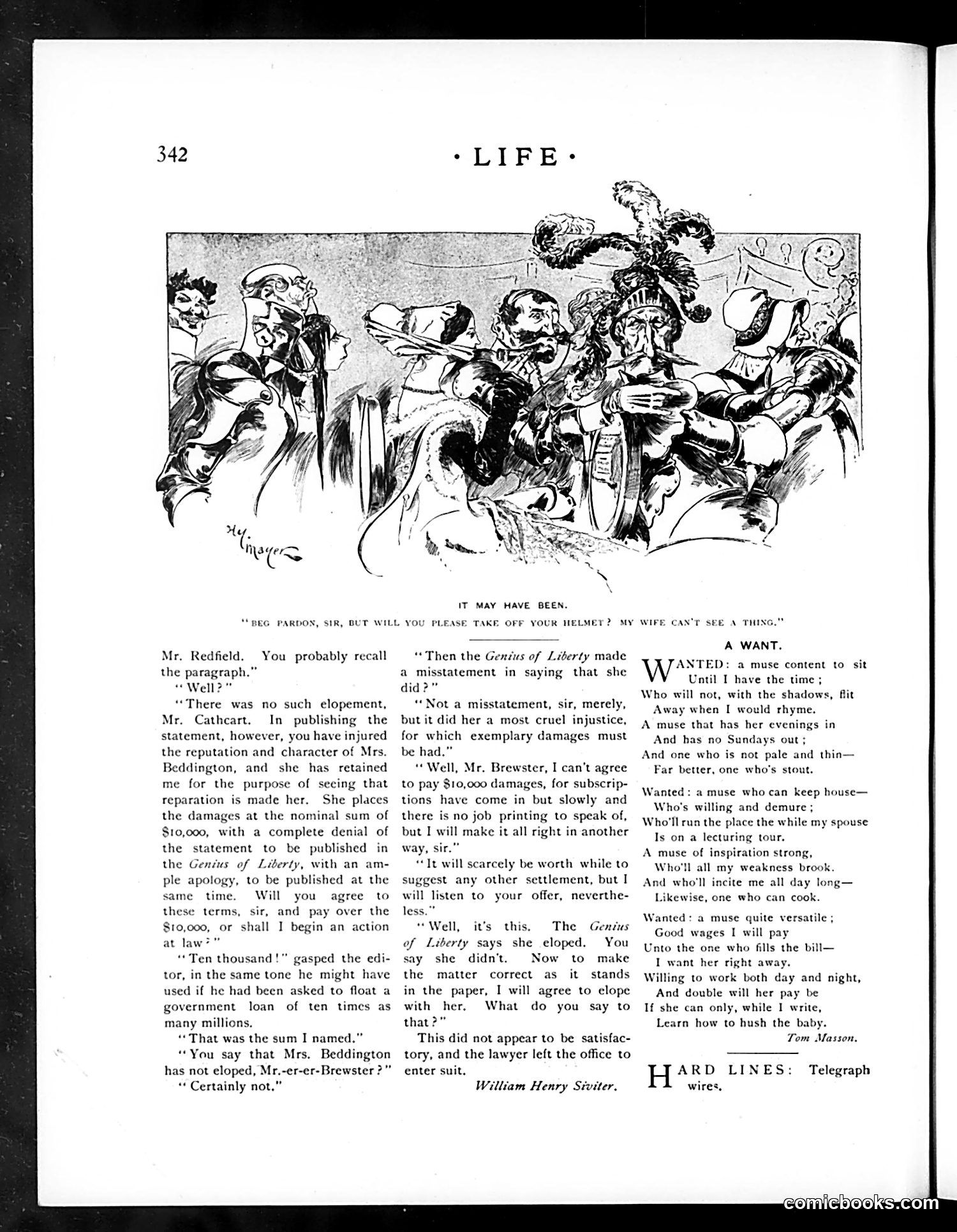
This page contains a satirical short story about newspaper libel and damage claims. A lawyer confronts a newspaper editor (Mr. Cathcart) who published a false statement claiming Mrs. Beddington eloped. The lawyer demands $10,000 in damages plus a published retraction. The satire's punchline: when the editor claims he can't afford the settlement, he offers an absurd alternative—he'll elope *with Mrs. Beddington himself* to "correct" the paper's statement, making it true retroactively. The joke ridicules both the editor's desperation and the absurdity of libel law logic. The accompanying cartoon (top) humorously illustrates this ridiculous proposal, showing various figures reacting to this outlandish "solution." The page also includes unrelated humorous advertisements, including a poem about wanting to hire a "muse" (poetic inspiration) who doubles as a housekeeper and babysitter—satirizing both romantic idealization of artistic muses and the domestic demands placed on women.
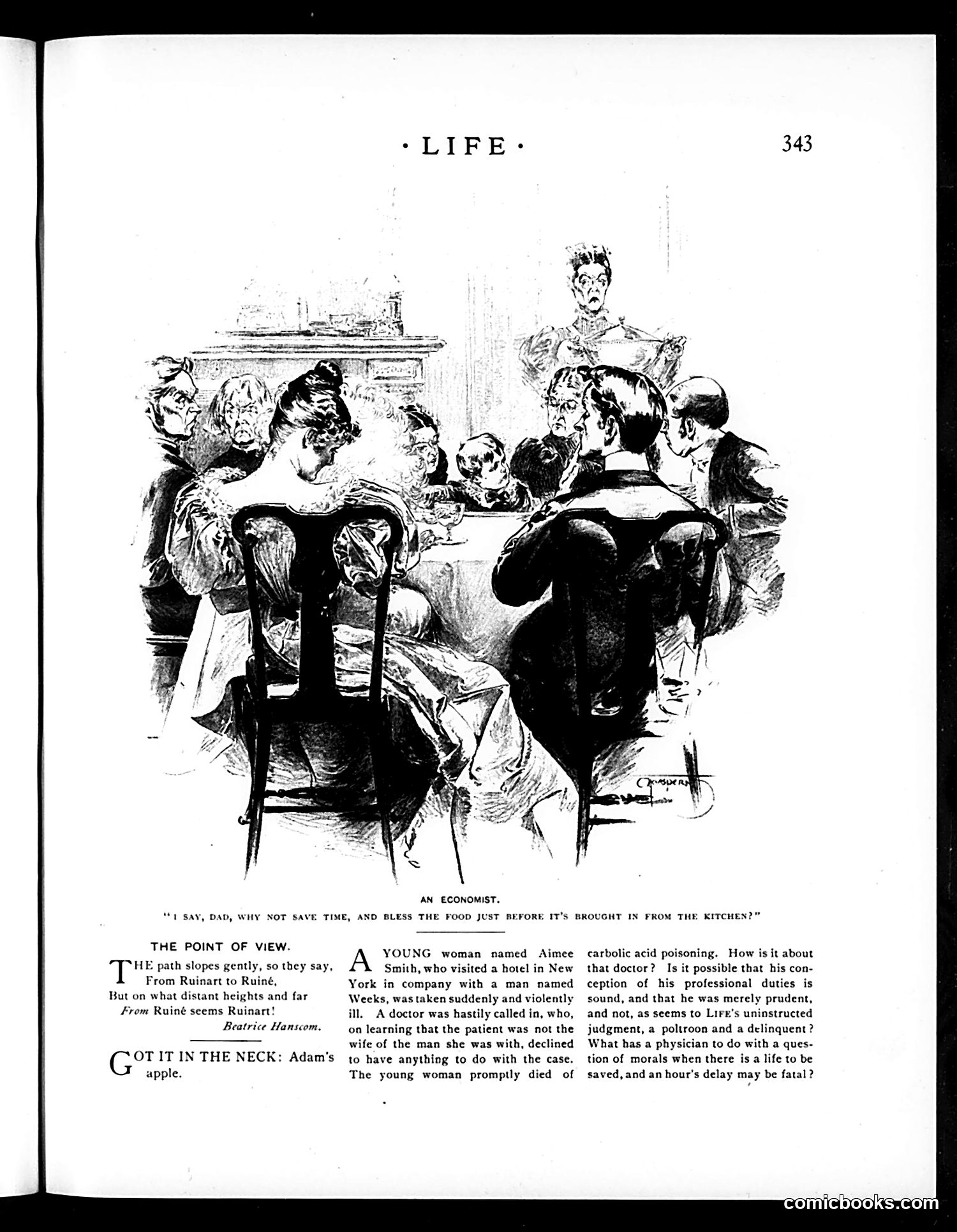
This page contains three distinct satirical pieces: **"An Economist"** (main illustration): A dinner party scene where a child suggests saying grace *before* the food arrives from the kitchen rather than after—satirizing misguided "economizing" by wealthy people. The joke mocks the absurdity of applying penny-pinching logic to sacred rituals. **"The Point of View"** (poetic verse): A brief poem by Beatrice Hanscom playing on the French words "Ruinart" and "Ruiné" (ruin), suggesting the ironic distance between wealth and poverty—likely social commentary on economic inequality. **"Got It in the Neck"** (titled anecdote): A serious moral critique disguised as wordplay. It describes a real case where a doctor refused to treat a woman because she wasn't married to her companion, resulting in her death from poisoning. Life's editorial voice sarcastically questions whether the doctor's "professional prudence" was actually cowardly moral judgment, arguing physicians have ethical duties regardless of patients' moral status. This attacks rigid moralizing that prioritizes judgment over human life.
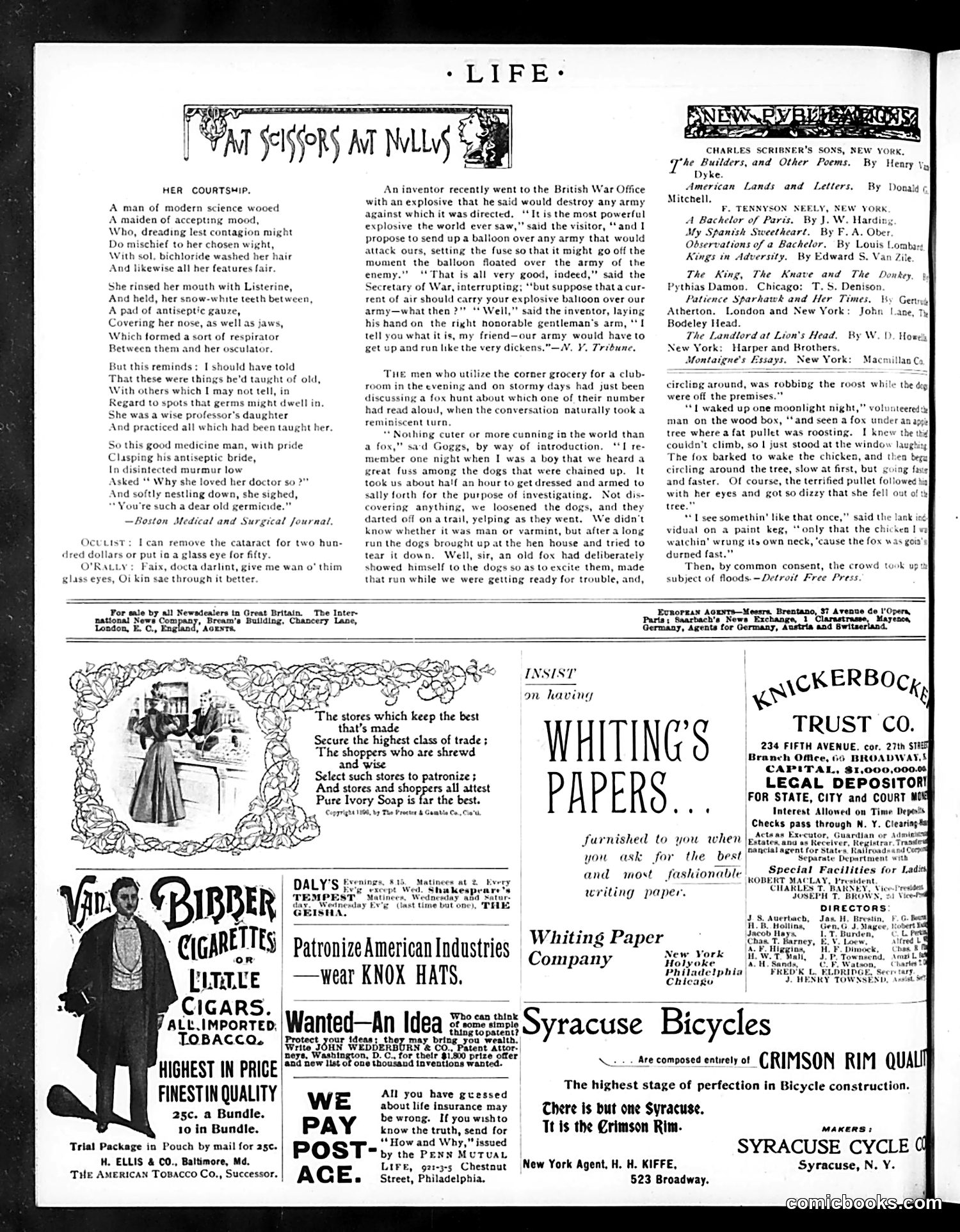
This poem mocks the exaggerated application of germ theory to courtship. A scientist woos a woman by teaching her extreme antiseptic precautions—washing with bichloride of mercury, using Listerine mouthwash, and placing antiseptic gauze over her nose and mouth before kissing (forming a "respirator"). The satire targets late-Victorian anxiety about "contagion" and germs, which had become fashionable concerns following advances in microbiology. The punchline—she loves him because he's a "germicide"—ridicules how absurdly clinical their romance has become. The page also includes other satirical pieces: a brief joke about a foolish inventor pitching a bomb to the British War Office, and anecdotes about foxes outwitting hunters. These exemplify *Life* magazine's typical mix of medical/scientific satire and humorous tall tales.
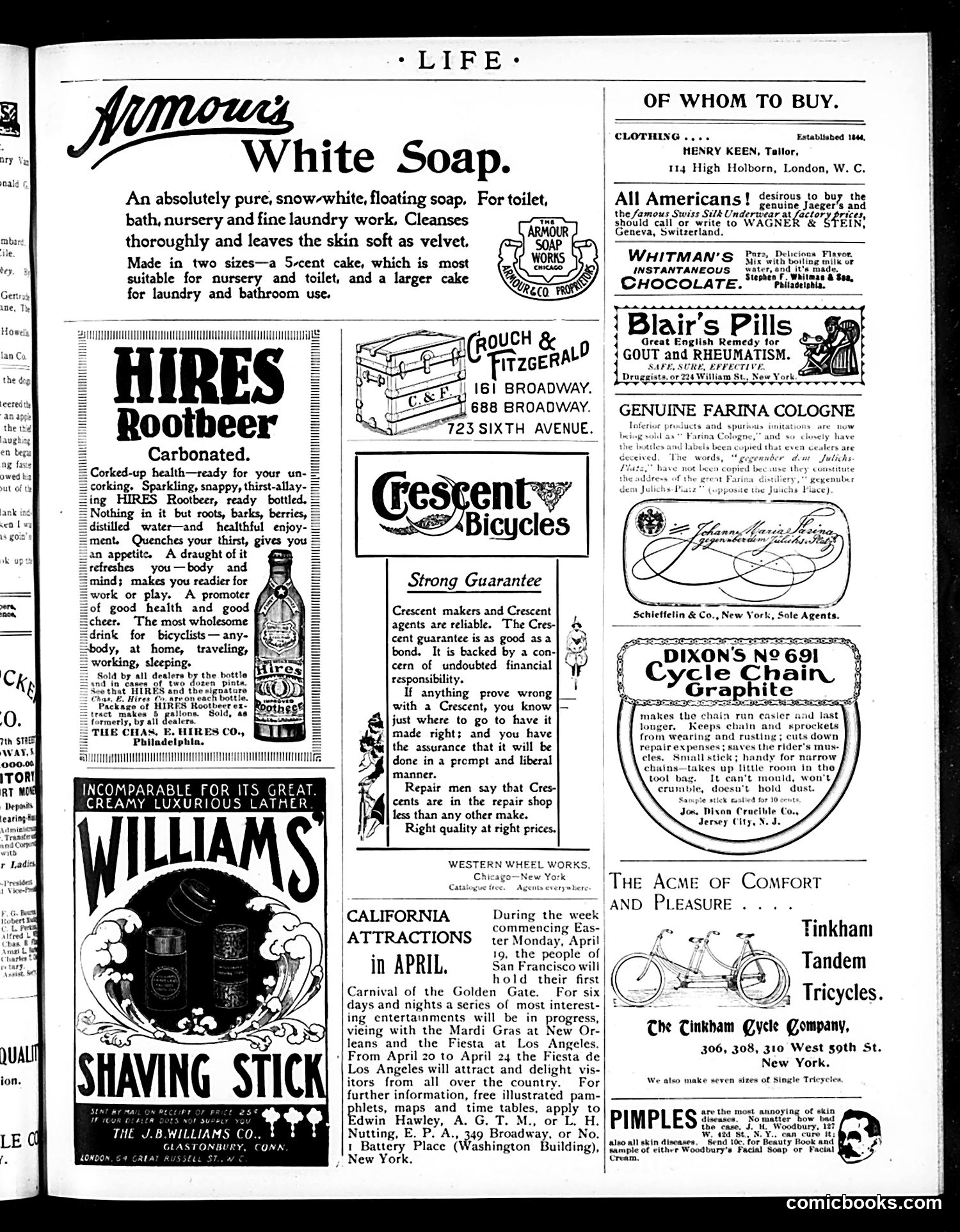
This is **primarily an advertising page** from Life magazine, not a satirical cartoon page. The content consists almost entirely of commercial advertisements for consumer products popular in the late 19th/early 20th century. The ads feature typical period products: Armour's White Soap, Hires Rootbeer, Williams Shaving Stick, Crescent Bicycles, Cinkham Tricycles, Blair's Pills for gout, and Dixon's Cycle Chain lubricant. There's also a "California Attractions in April" notice promoting Easter week festivities in San Francisco and Los Angeles. A small section titled "Of Whom to Buy" lists retailers and manufacturers, including a tailor in London and Swiss undergarment makers. The page reflects the commercial culture of the era—advertisements emphasizing product purity, health benefits, and reliability. There are no political cartoons or social satire visible. This appears to be a standard advertising section from Life's regular commercial content.
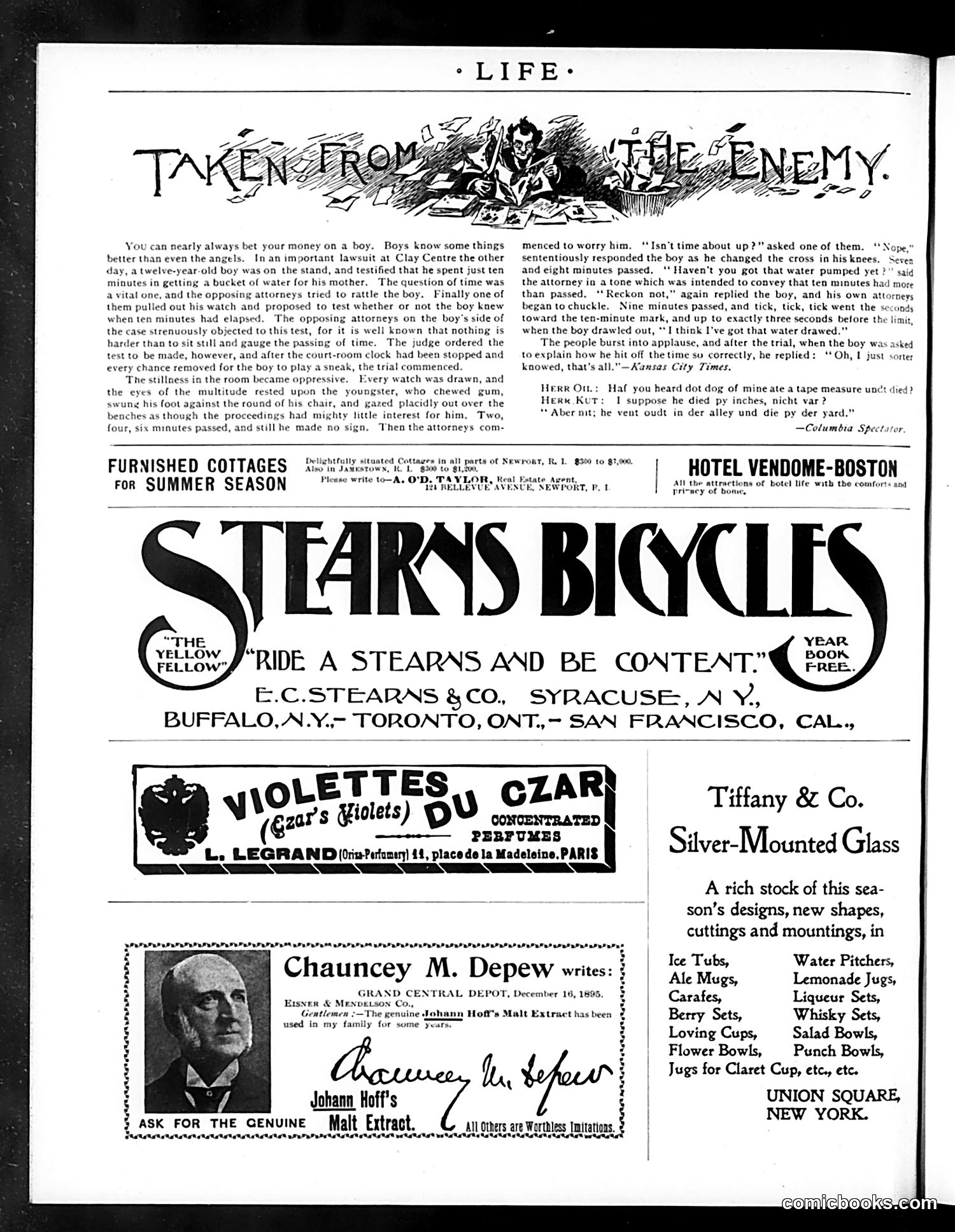
The main article describes a clever courtroom anecdote from Clay Centre. A twelve-year-old boy testifies about fetching water for his mother, and opposing attorneys attempt to test whether he can accurately judge ten minutes by stopping the courtroom clock. The boy, remaining calm and chewing gum throughout, succeeds—calling out "I think I've got that water drawed" just three seconds before the ten-minute mark expires. The satire mocks the attorneys' attempt to "rattle" an innocent child witness through psychological pressure. The boy's composed, rural demeanor ("I just sorter knowed, that's all") outsmarts the legal professionals, suggesting that common sense and honest intuition trump lawyerly tricks. The applause from the courtroom audience indicates public approval of the child's triumph over manipulation—a populist theme common in *Life* magazine's satirical content. The page is mostly advertisements otherwise.
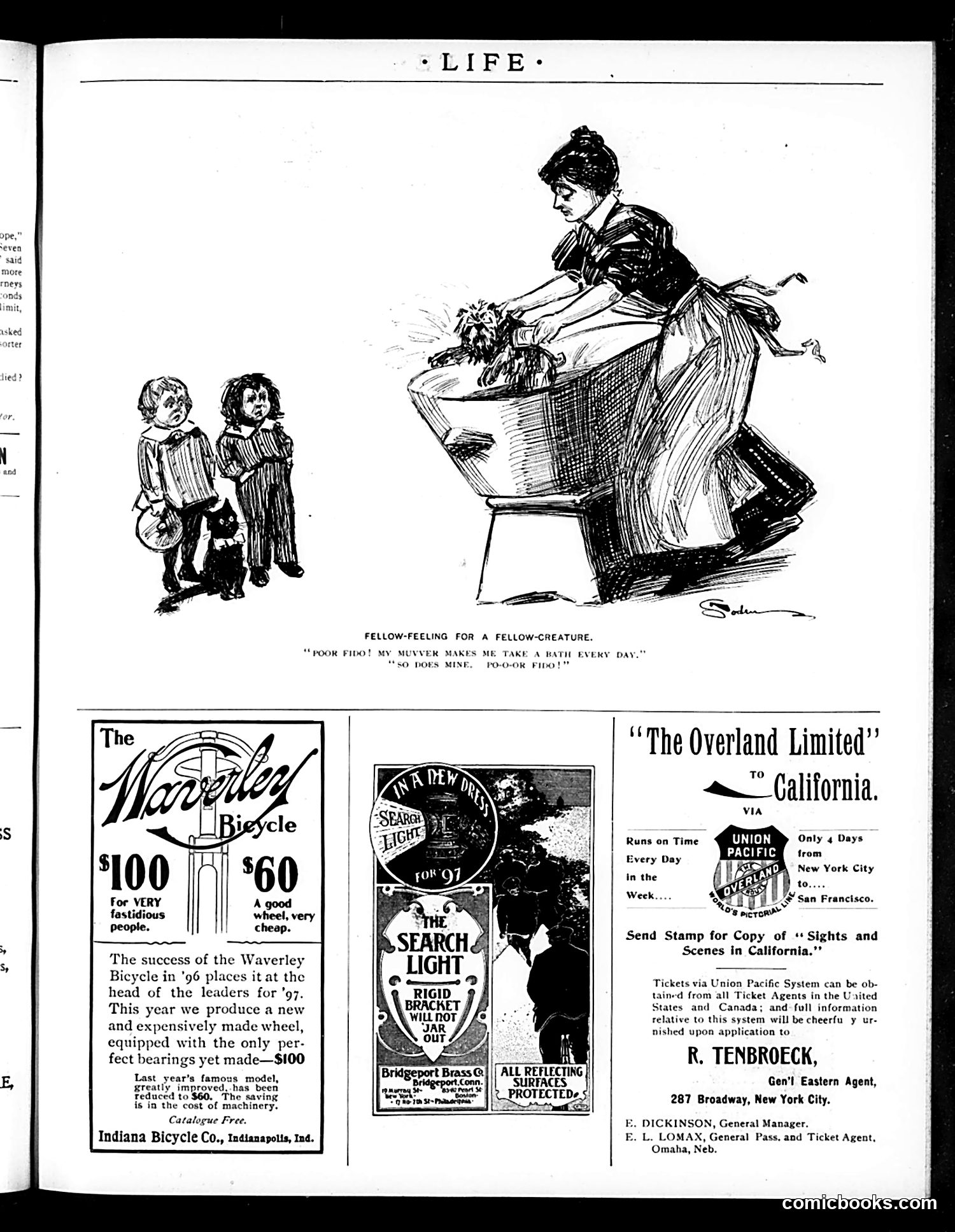
The main cartoon satirizes **child labor and harsh treatment of children** through a humorous comparison. Two young children commiserate about being forced to bathe daily—one says "my mother makes me take a bath every day," and the other responds "so does mine, poor Fido!" The joke's cruel humor lies in the children equating themselves with a dog ("Fido"), suggesting they're treated like animals. This reflects late-19th-century anxieties about **inadequate child welfare and parental discipline practices**. The exaggerated baby-talk spelling ("MUVVER," "KATH") emphasizes their youth and vulnerability. The page also contains period advertisements for bicycles and railroad travel—typical for *Life* magazine of the 1890s, which mixed satirical editorial content with commercial ads. These ads provide historical context about contemporary consumer goods and transportation.
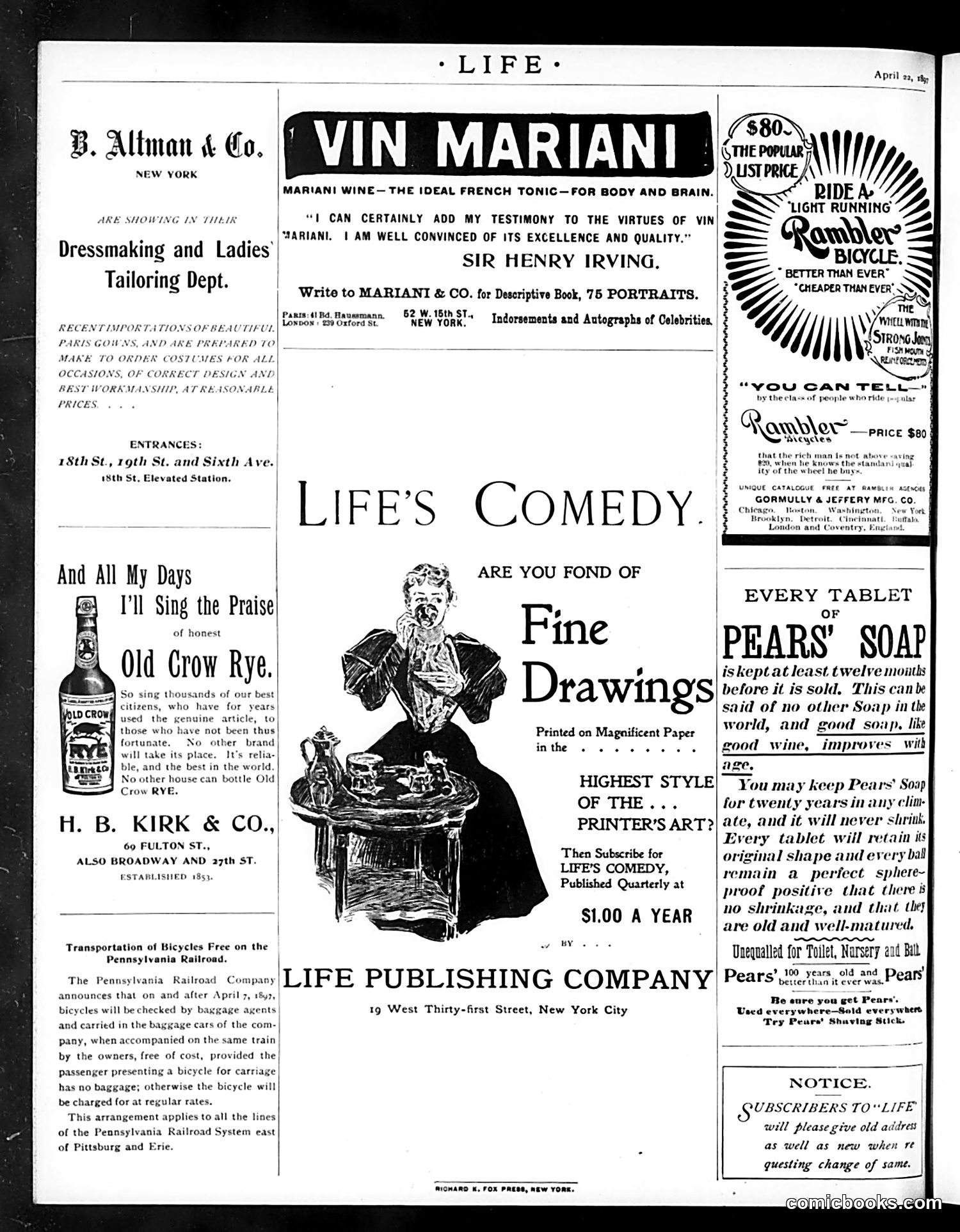
This is primarily an **advertising page** from Life magazine's early period. The central cartoon—"Life's Comedy"—depicts a well-dressed man exclaiming over fine drawings, serving as a hook to promote Life's "Comedy" quarterly publication at $1.00/year. The page is dominated by period advertisements: Vin Mariani (a French wine tonic endorsed by actor Sir Henry Irving), Old Crow Rye whiskey, Pears' Soap, the Rambler bicycle, and department store notices. These ads reflect 1890s consumer culture and marketing tactics using celebrity endorsements. The bicycle transportation notice indicates the Pennsylvania Railroad's new policy—significant for the era's cycling boom. The dressmaking department advertisement shows urban fashion commerce. No political satire is evident; this is a straightforward commercial publication page typical of 1890s American magazines, which relied heavily on advertising revenue.