
Life, 1897-04-22 · page 15 of 20
Life — April 22, 1897 — page 15: what you’re looking at
What you’re looking at
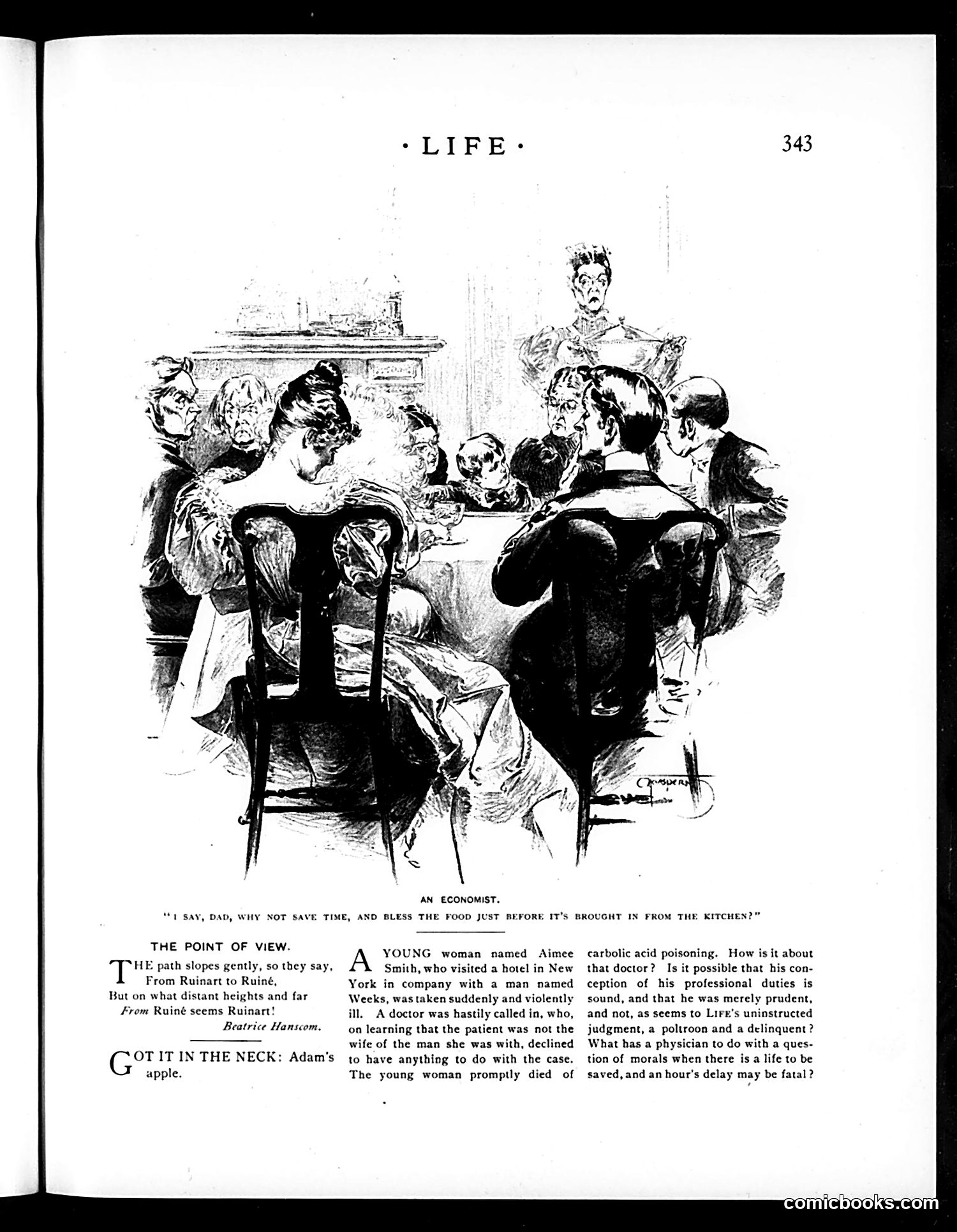
This page contains three distinct satirical pieces: **"An Economist"** (main illustration): A dinner party scene where a child suggests saying grace *before* the food arrives from the kitchen rather than after—satirizing misguided "economizing" by wealthy people. The joke mocks the absurdity of applying penny-pinching logic to sacred rituals. **"The Point of View"** (poetic verse): A brief poem by Beatrice Hanscom playing on the French words "Ruinart" and "Ruiné" (ruin), suggesting the ironic distance between wealth and poverty—likely social commentary on economic inequality. **"Got It in the Neck"** (titled anecdote): A serious moral critique disguised as wordplay. It describes a real case where a doctor refused to treat a woman because she wasn't married to her companion, resulting in her death from poisoning. Life's editorial voice sarcastically questions whether the doctor's "professional prudence" was actually cowardly moral judgment, arguing physicians have ethical duties regardless of patients' moral status. This attacks rigid moralizing that prioritizes judgment over human life.
📄 Transcribed text from this page (OCR, searchable)
Machine-transcribed from the original scan — historical spelling and the odd misread are preserved.
AN ECONOMIST. ‘41 SAY, DAD, WHY NOT SAVE TIME, AND BLESS THE FOOD JUST BEFORE IT’S BROUGHT IN FROM THE KITCHEN?” THE POINT OF VIEW. HE path slopes gently, so they say, From Ruinart to Ruiné, But on what distant heights and far From Ruiné seems Ruinart! Beatrice Hanscom. OT IT IN THE NECK: Adam's apple. YOUNG woman named Aimee Smith, who visited a hotel in New York in company with a man named Weeks, was taken suddenly and violently ill. A doctor was hastily called in, who, on learning that the patient was not the wife of the man she was with, declined to have anything to do with the case. The young woman promptly died of carbolic acid poisoning. How is it about that doctor? Is it possible that his con- ception of his professional duties is sound, and that he was merely prudent, and not, as seems to Lire’s uninstructed judgment, a poltroon and a delinquent? What has a physician to do with a ques- tion of morals when there is a life to be saved, and an hour's delay may be fatal?