
Life, 1897-04-22 · page 6 of 20
Life — April 22, 1897 — page 6: what you’re looking at
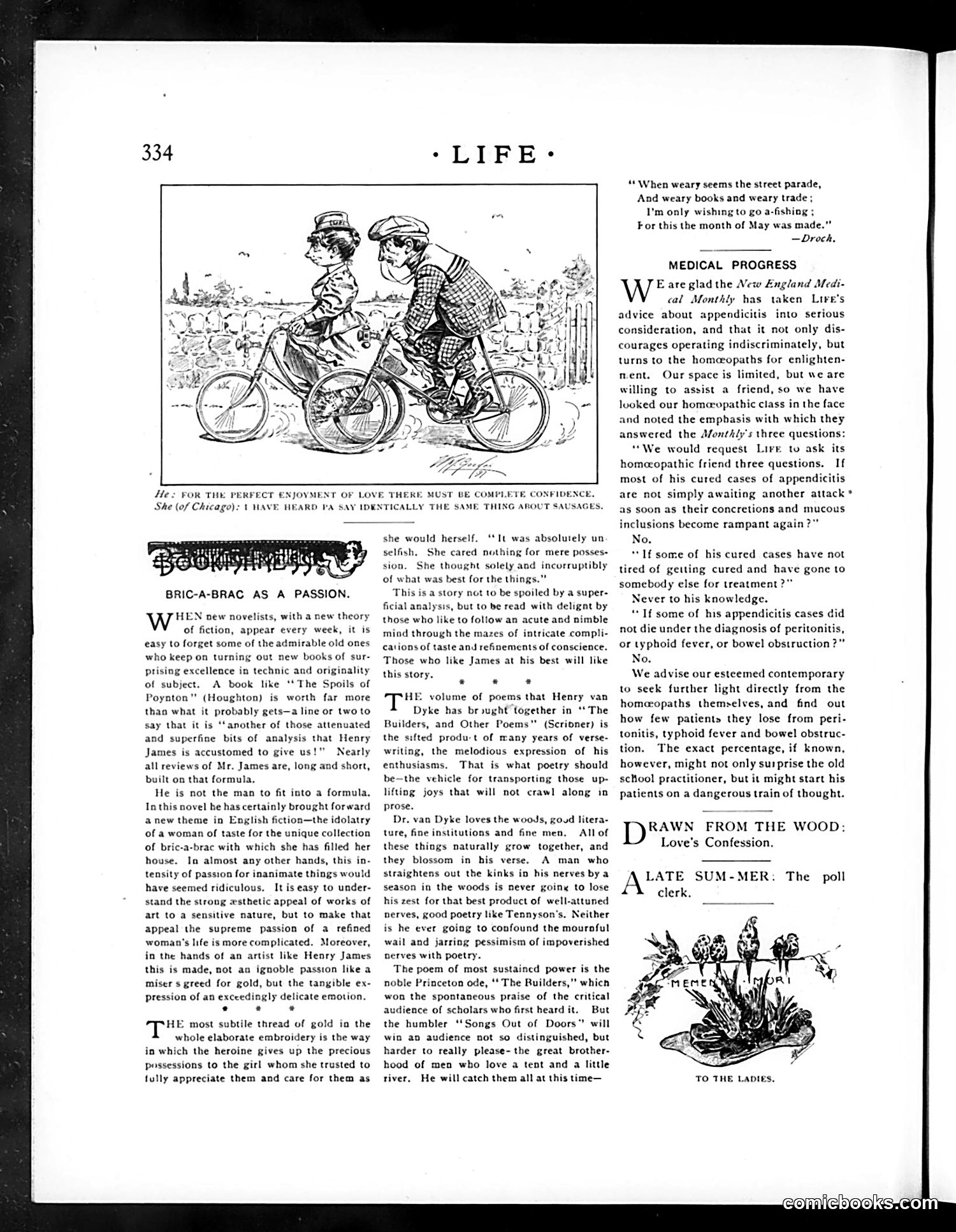
What you’re looking at
The main illustration shows two cyclists riding together with the caption: "FOR THE PERFECT ENJOYMENT OF LOVE THERE MUST BE COMPLETE CONFIDENCE. She of Chicago: 'I HAVE HEARD PA SAY IDENTICALY THE SAME THING ABOUT SAUSAGES.'" This is a joke about trust in relationships, playing on a double meaning. The woman from Chicago references her father's statement about sausages—implying that just as people shouldn't know what goes into sausages (willful ignorance makes them more palatable), romantic partners similarly benefit from not knowing certain truths about each other. It's satirizing naive notions of love while also poking fun at Chicago's famous meatpacking industry. The humor relies on the audience understanding the colloquial wisdom about not scrutinizing sausage-making.
📄 Transcribed text from this page (OCR, searchable)
Machine-transcribed from the original scan — historical spelling and the odd misread are preserved.
BRIC-A-BRAC AS A PASSION. HEN new novelists, with a new theory of fiction, appear every week, it is easy to forget some of the admirable old ones who keep on turning out new books of sur- prising excellence in technic and originality of subject. A book like ** The Spoils of Poynton" (Houghton) is worth far more than what it probably gets—a line or two to say that it is ‘‘another of those attenuated and superfine bits of analysis that Henry James is accustomed to give us!" Nearly all reviews of Mr. James are, long and short, built on that formula, He is not the man to fit into a formula, In this novel he has certainly brought forward anew theme in English fiction—the idolatry of a woman of taste for the unique collection of bric-a-brac with which she has filled her house. In almost any other hands, this in- tensity of passion for inanimate things would have seemed ridiculous. It is easy to under- stand the strong xsthetic appeal of works of art to a sensitive nature, but to make that appeal the supreme passion of a refined woman's life is more complicated. Moreover, in the hands of an artist like Henry James this is made, not an ignoble passion like a miser s greed for gold, but the tangible ex- pression of an exceedingly delicate emotion. * * * HE most subtile thread of gold in the whole elaborate embroidery is the way ion which the heroine gives up the precious possessions to the girl whom she trusted to fully appreciate them and care for them as NFIDENCE. DUT SAUSAGES. she would herself. ‘It was absoluiely un She cared nothing for mere posses- sion, She thought solely and incorruptibly of what was best for the things.” This is a story not to be spoiled by a super- ficial analysis, but to be read with delignt by those who like to follow an acute and nimble mind through the mazes of intricate compli- cations of taste and refinements of conscience. Those who like James at his best will like this story. selfish. * * HE volume of poems that Henry van Dyke has brought together in “The Builders, and Other Poems” (Scrioner) is the sifted produ:t of many years of verse- writing, the melodious expression of his enthusiasms. That is what poetry should be-the vehicle for transporting those up- lifting joys that will not crawl along in prose. Dr. van Dyke loves the woods, goud litera- ture, fine institutions and fine men. All of these things naturally grow together, and they blossom in bis verse. A man who straightens out the kinks in his nerves by a season in the woods is never going to lose his zest for that best product of well-attuned nerves, good poetry like Tennyson's. Neither is he ever going to confound the mouroful wail and jarring pessimism of impoverished nerves with poetry. The poem of most sustained power is the noble Princeton ode, “* The Builders,” which won the spontaneous praise of the critical audience of scholars who first heard it. But the humbler ‘Songs Out of Doors” will win ap audience not so distinguished, but harder to really please-the great brother- hood of men who love a tent and a little river, He will catch them all at this time— “When weary seems the street parade, And weary books and weary trade ; I'm only wishing to go a-fishing For this the month of May was made.” —Droch. MEDICAL PROGRESS E are glad the New England Medi- cal Monthly has taken Live's advice about appendicitis into serious consideration, and that it not only dis- courages operating indiscriminately, but turns to the homaopaths for enlighten- ment. Our space is limited, but we are willing to assist a friend, so we have looked our homovopathic class in the face and noted the emphasis with which they answered the Monthly's three questions: "We would request Lirr to ask its homeopathic friend three questions. If most of his cured cases of appendi are not simply awaiting another attack as soon as their concretions and mucous inclusions become rampant again?" No. “Lf some of his cured cases have not tired of getting cured and have gone to somebody else for treatment?” Never to his knowledge. “Tf some of his appendicitis cases did not die under the diagnosis of peritonitis, or typhoid fever, or bowel obstruction?” No. We advise our esteemed contemporary to seek further light directly from the homaopaths themselves, and find out how few patients they lose from peri- tonitis, typhoid fever and bowel obstruc- tion. The exact percentage, if known, however, might not only surprise the old scHool practitioner, but it might start his patients on a dangerous train of thought. |B a FROM THE WOOD: Love's Confession. AraTE SUM-MER: The poll TO THE Lapies,