
Life, 1897-04-22 · page 12 of 20
Life — April 22, 1897 — page 12: what you’re looking at
What you’re looking at
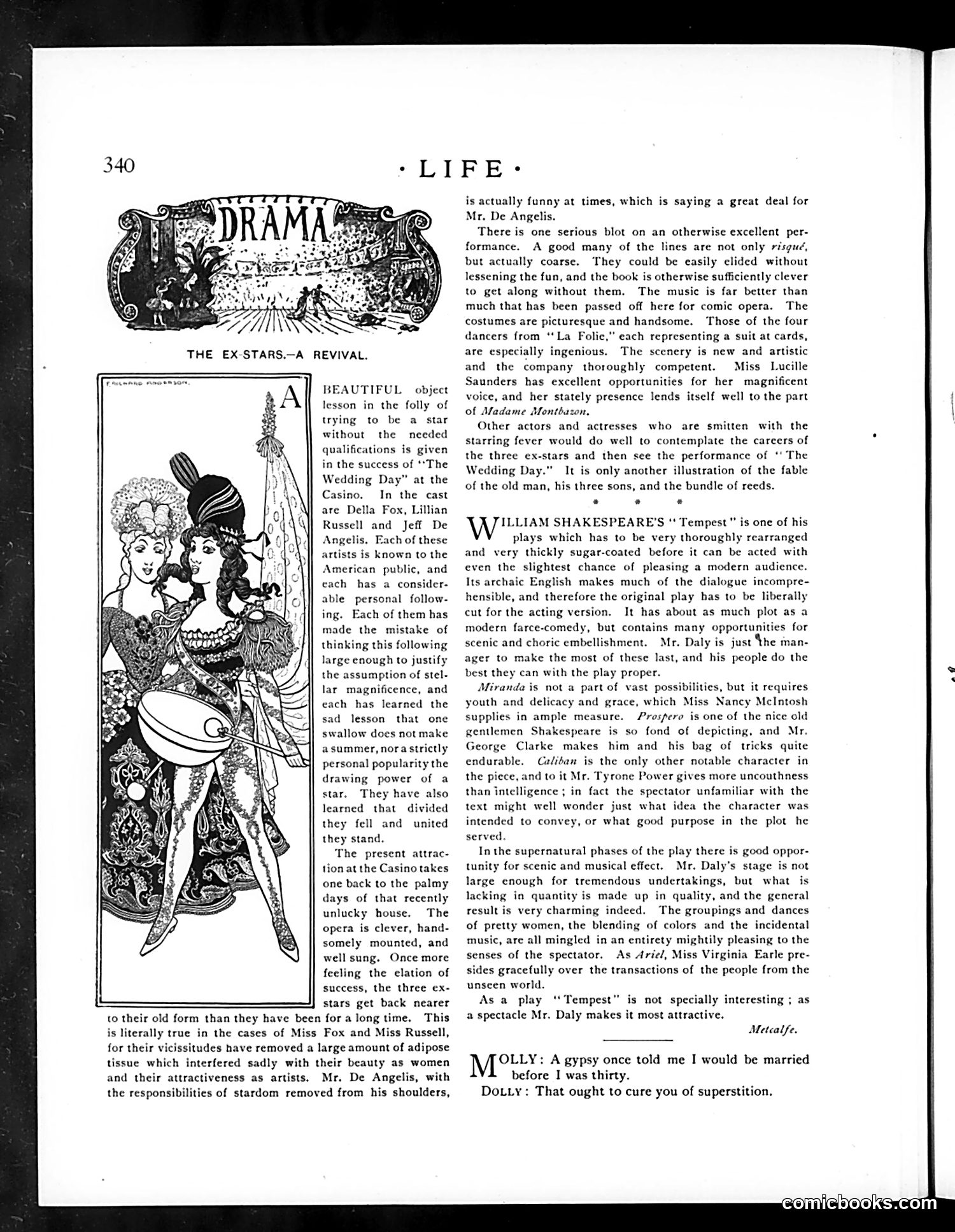
This page reviews theatrical productions. The main illustration depicts two elaborately costumed female performers from "The Ex Stars—A Revival," likely representing Della Fox and Lillian Russell, who were prominent American entertainers of the era. The review notes these famous actresses have "removed a large amount of adipose tissue," sarcastically crediting their weight loss to renewed career success. The text also reviews Shakespeare's "Tempest" and mentions a joke about superstition. The satire targets aging performers attempting comebacks and comments on how female entertainers' appearance remained subject to public scrutiny and commentary, even as their professional accomplishments were acknowledged.
📄 Transcribed text from this page (OCR, searchable)
Machine-transcribed from the original scan — historical spelling and the odd misread are preserved.
- LIFE: BEAUTIFUL lesson in the folly of trying to be a star without the needed object qualifications is given in the success of *'The Wedding Day” at the Casino. In the cast are Della Fox, Lillian Russell and Jeff De Angelis. Each of these artists is known to the American public, and cach has a consider- able personal follow- ing. Each of them has made the mistake of thinking this following large enough to justify the assumption of stel- lar magnificence, and each has learned the sad lesson that one swallow does not make asummer, norastrictly personal popularity the drawing power of a star. They have learned that they fell and they stand. The present attrac- tion at the Casino takes one back to the palmy days of that recently unlucky house. The opera is clever, hand- somely mounted, and well sung. Once more feeling the elation of success, the three ex- stars get back nearer to their old form than they have been for a long time. This is literally true in the cases of Miss Fox and Miss Russell, for their vicissitudes have removed a large amount of adipose tissue which interfered sadly with their beauty as women and their attractiveness as artists. Mr. De Angelis, with the responsibilities of stardom removed from his shoulders, united is actually funny at times, which is saying a great deal for Mr, De Angelis. There is one serious blot on an otherwise excellent per- formance. A good many of the lines are not only risgud, but actually coarse. They could be easily clided without lessening the fun, and the book is otherwise sufficiently clever to get along without them. The music is far better than much that has been passed off here for comic opera. The costumes are picturesque and handsome. ‘Those of the four dancers from ‘La Folie,” each representing a suit at cards, are especially ingenious. The scenery is new and artistic and the company thoroughly competent. Miss Lucille Saunders has excellent opportunities for her magnificent voice, and her stately presence lends itself well to the part of Madame Montbazon, Other actors and actresses who are smitten with the starring fever would do well to contemplate the carcers of the three ex-stars and then see the performance of ‘' The Wedding Day.” It is only another illustration of the fable of the old man, his three sons, and the bundle of reeds. . * . ILLIAM SHAKESPEARE'S “' Tempest " is one of his plays which has to be very thoroughly rearranged and very thickly sugar-coated before it can be acted with even the slightest chance of pleasing a modern audience. Its archaic English makes much of the dialogue incompre- hensible, and therefore the original play bas to be liberally cut for the acting version. It has about as much plot as a modern farce-comedy, but contains many opportunities for scenic and choric embellishment. Mr. Daly is just Yhe man- ager to make the most of these last, and his people do the best they can with the play proper. Miranda is not a part of vast possibilities, but it requires youth and delicacy and grace, which Miss Nancy McIntosh supplies in ample measure. Prospero is one of the nice old gentlemen Shakespeare is so fond of depicting, and Mr. George Clarke makes him and his bag of tricks quite endurable. Ca/itan is the only other notable character in the piece, and to it Mr. Tyrone Power gives more uncouthness than intelligence ; in fact the spectator unfamiliar with the text might well wonder just what idea the character was intended to convey, or what good purpose in the plot he served. In the supernatural phases of the play there is good oppor- tunity for scenic and musical effect. Mr. Daly's stage is not large enough for tremendous undertakings, but lacking in quantity is made up in quality, and the general result is very charming indeed. The groupings and dances of pretty women, the blending of colors and the incidental music, are all mingled in an entirety mightily pleasing to the senses of the spectator. As Ariel, Miss Virginia Earle pre- sides gracefully over the transactions of the people from the unscen world. As a play Tempest" is not specially interesting ; as a spectacle Mr. Daly makes it most attractive. what is Metcalfe. OLLY: A gypsy once told me I would be married before I was thirty. Dotty: That ought to cure you of superstition.