
A complete issue · 26 pages · 1897
Life — April 8, 1897
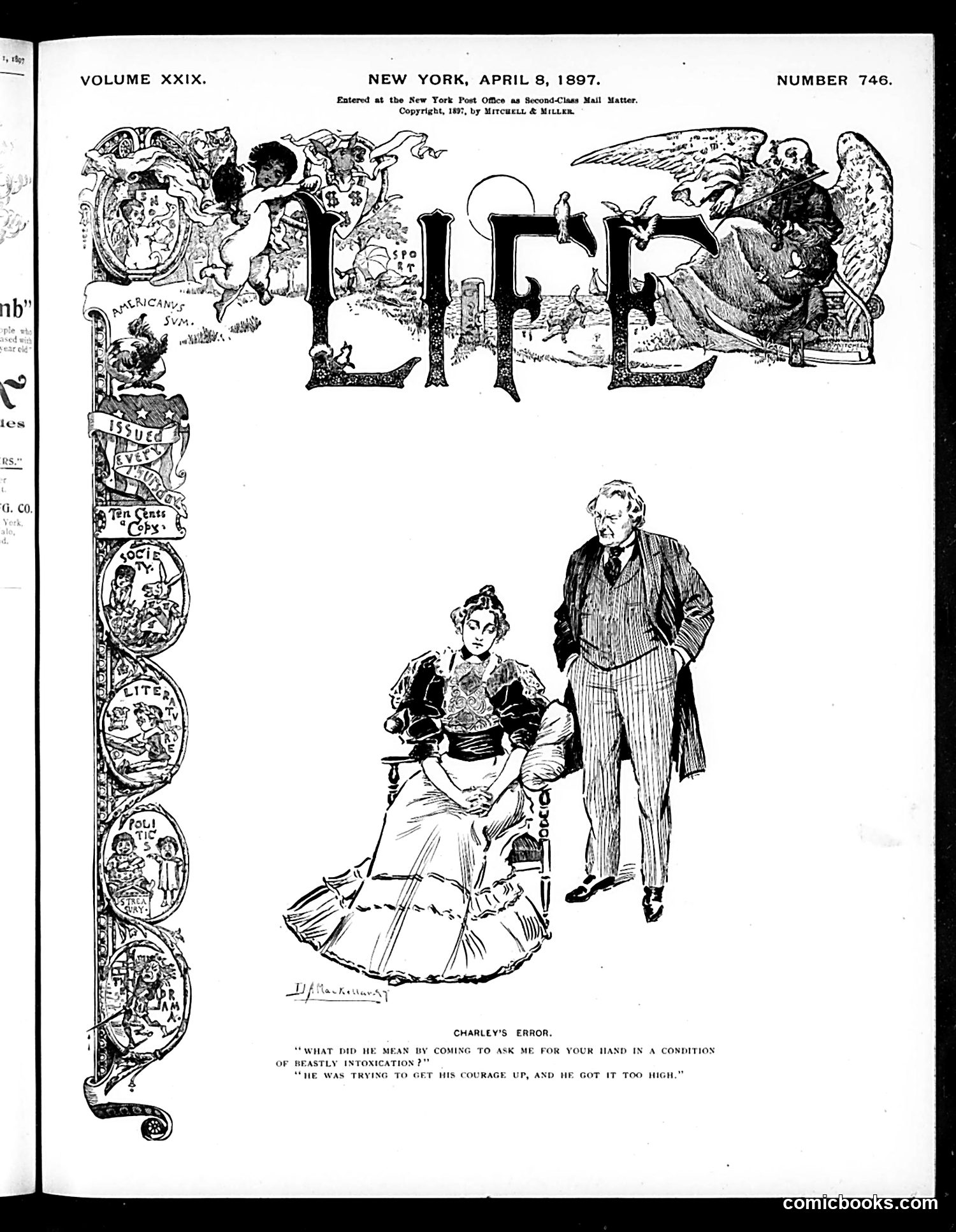
This page features a cartoon titled "Charley's Error" depicting a domestic dispute. A woman sits while a man stands nearby. The caption reads: "What did he mean by coming to ask me for your hand in a condition of beastly intoxication?" / "He was trying to get his courage up, and he got it too high." The satire mocks a marriage proposal made while drunk. The humor plays on the common social convention that men needed "liquid courage" to propose marriage, but the husband-to-be overindulged, arriving intoxicated rather than properly composed. The joke critiques both masculine social anxieties about courtship and the era's attitudes toward alcohol as a social lubricant. The ornate left border contains decorative vignettes typical of Life's design.
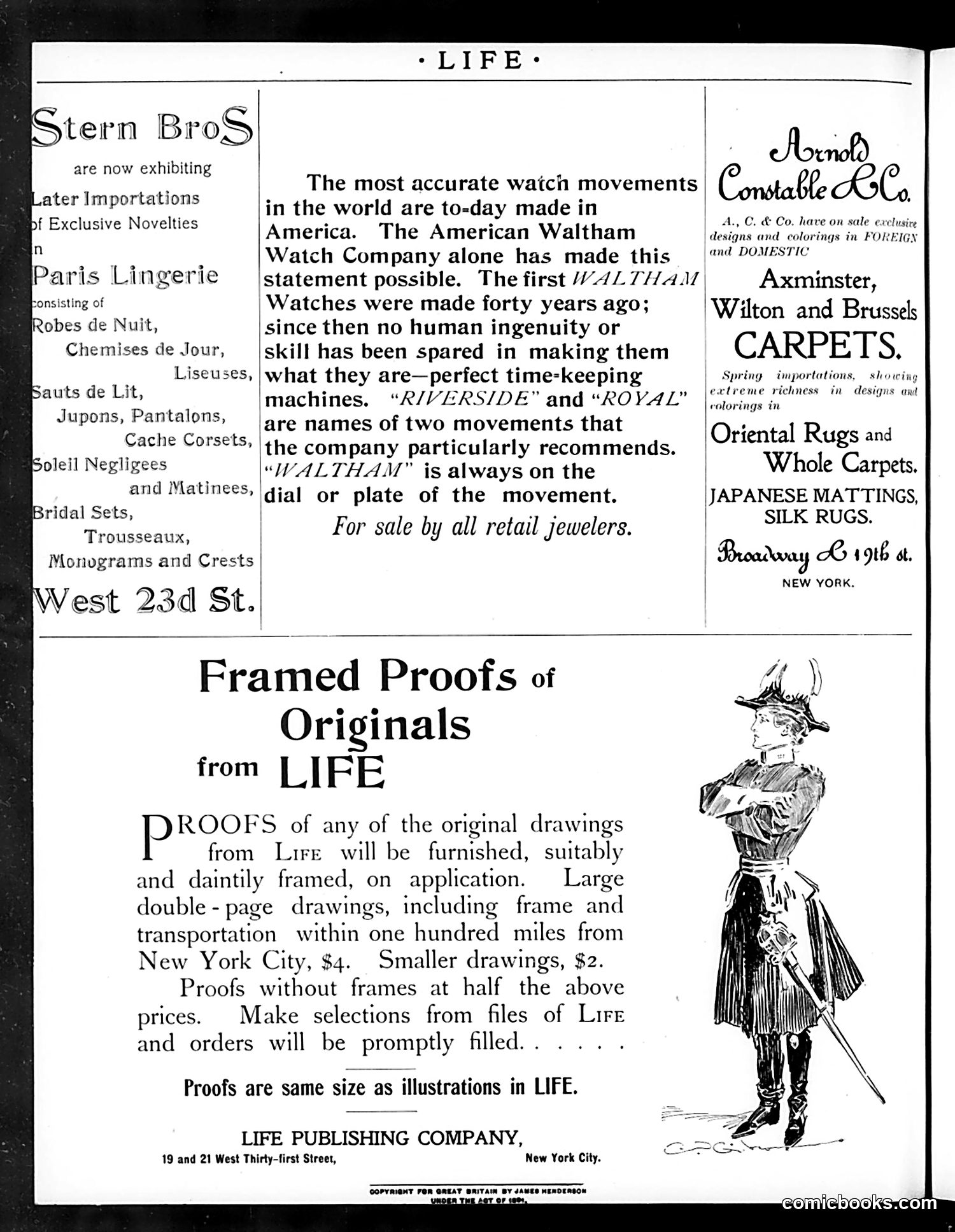
This page is **primarily advertising** rather than editorial content or satire. The top portion contains three distinct ads: 1. **Stern Bros.** advertises Paris lingerie and intimate apparel 2. **American Waltham Watch Company** promotes their watch movements as superior American manufacturing 3. **Arnold Constable & Co.** advertises carpets and rugs from Axminster, Wilton, Brussels, and Oriental sources The bottom half features **Life Publishing Company's** offer to provide framed proofs of original artwork from Life magazine, with pricing details. The single illustration—a woman in Edwardian dress with a feathered hat and sword—appears to be a generic fashion figure rather than political satire or commentary. This is a **commercial page** with no discernible political or social commentary.
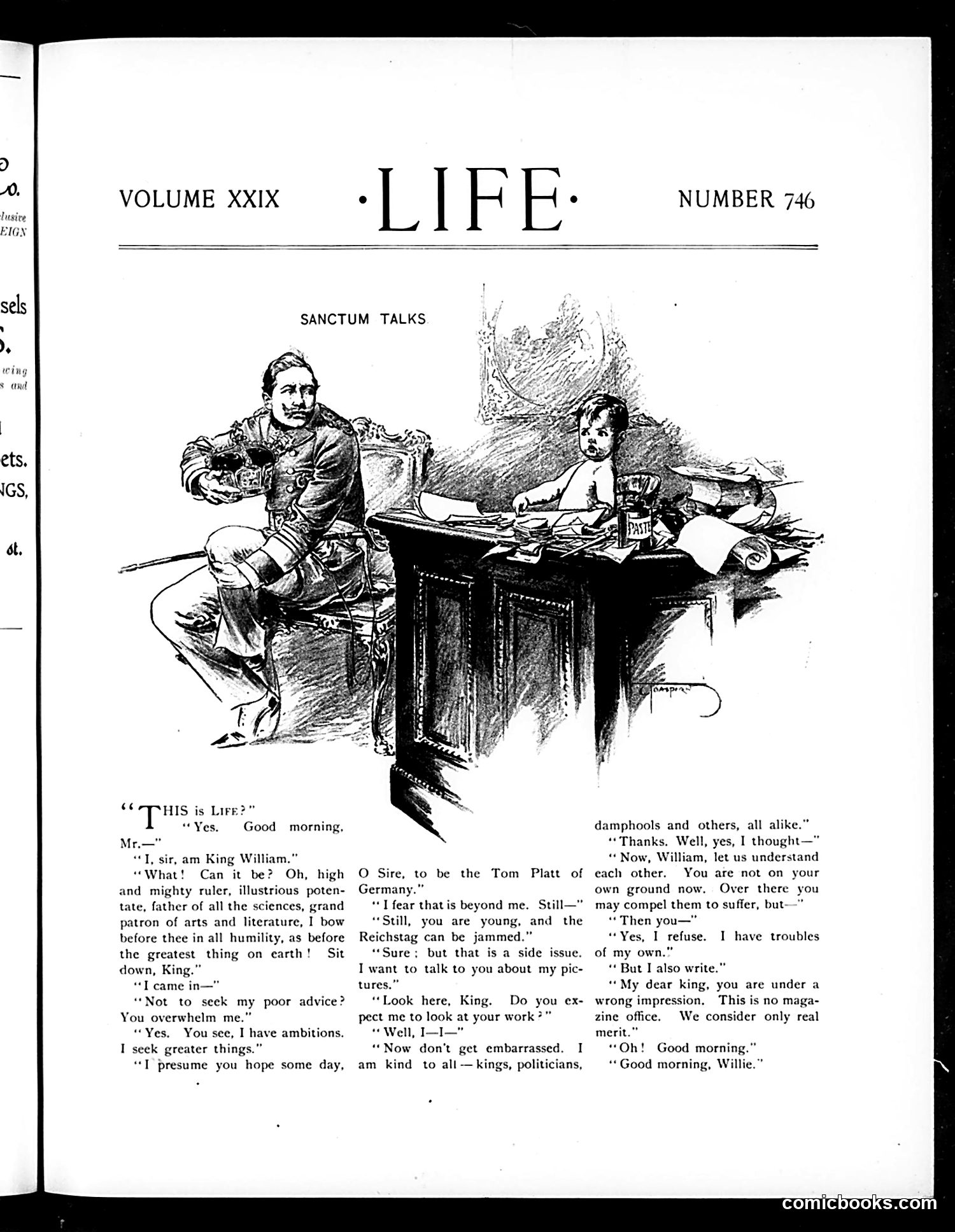
This satirical cartoon depicts two figures in what appears to be a magazine or newspaper office (suggested by papers and desk clutter). The left figure, identified as "King William," is a ruler or authority figure visiting the office of what appears to be a magazine editor or publisher (on the right). The satire mocks the contrast between grandiose self-perception and mundane reality. King William presents himself as a great patron of arts and sciences seeking the editor's advice, but the editor dismissively suggests this is merely a magazine office concerned with "real merit"—deflating the visitor's pretensions. The joke hinges on the editor's casual indifference to the supposed importance of his visitor, treating him as just another person seeking publication or validation.
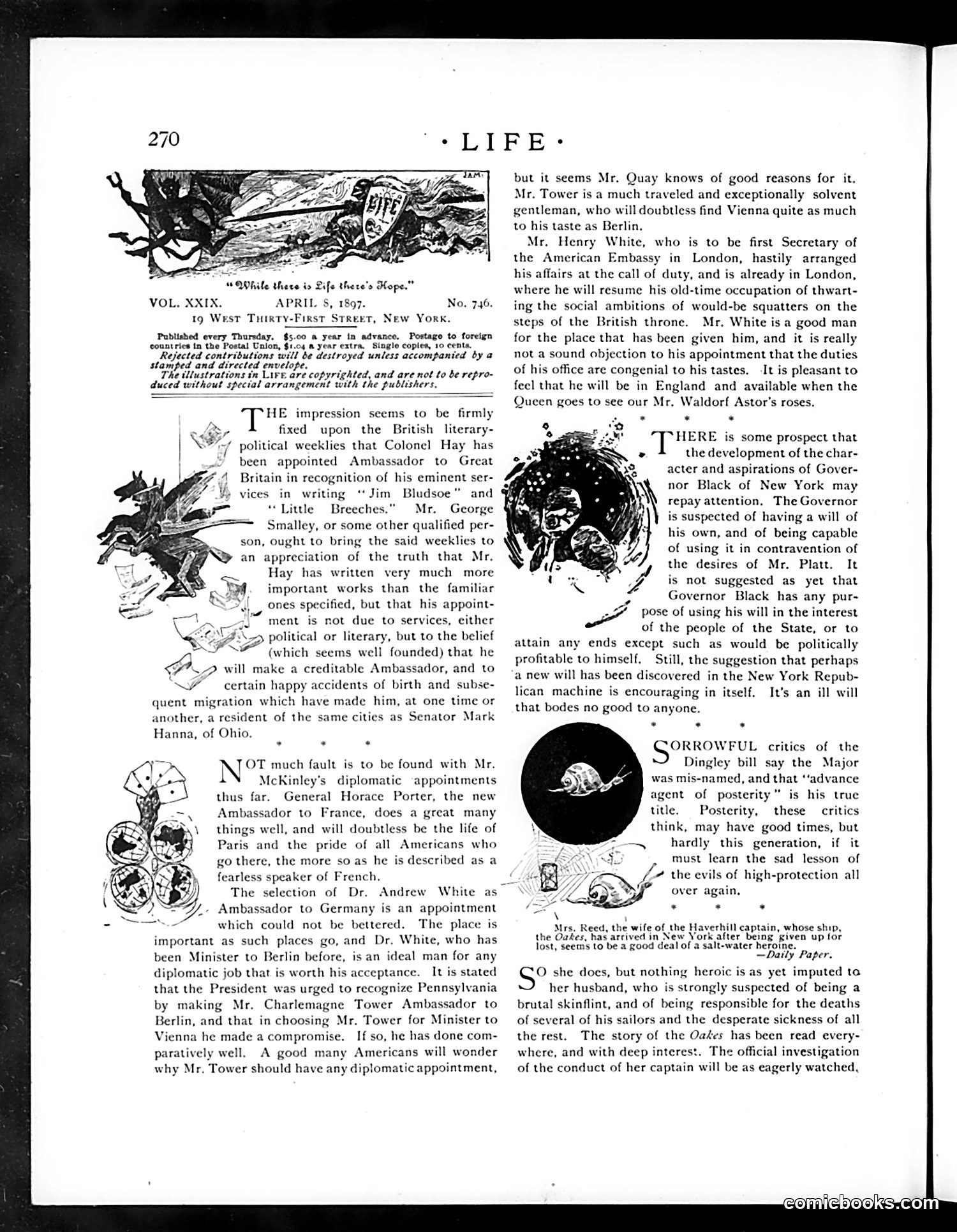
This page contains diplomatic gossip rather than formal political cartoons. The text discusses several ambassadorial appointments: - **Colonel Hay** appointed ambassador to Great Britain, praised for his literary works - **General Horace Porter** appointed to France, noted as a skilled diplomat - **Dr. Andrew White** appointed to Germany, described as an ideal choice - **Mr. Charlemagne Tower** appointed to Berlin (a compromise after Pennsylvania was denied a different ambassadorship) - **Mr. Henry White** as First Secretary to the American Embassy in London - **Governor Black of New York**, suspected of having political ambitions involving his will The decorative illustrations (snakes, coins, sleeping figures) appear to be generic satirical flourishes typical of Life magazine's style, rather than caricatures of specific individuals. The page mocks diplomatic maneuvering and political patronage more than particular personalities.
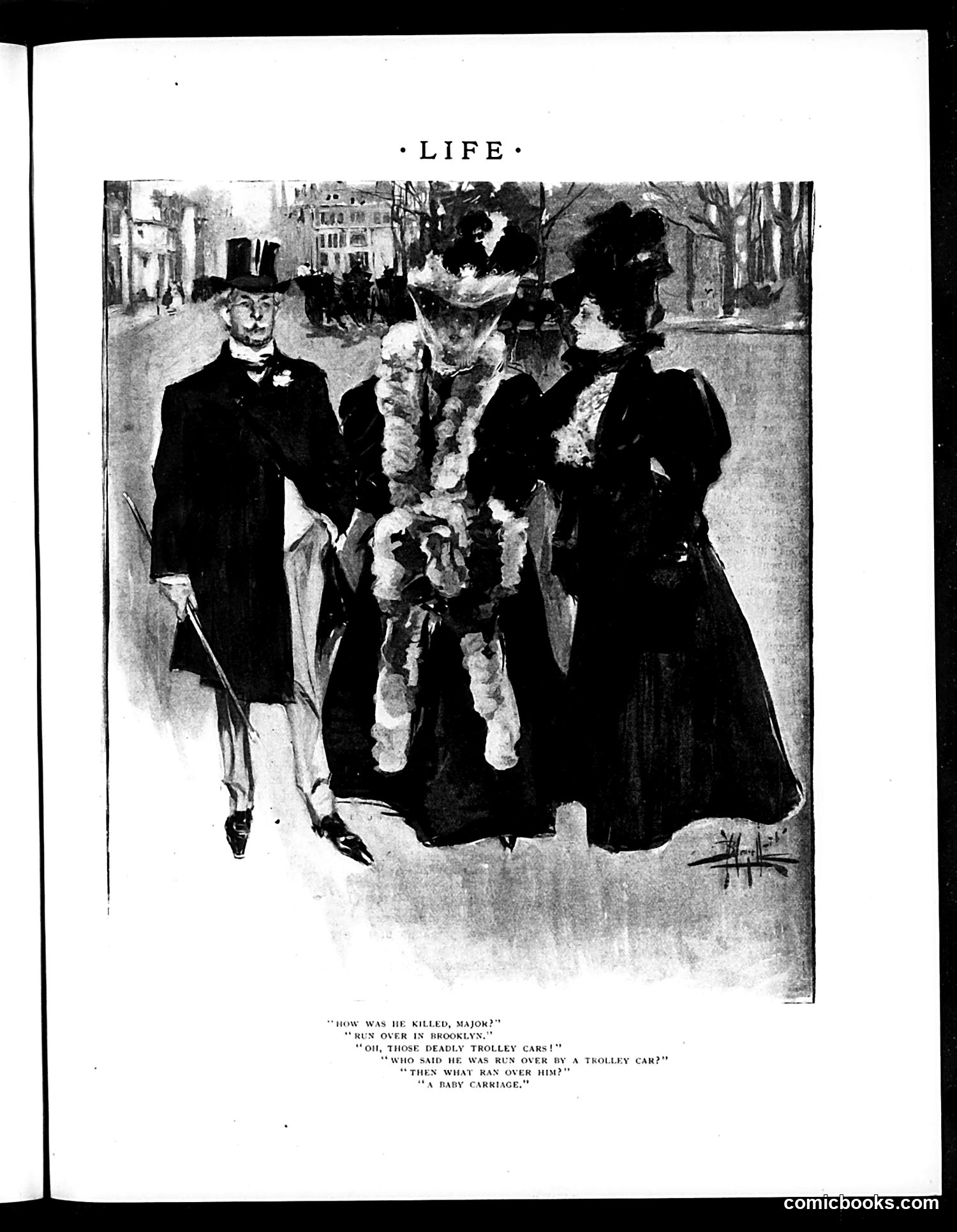
This cartoon satirizes upper-class society's casual indifference to tragedy. The dialogue reveals the joke: when someone asks "How was he killed, Major?" the response focuses entirely on trivial social details—"run over in Brooklyn," "those deadly trolley cars," "what ran over him? A baby carriage"—treating a fatal accident as mere gossip material. The well-dressed figures (a man in top hat with cane, fashionable women) represent wealthy New Yorkers discussing death with detached superficiality. The irony is that they care more about the *mode* of death (trolley cars vs. baby carriages) than the actual human loss. The satire critiques the wealthy's disconnection from ordinary urban dangers and their tendency to trivialize serious matters as conversation fodder.
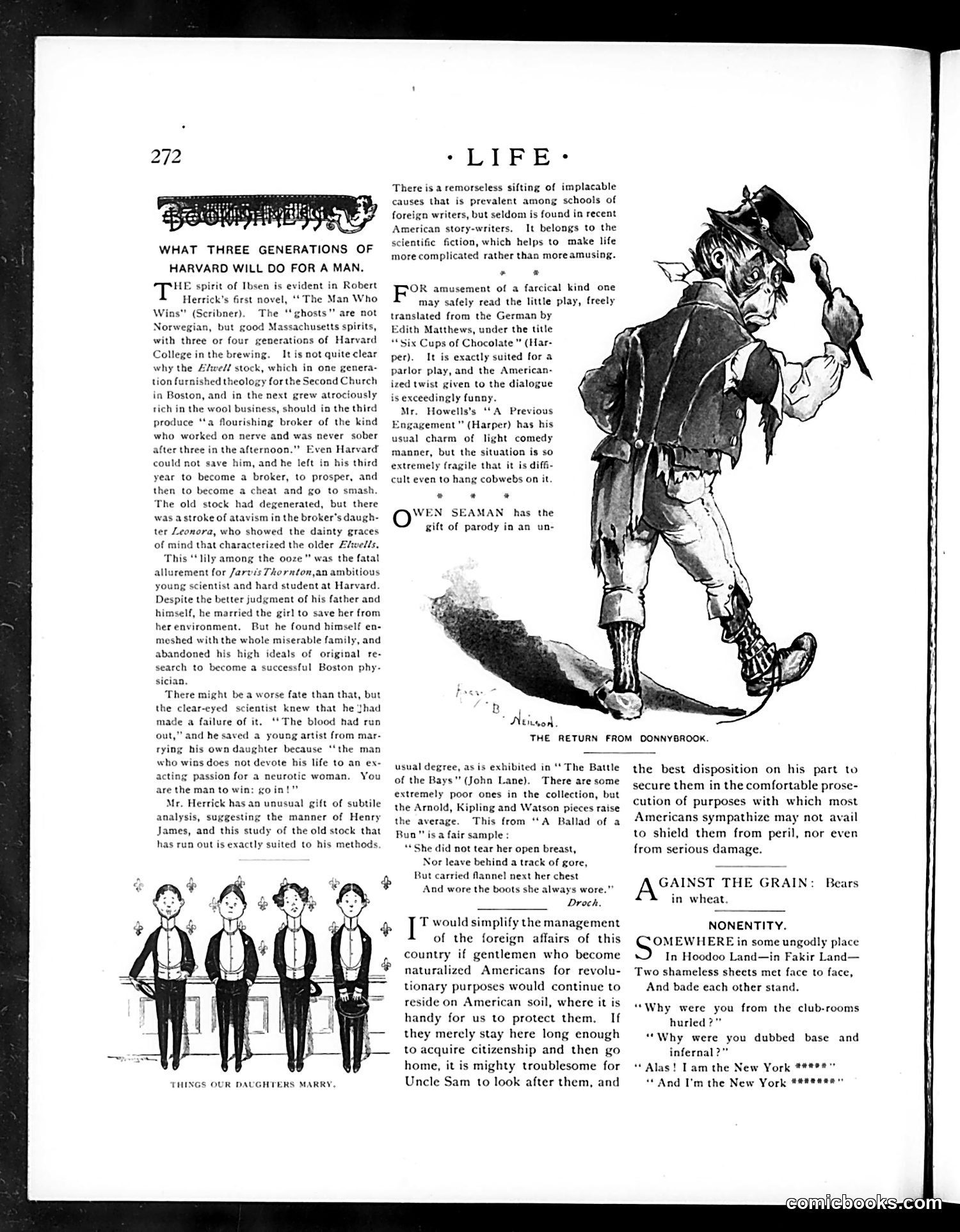
This page contains three distinct pieces: 1. **"What Three Generations of Harvards Did for a Man"** - A satirical article about Harvard's Ewell stock degenerating across generations, ultimately producing a failed scientist named Jarvis Thornton who abandoned research to become a Boston stockbroker. 2. **"Things Our Daughters Marry"** - A cartoon showing four identical men in formal dress, satirizing women's limited choices in marriage partners (all appear identical/interchangeable). 3. **"The Return from Donnybrook"** - An illustration depicting a disheveled man on horseback, apparently returning from conflict. 4. **"Against the Grain: Bears in Wheat"** and **"Nonentity"** - Brief satirical pieces about foreign affairs and New York identity. The page satirizes American institutions (Harvard), gender relations, and urban society with light humor typical of early 20th-century Life magazine.
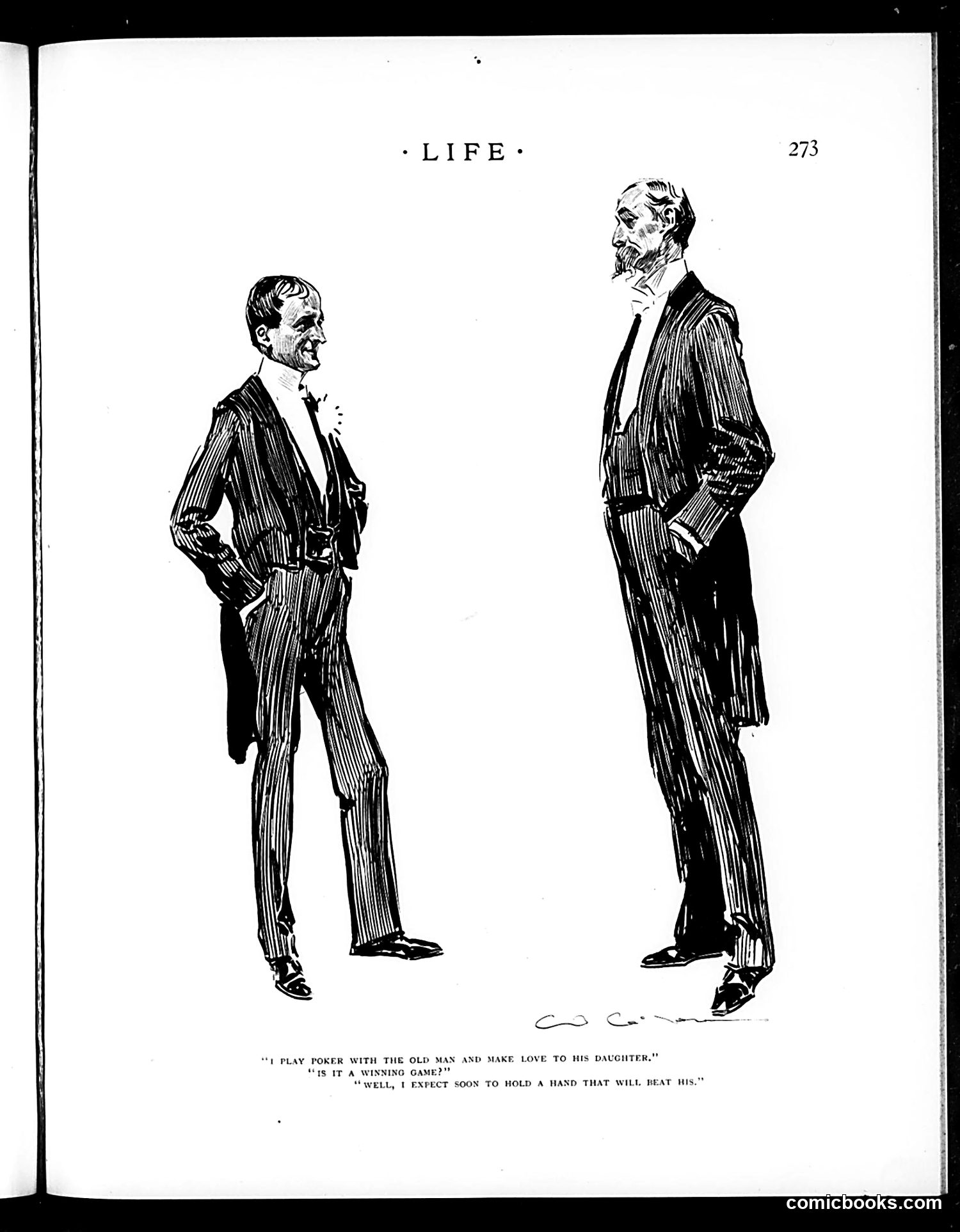
This single-panel cartoon depicts two men in business suits engaged in conversation. The caption reads: "I play poker with the old man and make love to his daughter. Is it a winning game?" / "Well, I expect soon to hold a hand that will beat his." The satire centers on courtship and financial calculation. The younger man (left) is strategizing about marrying into wealth by courting the daughter while also playing poker with her wealthy father. The older man (right) responds with a cynical quip about eventually winning a poker hand superior enough to best his rival. The joke mocks both masculine competition and transactional attitudes toward romance—suggesting that courtship among the wealthy involves calculated games and material advantage rather than genuine affection.
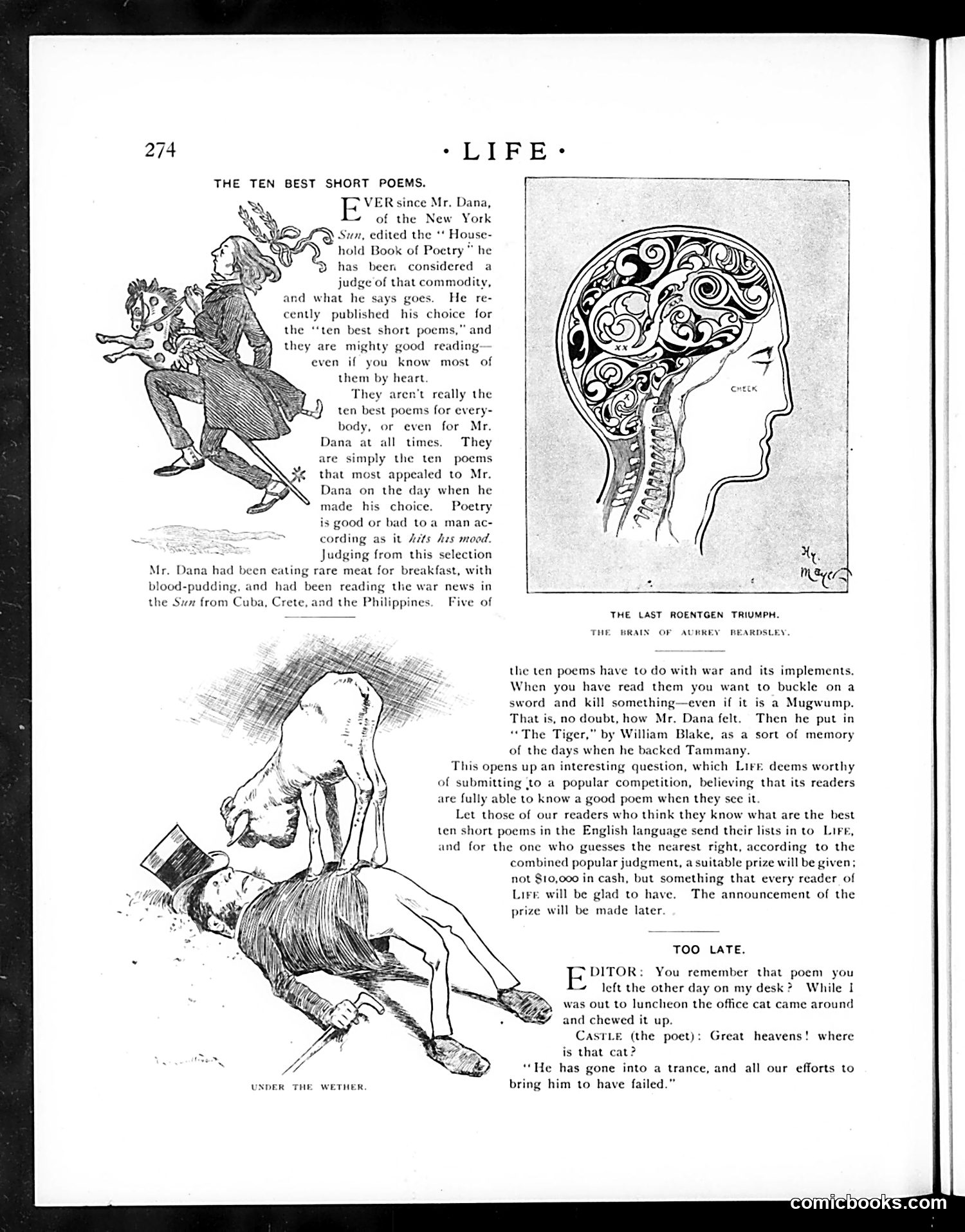
This page discusses editor Richard Dana's selection of the ten best short poems in English. The satirical angle appears in the opening: Dana had been reading war news from Cuba, Crete, and the Philippines while eating rare meat for breakfast—suggesting his violent, martial mood influenced his poetry choices. The cartoon "Under the Wether" depicts a man collapsed or lying down, apparently illustrating the physical toll of Dana's editorial process or the general war-saturated mood of the period. The page includes an anatomical illustration of "The Brain of Aubrey Beardsley," the famous Art Nouveau illustrator, likely mocking aesthetic pretension. A humorous dialogue ("Too Late") follows, where an editor's poem is eaten by an office cat—a joke about the fate of submitted work.
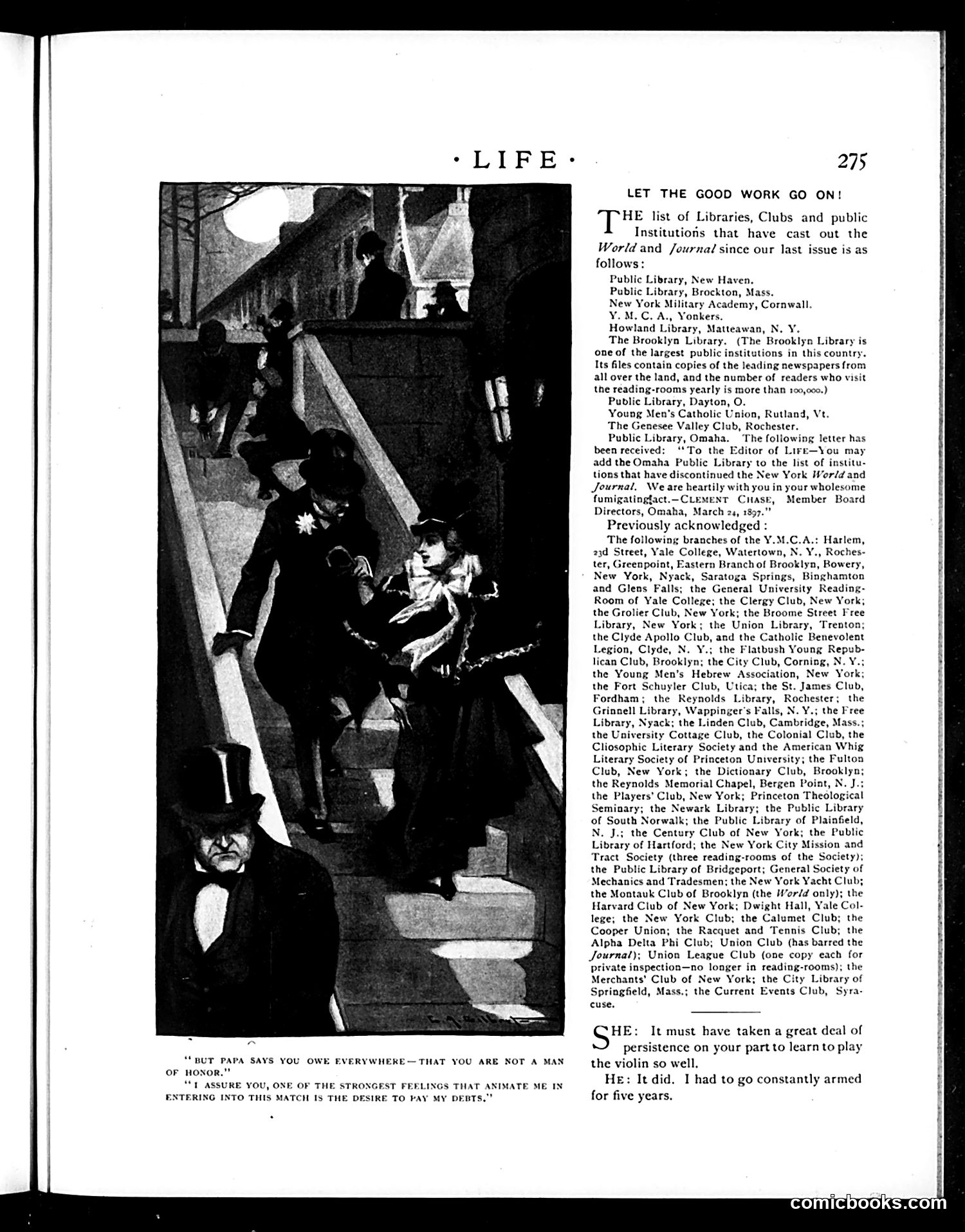
This page contains a dramatic illustration of what appears to be a dramatic scene with multiple figures in dark clothing, accompanied by dialogue quotes at the bottom. The quotes reference a father figure ("Papa") warning about honor and debts, with another character responding about learning violin over five years while "armed." The illustration depicts what seems to be a serious domestic or confrontational scenario, though the exact narrative context is unclear from the image alone. The dialogue suggests themes of honor, financial obligation, and personal achievement—common satirical subjects in early 20th-century Life magazine. The right column lists institutions that have discontinued their subscriptions to Life, indicating this is part of the magazine's administrative content rather than pure satire. Without clearer identification of the characters or scene's specific reference, the exact satirical target remains ambiguous.
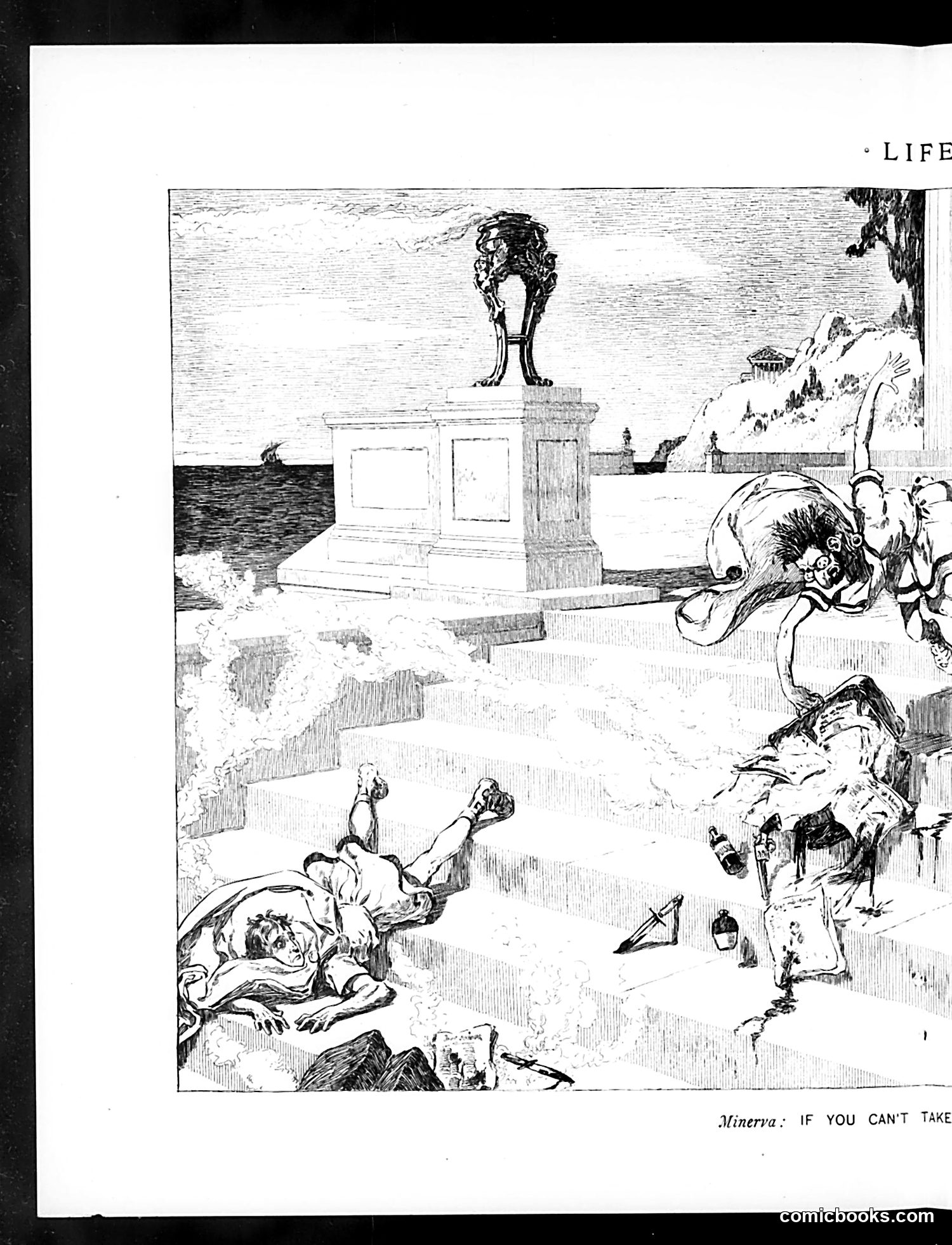
This is a classical allegory cartoon depicting **Minerva** (Roman goddess of wisdom, identifiable by her owl and warrior attributes on the pedestal) observing a beach scene of apparent chaos or conflict below. The caption reads "IF YOU CAN'T TAKE..." (incomplete), suggesting a test of endurance or resolve. The figures on the beach appear to be engaged in conflict or struggle—possibly depicting social unrest, labor disputes, or political turmoil of the era. The contrast between the idealized classical monument to wisdom above and the disorder below creates ironic commentary: despite civilization's values and ideals (represented by Minerva), human behavior remains chaotic and violent. Without the complete caption and publication date, the specific historical event referenced remains unclear, but this appears to critique the gap between society's aspirations and its actual conduct.
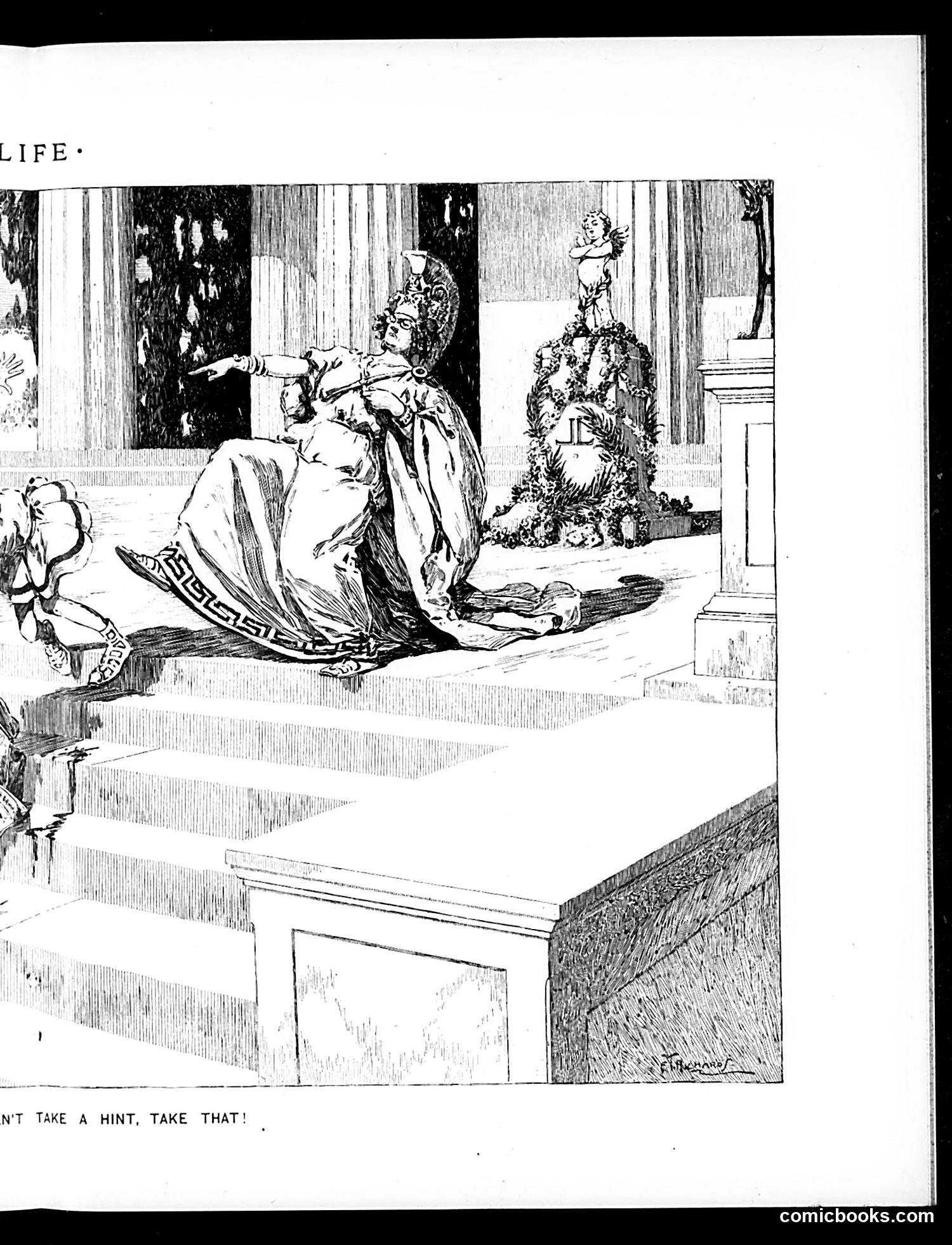
This Life magazine cartoon depicts an opulent interior scene where a reclining aristocratic woman gestures dismissively while addressing another figure. The caption reads: "DON'T TAKE A HINT, TAKE THAT!" The satire appears to mock upper-class entitlement and dismissive attitudes toward social inferiors. The woman's elaborate dress, reclining posture, and commanding gesture suggest aristocratic privilege, while her pointed remark suggests she's dealing with someone who fails to understand social hierarchy or subtle hints of rejection. The ornate setting—with classical columns, decorative plants, and refined furnishings—emphasizes the wealth and status being satirized. The cartoon likely critiques how the wealthy communicate with servants or lower-class individuals through condescension rather than direct speech, viewing them as obtuse or requiring blunt treatment.
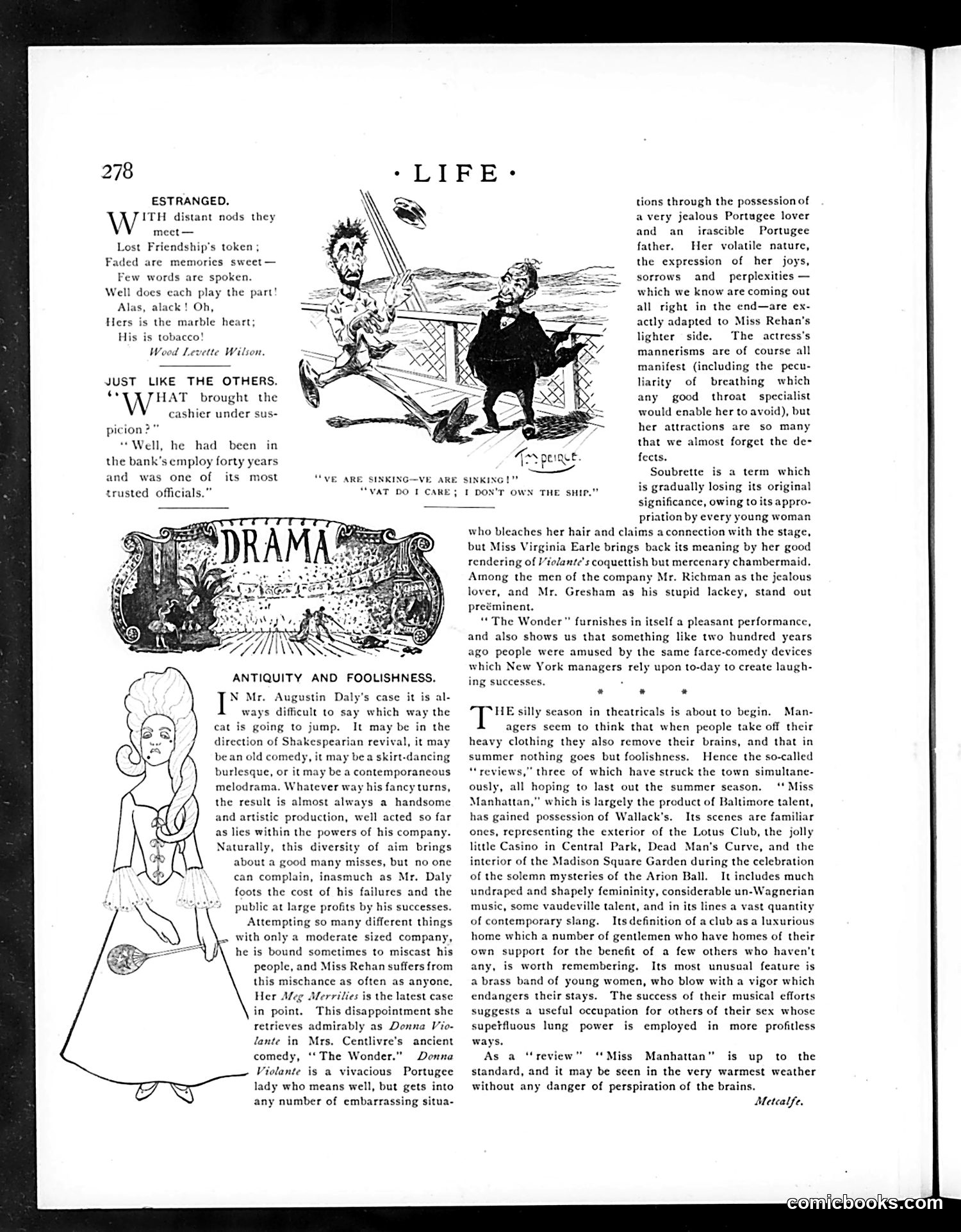
This page contains theatrical reviews and criticism. The main illustration shows two men on a ship—one appears distressed while the other remains calm, captioned "I'VE ARE SINKING—WE ARE SINKING!" / "WHY DO I CARE; I DON'T OWN THE SHIP." The "Drama" section reviews contemporary theatrical productions, including discussion of "The Wonder" and "Miss Manhattan." The text critiques various theatrical trends and performers of the era, particularly commenting on actresses' mannerisms and the prevalence of similar comedic devices in New York theater. The left sidebar contains a caricature labeled "Antiquity and Foolishness," depicting what appears to be a performer in exaggerated costume, likely satirizing overly theatrical or antiquated acting styles then in vogue. The overall tone mocks both theatrical excess and the formulaic nature of contemporary stage productions.
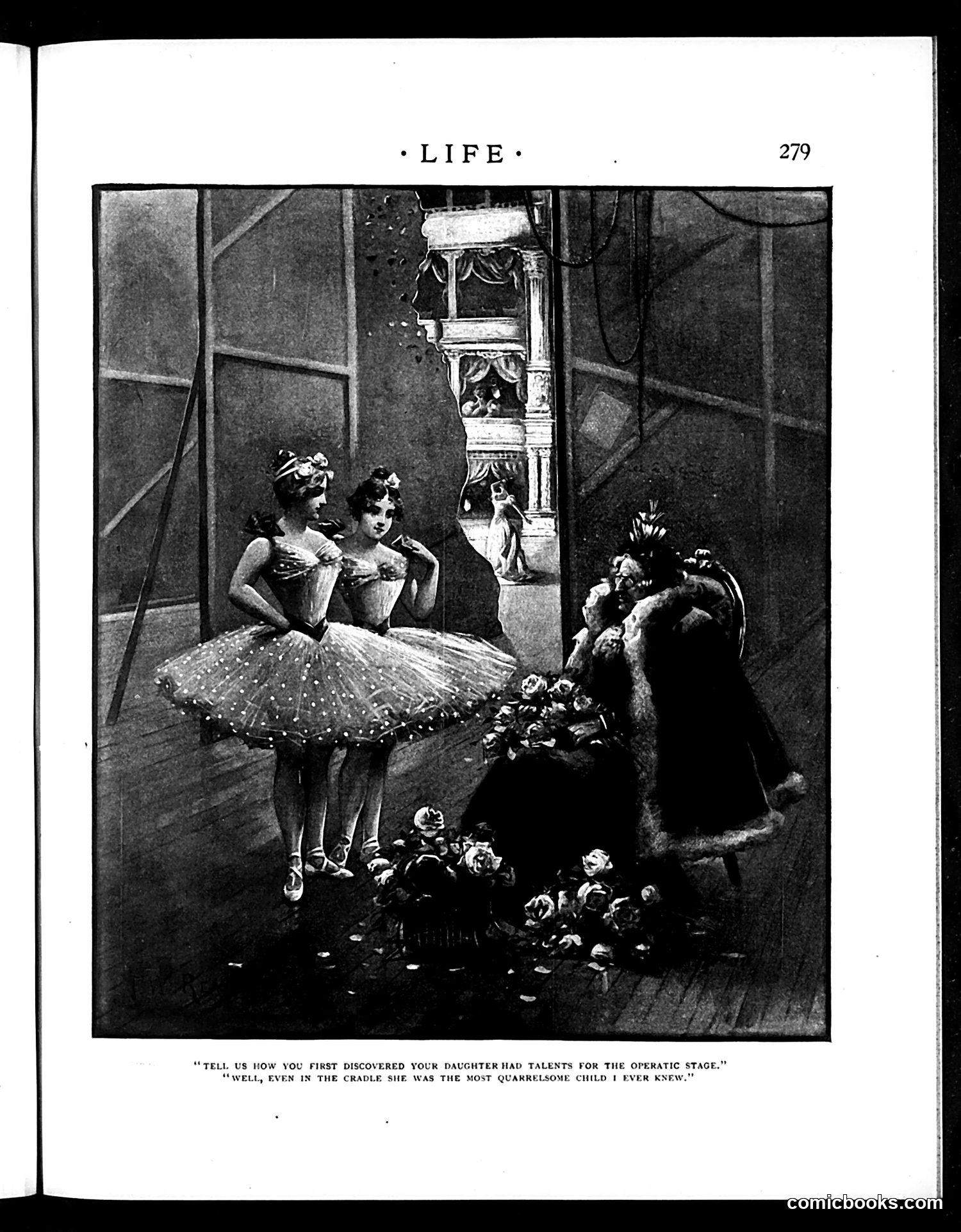
This is a satirical cartoon about opera and parenting. A well-dressed man (apparently a father) is being interviewed about his daughter's operatic talents. His punchline—that she was "the most quarrelsome child" even in the cradle—jokes that a tendency toward arguing or shrewishness naturally leads to opera singing. The humor relies on a stereotype that opera singers are dramatic, temperamental, and loud-voiced. The implication is that a quarrelsome disposition actually predicts operatic success. The scene appears set backstage at an opera house, with two young women in ballet tutus visible, suggesting a theatrical context where such talent discovery stories would be relevant. The satire gently mocks both proud stage parents and opera culture itself.
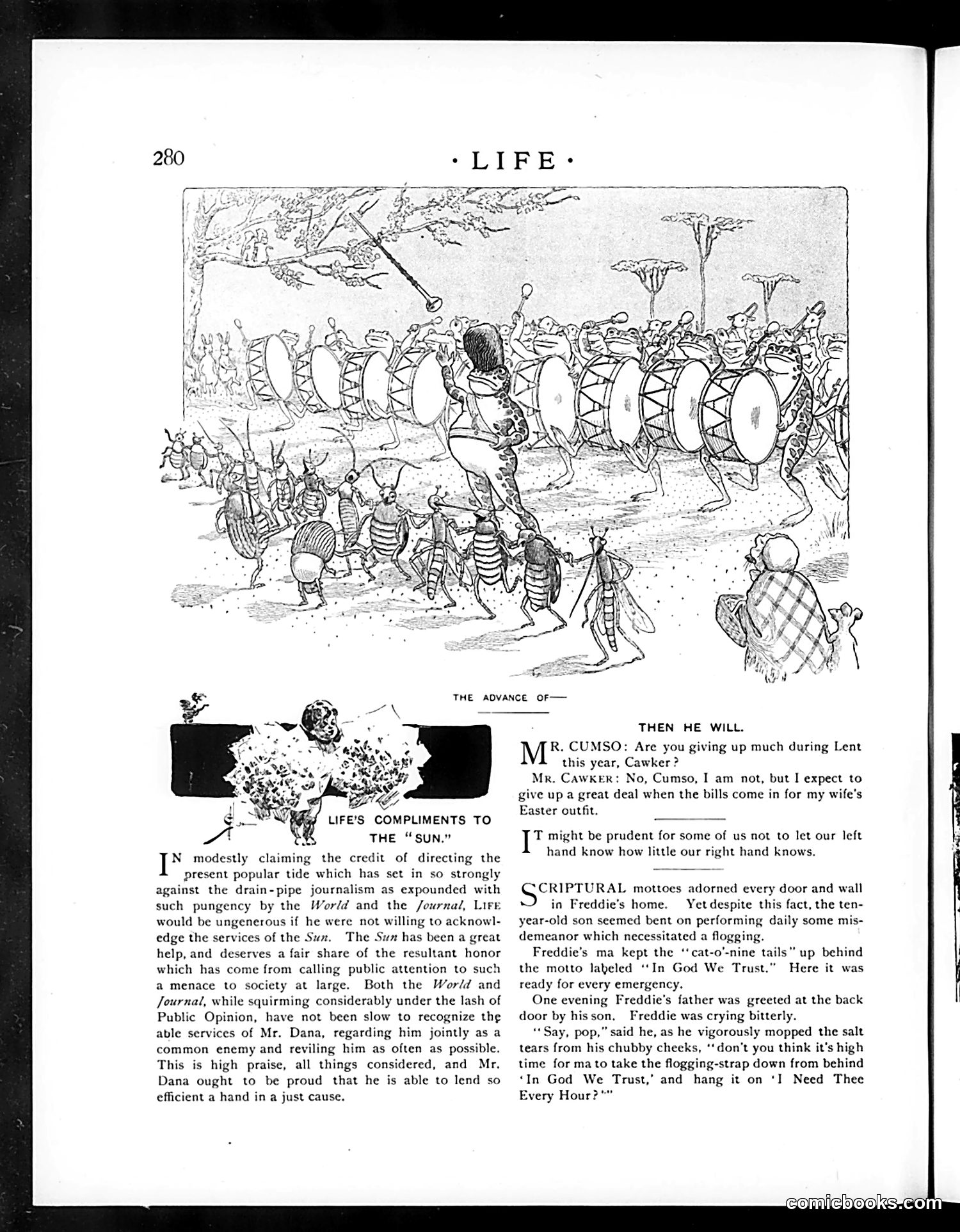
**The Main Cartoon** (top): An elaborate illustration depicting insects—apparently ants or similar creatures—marching in organized, military-like formation with large drums. This appears to be satirizing "drain-pipe journalism" (sensationalist yellow journalism), with the insects representing either the newspapers themselves or their aggressive, coordinated tactics invading society. **The Text Block** praises the newspaper *The Sun* for opposing sensationalist rivals *The World* and *Journal*, crediting it with directing public opinion against "drain-pipe journalism"—a contemporary pejorative for exploitative, scandal-focused reporting that dominated 1890s American media. **The Humor Pieces** below are domestic jokes: one about a husband avoiding Lenten sacrifice but facing his wife's Easter spending; another mocking religious hypocrisy—a home displaying "In God We Trust" while using a whip for discipline, with the child sardonically suggesting it should hang beside "I Need Thee Every Hour." The satire targets both yellow journalism and religious contradiction.
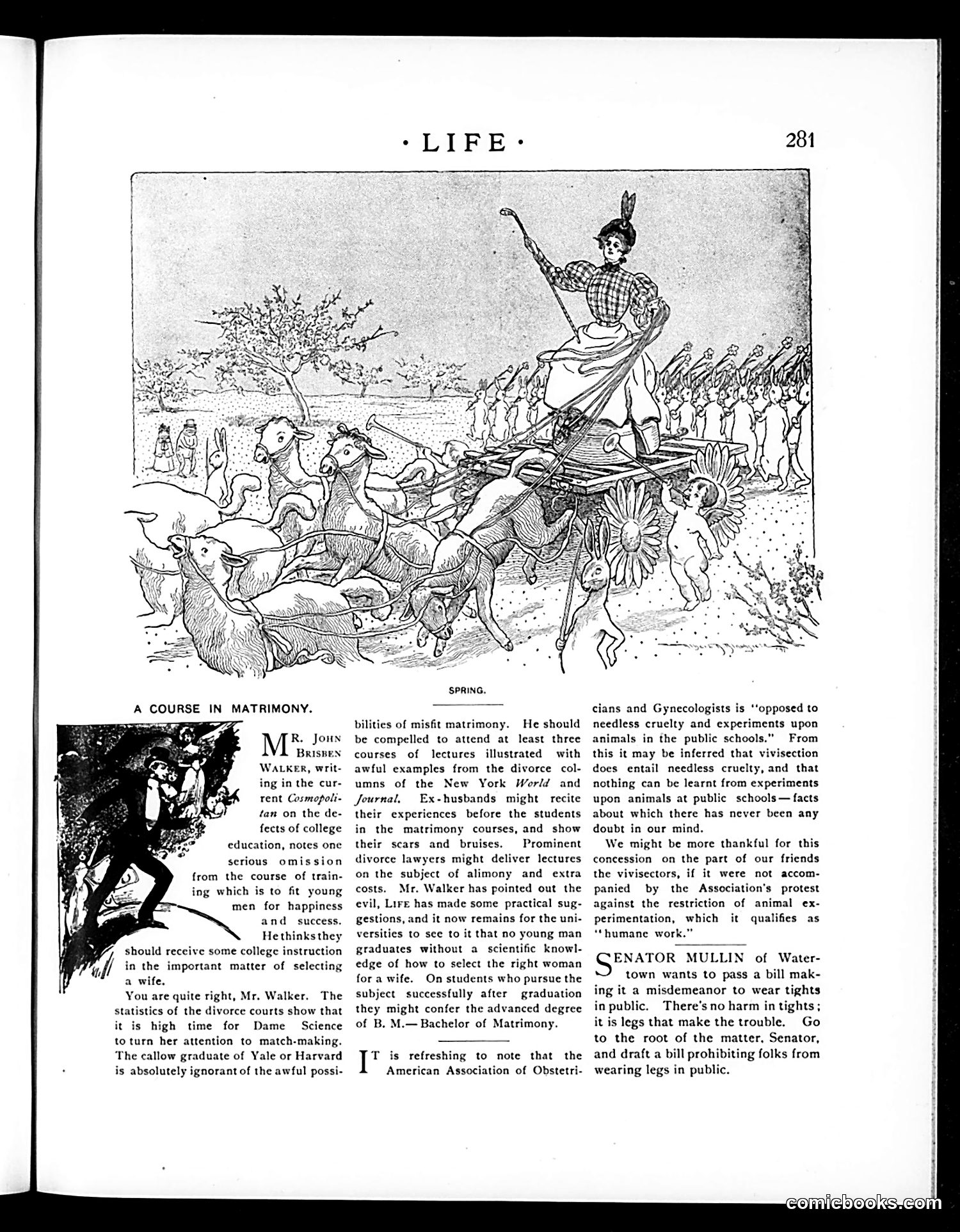
This satirical piece mocks a proposal by writer John Walker (published in *Cosmopolitan*) suggesting colleges should teach men how to select wives, given high divorce rates. Life sarcastically expands the idea: universities should offer mandatory matrimony courses featuring divorce lawyers lecturing on alimony costs, ex-husbands displaying their "scars and bruises," and examples from divorce columns. The joke culminates in awarding a "B.M.—Bachelor of Matrimony" degree. The accompanying illustration depicts a woman riding triumphantly in a chariot pulled by various animals and cherubs—a classical allegory of spring or victory, which contrasts humorously with the text's portrayal of matrimony as a hazardous battlefield requiring scientific study. The piece reflects early-20th-century anxieties about rising divorce rates and satirizes both masculine naïveté about marriage and the growing role of "scientific" solutions to social problems.
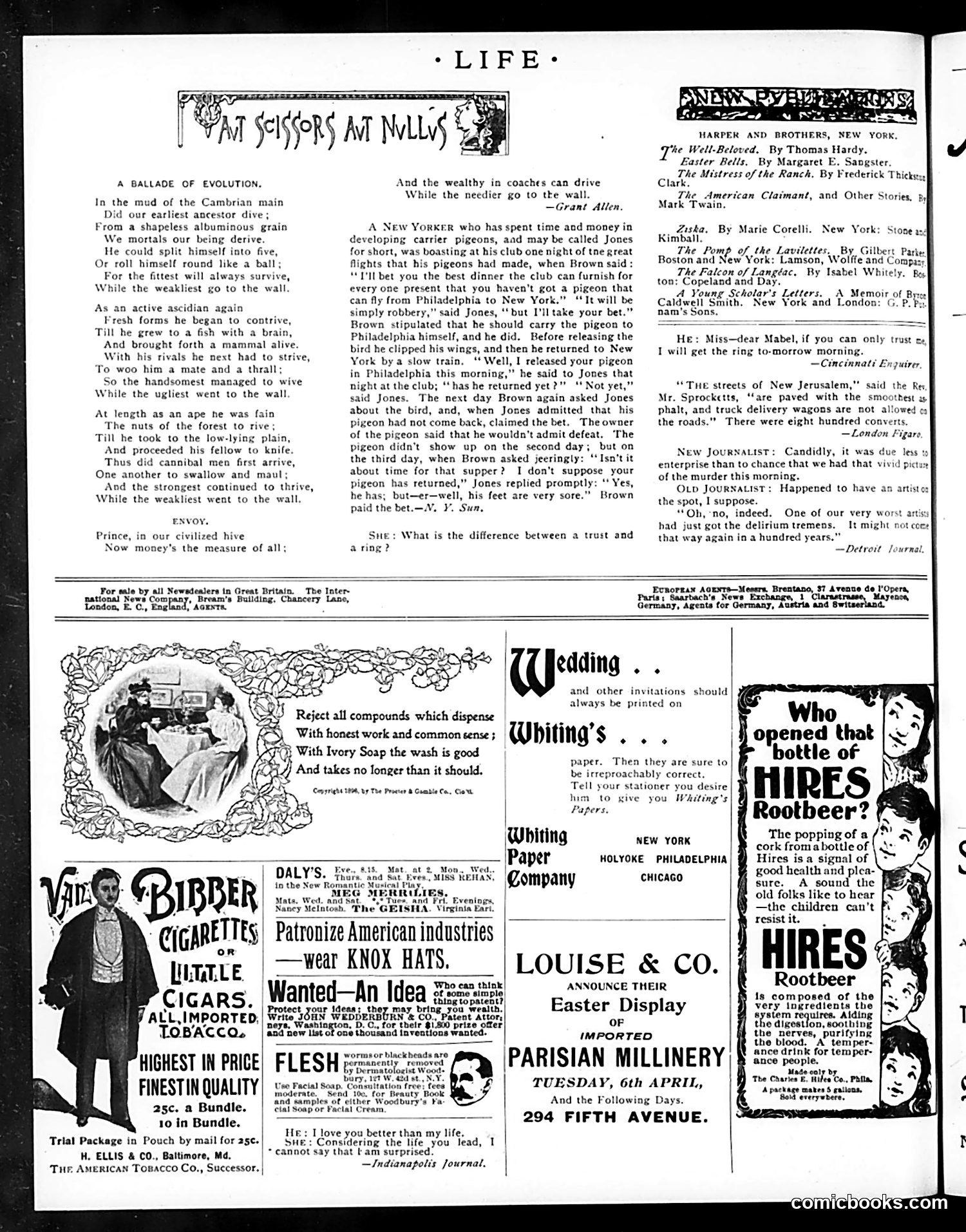
This page's main content is Grant Allen's poem "A Ballade of Evolution," which satirizes the misapplication of Darwin's evolutionary theory to justify social inequality. The poem traces humanity's ascent from "shapeless albuminous grain" through fish, mammal, and ape stages to civilized man—but with a sharp critique embedded in its refrain: "While the weakliest go to the wall." Allen shows how each evolutionary stage supposedly favored the strong and fit, but then reveals the real point: in "our civilized hive," this brutal logic persists unchanged—"Now money's the measure of all," with the wealthy in coaches while the poor go "to the wall." The satire targets the era's use of evolutionary theory to justify ruthless capitalism and class hierarchy as "natural" and inevitable. Allen argues that civilization hasn't transcended this brutal competition; it's merely replaced physical strength with wealth as the measure of survival. The anecdote below about the pigeon bet adds humorous irony—human "cleverness" triumphs through deception rather than fitness.
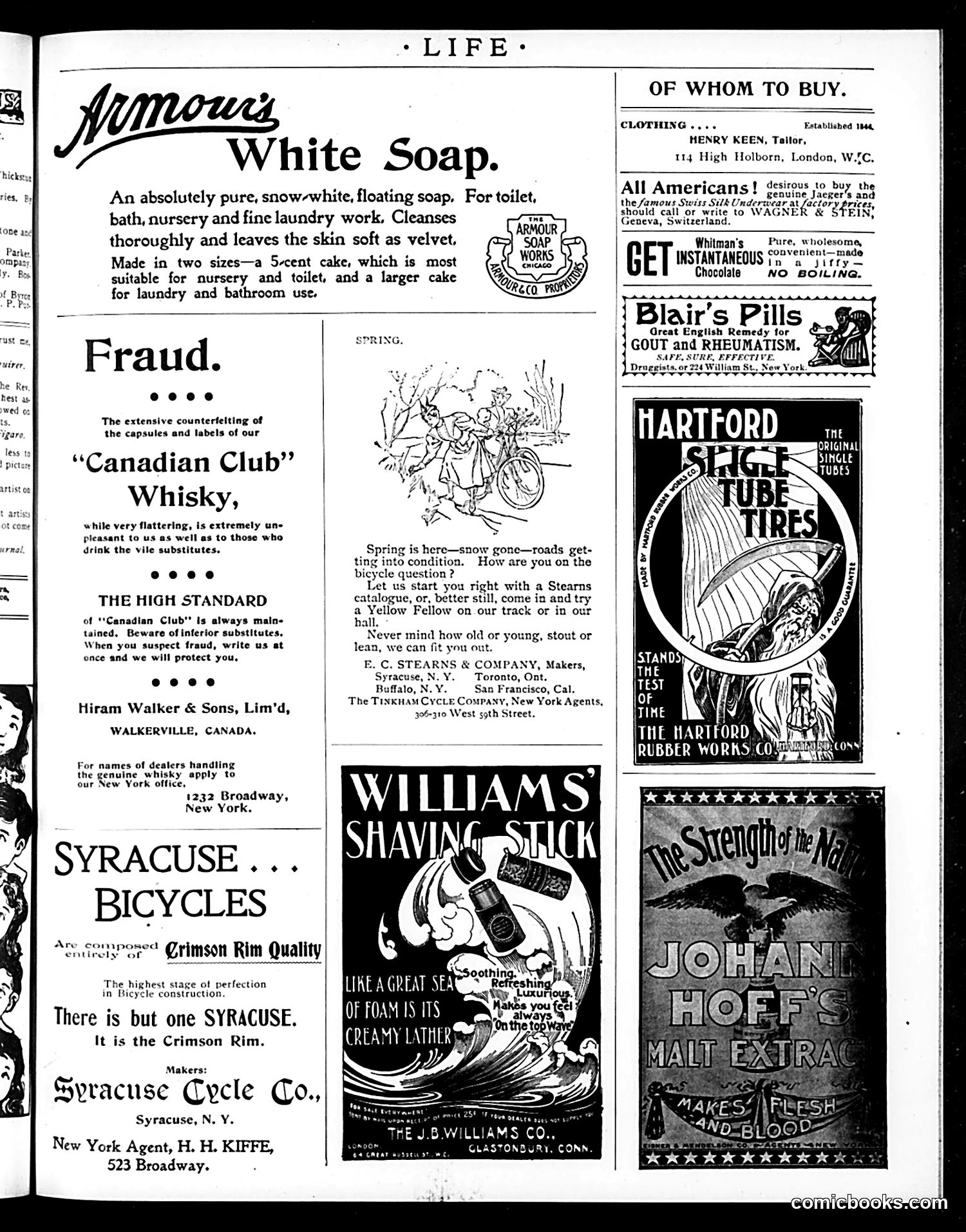
This page from *Life* magazine is mostly commercial advertisements rather than satirical content. The main items are: **Notable ad**: The "Fraud" section warns against counterfeit "Canadian Club" whisky, claiming extensive counterfeiting exists. This appears to be a legitimate consumer alert disguised as editorial content—a common early advertising practice. **Other ads** promote: Armour's White Soap, Syracuse bicycles, Stearns bicycles, Williams Shaving Stick, and various patent medicines and clothing items typical of early 1900s advertising. The "Spring" illustration shows a bicycle rider and serves as seasonal tie-in for bicycle advertisements. **No clear political satire** is visible on this page. The content reflects early 20th-century product marketing and consumer concerns about counterfeit goods—issues that would resonate with contemporary readers worried about product authenticity and quality.
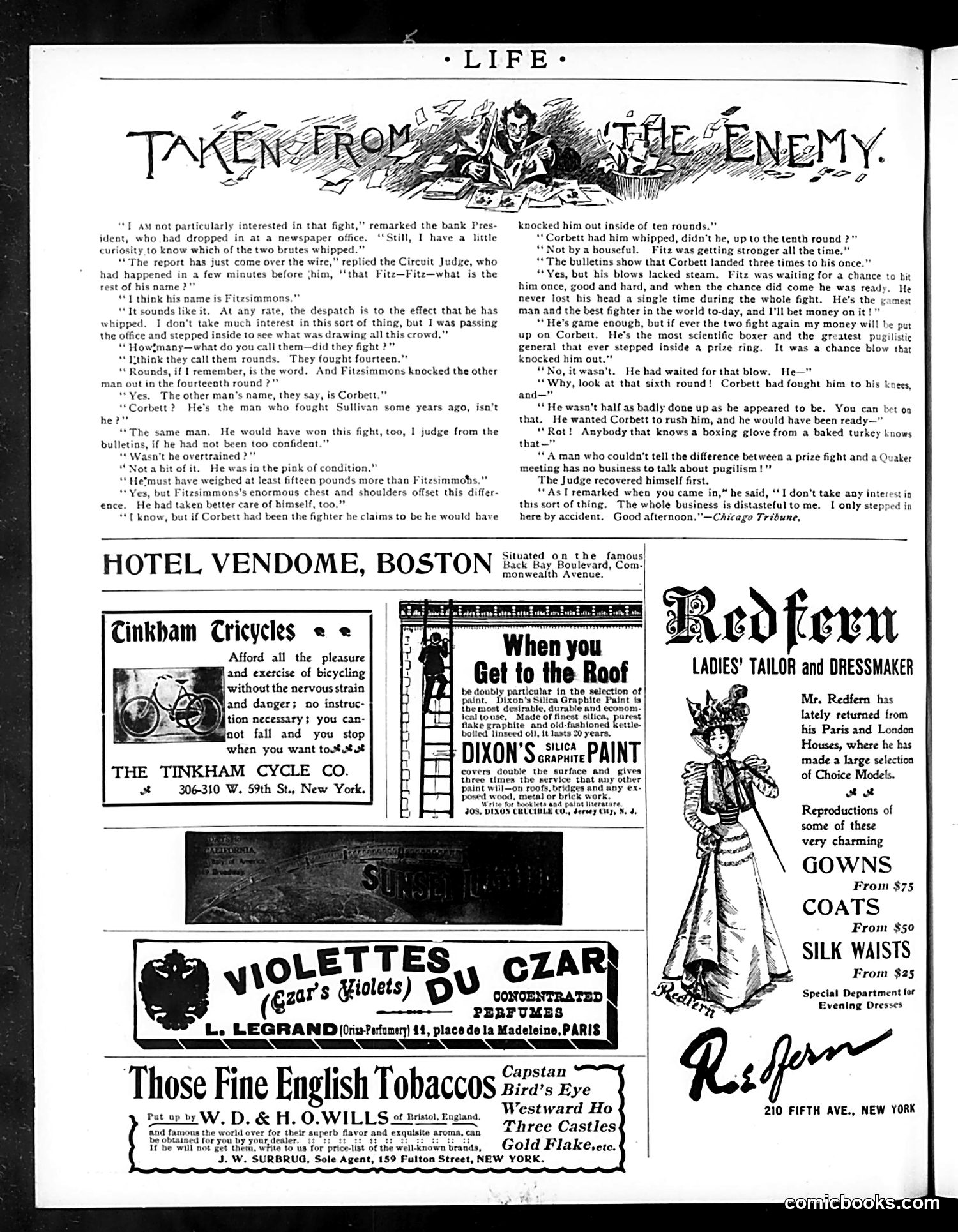
This satirical piece depicts a conversation between a bank president and circuit judge discussing a recent prizefight between **Fitzsimmons and Corbett**—likely referencing the 1897 heavyweight championship bout won by Bob Fitzsimmons. The humor centers on the judges' *contrasting opinions* about the match. One claims Fitzsimmons deserved victory outright; the other insists Corbett was superior and lost only through a "chance blow." Their increasingly heated argument—over technicalities like rounds, conditioning, and scientific boxing versus raw power—escalates until the judge, embarrassed by his own passion about a sport he claimed to find distasteful, abruptly exits. The satire mocks how intelligent, respectable men become irrational and argumentative over prizefighting, contradicting their own stated indifference. The title suggests the fight itself becomes a weapon in their social competition.
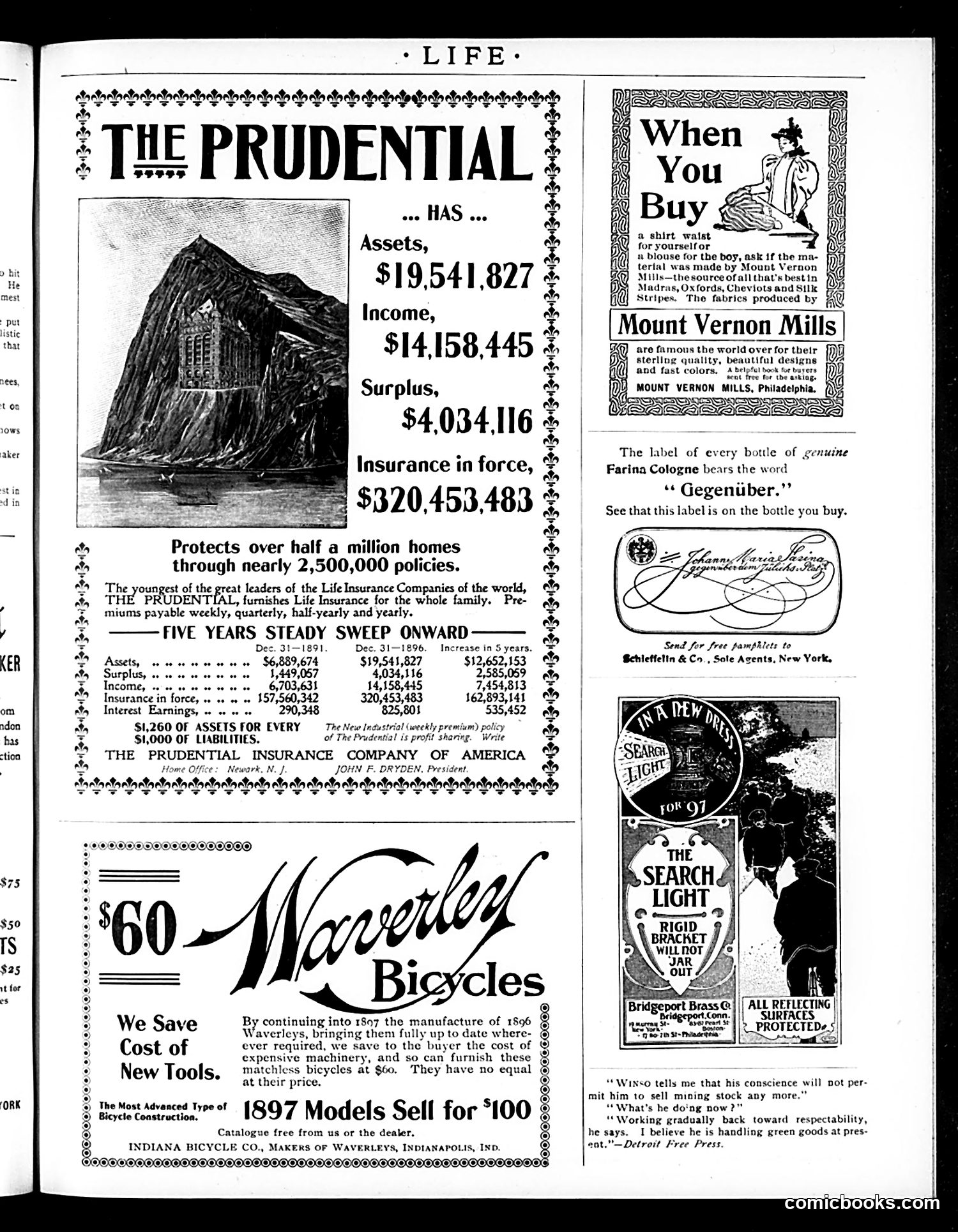
This page is primarily **advertising**, not political satire. It contains four distinct commercial advertisements: 1. **The Prudential Insurance Company**: Showcases financial statistics (assets of $19.5 million, $320+ million in force) to promote life insurance to working families. The dramatic mountain imagery conveys stability and strength. 2. **Waverley Bicycles**: Markets $60 bicycles as affordable alternatives to more expensive $100 models, emphasizing cost savings through continued 1896 manufacturing. 3. **Mount Vernon Mills**: Advertises fabric quality for clothing (shirt waists, blouses). 4. **Farina Cologne**: Warns consumers to check for the "Gegenüber" label on genuine bottles. The page also contains a small joke from the *Detroit Free Press* about a man named Winco transitioning from dishonest mining stock schemes toward "respectability" by selling "green goods" (counterfeit currency)—implying his moral improvement remains questionable. The content reflects late-1890s consumer capitalism and advertising conventions.
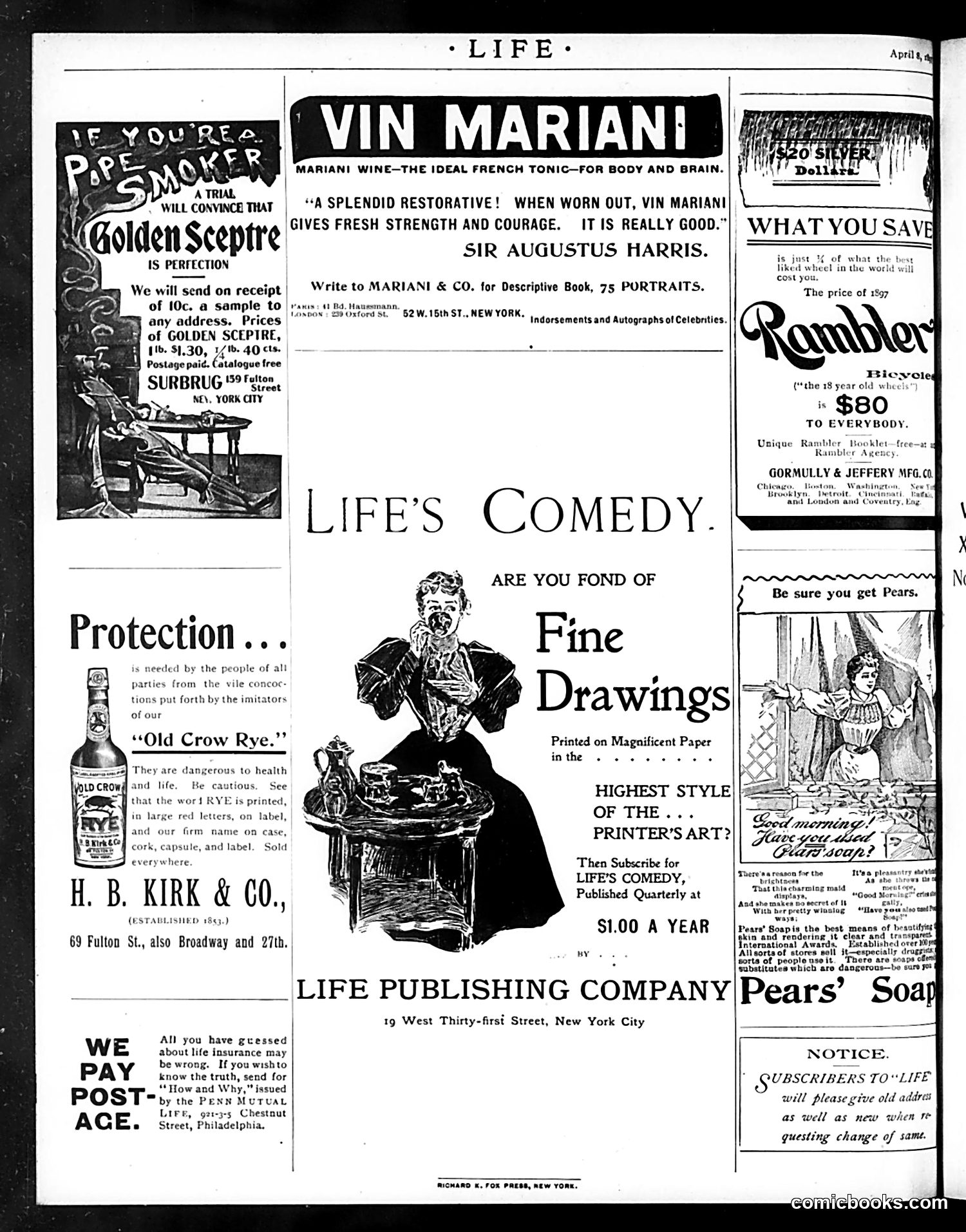
This is primarily an **advertising page** from Life magazine (dated April, appears to be late 1890s based on product references). The page contains multiple product advertisements rather than political cartoons or satire. Key advertisements include: - **Vin Mariani**: A French wine tonic claiming to restore "strength and courage," endorsed by "Sir Augustus Harris." This was a real patent medicine of the era, notably containing coca leaf extract. - **Golden Sceptre pipe tobacco** and **Old Crow Rye whiskey**: Both emphasizing authenticity and warning against imitations—common concerns in an era of unregulated consumer goods. - **Rambler bicycle**: Priced at $80 (expensive for 1890s). - **Pears' Soap** and other products. The only satirical content is a small illustration titled "Life's Comedy" showing a well-dressed man with fine drawings, promoting Life's own quarterly publication. The page reflects late-Victorian consumer culture and the prevalence of dubious health tonics marketed with celebrity endorsements.
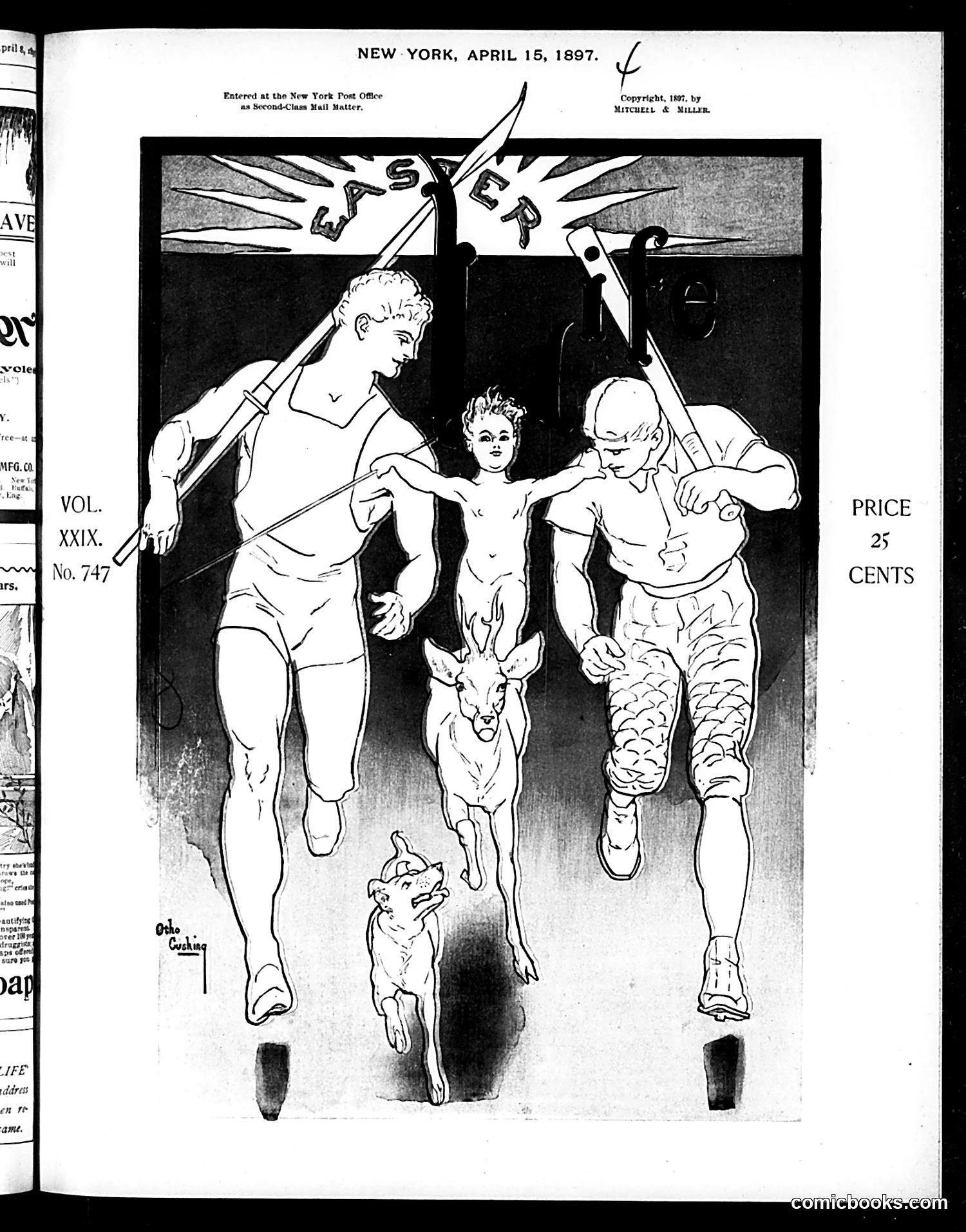
This 1897 Life magazine cartoon depicts a classical allegorical scene: an adult female figure (likely representing Liberty or Justice) wielding a sword alongside two cherubs, pursuing what appears to be a goat and a small devil-like creature. The "SUPER" and "ER" text visible at top suggests fragmented words, possibly indicating editorial content about "superfluous" matters or similar criticism. The imagery employs typical 19th-century satirical conventions—virtuous feminine allegorical figures battling evil or vice. Without clearer text identifying specific contemporary targets, the exact political reference remains unclear, though the composition suggests commentary on moral or political struggle of the 1890s era. The artist is credited as "Ode Cushing" (visible signature). The cartoon's specific satirical point—what corruption, folly, or vice is being attacked—cannot be definitively determined from the visible image alone.
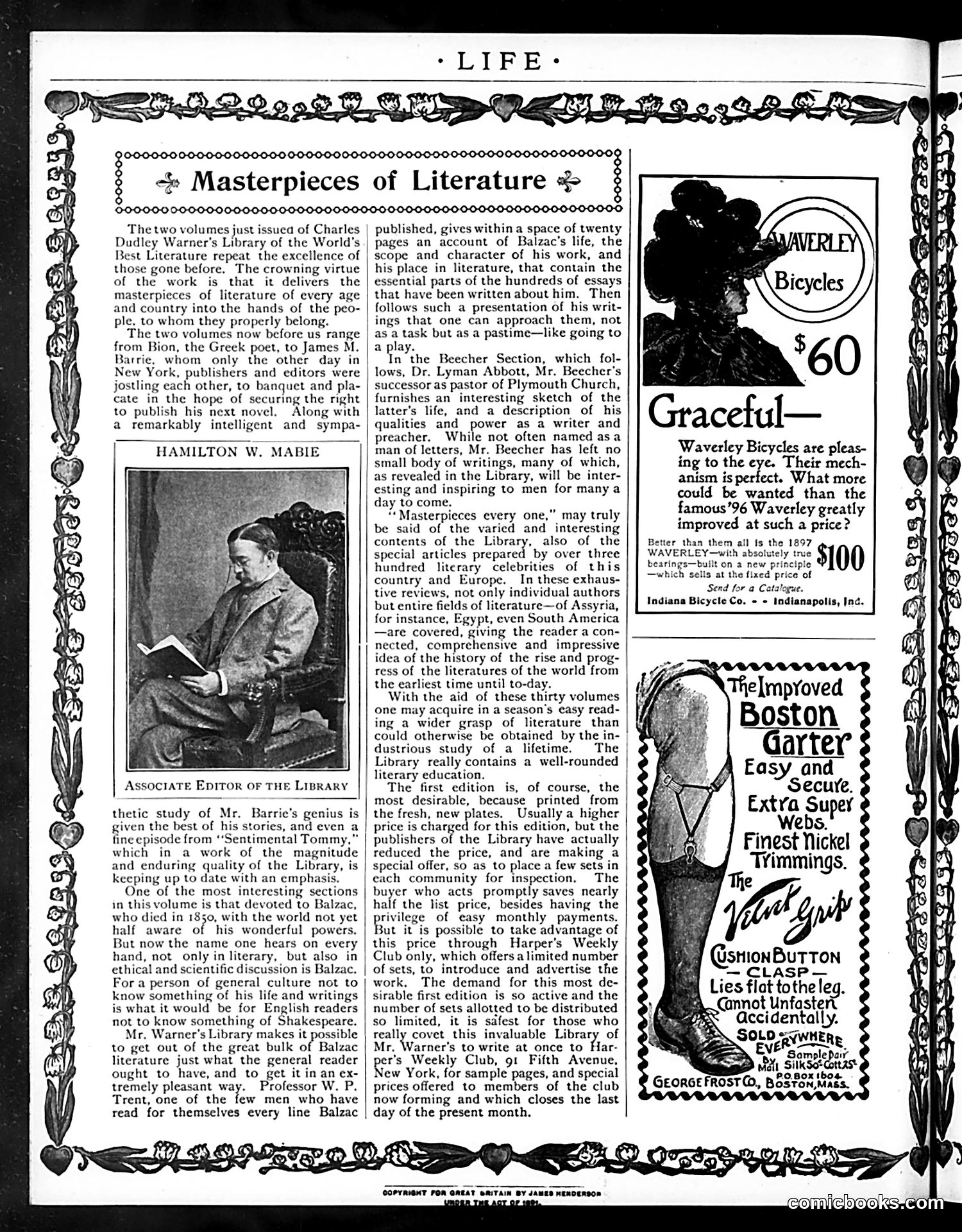
This page is primarily a **book review and advertisement** for Charles Dudley Warner's "Library of the World's Best Literature," not a political cartoon. The main content praises a comprehensive 30-volume literary collection that makes classic literature accessible to ordinary people. The review highlights included essays by notable figures like Hamilton W. Mabie (pictured), discussing authors from ancient Greek poet Bion through contemporary writer James M. Barrie. Particular emphasis is given to coverage of the French novelist Balzac and preacher Henry Ward Beecher. The **satire is implicit rather than explicit**: the piece gently mocks the pretension of literary culture by emphasizing that this library allows ordinary readers to acquire "in a season's easy reading" what would otherwise require "a lifetime" of study—suggesting both the democratization and potential superficiality of literary knowledge. The **right sidebar contains period advertisements** (Waverley Bicycles, Boston Garter) unrelated to the literary content, typical of Life magazine's revenue model.
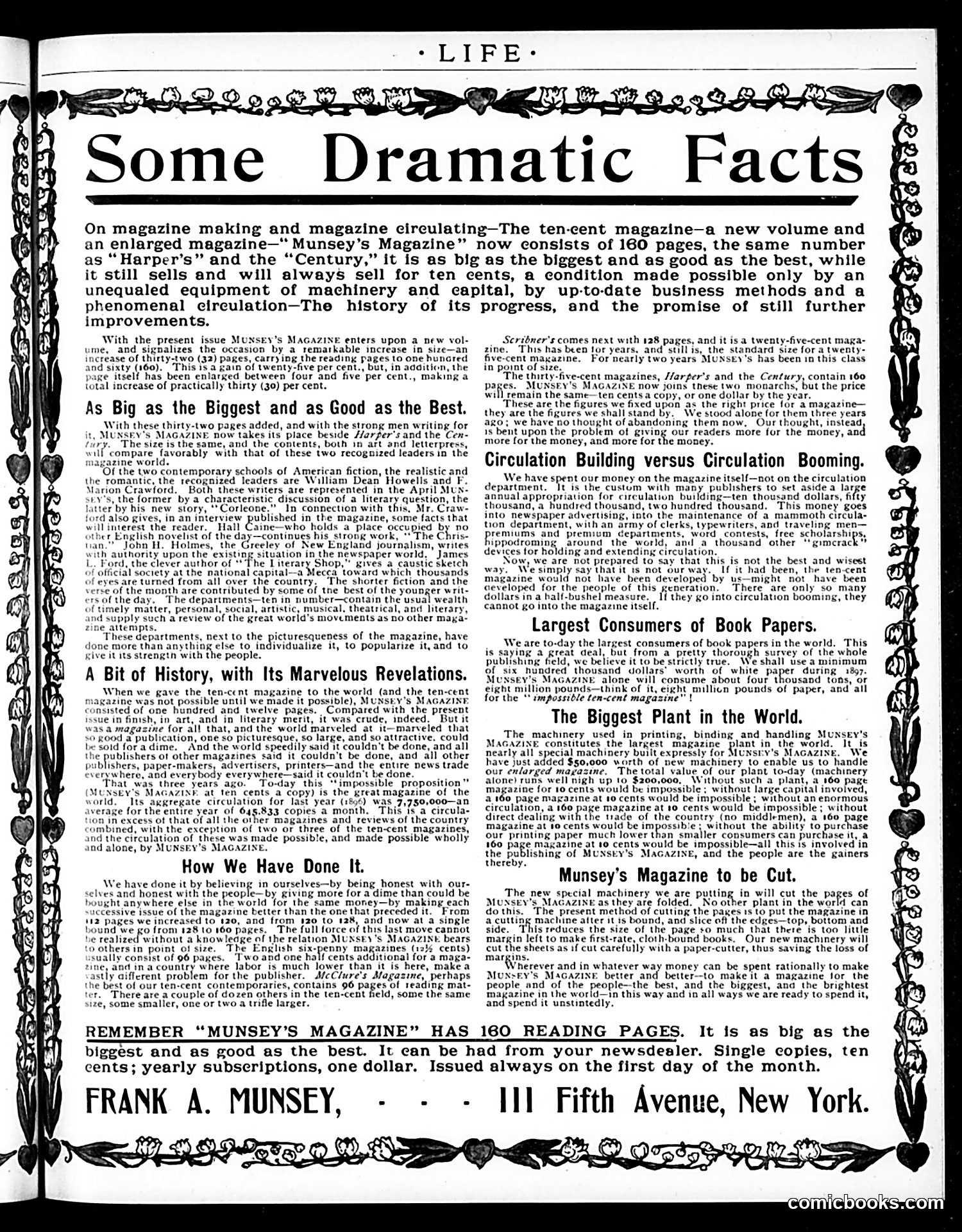
This is primarily **advertising copy**, not satirical content. It's a promotional piece by Frank Munsey advertising his magazine's expansion. **The Context:** In the 1890s, Munsey pioneered the affordable "ten-cent magazine"—a revolutionary business model. Previously, magazines cost 25-35 cents, making them luxuries. Munsey's low price point, enabled by large-scale printing and advertising revenue, democratized magazine access. **The Claims:** The text boasts that *Munsey's Magazine* now matches competitors like *Harper's* and *Century* in page count (160 pages) while remaining a dime—positioning itself as superior value. It emphasizes modern machinery, circulation scale, and quality writers (William Dean Howells, F. Marion Crawford). **The Pitch:** Rather than satire, this is straightforward boasting about business innovation and editorial ambition—typical turn-of-century magazine advertising that emphasizes both accessibility and prestige to attract readers and advertisers.
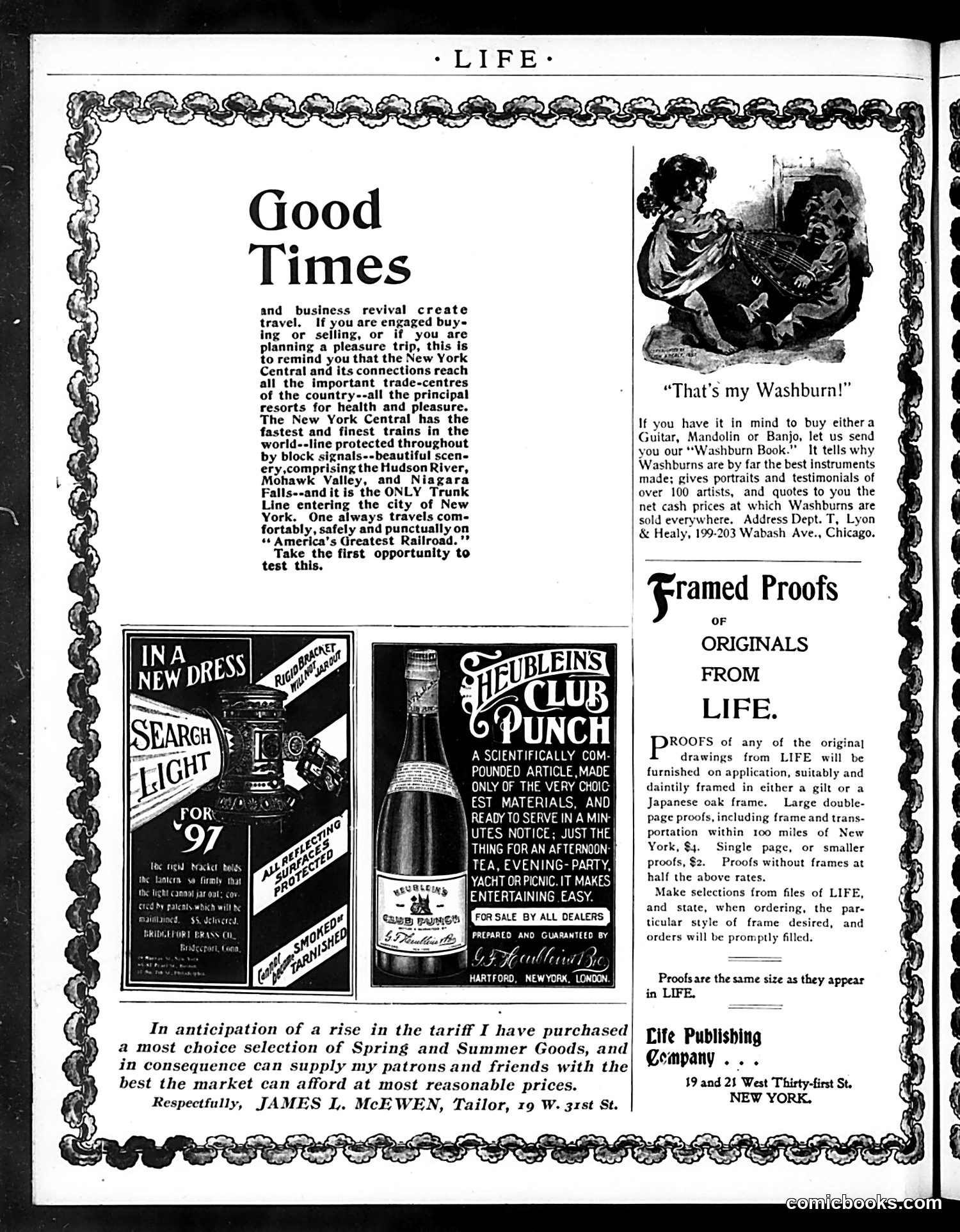
This is primarily an **advertising page** from Life magazine, not a political cartoon. The content reflects early 20th-century commercial culture. The main advertisements include: - **New York Central Railroad**: promoting business travel and leisure trips - **Search Light lamps**: for $97 - **Heublein's Club Punch**: a pre-made cocktail for entertaining - **Washburn musical instruments**: guitars and mandolins One small illustration shows a figure saying **"That's my Washburn!"**—a testimonial format common in period advertising. At bottom, **James L. McEwen**, a tailor at 19 W. 31st St., announces he's stocked spring/summer goods in anticipation of tariff increases—suggesting he bought inventory before expected price rises, a business strategy tied to trade policy debates of the era. The page also advertises **Life Publishing's framed proofs service**, offering original artwork from the magazine for home decoration. This reflects consumer culture and business concerns of the period rather than political satire.
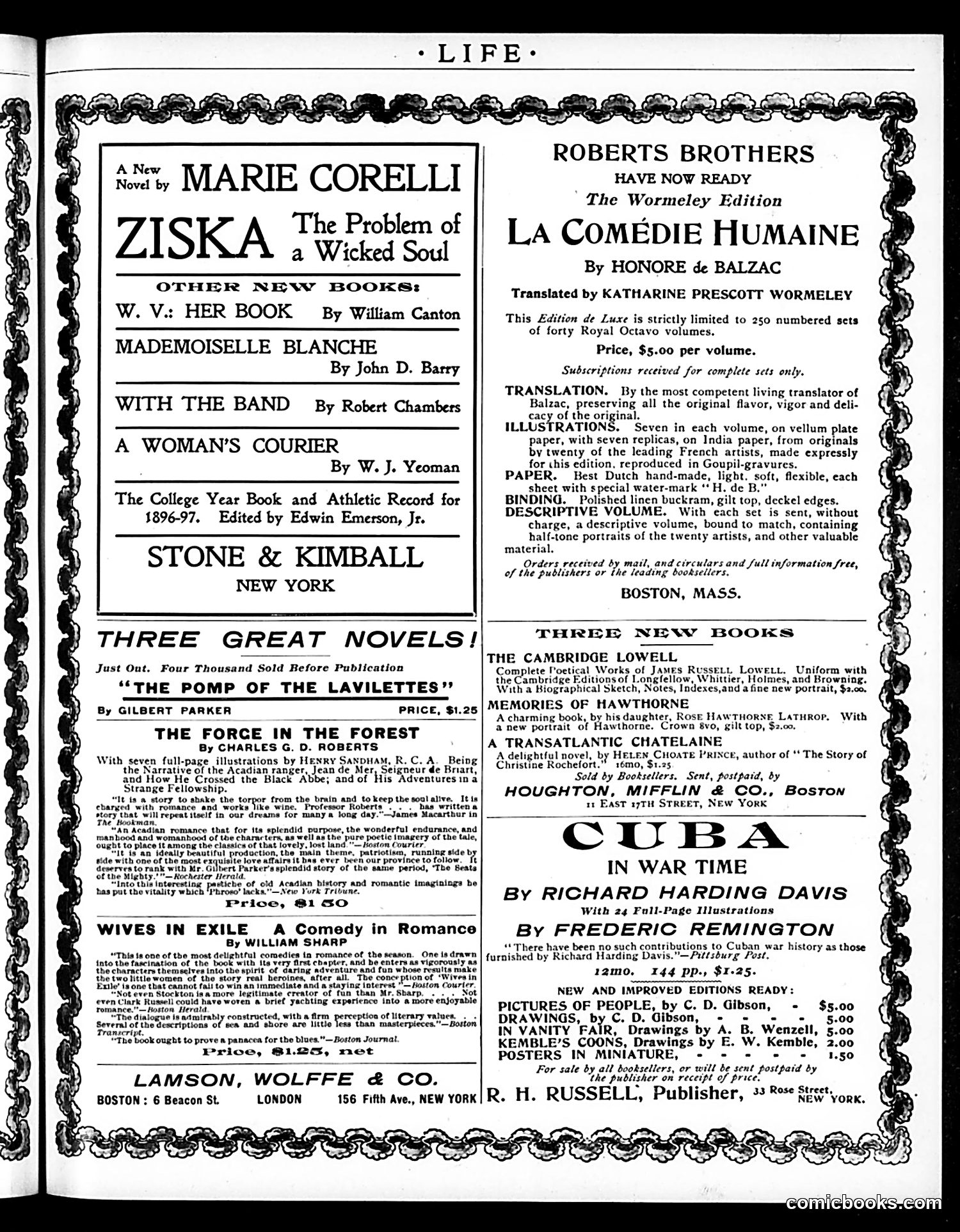
This page from *Life* magazine contains **no political cartoons or satirical content**—it is primarily a **book advertisements section** from the 1890s. The left column advertises new novels by popular authors of the period (Marie Corelli, William Canton, John D. Barry), while the right features Roberts Brothers' luxury edition of Honoré de Balzac's *La Comédie Humaine* translated by Katharine Prescott Wormeley—a limited, expensive collector's edition (250 sets) featuring illustrations by twenty French artists on hand-made Dutch paper. Below appear advertisements for three bestselling novels: Gilbert Parker's *The Pomp of the Lavilettes*, Charles G. D. Roberts's *The Force in the Forest*, and William Sharp's *Wives in Exile*. The decorative border and layout are typical of *Life*'s commercial pages, but there is **no satirical cartoon or political commentary** visible here—this is straightforward turn-of-the-century publishing promotion.
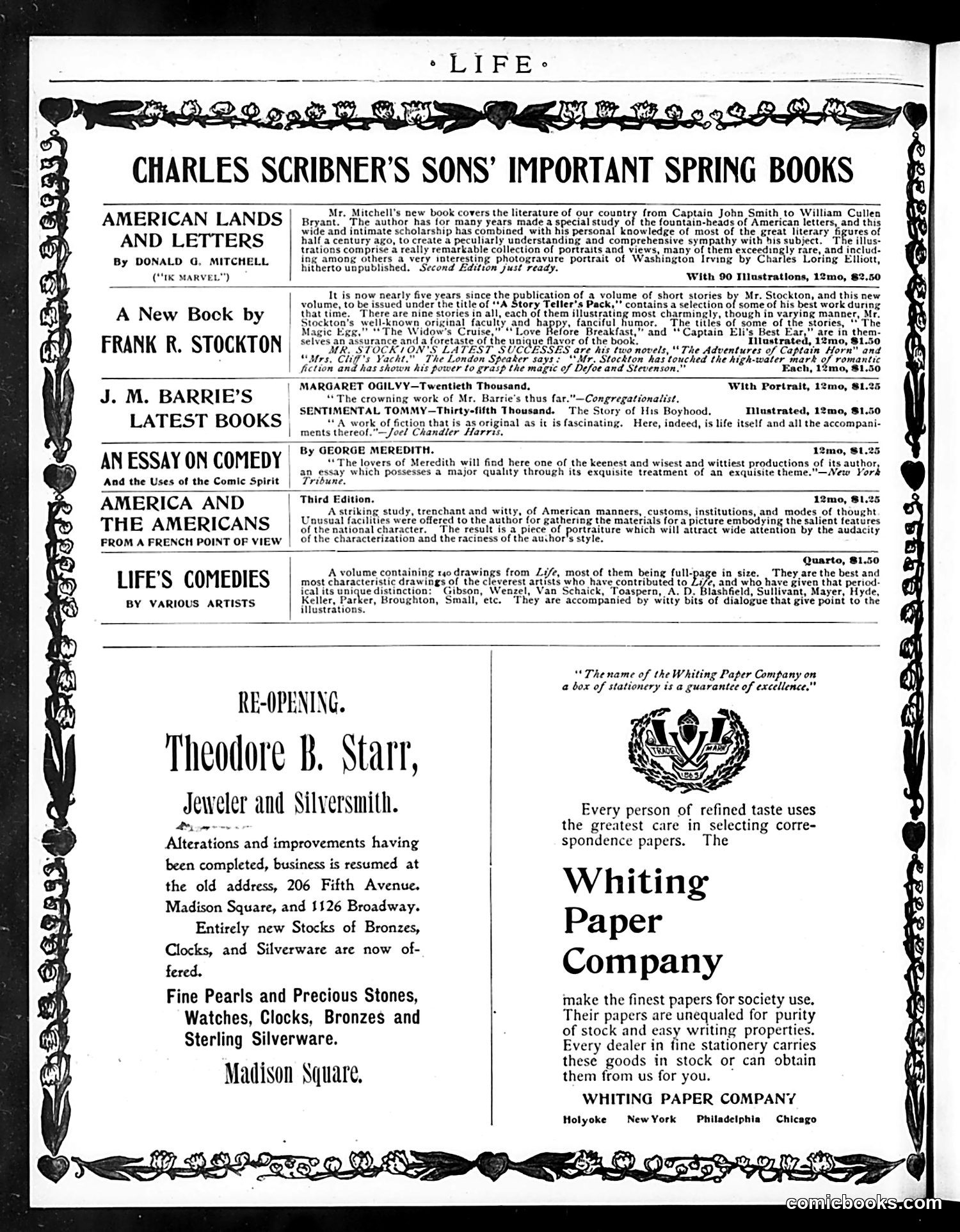
This is primarily a **book advertisement page**, not a political cartoon. It showcases Charles Scribner's Sons' spring book releases circa the 1890s-1900s. The page advertises literary works by prominent authors: Donald G. Mitchell's American literary history, Frank R. Stockton's short story collection "A Story Teller's Pack," J.M. Barrie's "Margaret Ogilvy" and "Sentimental Tommy," George Meredith's essay on comedy, and a French critique of American manners. The lower half includes two separate advertisements: one for jeweler Theodore B. Starr's reopening in Madison Square, and another for the Whiting Paper Company promoting fine stationery for "society use." **There are no political cartoons or caricatures on this page.** The decorative border and ornamental elements are purely aesthetic. The content reflects genteel late-19th-century American publishing and consumer goods marketing.