
Life, 1897-04-08 · page 4 of 26
Life — April 8, 1897 — page 4: what you’re looking at
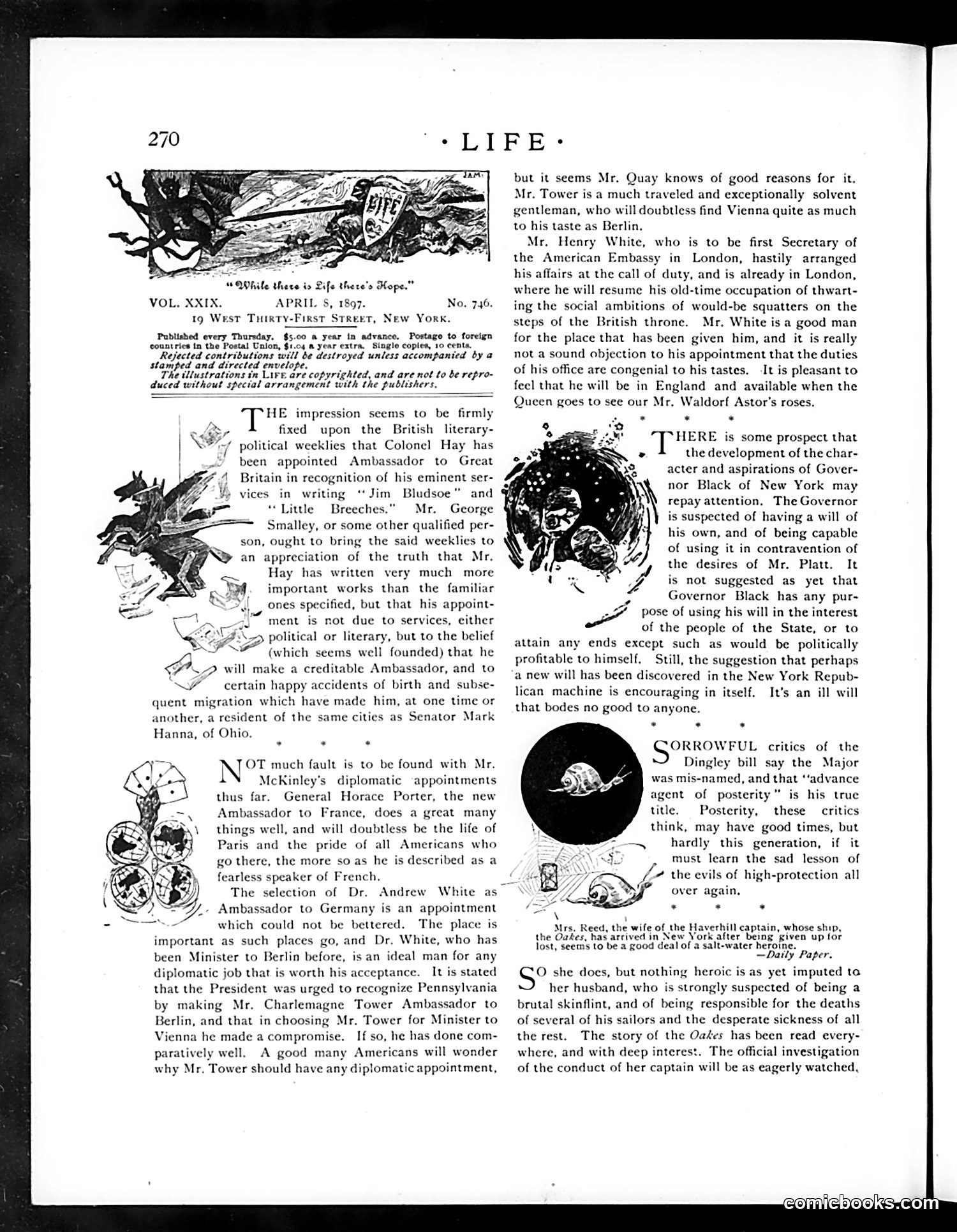
What you’re looking at
This page contains diplomatic gossip rather than formal political cartoons. The text discusses several ambassadorial appointments: - **Colonel Hay** appointed ambassador to Great Britain, praised for his literary works - **General Horace Porter** appointed to France, noted as a skilled diplomat - **Dr. Andrew White** appointed to Germany, described as an ideal choice - **Mr. Charlemagne Tower** appointed to Berlin (a compromise after Pennsylvania was denied a different ambassadorship) - **Mr. Henry White** as First Secretary to the American Embassy in London - **Governor Black of New York**, suspected of having political ambitions involving his will The decorative illustrations (snakes, coins, sleeping figures) appear to be generic satirical flourishes typical of Life magazine's style, rather than caricatures of specific individuals. The page mocks diplomatic maneuvering and political patronage more than particular personalities.
📄 Transcribed text from this page (OCR, searchable)
Machine-transcribed from the original scan — historical spelling and the odd misread are preserved.
“While there is Life there's Hope.” VOL. XXIX. APRIL §, 1897. No. 746. 19 West Tuirty-First Street, New York, Published every Thursday, $5.00 a year in advance, Postage to foreign countrics in the Postal Union, $1.04 a year extra. Single copies, 10 cents, Rejected contributions will be destroyed unless accompanied by a stamped and directed envelope. The illustrations in Lire are copyrighted, and are not to be repro- duced without special arrangement with the publishers. HE impression seems to be firmly fixed upon the British literary- ‘of political weeklies that Colonel Hay has been appointed Ambassador to Great Britain in recognition of his eminent ser- vices in writing ‘‘Jim Bludsoe” and “Little Breeches.” Mr. George Smalley, or some other qualified per- son, ought to bring the said weeklies to an appreciation of the truth that Mr. Hay has written very much more important works than the familiar ones specified, but that his appoint- ment is not due to services, cither political or literary, but to the belief - (which seems well founded) that he Crs will make a creditable Ambassador, and to “SY certain happy accidents of birth and subse- quent migration which have made him, at one time or as Senator Mark another, a resident of the same citie Hanna, of Ohio, N” much fault is to be found with Mr. McKinley's diplomatic appointments thus far. General Horace Porter, the new Ambassador to France, does a great many things well, and will doubtless be the life of Paris and the pride of all Americans who go there, the more so as he is described as a fearless speaker of French, The selection of Dr. Andrew Ambassador to Germany is an appointment which could not be bettered. The place is important as such places go, and Dr, White, who has been Minister to Berlin before, is an ideal man for any diplomatic job that is worth his acceptance. It is stated that the President was urged to recognize Pennsylvania by making Mr. Charlemagne Tower Ambassador to Berlin, and that in choosing Mr. Tower for Minister to Vienna he made a compromise. If so, he has done com- paratively well. A good many Americans will wonder why Mr. Tower should have any diplomatic appointment, White as— but it seems Mr. Quay knows of good reasons for it. Mr. Tower is a much traveled and exceptionally solvent gentleman, who will doubtless find Vienna quite as much to his taste as Berlin, Mr. Henry White, who is to be first Secretary of the American Emba: in London, hastily arranged his affairs at the call of duty, and is already in London, where he will resume his old-time occupation of thwart- ing the social ambitions of would-be squatters on the steps of the British throne. Mr. White is a good man for the place that has been given him, and it is really not a sound objection to his appointment that the duties of his office are congenial to his tastes. -It is pleasant to feel that he will be in England and available when the Queen goes to see our Mr. Waldorf Astor’s roses. . « “HERE is some prospect that Po the development of the char- acter and aspirations of Gover- nor Black of New York may repay attention. The Governor is suspected of having a will of is own, and of being capable of using it in contravention of the desires of Mr. Platt. It is not suggested as yet that Governor Black has any pur-~ —_ pose of using his will in the interest of the people of the State, or to attain any ends except such as would be politically profitable to himself. Still, the suggestion that perhaps a new will has been discovered in the New York Repub- lican machine is encouraging in itself. It’s an ill will that bodes no good to anyone. SORROWFUL critics of the Dingley bill say the Major was mis-named, and that “advance agent of posterity” is his true title. Posterity, these critics think, may have good times, but hardly this generation, if it must learn the sad lesson of £7 the evils of high-protection all over again, . . . Mrs. Reed, the wife of the Haverhill captain, whose ship, the Oakes, has arrived in New York after being ‘given up for lost, seem’ to be a good deal of a salt-water heroine. —Daily Paper. O she does, but nothing heroic is as yet imputed to her husband, who is strongly suspected of being a brutal skinflint, and of being responsible for the deaths of several of his sailors and the desperate sickness of all the rest. The story of the Oakes has been read every- where, and with deep interest. The official investigation of the conduct of her captain will be as eagerly watched,