
Life, 1897-04-08 · page 6 of 26
Life — April 8, 1897 — page 6: what you’re looking at
What you’re looking at
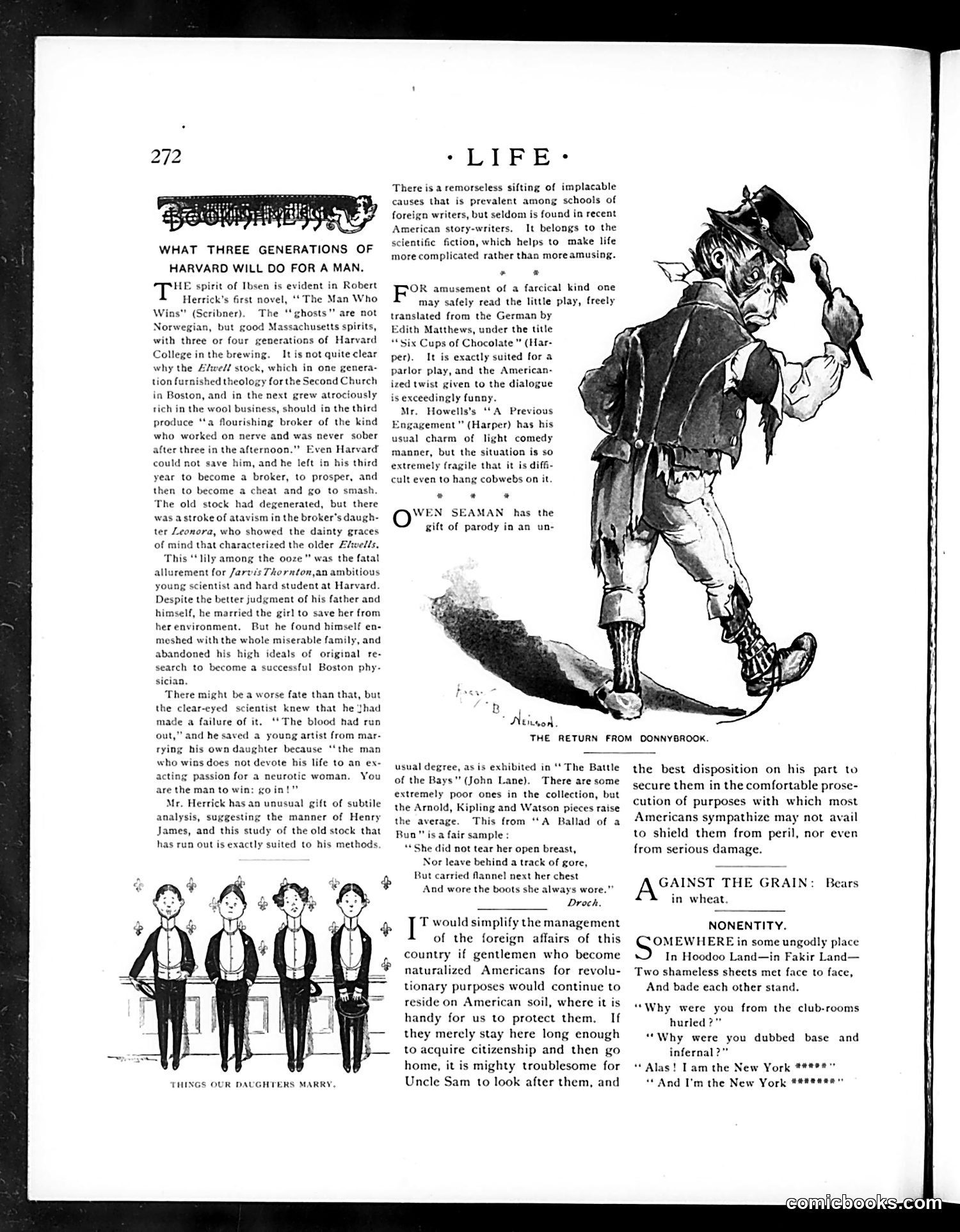
This page contains three distinct pieces: 1. **"What Three Generations of Harvards Did for a Man"** - A satirical article about Harvard's Ewell stock degenerating across generations, ultimately producing a failed scientist named Jarvis Thornton who abandoned research to become a Boston stockbroker. 2. **"Things Our Daughters Marry"** - A cartoon showing four identical men in formal dress, satirizing women's limited choices in marriage partners (all appear identical/interchangeable). 3. **"The Return from Donnybrook"** - An illustration depicting a disheveled man on horseback, apparently returning from conflict. 4. **"Against the Grain: Bears in Wheat"** and **"Nonentity"** - Brief satirical pieces about foreign affairs and New York identity. The page satirizes American institutions (Harvard), gender relations, and urban society with light humor typical of early 20th-century Life magazine.
📄 Transcribed text from this page (OCR, searchable)
Machine-transcribed from the original scan — historical spelling and the odd misread are preserved.
WHAT THREE GENERATIONS OF HARVARD WILL DO FOR A MAN. HE spirit of Ibsen is evident in Robert Herrick’s first novel, ‘The Man Who Wins" (Scribner), The “ghosts” are not Norwegian, but good Massachusetts spirits, with three or four generations of Harvard College in the brewing. It is not quite clear why the £fwe/! stock, which in one genera- tion furnished theology for the Second Church in Boston, and in the next grew atrociously tich in the wool business, should in the third produce ‘‘a flourishing broker of the kind who worked on nerve and was never sober after three in the afternoon.” Even Harvard could not save him, and he left in his third year to become a broker, to prosper, and then to become a cheat and go to smash. The old stock had degenerated, but there was a stroke of atavism in the broker's daugh- ter Leonora, who showed the dainty graces of mind that characterized the older Efvvells. This ‘lily among the ooze" was the fatal allurement for Jarvis Thornton,an ambitious young scientist and hard student at Harvard. Despite the better judgment of his father and himself, he married the girl to save her from herenvironment, But he found himself en- meshed with the whole miserable family, and abandoned his high ideals of original re- search to become a successful Boston phy- sician. There might be a worse fate than that, but the clear- d scientist knew that he Jhad made a failure of it. The blood had run out,” and he saved a young artist from mar- rying his own daughter because “the man who wins does not devote bis life to an ex- acting passion for a neurotic woman. You are the man to win: go in!” Mr. Herrick has an unusual gift of subtile analysis, suggesting the manner of Henry James, and this study of the old stock that has run out is exactly suited to his methods. THINGS OUR DAUGHTERS MARRY, * LIFE: There is a remorseless sifting of implacable causes that is prevalent among schools of foreign writers, but seldom is found in recent American story-writers. It belongs to the scientific fiction, which helps to make life more complicated rather than more amusing. ‘OR amusement of a farcical kind one may safely read the little play, freely translated from the German by Edith Matthews, under the title “Six Cups of Chocolate" (Har- per), It is exactly suited for a parlor play, and the American- ized twist given to the dialogue is exceedingly funny. Mr. Howells’s A Previous Engagement" (Harper) has his usual charm of light comedy manner, but the situation is so extremely fragile that it is diffi- cult even to hang cobwebs on it. . * * WE N has the gift of parody in an un- von. THE RETURN FROM DONNYBROOK. usual degree, as is exhibited in The Battle of the Bays" (John Lane). There are some extremely poor ones in the collection, but the Arnold, Kipling and Watson pieces raise the average. This from ‘A Ballad of a Bun" isa fair sample : “She did not tear her open breast, Nor leave behind a track of gore, But carried flannel next her chest And wore the boots she always wor Droch. T would simplify the of the foreign affairs of this country if gentlemen who become nagement naturalized Americans for revolu- tionary purposes would continue to reside on American soil, where it is handy for us to protect them, If they mercly stay here long enough to acquire citizenship and then go home, it is mighty troublesome for Uncle Sam to look after them, and the best disposition on his part to secure them in the comfortable prose- cution of purposes with which most Americans sympathize may not avail to shield them from peril, nor even from serious damage. GAINST THE GRAIN: Bears in wheat, NONENTITY. OMEWHERE in some ungodly place In Hoodoo Land—in Fakir Land— Two shameless sheets met face to face, And bade each other stand. “Why were you from the club-rooms hurled?” “Why were you dubbed base and infernal?” “Alas! Tam the New York *** “And I'm the New York *##*