
Life, 1897-04-08 · page 12 of 26
Life — April 8, 1897 — page 12: what you’re looking at
What you’re looking at
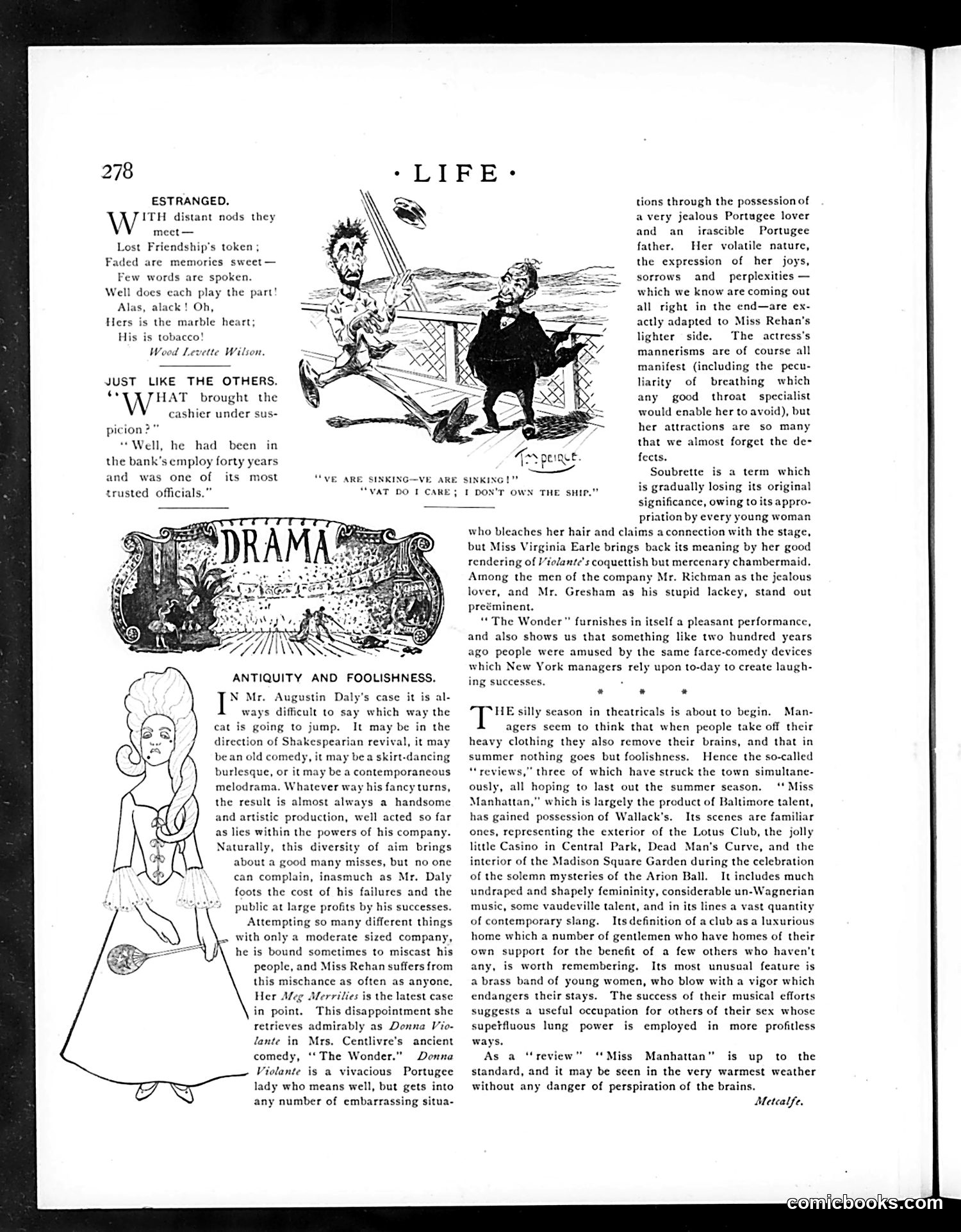
This page contains theatrical reviews and criticism. The main illustration shows two men on a ship—one appears distressed while the other remains calm, captioned "I'VE ARE SINKING—WE ARE SINKING!" / "WHY DO I CARE; I DON'T OWN THE SHIP." The "Drama" section reviews contemporary theatrical productions, including discussion of "The Wonder" and "Miss Manhattan." The text critiques various theatrical trends and performers of the era, particularly commenting on actresses' mannerisms and the prevalence of similar comedic devices in New York theater. The left sidebar contains a caricature labeled "Antiquity and Foolishness," depicting what appears to be a performer in exaggerated costume, likely satirizing overly theatrical or antiquated acting styles then in vogue. The overall tone mocks both theatrical excess and the formulaic nature of contemporary stage productions.
📄 Transcribed text from this page (OCR, searchable)
Machine-transcribed from the original scan — historical spelling and the odd misread are preserved.
278 ESTRANGED. ITH distant nods they Wi ncct Lost Friendship’s token ; Faded are memories sweet — Few words are spoken. Well does each play the part! Alas, alack ! Oh, Hers is the marble heart; His is tobacco! Wood Levette Wilson. JUST LIKE THE OTHERS. “were brought the cashier under sus- picion?” “Well, he had been the bank's employ forty years and was one of its trusted officials.” in most ‘AT DO I CARE; ANTIQUITY AND FOOLISHNESS. i Mr. Augustin Daly’s case it is al- ways difficult to say which way the cat is going to jump. It may be in the direction of Shakespearian revival, it may bean old comedy, it may bea skirt-dancing burlesque, or it may be a contemporaneous melodrama. Whatever way his fancy turns, the result is almost always a handsome and artistic production, well acted so far as lies within the powers of his company. Naturally, this diversity of aim brings about a good many misses, but no one can complain, inasmuch as Mr. Daly foots the cost of his failures and the public at large profits by his successes. Attempting so many different things = With only a moderate sized company, he is bound sometimes to miscast his people, and Miss Rehan suffers from this mischance as often as anyone. Her Meg Merrilies is the latest case in point. This disappointment she retrieves admirably as Donna Vio- Jante in Mrs. Centlivre's ancient comedy, ‘‘The Wonder.” Donna Violante is a vivacious Portugee lady who means well, but gets into any number of embarrassing situa- “VE ARE SINKING—VE ARE SINKING I" tions through the possession of avery jealous Portugee lover and an irascible Portugee father. Her volatile nature, the expression of her joys, and perplexities — which we know are coming out all right in the end—are ex- actly adapted to Miss Rehan’s lighter side. The actress's mannerisms are of course all manifest (including the pecu- liarity of breathing which any good throat specialist would enable her to avoid), but her attractions are so many that we almost forget the de> fects. Soubrette is a term which is gradually losing its original significance, owing to its appro- priation by every young woman who bleaches her hair and claims aconnection with the stage, but Miss Virginia Earle brings back its meaning by her good rendering of Violante’s coquettish but mercenary chambermaid. Among the men of the company Mr. Richman as the jealous lover, and Mr. Gresham as his stupid lackey, stand out pretminent. sorrows 1 DON’T OWN THE sutP.” ““The Wonder” furnishes in itself a pleasant performance, and also shows us that something like two hundred years ago people were amused by the same farce-comedy devices which New York managers rely upon to-day to create laugh- ing successes . * * * HE silly season in theatricals is about to begin. Man- agers seem to think that when people take off their heavy clothing they also remove their brains, and that in summer nothing goes but foolishness. Hence the so-called “reviews,” three of which have struck the town simultane- ously, all hoping to last out the summer season. ‘* Miss Manhattan,” which is largely the product of Baltimore talent, has gained possession of Wallack's. Its scenes are familiar ones, representing the exterior of the Lotus Club, the jolly little Casino in Central Park, Dead Man's Curve, and the interior of the Madison Square Garden during the celebration of the solemn mysteries of the Arion Ball. It includes much undraped and shapely femininity, considerable un-Wagnerian music, some vaudeville talent, and in its lines a vast quantity of contemporary slang. Its definition of a club asa luxurious home which a number of gentlemen who have homes of their own support for the benefit of a few others who haven't any, is worth remembering. Its most unusual feature is a brass band of young women, who blow with a vigor which endangers their stays. The success of their musical efforts suggests a useful occupation for others of their sex whose superfluous lung power is employed in more profitless ways. As a ‘‘review" ‘Miss Manhattan” is up to the standard, and it may be seen in the very warmest weather without any danger of perspiration of the brains. Metcalfe,