
Life, 1897-04-08 · page 23 of 26
Life — April 8, 1897 — page 23: what you’re looking at
What you’re looking at
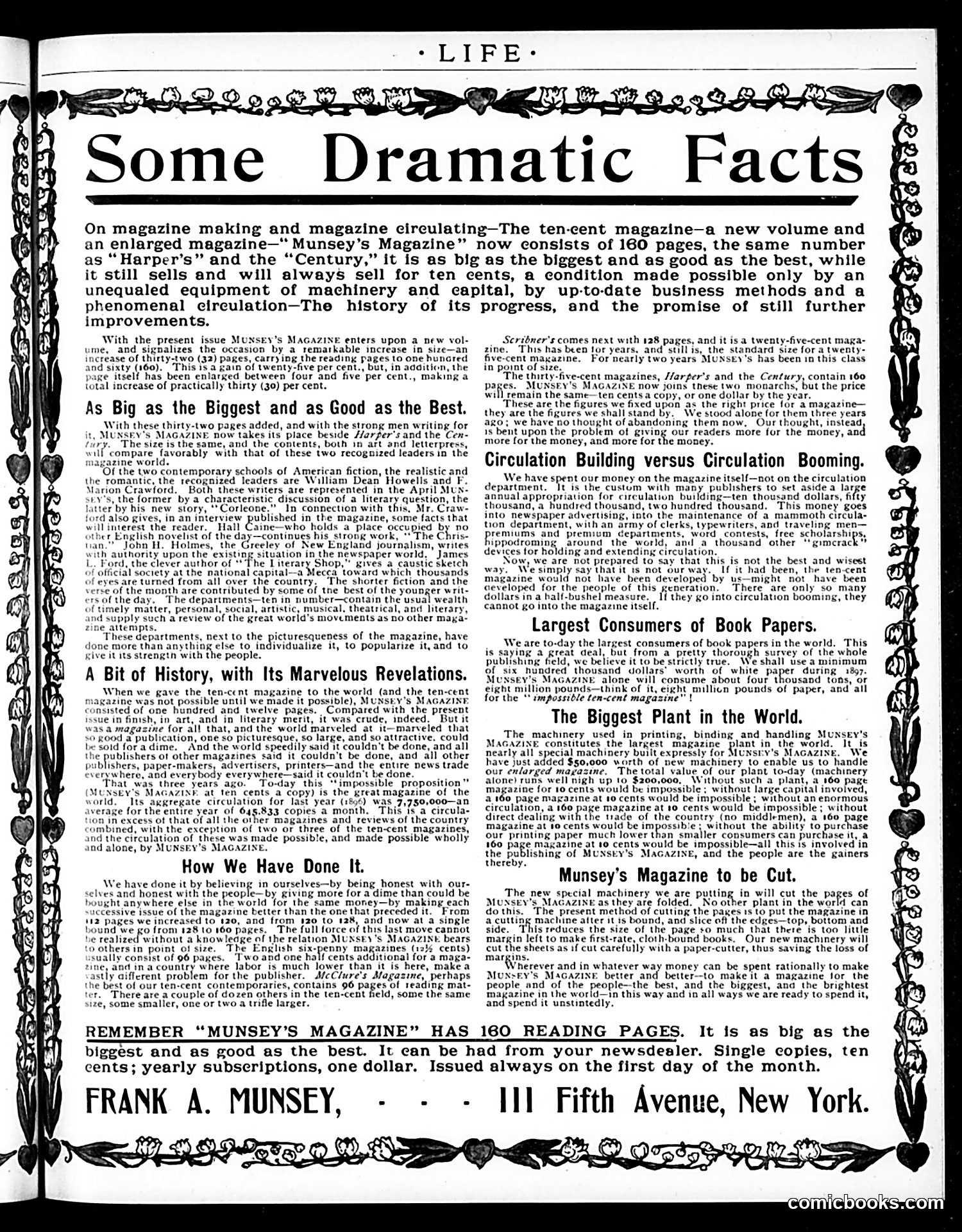
This is primarily **advertising copy**, not satirical content. It's a promotional piece by Frank Munsey advertising his magazine's expansion. **The Context:** In the 1890s, Munsey pioneered the affordable "ten-cent magazine"—a revolutionary business model. Previously, magazines cost 25-35 cents, making them luxuries. Munsey's low price point, enabled by large-scale printing and advertising revenue, democratized magazine access. **The Claims:** The text boasts that *Munsey's Magazine* now matches competitors like *Harper's* and *Century* in page count (160 pages) while remaining a dime—positioning itself as superior value. It emphasizes modern machinery, circulation scale, and quality writers (William Dean Howells, F. Marion Crawford). **The Pitch:** Rather than satire, this is straightforward boasting about business innovation and editorial ambition—typical turn-of-century magazine advertising that emphasizes both accessibility and prestige to attract readers and advertisers.
📄 Transcribed text from this page (OCR, searchable)
Machine-transcribed from the original scan — historical spelling and the odd misread are preserved.
On magazine making and magazine circulating—The ten-cent magazine—a new volume and an enlarged magazine— Munsey’s Magazine” now consists of 160 pages, the same number as “Harper’s” and the “Century,” it is as big as the biggest and as good as the best, while it still sells and will always sell for ten cents, a condition made possible only by an unequaled equipment of machinery and capital, by up-to-date business methods and a phenomenal ecireulation—The history of its progress, and the promise of still further improvements. With the present issue MUNSEY's MAGAZINE enters upon a new vol- ume, and signalizes the occasion by a remarkable increase in size—an increase of thirty-two (32) pages, carry ing the reading pages to one hunared and sixty (160). ‘This is. a gain of twenty-five per cent., but, in addition, the page itself has been enlarged between four and five per total increase of practically thirty (30) per cent. As Big as the Biggest and as Good as the Best. With these thirty-two pages added, and with the strong men writing for it, Mu 'S MAGAZINE now takes its’ place beside Harper's and the Cen- hiry. ‘The size is the same, and the contents, both in art and letterpress, cll compare favorably with that of these two recognized leaders in the gazine world. " ‘Of the two contemporary schools of American fiction, the realistic and the romantic, the recognized leaders are William Dean’ Howells and F, Marion Crawford, "Both these writers ate represented in the April MU st y's, the former ‘by a characteristic, discussion of a literary question, the latter by his new story, Corleone,” In connection with this, Mr. Craw- ford also gives, in an interview published in, the magazine, some facts that lerest the reader.” Tall Caine who holds place ‘occupied by no Sther English novelist of the day—continues his, strong work, "The Chris- tan.” Jobn H. Holmes, the Greeley of New England journalism, writes with authority upon the existing situation in the newspaper world, ' James i. Ford, the clever author of “fhe 1 iterary Shop," gives a caustic sketch of official society at the national capital—a Mecea toward which thousands of eyes are turned from ail over the country. The shorter fiction and the Verve of the month are contributed by some of the best of the younger writ- ersofthe day. The departments—ten in number—contain the usual wealth of timely matter, personal, social, artistic, musical, theatrical, and literary, ind supply such a review of the great world’s movements as no other mag zine aitempts, | These departments, next to the picturesqueness of the magazine, have done more than anything else to individualize it, to popularize it,and to give it its strengtn with the people. A Bit of History, with Its Marvelous Revelations. When we gave the ten-cent magazine to the world (and the ten-cent magazine was not possible until we made it possible), MUNSEY'S MAGAZINE onsisted of one hundred and twelve pages. Compared with the present ssue in fimsh, in art, and in literary merit, it was crude, indeed, But it was a magazine for all that, and the world marveled at it—marveled that good a publication, one so picturesque, so large, and so attractive. could be sold foradime. And the world speedily said it couldn't be done, and all ¢ publishers of other magazines said it couldn't be done, and all other publishers, paper-makers, advertisers, printers—and the entire news trade everywhere, and everybody everywhere—said it couldn't be done. That was three years ago. To-day this “impossible proposition” MUNSEY’S MaGaziNr at ten cents a copy) is the great magazine of the Its aggregate circulation for last year (186) was 7,7§0,000—an e for the entire year of 645.833 copies a month. This'is a circula- in excess of that of all the other magazines and reviews of the country combined, with the exception of two or three of the ten-cent magazines, and the citculation of these was made possible, and made possible wholly and alone, by MUNSEY’S MAGAZINE. How We Have Done It. We have done it by believing in ourselves—by being honest with our- selves and honest with the people by giving more for a dime than could be bought anywhere else in the world for the same money—by making each successive issue of the magazine better than the one that preceded it. From 112 pages we increased to #20, and from 120 to 128, and now at a single bound we go from 128 to 160 pages. The full force of this last move cannot be realized without a knowleage of the relation MUNSEY’S MaGaziNe bears to others in point of size, The English six-penny magazines (124 cents) sually consist of 96 pages. Two and one half cents additional for a maga- rine, and ina country where labor is much lower than it is here, make a astly aifferent problem forthe publisher. McClure's Magazine,’ perhaps the best of our ten-cent contemporaries, contains 96 pages of reading mat- ter. There are a couple of dozen others in the ten-cent field, some the same size, some smaller, one or two a trifle larger. ““MUNSEY’S MAGAZINE” ent., makit will REMEMBER HAS _ 160 READING PAGES. Scribner's comes next with 128 pages, and it is a twenty-five-cent maga- zine, This has been tor years, and still is, the standard size for a twenty- five-cent magazine. For nearly two years MUNSEY’S has been in this class in point of size. The thurty-five-cent magazines, Harper's and the Century, contain 160 pages. MUNSEY'S MAGAZINE now joins these two monarchs, but the price will remain the same—ten cents a copy, or one dollar by the year. These are the figures we fixed upon as the right price for a magazine— they are the figures we shall stand by, We stood alone for them three years ago; we have no thought of abandoning them now, Our thought, instead, is bent upon the problem of giving our readers more for the money, an more for the money, and more for the money. Circulation Building versus Circulation Booming. We have spent our money on the magazine itsel{—not on the circulation department. Vt is the custom with many publishers to set aside a lange annual appropriation for circulation building—ten thousand dollars, fifty thousand, a hundred thousand, two hundred thousand. This money’ goes into newspaper advertising, into the maintenance of a mammoth circula- tion department, with an army of clerks, typewriters, and traveling men— Femiums and premium departments, word contests, free scholarships hippodroming around the world, and a thousand ‘other “gimcrac devices tor holding and extending circulation. Now, we are not prepared to say that this is not the best and wisest way, We simply say that it is not our way. If it had been, the ten-cent magazine would not have been developed by us—might not have been Geveloped for the people of this generation, There are only so many dollars in a balf-bushel measure. Ii they go into circulation booming, they cannot go into the magazine itself. Largest Consumers of Book Papers. We are to-day the largest consumers of book papers in the world. This is saying a great deal, but from a pretty thorough survey of the whole publishing field, we believe it to be strictly true. We shall use a minimum of six hundred’ thousand dollars’ worth of white paper during 187. Mussey’s MaGaziNe alone will consume about four thousand tons, or eight million pounds—think of it, eight million pounds of paper, and’ all for the "impossible ten-cent magazine" | The Biggest Plant in the World. The machinery used in printing, binding and handling MuNsey's MAGAZINE constitutes the largest: magazine plant in the world. It is nearly all special machinery built expressly for MUNS MaGazinE. We have just added $50,000 worth of new machinery to enable us to handle our enlarged magazine, The total value of our plant to-day (machinery alone) runs well nigh up to $200,000, Without such a plant, a 160 page Magazine for 10 cents would be impossible ; without large capital involved, a.t60 page magazine at so cents would be impossible ; without an enormous circulation, a 160 page magazine at to cents would be impossible; without direct dealing with the trade of the country (no middlemen), a 160 page magazine at to cents would be impossible ; without the ability to purchase our printing paper much lower than smaller consumers can purchase it, a N60 page magazine at 10 cents would be impossible—all this is involved’ in the publishing of MUSsty’s MacaziNe, and the people are the gainers thereby. Munsey’s Magazine to be Cut. The new special machinery we are putting in will cut the pages of MUNSEY’s MAGAZINE as they are folded. No other plant in the world can do this. The present method of cutting the pages 1s to put the magazine in acutting machine after it is bound, and slice off the edges—top, bottom and side. This reduces the size of the page +o much that there is too little margin left to make first-rate, cloth-bound books. Our new machinery will cut the sheets as if cut carefully with a paper-cutter, thus saving the loss of margins. Vherever and in whatever way money can be spent rationally to make Monre MAGAZINE. better and better—to make it a magazine for the people and of the people--the best, and the biggest, and the brightest tmagazine in the world—in this way and in all ways we are ready to spend it, and spend it unstintedly, It is as big as the SS eee ee biggest and as good as the best. It ean be had from your newsdeasler. Single copies, ten eents; yearly subscriptions, one dollar. Issued always on the first day of the month. FRANK A. MUNSEY, : 111 Fifth Avenue, New York.