
A complete issue · 20 pages · 1897
Life — April 1, 1897
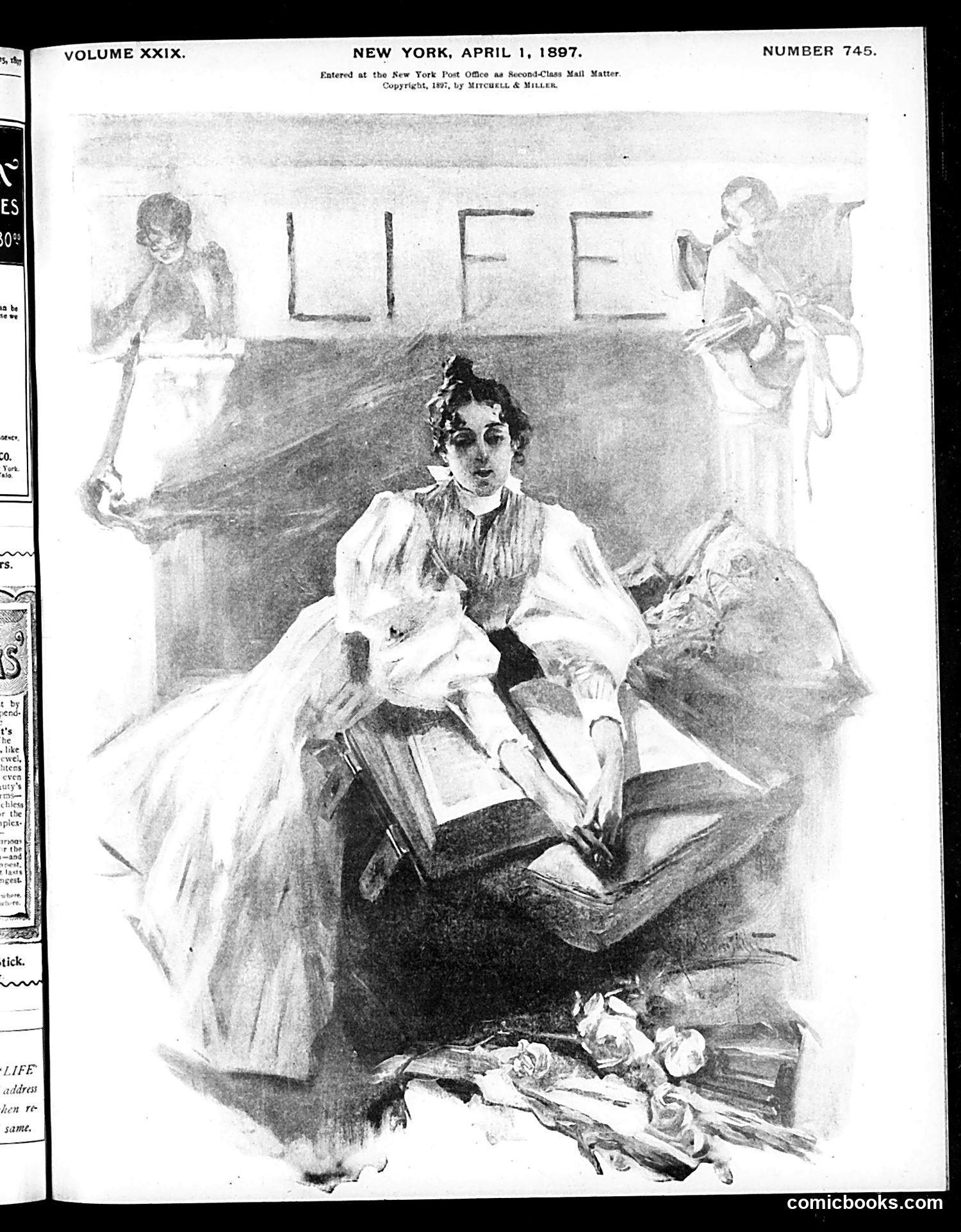
This appears to be a Life magazine cover titled "LIFE" featuring a central female figure seated among artistic materials—books, flowers, and what looks like sheet music or manuscripts. She's dressed in late 19th-century attire with a white blouse. The ethereal figures in the background (upper left and right) appear to be allegorical muses or artistic inspirations, suggesting this celebrates women's creative and intellectual pursuits. The composition emphasizes refinement, education, and artistic aspiration. Given the 1897 date during the "New Woman" era, this likely celebrates expanding opportunities for women in arts, literature, and intellectual life—a progressive theme for the period. The exact specific reference remains unclear without additional context.
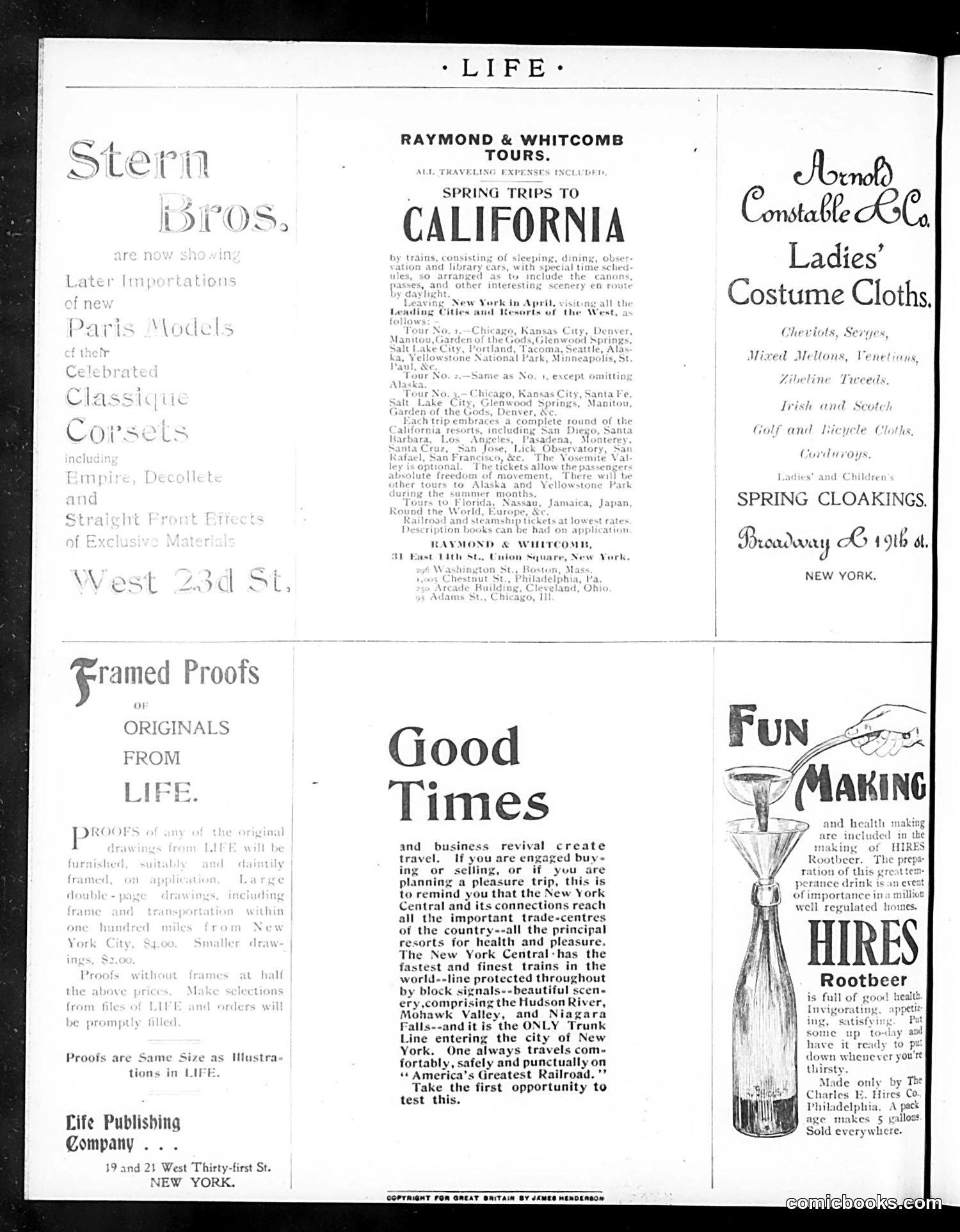
This page is **primarily advertising**, not satirical content. It contains commercial advertisements for: - **Stern Bros.**: Promoting imported Paris corset models at their West 23rd Street location - **Arnold Constable & Co.**: Ladies' costume cloths and spring cloakings on Broadway - **Raymond & Whitcomb Tours**: Spring trips to California by train - **Life Publishing Company**: Offering framed proofs of original Life magazine drawings - **Hires Rootbeer**: Advertisement emphasizing health benefits and availability The only content approaching editorial material is a "Good Times" section promoting the New York Central railroad for business travel and pleasure trips, highlighting its speed and scenic routes (Hudson River, Mohawk Valley, Niagara Falls). This appears to be a standard magazine back page of advertising from the early 1900s, with no apparent political satire or cartoon commentary.
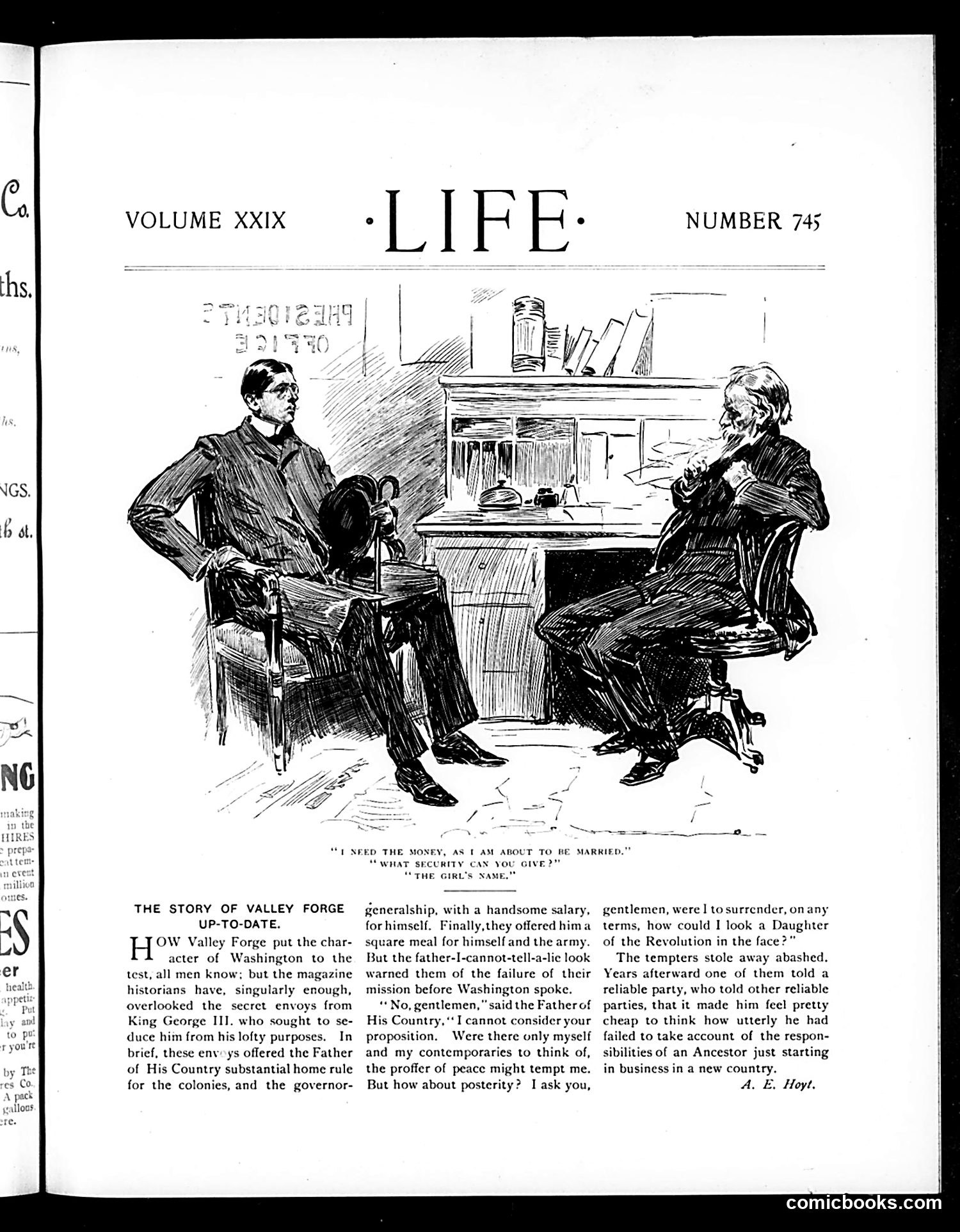
This page from *Life* magazine (Volume XXIX, Number 745) contains "The Story of Valley Forge Up-to-Date," a satirical piece about Washington and the Continental Army during the American Revolution. The illustration shows two men in an office setting. The caption reads: "I need the money, as I am about to be married. What security can you give? The girl's name." The satire appears to mock a soldier's financial desperation during Valley Forge by presenting a modern scenario where he seeks a loan, using only his fiancée's name as collateral—a darkly humorous commentary on soldiers' poverty and their limited assets. The text below discusses how Washington resisted British attempts to bribe him away from the revolutionary cause, but the cartoon juxtaposes this with contemporary financial struggles and the soldier's reduced circumstances.
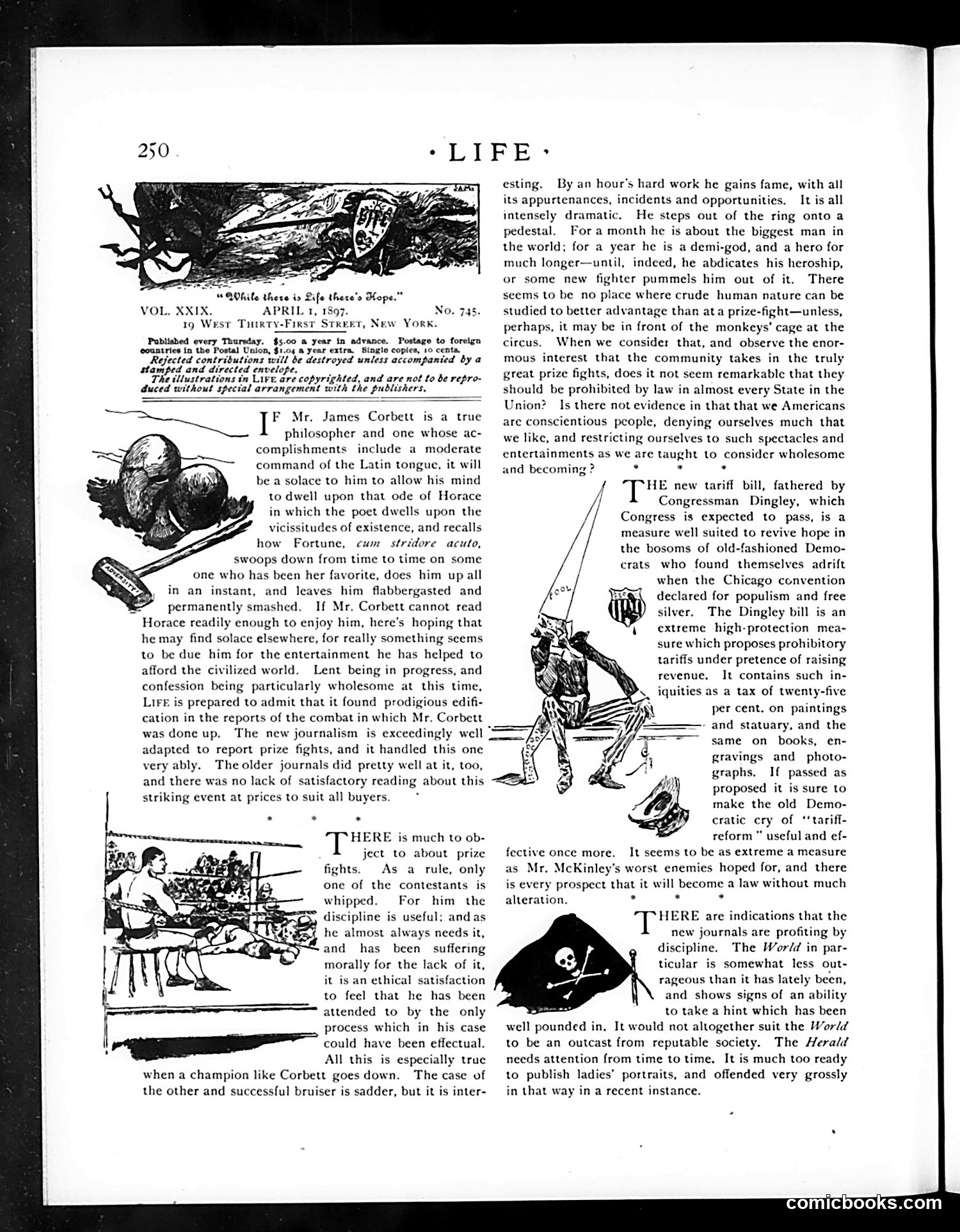
The page features two cartoons commenting on contemporary issues: **Top cartoon** ("While there is Life there's Hope"): Depicts a skeletal figure—likely representing Death or Misfortune—looming over a prone man. This appears to relate to the article's discussion of James Corbett, the boxer, suggesting the precariousness of fame and fortune in prize-fighting. **Bottom cartoon**: Shows a figure at what appears to be a printing press or writing desk, illustrating the article's critique of sensationalist journalism. The text discusses how new journals are using "discipline" (boxing coverage) to boost circulation, sometimes unethically—including publishing unflattering ladies' portraits. Both cartoons satirize the exploitative nature of late-19th-century media and prize-fighting entertainment culture.
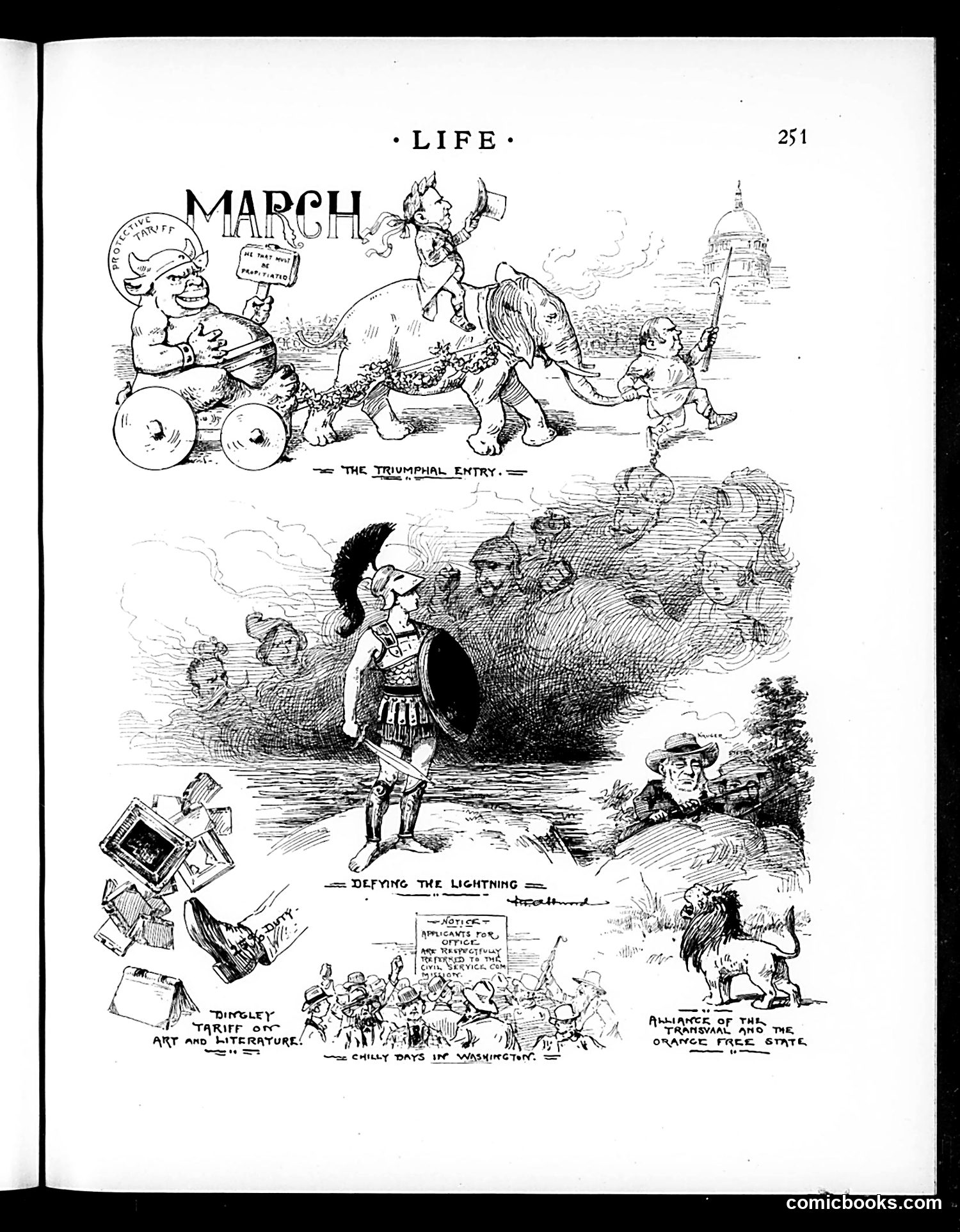
This page from *Life* magazine contains multiple satirical cartoons about American politics and society circa early 1900s. **"The Triumphal Entry"** (top) depicts a grotesque figure in a chariot pulled by an elephant—the Republican Party symbol—suggesting a political victory parade with caricatured supporters. **"Defying the Lightning"** (center) shows a classical warrior figure confronting a storm, likely representing political resistance or defiance. The lower cartoons reference contemporary issues: "Chilly Days in Washington" suggests political discord in the capital, while "Alliance of the Transvaal and the Orange Free State" references the Boer War context. **"Briskly 'Tariff on' Art and Literature"** critiques protectionist tariff policies affecting cultural imports. The satire targets Republican tariff politics and their perceived absurdities through exaggerated imagery.
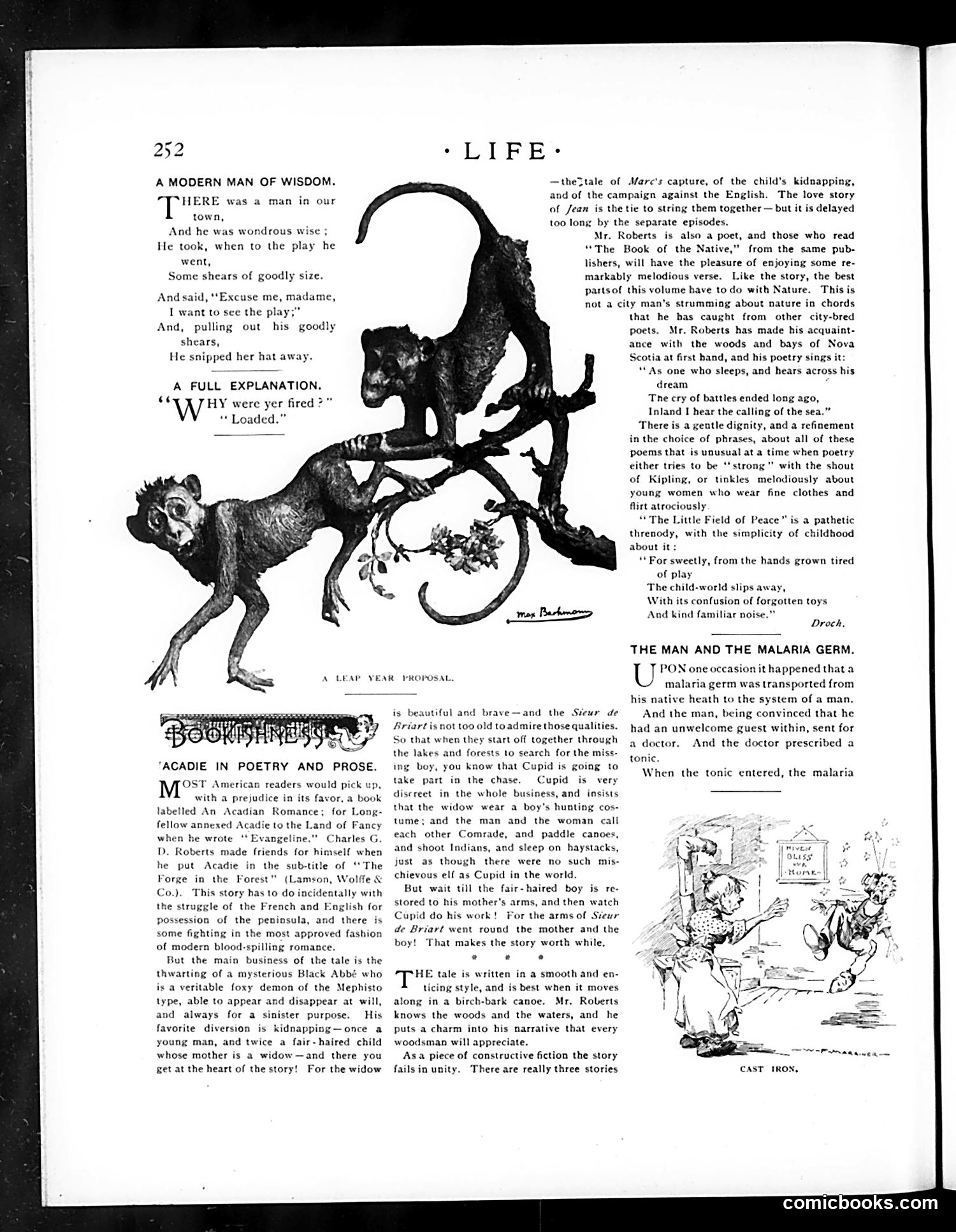
**"A Modern Man of Wisdom"** (top left): This brief poem mocks an overly cautious gentleman who attends theater but nervously requests to leave before the play begins—satirizing excessive caution or anxiety about public outings. **"A Full Explanation"** (middle): A simple joke where someone asks why a gun was fired, answered simply: "Loaded." The humor lies in the obvious, unstated answer. **"A Leap Year Proposal"** (center illustration): Features a woman (with exaggerated features typical of the era) pursuing a man who appears to be fleeing or falling backward. This references the tradition where women propose to men during leap years—satirizing role reversals and the apparent chaos this causes. The page demonstrates Life's approach: brief humorous commentary on social conventions and gender relations through simple jokes and illustration.
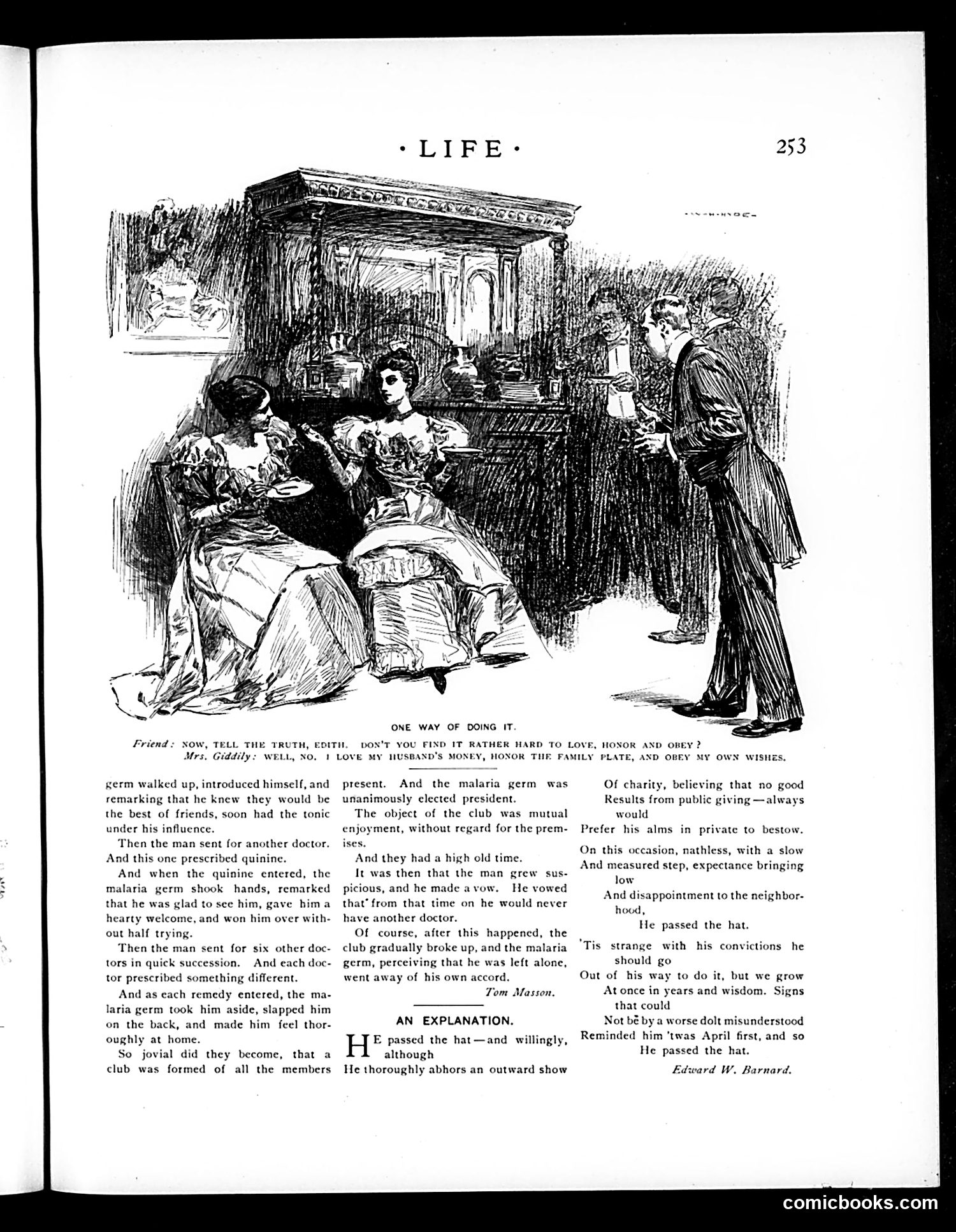
This satirical illustration depicts a social comedy about marriage and domestic priorities. Two women sit together while a man stands nearby; the dialogue reveals the satire's target. When a friend suggests that honor and love should guide a wife, Mrs. Giddily responds that she instead prioritizes her husband's money, "honor the family plate, and obey my own wishes." The cartoon mocks the mercenary attitudes of some wives toward marriage, suggesting that financial gain and material comfort—rather than affection or moral values—drive their decisions. The title "One Way of Doing It" sarcastically presents this materialistic approach as a valid marital strategy. The sketch exemplifies *Life* magazine's satirical commentary on upper-class social pretense and the gap between professed Victorian values and actual behavior.
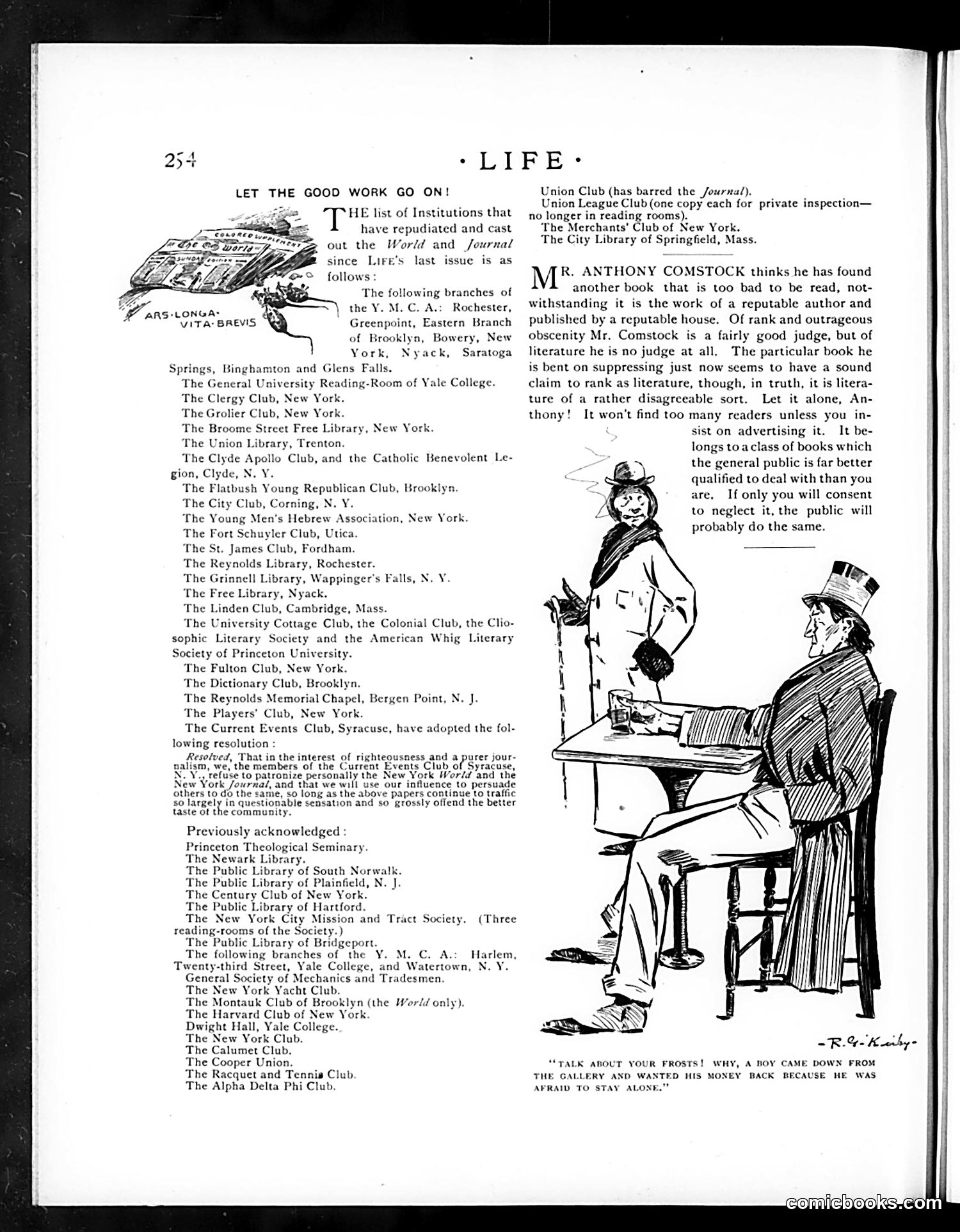
This page contains a section titled "Let the Good Work Go On" listing institutions that have banned Life magazine and the World Journal. The accompanying cartoon, credited to R. G. Kauffman, depicts two men at a desk in what appears to be a gallery or business setting. The caption reads: "Why, a boy came down from the gallery and wanted his money back because he was afraid to stay alone." The cartoon satirizes censorship and institutional prudishness. The listed organizations—churches, libraries, YMCAs, and clubs—have rejected Life's content as obscene or morally objectionable. The cartoon jokes that Life's supposedly dangerous material is so mild that even viewing it causes timidity rather than corruption, mocking these institutions' overzealous moral guardianship and the absurdity of their censorship decisions.
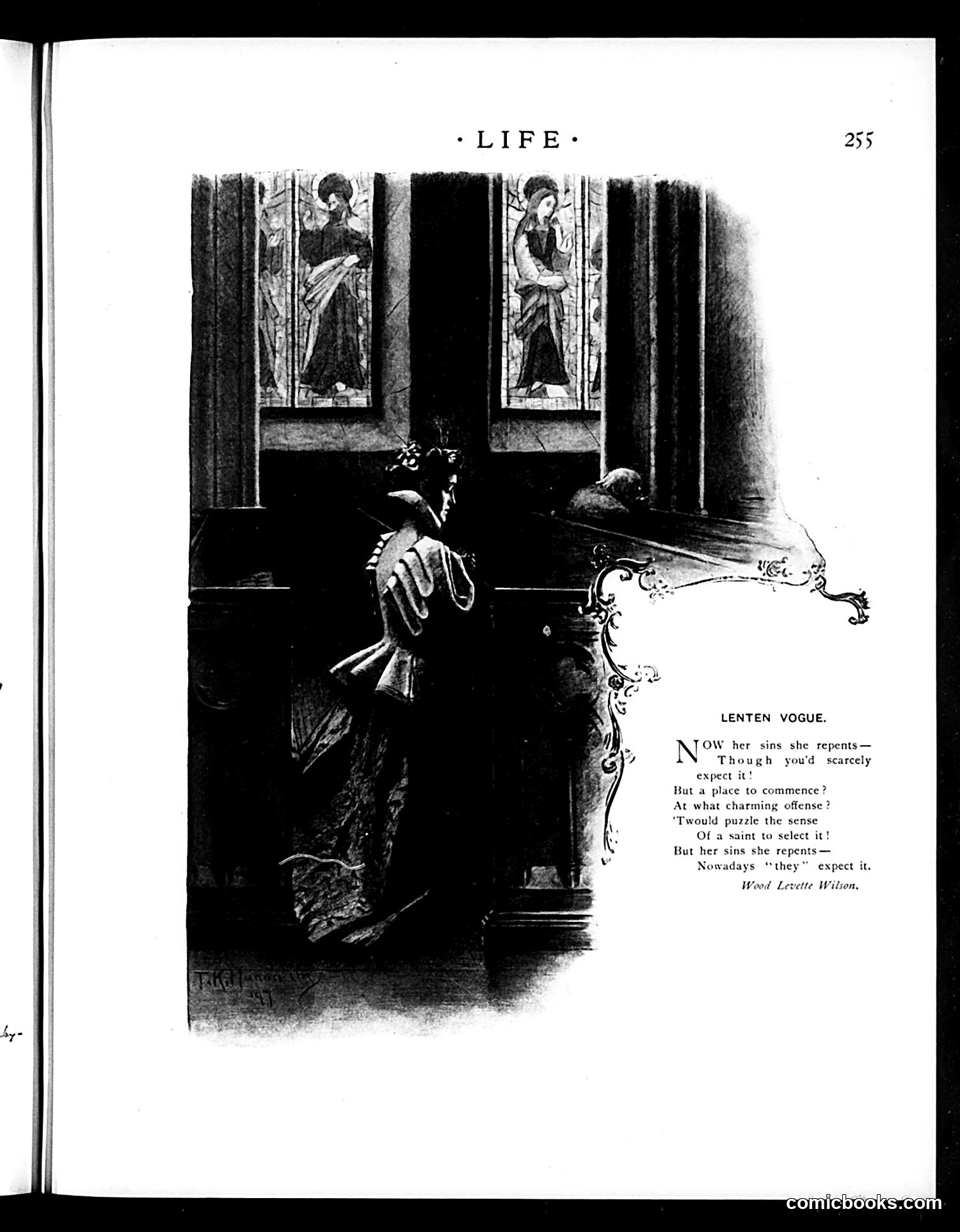
This illustration depicts a fashionable woman kneeling in prayer inside a church, positioned before religious iconography (saints visible in windows above). The accompanying verse by Wood Lewette Wilson is satirical: it mocks the superficiality of society women's religious observance during Lent. The joke targets the contradiction between genuine repentance ("her sins she repents") and the woman's likely shallow, fashionable participation in Lenten practices. The poem suggests that selecting which sins to repent would "puzzle the sense / Of a saint," implying these women's moral calculations are absurd. The satire critiques how wealthy, fashionable society women treated Lenten observance as a social performance rather than sincere spiritual practice—a common target of early 20th-century American humor about hypocrisy among the upper classes.
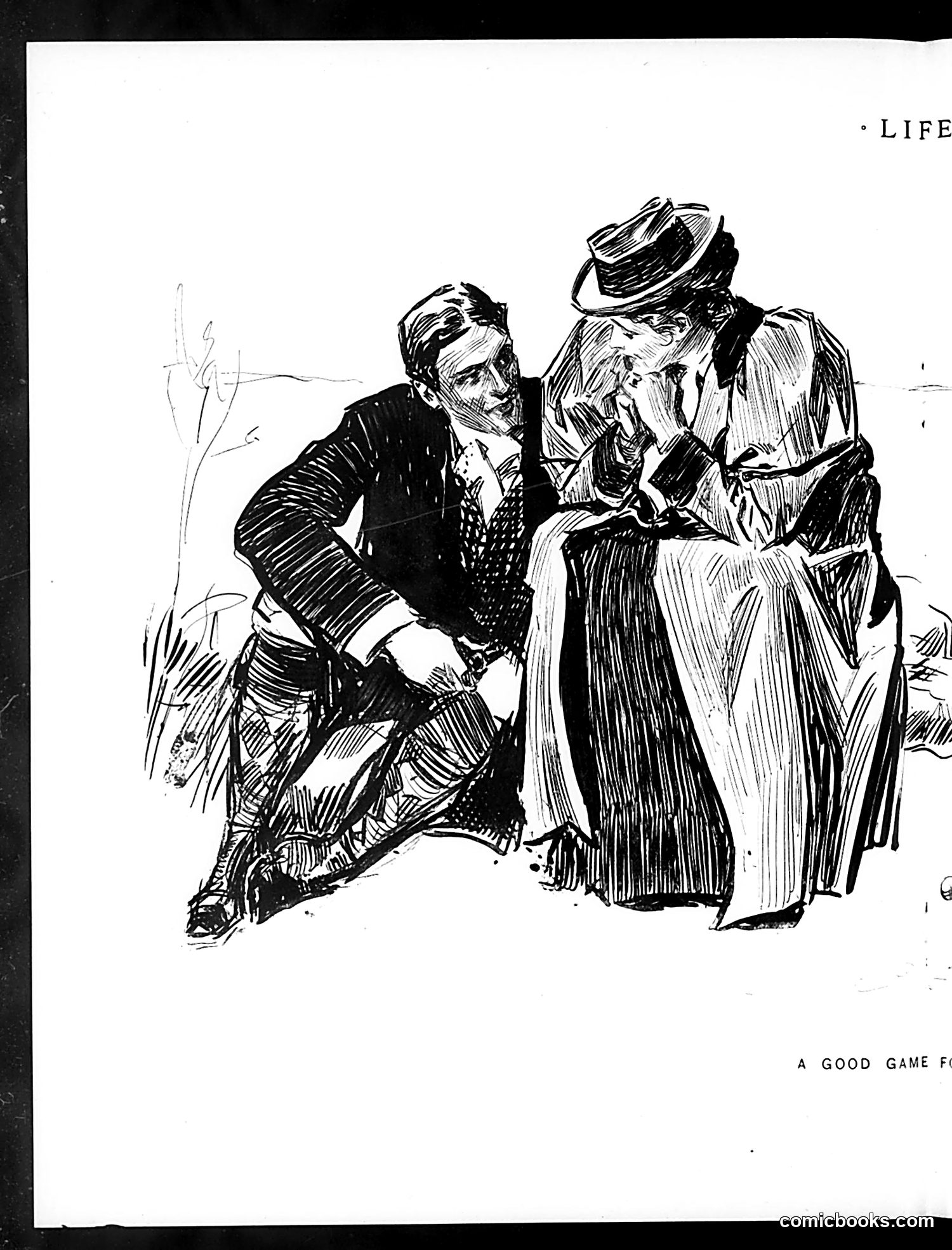
This appears to be a satirical cartoon from *Life* magazine depicting three men in formal attire engaged in what seems to be a heated discussion or confrontation. The figure on the left is crouching or bending forward, while two others stand nearby—one gesturing expressively. The caption reads "A GOOD GAME FO[R]" (text cut off), suggesting this illustrates some kind of game or competitive activity being satirized. Without the complete caption or date visible, I cannot definitively identify the specific figures or political event being referenced. The formal dress and body language suggest this mocks upper-class or political figures engaged in some form of deception or questionable behavior. The style is consistent with early-20th-century satirical illustration, but more context would be needed to explain the specific satire to modern readers.
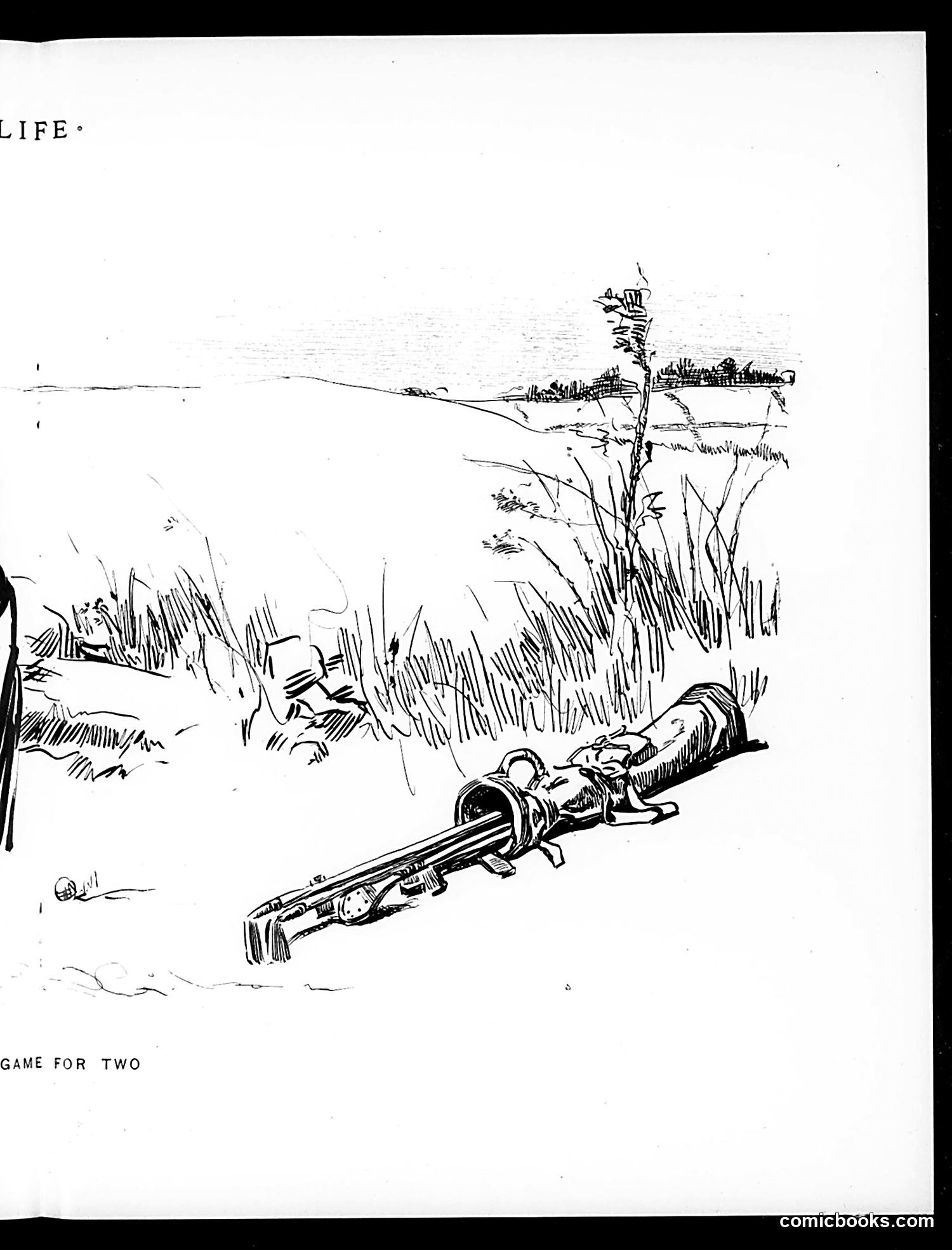
This political cartoon depicts a rifle lying in grass near water, with what appears to be two figures visible in the distance across the landscape. The title "Game for Two" is a dark pun suggesting hunting, but the composition—with the abandoned weapon positioned prominently in the foreground—implies a more sinister meaning. The cartoon likely satirizes a dangerous political or social conflict of its era, using hunting imagery metaphorically. The "game" referenced appears ironic, suggesting that whatever dispute or competition exists between two parties is deadly serious, not merely sport. Without the publication date visible, the specific political context remains unclear, but the tone is unmistakably cynical about human conflict.
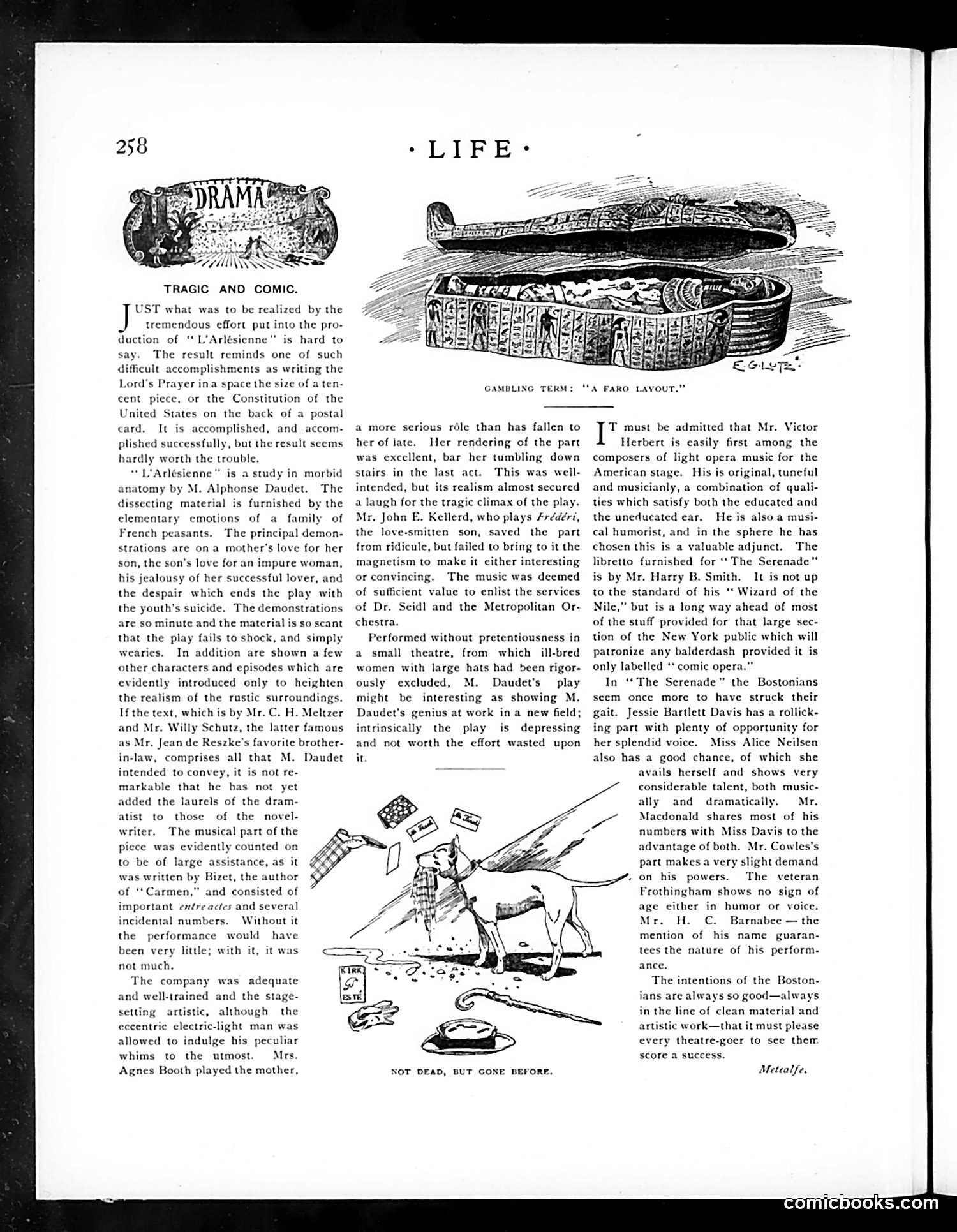
This page contains two sections: a theater review titled "Tragic and Comic" discussing the production of "L'Arlésienne," and a separate cartoon labeled "Not Dead, But Gone Before." The main cartoon depicts a dog sniffing at scattered gambling items (dice, cards, money) on the ground. The caption suggests this is satirizing gambling culture—the "dead" subject appears to be gambling itself or a gambler's fortunes, portrayed humorously through the dog's investigation of the remnants. The theater section reviews various Boston productions, critiquing their artistic merit and performances. The text discusses composers and light opera, suggesting this is cultural criticism from early 20th-century American society. The page reflects Life magazine's dual focus on theatrical satire and visual humor targeting contemporary social behaviors like gambling.
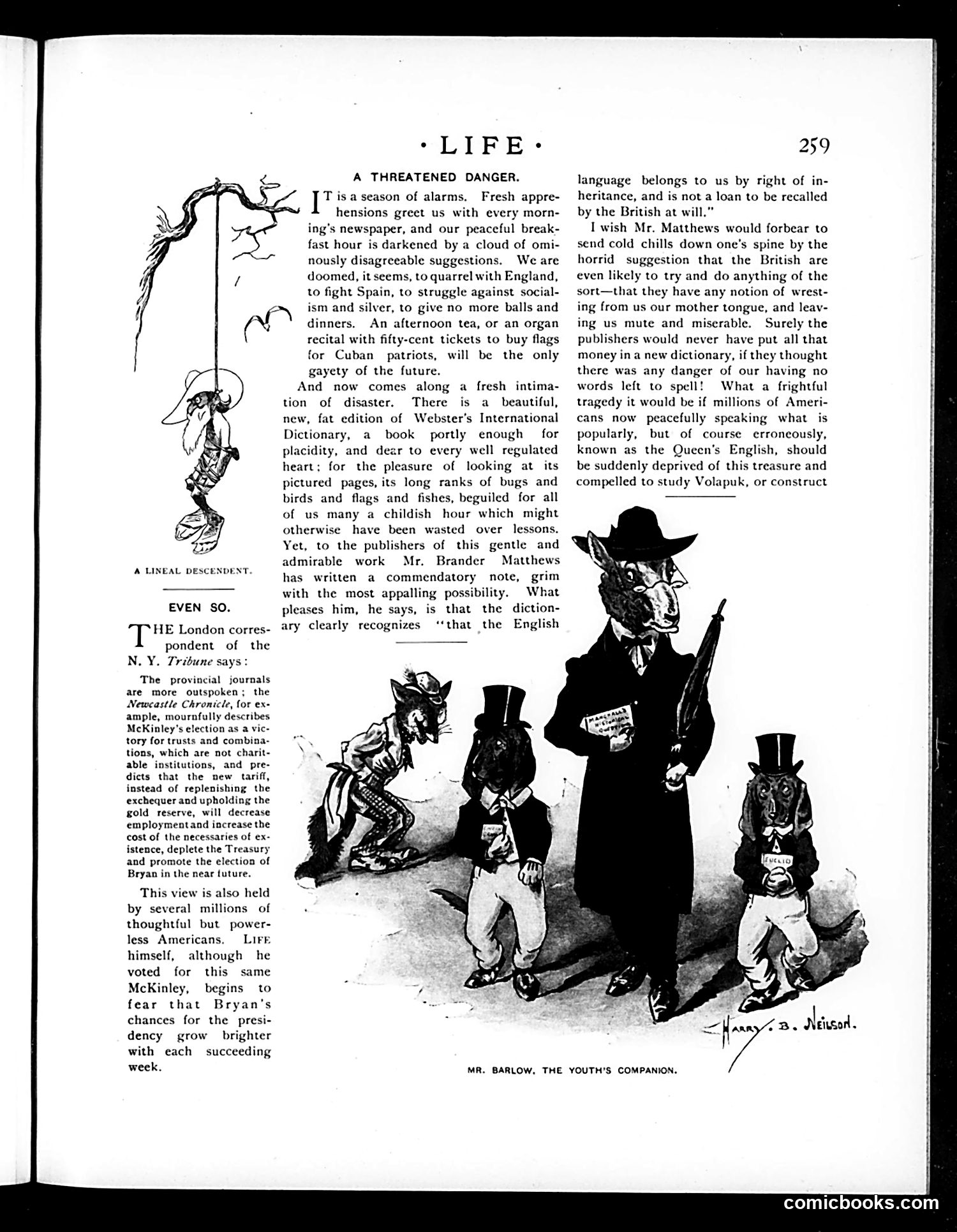
This page satirizes American anxieties following William McKinley's 1896 presidential election victory over William Jennings Bryan. **Main Cartoon** ("Mr. Barlow, The Youth's Companion"): Shows anthropomorphic animals in top hats—likely representing different nations or political factions—gathered ominously, embodying the "threatened dangers" mentioned in the text. **Political Context**: The article mocks contemporary American fears: war with Spain, conflict with England, threats from socialism and "free silver" (Bryan's platform). It ridicules these anxieties as overblown, particularly lampooning Brander Matthews' commendatory note to Webster's Dictionary suggesting the British might reclaim the English language. **The Joke**: Life magazine satirizes American paranoia by presenting the notion that Britain could literally steal American use of English as absurdly apocalyptic—so dire that Americans might need to learn artificial languages like Volapük instead. This mocks both war-mongering rhetoric and nationalist linguistic anxieties of the era. The satire targets excessive political fear-mongering while acknowledging that real concerns (about McKinley's pro-trust policies) existed among American voters.
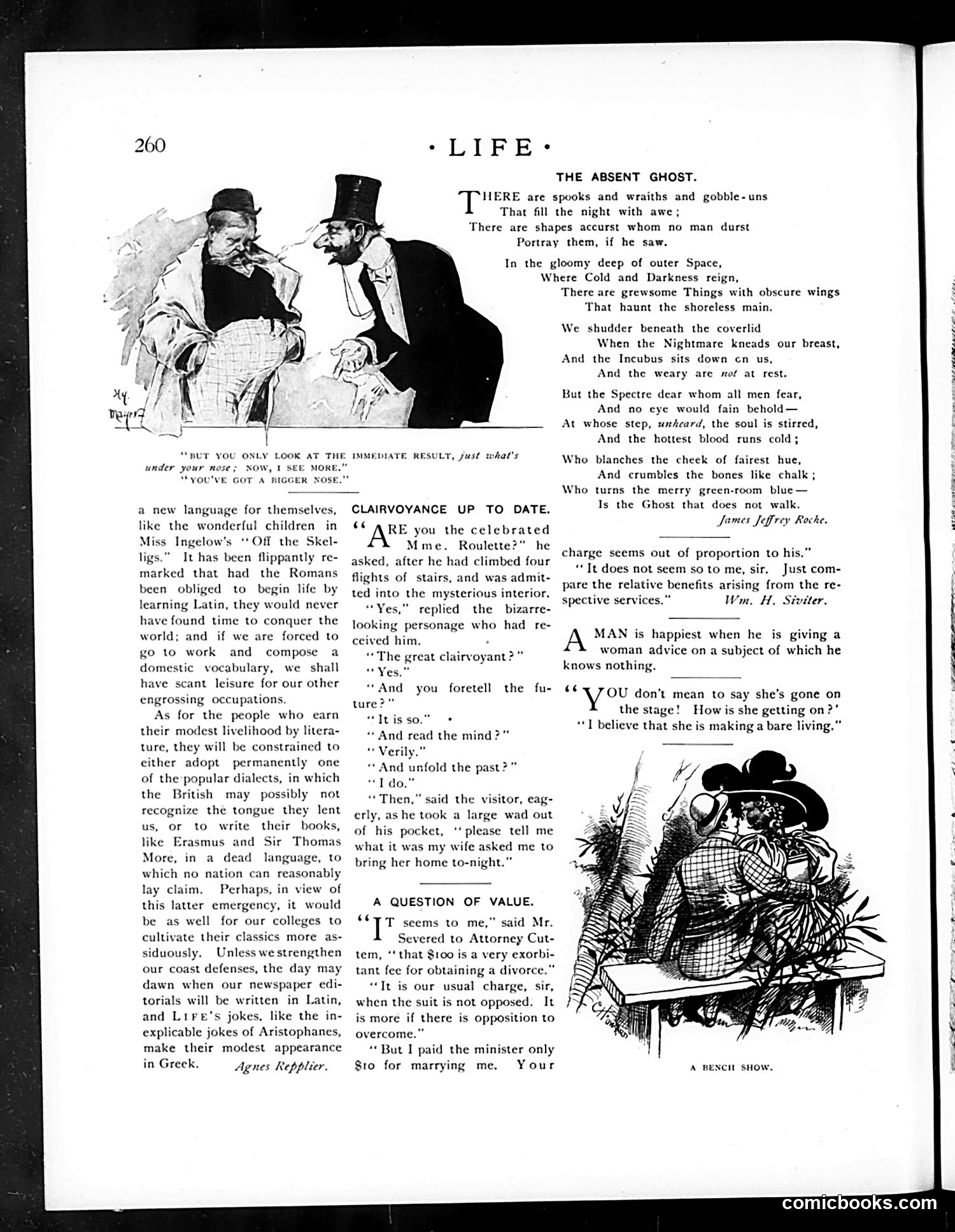
This page from *Life* magazine contains several satirical pieces mocking contemporary society: **"The Absent Ghost"** is a humorous poem by James Jeffrey Roche about the one specter people genuinely fear: not supernatural ghosts, but "the Ghost that does not walk"—likely referring to an absent or negligent person, possibly a deadbeat debtor or irresponsible spouse. **"Clairvoyance Up to Date"** satirizes fraudulent fortune tellers. A man visits Mme. Roulette, a self-proclaimed clairvoyant, and tests her powers by asking her to divine what his wife requested he bring home. The joke is that a genuine mind-reader would know this simple fact, exposing her as a charlatan. **"A Question of Value"** mocks the legal profession's fee structure. A man complains that a divorce lawyer's $100 fee seems excessive compared to the $10 he paid a minister for marriage—the absurd comparison highlights how divorce had become commercialized and lucrative for lawyers. The cartoons and brief quips throughout mock marriage, fortune-telling, legal professions, and gender relations typical of early 20th-century satirical humor.
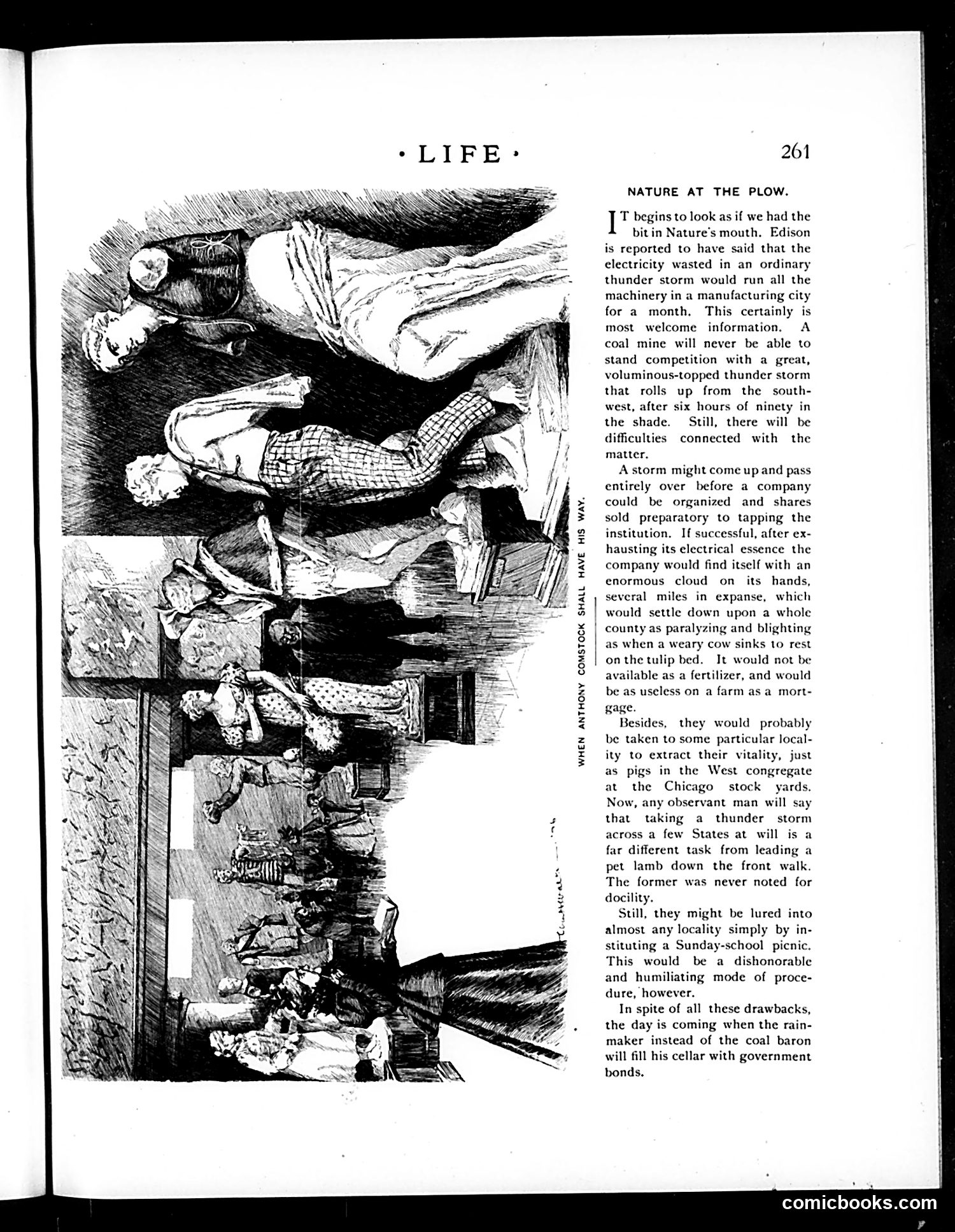
This is a satirical piece mocking the idea of harnessing thunderstorms for electricity, supposedly based on Edison's claim that a single storm contains enough energy to power a city for a month. The cartoon illustrates rural farm life (people working at a plow) while the text humorously explores the absurd logistics of capturing and transporting storms. The satire ridicules both the impracticality—storms won't arrive on schedule, can't be herded like livestock, and leave useless clouds behind—and the get-rich-quick scheme mentality it satirizes. The final joke predicts that "rainmakers" (weather manipulators) will replace coal barons as the new wealthy class, filling cellars with government bonds. This mocks both emerging technological optimism and the concentration of industrial wealth. The reference to luring storms with "Sunday-school picnics" adds absurdist humor about controlling nature itself. The piece targets the period's naive techno-utopianism while celebrating coal's continued economic dominance.
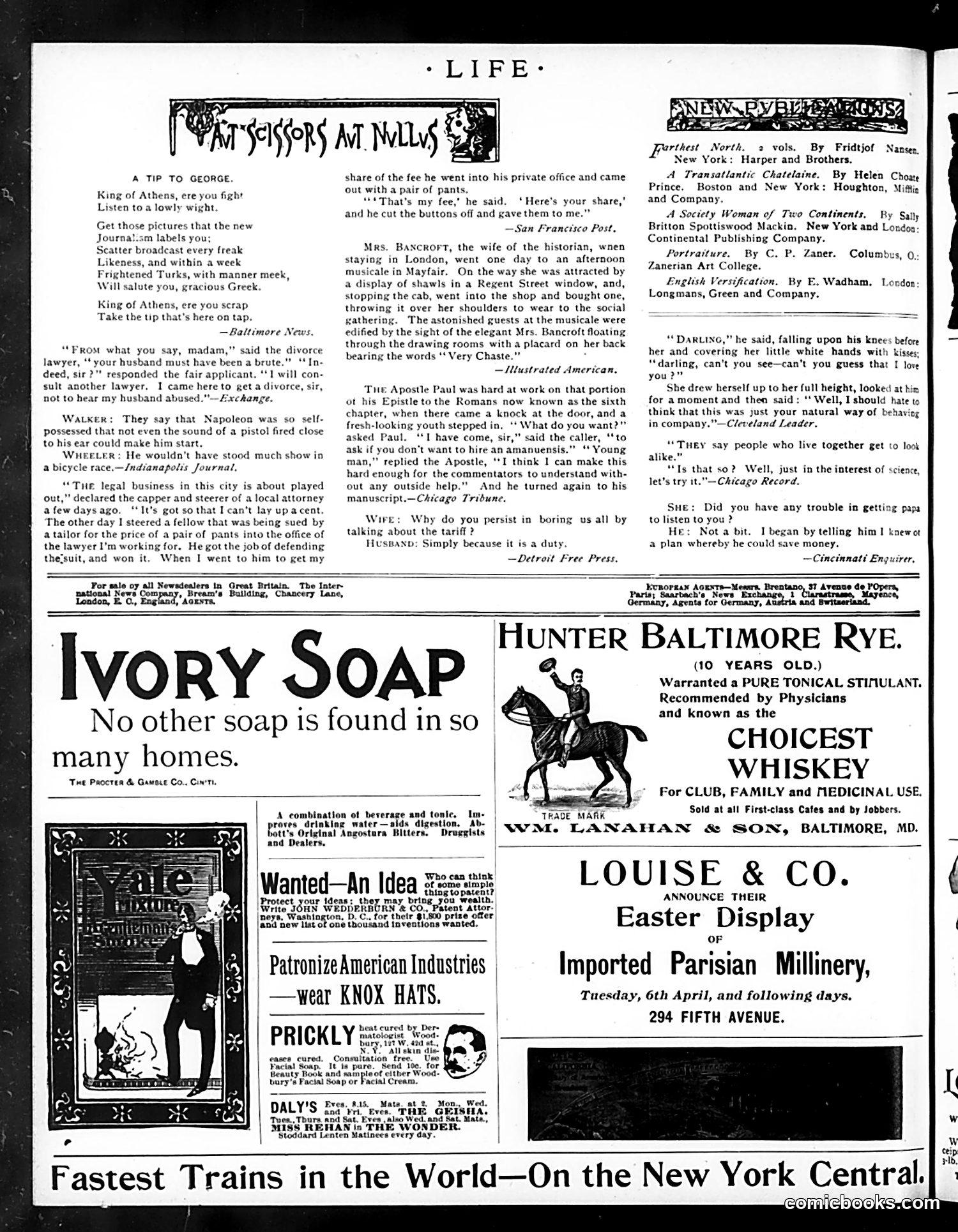
This page from *Life* magazine contains several short humorous pieces typical of the publication's satirical style. The lead item, "A Tip to George," appears to reference a contemporary political figure (likely a Greek or Balkan leader involved in conflict). The joke satirizes modern journalism's reliance on sensational imagery, suggesting that publishing unflattering photographs of an opponent could intimidate enemies through ridicule. The remaining pieces are brief joke columns mocking various social absurdities: a divorce lawyer's overly sympathetic approach, a tailor's bizarre fee structure, and academic pedantry about Biblical composition. The final joke plays on marital familiarity—a woman warns her suitor that his passionate behavior might simply reflect his general manner rather than genuine affection. These pieces exemplify *Life*'s format: satirizing contemporary manners, institutions, and public figures through short, punchy humor aimed at educated urban readers.
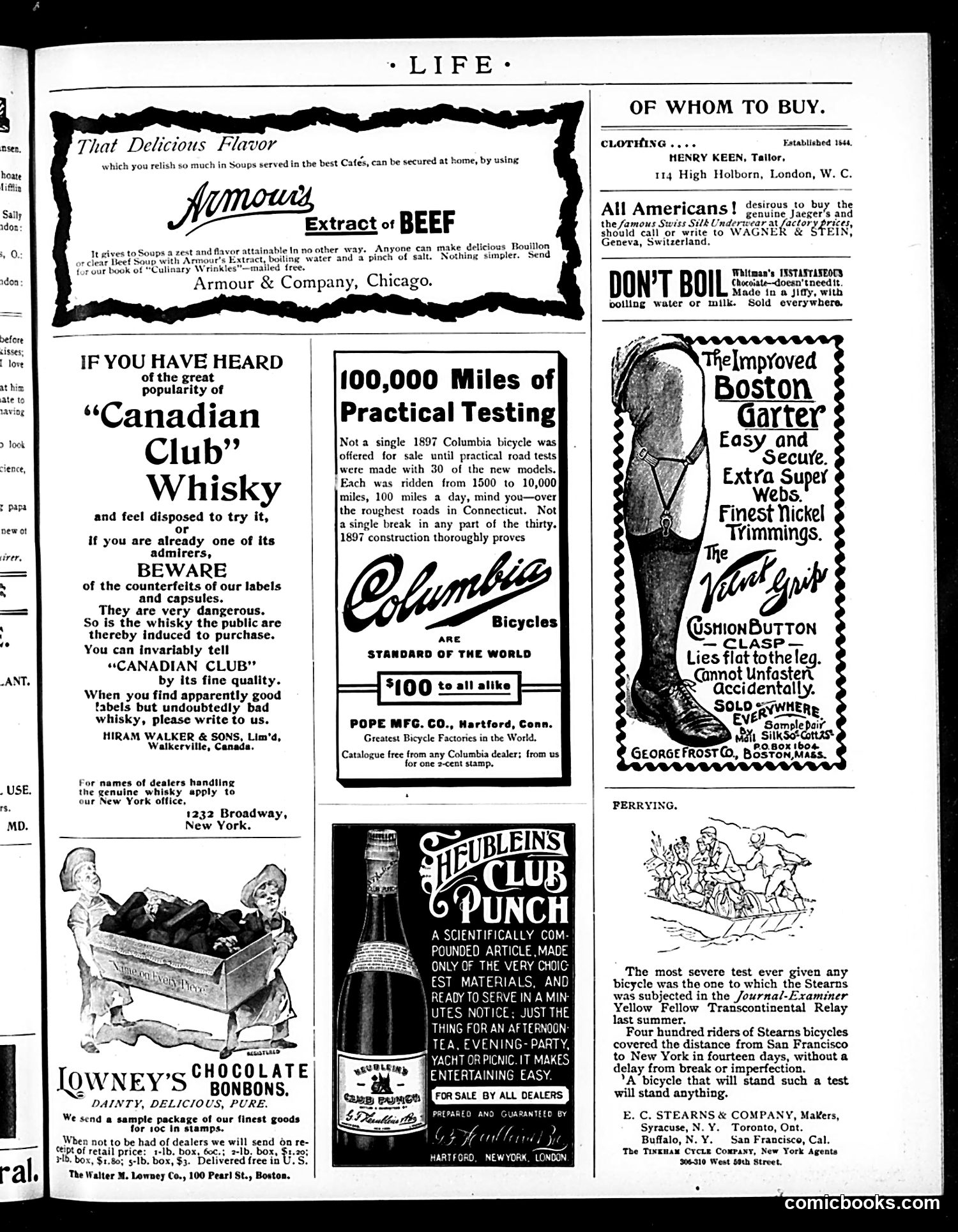
This is primarily a **product advertisement page** from approximately 1897, not a political cartoon. The page contains multiple consumer advertisements targeting middle and upper-class readers. Key advertisements include: - **Armour's Extract of Beef** — promoting convenient home cooking - **Canadian Club Whisky** — warning against counterfeit labels, reflecting era concerns about product authenticity - **Columbia Bicycles** — emphasizing durability through "100,000 Miles of Practical Testing," reflecting the bicycle boom of the 1890s - **Lowney's Chocolates** and **Heubleins Club Punch** — convenience foods/drinks - **Boston Garter** and **Stearns Bicycles** — highlighting a transcontinental relay test The page reflects **1890s consumer culture**, where manufacturers competed partly through claims of rigorous testing and authenticity. The emphasis on "practical testing" and reliability suggests manufacturers were building consumer confidence in industrial products—a relatively new concern as mass production expanded. No political satire or cartoon commentary is evident; this is straightforward commercial marketing.
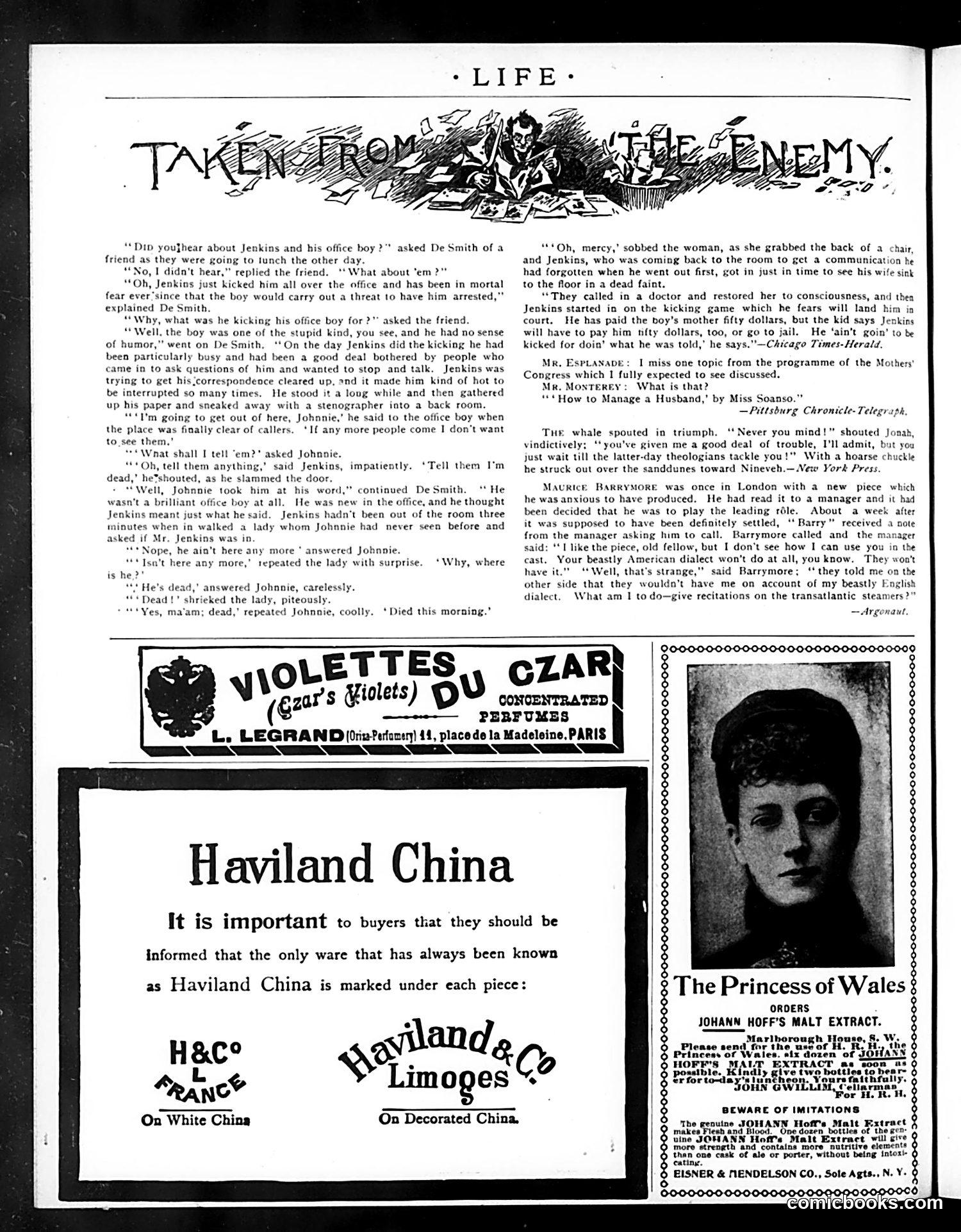
This page contains three distinct humor pieces: **Main Cartoon Story**: A lengthy anecdote about an office boy who takes his boss Jenkins literally. When Jenkins says anyone asking for him should be told he's "dead," the boy does exactly that to Jenkins's wife, causing her to faint. Jenkins then beats the boy, who threatens legal action. The joke satirizes workplace hierarchy, miscommunication, and the clash between literal obedience and common sense—poking fun at both the impatient boss and the simple-minded employee. **Additional Quips**: Brief satirical comments on Congress (mocking debates about managing husbands), the biblical Jonah and a whale, and actor Maurice Barrymore's struggles with his American accent in London theater—all gentle, genteel humor typical of early Life magazine's satirical style. The page is primarily text-based humor rather than visual cartooning, with period advertisements (Haviland China, perfume) interspersed.
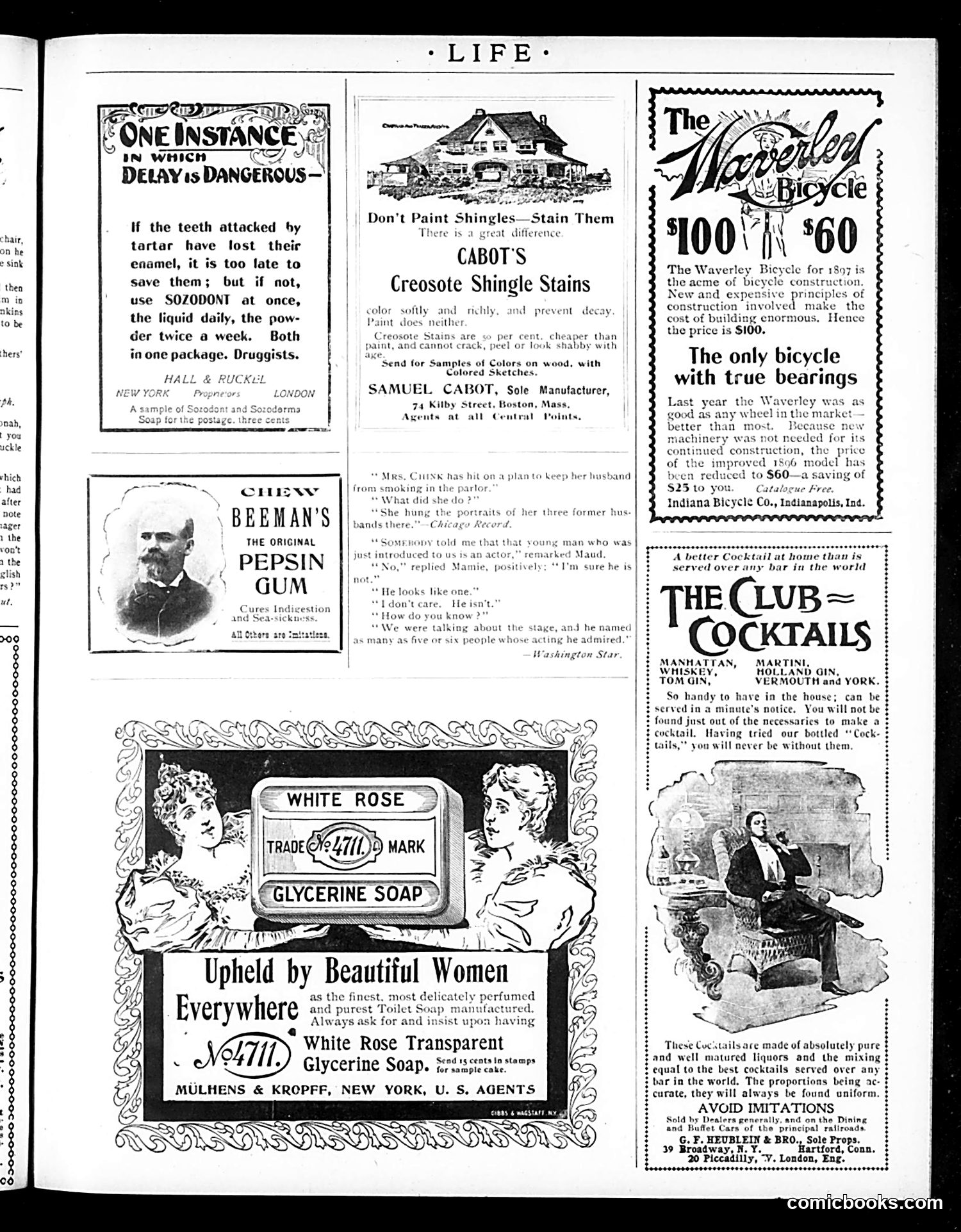
This is primarily an **advertising page** from Life magazine, not a satirical cartoon. The page contains several product advertisements from the early 1900s: **Dental care** (Sozodont): warns about tartar damage to tooth enamel—a genuine health concern of the era. **Building materials** (Cabot's Creosote Stains): promotes wood stain as cheaper than paint for shingles. **Bicycles** (Waverley): advertises a bicycle model with "true bearings," emphasizing its mechanical superiority and reduced price ($60 vs. $100). **Toiletries** (White Rose Glycerine Soap): uses decorative imagery of women to market luxury soap as refined and pure. **Alcohol** (Club Cocktails): advertises pre-mixed cocktail bottles for home convenience, listing specific drink types (Manhattan, Martini, etc.). A brief **humorous anecdote** about a woman keeping her husband home by decorating appears between ads but isn't a political cartoon. The page reflects early 1900s consumer culture, emphasizing convenience, technology, and luxury goods for middle-class households.
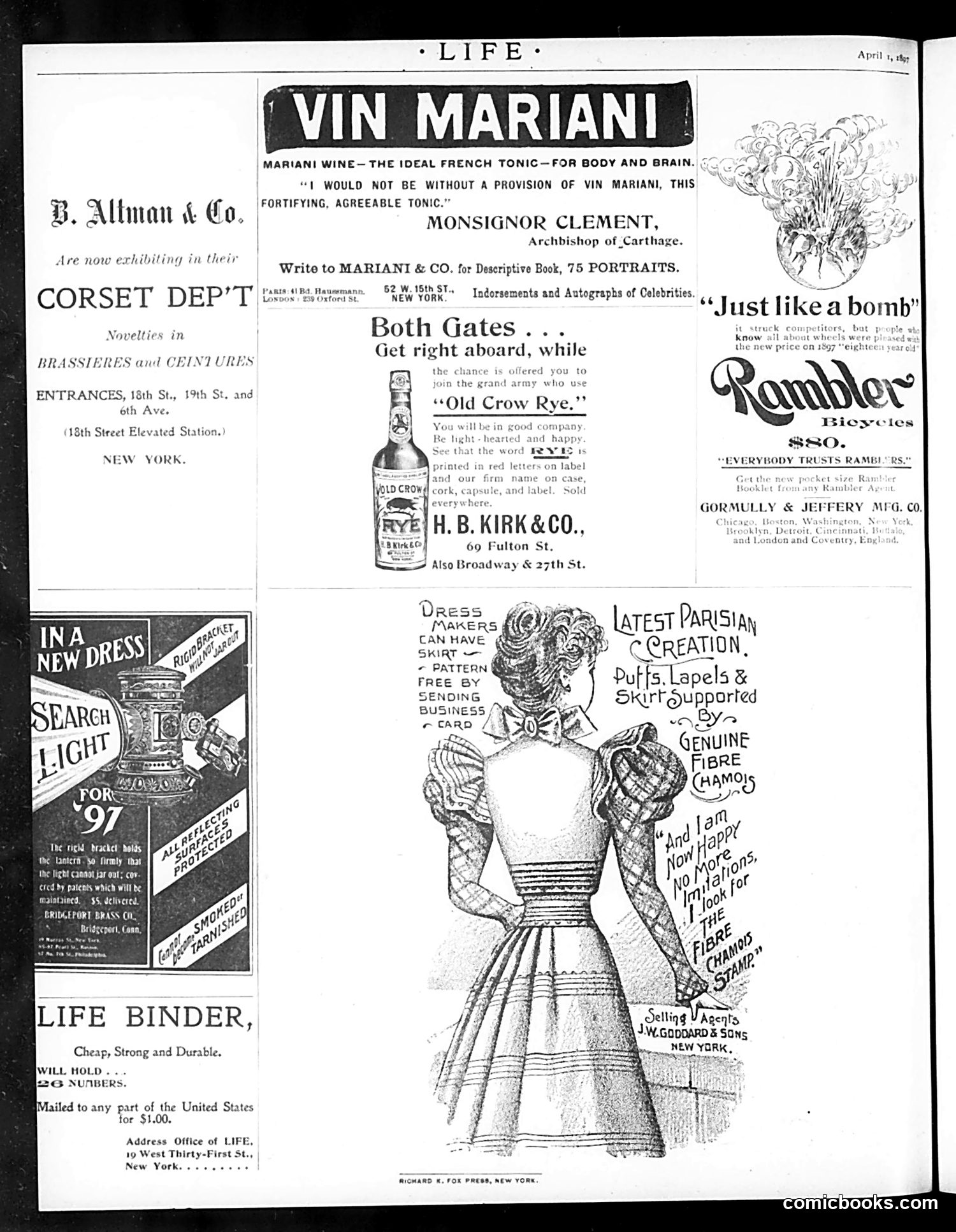
This is primarily an **advertising page** with no political cartoons. The content consists of product endorsements typical of the era: **Key Advertisements:** - **Vin Mariani**: A French wine marketed as a tonic for "body and brain," endorsed by Monsignor Clement (Archbishop of Carthage). This reflects the late-19th-century practice of using wine and alcohol as supposed medicinal tonics. - **Old Crow Rye whiskey**: Advertised with the slogan "Just like a bomb"—appealing to military recruitment ("join the grand army"). - **Rambler Bicycles**: Marketed as trustworthy ($50 price). - **Fashion items**: Corsets, dress patterns, and Parisian skirt supports emphasizing women's fashion. - **Miscellaneous**: Life Binder, Search Light dress, and other consumer goods. The page reflects **1890s consumer culture and advertising techniques**, including celebrity endorsements and health claims now recognized as dubious. No satire or political commentary is evident—this is straightforward commercial promotion.